
CSC 320 Chapter #5, Spring 2015
Lebanese American University · Computer Organisation · 14 pages · Dr. Anonymous




Showing the first 10 of 14 pages. Download the PDF to see all of it.
More CSC 320 files
- Chapter #1 · Spring 2015ChapterView
- Chapter #2 · Spring 2015ChapterView
- Chapter #3 · Spring 2015ChapterView
- Chapter #4 · Spring 2015ChapterView
- Chapter #7 · Spring 2015ChapterView
- Chapter Conversion · Spring 2015ChapterView
- Exam For Chapter 1 · Spring 2015ChapterView
- Exam For Chapter 2 · Spring 2015ChapterView
Show the text of this chapter
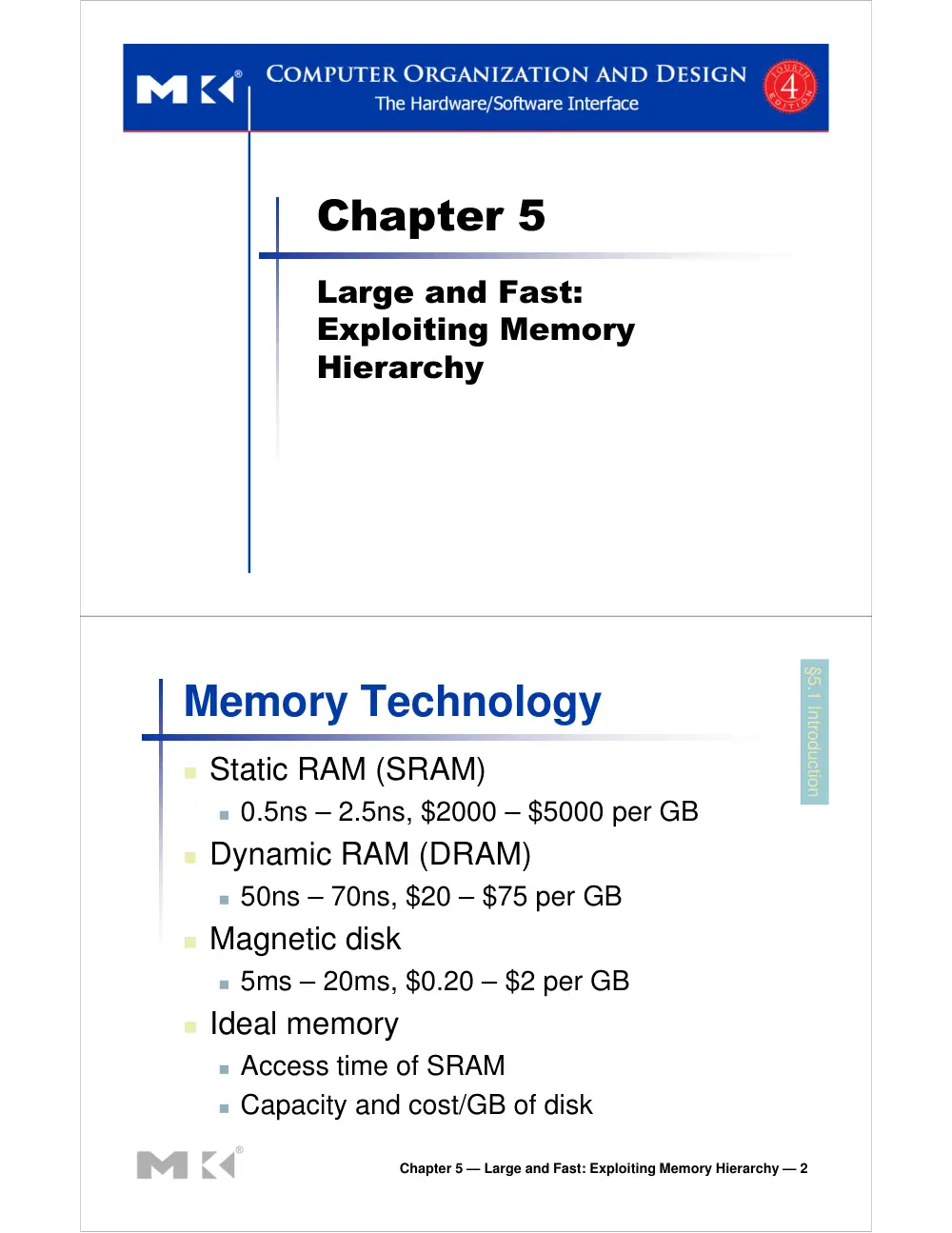
Chapter 5
Large and Fast:
Exploiting Memory
Hierarchy
Chapter 5 — Large and Fast: Exploiting Memory Hierarchy — 2
Memory Technology
� Static RAM (SRAM)
� 0.5ns – 2.5ns, $2000 – $5000 per GB
� Dynamic RAM (DRAM)
� 50ns – 70ns, $20 – $75 per GB
� Magnetic disk
� 5ms – 20ms, $0.20 – $2 per GB
� Ideal memory
� Access time of SRAM
� Capacity and cost/GB of disk
§5.1 Introduction
Chapter 5 — Large and Fast: Exploiting Memory Hierarchy — 3
Principle of Locality
� Programs access a small proportion of
their address space at any time
� Temporal locality
� Items accessed recently are likely to be
accessed again soon
� e.g., instructions in a loop, induction variables
� Spatial locality
� Items near those accessed recently are likely
to be accessed soon
� E.g., sequential instruction access, array data
Chapter 5 — Large and Fast: Exploiting Memory Hierarchy — 4
Taking Advantage of Locality
� Memory hierarchy
� Store everything on disk
� Copy recently accessed (and nearby)
items from disk to smaller DRAM memory
� Main memory
� Copy more recently accessed (and
nearby) items from DRAM to smaller
SRAM memory
� Cache memory attached to CPU
Chapter 5 — Large and Fast: Exploiting Memory Hierarchy — 5
Memory Hierarchy Levels
� Block (aka line): unit of copying
� May be multiple words
� If accessed data is present in
upper level
� Hit: access satisfied by upper level
� Hit ratio: hits/accesses
� If accessed data is absent
� Miss: block copied from lower level
� Time taken: miss penalty
� Miss ratio: misses/accesses
= 1 – hit ratio
� Then accessed data supplied from
upper level
Chapter 5 — Large and Fast: Exploiting Memory Hierarchy — 6
Cache Memory
� Cache memory
� The level of the memory hierarchy closest to
the CPU
� Given accesses X1, …, Xn–1, Xn
§5.2 The Basics of Caches
� How do we know if
the data is present?
� Where do we look?
Chapter 5 — Large and Fast: Exploiting Memory Hierarchy — 7
Direct Mapped Cache
� Location determined by address
� Direct mapped: only one choice
� (Block address) modulo (#Blocks in cache)
� #Blocks is a
power of 2
� Use low-order
address bits
Chapter 5 — Large and Fast: Exploiting Memory Hierarchy — 8
Tags and Valid Bits
� How do we know which particular block is
stored in a cache location?
� Store block address as well as the data
� Actually, only need the high-order bits
� Called the tag
� What if there is no data in a location?
� Valid bit: 1 = present, 0 = not present
� Initially 0
Chapter 5 — Large and Fast: Exploiting Memory Hierarchy — 9
Cache Example
� 8-blocks, 1 word/block, direct mapped
� Initial state
Index
V
Tag
Data
000
N
001
N
010
N
011
N
100
N
101
N
110
N
111
N
Chapter 5 — Large and Fast: Exploiting Memory Hierarchy — 10
Cache Example
Index
V
Tag
Data
000
N
001
N
010
N
011
N
100
N
101
N
110
Y
10
Mem[10110]
111
N
Word addr
Binary addr
Hit/miss
Cache block
22
10 110
Miss
110
Chapter 5 — Large and Fast: Exploiting Memory Hierarchy — 11
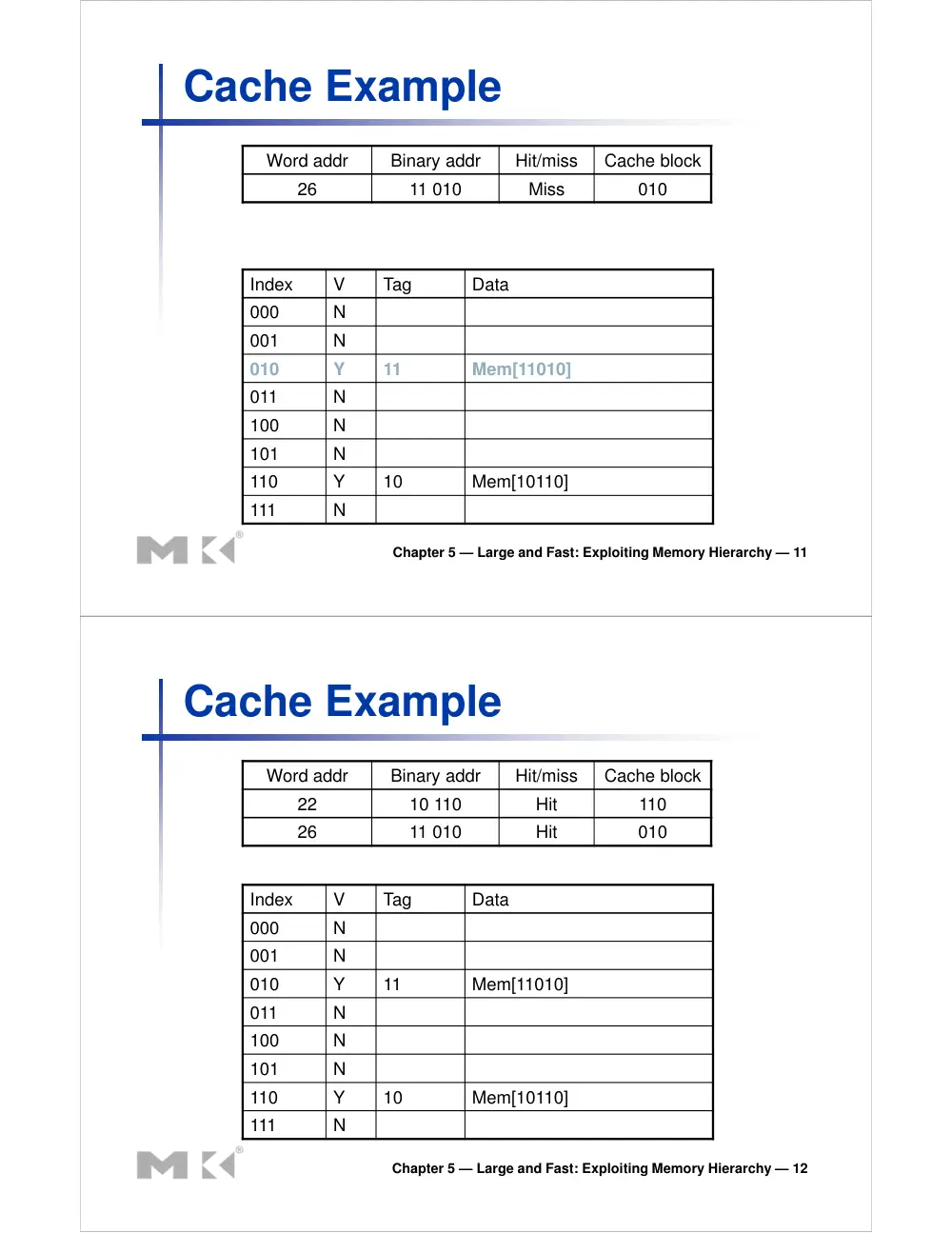
Cache Example
Index
V
Tag
Data
000
N
001
N
010
Y
11
Mem[11010]
011
N
100
N
101
N
110
Y
10
Mem[10110]
111
N
Word addr
Binary addr
Hit/miss
Cache block
26
11 010
Miss
010
Chapter 5 — Large and Fast: Exploiting Memory Hierarchy — 12
Cache Example
Index
V
Tag
Data
000
N
001
N
010
Y
11
Mem[11010]
011
N
100
N
101
N
110
Y
10
Mem[10110]
111
N
Word addr
Binary addr
Hit/miss
Cache block
22
10 110
Hit
110
26
11 010
Hit
010
Chapter 5 — Large and Fast: Exploiting Memory Hierarchy — 13
Cache Example
Index
V
Tag
Data
000
Y
10
Mem[10000]
001
N
010
Y
11
Mem[11010]
011
Y
00
Mem[00011]
100
N
101
N
110
Y
10
Mem[10110]
111
N
Word addr
Binary addr
Hit/miss
Cache block
16
10 000
Miss
000
3
00 011
Miss
011
16
10 000
Hit
000
Chapter 5 — Large and Fast: Exploiting Memory Hierarchy — 14
Cache Example
Index
V
Tag
Data
000
Y
10
Mem[10000]
001
N
010
Y
10
Mem[10010]
011
Y
00
Mem[00011]
100
N
101
N
110
Y
10
Mem[10110]
111
N
Word addr
Binary addr
Hit/miss
Cache block
18
10 010
Miss
010
Chapter 5 — Large and Fast: Exploiting Memory Hierarchy — 15
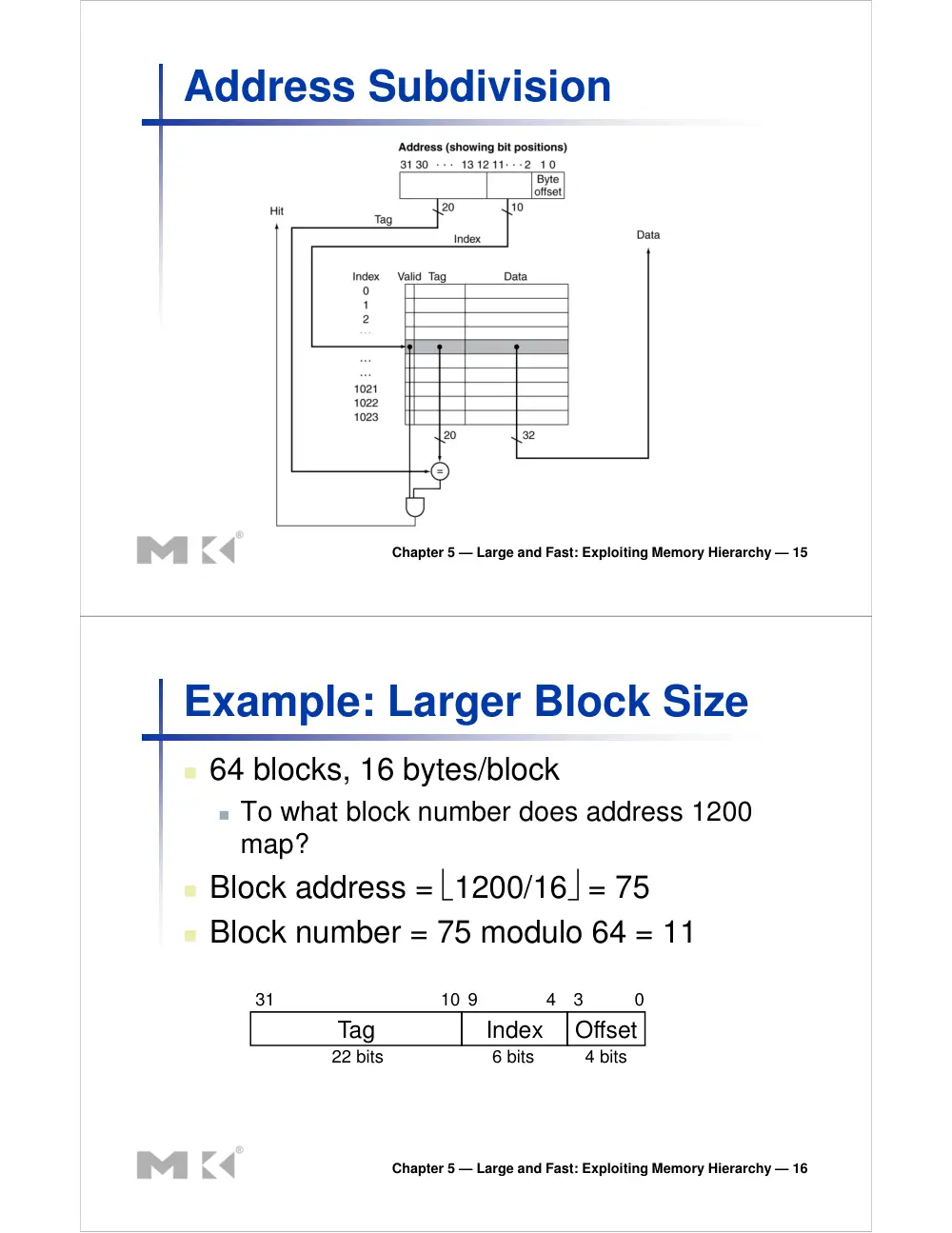
Address Subdivision
Chapter 5 — Large and Fast: Exploiting Memory Hierarchy — 16
Example: Larger Block Size
� 64 blocks, 16 bytes/block
� To what block number does address 1200
map?
� Block address = 1200/16 = 75
� Block number = 75 modulo 64 = 11
Tag
Index
Offset
0
3
4
10 9
31
4 bits
6 bits
22 bits
Chapter 5 — Large and Fast: Exploiting Memory Hierarchy — 17
Block Size Considerations
� Larger blocks should reduce miss rate
� Due to spatial locality
� But in a fixed-sized cache
� Larger blocks ⇒ fewer of them
� More competition ⇒ increased miss rate
� Larger blocks ⇒ pollution
� Larger miss penalty
� Can override benefit of reduced miss rate
� Early restart and critical-word-first can help
Chapter 5 — Large and Fast: Exploiting Memory Hierarchy — 18
Cache Misses
� On cache hit, CPU proceeds normally
� On cache miss
� Stall the CPU pipeline
� Fetch block from next level of hierarchy
� Instruction cache miss
� Restart instruction fetch
� Data cache miss
� Complete data access
Chapter 5 — Large and Fast: Exploiting Memory Hierarchy — 19
Write-Through
� On data-write hit, could just update the block in
cache
� But then cache and memory would be inconsistent
� Write through: also update memory
� But makes writes take longer
� e.g., if base CPI = 1, 10% of instructions are stores,
write to memory takes 100 cycles
�
Effective CPI = 1 + 0.1×100 = 11
� Solution: write buffer
� Holds data waiting to be written to memory
� CPU continues immediately
� Only stalls on write if write buffer is already full
Chapter 5 — Large and Fast: Exploiting Memory Hierarchy — 20
Write-Back
� Alternative: On data-write hit, just update
the block in cache
� Keep track of whether each block is dirty
� When a dirty block is replaced
� Write it back to memory
� Can use a write buffer to allow replacing block
to be read first
Chapter 5 — Large and Fast: Exploiting Memory Hierarchy — 28
Measuring Cache Performance
� Components of CPU time
� Program execution cycles
� Includes cache hit time
� Memory stall cycles
� Mainly from cache misses
� With simplifying assumptions:
§5.3 Measuring and Improving Cache Performance
Instruction Miss penalty
Misses
Program
ns
Instructio
Miss rate Miss penalty
Program
accesses
Memory
stall cycles
Memory
×
×
=
×
×
=
Chapter 5 — Large and Fast: Exploiting Memory Hierarchy — 29
Cache Performance Example
� Given
� I-cache miss rate = 2%
� D-cache miss rate = 4%
� Miss penalty = 100 cycles
� Base CPI (ideal cache) = 2
� Load & stores are 36% of instructions
� Miss cycles per instruction
� I-cache: 0.02 × 100 = 2
� D-cache: 0.36 × 0.04 × 100 = 1.44
� Actual CPI = 2 + 2 + 1.44 = 5.44
� Ideal CPU is 5.44/2 =2.72 times faster
Chapter 5 — Large and Fast: Exploiting Memory Hierarchy — 30
Average Access Time
� Hit time is also important for performance
� Average memory access time (AMAT)
� AMAT = Hit time + Miss rate × Miss penalty
� Example
� CPU with 1ns clock, hit time = 1 cycle, miss
penalty = 20 cycles, I-cache miss rate = 5%
� AMAT = 1 + 0.05 × 20 = 2ns
� 2 cycles per instruction
Chapter 5 — Large and Fast: Exploiting Memory Hierarchy — 31
Performance Summary
� When CPU performance increased
� Miss penalty becomes more significant
� Decreasing base CPI
� Greater proportion of time spent on memory
stalls
� Increasing clock rate
� Memory stalls account for more CPU cycles
� Can’t neglect cache behavior when
evaluating system performance
Chapter 5 — Large and Fast: Exploiting Memory Hierarchy — 46
Virtual Memory
� Use main memory as a “cache” for
secondary (disk) storage
� Managed jointly by CPU hardware and the
operating system (OS)
� Programs share main memory
� Each gets a private virtual address space
holding its frequently used code and data
� Protected from other programs
� CPU and OS translate virtual addresses to
physical addresses
� VM “block” is called a page
� VM translation “miss” is called a page fault
§5.4 Virtual Memory
Chapter 5 — Large and Fast: Exploiting Memory Hierarchy — 47
Address Translation
� Fixed-size pages (e.g., 4K)
Chapter 5 — Large and Fast: Exploiting Memory Hierarchy — 60
The Memory Hierarchy
� Common principles apply at all levels of
the memory hierarchy
� Based on notions of caching
� At each level in the hierarchy
� Block placement
� Finding a block
� Replacement on a miss
� Write policy
§5.5 A Common Framework for Memory Hierarchies
The BIG Picture
Chapter 5 — Large and Fast: Exploiting Memory Hierarchy — 87
Concluding Remarks
� Fast memories are small, large memories are
slow
� We really want fast, large memories �
� Caching gives this illusion ☺
� Principle of locality
� Programs use a small part of their memory space
frequently
� Memory hierarchy
� L1 cache ↔ L2 cache ↔ … ↔ DRAM memory
↔ disk
� Memory system design is critical for
multiprocessors
§5.12 Concluding Remarks