
ECO 201 Chapter 7, Fall 2016
Lebanese American University · Microeconomics · 21 pages · Dr. Saifedean Ammous

Showing the first 10 of 21 pages. Download the PDF to see all of it.
More ECO 201 files
Show the text of this chapter
1 of 32
© 2014 Pearson Education, Inc. Publishing as Prentice Hall
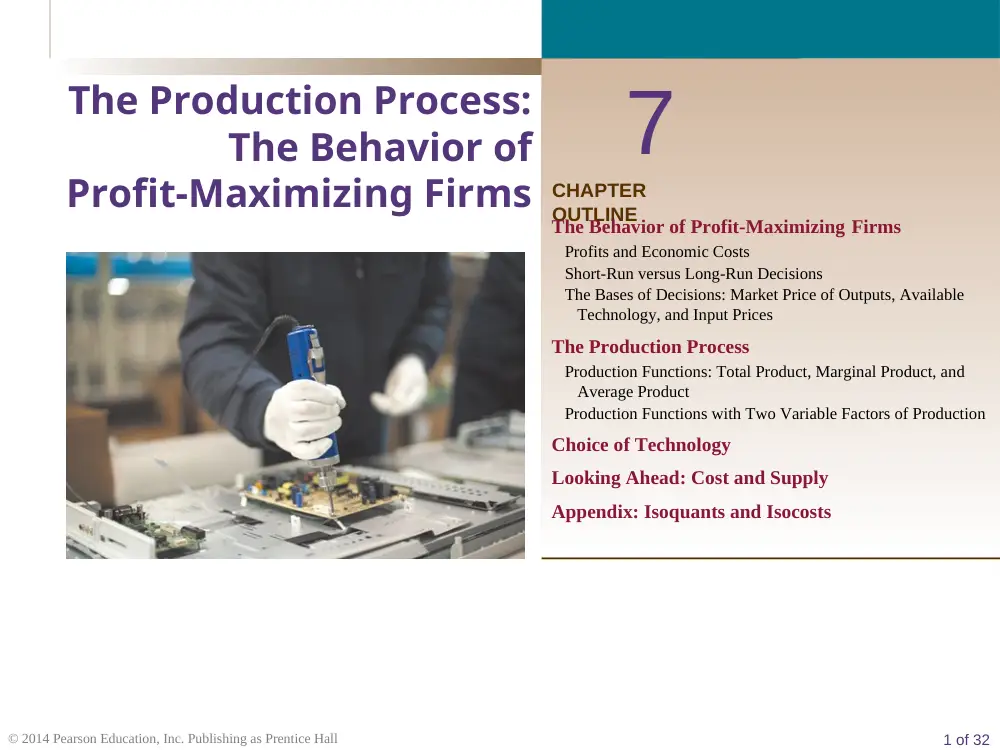
CHAPTER
OUTLINE7
The Production Process:
The Behavior of
Profit-Maximizing Firms
The Behavior of Profit-Maximizing Firms
Profits and Economic Costs
Short-Run versus Long-Run Decisions
The Bases of Decisions: Market Price of Outputs, Available
Technology, and Input Prices
The Production Process
Production Functions: Total Product, Marginal Product, and
Average Product
Production Functions with Two Variable Factors of Production
Choice of Technology
Looking Ahead: Cost and Supply
Appendix: Isoquants and Isocosts
2 of 32
© 2014 Pearson Education, Inc. Publishing as Prentice Hall
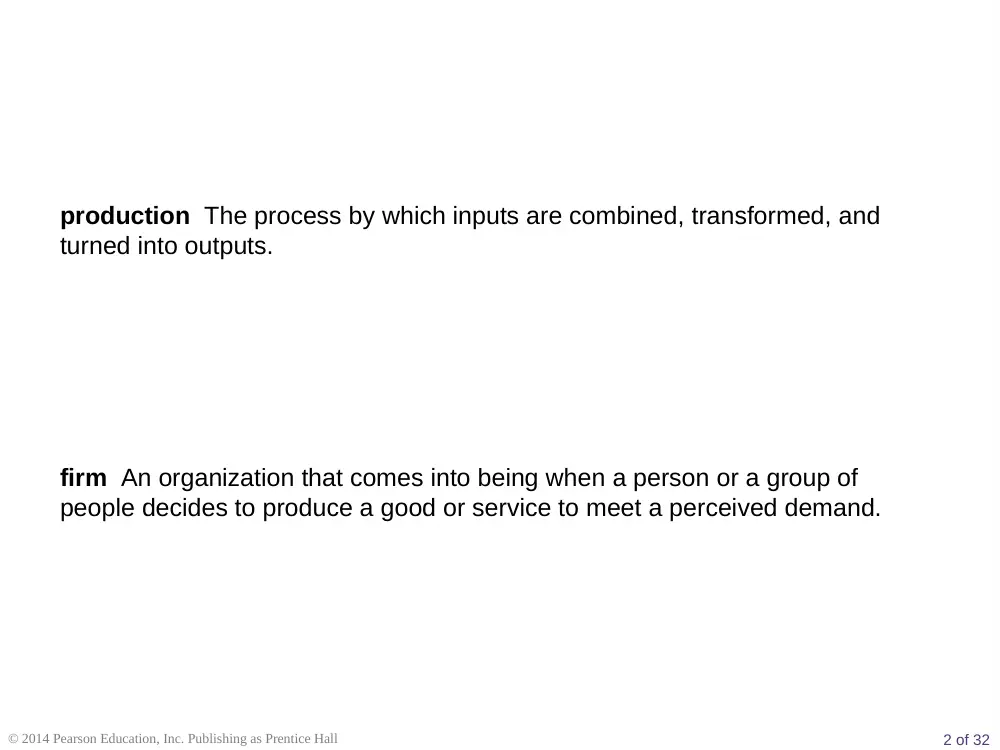
production The process by which inputs are combined, transformed, and
turned into outputs.
firm An organization that comes into being when a person or a group of
people decides to produce a good or service to meet a perceived demand.
3 of 32
© 2014 Pearson Education, Inc. Publishing as Prentice Hall
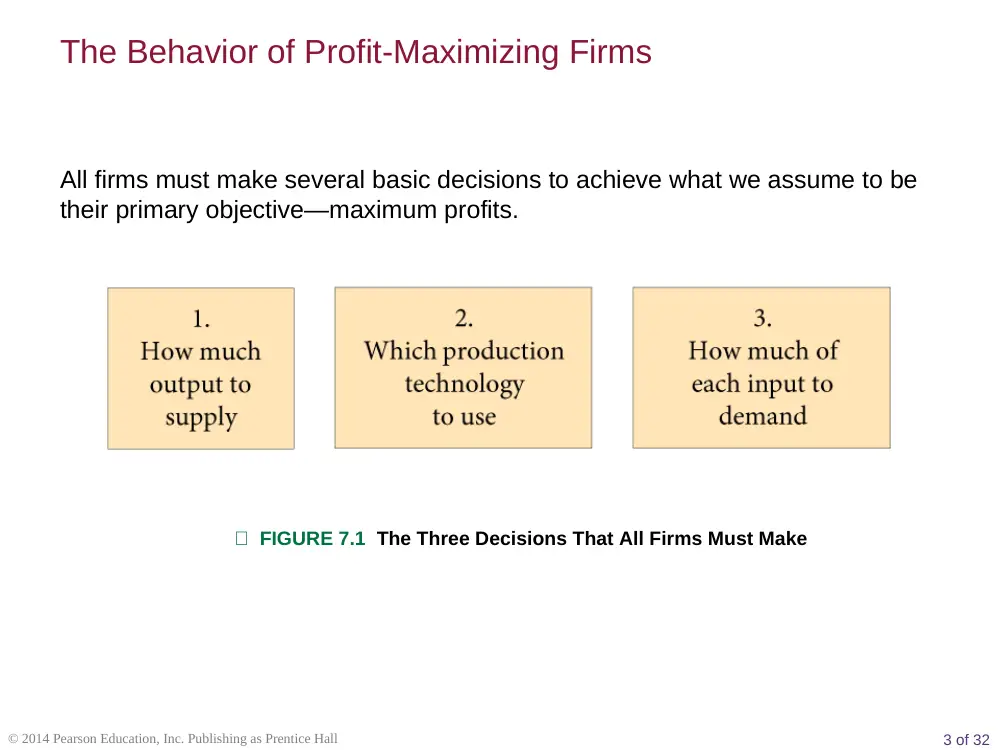
All firms must make several basic decisions to achieve what we assume to be
their primary objective—maximum profits.
FIGURE 7.1 The Three Decisions That All Firms Must Make
The Behavior of Profit-Maximizing Firms
4 of 32
© 2014 Pearson Education, Inc. Publishing as Prentice Hall
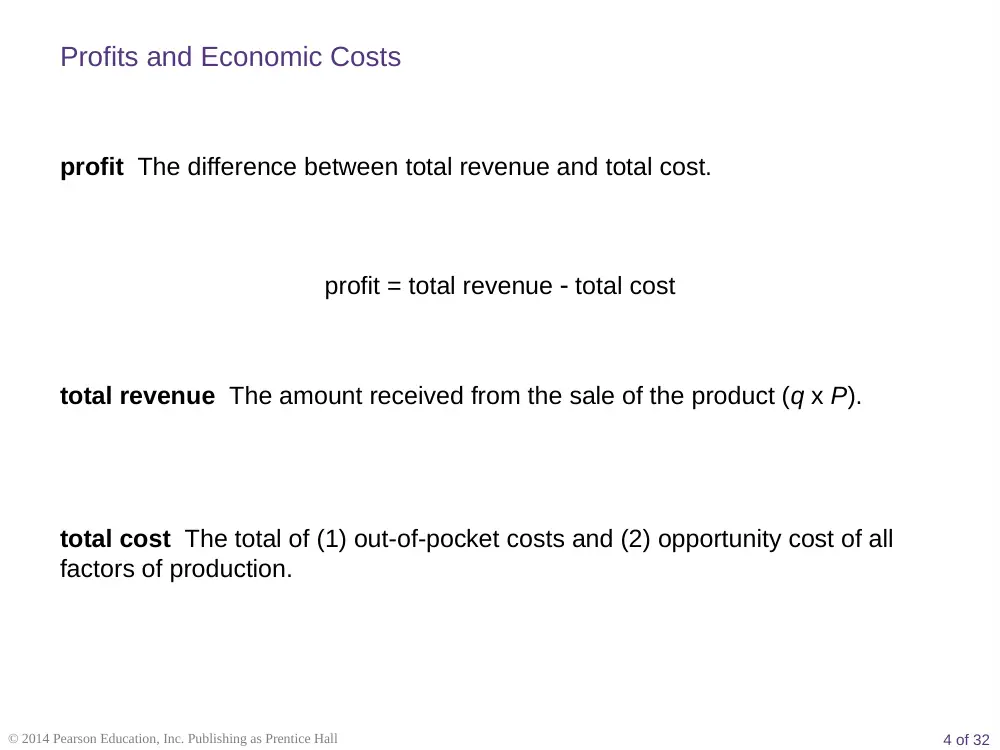
profit The difference between total revenue and total cost.
profit = total revenue total cost
total revenue The amount received from the sale of the product (q x P).
Profits and Economic Costs
total cost The total of (1) out-of-pocket costs and (2) opportunity cost of all
factors of production.
5 of 32
© 2014 Pearson Education, Inc. Publishing as Prentice Hall
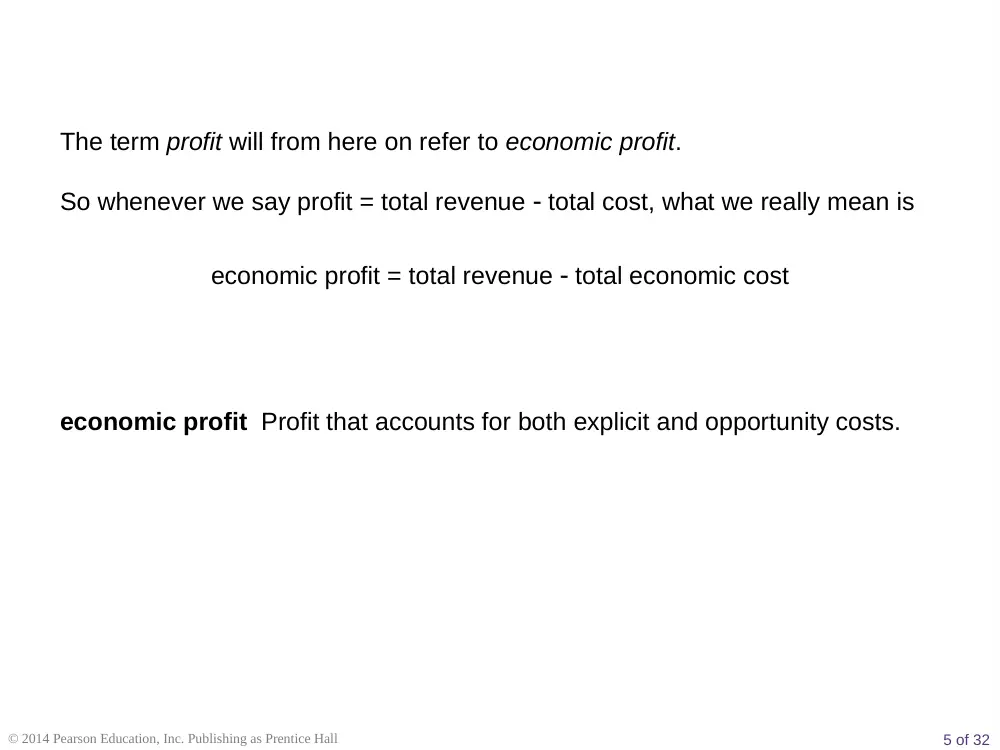
economic profit = total revenue total economic cost
The term profit will from here on refer to economic profit.
So whenever we say profit = total revenue total cost, what we really mean is
economic profit Profit that accounts for both explicit and opportunity costs.
6 of 32
© 2014 Pearson Education, Inc. Publishing as Prentice Hall
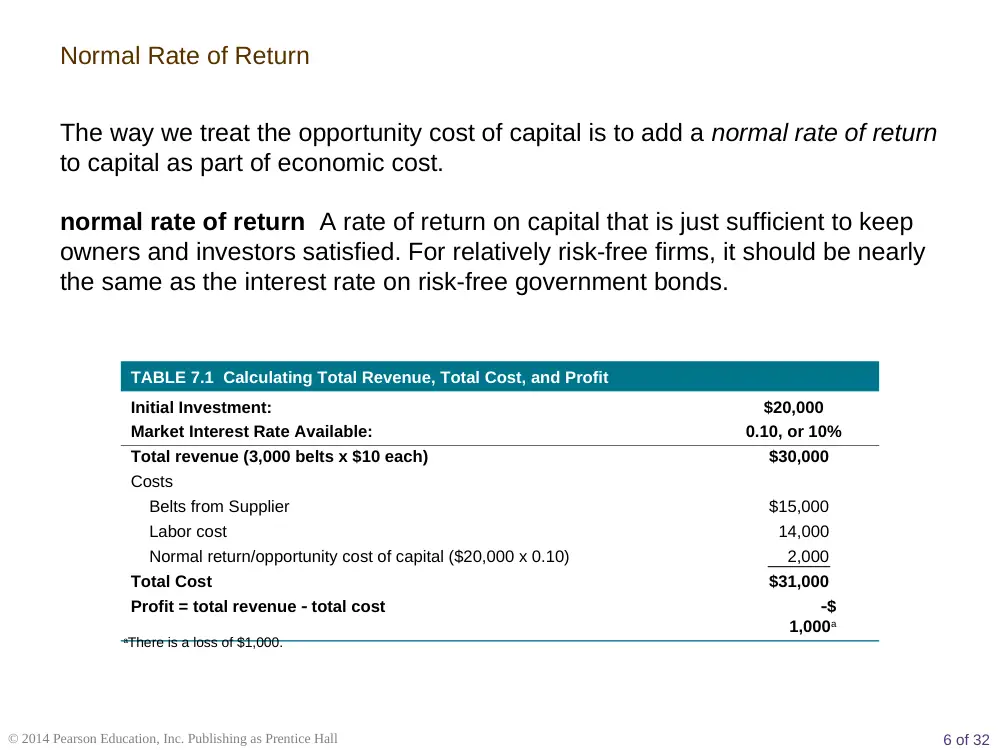
normal rate of return A rate of return on capital that is just sufficient to keep
owners and investors satisfied. For relatively risk-free firms, it should be nearly
the same as the interest rate on risk-free government bonds.
TABLE 7.1 Calculating Total Revenue, Total Cost, and Profit
Initial Investment:
Market Interest Rate Available:
$20,000
0.10, or 10%
Total revenue (3,000 belts x $10 each)
$30,000
Costs
Belts from Supplier
$15,000
Labor cost
14,000
Normal return/opportunity cost of capital ($20,000 x 0.10)
2,000
Total Cost
$31,000
Profit = total revenue total cost
$
1,000a
Normal Rate of Return
aThere is a loss of $1,000.
The way we treat the opportunity cost of capital is to add a normal rate of return
to capital as part of economic cost.
7 of 32
© 2014 Pearson Education, Inc. Publishing as Prentice Hall
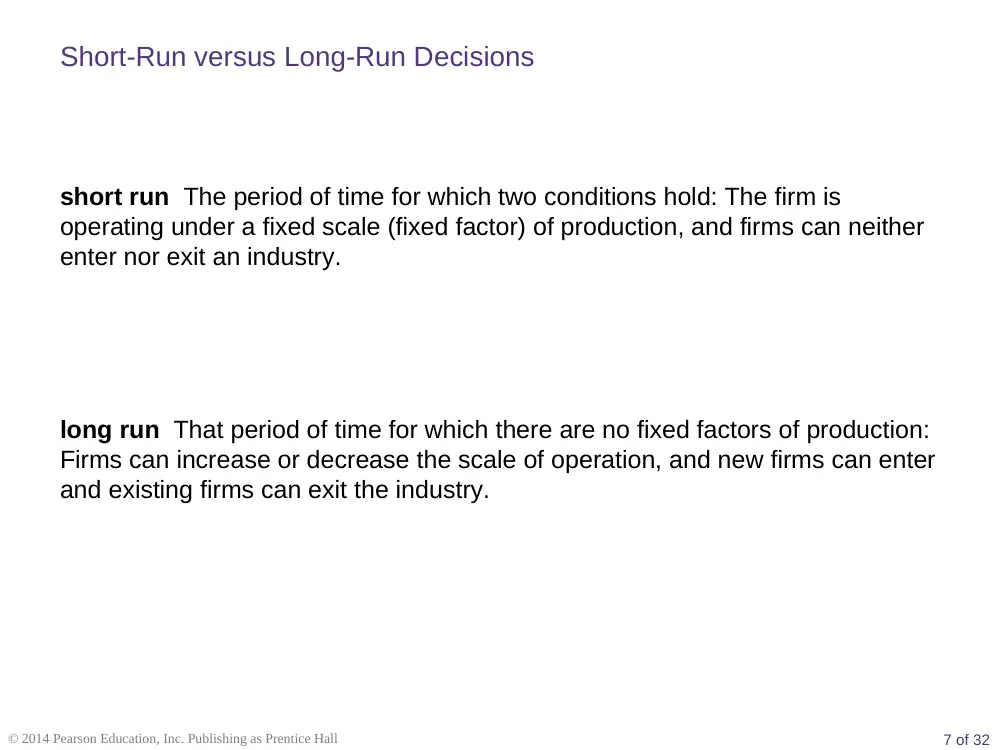
short run The period of time for which two conditions hold: The firm is
operating under a fixed scale (fixed factor) of production, and firms can neither
enter nor exit an industry.
long run That period of time for which there are no fixed factors of production:
Firms can increase or decrease the scale of operation, and new firms can enter
and existing firms can exit the industry.
Short-Run versus Long-Run Decisions
8 of 32
© 2014 Pearson Education, Inc. Publishing as Prentice Hall
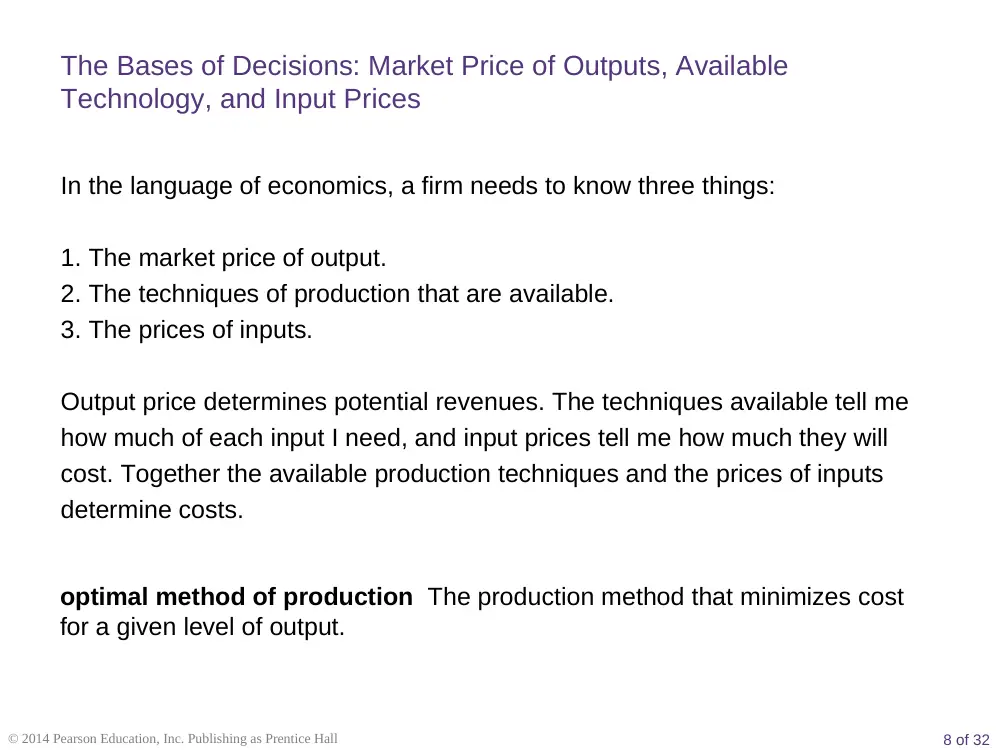
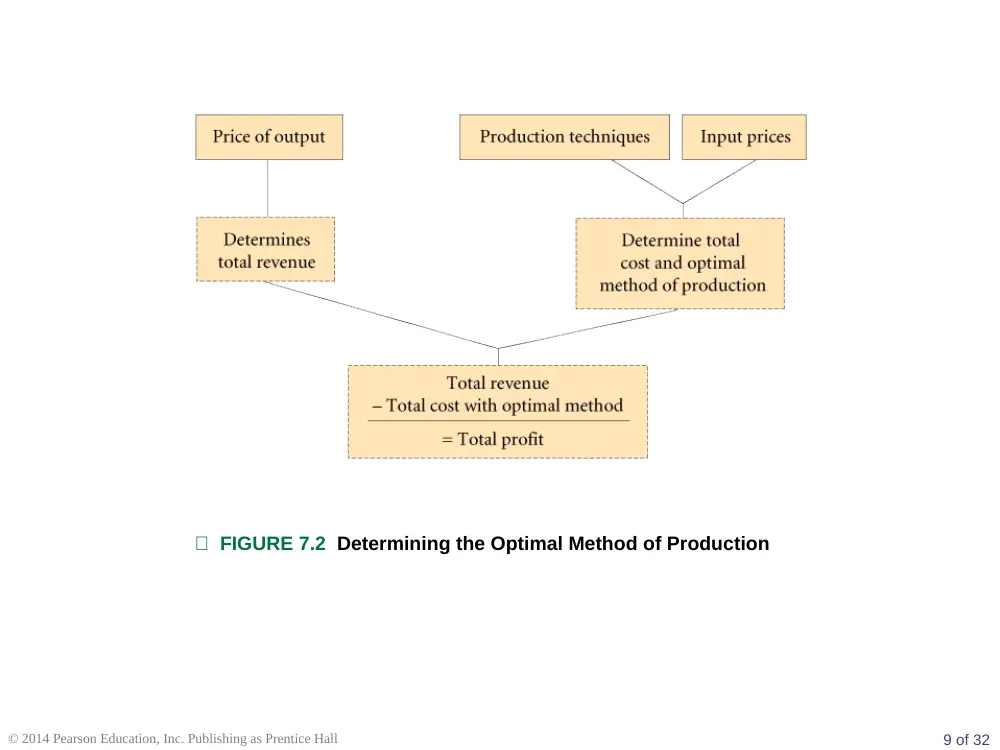
In the language of economics, a firm needs to know three things:
1. The market price of output.
2. The techniques of production that are available.
3. The prices of inputs.
Output price determines potential revenues. The techniques available tell me
how much of each input I need, and input prices tell me how much they will
cost. Together the available production techniques and the prices of inputs
determine costs.
The Bases of Decisions: Market Price of Outputs, Available
Technology, and Input Prices
optimal method of production The production method that minimizes cost
for a given level of output.
9 of 32
© 2014 Pearson Education, Inc. Publishing as Prentice Hall
FIGURE 7.2 Determining the Optimal Method of Production
10 of 32
© 2014 Pearson Education, Inc. Publishing as Prentice Hall
production technology The quantitative relationship between inputs and
outputs.
labor-intensive technology Technology that relies heavily on human labor
instead of capital.
capital-intensive technology Technology that relies heavily on capital
instead of human labor.
The Production Process
11 of 32
© 2014 Pearson Education, Inc. Publishing as Prentice Hall
production function or total product function A numerical or mathematical
expression of a relationship between inputs and outputs. It shows units of total
product as a function of units of inputs.
TABLE 7.2 Production Function
(1)
Labor Units
(Employees)
(2)
Total Product
(Sandwiches per Hour)
(3)
Marginal Product
of Labor
(4)
Average Product of Labor
(Total Product ÷ Labor Units)
0
1
2
3
4
5
6
0
10
25
35
40
42
42
10
15
10
5
2
0
10.0
12.5
11.7
10.0
8.4
7.0
Production Functions: Total Product, Marginal Product, and
Average Product
12 of 32
© 2014 Pearson Education, Inc. Publishing as Prentice Hall
FIGURE 7.3 Production Function for Sandwiches
A production function is a numerical representation of the relationship between inputs and
outputs.
In Figure 7.3(a), total product (sandwiches) is graphed as a function of labor inputs.
The marginal product of labor is the additional output that one additional unit of labor
produces.
Figure 7.3(b) shows that the marginal product of the second unit of labor at the sandwich
shop is 15 units of output; the marginal product of the fourth unit of labor is 5 units of
output.
13 of 32
© 2014 Pearson Education, Inc. Publishing as Prentice Hall
marginal product The additional output that can be produced by adding one
more unit of a specific input, ceteris paribus.
law of diminishing returns When additional units of a variable input are
added to fixed inputs, after a certain point, the marginal product of the variable
input declines.
Every firm will face diminishing returns, which always apply in the short run.
This means that every firm finds it progressively more difficult to increase its
output as it approaches capacity production.
Marginal Product and the Law of Diminishing Returns
14 of 32
© 2014 Pearson Education, Inc. Publishing as Prentice Hall
average product The average amount produced by each unit of a variable
factor of production.
total product
average product of labor
total units of labor
Marginal Product versus Average Product
If marginal product is above average product, the average rises; if marginal
product is below average product, the average falls.
15 of 32
© 2014 Pearson Education, Inc. Publishing as Prentice Hall
FIGURE 7.4 Total Average and Marginal
Product
Marginal and average product curves
can be derived from total product curves.
Average product is at its maximum at the
point of intersection with marginal
product.
16 of 32
© 2014 Pearson Education, Inc. Publishing as Prentice Hall
Production Functions with Two Variable Factors of Production
Inputs work together in production. Capital and labor are complementary inputs.
Additional capital increases the productivity of labor—that is, the amount of
output produced per worker per hour.
This simple relationship lies at the heart of worries about productivity at the
national and international levels. Building new, modern plants and equipment
enhances a nation’s productivity.
In the last decade, China has accumulated capital (that is, built plants and
equipment) at a very high rate. The result is growth in the average quantity of
output per worker in China.
17 of 32
© 2014 Pearson Education, Inc. Publishing as Prentice Hall
In farming, as in manufacturing, we
need a given combination of labor
and capital to produce output, here a
crop.
In the 1990s, an area of Ghana
changed from an exclusive reliance
on maize as the agricultural crop to
the development of pineapple farms.
The choice of how much fertilizer to
use was highly dependent on how
much fertilizer their more successful
neighbor farmers used.
Social learning obviously plays a role
in the diffusion of manufacturing
technology as well.
Learning about Growing Pineapples in Ghana
E C O N O M I C S I N P R A C T I C E
THINKING PRACTICALLY
1. In many high-tech firms, executives must
sign non-compete agreements, preventing them
from working for a competitor after they stop
working for their current firm. These
agreements are much less common in mature
manufacturing firms. Why?
THINKING PRACTICALLY
1. In many high-tech firms, executives must
sign non-compete agreements, preventing them
from working for a competitor after they stop
working for their current firm. These
agreements are much less common in mature
manufacturing firms. Why?
18 of 32
© 2014 Pearson Education, Inc. Publishing as Prentice Hall
TABLE 7.3 Inputs Required to Produce 100 Diapers Using Alternative Technologies
Technology
Units of Capital (K)
Units of Labor (L)
A
B
C
D
E
2
3
4
6
10
10
6
4
3
2
TABLE 7.4 Cost-Minimizing Choice among Alternative Technologies (100 Diapers)
(1)
Technology
(2)
Units of Capital (K)
(3)
Units of Labor (L)
Cost = (L X PL) + (K X PK)
(4)
(5)
PL = $1
PK = $1
PL = $5
PK = $1
A
B
C
D
E
2
3
4
6
10
10
6
4
3
2
$12
9
8
9
12
$52
33
24
21
20
Choice of Technology
Two things determine the cost of production: (1) technologies that are available and (2)
input prices. Profit-maximizing firms will choose the technology that minimizes the cost of
production given current market input prices.
19 of 32
© 2014 Pearson Education, Inc. Publishing as Prentice Hall
The trucking business gives us an opportunity
to think about choice among technologies in a
concrete way.
Modern technology, in the form of on-board
computers, allows a modern trucking firm to
monitor driving speed and instruct drivers.
How Fast Should a Truck Driver Go?
E C O N O M I C S I N P R A C T I C E
Fuel Price
$3.50
$4.00
$4.50
Drive Fast
$124.98
$133.33
$141.63
Drive Slowly
$126.67
$133.33
$139.99
THINKING PRACTICALLY
1. When gasoline prices rise, accident rates fall.
Provide two reasons this might be true.
THINKING PRACTICALLY
1. When gasoline prices rise, accident rates fall.
Provide two reasons this might be true.
20 of 32
© 2014 Pearson Education, Inc. Publishing as Prentice Hall
Looking Ahead: Cost and Supply
So far, we have looked only at a single level of output.
One of our main objectives in the next chapter is to determine the amount that a
competitive firm will choose to supply during a given time period.
21 of 32
© 2014 Pearson Education, Inc. Publishing as Prentice Hall
average product
capital-intensive technology
firm
labor-intensive technology
law of diminishing returns
long run
marginal product
normal rate of return
optimal method of production
production
production function or total product function
production technology
profit (economic profit)
short run
total cost (total economic cost)
total revenue
Profit = total revenue – total cost
s of labor
total unit
total product
Average product of labor
R E V I E W T E R M S A N D C O N C E P T
S