
CSC 213 Chapter 10, Fall 2007
Notre Dame University–Louaize · Program Design and Data Abstraction II · 38 pages

Showing the first 10 of 38 pages. Download the PDF to see all of it.
More CSC 213 files
Show the text of this chapter
1
2000 Prentice Hall, Inc. All rights reserved.
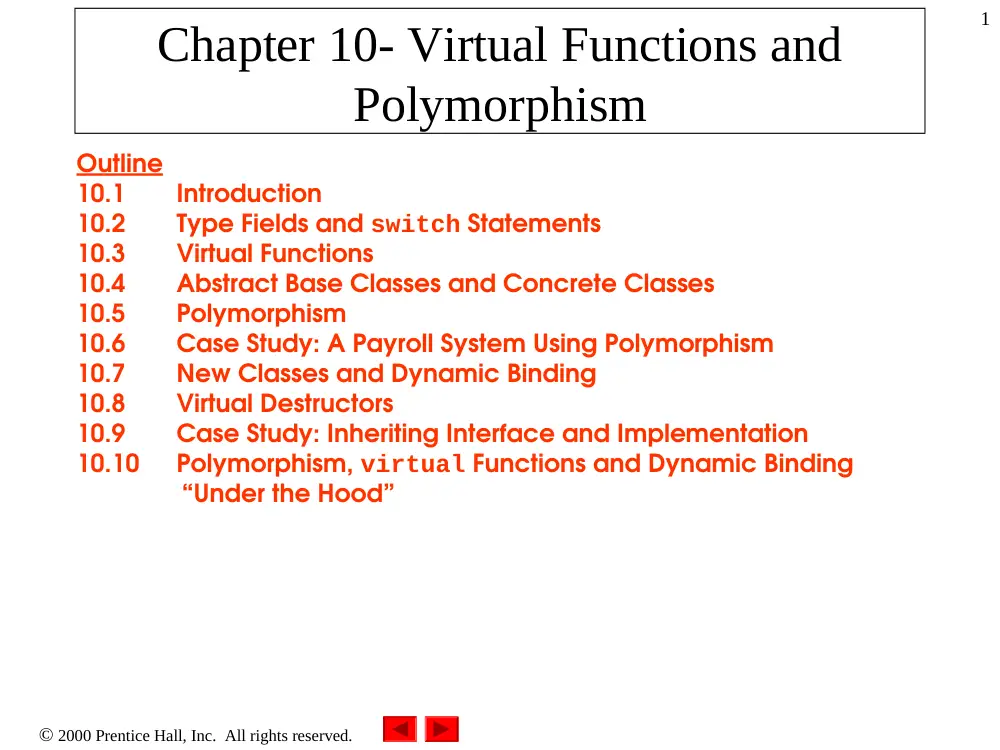
Chapter 10- Virtual Functions and
Polymorphism
Outline
10.1
Introduction
10.2
Type Fields and switch Statements
10.3
Virtual Functions
10.4
Abstract Base Classes and Concrete Classes
10.5
Polymorphism
10.6
Case Study: A Payroll System Using Polymorphism
10.7
New Classes and Dynamic Binding
10.8
Virtual Destructors
10.9
Case Study: Inheriting Interface and Implementation
10.10
Polymorphism, virtual Functions and Dynamic Binding
“Under the Hood”
2
2000 Prentice Hall, Inc. All rights reserved.
10.1 Introduction
• virtual functions and polymorphism
– Design and implement systems that are more easily extensible
– Programs written to generically process objects of all existing
classes in a hierarchy
3
2000 Prentice Hall, Inc. All rights reserved.
10.2 Type Fields and switch Statements
• switch statement
– Take an action on a object based on its type
– A switch structure could determine which print function
to call based on which type in a hierarchy of shapes
• Problems with switch
– Programmer may forget to test all possible cases in a
switch
• Tracking this down can be time consuming and prone to error
– virtual functions and polymorphic programming can
eliminate the need for switch logic
4
2000 Prentice Hall, Inc. All rights reserved.
10.3 virtual Functions
• virtual functions
– Suppose a set of shape classes such as Circle, Triangle, etc.
– Every shape has own unique draw function but possible to call
them by calling the draw function of base class Shape
• Compiler determines dynamically (i.e., at run time) which to call
– In base-class declare draw to be virtual
– Override draw in each of the derived classes
– virtual declaration:
• Keyword virtual before function prototype in base-class
virtual void draw() const;
– A base-class pointer to a derived class object will call the correct
draw function
Shape->draw();
– If a derived class does not define a virtual function, the
function is inherited from the base class
5
2000 Prentice Hall, Inc. All rights reserved.
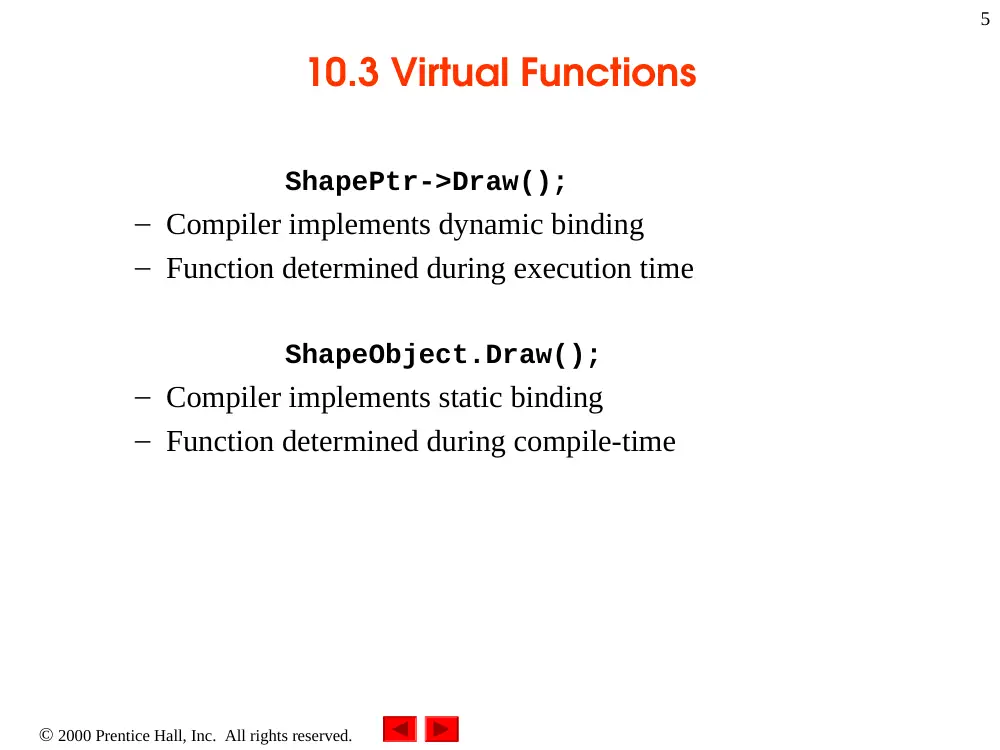
10.3 Virtual Functions
ShapePtr->Draw();
– Compiler implements dynamic binding
– Function determined during execution time
ShapeObject.Draw();
– Compiler implements static binding
– Function determined during compile-time
6
2000 Prentice Hall, Inc. All rights reserved.
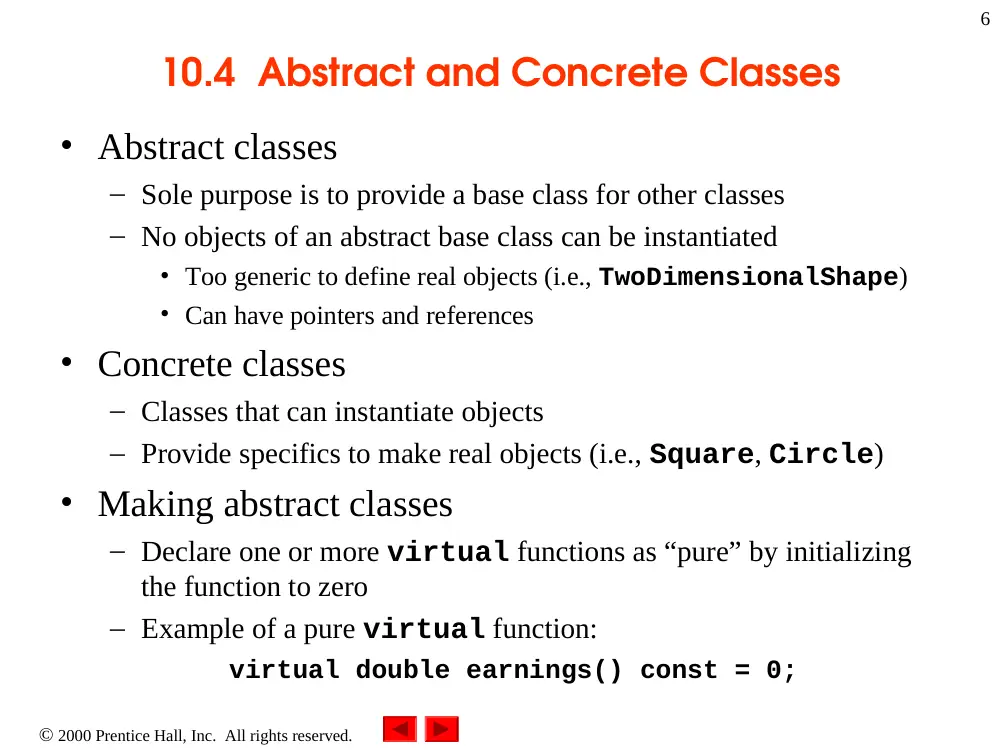
10.4 Abstract and Concrete Classes
• Abstract classes
– Sole purpose is to provide a base class for other classes
– No objects of an abstract base class can be instantiated
• Too generic to define real objects (i.e., TwoDimensionalShape)
• Can have pointers and references
• Concrete classes
– Classes that can instantiate objects
– Provide specifics to make real objects (i.e., Square, Circle)
• Making abstract classes
– Declare one or more virtual functions as “pure” by initializing
the function to zero
– Example of a pure virtual function:
virtual double earnings() const = 0;
7
2000 Prentice Hall, Inc. All rights reserved.
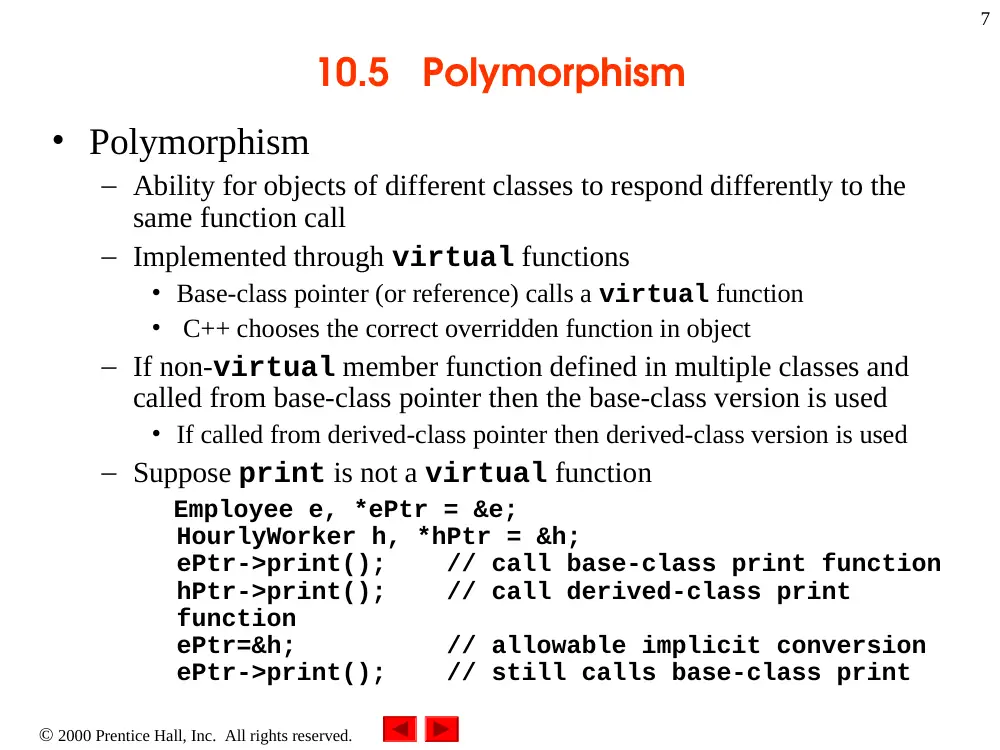
10.5 Polymorphism
• Polymorphism
– Ability for objects of different classes to respond differently to the
same function call
– Implemented through virtual functions
• Base-class pointer (or reference) calls a virtual function
• C++ chooses the correct overridden function in object
– If non-virtual member function defined in multiple classes and
called from base-class pointer then the base-class version is used
• If called from derived-class pointer then derived-class version is used
– Suppose print is not a virtual function
Employee e, *ePtr = &e;
HourlyWorker h, *hPtr = &h;
ePtr->print(); // call base-class print function
hPtr->print(); // call derived-class print
function
ePtr=&h; // allowable implicit conversion
ePtr->print(); // still calls base-class print
8
2000 Prentice Hall, Inc. All rights reserved.
10.6 Case Study: A Payroll System Using
Polymorphism
• The following example is a payroll system
– Uses virtual functions and polymorphism to perform
payroll calculations based on the type of an employee
2000 Prentice Hall, Inc. All rights reserved.
Outline
9
Outline
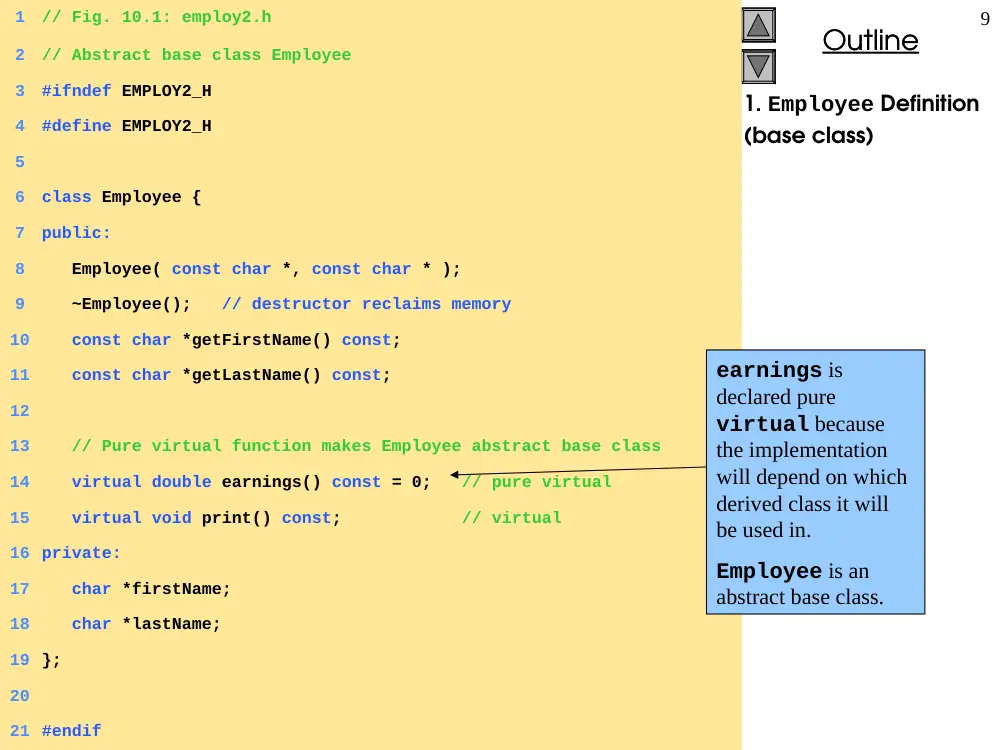
1. Employee Definition
(base class)
1
// Fig. 10.1: employ2.h
2
// Abstract base class Employee
3
#ifndef EMPLOY2_H
4
#define EMPLOY2_H
5
6
class Employee {
7
public:
8
Employee( const char *, const char * );
9
~Employee(); // destructor reclaims memory
10 const char *getFirstName() const;
11 const char *getLastName() const;
12
13 // Pure virtual function makes Employee abstract base class
14 virtual double earnings() const = 0; // pure virtual
15 virtual void print() const; // virtual
16 private:
17 char *firstName;
18 char *lastName;
19 };
20
21 #endif
earnings is
declared pure
virtual because
the implementation
will depend on which
derived class it will
be used in.
Employee is an
abstract base class.
2000 Prentice Hall, Inc. All rights reserved.
Outline
10
Outline
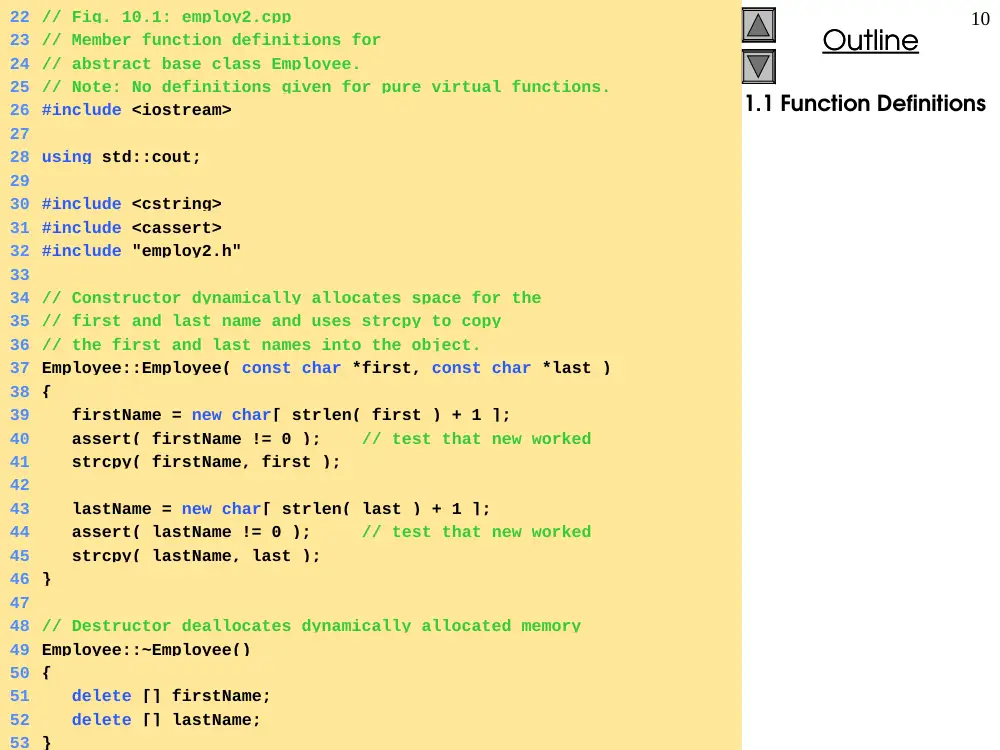
1.1 Function Definitions
22 // Fig. 10.1: employ2.cpp
23 // Member function definitions for
24 // abstract base class Employee.
25 // Note: No definitions given for pure virtual functions.
26 #include <iostream>
27
28 using std::cout;
29
30 #include <cstring>
31 #include <cassert>
32 #include "employ2.h"
33
34 // Constructor dynamically allocates space for the
35 // first and last name and uses strcpy to copy
36 // the first and last names into the object.
37 Employee::Employee( const char *first, const char *last )
38 {
39 firstName = new char[ strlen( first ) + 1 ];
40 assert( firstName != 0 ); // test that new worked
41 strcpy( firstName, first );
42
43 lastName = new char[ strlen( last ) + 1 ];
44 assert( lastName != 0 ); // test that new worked
45 strcpy( lastName, last );
46 }
47
48 // Destructor deallocates dynamically allocated memory
49 Employee::~Employee()
50 {
51 delete [] firstName;
52 delete [] lastName;
53 }
2000 Prentice Hall, Inc. All rights reserved.
Outline
11
Outline
1.1 Function Definitions
54
55 // Return a pointer to the first name
56 // Const return type prevents caller from modifying private
57 // data. Caller should copy returned string before destructor
58 // deletes dynamic storage to prevent undefined pointer.
59 const char *Employee::getFirstName() const
60 {
61 return firstName; // caller must delete memory
62 }
63
64 // Return a pointer to the last name
65 // Const return type prevents caller from modifying private
66 // data. Caller should copy returned string before destructor
67 // deletes dynamic storage to prevent undefined pointer.
68 const char *Employee::getLastName() const
69 {
70 return lastName; // caller must delete memory
71 }
72
73 // Print the name of the Employee
74 void Employee::print() const
75 { cout << firstName << ' ' << lastName; }
2000 Prentice Hall, Inc. All rights reserved.
Outline
12
Outline
1. Boss Definition
(derived class)
76 // Fig. 10.1: boss1.h
77 // Boss class derived from Employee
78 #ifndef BOSS1_H
79 #define BOSS1_H
80 #include "employ2.h"
81
82 class Boss : public Employee {
83 public:
84 Boss( const char *, const char *, double = 0.0 );
85 void setWeeklySalary( double );
86 virtual double earnings() const;
87 virtual void print() const;
88 private:
89 double weeklySalary;
90 };
91
92 #endif
2000 Prentice Hall, Inc. All rights reserved.
Outline
13
Outline
1.1 Function Definitions
93 // Fig. 10.1: boss1.cpp
94 // Member function definitions for class Boss
95 #include <iostream>
96
97 using std::cout;
98
99 #include "boss1.h"
100
101// Constructor function for class Boss
102Boss::Boss( const char *first, const char *last, double s )
103 : Employee( first, last ) // call base-class constructor
104{ setWeeklySalary( s ); }
105
106// Set the Boss's salary
107void Boss::setWeeklySalary( double s )
108 { weeklySalary = s > 0 ? s : 0; }
109
110// Get the Boss's pay
111double Boss::earnings() const { return weeklySalary; }
112
113// Print the Boss's name
114void Boss::print() const
115{
116 cout << "\n Boss: ";
117 Employee::print();
118}
Notice the overriden
earnings and
print functions.
They were declared
virtual in the base
class.
2000 Prentice Hall, Inc. All rights reserved.
Outline
14
Outline
1. CommissionWorker
Definition (derived
class)
119// Fig. 10.1: commis1.h
120// CommissionWorker class derived from Employee
121#ifndef COMMIS1_H
122#define COMMIS1_H
123#include "employ2.h"
124
125class CommissionWorker : public Employee {
126public:
127 CommissionWorker( const char *, const char *,
128 double = 0.0, double = 0.0,
129 int = 0 );
130 void setSalary( double );
131 void setCommission( double );
132 void setQuantity( int );
133 virtual double earnings() const;
134 virtual void print() const;
135private:
136 double salary; // base salary per week
137 double commission; // amount per item sold
138 int quantity; // total items sold for week
139};
140
141#endif
2000 Prentice Hall, Inc. All rights reserved.
Outline
15
Outline
1.1 Function Definitions
142// Fig. 10.1: commis1.cpp
143// Member function definitions for class CommissionWorker
144#include <iostream>
145
146using std::cout;
147
148#include "commis1.h"
149
150// Constructor for class CommissionWorker
151CommissionWorker::CommissionWorker( const char *first,
152 const char *last, double s, double c, int q )
153 : Employee( first, last ) // call base-class constructor
154{
155 setSalary( s );
156 setCommission( c );
157 setQuantity( q );
158}
159
160// Set CommissionWorker's weekly base salary
161void CommissionWorker::setSalary( double s )
162 { salary = s > 0 ? s : 0; }
2000 Prentice Hall, Inc. All rights reserved.
Outline
16
Outline
1.1 Function Definitions
163
164// Set CommissionWorker's commission
165void CommissionWorker::setCommission( double c )
166 { commission = c > 0 ? c : 0; }
167
168// Set CommissionWorker's quantity sold
169void CommissionWorker::setQuantity( int q )
170 { quantity = q > 0 ? q : 0; }
171
172// Determine CommissionWorker's earnings
173double CommissionWorker::earnings() const
174 { return salary + commission * quantity; }
175
176// Print the CommissionWorker's name
177void CommissionWorker::print() const
178{
179 cout << "\nCommission worker: ";
180 Employee::print();
181}
Notice the overriden
earnings and
print functions.
They were declared
virtual in the base
class.
2000 Prentice Hall, Inc. All rights reserved.
Outline
17
Outline
1. PieceWorker
Definition (derived
class)
182// Fig. 10.1: piece1.h
183// PieceWorker class derived from Employee
184#ifndef PIECE1_H
185#define PIECE1_H
186#include "employ2.h"
187
188class PieceWorker : public Employee {
189public:
190 PieceWorker( const char *, const char *,
191 double = 0.0, int = 0);
192 void setWage( double );
193 void setQuantity( int );
194 virtual double earnings() const;
195 virtual void print() const;
196private:
197 double wagePerPiece; // wage for each piece output
198 int quantity; // output for week
199};
200
201#endif
2000 Prentice Hall, Inc. All rights reserved.
Outline
18
Outline
1.1 Function Definitions
202// Fig. 10.1: piece1.cpp
203// Member function definitions for class PieceWorker
204#include <iostream>
205
206using std::cout;
207
208#include "piece1.h"
209
210// Constructor for class PieceWorker
211PieceWorker::PieceWorker( const char *first, const char *last,
212 double w, int q )
213 : Employee( first, last ) // call base-class constructor
214{
215 setWage( w );
216 setQuantity( q );
217}
218
219// Set the wage
220void PieceWorker::setWage( double w )
221 { wagePerPiece = w > 0 ? w : 0; }
222
223// Set the number of items output
224void PieceWorker::setQuantity( int q )
225 { quantity = q > 0 ? q : 0; }
226
227// Determine the PieceWorker's earnings
228double PieceWorker::earnings() const
229 { return quantity * wagePerPiece; }
230
231// Print the PieceWorker's name
232void PieceWorker::print() const
233{
234 cout << "\n Piece worker: ";
235 Employee::print();
236}
Again, notice the
overridden
earnings and
print functions.
They were declared
virtual in the base
class.
2000 Prentice Hall, Inc. All rights reserved.
Outline
19
Outline
1. HourlyWorker
Definition (derived
class)
237// Fig. 10.1: hourly1.h
238// Definition of class HourlyWorker
239#ifndef HOURLY1_H
240#define HOURLY1_H
241#include "employ2.h"
242
243class HourlyWorker : public Employee {
244public:
245 HourlyWorker( const char *, const char *,
246 double = 0.0, double = 0.0);
247 void setWage( double );
248 void setHours( double );
249 virtual double earnings() const;
250 virtual void print() const;
251private:
252 double wage; // wage per hour
253 double hours; // hours worked for week
254};
255
256#endif
2000 Prentice Hall, Inc. All rights reserved.
Outline
20
Outline
1.1 Function Definitions
257// Fig. 10.1: hourly1.cpp
258// Member function definitions for class HourlyWorker
259#include <iostream>
260
261using std::cout;
262
263#include "hourly1.h"
264
265// Constructor for class HourlyWorker
266HourlyWorker::HourlyWorker( const char *first,
267 const char *last,
268 double w, double h )
269 : Employee( first, last ) // call base-class constructor
270{
271 setWage( w );
272 setHours( h );
273}
274
275// Set the wage
276void HourlyWorker::setWage( double w )
277 { wage = w > 0 ? w : 0; }
2000 Prentice Hall, Inc. All rights reserved.
Outline
21
Outline
1.1 Function Definitions
278
279// Set the hours worked
280void HourlyWorker::setHours( double h )
281 { hours = h >= 0 && h < 168 ? h : 0; }
282
283// Get the HourlyWorker's pay
284double HourlyWorker::earnings() const
285{
286 if ( hours <= 40 ) // no overtime
287 return wage * hours;
288 else // overtime is paid at wage * 1.5
289 return 40 * wage + ( hours - 40 ) * wage * 1.5;
290}
291
292// Print the HourlyWorker's name
293void HourlyWorker::print() const
294{
295 cout << "\n Hourly worker: ";
296 Employee::print();
297}
Overridden functions.
2000 Prentice Hall, Inc. All rights reserved.
Outline
22
Outline
1. Load headers
298// Fig. 10.1: fig10_01.cpp
299// Driver for Employee hierarchy
300#include <iostream>
301
302using std::cout;
303using std::endl;
304
305#include <iomanip>
306
307using std::ios;
308using std::setiosflags;
309using std::setprecision;
310
311#include "employ2.h"
312#include "boss1.h"
313#include "commis1.h"
314#include "piece1.h"
315#include "hourly1.h"
316
317void virtualViaPointer( const Employee * );
318void virtualViaReference( const Employee & );
319
320int main()
321{
322 // set output formatting
323 cout << setiosflags( ios::fixed | ios::showpoint )
324 << setprecision( 2 );
325
2000 Prentice Hall, Inc. All rights reserved.
Outline
23
Outline
1.1 Initialize objects
2. Print
326 Boss b( "John", "Smith", 800.00 );
327 b.print(); // static binding
328 cout << " earned $" << b.earnings(); // static binding
329 virtualViaPointer( &b ); // uses dynamic binding
330 virtualViaReference( b ); // uses dynamic binding
331
332 CommissionWorker c( "Sue", "Jones", 200.0, 3.0, 150 );
333 c.print(); // static binding
334 cout << " earned $" << c.earnings(); // static binding
335 virtualViaPointer( &c ); // uses dynamic binding
336 virtualViaReference( c ); // uses dynamic binding
337
338 PieceWorker p( "Bob", "Lewis", 2.5, 200 );
339 p.print(); // static binding
340 cout << " earned $" << p.earnings(); // static binding
341 virtualViaPointer( &p ); // uses dynamic binding
342 virtualViaReference( p ); // uses dynamic binding
343
344 HourlyWorker h( "Karen", "Price", 13.75, 40 );
345 h.print(); // static binding
346 cout << " earned $" << h.earnings(); // static binding
347 virtualViaPointer( &h ); // uses dynamic binding
348 virtualViaReference( h ); // uses dynamic binding
349 cout << endl;
350 return 0;
351}
352
353// Make virtual function calls off a base-class pointer
354// using dynamic binding.
355void virtualViaPointer( const Employee *baseClassPtr )
356{
357 baseClassPtr->print();
358 cout << " earned $" << baseClassPtr->earnings();
359}
Boss: John Smith earned $800.00
Call function print using the object itself.
Call function print, using a base-
class pointer.
This uses virtual functions and
dynamic binding.
Call function print, using a base-
class reference.
This uses virtual functions and
dynamic binding.
Boss: John Smith earned $800.00
Boss: John Smith earned $800.00
Commission worker: Sue Jones earned $650.00
Commission worker: Sue Jones earned $650.00
Commission worker: Sue Jones earned $650.00
Piece worker: Bob Lewis earned $500.00
Piece worker: Bob Lewis earned $500.00
Piece worker: Bob Lewis earned $500.00
Hourly worker: Karen Price earned $550.00
Hourly worker: Karen Price earned $550.00
Hourly worker: Karen Price earned $550.00
Take in a baseclass pointer, call
the virtual function print.
2000 Prentice Hall, Inc. All rights reserved.
Outline
24
Outline
3. Function Definitions
Program Output
360
361// Make virtual function calls off a base-class reference
362// using dynamic binding.
363void virtualViaReference( const Employee &baseClassRef )
364{
365 baseClassRef.print();
366 cout << " earned $" << baseClassRef.earnings();
367}
Boss: John Smith earned $800.00
Boss: John Smith earned $800.00
Boss: John Smith earned $800.00
Commission worker: Sue Jones earned $650.00
Commission worker: Sue Jones earned $650.00
Commission worker: Sue Jones earned $650.00
Piece worker: Bob Lewis earned $500.00
Piece worker: Bob Lewis earned $500.00
Piece worker: Bob Lewis earned $500.00
Hourly worker: Karen Price earned $550.00
Hourly worker: Karen Price earned $550.00
Hourly worker: Karen Price earned $550.00
Take in base class reference, call
the virtual function print.
25
2000 Prentice Hall, Inc. All rights reserved.
10.7 New Classes and Dynamic Binding
• Polymorphism and virtual functions
– Work well when all classes are not known in advance
– Use dynamic binding to accommodate new classes being
added to a system
• Dynamic binding (late binding)
– Object's type need not be know at compile time for a
virtual function
– virtual function call is matched at run time
26
2000 Prentice Hall, Inc. All rights reserved.
10.8 Virtual Destructors
• Problem:
– If a base-class pointer to a derived object is deleted, the base-
class destructor will act on the object
• Solution:
– declare a virtual base-class destructor to ensure that the
appropriate destructor will be called
27
2000 Prentice Hall, Inc. All rights reserved.
10.9 Case Study: Inheriting Interface and
Implementation
• Extension of point, circle, cylinder hierarchy
– Use the abstract base class Shape to head the hierarchy
• Two pure virtual functions printShapeName and print
• Two other virtual functions volume and area
– Point is derived from Shape and inherits these
implementations
2000 Prentice Hall, Inc. All rights reserved.
Outline
28
Outline
1. Shape Definition
(abstract base class)
---------------------
1. Point Definition
(derived class)
1
// Fig. 10.2: shape.h
2
// Definition of abstract base class Shape
3
#ifndef SHAPE_H
4
#define SHAPE_H
5
6
class Shape {
7
public:
8
virtual double area() const { return 0.0; }
9
virtual double volume() const { return 0.0; }
10
11 // pure virtual functions overridden in derived classes
12 virtual void printShapeName() const = 0;
13 virtual void print() const = 0;
14 };
15
16 #endif
17 // Fig. 10.2: point1.h
18 // Definition of class Point
19 #ifndef POINT1_H
20 #define POINT1_H
21
22 #include <iostream>
23
24 using std::cout;
25
26 #include "shape.h"
27
28 class Point : public Shape {
29 public:
30 Point( int = 0, int = 0 ); // default constructor
31 void setPoint( int, int );
32 int getX() const { return x; }
33 int getY() const { return y; }
Point inherits from the
abstract base class.
Notice the virtual
functions which will be
overridden by each class.
2000 Prentice Hall, Inc. All rights reserved.
Outline
29
Outline
1. Point Definition
(derived class)
1.1 Function Definitions
34 virtual void printShapeName() const { cout << "Point: "; }
35 virtual void print() const;
36 private:
37 int x, y; // x and y coordinates of Point
38 };
39
40 #endif
41 // Fig. 10.2: point1.cpp
42 // Member function definitions for class Point
43 #include "point1.h"
44
45 Point::Point( int a, int b ) { setPoint( a, b ); }
46
47 void Point::setPoint( int a, int b )
48 {
49 x = a;
50 y = b;
51 }
52
53 void Point::print() const
54 { cout << '[' << x << ", " << y << ']'; }
2000 Prentice Hall, Inc. All rights reserved.
Outline
30
Outline
1. Circle Definition
(derived class)
55 // Fig. 10.2: circle1.h
56 // Definition of class Circle
57 #ifndef CIRCLE1_H
58 #define CIRCLE1_H
59 #include "point1.h"
60
61 class Circle : public Point {
62 public:
63 // default constructor
64 Circle( double r = 0.0, int x = 0, int y = 0 );
65
66 void setRadius( double );
67 double getRadius() const;
68 virtual double area() const;
69 virtual void printShapeName() const { cout << "Circle: "; }
70 virtual void print() const;
71 private:
72 double radius; // radius of Circle
73 };
74
75 #endif
Circle inherits
from Point.
2000 Prentice Hall, Inc. All rights reserved.
Outline
31
Outline
1.1 Function Definitions
76 // Fig. 10.2: circle1.cpp
77 // Member function definitions for class Circle
78 #include <iostream>
79
80 using std::cout;
81
82 #include "circle1.h"
83
84 Circle::Circle( double r, int a, int b )
85 : Point( a, b ) // call base-class constructor
86 { setRadius( r ); }
87
88 void Circle::setRadius( double r ) { radius = r > 0 ? r : 0; }
89
90 double Circle::getRadius() const { return radius; }
91
92 double Circle::area() const
93 { return 3.14159 * radius * radius; }
94
95 void Circle::print() const
96 {
97 Point::print();
98 cout << "; Radius = " << radius;
99 }
2000 Prentice Hall, Inc. All rights reserved.
Outline
32
Outline
1. Cylinder Definition
(derived class)
100// Fig. 10.2: cylindr1.h
101// Definition of class Cylinder
102#ifndef CYLINDR1_H
103#define CYLINDR1_H
104#include "circle1.h"
105
106class Cylinder : public Circle {
107public:
108 // default constructor
109 Cylinder( double h = 0.0, double r = 0.0,
110 int x = 0, int y = 0 );
111
112 void setHeight( double );
113 double getHeight();
114 virtual double area() const;
115 virtual double volume() const;
116 virtual void printShapeName() const { cout << "Cylinder: "; }
117 virtual void print() const;
118private:
119 double height; // height of Cylinder
120};
121
122#endif
Cylinder
inherits from
Circle.
2000 Prentice Hall, Inc. All rights reserved.
Outline
33
Outline
1.1 Function Definitions
123// Fig. 10.2: cylindr1.cpp
124// Member and friend function definitions for class Cylinder
125#include <iostream>
126
127using std::cout;
128
129#include "cylindr1.h"
130
131Cylinder::Cylinder( double h, double r, int x, int y )
132 : Circle( r, x, y ) // call base-class constructor
133{ setHeight( h ); }
134
135void Cylinder::setHeight( double h )
136 { height = h > 0 ? h : 0; }
137
138double Cylinder::getHeight() { return height; }
139
140double Cylinder::area() const
141{
142 // surface area of Cylinder
143 return 2 * Circle::area() +
144 2 * 3.14159 * getRadius() * height;
145}
146
147double Cylinder::volume() const
148 { return Circle::area() * height; }
149
150void Cylinder::print() const
151{
152 Circle::print();
153 cout << "; Height = " << height;
154}
2000 Prentice Hall, Inc. All rights reserved.
Outline
34
Outline
1. Load headers
1.1 Function
prototypes
1.2 Initialize objects
155// Fig. 10.2: fig10_02.cpp
156// Driver for shape, point, circle, cylinder hierarchy
157#include <iostream>
158
159using std::cout;
160using std::endl;
161
162#include <iomanip>
163
164using std::ios;
165using std::setiosflags;
166using std::setprecision;
167
168#include "shape.h"
169#include "point1.h"
170#include "circle1.h"
171#include "cylindr1.h"
172
173void virtualViaPointer( const Shape * );
174void virtualViaReference( const Shape & );
175
176int main()
177{
178 cout << setiosflags( ios::fixed | ios::showpoint )
179 << setprecision( 2 );
180
181 Point point( 7, 11 ); // create a Point
182 Circle circle( 3.5, 22, 8 ); // create a Circle
183 Cylinder cylinder( 10, 3.3, 10, 10 ); // create a Cylinder
184
185 point.printShapeName(); // static binding
2000 Prentice Hall, Inc. All rights reserved.
Outline
35
Outline
2. Function calls
186 point.print(); // static binding
187 cout << '\n';
188
189 circle.printShapeName(); // static binding
190 circle.print(); // static binding
191 cout << '\n';
192
193 cylinder.printShapeName(); // static binding
194 cylinder.print(); // static binding
195 cout << "\n\n";
196
197 Shape *arrayOfShapes[ 3 ]; // array of base-class pointers
198
199 // aim arrayOfShapes[0] at derived-class Point object
200 arrayOfShapes[ 0 ] = &point;
201
202 // aim arrayOfShapes[1] at derived-class Circle object
203 arrayOfShapes[ 1 ] = &circle;
204
205 // aim arrayOfShapes[2] at derived-class Cylinder object
206 arrayOfShapes[ 2 ] = &cylinder;
207
208 // Loop through arrayOfShapes and call virtualViaPointer
209 // to print the shape name, attributes, area, and volume
210 // of each object using dynamic binding.
211 cout << "Virtual function calls made off "
212 << "base-class pointers\n";
213
214 for ( int i = 0; i < 3; i++ )
215 virtualViaPointer( arrayOfShapes[ i ] );
216
217 // Loop through arrayOfShapes and call virtualViaReference
218 // to print the shape name, attributes, area, and volume
219 // of each object using dynamic binding.
Point: [7, 11]
Print using the object itself.
Circle: [22, 8]; Radius = 3.50
Cylinder: [10, 10]; Radius = 3.30; Height = 10.00
Create an array of base class
pointers. Assign these to the
objects, then call the print
functions again, using the
base class pointers. The
appropriate virtual
functions will be called.
Cylinder: [10, 10]; Radius = 3.30; Height =
10.00
Area = 275.77
Volume = 342.12
Virtual function calls made off base-class pointers
Point: [7, 11]
Area = 0.00
Volume = 0.00
Circle: [22, 8]; Radius = 3.50
Area = 38.48
Volume = 0.00
2000 Prentice Hall, Inc. All rights reserved.
Outline
36
Outline
2. Function calls
3. Function Definitions
220 cout << "Virtual function calls made off "
221 << "base-class references\n";
222
223 for ( int j = 0; j < 3; j++ )
224 virtualViaReference( *arrayOfShapes[ j ] );
225
226 return 0;
227}
228
229// Make virtual function calls off a base-class pointer
230// using dynamic binding.
231void virtualViaPointer( const Shape *baseClassPtr )
232{
233 baseClassPtr->printShapeName();
234 baseClassPtr->print();
235 cout << "\nArea = " << baseClassPtr->area()
236 << "\nVolume = " << baseClassPtr->volume() << "\n\n";
237}
238
239// Make virtual function calls off a base-class reference
240// using dynamic binding.
241void virtualViaReference( const Shape &baseClassRef )
242{
243 baseClassRef.printShapeName();
244 baseClassRef.print();
245 cout << "\nArea = " << baseClassRef.area()
246 << "\nVolume = " << baseClassRef.volume() << "\n\n";
247}
Repeat process using base-class
references.
Virtual function calls made off base-class
references
Point: [7, 11]
Area = 0.00
Volume = 0.00
Circle: [22, 8]; Radius = 3.50
Area = 38.48
Volume = 0.00
Cylinder: [10, 10]; Radius = 3.30; Height =
10.00
Area = 275.77
Volume = 342.12
2000 Prentice Hall, Inc. All rights reserved.
Outline
37
Outline
Program Output
Point: [7, 11]
Circle: [22, 8]; Radius = 3.50
Cylinder: [10, 10]; Radius = 3.30; Height = 10.00
Virtual function calls made off base-class pointers
Point: [7, 11]
Area = 0.00
Volume = 0.00
Circle: [22, 8]; Radius = 3.50
Area = 38.48
Volume = 0.00
Cylinder: [10, 10]; Radius = 3.30; Height = 10.00
Area = 275.77
Volume = 342.12
Virtual function calls made off base-class references
Point: [7, 11]
Area = 0.00
Volume = 0.00
Circle: [22, 8]; Radius = 3.50
Area = 38.48
Volume = 0.00
Cylinder: [10, 10]; Radius = 3.30; Height = 10.00
Area = 275.77
Volume = 342.12
38
2000 Prentice Hall, Inc. All rights reserved.
10.10 Polymorphism, virtual Functions and
Dynamic Binding “Under the Hood”
• When to use polymorphism
– Polymorphism requires a lot of overhead
– Polymorphism is not used in STL (Standard Template
Library) to optimize performance
• virtual function table (vtable)
– Every class with a virtual function has a vtable
– For every virtual function, its vtable has a pointer to the
proper function
• If a derived class has the same function as a base class, then
the function pointer points to the base-class function
– Detailed explanation in Fig. 10.3