
CSC 213 Code Chapter 8, Fall 2007
Notre Dame University–Louaize · Program Design and Data Abstraction II · 6 pages

More CSC 213 files
- Code Chapter 9 · Fall 2007FileView
- Useful File Number Systems · Fall 2007FileView
- Useful File IO Stream · Fall 2007FileView
- Code Chapter 7 · Fall 2007FileView
- Useful File Operator Precedence and Associativity · Fall 2007FileView
- Useful File ASCII Table · Fall 2007FileView
- Code Chapter 14 · Fall 2007FileView
- Code Chapter 13 · Fall 2007FileView
Show the text of this file
Operator Overloading
1
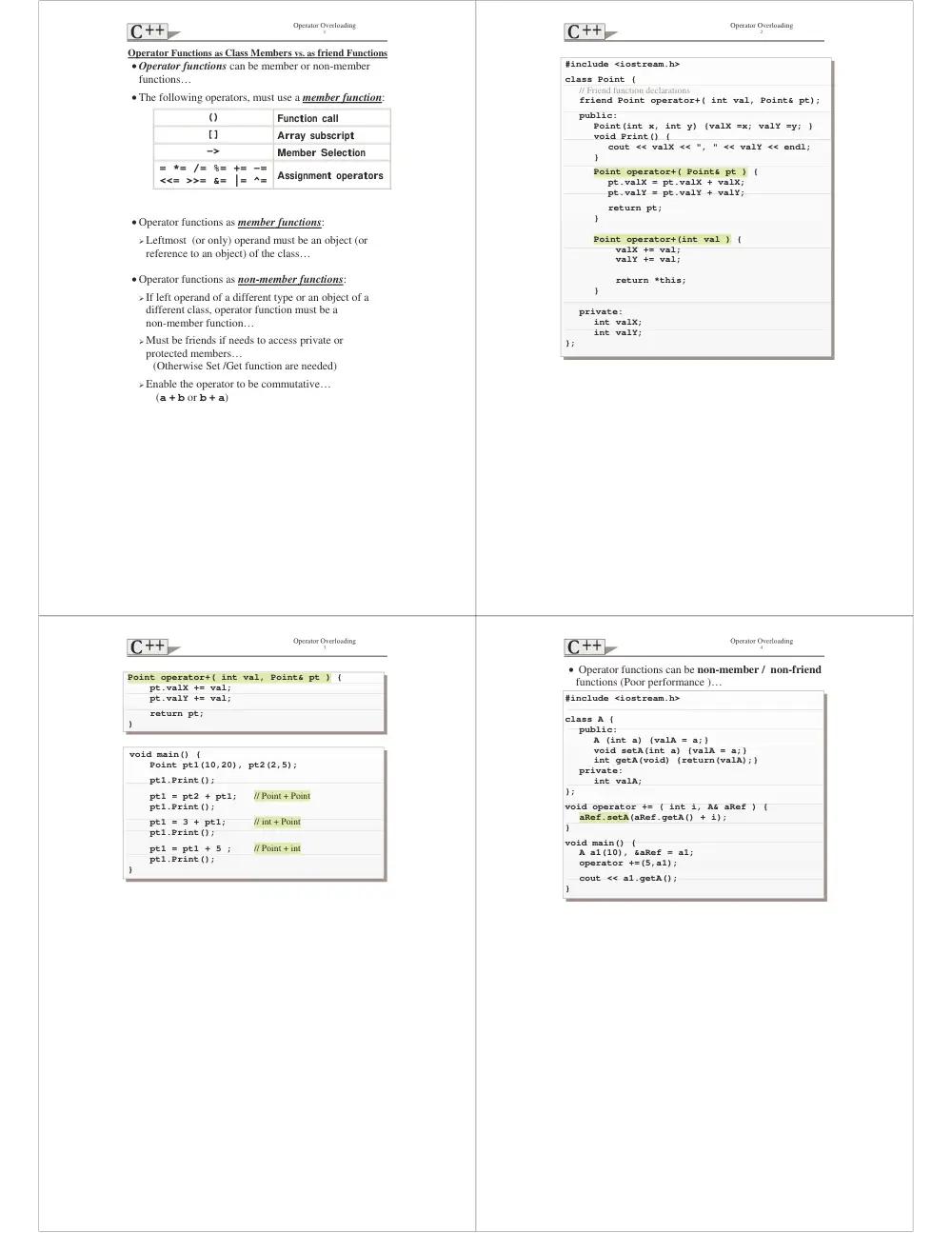
Operator Functions as Class Members vs. as friend Functions
• Operator functions can be member or non-member
functions…
• The following operators, must use a member function:
()
Function call
[]
Array subscript
->
Member Selection
= *= /= %= += -=
<<= >>= &= |= ^= Assignment operators
• Operator functions as member functions:
! Leftmost (or only) operand must be an object (or
reference to an object) of the class…
• Operator functions as non-member functions:
! If left operand of a different type or an object of a
different class, operator function must be a
non-member function…
! Must be friends if needs to access private or
protected members…
(Otherwise Set /Get function are needed)
! Enable the operator to be commutative…
(a + b or b + a)
Operator Overloading
2
#include <iostream.h>
class Point {
// Friend function declarations
friend Point operator+( int val, Point& pt);
public:
Point(int x, int y) {valX =x; valY =y; }
void Print() {
cout << valX << ", " << valY << endl;
}
Point operator+( Point& pt ) {
pt.valX = pt.valX + valX;
pt.valY = pt.valY + valY;
return pt;
}
Point operator+(int val ) {
valX += val;
valY += val;
return *this;
}
private:
int valX;
int valY;
};
Operator Overloading
3
Point operator+( int val, Point& pt ) {
pt.valX += val;
pt.valY += val;
return pt;
}
void main() {
Point pt1(10,20), pt2(2,5);
pt1.Print();
pt1 = pt2 + pt1; // Point + Point
pt1.Print();
pt1 = 3 + pt1; // int + Point
pt1.Print();
pt1 = pt1 + 5 ; // Point + int
pt1.Print();
}
Operator Overloading
4
• Operator functions can be non-member / non-friend
functions (Poor performance )…
#include <iostream.h>
class A {
public:
A (int a) {valA = a;}
void setA(int a) {valA = a;}
int getA(void) {return(valA);}
private:
int valA;
};
void operator += ( int i, A& aRef ) {
aRef.setA(aRef.getA() + i);
}
void main() {
A a1(10), &aRef = a1;
operator +=(5,a1);
cout << a1.getA();
}
Operator Overloading
5
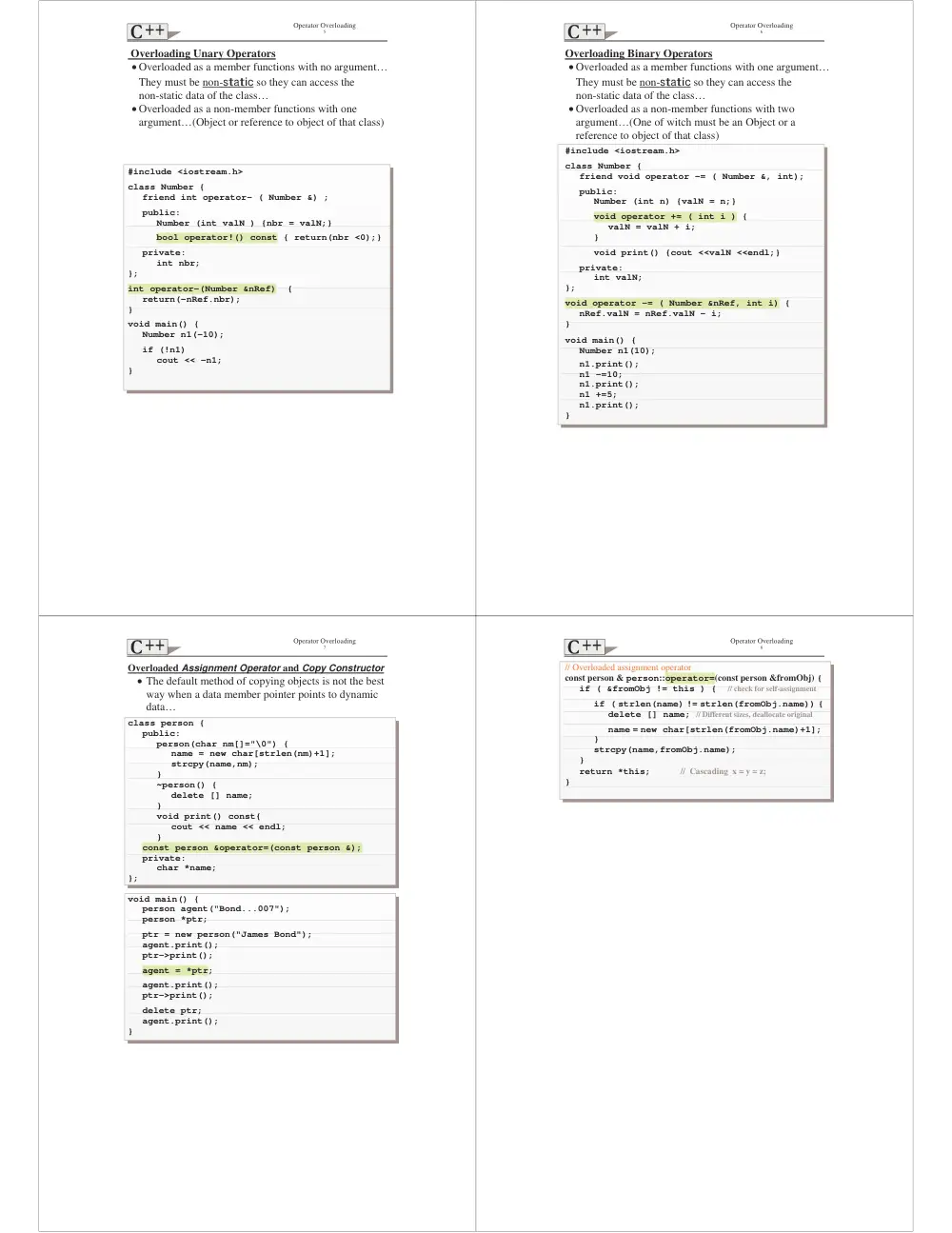
Overloading Unary Operators
• Overloaded as a member functions with no argument…
They must be non-static so they can access the
non-static data of the class…
• Overloaded as a non-member functions with one
argument…(Object or reference to object of that class)
#include <iostream.h>
class Number {
friend int operator- ( Number &) ;
public:
Number (int valN ) {nbr = valN;}
bool operator!() const { return(nbr <0);}
private:
int nbr;
};
int operator-(Number &nRef) {
return(-nRef.nbr);
}
void main() {
Number n1(-10);
if (!n1)
cout << -n1;
}
Operator Overloading
6
Overloading Binary Operators
• Overloaded as a member functions with one argument…
They must be non-static so they can access the
non-static data of the class…
• Overloaded as a non-member functions with two
argument…(One of witch must be an Object or a
reference to object of that class)
#include <iostream.h>
class Number {
friend void operator -= ( Number &, int);
public:
Number (int n) {valN = n;}
void operator += ( int i ) {
valN = valN + i;
}
void print() {cout <<valN <<endl;}
private:
int valN;
};
void operator -= ( Number &nRef, int i) {
nRef.valN = nRef.valN - i;
}
void main() {
Number n1(10);
n1.print();
n1 -=10;
n1.print();
n1 +=5;
n1.print();
}
Operator Overloading
7
Overloaded Assignment Operator and Copy Constructor
• The default method of copying objects is not the best
way when a data member pointer points to dynamic
data…
class person {
public:
person(char nm[]="\0") {
name = new char[strlen(nm)+1];
strcpy(name,nm);
}
~person() {
delete [] name;
}
void print() const{
cout << name << endl;
}
const person &operator=(const person &);
private:
char *name;
};
void main() {
person agent("Bond...007");
person *ptr;
ptr = new person("James Bond");
agent.print();
ptr->print();
agent = *ptr;
agent.print();
ptr->print();
delete ptr;
agent.print();
}
Operator Overloading
8
// Overloaded assignment operator
const person & person::operator=(const person &fromObj) {
if ( &fromObj != this ) { // check for self-assignment
if ( strlen(name) != strlen(fromObj.name)) {
delete [] name; // Different sizes, deallocate original
name = new char[strlen(fromObj.name)+1];
}
strcpy(name,fromObj.name);
}
return *this;
// Cascading x = y = z;
}
Operator Overloading
9
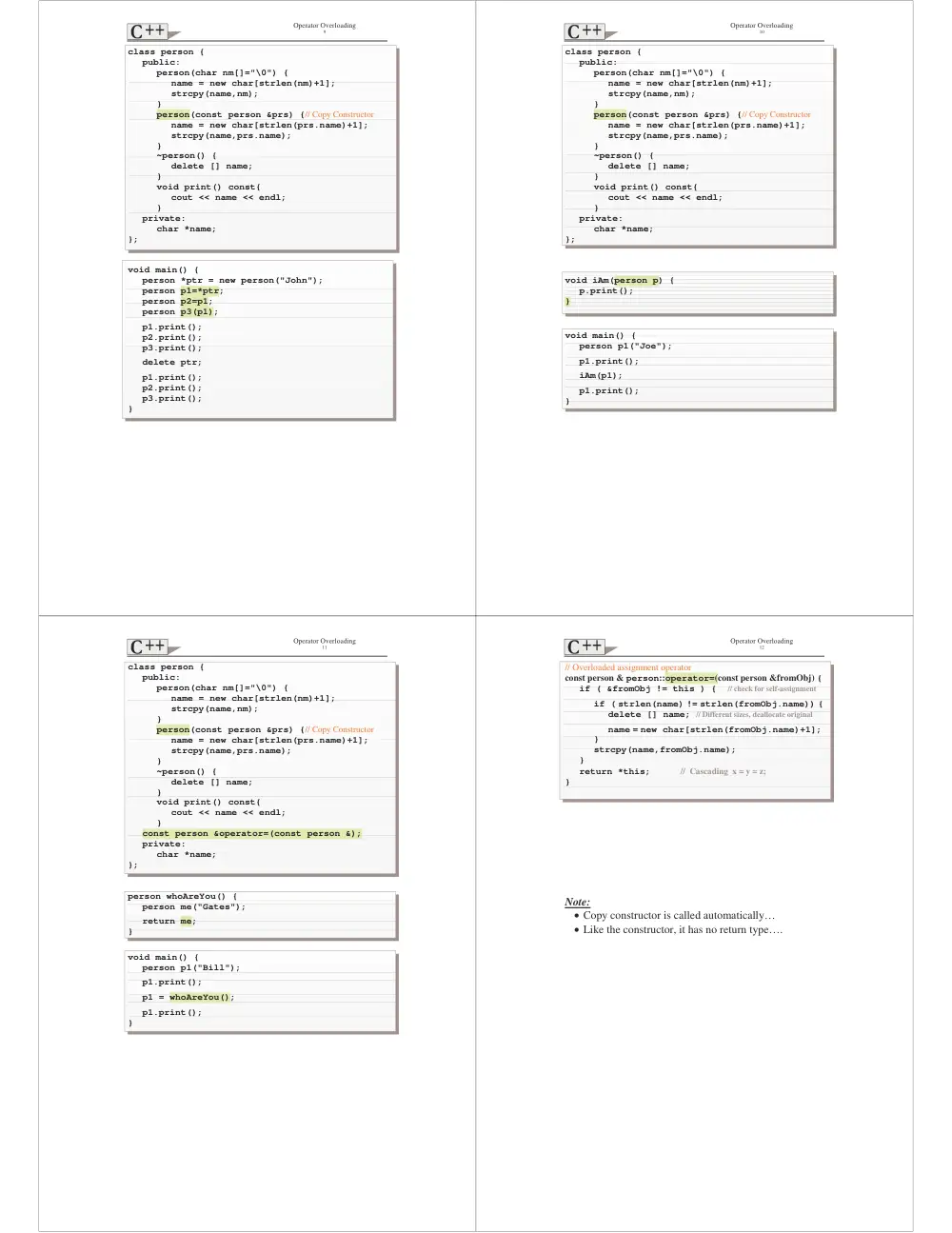
class person {
public:
person(char nm[]="\0") {
name = new char[strlen(nm)+1];
strcpy(name,nm);
}
person(const person &prs) {// Copy Constructor
name = new char[strlen(prs.name)+1];
strcpy(name,prs.name);
}
~person() {
delete [] name;
}
void print() const{
cout << name << endl;
}
private:
char *name;
};
void main() {
person *ptr = new person("John");
person p1=*ptr;
person p2=p1;
person p3(p1);
p1.print();
p2.print();
p3.print();
delete ptr;
p1.print();
p2.print();
p3.print();
}
Operator Overloading
10
class person {
public:
person(char nm[]="\0") {
name = new char[strlen(nm)+1];
strcpy(name,nm);
}
person(const person &prs) {// Copy Constructor
name = new char[strlen(prs.name)+1];
strcpy(name,prs.name);
}
~person() {
delete [] name;
}
void print() const{
cout << name << endl;
}
private:
char *name;
};
void iAm(person p) {
p.print();
}
void main() {
person p1("Joe");
p1.print();
iAm(p1);
p1.print();
}
Operator Overloading
11
class person {
public:
person(char nm[]="\0") {
name = new char[strlen(nm)+1];
strcpy(name,nm);
}
person(const person &prs) {// Copy Constructor
name = new char[strlen(prs.name)+1];
strcpy(name,prs.name);
}
~person() {
delete [] name;
}
void print() const{
cout << name << endl;
}
const person &operator=(const person &);
private:
char *name;
};
person whoAreYou() {
person me("Gates");
return me;
}
void main() {
person p1("Bill");
p1.print();
p1 = whoAreYou();
p1.print();
}
Operator Overloading
12
// Overloaded assignment operator
const person & person::operator=(const person &fromObj) {
if ( &fromObj != this ) { // check for self-assignment
if ( strlen(name) != strlen(fromObj.name)) {
delete [] name; // Different sizes, deallocate original
name = new char[strlen(fromObj.name)+1];
}
strcpy(name,fromObj.name);
}
return *this;
// Cascading x = y = z;
}
Note:
• Copy constructor is called automatically…
• Like the constructor, it has no return type….
Operator Overloading
13
Converting between types
• The complier knows how to perform certain conversion
among built-in types …
#include <iostream.h>
void fn(int val) {
cout << val << endl;
}
void main() {
float f1;
int i1;
f1=1.5;
i1=f1;
cout << f1 << endl;
cout << i1 << endl;
fn(f1);
}
BBuutt wwhhaatt aabboouutt uusseerr--ddeeffiinneedd ttyyppeess…
…
• The compiler cannot know how to convert among user
define types and built-in types…
Conversion constructor…(Cast operator)
Operator Overloading
14
#include <iostream.h>
class A {
public:
A(float f1) { fVal = f1; }
operator float () const { return fVal;}
operator int() const { return fVal+0.5;}
private:
float fVal;
};
void fn(int val) {
cout << val << endl;
}
void main() {
float d1;
A a1(1.5);
d1 = a1;
cout << d1 << endl;
fn(a1);
}
• Conversion constructor does not specify a return
type… The return type is the type in which the object its
been converted… Must be non-static member
function… It cannot be a friend function…
Operator Overloading
15
#include <iostream.h>
class A {
public:
A(float f1=0.0) { fVal = f1; }
void setA(float f1) { fVal= f1; }
private:
float fVal;
};
class B {
public:
B() { iVal = 10; }
operator A() {
A tmpA;
if (iVal > 0)
tmpA.setA(iVal);
else
tmpA.setA(-iVal);
return tmpA;
}
private:
int iVal;
};
void main() {
A a1(1.5);
B b1;
a1 = b1;
}
Operator Overloading
16
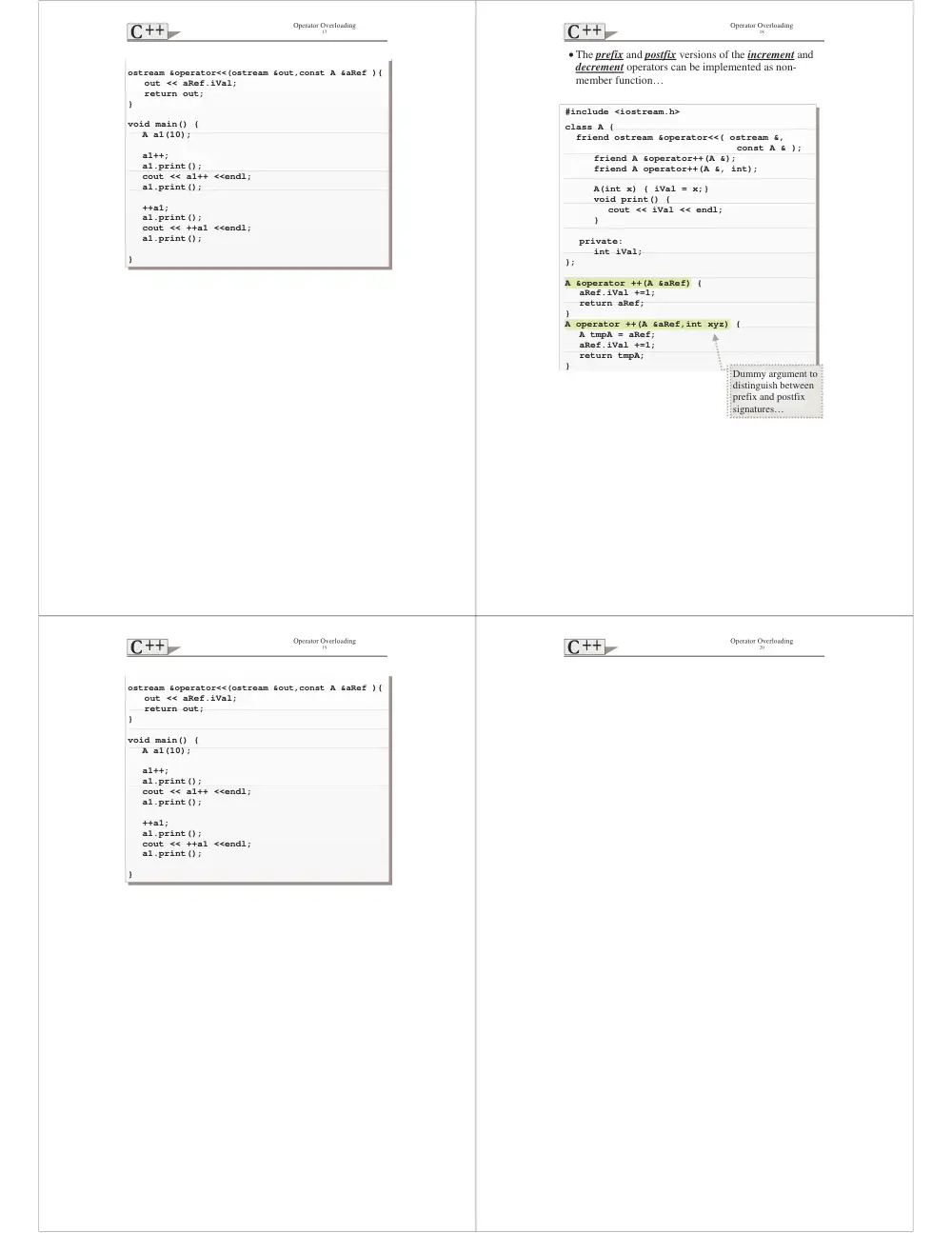
Overloading ++ and -- operators
• The prefix and postfix versions of the increment and
decrement operators can be separately overloaded…
• Each overloaded operator must have its distinct
signature… Thus, the following rule is observed:
!
The prefix form of the operator is declared exactly
the same way as any other unary operator…
!
The postfix form accepts an additional dummy
argument of type int…
#include <iostream.h>
class A {
friend ostream &operator<<( ostream &,
const A & );
public:
A(int x) { iVal = x;}
A &operator ++() {
iVal +=1;
return *this;
}
A operator ++(int x) {
A tmpA = *this;
iVal +=1;
return tmpA;
}
void print() {cout << iVal << endl;}
private:
int iVal;
};
Dummy argument to
distinguish between
prefix and postfix
signatures…
Operator Overloading
17
ostream &operator<<(ostream &out,const A &aRef ){
out << aRef.iVal;
return out;
}
void main() {
A a1(10);
a1++;
a1.print();
cout << a1++ <<endl;
a1.print();
++a1;
a1.print();
cout << ++a1 <<endl;
a1.print();
}
Operator Overloading
18
• The prefix and postfix versions of the increment and
decrement operators can be implemented as non-
member function…
#include <iostream.h>
class A {
friend ostream &operator<<( ostream &,
const A & );
friend A &operator++(A &);
friend A operator++(A &, int);
A(int x) { iVal = x;}
void print() {
cout << iVal << endl;
}
private:
int iVal;
};
A &operator ++(A &aRef) {
aRef.iVal +=1;
return aRef;
}
A operator ++(A &aRef,int xyz) {
A tmpA = aRef;
aRef.iVal +=1;
return tmpA;
}
Dummy argument to
distinguish between
prefix and postfix
signatures…
Operator Overloading
19
ostream &operator<<(ostream &out,const A &aRef ){
out << aRef.iVal;
return out;
}
void main() {
A a1(10);
a1++;
a1.print();
cout << a1++ <<endl;
a1.print();
++a1;
a1.print();
cout << ++a1 <<endl;
a1.print();
}
Operator Overloading
20
Operator Overloading
21
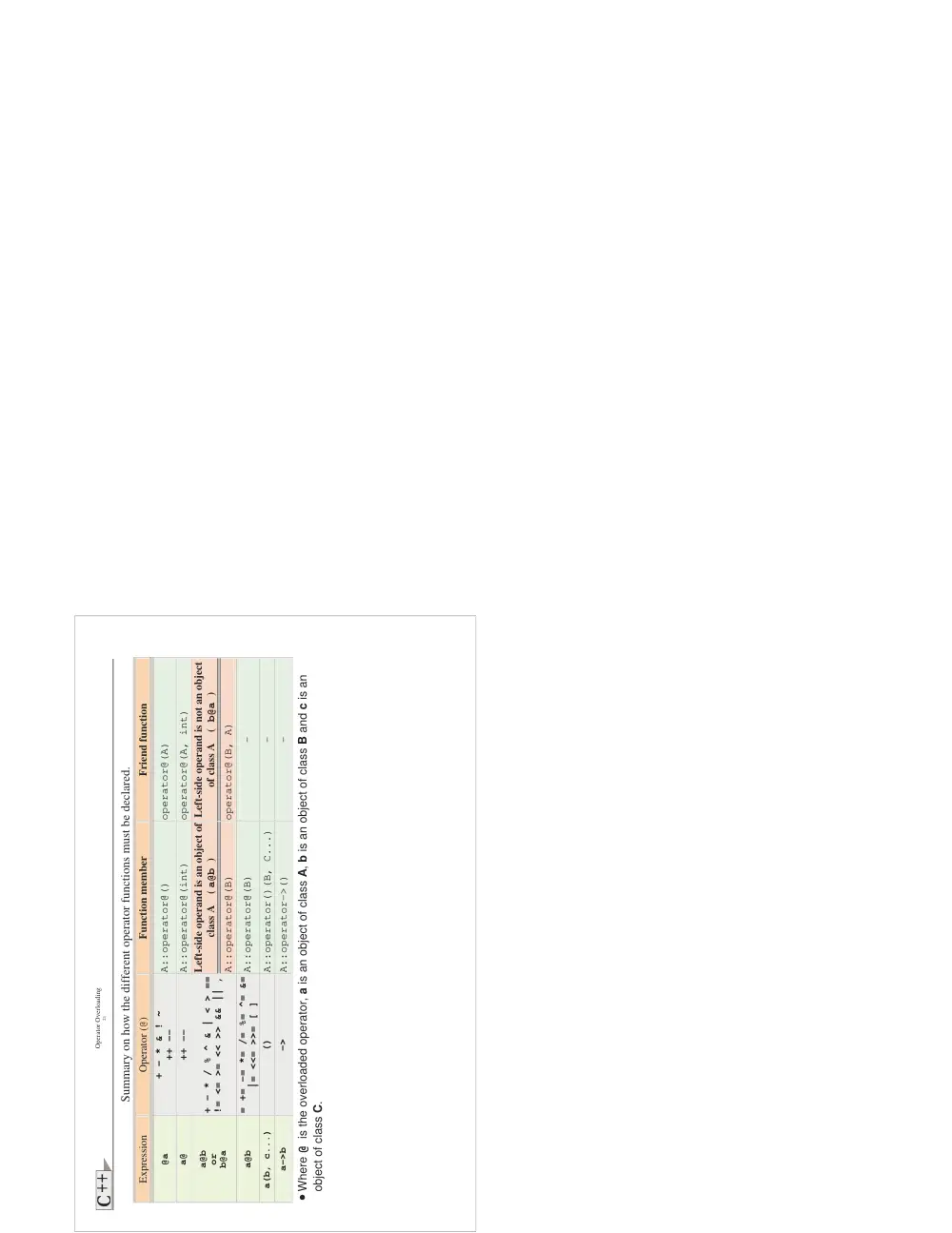
Summary on how the different operator functions must be declared.
Expression
Operator (@)
Function member
Friend function
@a
+ - * & ! ~
++ --
A::operator@()
operator@(A)
a@
++ --
A::operator@(int)
operator@(A, int)
Left-side operand is an object of
class A ( a@b )
Left-side operand is not an object
of class A ( b@a )
a@b
or
b@a
+ - * / % ^ & | < > ==
!= <= >= << >> && || ,
A::operator@(B)
operator@(B, A)
a@b
= += -= *= /= %= ^= &=
|= <<= >>= [ ]
A::operator@(B)
-
a(b, c...)
()
A::operator()(B, C...)
-
a->b
->
A::operator->()
-
• Where @ is the overloaded operator, a is an object of class A, b is an object of class B and c is an
object of class C.