
CSC 213 Problems Sec 12.1, Fall 2007
Notre Dame University–Louaize · Program Design and Data Abstraction II · 2 pages

More CSC 213 files
- Problems Assignment 1 · Fall 2012ProblemsView
- Problems Assignment 2 · Fall 2012ProblemsView
- Problems Sec 10 · Fall 2007ProblemsView
- Problems Sec 14 · Fall 2007ProblemsView
- Problems Sec 12.2 · Fall 2007ProblemsView
- Problems Sec 7.1 · Fall 2007ProblemsView
- Problems Sec 7 · Fall 2007ProblemsView
- Problems Sec 6 · Fall 2007ProblemsView
Show the text of this problems
Exercice #12-1
1
Create a template for the Array class developed in chapter 8.
// Simple class Array converted to a template
#ifndef ARRAY1_H
#define ARRAY1_H
#include <iostream.h>
#include <iomanip.h>
#include <assert.h>
template< class T>
class ArrayT {
friend ostream &operator << ( ostream &,
const ArrayT<T> & );
friend istream &operator >> ( istream &,
ArrayT<T> & );
public:
ArrayT( int = 10 );
ArrayT( const ArrayT<T> & ); // copy constructor
~ArrayT();
int getSize() const;
const ArrayT<T> &operator=(const ArrayT<T> &);
int operator==( const ArrayT<T> & ) const;
int operator!=( const ArrayT<T> &right ) const
{ return ! ( *this == right ); }
T &operator[]( int
const T &operator[]( int ) const;
static int getArrayCount();
private:
int size; // size of the array
T *ptr; // pointer to first element of array
static int arrayCount; // # of Arrays instantiated
};
Exercice #12-1
2
// Member function definitions for class ArrayT TEMPLATE
// Initialize static data member at file scope
template <class T>
int ArrayT<T>::arrayCount = 0; // no objects yet
// Default constructor for class ArrayT (default size 10)
template <class T>
ArrayT<T>::ArrayT( int arraySize ) {
size = ( arraySize > 0 ? arraySize : 10 );
ptr = new T[ size ]; // create space for array
assert( ptr != 0 ); // exit if memory not allocated
++arrayCount; // count one more object
for ( int i = 0; i < size; i++ )
ptr[ i ] = 0; // initialize array
}
// Copy constructor for class ArrayT
// must receive a reference to prevent infinite recursion
template <class T>
ArrayT<T>::ArrayT( const ArrayT<T> &init ) {
Size= init.size;
ptr = new T[ size ]; // create space for array
assert( ptr != 0 ); // exit if memory not allocated
++arrayCount; // count one more object
for ( int i = 0; i < size; i++ )
ptr[ i ] = init.ptr[ i ]; // copy init into object
}
Exercice #12-1
3
// Destructor for class ArrayT
template <class T>
ArrayT<T>::~ArrayT() {
delete [] ptr; // reclaim space for array
--arrayCount; // one fewer objects
}
// Get the size of the array
template <class T>
int ArrayT<T>::getSize() const { return size; }
// Overloaded assignment operator const return avoids: ( a1 = a2 ) = a3
template <class T>
const ArrayT<T> &ArrayT<T>::operator=(
const ArrayT<T> &right ) {
if ( &right != this ) { // check for self-assignment
// for arrays of different sizes, deallocate original
// left side array, then allocate new left side array.
if ( size != right.size ) {
delete [] ptr; // reclaim space
size = right.size; // resize this object
ptr = new T[ size ]; // create space for array copy
assert( ptr != 0 ); // exit if not allocated
}
for ( int i = 0; i < size; i++ )
ptr[i] = right.ptr[i]; // copy array into object
}
return *this; // enables x = y = z;
}
Exercice #12-1
4
// Determine if two arrays are equal and return 1, otherwise return 0.
template <class T>
int ArrayT<T>::operator==(
const ArrayT<T> &right ) const {
if ( size != right.size )
return 0; // arrays of different sizes
for ( int i = 0; i < size; i++ )
if ( ptr[ i ] != right.ptr[ i ] )
return 0; // arrays are not equal
return 1; // arrays are equal
}
// Overloaded subscript operator for non-const Arrays
// reference return creates an lvalue
template <class T>
T & ArrayT<T>::operator[]( int subscript ) {
// check for subscript out of range error
assert(0 <= subscript && subscript < size);
return ptr[ subscript ]; // reference return
}
// Overloaded subscript operator for const Arrays
// const reference return creates an rvalue
template <class T>
const T &ArrayT<T>::operator[]( int subscript ) const {
// check for subscript out of range error
assert(0 <= subscript && subscript < size);
return ptr[ subscript ]; // const reference return
}
Exercice #12-1
5
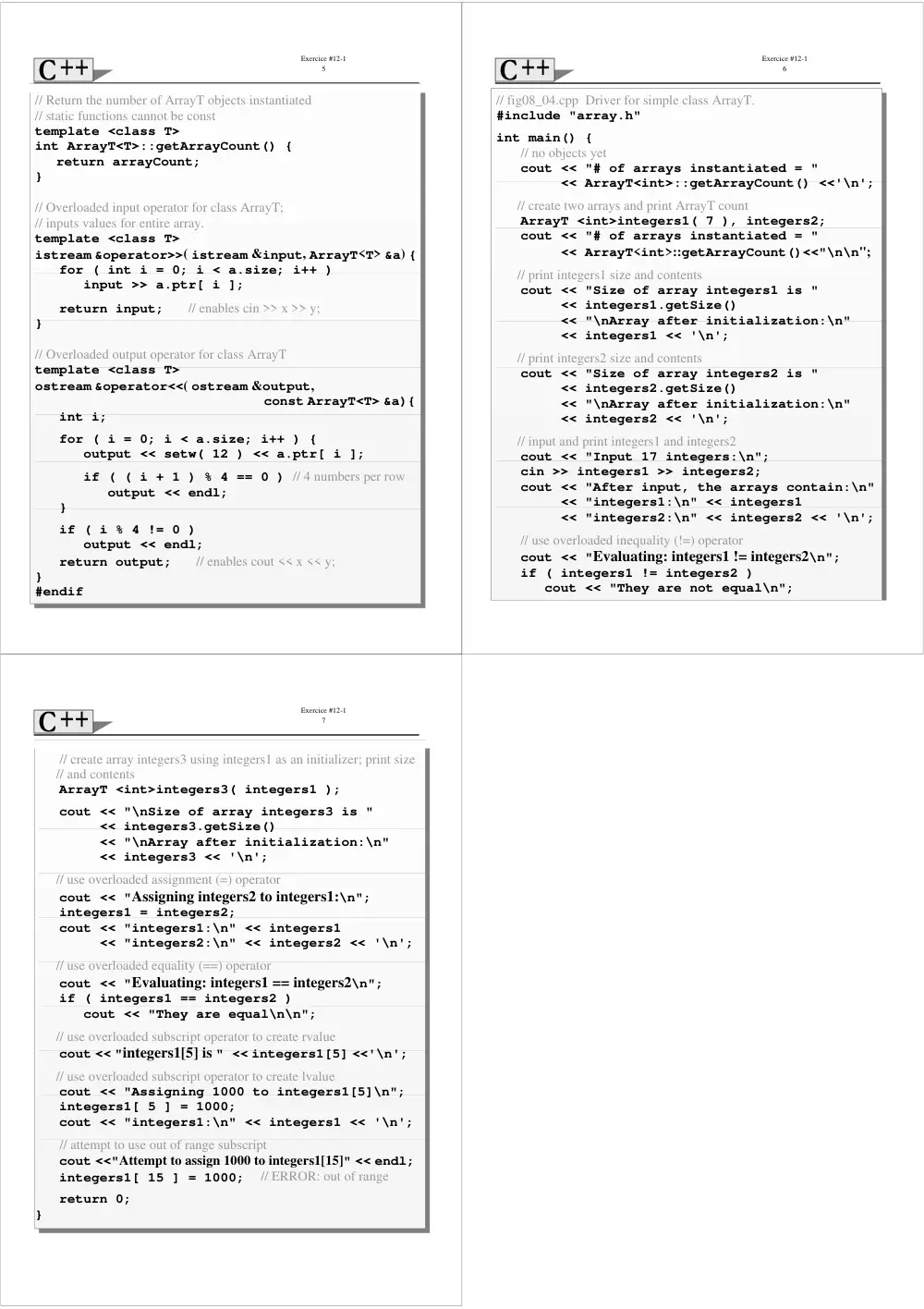
// Return the number of ArrayT objects instantiated
// static functions cannot be const
template <class T>
int ArrayT<T>::getArrayCount() {
return arrayCount;
}
// Overloaded input operator for class ArrayT;
// inputs values for entire array.
template <class T>
istream &operator>>( istream &input, ArrayT<T> &a) {
for ( int i = 0; i < a.size; i++ )
input >> a.ptr[ i ];
return input; // enables cin >> x >> y;
}
// Overloaded output operator for class ArrayT
template <class T>
ostream &operator<<( ostream &output,
const ArrayT<T> &a){
int i;
for ( i = 0; i < a.size; i++ ) {
output << setw( 12 ) << a.ptr[ i ];
if ( ( i + 1 ) % 4 == 0 ) // 4 numbers per row
output << endl;
}
if ( i % 4 != 0 )
output << endl;
return output; // enables cout << x << y;
}
#endif
Exercice #12-1
6
// fig08_04.cpp Driver for simple class ArrayT.
#include "array.h"
int main() {
// no objects yet
cout << "# of arrays instantiated = "
<< ArrayT<int>::getArrayCount() <<'\n';
// create two arrays and print ArrayT count
ArrayT <int>integers1( 7 ), integers2;
cout << "# of arrays instantiated = "
<< ArrayT<int>::getArrayCount()<<"\n\n";
// print integers1 size and contents
cout << "Size of array integers1 is "
<< integers1.getSize()
<< "\nArray after initialization:\n"
<< integers1 << '\n';
// print integers2 size and contents
cout << "Size of array integers2 is "
<< integers2.getSize()
<< "\nArray after initialization:\n"
<< integers2 << '\n';
// input and print integers1 and integers2
cout << "Input 17 integers:\n";
cin >> integers1 >> integers2;
cout << "After input, the arrays contain:\n"
<< "integers1:\n" << integers1
<< "integers2:\n" << integers2 << '\n';
// use overloaded inequality (!=) operator
cout << "Evaluating: integers1 != integers2\n";
if ( integers1 != integers2 )
cout << "They are not equal\n";
Exercice #12-1
7
// create array integers3 using integers1 as an initializer; print size
// and contents
ArrayT <int>integers3( integers1 );
cout << "\nSize of array integers3 is "
<< integers3.getSize()
<< "\nArray after initialization:\n"
<< integers3 << '\n';
// use overloaded assignment (=) operator
cout << "Assigning integers2 to integers1:\n";
integers1 = integers2;
cout << "integers1:\n" << integers1
<< "integers2:\n" << integers2 << '\n';
// use overloaded equality (==) operator
cout << "Evaluating: integers1 == integers2\n";
if ( integers1 == integers2 )
cout << "They are equal\n\n";
// use overloaded subscript operator to create rvalue
cout << "integers1[5] is " << integers1[5] <<'\n';
// use overloaded subscript operator to create lvalue
cout << "Assigning 1000 to integers1[5]\n";
integers1[ 5 ] = 1000;
cout << "integers1:\n" << integers1 << '\n';
// attempt to use out of range subscript
cout <<"Attempt to assign 1000 to integers1[15]" << endl;
integers1[ 15 ] = 1000; // ERROR: out of range
return 0;
}