
CSC 213 Problems Sec 12.2, Fall 2007
Notre Dame University–Louaize · Program Design and Data Abstraction II · 3 pages
More CSC 213 files
- Problems Assignment 1 · Fall 2012ProblemsView
- Problems Assignment 2 · Fall 2012ProblemsView
- Problems Sec 10 · Fall 2007ProblemsView
- Problems Sec 14 · Fall 2007ProblemsView
- Problems Sec 12.1 · Fall 2007ProblemsView
- Problems Sec 7.1 · Fall 2007ProblemsView
- Problems Sec 7 · Fall 2007ProblemsView
- Problems Sec 6 · Fall 2007ProblemsView
Show the text of this problems
Exercice #12-2
1
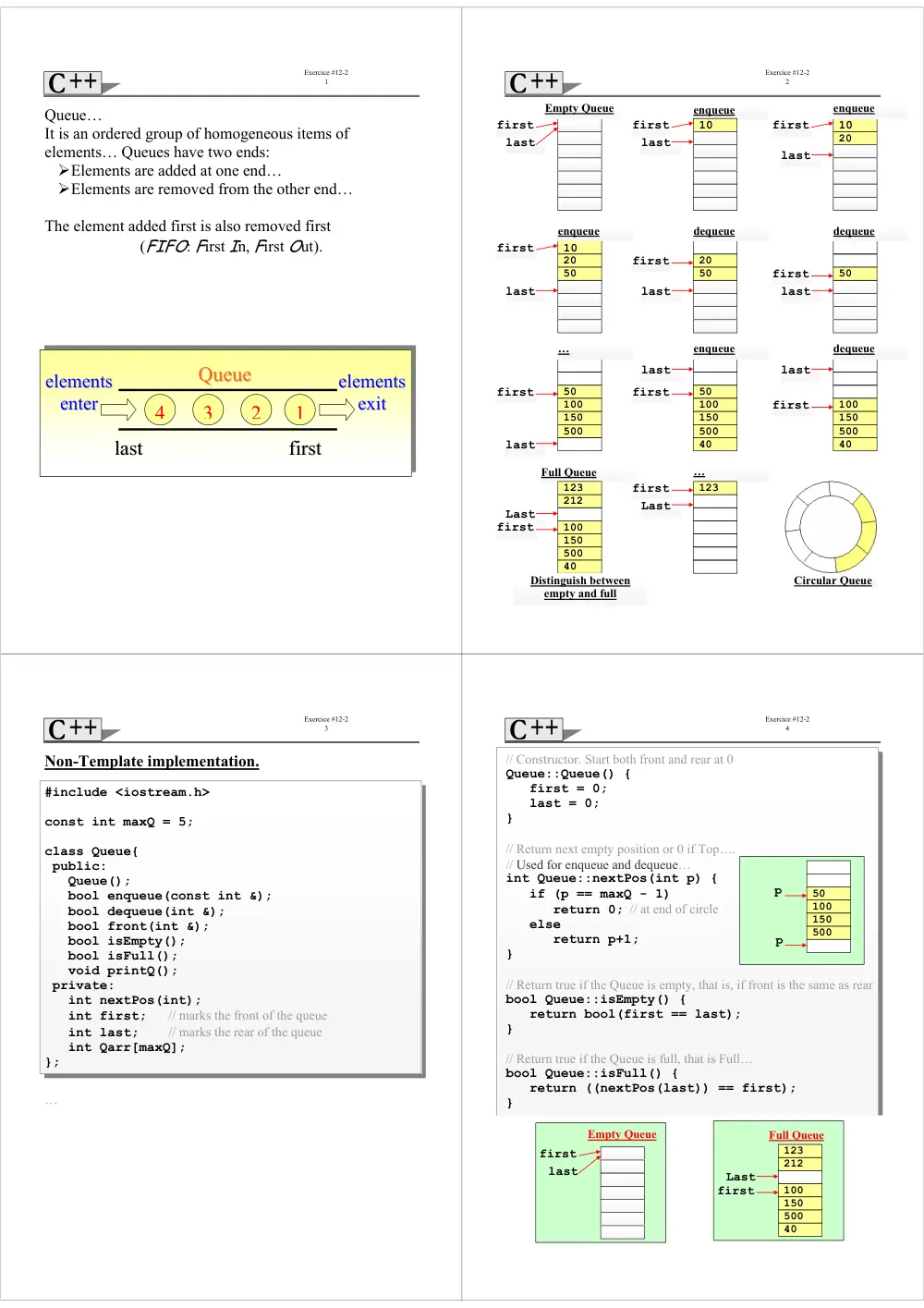
Queue…
It is an ordered group of homogeneous items of
elements… Queues have two ends:
� Elements are added at one end…
� Elements are removed from the other end…
The element added first is also removed first
(FIFO: First In, First Out).
QQuueeuuee
eelleem
meennttss
eenntteerr
eelleem
meennttss
eexxiitt
2
3
4
1
llaasstt
ffiirrsstt
Exercice #12-2
2
last
first
Empty Queue
enqueue
10
last
first
10
20
last
first
enqueue
10
20
last
first
enqueue
50
20
last
first
dequeue
50
last
first
dequeue
50
last
first
…
50
100
150
500
last
first
enqueue
50
100
150
500
40
last
first
dequeue
100
150
500
40
212
Last
first
Full Queue
100
150
500
40
123
Last
first
…
123
Circular Queue
Distinguish between
empty and full
Exercice #12-2
3
Non-Template implementation.
#include <iostream.h>
const int maxQ = 5;
class Queue{
public:
Queue();
bool enqueue(const int &);
bool dequeue(int &);
bool front(int &);
bool isEmpty();
bool isFull();
void printQ();
private:
int nextPos(int);
int first;
// marks the front of the queue
int last;
// marks the rear of the queue
int Qarr[maxQ];
};
…
Exercice #12-2
4
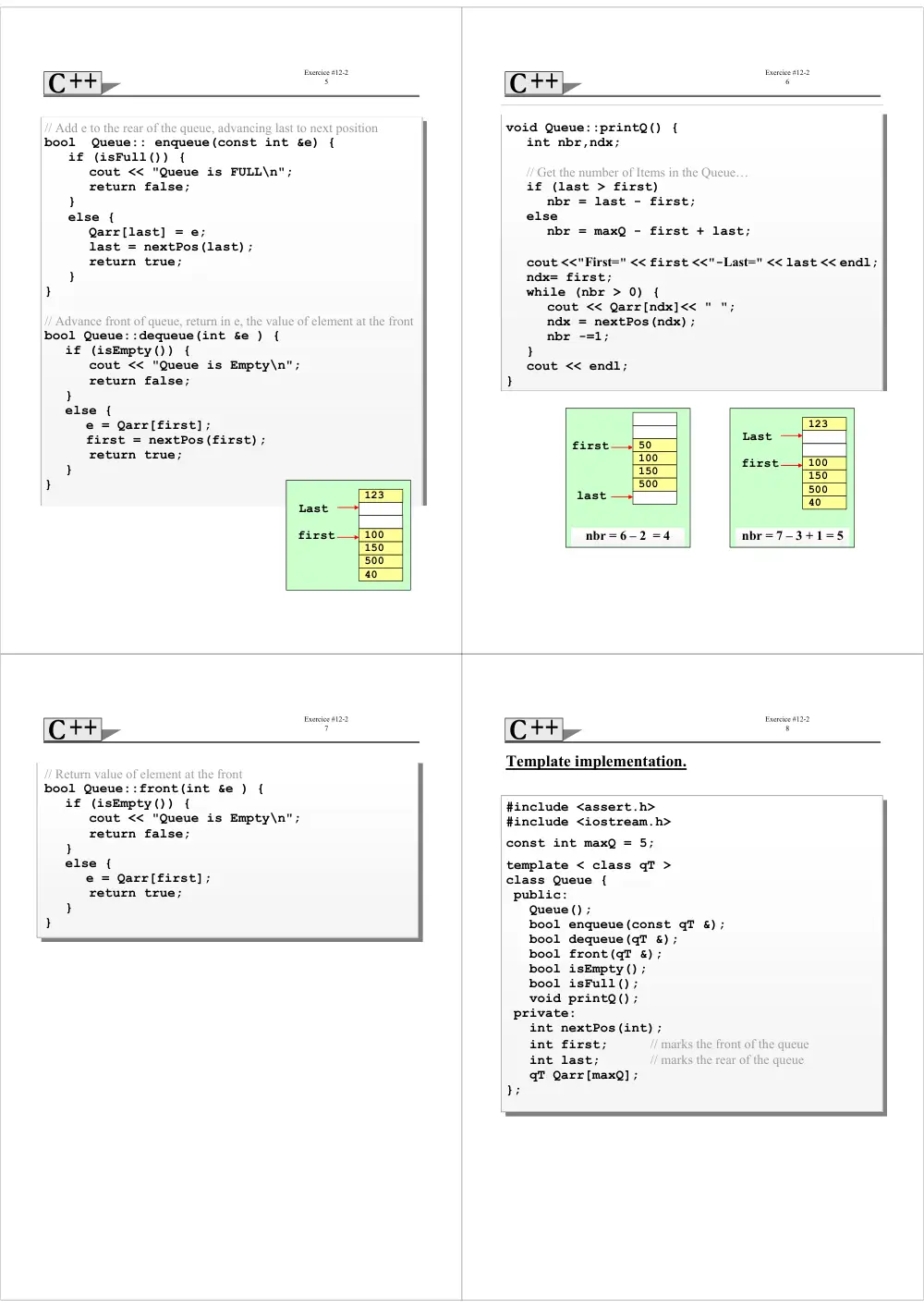
// Constructor. Start both front and rear at 0
Queue::Queue() {
first = 0;
last = 0;
}
// Return next empty position or 0 if Top….
// Used for enqueue and dequeue…
int Queue::nextPos(int p) {
if (p == maxQ - 1)
return 0; // at end of circle
else
return p+1;
}
// Return true if the Queue is empty, that is, if front is the same as rear
bool Queue::isEmpty() {
return bool(first == last);
}
// Return true if the Queue is full, that is Full…
bool Queue::isFull() {
return ((nextPos(last)) == first);
}
last
first
Empty Queue
212
Last
first
Full Queue
100
150
500
40
123
p
50
100
150
500
p
Exercice #12-2
5
// Add e to the rear of the queue, advancing last to next position
bool Queue:: enqueue(const int &e) {
if (isFull()) {
cout << "Queue is FULL\n";
return false;
}
else {
Qarr[last] = e;
last = nextPos(last);
return true;
}
}
// Advance front of queue, return in e, the value of element at the front
bool Queue::dequeue(int &e ) {
if (isEmpty()) {
cout << "Queue is Empty\n";
return false;
}
else {
e = Qarr[first];
first = nextPos(first);
return true;
}
}
Last
first
100
150
500
40
123
Exercice #12-2
6
void Queue::printQ() {
int nbr,ndx;
// Get the number of Items in the Queue…
if (last > first)
nbr = last - first;
else
nbr = maxQ - first + last;
cout <<"First=" << first <<"-Last=" << last << endl;
ndx= first;
while (nbr > 0) {
cout << Qarr[ndx]<< " ";
ndx = nextPos(ndx);
nbr -=1;
}
cout << endl;
}
last
first
50
100
150
500
nbr = 6 – 2 = 4
Last
first
100
150
500
40
123
nbr = 7 – 3 + 1 = 5
Exercice #12-2
7
// Return value of element at the front
bool Queue::front(int &e ) {
if (isEmpty()) {
cout << "Queue is Empty\n";
return false;
}
else {
e = Qarr[first];
return true;
}
}
Exercice #12-2
8
Template implementation.
#include <assert.h>
#include <iostream.h>
const int maxQ = 5;
template < class qT >
class Queue {
public:
Queue();
bool enqueue(const qT &);
bool dequeue(qT &);
bool front(qT &);
bool isEmpty();
bool isFull();
void printQ();
private:
int nextPos(int);
int first;
// marks the front of the queue
int last;
// marks the rear of the queue
qT Qarr[maxQ];
};
Exercice #12-2
9
// Constructor. Start both front and rear at 0
template < class qT >
Queue < qT >::Queue() {
first = 0;
last = 0;
}
// add e to the rear of the queue, advancing last to next position
template < class qT >
bool Queue< qT > :: enqueue(const qT &e) {
if (isFull()) {
cout << "Queue is FULL\n";
return false;
}
else {
Qarr[last] = e;
last = nextPos(last);
return true;
}
}
// Advance front of queue, return in e, the value of element at the front
template < class qT >
bool Queue < qT >::dequeue(qT &e ) {
if (isEmpty()) {
cout << "Queue is Empty\n";
return false;
}
else {
e = Qarr[first];
first = nextPos(first);
return true;
}
}
Exercice #12-2
10
// Return value of element at the front
template < class qT >
bool Queue < qT >::front(qT &e ) {
if (isEmpty()) {
cout << "Queue is Empty\n";
return false;
}
else {
e = Qarr[first];
return true;
}
}
// Return true if the Queue is empty, that is, if front is the same as rear
template < class qT >
bool Queue < qT >::isEmpty() {
return bool(first == last);
}
// Return true if the Queue is full, that is Full…
template < class qT >
bool Queue < qT >::isFull() {
return ((nextPos(last)) == first);
}
Exercice #12-2
11
// Return next empty position or 0 if full.
template < class qT >
int Queue < qT >::nextPos(int p) {
if (p == maxQ - 1)
return 0;
// at end of circle
else
return p+1;
}
template < class qT >
void Queue < qT >::printQ() {
int nbr,ndx;
if (last > first)
nbr = last - first;
else
nbr = maxQ - first + last;
cout <<"First=" << first <<"-Last=" << last << endl;
ndx= first;
while (nbr > 0) {
cout << Qarr[ndx]<< " ";
ndx = nextPos(ndx);
nbr -=1;
}
cout << endl;
}
Exercice #12-2
12
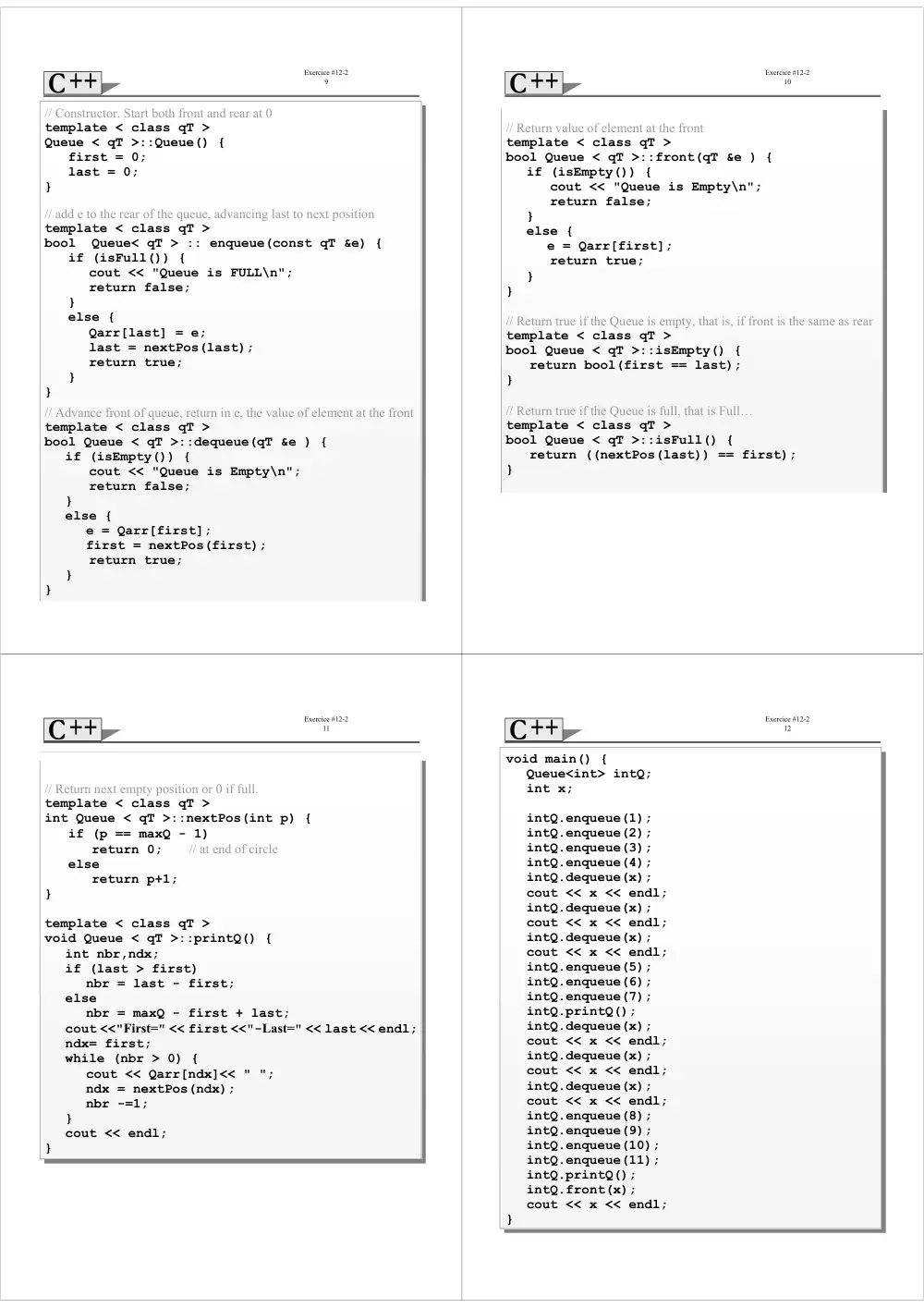
void main() {
Queue<int> intQ;
int x;
intQ.enqueue(1);
intQ.enqueue(2);
intQ.enqueue(3);
intQ.enqueue(4);
intQ.dequeue(x);
cout << x << endl;
intQ.dequeue(x);
cout << x << endl;
intQ.dequeue(x);
cout << x << endl;
intQ.enqueue(5);
intQ.enqueue(6);
intQ.enqueue(7);
intQ.printQ();
intQ.dequeue(x);
cout << x << endl;
intQ.dequeue(x);
cout << x << endl;
intQ.dequeue(x);
cout << x << endl;
intQ.enqueue(8);
intQ.enqueue(9);
intQ.enqueue(10);
intQ.enqueue(11);
intQ.printQ();
intQ.front(x);
cout << x << endl;
}