
ECN 212 Problems, Fall 2008
Notre Dame University–Louaize · Principles of Macroeconomics · 80 pages


Showing the first 10 of 80 pages. Download the PDF to see all of it.
More ECN 212 files
- Problems with Some Answers · Fall 2008Problems · with solutionView
- Problems with Solution · Fall 2008Problems · with solutionView
- Problems with Answers · Fall 2008Problems · with solutionView
- Problems For Book Principles of Macroeconomics Case · Fall 2008ProblemsView
- Problems · Fall 2008ProblemsView
- Problems Quest.&Answ. Chapter 5 Introduction to Macroeconomics · Spring 2012ChapterView
- Exam 1 with Solution · Fall 2008Exam · with solutionView
- Other · Fall 2008FileView
Show the text of this problems
Chapter 9 The Government and Fiscal Policy
Principles of Macroeconomics, Case/Fair, 8e
9.1 Government in the Economy
Multiple Choice
1)
Fiscal policy refers to
A)
the techniques used by a business firm to reduce its tax liability.
B)
the behavior of the nation's central bank, the Federal Reserve, regarding the nation's money supply.
C)
the spending and taxing policies used by the government to influence the economy.
D)
the government's ability to regulate a firm's behavior in the financial markets.
Answer:
C
Diff: 1
Skill: D
2)
Which of the following is NOT a category of fiscal policy?
A)
Government policies regarding the purchase of goods and services
B)
Government policies regarding taxation
C)
Government policies regarding money supply in the economy
D)
Government policies regarding transfer payments and welfare benefits
Answer:
C
Diff: 1
Skill: F
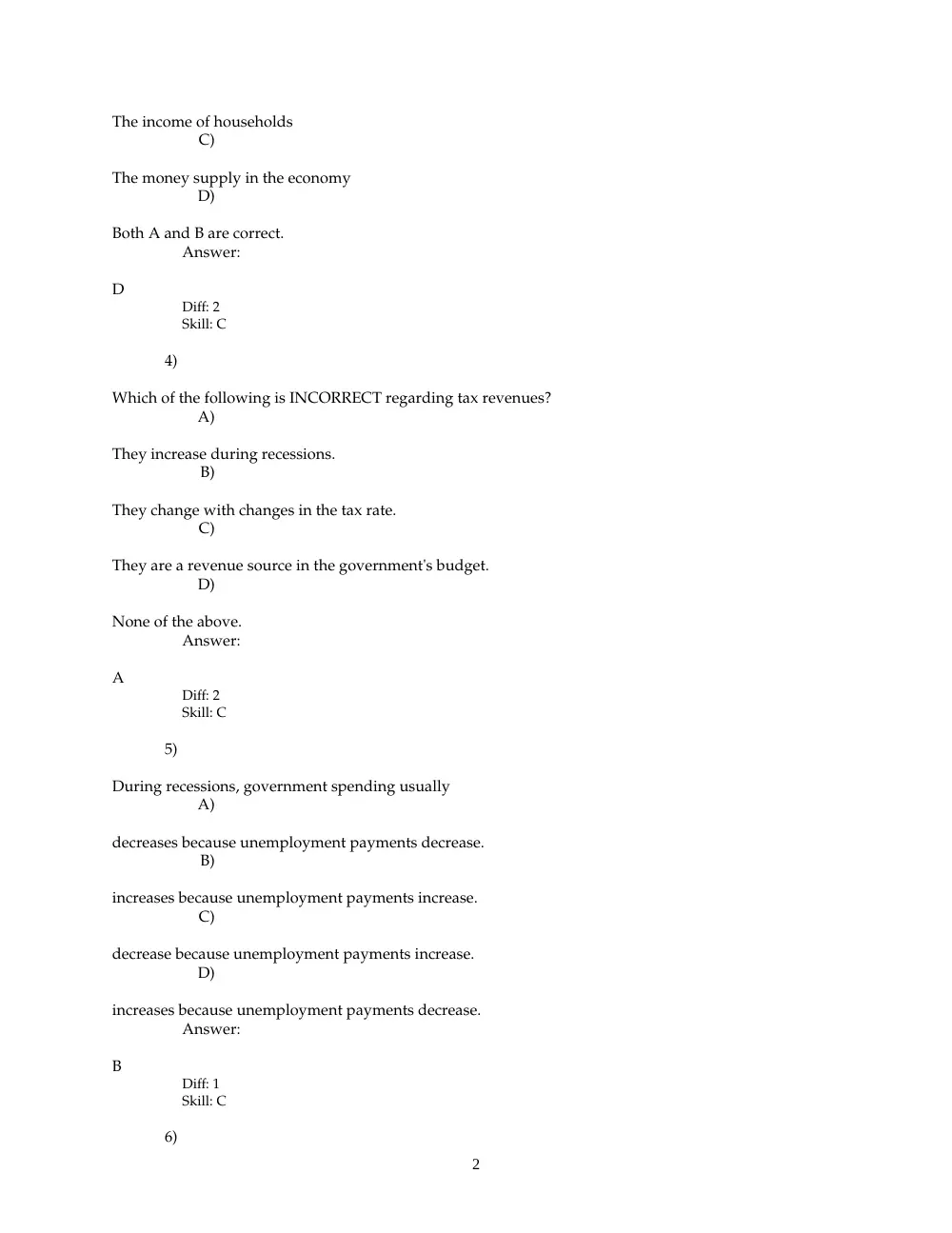
3)
What determines tax revenues?
A)
The income tax rate
B)
1
The income of households
C)
The money supply in the economy
D)
Both A and B are correct.
Answer:
D
Diff: 2
Skill: C
4)
Which of the following is INCORRECT regarding tax revenues?
A)
They increase during recessions.
B)
They change with changes in the tax rate.
C)
They are a revenue source in the government's budget.
D)
None of the above.
Answer:
A
Diff: 2
Skill: C
5)
During recessions, government spending usually
A)
decreases because unemployment payments decrease.
B)
increases because unemployment payments increase.
C)
decrease because unemployment payments increase.
D)
increases because unemployment payments decrease.
Answer:
B
Diff: 1
Skill: C
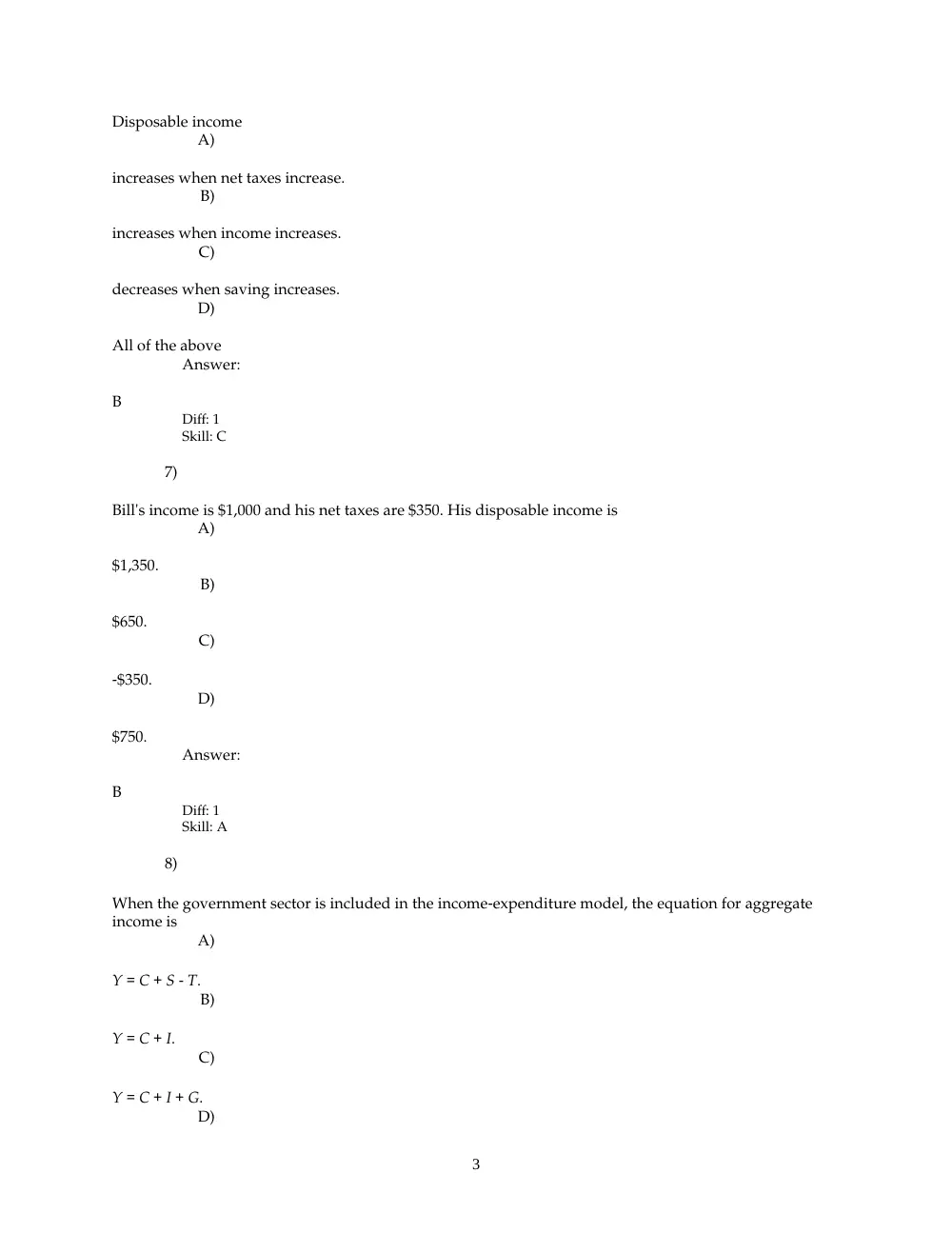
6)
2
Disposable income
A)
increases when net taxes increase.
B)
increases when income increases.
C)
decreases when saving increases.
D)
All of the above
Answer:
B
Diff: 1
Skill: C
7)
Bill's income is $1,000 and his net taxes are $350. His disposable income is
A)
$1,350.
B)
$650.
C)
-$350.
D)
$750.
Answer:
B
Diff: 1
Skill: A
8)
When the government sector is included in the income-expenditure model, the equation for aggregate
income is
A)
Y = C + S - T.
B)
Y = C + I.
C)
Y = C + I + G.
D)
3
Y = C + S + I.
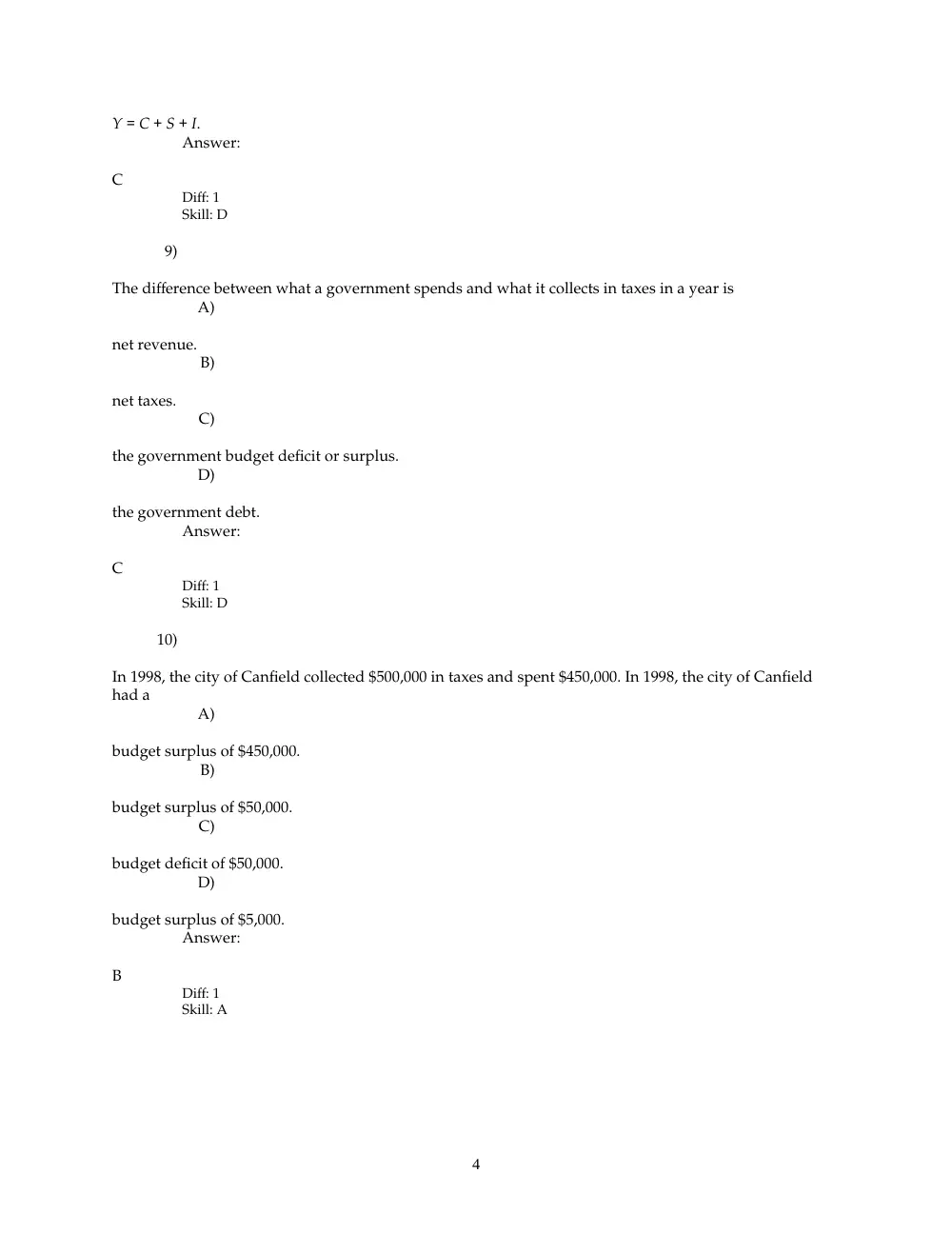
Answer:
C
Diff: 1
Skill: D
9)
The difference between what a government spends and what it collects in taxes in a year is
A)
net revenue.
B)
net taxes.
C)
the government budget deficit or surplus.
D)
the government debt.
Answer:
C
Diff: 1
Skill: D
10)
In 1998, the city of Canfield collected $500,000 in taxes and spent $450,000. In 1998, the city of Canfield
had a
A)
budget surplus of $450,000.
B)
budget surplus of $50,000.
C)
budget deficit of $50,000.
D)
budget surplus of $5,000.
Answer:
B
Diff: 1
Skill: A
4
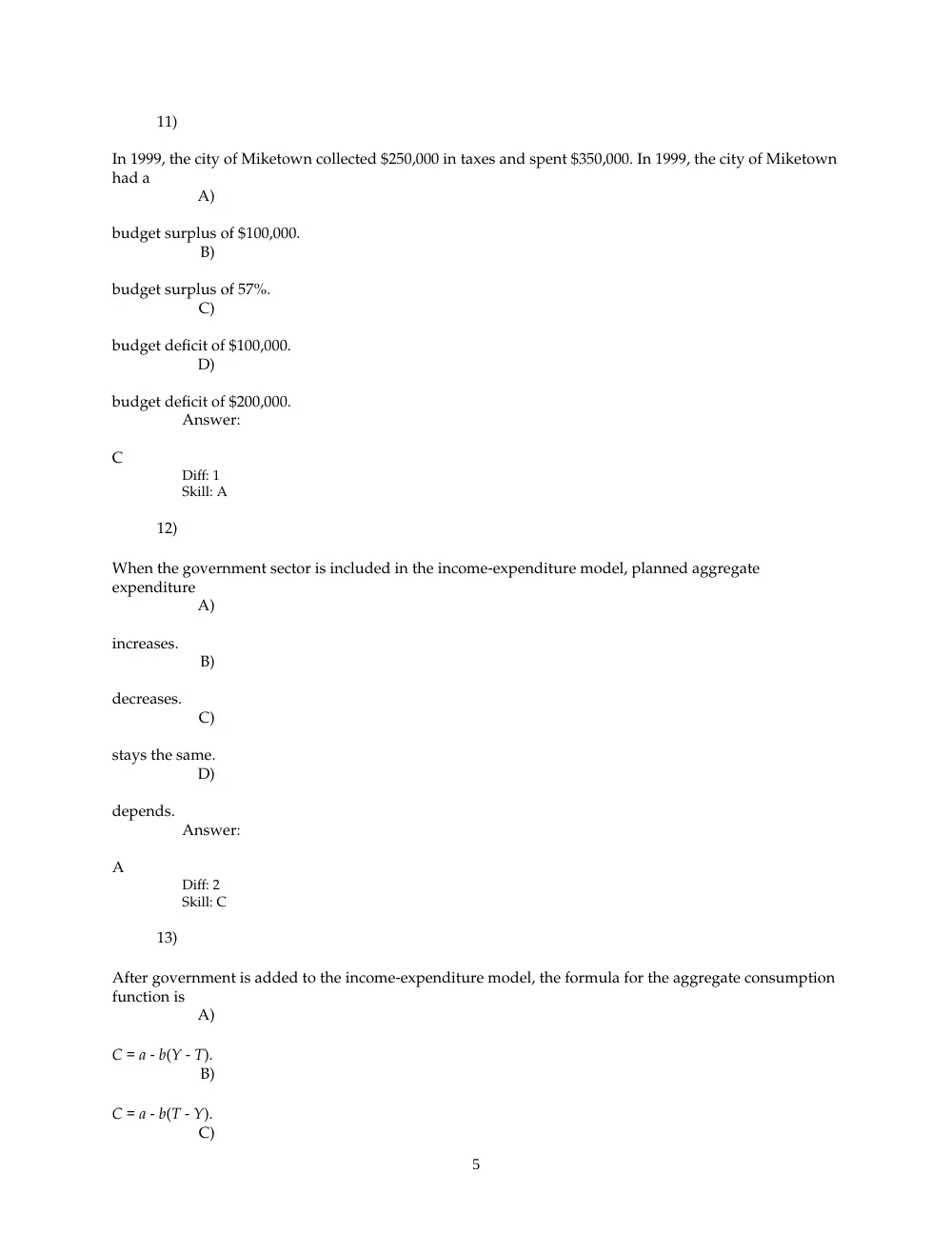
11)
In 1999, the city of Miketown collected $250,000 in taxes and spent $350,000. In 1999, the city of Miketown
had a
A)
budget surplus of $100,000.
B)
budget surplus of 57%.
C)
budget deficit of $100,000.
D)
budget deficit of $200,000.
Answer:
C
Diff: 1
Skill: A
12)
When the government sector is included in the income-expenditure model, planned aggregate
expenditure
A)
increases.
B)
decreases.
C)
stays the same.
D)
depends.
Answer:
A
Diff: 2
Skill: C
13)
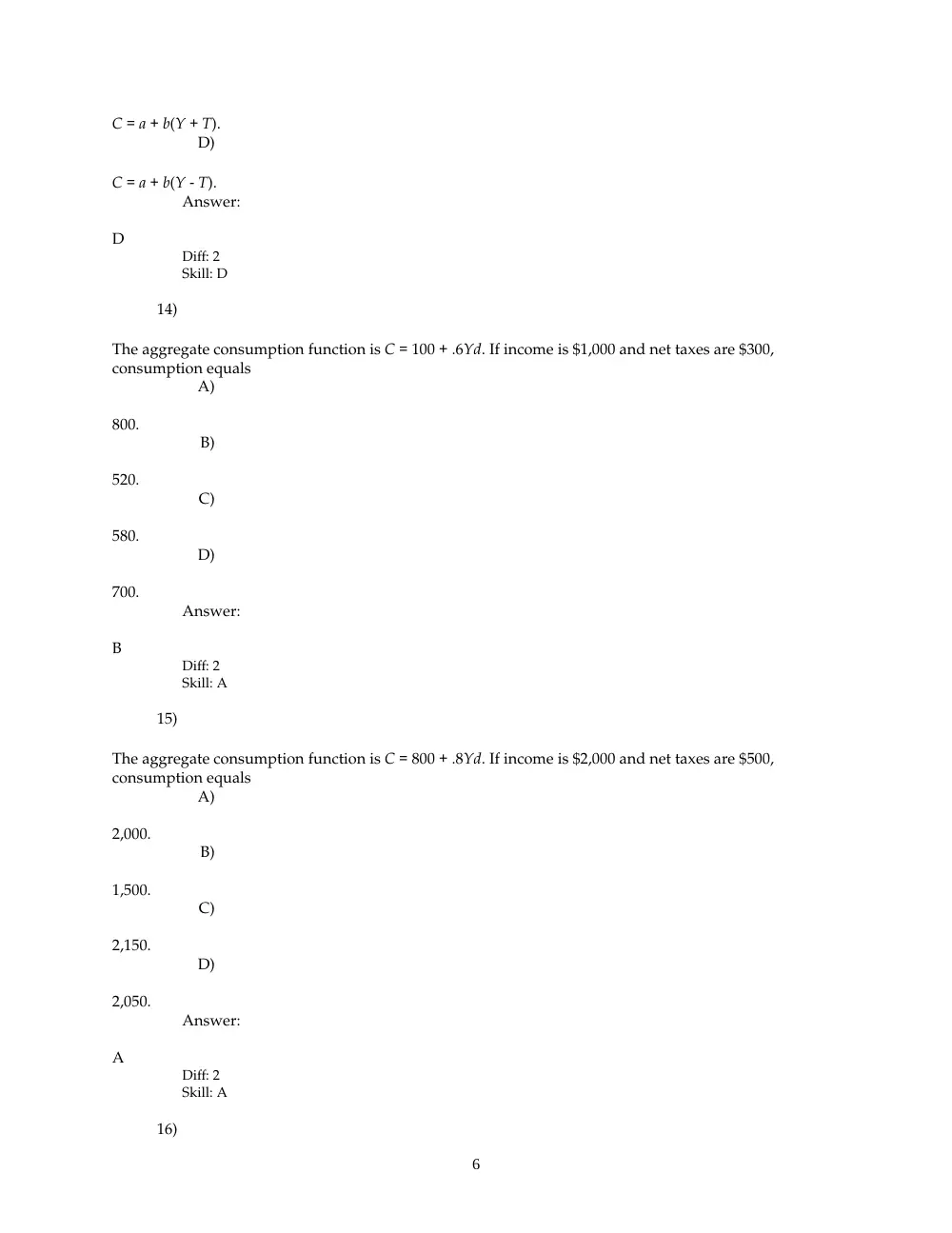
After government is added to the income-expenditure model, the formula for the aggregate consumption
function is
A)
C = a - b(Y - T).
B)
C = a - b(T - Y).
C)
5
C = a + b(Y + T).
D)
C = a + b(Y - T).
Answer:
D
Diff: 2
Skill: D
14)
The aggregate consumption function is C = 100 + .6Yd. If income is $1,000 and net taxes are $300,
consumption equals
A)
800.
B)
520.
C)
580.
D)
700.
Answer:
B
Diff: 2
Skill: A
15)
The aggregate consumption function is C = 800 + .8Yd. If income is $2,000 and net taxes are $500,
consumption equals
A)
2,000.
B)
1,500.
C)
2,150.
D)
2,050.
Answer:
A
Diff: 2
Skill: A
16)
6
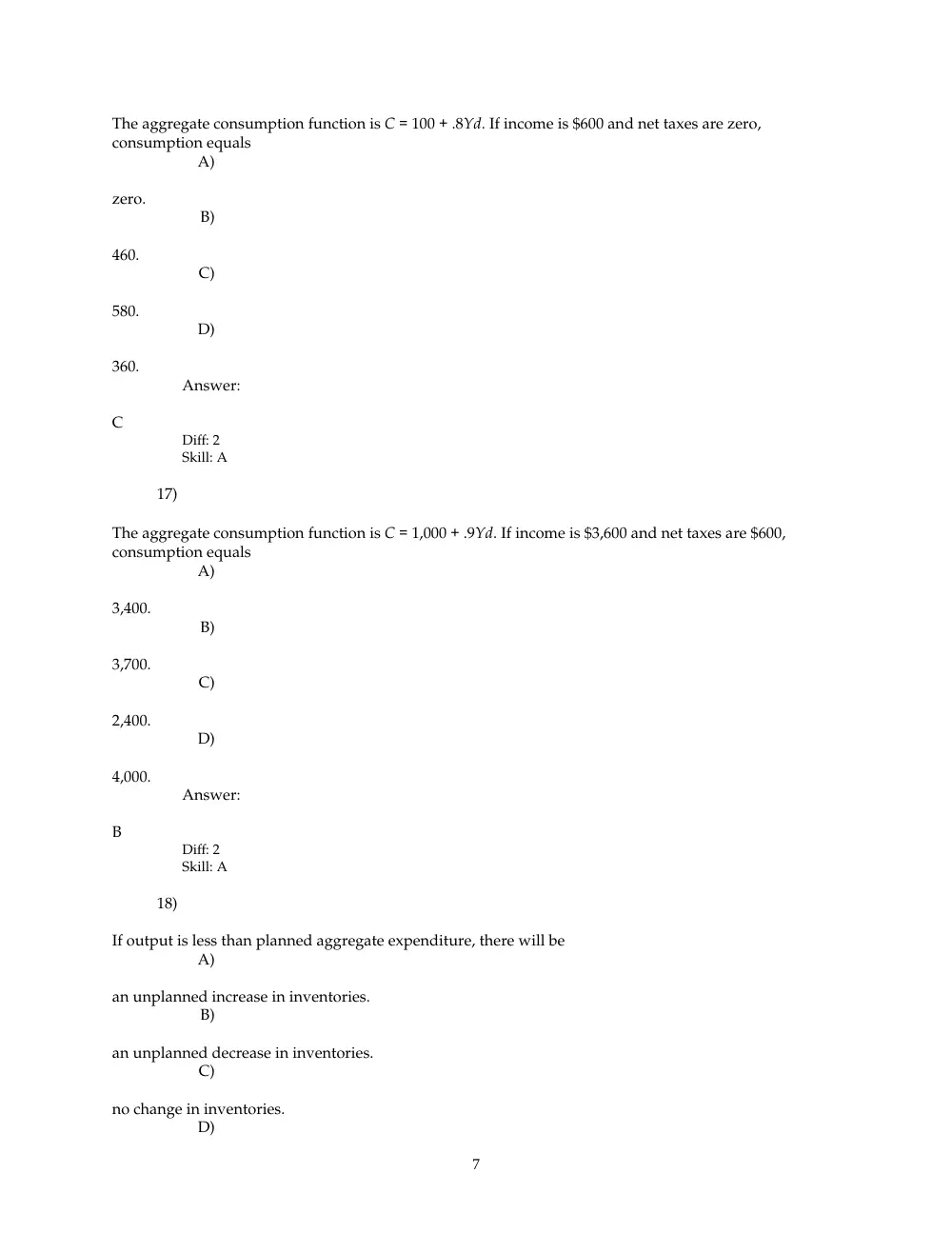
The aggregate consumption function is C = 100 + .8Yd. If income is $600 and net taxes are zero,
consumption equals
A)
zero.
B)
460.
C)
580.
D)
360.
Answer:
C
Diff: 2
Skill: A
17)
The aggregate consumption function is C = 1,000 + .9Yd. If income is $3,600 and net taxes are $600,
consumption equals
A)
3,400.
B)
3,700.
C)
2,400.
D)
4,000.
Answer:
B
Diff: 2
Skill: A
18)
If output is less than planned aggregate expenditure, there will be
A)
an unplanned increase in inventories.
B)
an unplanned decrease in inventories.
C)
no change in inventories.
D)
7
a planned increase in inventories.
Answer:
B
Diff: 2
Skill: C
Refer to the information provided in Table 9.1 below to answer the questions that follow.
Table 9.1
19)
Refer to Table 9.1. At an output level of $600 billion, the level of aggregate expenditure is
A)
$500 billion.
B)
$600 billion.
C)
$700 billion.
D)
$900 billion.
Answer:
C
Diff: 1
Skill: A
20)
Refer to Table 9.1. At an output level of $600 billion, there is an unplanned inventory change of
A)
positive $10 billion.
B)
zero.
C)
negative $100 billion.
D)
positive $100 billion.
8
Answer:
C
Diff: 2
Skill: A
21)
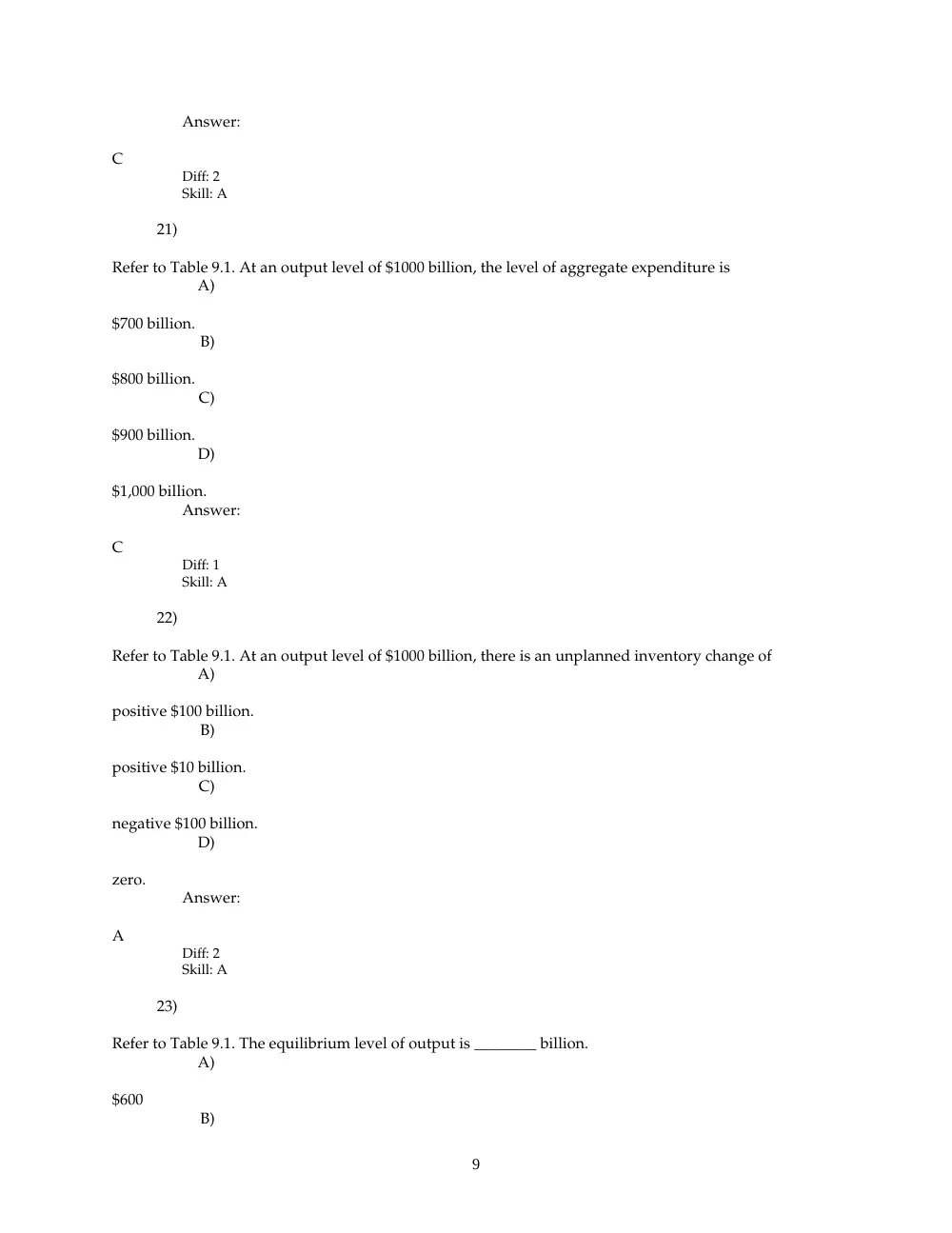
Refer to Table 9.1. At an output level of $1000 billion, the level of aggregate expenditure is
A)
$700 billion.
B)
$800 billion.
C)
$900 billion.
D)
$1,000 billion.
Answer:
C
Diff: 1
Skill: A
22)
Refer to Table 9.1. At an output level of $1000 billion, there is an unplanned inventory change of
A)
positive $100 billion.
B)
positive $10 billion.
C)
negative $100 billion.
D)
zero.
Answer:
A
Diff: 2
Skill: A
23)
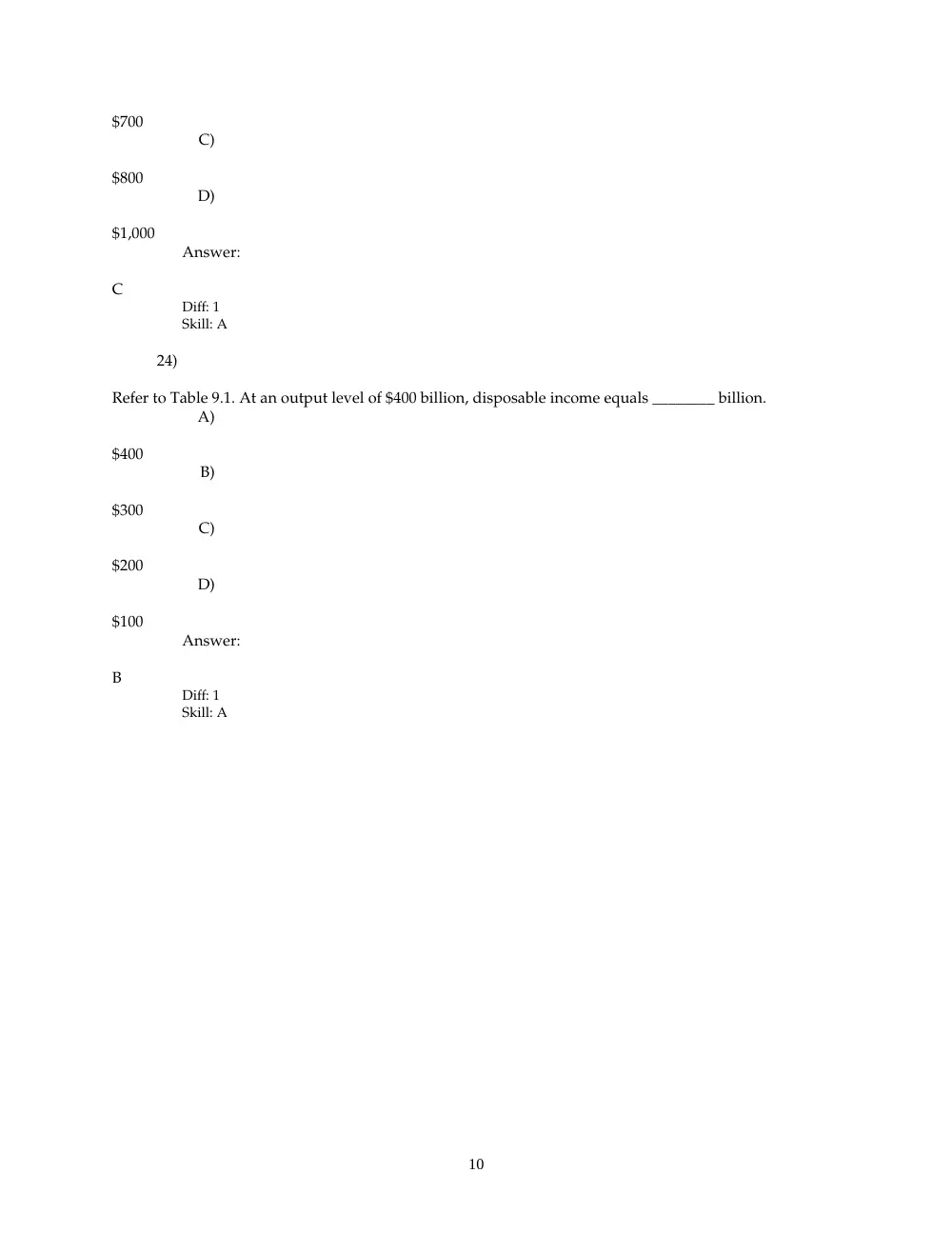
Refer to Table 9.1. The equilibrium level of output is ________ billion.
A)
$600
B)
9
$700
C)
$800
D)
$1,000
Answer:
C
Diff: 1
Skill: A
24)
Refer to Table 9.1. At an output level of $400 billion, disposable income equals ________ billion.
A)
$400
B)
$300
C)
$200
D)
$100
Answer:
B
Diff: 1
Skill: A
10
25)
Refer to Table 9.1. At an output level of $1,000 billion, the value of saving
A)
cannot be determined from the given information.
B)
is $300 billion.
C)
is $200 billion.
D)
is $100 billion.
Answer:
B
Diff: 2
Skill: A
26)
Refer to Table 9.1. At the equilibrium level of income, leakages equal ________ billion.
A)
$0
B)
$100
C)
$200
D)
$300
Answer:
D
Diff: 3
Skill: A
27)
Refer to Table 9.1 At an output level of $600 billion, there is a tendency for output
A)
to fall.
B)
to increase.
C)
to remain constant.
D)
11
to either increase or decrease.
Answer:
B
Diff: 3
Skill: A
Refer to the information provided in Table 9.2 below to answer the questions that follow.
Table 9.2
28)
Refer to Table 9.2. At an output level of $1,500 billion, the level of aggregate expenditure is ________
billion.
A)
$1,300
B)
$1,400
C)
$1,500
D)
$1,600
Answer:
B
Diff: 1
Skill: A
29)
Refer to Table 9.2. At an output level of $1,500 billion, there is an unplanned inventory
A)
decrease of $200 billion.
B)
change of $0.
C)
increase of $100 billion.
D)
12
increase of $150 billion.
Answer:
C
Diff: 2
Skill: A
30)
Refer to Table 9.2. At an output level of $2,500, the level of aggregate expenditure is ________ billion.
A)
$1,500
B)
$2,000
C)
$2,300
D)
$2,200
Answer:
D
Diff: 1
Skill: A
31)
Refer to Table 9.2. At an output level of $2,500, there is an unplanned inventory
A)
increase of $300 billion.
B)
decrease of $200 billion.
C)
change of $0.
D)
increase of $200 billion.
Answer:
A
Diff: 2
Skill: A
32)
Refer to Table 9.2. The equilibrium level of output is ________ billion.
A)
$1000
B)
13
$1,500
C)
$2,000
D)
$2,500
Answer:
A
Diff: 1
Skill: A
33)
Refer to Table 9.2. At an output level of $1,500, disposable income
A)
is $1,000.
B)
is $1,200.
C)
is $1,400.
D)
cannot be determined from this information.
Answer:
C
Diff: 1
Skill: A
14
34)
Refer to Table 9.2. At an output level of $2,500, the level for saving
A)
is $300.
B)
is $400.
C)
is $500.
D)
cannot be determined from this information.
Answer:
B
Diff: 2
Skill: A
35)
Refer to Table 9.2 At the equilibrium level of income, leakages equal ________ billion.
A)
$0
B)
$300
C)
$500
D)
$200
Answer:
D
Diff: 3
Skill: A
36)
Refer to Table 9.2. At an output level of $2,500, there is a tendency for output
A)
to increase.
B)
to remain constant.
C)
to either increase or decrease.
D)
15
to fall.
Answer:
D
Diff: 2
Skill: A
The Italian economy can be characterized by Equation 9.1.
EQUATION 9.1:
C = 200 + .75Yd
G = 500
T = 200
I = 200
37)
Refer to Equation 9.1. The equilibrium level of output for the Italian economy is
A)
$2,533.3.
B)
$3,000.
C)
$2,678.9.
D)
$3,500.
Answer:
B
Diff: 2
Skill: A
16
38)
Refer to Equation 9.1. At the equilibrium level of output in Italy, consumption equals
A)
$2,300.
B)
$2,500.
C)
$1,833.3.
D)
$2,010.2
Answer:
A
Diff: 2
Skill: A
39)
Refer to Equation 9.1. At the equilibrium level of output in Italy, saving equals
A)
$450.
B)
$400.
C)
$550.
D)
$500.
Answer:
D
Diff: 3
Skill: A
40)
Refer to Equation 9.1. At the equilibrium level of output in Italy, leakages equal
A)
$650.
B)
$600.
C)
$750.
D)
17
$700.
Answer:
D
Diff: 3
Skill: A
The Canadian economy can be characterized by Equation 9.2.
EQUATION 9.2:
C = 500 + .5Yd
Taxes = 600
Equilibrium Output = $4,000
41)
Refer to Equation 9.2. At equilibrium, the sum of investment and government purchases in Canada is
A)
$1,800.
B)
$1,500.
C)
$1,750.
D)
cannot be determined from the given information.
Answer:
A
Diff: 3
Skill: A
18
42)
Refer to Equation 9.2. At equilibrium, government purchases in Canada is
A)
$1,500.
B)
$1,000.
C)
$1,250.
D)
Cannot be determined from the given information.
Answer:
D
Diff: 3
Skill: A
43)
Refer to Equation 9.2. At equilibrium, saving in Canada equals
A)
$1,200.
B)
$1,600.
C)
$1,350.
D)
$1,250.
Answer:
A
Diff: 3
Skill: A
44)
Refer to Equation 9.2. At equilibrium leakages in Canada equal
A)
$1,750.
B)
$1,800.
C)
$2,100.
D)
19
$1,700.
Answer:
B
Diff: 3
Skill: A
45)
Assuming there is no foreign trade in the economy, the economy is in equilibrium when
A)
S + T = C + I.
B)
I + G = S + T.
C)
IT = S + G.
D)
G + T = S + I.
Answer:
B
Diff: 1
Skill: F
46)
Assuming there is no foreign trade in the economy, equilibrium is achieved when government purchases
equal
A)
saving minus net taxes minus consumption.
B)
saving plus net taxes minus investment.
C)
net taxes plus investment minus saving.
D)
net taxes minus investment minus saving.
Answer:
B
Diff: 1
Skill: F
20
Refer to the information provided in Figure 9.1 below to answer the questions that follow.
Figure 9.1
47)
Refer to Figure 9.1. The equilibrium level of aggregate expenditure is $________ billion.
A)
3,000
B)
2,000
C)
4,000
D)
1,500
Answer:
B
Diff: 1
Skill: A
48)
Refer to Figure 9.1. The MPC in this economy is
A)
0.4.
B)
0.6.
C)
0.5.
D)
Cannot be determined from the given information.
Answer:
C
21
Diff: 2
Skill: A
49)
Refer to Figure 9.1. At equilibrium, injections
A)
can be greater than $1,000 billion.
B)
equal $1,500 billion.
C)
equal leakages.
D)
equal $2,000 billion.
Answer:
C
Diff: 3
Skill: A
22
50)
Refer to Figure 9.1. At equilibrium, the part of consumption that is dependent on income equals
$________ billion.
A)
$1,500
B)
$1,000
C)
$2,000
D)
Cannot be determined from the given information.
Answer:
B
Diff: 2
Skill: A
51)
Refer to Figure 9.1. Suppose that the consumption function is C = 400 + 0.5Yd and taxes are $200 billion, at
equilibrium the value of injections are
A)
$700 billion.
B)
$500 billion.
C)
$650 billion.
D)
$350 billion.
Answer:
A
Diff: 3
Skill: A
52)
Refer to Figure 9.1. Suppose that the consumption function is C = 400 + 0.5Yd and taxes are $200 billion, at
equilibrium the value of autonomous consumption is
A)
$400 billion.
B)
$300 billion.
C)
23
$100 billion.
D)
$200 billion.
Answer:
B
Diff: 2
Skill: A
53)
Refer to Figure 9.1. Suppose that the consumption function is C = 400 + 0.5Yd and taxes are $200 billion, at
equilibrium, what is the value of consumption?
A)
$1,350
B)
$2,000
C)
$1,300
D)
$1,150
Answer:
C
Diff: 2
Skill: A
54)
If planned injections exceed leakages, output will
A)
decrease.
B)
increase.
C)
remain constant.
D)
either increase or decrease.
Answer:
B
Diff: 2
Skill: C
24
55)
For the economy to be in equilibrium,
A)
government purchases must equal tax revenue and saving must equal investment.
B)
government purchases must equal the sum of tax revenue, saving and investment.
C)
government purchases plus investment must equal saving plus tax revenue.
D)
investment plus tax revenue must equal government purchases plus saving.
Answer:
C
Diff: 1
Skill: F
True/False
1)
The economy is in equilibrium when aggregate output equals consumption spending.
Answer:
True
False
Diff: 1
Skill: D
2)
For the economy to be in equilibrium, the following condition must be satisfied: G + I = S + T.
Answer:
True
False
Diff: 1
Skill: D
3)
When investment is greater than planned investment, output grows.
Answer:
True
25
False
Diff: 2
Skill: C
4)
Disposable income is income less net taxes.
Answer:
True
False
Diff: 1
Skill: D
9.2 Fiscal Policy at Work: Multiplier Effect
Multiple Choice
1)
If the government wants to reduce unemployment, government purchases should be ________ and/or
taxes should be ________.
A)
increased; increased
B)
decreased; decreased
C)
decreased; increased
D)
increased; decreased
Answer:
D
Diff: 1
Skill: C
26
2)
The President of Vulcan hires you as an economic consultant. He is concerned that the output level in
Vulcan is too high and that this will cause prices to rise. He feels that it is necessary to reduce output by
$10 billion. He tells you that the MPC in Vulcan is .6. Which of the following would be the best advice to
give to the Vulcan president?
A)
Reduce government purchases in Vulcan by $4 billion.
B)
Increase taxes in Vulcan by $10 billion.
C)
Reduce government purchases in Vulcan by $10 billion.
D)
Increase taxes in Vulcan by $2.5 billion.
Answer:
A
Diff: 2
Skill: A
3)
The leader of Atlantis hires you as an economic consultant. He is concerned that the output level in
Atlantis is too low and that this will cause prices to fall. He feels that it is necessary to increase output by
$200 billion. He tells you that the MPC in Atlantis is .8. Which of the following would be the best advice
to give to the Atlantis president?
A)
Reduce government spending in Atlantis by $100 billion.
B)
Decease taxes in Atlantis by $50 billion.
C)
Increase government spending in Atlantis by $200 billion.
D)
Increase government spending in Atlantis by $100 billion.
Answer:
B
Diff: 2
Skill: A
Refer to the information provided in Table 9.3 below to answer the questions that follow.
Table 9.3
All Numbers are in $ Million
27
4)
Refer to Table 9.3. Assuming constant MPC, at income of $1,200 million, consumption is $________
million, and at income of $1,500 million, consumption is $________ million.
A)
800; 1,100
B)
790; 1,150
C)
840; 1,080
D)
900; 1,150
Answer:
C
Diff: 1
Skill: A
28
5)
Refer to Table 9.3. Assuming constant MPC, at income of $1,000 million, saving is $________ million, at
income of $1,100 million, saving is $________ million.
A)
100; 110
B)
120; 140
C)
130; 150
D)
140; 150
Answer:
B
Diff: 1
Skill: A
6)
Refer to Table 9.3. The MPC in this economy is ________ and the MPS is ________.
A)
0.5; 0.5
B)
0.7; 0.5
C)
0.9; 0.1
D)
0.8; 0.2
Answer:
D
Diff: 2
Skill: A
7)
Refer to Table 9.3. The equilibrium level of aggregate output is $________ million.
A)
1,200
B)
1,300
C)
1,400
D)
29
1,500
Answer:
C
Diff: 1
Skill: A
8)
Refer to Table 9.3. Which of the following variables is NOT considered autonomous?
A)
Saving
B)
Planned investment
C)
Planned government spending
D)
None of the above
Answer:
A
Diff: 1
Skill: A
9)
Refer to Table 9.3. Suppose the economy is in equilibrium and the government increases spending by $50
million, the new equilibrium output is $________ million
A)
1,650
B)
1,450
C)
1,750
D)
1,350
Answer:
A
Diff: 2
Skill: A
30
10)
Refer to Table 9.3. Suppose the economy is in equilibrium and the government raises taxes from $100
million to $120 million, equilibrium output will ________ by $________ million.
A)
decrease; 20
B)
increase; 20
C)
decrease; 80
D)
increase; 80
Answer:
C
Diff: 2
Skill: A
Refer to the information provided in Table 9.4 below to answer the questions that follow.
Table 9.4
All Figures in Billions of Dollars
11)
Refer to Table 9.4. The equilibrium level of income is
A)
$3400 billion.
B)
$3,800 billion.
C)
$2,000 billion.
D)
$3,600 billion.
Answer:
A
31
Diff: 1
Skill: A
12)
Refer to Table 9.4. The MPS
A)
is .8.
B)
is .1.
C)
is .2
D)
cannot be determined from the available information.
Answer:
B
Diff: 2
Skill: A
13)
Refer to Table 9.4. The value of the government spending multiplier
A)
is 10.
B)
is .9.
C)
is 5.
D)
Cannot be determined from the available information
Answer:
A
Diff: 2
Skill: A
14)
Refer to Table 9.4. The economy is at the equilibrium level of output. If government spending increases to
$400 billion, the new equilibrium level of output is
A)
$5,400 billion.
B)
$2,100 billion.
C)
32
$6,040 billion.
D)
$6,600 billion.
Answer:
A
Diff: 2
Skill: A
15)
Refer to Table 9.4. The economy is at the equilibrium level of output. If government spending decreases
by $100 billion, the new equilibrium level of output is
A)
$3,100 billion.
B)
$2,400 billion.
C)
$1,450 billion.
D)
$1,550 billion.
Answer:
B
Diff: 2
Skill: A
16)
Refer to Table 9.4. If taxes are reduced from $100 billion to $50 billion, the new equilibrium level of
output is
A)
$4,050 billion.
B)
$1,600 billion.
C)
$3,850 billion.
D)
$2,100 billion.
Answer:
C
Diff: 2
Skill: A
17)
33
Refer to Table 9.4. If taxes are reduced from $100 billion to $50 billion and government spending is
reduced from $200 billion to $150 billion, the new equilibrium level of income
A)
is $3,350 billion.
B)
is $3,550 billion.
C)
is $1,600 billion.
D)
cannot be determined from this information.
Answer:
A
Diff: 2
Skill: A
34
18)
The government purchases multiplier is
A)
the difference between the old equilibrium level of output and the new equilibrium level of output.
B)
the ratio of the change in government purchases to the change in the equilibrium level of output.
C)
the ratio of the change in the equilibrium level of output to a change in government purchases.
D)
the difference between the new and old levels of government purchases.
Answer:
C
Diff: 1
Skill: D
19)
The formula for the government spending multiplier is
A)
1/(1 + MPC).
B)
1/MPS.
C)
1/MPC.
D)
1/(1 + MPS).
Answer:
B
Diff: 1
Skill: D
20)
If the MPS is .2, the government spending multiplier is
A)
4.
B)
1.11.
C)
9.
D)
35
5.
Answer:
D
Diff: 1
Skill: F
21)
If the MPS is .1, the government spending multiplier is
A)
10.
B)
1.11.
C)
5.
D)
2.
Answer:
A
Diff: 1
Skill: F
22)
If the MPC is .6, the government spending multiplier is
A)
1.10.
B)
2.5.
C)
1.5.
D)
8.5.
Answer:
B
Diff: 1
Skill: F
36
23)
If the MPC is .5, the tax multiplier is
A)
-2.5.
B)
-2.
C)
-1.
D)
-1.666.
Answer:
C
Diff: 1
Skill: F
24)
If the government spending multiplier is 5 and government purchases increase by $100 billion, output
will increase by
A)
$100 billion.
B)
$400 billion.
C)
$1,600 billion.
D)
$500 billion.
Answer:
D
Diff: 2
Skill: A
25)
If the government spending multiplier is 4 and government spending decreases by $50 billion, output
will ________ by $________ billion.
A)
increase; 200
B)
decrease; 200
C)
37
decrease; 50
D)
decrease; 100
Answer:
B
Diff: 2
Skill: A
The economy of Bananaland can be characterized by Equation 9.3.
EQUATION 9.3:
C = 2,000 + .75Yd
T = 200
G = 400
I = 500
26)
Refer to Equation 9.3. The equilibrium level of income in Bananaland is
A)
4,800.
B)
11,000.
C)
10,000.
D)
5,600.
Answer:
B
Diff: 2
Skill: A
38
27)
Refer to Equation 9.3. If government spending in Bananaland increases by $100, equilibrium output
increases by
A)
$100.
B)
$200.
C)
$400.
D)
$800.
Answer:
C
Diff: 2
Skill: A
Refer to the information provided in Figure 9.3 below to answer the questions that follow.
Figure 9.3
28)
Refer to Figure 9.3. At equilibrium, autonomous planned expenditures equal $________ billion.
A)
200
B)
100
C)
150
D)
300
Answer:
39
A
Diff: 2
Skill: A
29)
Refer to Figure 9.3. The expenditure multiplier is
A)
4.
B)
3.
C)
2.
D)
10.
Answer:
C
Diff: 2
Skill: A
40
30)
Refer to Figure 9.3. If autonomous planned expenditure increases by $10 billion, equilibrium aggregate
output ________ to $________ billion.
A)
decreases; 360
B)
increases; 550
C)
increases; 420
D)
increases; 440
Answer:
C
Diff: 2
Skill: A
Refer to the information provided in Figure 9.4 below to answer the questions that follow.
Figure 9.4
31)
Refer to Figure 9.4. Along aggregate expenditure AE1, the MPC is
A)
.6.
B)
.7.
C)
.8.
D)
.9.
41
C
Diff: 2
Skill: A
32)
Refer to Figure 9.4. What is the value of Point A?
A)
$3,500 billion.
B)
$6,000 billion.
C)
$7,000 billion.
D)
Cannot be determined from the given information.
Answer:
A
Diff: 3
Skill: A
42
33)
Refer to Figure 9.4. What is the value of Point B?
A)
$7,000 billion
B)
$3,500 billion
C)
$6,000 billion
D)
Cannot be determined from the given information.
Answer:
B
Diff: 3
Skill: A
34)
Refer to Figure 9.4. What is the value of the expenditure multiplier?
A)
8
B)
10
C)
5
D)
20
Answer:
C
Diff: 2
Skill: A
35)
Refer to Figure 9.4. Along AE1, injections equal leakages when aggregate output equals $________ billion.
A)
1,500
B)
3,000
C)
2,500
D)
43
2,000
Answer:
D
Diff: 2
Skill: A
36)
Refer to Figure 9.4. If aggregate expenditures are represented by AE2 and government spending increases
by $20 billion, equilibrium aggregate output increases by $________ billion.
A)
100
B)
200
C)
400
D)
800
Answer:
A
Diff: 2
Skill: A
37)
Government spending increases by $50 billion and the equilibrium level of output increases by $200
billion. The government spending multiplier
A)
is 5.
B)
is 4.
C)
cannot be determined from this information, because the MPC is not given.
D)
is 6.
Answer:
B
Diff: 2
Skill: A
44
38)
Assume an economy is in equilibrium at an output level of $1,000 billion. If government spending
increases by $100 billion, then at the output level of $1,000 billion, there is
A)
an unplanned rise in inventories.
B)
an unplanned fall in inventories.
C)
an unplanned inventory change of zero.
D)
either an unplanned increase or decrease in inventories depending on the value of the MPC.
Answer:
B
Diff: 2
Skill: A
39)
Assume an economy is in equilibrium at an output level of $400 billion. If government purchases
decrease by $50 billion, then at the output level of $400 billion, there is
A)
an unplanned increase in inventories.
B)
an unplanned inventory change of zero.
C)
either an unplanned increase or decrease in inventories depending on the value of the MPC.
D)
an unplanned decrease in inventories.
Answer:
A
Diff: 2
Skill: A
40)
A decrease in lump-sum taxes will
A)
make the consumption function flatter.
B)
make the consumption function steeper.
C)
shift the consumption function downward.
45
D)
shift the consumption function upward.
Answer:
D
Diff: 2
Skill: C
41)
The tax multiplier is
A)
the ratio of the change in taxes to the change in the equilibrium level of output.
B)
the MPC multiplied by the MPS.
C)
the difference in taxes multiplied by the change in the equilibrium level of output.
D)
the ratio of the change in the equilibrium level of output to the change in taxes.
Answer:
D
Diff: 1
Skill: D
42)
The formula for the tax multiplier is
A)
-(MPS/MPC).
B)
MPS/MPC.
C)
-(MPC/MPS).
D)
-1/MPS.
Answer:
C
Diff: 1
Skill: D
46
43)
If the MPC is .9, the tax multiplier is
A)
-9.
B)
-10.
C)
-1.10.
D)
10.
Answer:
A
Diff: 1
Skill: F
44)
If the MPC is .55, the tax multiplier is
A)
-2.22.
B)
-1.22.
C)
-2.33.
D)
-3.33.
Answer:
B
Diff: 1
Skill: F
45)
If the MPS is .3, the tax multiplier is
A)
-2.5.
B)
-1.67.
C)
-1.5.
47
D)
-2.33.
Answer:
D
Diff: 1
Skill: F
46)
If the MPS is .25, the tax multiplier is
A)
-9.
B)
-4.
C)
-3.
D)
-5.
Answer:
C
Diff: 1
Skill: F
47)
Taxes are reduced by $50 billion and income increases by $200 billion. The value of the tax multiplier is
A)
-4.
B)
-20.
C)
-10.
D)
-5.
Answer:
A
Diff: 2
Skill: A
48
48)
Taxes are reduced by $100 billion and income increases by $1,000 billion. The value of the tax multiplier is
A)
-4.
B)
9.
C)
-10.
D)
-5.
Answer:
C
Diff: 2
Skill: A
49)
If the tax multiplier is -6 and taxes are reduced by $100 billion, output
A)
falls by $100 billion.
B)
falls by $600 billion.
C)
increases by $600 billion.
D)
increases by $100 billion.
Answer:
C
Diff: 2
Skill: A
50)
If the tax multiplier is -5 and taxes are increased by $10 billion, output
A)
falls by $10 billion.
B)
falls by $50 billion.
C)
increases by $500 billion.
D)
49
increases by $50 billion.
Answer:
B
Diff: 2
Skill: A
50
Refer to the information provided in Figure 9.5 below to answer the questions that follow.
Figure 9.5
51)
Refer to Figure 9.5. Which of the following equations best represents the aggregate expenditure function?
A)
AE = 600 + .5Y.
B)
AE = 600+ .8Y.
C)
AE = 750 + .75Y.
D)
AE = 2,250 + .2Y.
Answer:
B
Diff: 3
Skill: A
52)
Refer to Figure 9.5. At aggregate output of $4,000 billion, unplanned inventories equal $________ billion.
A)
200
B)
250
C)
-250
D)
-1,000
Answer:
51
A
Diff: 3
Skill: A
53)
Refer to Figure 9.5. The government spending multiplier equals ________ and the tax multiplier equals
________.
A)
2.5; -1.5
B)
4; -3
C)
5; -4
D)
9; -8
Answer:
C
Diff: 2
Skill: A
52
54)
Refer to Figure 9.5. If the economy is in equilibrium and the government increases spending by $100
billion, equilibrium aggregate expenditures increase to $________ billion.
A)
3,400
B)
3,100
C)
3,500
D)
3,600
Answer:
C
Diff: 2
Skill: A
55)
Refer to Figure 9.5. If the economy is in equilibrium and the government decreases spending by $200
billion, equilibrium aggregate output decreases to $________ billion.
A)
2,800
B)
2,400
C)
2,200
D)
2,000
Answer:
D
Diff: 2
Skill: A
56)
Refer to Figure 9.5. If the economy is in equilibrium and the government increases taxes by $50 billion,
equilibrium aggregate output ________ to $________ billion.
A)
increases; 3,050
B)
decreases; 2,950
C)
53
decreases; 2,800
D)
decreases; 2,850
Answer:
C
Diff: 2
Skill: A
57)
Refer to Figure 9.5. If the economy is in equilibrium and the government increases spending by $100
billion and increases taxes by $100 billion, equilibrium aggregate output
A)
does not change.
B)
increases by $100 billion.
C)
increases by less than $100 billion.
D)
increases by more than $100 billion.
Answer:
B
Diff: 2
Skill: A
58)
If the government spending multiplier is 10, then the tax multiplier
A)
is -5.
B)
is -4.
C)
is -9.
D)
cannot be determined because the MPS is not given.
Answer:
C
Diff: 2
Skill: F
54
59)
If the tax multiplier is -6.66, then the government purchases multiplier
A)
is 6.66.
B)
is 7.66.
C)
is 3.34.
D)
cannot be determined because the MPS is not given.
Answer:
B
Diff: 2
Skill: F
60)
If government spending is increased by $400, taxes are reduced by $400, and the MPS is .5, equilibrium
output will change by
A)
-$400.
B)
$0.
C)
$1,200.
D)
an amount that cannot be determined from this information.
Answer:
C
Diff: 2
Skill: A
61)
If government purchases are increased by $100, taxes are reduced by $100, and the MPC is .8, equilibrium
output will change by
A)
-$400.
B)
$1,800.
C)
55
$900.
D)
an amount that cannot be determined from this information.
Answer:
C
Diff: 2
Skill: A
62)
If government spending is increased by $700 and taxes are increased by $700, the equilibrium level of
income will
A)
decrease by $700.
B)
not change.
C)
increase by $700.
D)
increase by $1,400.
Answer:
C
Diff: 2
Skill: A
63)
If government purchases are decreased by $800 and taxes are decreased by $800, the equilibrium level of
income will
A)
decrease by $800.
B)
increase by $800.
C)
not change.
D)
decrease by $1600
Answer:
A
Diff: 2
Skill: A
56
64)
Assume that the MPC is .75. If government spending increases by $400, equilibrium output ________; and
if taxes increase by $400, equilibrium output ________.
A)
increases by $1,600; decreases by $1,600
B)
increases by $1,600; decreases by $1,200
C)
increases by $1,200; decreases by $1,600
D)
increases by $400; decreases by $400
Answer:
B
Diff: 2
Skill: A
65)
Assume that the MPC is .9. If government purchases increase by $100, equilibrium output ________; and
if taxes increase by $100, equilibrium output ________.
A)
increases by $1,000; decreases by $1,000
B)
increases by $900; decreases by $1,000
C)
increases by $1,000; decreases by $900
D)
increases by $400; decreases by $400
Answer:
C
Diff: 2
Skill: A
66)
You are hired by the Council of Economic Advisors (CEA) as an economic consultant. The Chairperson of
the CEA tells you that she believes the current unemployment rate is too high. The unemployment rate
can be reduced if aggregate output increases. She wants to know what policy to pursue to increase
aggregate output by $300 billion. The best estimate she has for the MPC is .8. Which of the following
policies should you recommend?
A)
Increase government purchases by $60 billion.
B)
57
Increase government purchases by $150 billion.
C)
Cut taxes by $60 billion.
D)
Cut taxes by $60 billion and to increase government purchases by $60 billion.
Answer:
A
Diff: 2
Skill: A
67)
You are hired by the Bureau of Economic Analogies (BEA) as an economic consultant. The Chairperson of
the BEA tells you that he believes the current unemployment rate is too low. The unemployment rate can
be increased if aggregate output decreases. He wants to know what policy to pursue to decrease
aggregate output by $100 billion. The best estimate he has for the MPC is .9. Which of the following
policies should you recommend?
A)
Decrease government spending by $10 billion.
B)
Decrease government spending by $100 billion.
C)
Increase taxes by $100 billion.
D)
Cut taxes by $60 billion and to increase government spending by $60 billion.
Answer:
A
Diff: 2
Skill: A
58
68)
You are hired by the Council of Economic Advisors (CEA) as an economic consultant. The chairperson of
the CEA tells you that she believes the current unemployment rate is too high. The unemployment rate
can be reduced if aggregate output increases. She wants to know what policy to pursue to increase
aggregate output by $300 billion. The best estimate she has for the MPC is .8. Which of the following
policies should you recommend?
A)
Increase government purchases by $75 billion.
B)
Reduce taxes by $75 billion.
C)
Reduce taxes by