
ECN 212 Problems with Solution, Fall 2008
Notre Dame University–Louaize · Principles of Macroeconomics · 4 pages · with solution

More ECN 212 files
- Problems with Some Answers · Fall 2008Problems · with solutionView
- Problems with Answers · Fall 2008Problems · with solutionView
- Problems For Book Principles of Macroeconomics Case · Fall 2008ProblemsView
- Problems · Fall 2008ProblemsView
- Problems · Fall 2008ProblemsView
- Problems Quest.&Answ. Chapter 5 Introduction to Macroeconomics · Spring 2012ChapterView
- Exam 1 with Solution · Fall 2008Exam · with solutionView
- Other · Fall 2008FileView
Show the text of this problems
1
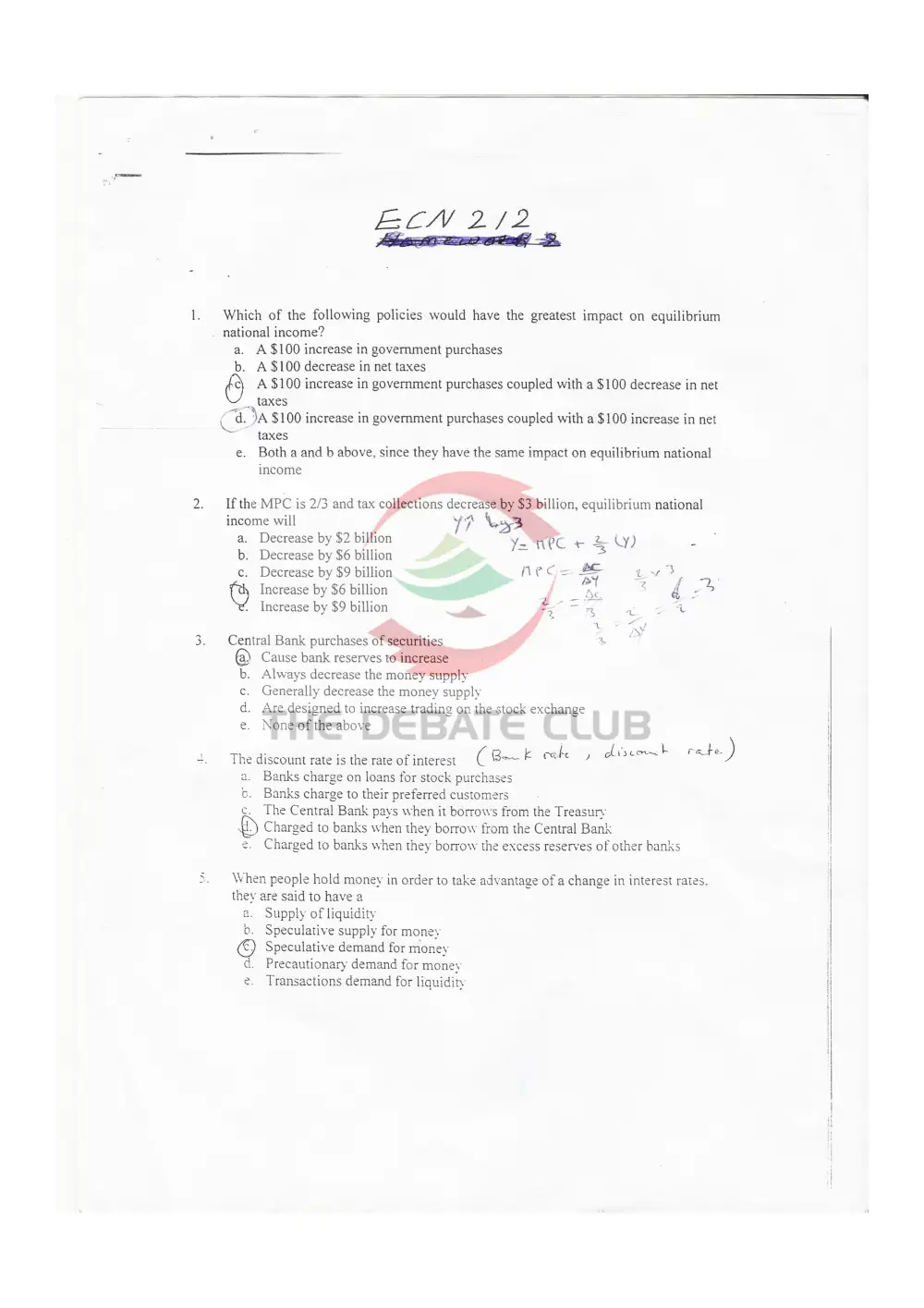
2:
oy
ECW 22
PP ARACE RELAY CPOE, Bu
Which of the following policies would have the greatest impact on equilibrium
national income?
a. A $100 increase in government purchases
b. A $100 decrease in net taxes
A $100 increase in government purchases coupled with a $100 decrease in net
_.. taxes
Ca A $100 increase in government purchases coupled with a $100 increase in net
taxes
e. Bothaand b above, since they have the same impact on equilibrium national
income
If the MPC is 2/3 and tax collections decrease by $3)billion, equilibrium national
income will 7 a ass
a. Decrease by $2 billion y= AOC + & Y) in
b. Decrease by $6 billion
c. Decrease by $9 billion (AKRS a Ly oe
Increase by $6 billion a 3 Og ee
Increase by $9 billion E, ee E i
Central Bank purchases of securities %
@ Cause bank reserves to increase
Always decrease the money supply
Generally decrease the money supply
Are.designed to increase.trading on the.stock exchange
Nonevof thesabove
ones
The discount rate is the rate of interest. ( B~E © ie a ae ste)
a. Banks charge on loans for stock purchase
c. Banks charge to their preferred customers
c. The Central Bank pays when it borrows from the Treasury
& Charged to banks when they borrow from the Central Bank
e. Charged to banks when they borrow the excess reserves of other bank
a
a
When people hold money in order to take advantage of a change in interest rates.
they are said to have a
a. Supply of liquidity
©. Speculative supply for money
Speculative demand for money
d. Precautionary demand for money
e. Transactions demand for liquidity
19)
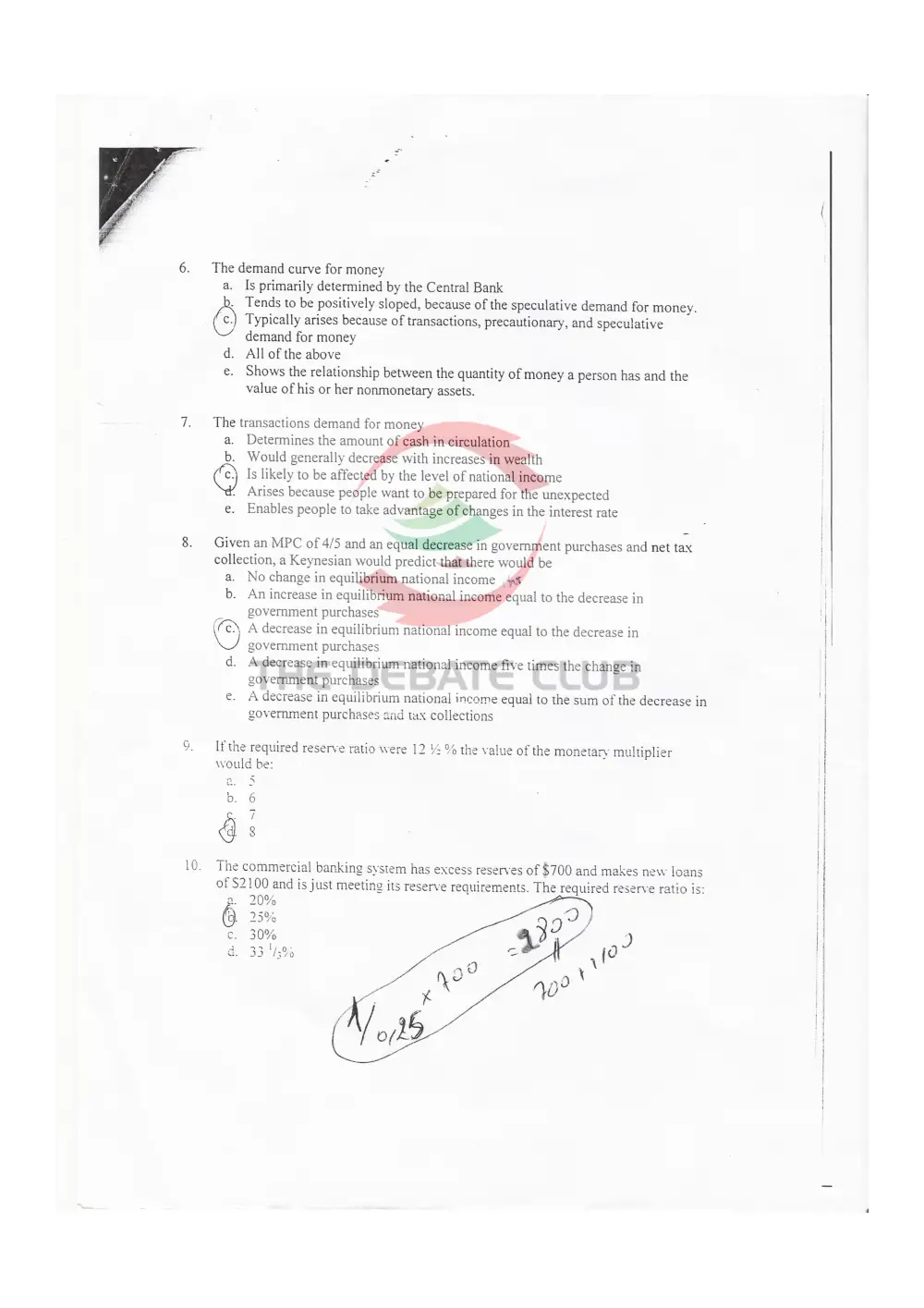
The demand curve for money
Is primarily determined by the Central Bank
Tends to be positively sloped, because of the speculative demand for money.
Typically arises because of transactions, precautionary, and speculative
demand for money
d. All of the above
e. Shows the relationship between the quantity of money a person has and the
value of his or her nonmonetary assets.
The transactions demand for money
a. Determines the amount ofi¢ash in circulation
b. Would generally decrease with increases in wealth
G) Is likely to be affected by the level of national inéome
Arises because people want to be prepared for the unexpected
e. Enables people to take advantage of changes in the interest rate
Given an MPC of 4/5 and an equal decrease in goverment purchases and net tax
collection, a Keynesian would predict-thatithere would be
a. No change in equilibrium national income sav
b. An increase in equilibrium national income equal to the decrease in
government purchases
(CCD A decrease in equilibrium national income equal to the decrease in
NS) government purchases
d.
Aedecreasevin:equilibriumnationallincome’five timesithe change"in
government purchases
e. A decrease in equilibrium national income equal to the sum of the decrease in
government purchases and tax collections
Ifthe required reserve ratio were 12 ¥% the value of the monetary multiplier
would be:
2
d.
The commercial banking system has excess reserves of $700 and makes new loans
of $2100 and is just meeting its reserve requirements. The required reserve ratio is:
20%
NOH
i)
(ah ie) Qe
se
WSUS) {ho}
Oy ey Ui
<—
ae)
|
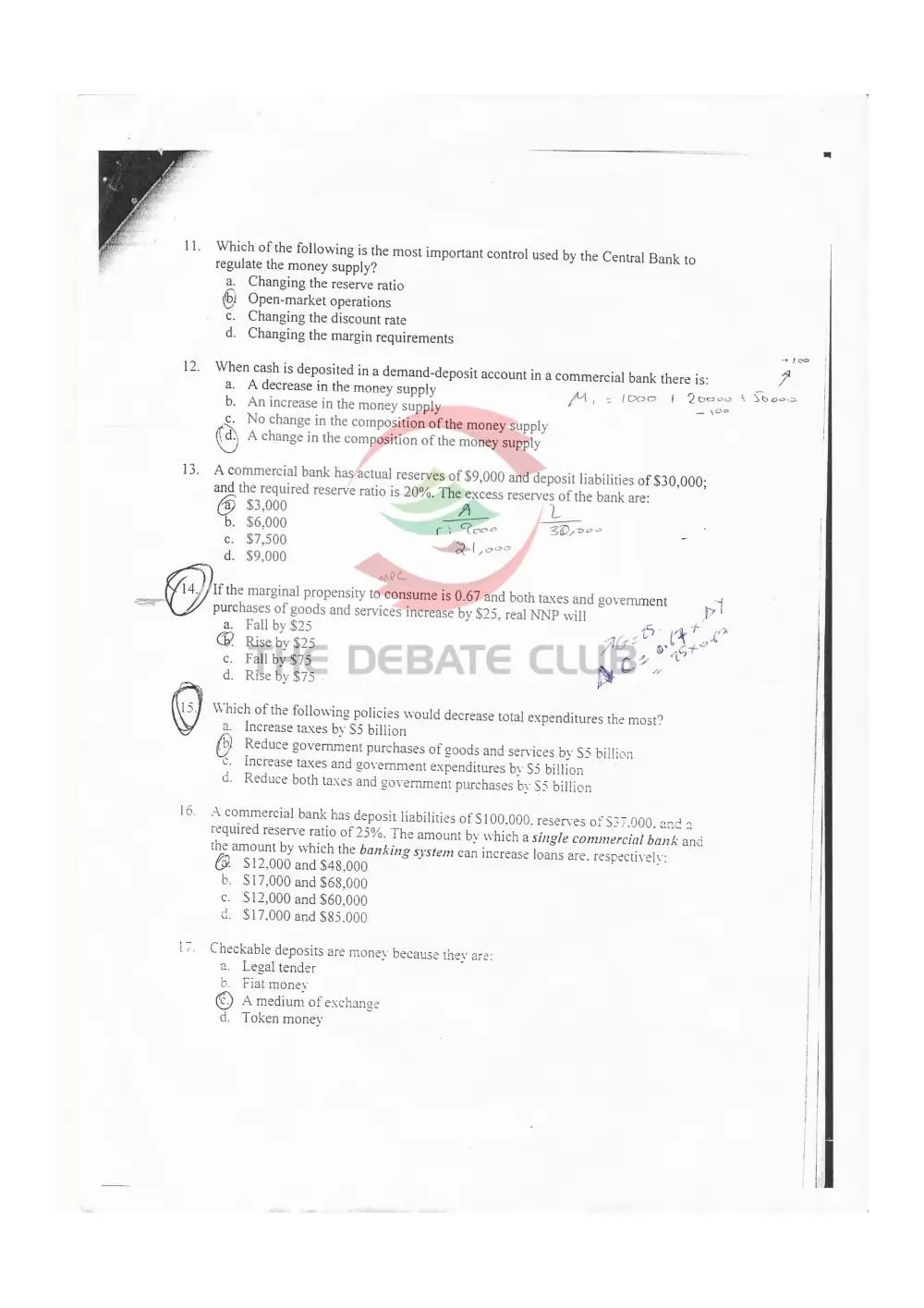
Which of the following is the most important control used by the Central Bank to
regulate the money supply?
a. Changing the reserve ratio
@ Open-market operations
c. Changing the discount rate
d. Changing the margin requirements
12. When cash is deposited in a demand-deposit account in a commercial bank there is:
a. A decrease in the money supply JA, = [bee 4 Zoos +
b. An increase in the money supply, ae
¢. No change in the composition of the money supply
(% A change in the compoSition of the money supply
13. A commercial bank has/actual reserves of $9,000 and deposit liabilities of $30,000;
and the required reserve ratio is 20%. The excess reserves of the bank are:
(® $3,000 A iL
b. $6,000 Sa - Zpppes =
c. $7,500 Rl cee
d. $9,000
wee
14,//If the marginal propensity to’eonsume is 0.67 and both taxes and government =|
purchases of goods and services increase by $25, real NNP will
a. Fall by $25
@ Rise by $25
c. Fall bys$75
d. Rise by $75
Which of the following policies would decrease total expenditures the most?
a. Increase taxes by $5 billion
9) Reduce government purchases of goods and services by $5 billion
€. Increase taxes and government expenditures by $5 billion
d. Reduce both taxes and government purchases by $3 billion
16. A commercial bank has deposit liabilities of $100,000, reserves of $37,000. and 2
required reserve ratio of 25%. The amount by which a single commercial bank and
the amount by which the banking system can increase loans are. respectively:
$12,000 and $48,000
b. $17,000 and $68,000
¢. $12,000 and $60,000
d. $17,000 and $85,000
17. Checkable deposits are money because they are:
a. Legal tender
o. Fiat money
© A medium of exchange
d. Token money
Sboos
18. Ifthe government wishes to increase the level of GDP, it might
\fa. Reduce taxes
Reduce its purchases of goods and services
c. Reduce transfer payments
d. Reduce the size ofthe budget deficit
19. The supply of money is determined by the.Central Bank and does not change when
the interest rate changes, so therefore'the:
a. Supply of money curve is downward sloping
b. Demand for money.curve is downward sloping
c. Supply of money curve isjupward sloping
& Supply of money curve is vertical
20. Which one of the following points would be true?
a. Bond prices.and the interest.rate are directly related
b. A lower interest rate raises the opportunity-cost of holding money
The supply Of money is directly related tothe interest rate
(i The total demand for money is inversely related to the interest rate
GOOD WORK ©