
ECN 212 Problems, Fall 2008
Notre Dame University–Louaize · Principles of Macroeconomics · 58 pages

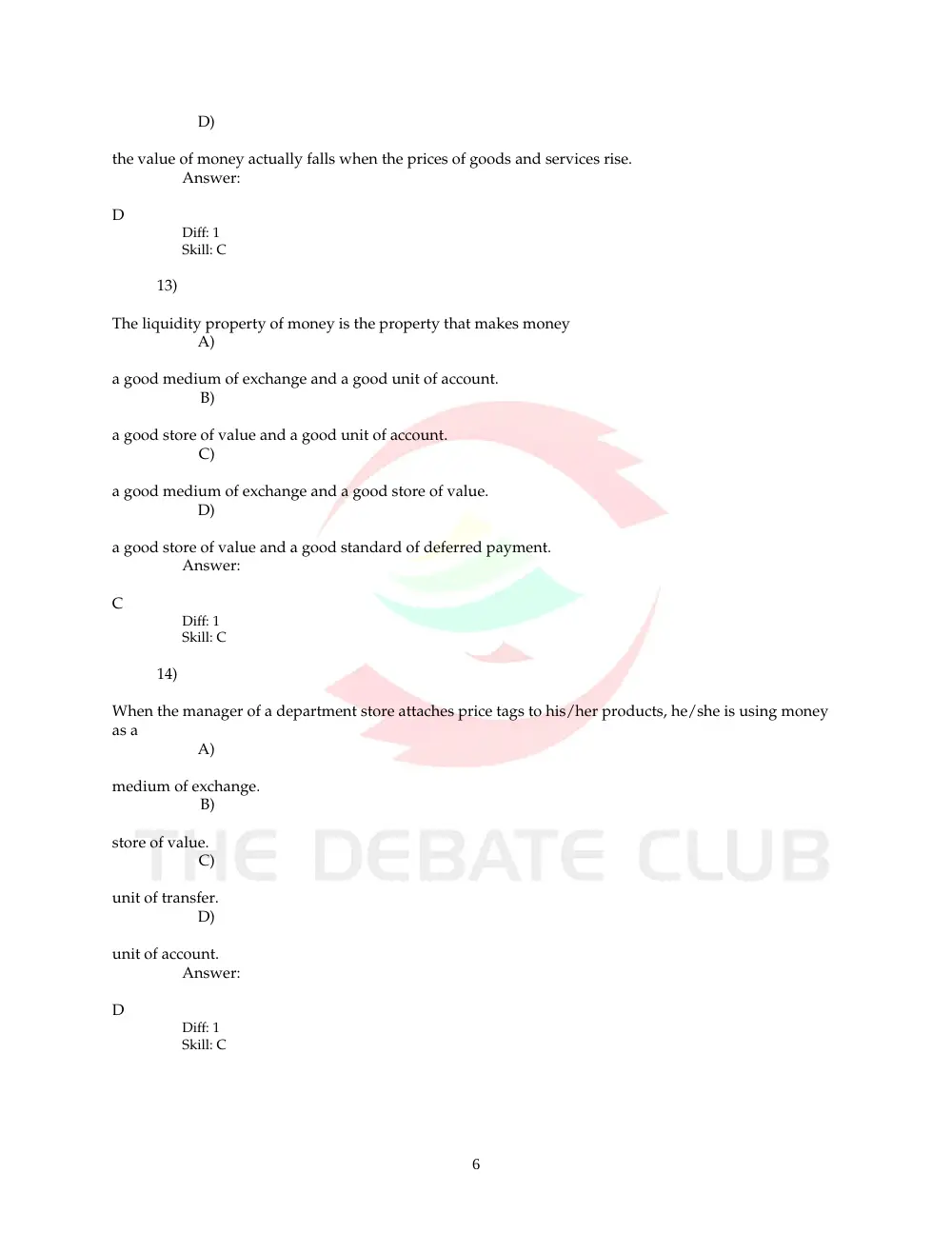
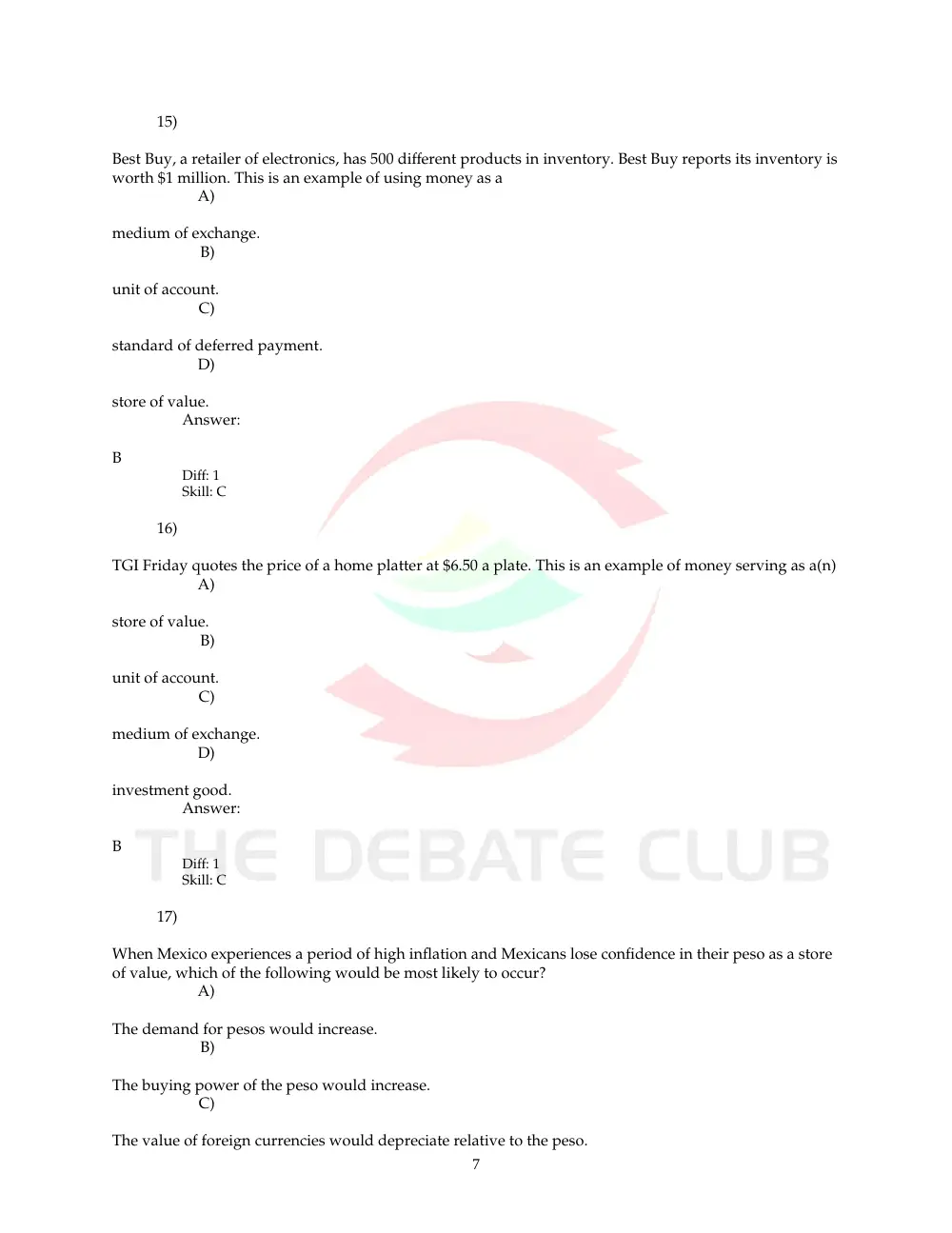
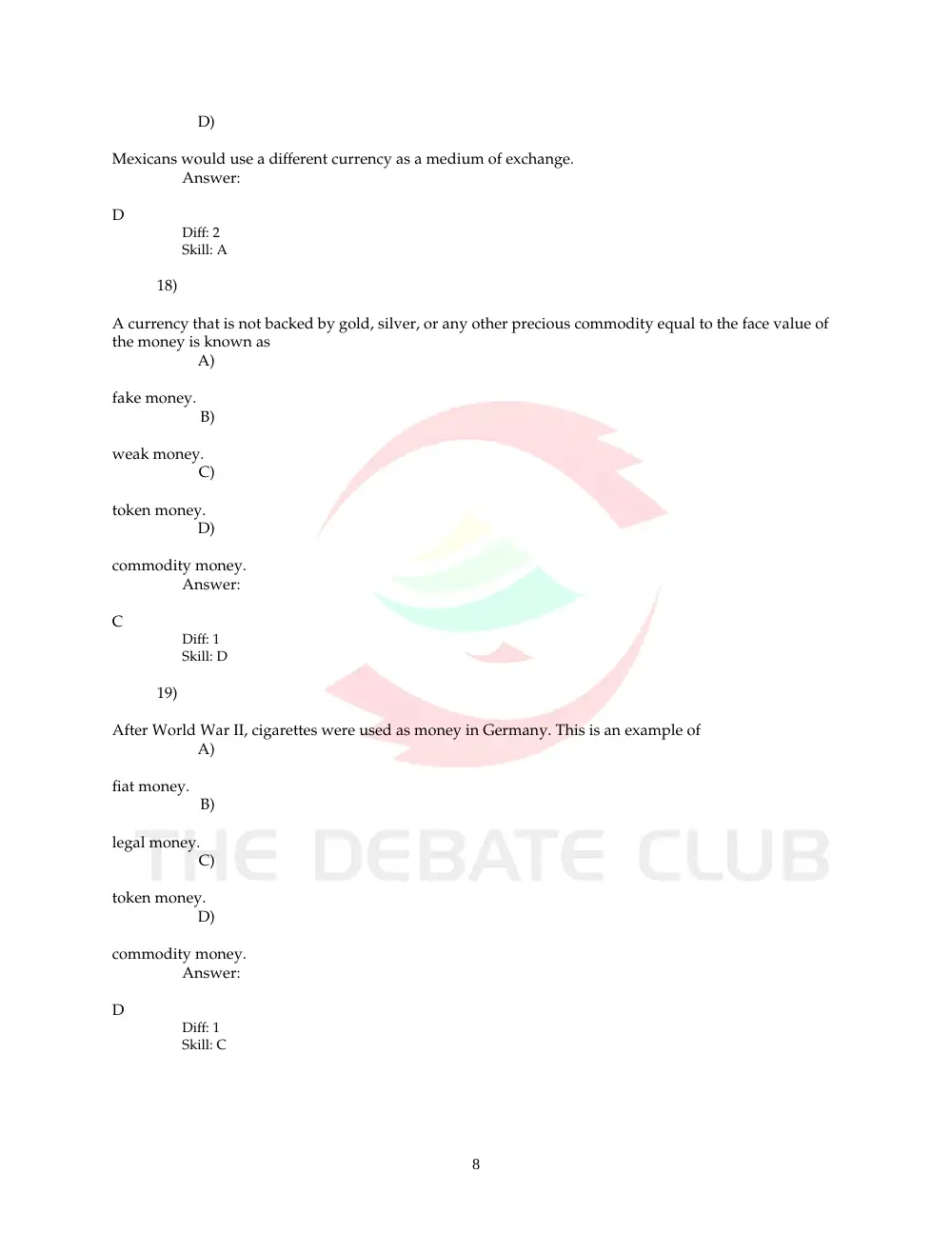
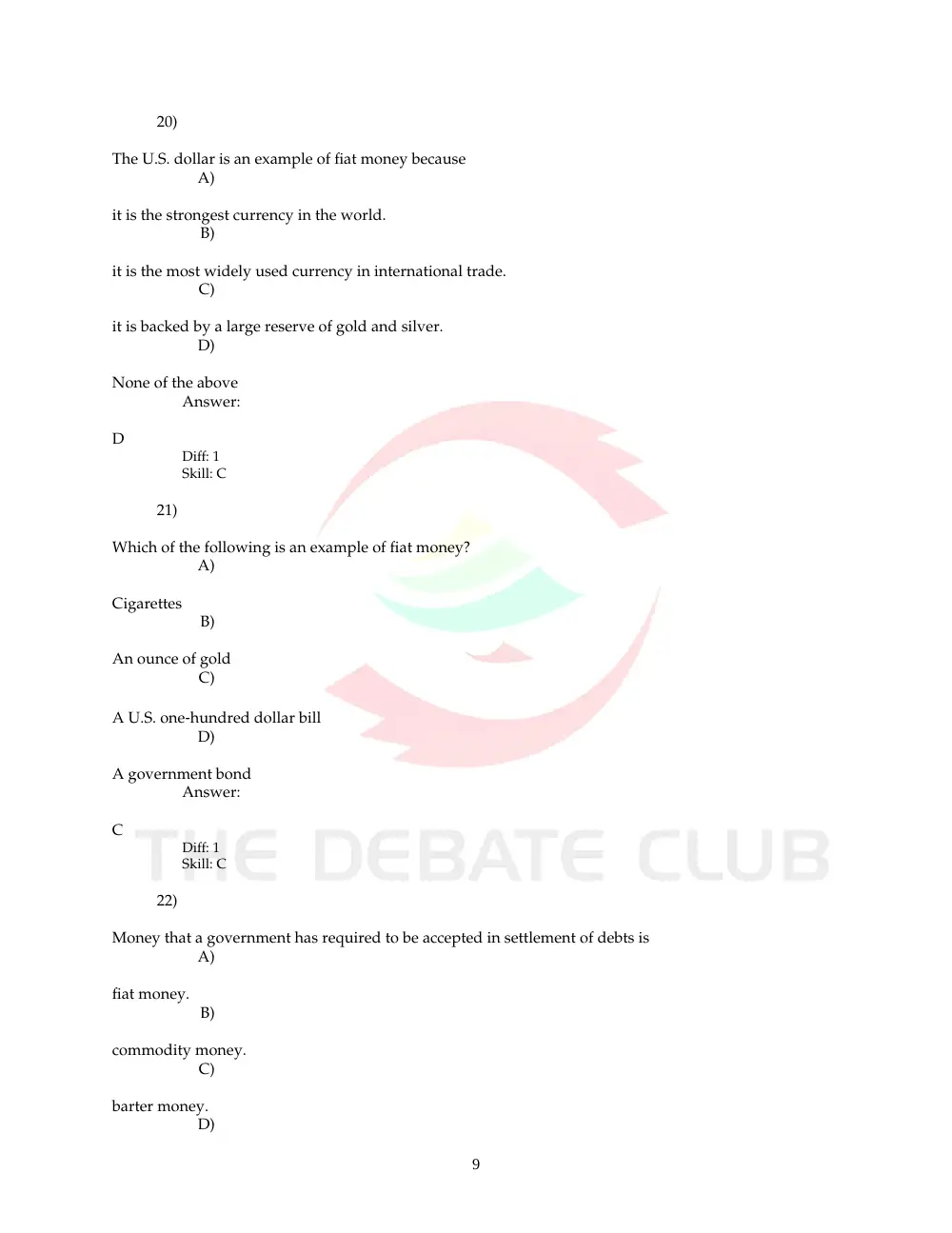
Showing the first 10 of 58 pages. Download the PDF to see all of it.
More ECN 212 files
- Problems with Some Answers · Fall 2008Problems · with solutionView
- Problems with Solution · Fall 2008Problems · with solutionView
- Problems with Answers · Fall 2008Problems · with solutionView
- Problems For Book Principles of Macroeconomics Case · Fall 2008ProblemsView
- Problems · Fall 2008ProblemsView
- Problems Quest.&Answ. Chapter 5 Introduction to Macroeconomics · Spring 2012ChapterView
- Exam 1 with Solution · Fall 2008Exam · with solutionView
- Other · Fall 2008FileView
Show the text of this problems
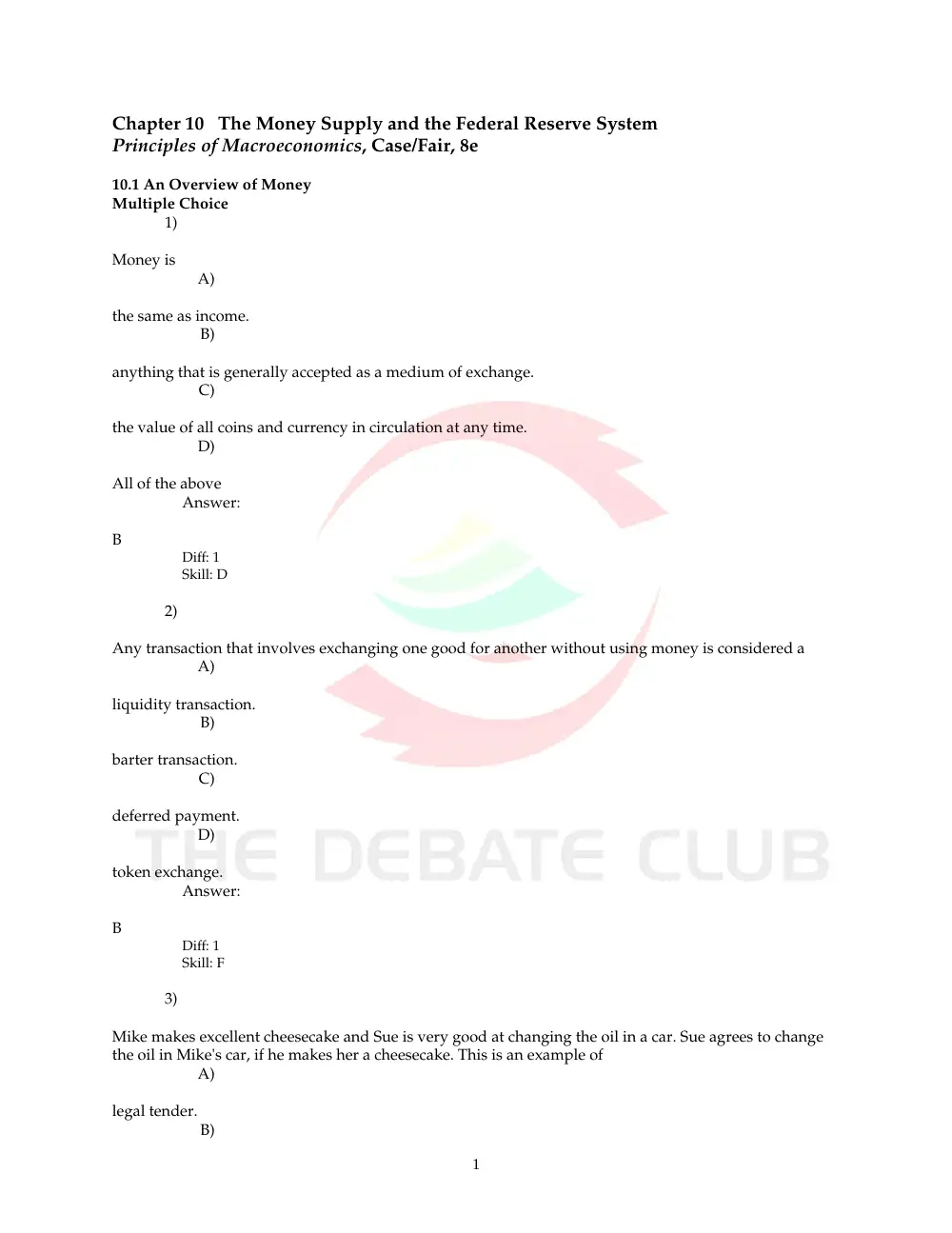
Chapter 10 The Money Supply and the Federal Reserve System
Principles of Macroeconomics, Case/Fair, 8e
10.1 An Overview of Money
Multiple Choice
1)
Money is
A)
the same as income.
B)
anything that is generally accepted as a medium of exchange.
C)
the value of all coins and currency in circulation at any time.
D)
All of the above
Answer:
B
Diff: 1
Skill: D
2)
Any transaction that involves exchanging one good for another without using money is considered a
A)
liquidity transaction.
B)
barter transaction.
C)
deferred payment.
D)
token exchange.
Answer:
B
Diff: 1
Skill: F
3)
Mike makes excellent cheesecake and Sue is very good at changing the oil in a car. Sue agrees to change
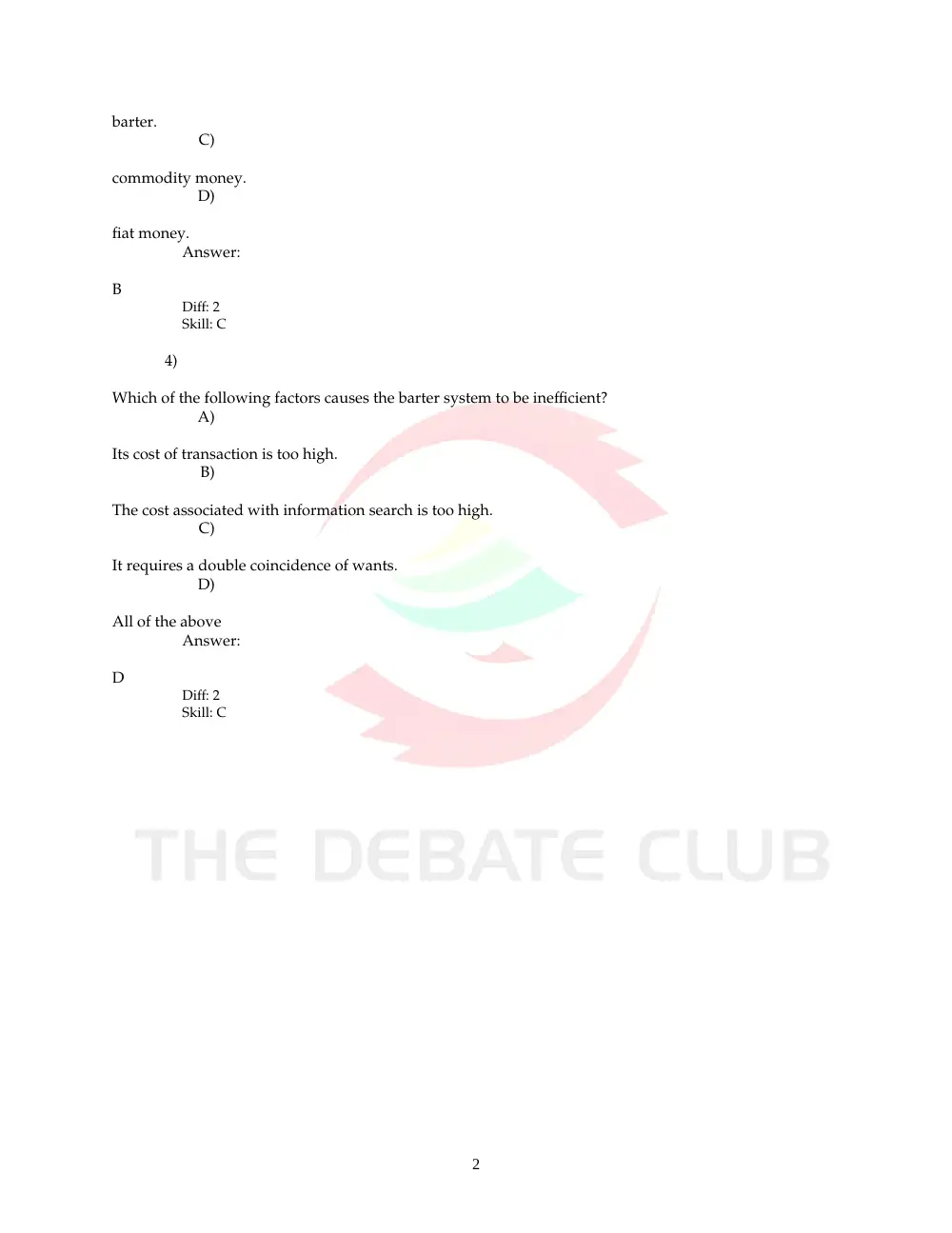
the oil in Mike's car, if he makes her a cheesecake. This is an example of
A)
legal tender.
B)
1
barter.
C)
commodity money.
D)
fiat money.
Answer:
B
Diff: 2
Skill: C
4)
Which of the following factors causes the barter system to be inefficient?
A)
Its cost of transaction is too high.
B)
The cost associated with information search is too high.
C)
It requires a double coincidence of wants.
D)
All of the above
Answer:
D
Diff: 2
Skill: C
2
5)
Mary wants to trade piano lessons for ice-skating lessons. Sarah wants to trade ice-skating lessons for
piano lessons. Mary and Sarah have
A)
the basis for a liquidity exchange.
B)
a double incidence of demand.
C)
the basis for a double fiat exchange.
D)
a double coincidence of wants.
Answer:
D
Diff: 2
Skill: C
6)
The development of money as a medium of exchange has facilitated the expansion of trade because
A)
holding money increases people's wealth.
B)
holding money increases people's income.
C)
money eliminates the "double coincidence of wants" problem.
D)
no other mediums of exchange are available.
Answer:
C
Diff: 2
Skill: C
7)
When money is used as a medium of exchange
A)
the need for a barter system diminishes.
B)
the cost of transactions increases.
C)
the need for a banking system in the economy decreases.
D)
3
it reduces the number of transactions in the economy.
Answer:
A
Diff: 2
Skill: C
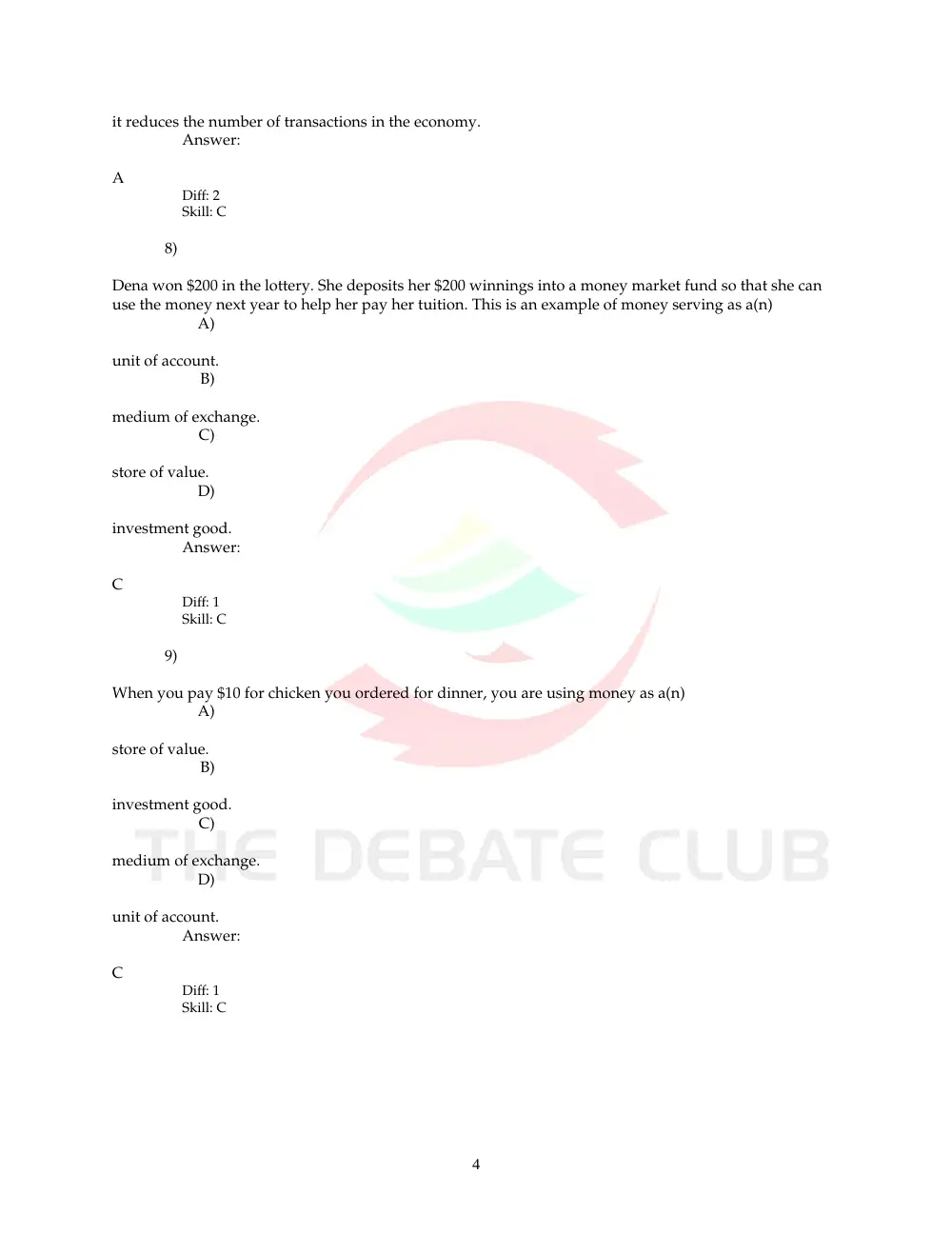
8)
Dena won $200 in the lottery. She deposits her $200 winnings into a money market fund so that she can
use the money next year to help her pay her tuition. This is an example of money serving as a(n)
A)
unit of account.
B)
medium of exchange.
C)
store of value.
D)
investment good.
Answer:
C
Diff: 1
Skill: C
9)
When you pay $10 for chicken you ordered for dinner, you are using money as a(n)
A)
store of value.
B)
investment good.
C)
medium of exchange.
D)
unit of account.
Answer:
C
Diff: 1
Skill: C
4
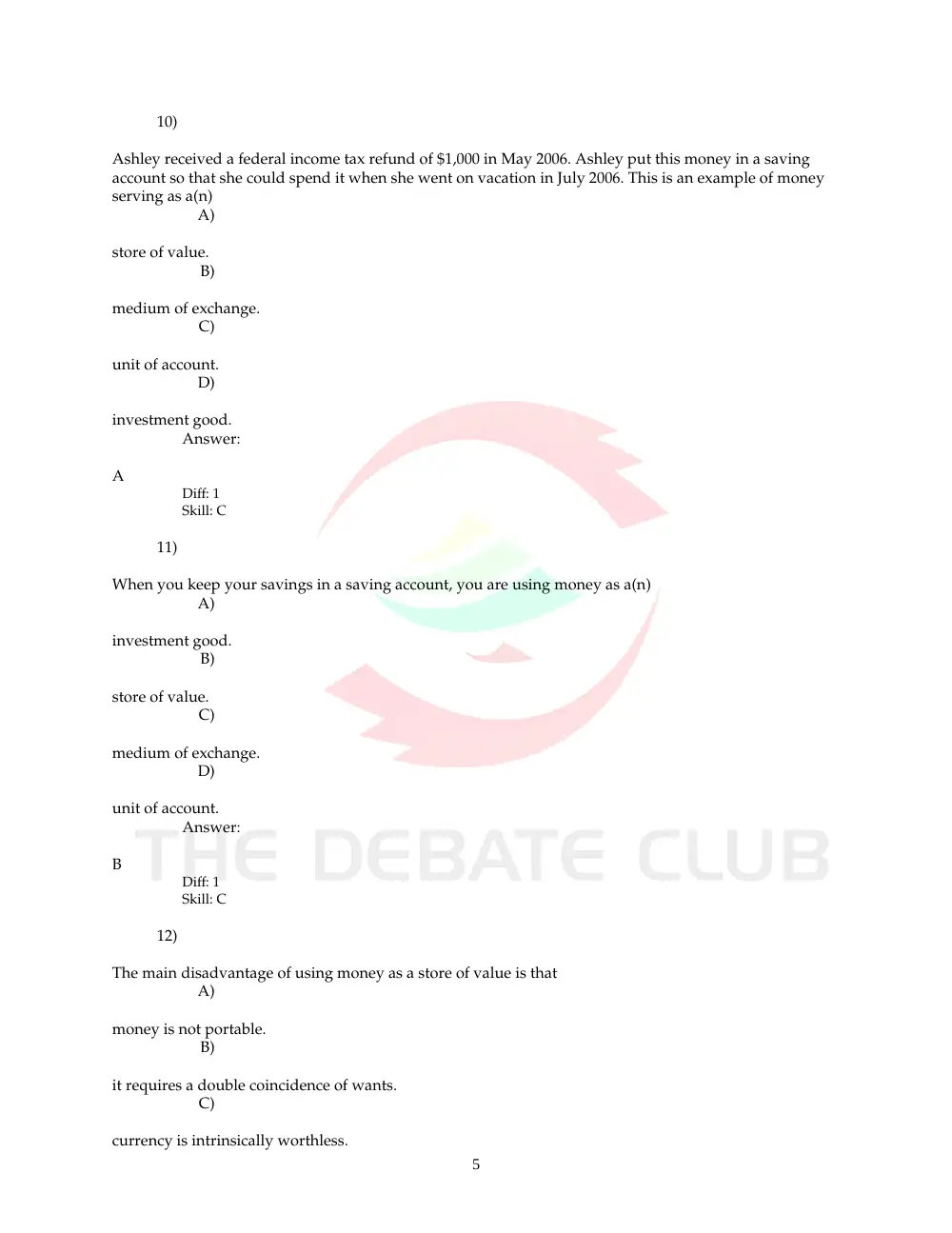
10)
Ashley received a federal income tax refund of $1,000 in May 2006. Ashley put this money in a saving
account so that she could spend it when she went on vacation in July 2006. This is an example of money
serving as a(n)
A)
store of value.
B)
medium of exchange.
C)
unit of account.
D)
investment good.
Answer:
A
Diff: 1
Skill: C
11)
When you keep your savings in a saving account, you are using money as a(n)
A)
investment good.
B)
store of value.
C)
medium of exchange.
D)
unit of account.
Answer:
B
Diff: 1
Skill: C
12)
The main disadvantage of using money as a store of value is that
A)
money is not portable.
B)
it requires a double coincidence of wants.
C)
currency is intrinsically worthless.
5
D)
the value of money actually falls when the prices of goods and services rise.
Answer:
D
Diff: 1
Skill: C
13)
The liquidity property of money is the property that makes money
A)
a good medium of exchange and a good unit of account.
B)
a good store of value and a good unit of account.
C)
a good medium of exchange and a good store of value.
D)
a good store of value and a good standard of deferred payment.
Answer:
C
Diff: 1
Skill: C
14)
When the manager of a department store attaches price tags to his/her products, he/she is using money
as a
A)
medium of exchange.
B)
store of value.
C)
unit of transfer.
D)
unit of account.
Answer:
D
Diff: 1
Skill: C
6
15)
Best Buy, a retailer of electronics, has 500 different products in inventory. Best Buy reports its inventory is
worth $1 million. This is an example of using money as a
A)
medium of exchange.
B)
unit of account.
C)
standard of deferred payment.
D)
store of value.
Answer:
B
Diff: 1
Skill: C
16)
TGI Friday quotes the price of a home platter at $6.50 a plate. This is an example of money serving as a(n)
A)
store of value.
B)
unit of account.
C)
medium of exchange.
D)
investment good.
Answer:
B
Diff: 1
Skill: C
17)
When Mexico experiences a period of high inflation and Mexicans lose confidence in their peso as a store
of value, which of the following would be most likely to occur?
A)
The demand for pesos would increase.
B)
The buying power of the peso would increase.
C)
The value of foreign currencies would depreciate relative to the peso.
7
D)
Mexicans would use a different currency as a medium of exchange.
Answer:
D
Diff: 2
Skill: A
18)
A currency that is not backed by gold, silver, or any other precious commodity equal to the face value of
the money is known as
A)
fake money.
B)
weak money.
C)
token money.
D)
commodity money.
Answer:
C
Diff: 1
Skill: D
19)
After World War II, cigarettes were used as money in Germany. This is an example of
A)
fiat money.
B)
legal money.
C)
token money.
D)
commodity money.
Answer:
D
Diff: 1
Skill: C
8
20)
The U.S. dollar is an example of fiat money because
A)
it is the strongest currency in the world.
B)
it is the most widely used currency in international trade.
C)
it is backed by a large reserve of gold and silver.
D)
None of the above
Answer:
D
Diff: 1
Skill: C
21)
Which of the following is an example of fiat money?
A)
Cigarettes
B)
An ounce of gold
C)
A U.S. one-hundred dollar bill
D)
A government bond
Answer:
C
Diff: 1
Skill: C
22)
Money that a government has required to be accepted in settlement of debts is
A)
fiat money.
B)
commodity money.
C)
barter money.
D)
9
legal tender.
Answer:
D
Diff: 1
Skill: D
23)
To ensure that paper money will be accepted, the U.S. government implicitly promises the public that
A)
it will not print money so fast that it loses its value.
B)
it will not change the rate at which the dollar is exchanged for other currencies.
C)
it will not change currency denominations so that the paper currencies U.S. citizens have will continue to
be used for exchanges.
D)
the U.S. monetary system will always be backed by a precious metal.
Answer:
A
Diff: 2
Skill: C
24)
Currency debasement occurs when
A)
the value of money falls as a result of a rapid increase in its supply.
B)
the government requires that a certain form of money must be accepted in settlement of debts.
C)
items are designated as money that are intrinsically worthless.
D)
items are used as money that also have intrinsic value in some other use.
Answer:
A
Diff: 2
Skill: D
10
25)
Assume that in the country of Salmon, the government tripled the money supply overnight. As a result of
this action, the price of a loaf of bread increased from 1 bill to 100 bills. This is an example of
A)
a change in the legal tender.
B)
a change from commodity money to fiat money.
C)
currency debasement.
D)
deflation.
Answer:
C
Diff: 2
Skill: C
26)
Currency held outside banks + demand deposits + travelers checks + other checkable deposits =
A)
M3.
B)
M2 - M1.
C)
M3 - M1.
D)
M1.
Answer:
D
Diff: 2
Skill: D
27)
Transaction money is
A)
M1.
B)
M2.
C)
11
M3.
D)
M4.
Answer:
A
Diff: 1
Skill: F
28)
Traveler's checks are
A)
not money.
B)
included in M1 and M2.
C)
not included in M2.
D)
not included in M1.
Answer:
B
Diff: 1
Skill: F
29)
Which of the following is included in M2, but not included in M1?
A)
currency held outside banks
B)
travelers checks
C)
demand deposits
D)
savings accounts
Answer:
D
Diff: 1
Skill: F
30)
John transfers $1,000 from his checking account to his savings account. This transaction will
12
A)
decrease both M1 and M2.
B)
not change M1 and decrease M2.
C)
decrease M1 and not change M2.
D)
increase both M1 and M2.
Answer:
C
Diff: 2
Skill: A
31)
Karen transfers $500 from her saving account to her checking account. This transaction will
A)
increase M1 and not change M2.
B)
not change M1 and decrease M2.
C)
increase both M1 and M2.
D)
decrease both M1 and M2.
Answer:
A
Diff: 2
Skill: A
32)
Jamie transfers $150 from his money market fund to his checking account. This transaction will
A)
decrease M2 and increase M1.
B)
increase M1, but leave M2 unchanged.
C)
decrease M1 and increase M2.
D)
13
decrease both M1 and M2.
Answer:
B
Diff: 2
Skill: A
33)
Which of the following would NOT be counted as part of M1?
A)
Demand deposits
B)
Traveler's check
C)
Money market accounts
D)
Currency
Answer:
C
Diff: 1
Skill: F
34)
Saving account balances are included in
A)
M1.
B)
M2.
C)
neither M1 nor M2.
D)
both M1 and M2.
Answer:
B
Diff: 1
Skill: F
14
35)
Which of the following would NOT be included in M2?
A)
Demand deposits
B)
Money market accounts
C)
Checking accounts
D)
None of the above
Answer:
D
Diff: 1
Skill: F
36)
Included in M2 are
A)
Demand deposits
B)
Money market accounts
C)
Savings accounts
D)
All of the above
Answer:
D
Diff: 1
Skill: F
37)
Which of the following would NOT be included in M1?
A)
Demand deposits
B)
Money market accounts
C)
Checking accounts
D)
15
All of the above
Answer:
B
Diff: 1
Skill: F
38)
Currency held outside banks is included in
A)
both M1 and M2.
B)
M2 only.
C)
M1 only.
D)
neither M1 nor M2.
Answer:
A
Diff: 1
Skill: F
39)
Close substitutes for transactions money are known as
A)
fiat monies.
B)
near monies.
C)
commodity monies.
D)
token monies.
Answer:
B
Diff: 1
Skill: D
16
40)
Which of the following is the best example of a near money?
A)
A valuable painting.
B)
A dollar bill.
C)
A Treasury bond.
D)
A money market account.
Answer:
D
Diff: 1
Skill: D
41)
An equation for M1 is
A)
M2 + Savings Accounts - Currency Held Outside Banks + Other Near Monies.
B)
M2 - Savings Accounts - Money Market Accounts - Other Near Monies.
C)
Money Market Accounts + Automatic-transfer Savings Accounts.
D)
M2 + Near Monies.
Answer:
B
Diff: 2
Skill: D
42)
The main advantage of using M2 instead of M1 as the measure for money is that
A)
M2 can be measured more accurately.
B)
M2 includes only readily spendable assets.
C)
M2 is sometimes more stable.
17
D)
M2 varies as the interest rate varies.
Answer:
C
Diff: 2
Skill: C
43)
Commercial banks
A)
implement monetary policy.
B)
are nonprofit organizations that lend and borrow funds.
C)
are financial intermediaries that lend funds and accept deposits.
D)
All of the above
Answer:
C
Diff: 1
Skill: D
44)
Among the assets of a commercial bank are
A)
loans.
B)
demand deposits.
C)
savings deposits.
D)
All of the above
Answer:
A
Diff: 1
Skill: C
18
45)
Among the liabilities of commercial banks are
A)
loans.
B)
demand deposits.
C)
reserves.
D)
All of the above
Answer:
B
Diff: 1
Skill: C
46)
Net worth is
A)
assets - liabilities.
B)
assets + capital.
C)
assets - capital.
D)
assets + liabilities.
Answer:
A
Diff: 1
Skill: D
True/False
1)
When you use money to fill your car with gas every week, you are using money as a unit of account.
Answer:
True
False
Diff: 1
Skill: C
19
2)
Money is anything that generally is accepted as a medium of exchange.
Answer:
True
False
Diff: 1
Skill: D
3)
In an economy that uses fiat money, there is no need for double coincidence of wants.
Answer:
True
False
Diff: 1
Skill: C
4)
When you take $100 from your saving account and deposit it in your checking account, M2 decreases.
Answer:
True
False
Diff: 2
Skill: C
5)
If all banks are loaned up, a $1,000 deposit creates $1,000 in new money.
Answer:
True
False
Diff: 2
Skill: C
6)
Fiat money is money the government says is money.
20
Answer:
True
False
Diff: 2
Skill: C
7)
The M1 definition of money includes money market accounts.
Answer:
True
False
Diff: 2
Skill: C
8)
The M2 definition of money includes demand deposits.
Answer:
True
False
Diff: 2
Skill: C
10.2 How Banks Create Money
Multiple Choice
1)
First National Bank has liabilities of $1 million and net worth of $100,000. First National Bank's assets are
A)
$100,000.
B)
$900,000.
C)
$1.1 million.
D)
$1.3 million.
Answer:
C
21
Diff: 2
Skill: A
2)
Hazard County Savings and Loan has liabilities of $300,000 and net worth of $50,000. Hazard County
Savings and Loan's assets are
A)
$350,000.
B)
$450,000.
C)
-$350,000.
D)
-$450,000.
Answer:
A
Diff: 2
Skill: A
3)
First National Trust has assets of $900,000 and liabilities of $300,000. First National Trust's net worth is
A)
$0.
B)
$300,000.
C)
$600,000.
D)
$900,000.
Answer:
C
Diff: 2
Skill: A
4)
A commercial bank lists
A)
loans as liabilities.
B)
deposits as liabilities.
C)
22
required reserves as liabilities.
D)
excess reserves as liabilities.
Answer:
B
Diff: 1
Skill: F
5)
Things that a firm owns that are worth something are classified as
A)
liabilities.
B)
assets.
C)
deposits.
D)
net worth.
Answer:
B
Diff: 1
Skill: F
6)
Which of the following is considered a liability to a bank?
A)
Time deposits
B)
Reserves
C)
The bank's loans
D)
The bank's buildings and equipment
Answer:
A
Diff: 2
Skill: F
7)
The central bank of the United States is known as the
A)
23
Federal Reserve System.
B)
Federal Deposit Insurance Corporation.
C)
Department of the Treasury.
D)
Federal Savings and Loan Insurance Corporation.
Answer:
A
Diff: 1
Skill: F
8)
A loan made by a bank is considered ________ of that bank.
A)
a liability
B)
capital
C)
net worth
D)
an asset
Answer:
D
Diff: 1
Skill: F
9)
A checking deposit in a bank is considered ________ of that bank.
A)
an asset
B)
a liability
C)
net worth
D)
capital
Answer:
B
Diff: 1
24
Skill: F
25
Refer to the information provided in Table 10.1 below to answer the questions that follow.
Table 10.1
10)
Refer to Table 10.1. The required reserve ratio is 10%. If the First Charter Bank is meeting its reserve
requirement and has no excess reserves, its reserves equal
A)
$20.
B)
$70.
C)
$140.
D)
$90.
Answer:
B
Diff: 2
Skill: A
11)
Refer to Table 10.1. The required reserve ratio is 10%. If the First Charter Bank is meeting its reserve
requirement and has no excess reserves, its loans equal
A)
$500.
B)
$830.
C)
$900.
D)
$760.
Answer:
B
Diff: 2
Skill: A
12)
26
Refer to Table 10.1. First Charter Bank's total assets
A)
are $900.
B)
are $500.
C)
are $700.
D)
Cannot be determined from this information.
Answer:
A
Diff: 2
Skill: A
27
Refer to the information provided in Table 10.2 below to answer the questions that follow.
Table 10.2
13)
Refer to Table 10.2. First Commercial Bank's required reserves equal $________.
A)
150,000
B)
250,000
C)
100,000
D)
50,000
Answer:
A
Diff: 2
Skill: A
14)
Refer to Table 10.2. The required reserve ratio
A)
is 15%.
B)
is 10%.
C)
is 12.5%.
D)
cannot be determined from the given information.
Answer:
A
Diff: 2
Skill: A
15)
28
Refer to Table 10.2. First Commercial Bank's total loans equal $________.
A)
1,050,000
B)
1,200,000
C)
1,150,000
D)
1,000,000.
Answer:
D
Diff: 2
Skill: A
29
Refer to the information provided in Table 10.3 below to answer the questions that follow.
Table 10.3
16)
Refer to Table 10.3. The net worth of People's Bank is $________.
A)
700,000
B)
400,000
C)
200,000
D)
300,000
Answer:
D
Diff: 2
Skill: A
17)
Refer to Table 10.3. The required reserve ratio is
A)
15%.
B)
25%.
C)
10%.
D)
8%.
Answer:
C
Diff: 2
Skill: A
18)
30
Refer to Table 10.3. People's Bank excess reserves are $________.
A)
10,000
B)
20,000
C)
90,000
D)
60,000
Answer:
A
Diff: 2
Skill: A
19)
Refer to Table 10.3. Total loans of People's Bank equal $________.
A)
640,000
B)
600,000
C)
650,000
D)
610,000
Answer:
C
Diff: 2
Skill: A
31
20)
Bank of Sim City has $250 million in deposits. Bank of Sim City is meeting its reserve requirement and
has no excess reserves. It has $10 million in reserves. Bank of Sim City faces a required reserve ratio of
A)
1.25%.
B)
4%.
C)
20%.
D)
37.5%.
Answer:
B
Diff: 3
Skill: A
21)
Third National Bank has $750 million in deposits. The required reserve ratio is 15%. Third National Bank
must keep ________ in reserves.
A)
$150 million
B)
$105 million
C)
$112.5 million
D)
$160.5 million
Answer:
C
Diff: 2
Skill: A
22)
Bank of Sim City has $600 million in deposits. The required reserve ratio is 25%. Bank of Sim City must
keep ________ in reserves.
A)
$125 million
B)
$700 million
C)
32
$150 million
D)
$160 million
Answer:
C
Diff: 2
Skill: A
23)
The Republic Bank has $2 million in deposits and $200,000 in reserves. If the required reserve ratio is 10%,
excess reserves are equal to
A)
$200,000.
B)
$50,000.
C)
zero.
D)
$450,000.
Answer:
C
Diff: 2
Skill: A
24)
The Bank of New York has $4 million in deposits and $400,000 in reserves. If the required reserve ratio is
5%, excess reserves are equal to
A)
$150,000.
B)
$200,000.
C)
$350,000.
D)
zero.
Answer:
B
Diff: 2
Skill: A
25)
33
The Bank of Texas has $1 million in deposits and $300,000 in reserves. If excess reserves are equal to
$150,000, the required reserve ratio is
A)
15%.
B)
10%.
C)
8%.
D)
5%.
Answer:
A
Diff: 2
Skill: A
Refer to the information provided in Table 10.4 below to answer the questions that follow.
Table 10.4
26)
Refer to Table 10.4. If the required reserve ratio is 10%, First Charter Bank
A)
is loaned up.
B)
has too few reserves on hand.
C)
is meeting its required reserve ratio and has no excess reserves.
D)
has excess reserves of $100,000.
Answer:
A
Diff: 2
Skill: A
27)
Refer to Table 10.4. First Charter Bank will be loaned up if the required reserve ratio is
A)
34
10%.
B)
15%.
C)
20%.
D)
30%.
Answer:
A
Diff: 2
Skill: A
28)
Refer to Table 10.4. First Charter Bank could make additional loans of $50,000, if the required reserve
ratio were
A)
10%.
B)
8%.
C)
7.5%.
D)
2.5%.
Answer:
C
Diff: 2
Skill: A
35
29)
Refer to Table 10.4. If the required reserve ratio were changed to 5% and First Charter Bank continues to
hold $200,000 in reserves, its excess reserves will be
A)
$40,000.
B)
$50,000.
C)
$100,000.
D)
$60,000.
Answer:
C
Diff: 2
Skill: A
30)
Dollar Bank is currently loaned up. If the required reserve ratio is lowered,
A)
Dollar Bank's net worth will increase.
B)
Dollar Bank will have excess reserves that it can lend out.
C)
Dollar Bank will still be loaned up because it did not receive any additional deposits.
D)
Dollar Bank's actual reserves will increase, but it will still be loaned up.
Answer:
B
Diff: 3
Skill: A
31)
When a bank has no excess reserves, and thus can make no more loans, it is said to be
A)
bankrupt.
B)
ripe for a takeover.
C)
in receivership.
D)
36
loaned up.
Answer:
D
Diff: 1
Skill: C
32)
Commercial banks create money through
A)
printing treasury notes.
B)
making loans.
C)
facilitating borrowing from the Federal Reserve to the public.
D)
reducing risk in the economy.
Answer:
B
Diff: 1
Skill: F
33)
The multiple by which total deposits can increase for every dollar increase in reserves is the
A)
required reserve ratio.
B)
bank's line of credit.
C)
deposit insurance limit.
D)
money multiplier.
Answer:
D
Diff: 1
Skill: D
37
34)
Suppose the required reserve ratio is 20%. A $10 million cash deposit will allow commercial banks to
create at most
A)
$20 million.
B)
$2 million.
C)
$50 million.
D)
$100 million.
Answer:
C
Diff: 2
Skill: A
35)
Suppose the required reserve ratio is 10%. A $5 million deposit allows commercial banks to create at most
A)
$25 million.
B)
$20 million.
C)
$10 million.
D)
$50 million.
Answer:
D
Diff: 2
Skill: A
36)
The required reserve ratio is 10%. The money multiplier is
A)
0.1.
B)
1.
C)
9.
D)
38
10.
Answer:
D
Diff: 1
Skill: F
37)
The required reserve ratio is 15%. The money multiplier is
A)
5.67.
B)
8.12.
C)
5.54.
D)
6.67.
Answer:
D
Diff: 1
Skill: F
38)
If the money multiplier is 4, the required reserve ratio is
A)
2%.
B)
20%.
C)
25%.
D)
50%.
Answer:
C
Diff: 1
Skill: F
39
39)
Assume that banks become more conservative in their lending policies and start holding some excess
reserves. Compared to a situation in which banks are not holding excess reserves, the size of the money
supply will be
A)
zero.
B)
larger.
C)
the same.
D)
smaller.
Answer:
D
Diff: 2
Skill: C
40)
As commercial banks keep more excess reserves, money creation
A)
increases.
B)
decreases.
C)
remains the same, as long as banks hold no excess reserves.
D)
could either increase or decrease.
Answer:
B
Diff: 2
Skill: C
Refer to the information provided in Scenario 10.1 below to answer the questions that follow.
SCENARIO 1: The following table shows the changes in deposits, reserves, and loans of 4 banks as a
result of a $100,000 initial deposit in Bank No. 1. Assume all banks are loaned up.
40
41)
Refer to Scenario 1. What is the required reserve ratio?
A)
4%
B)
5%
C)
8%
D)
10%
Answer:
B
Diff: 3
Skill: A
42)
Refer to Scenario 1. What is the money multiplier in this economy?
A)
20
B)
10
C)
50
D)
16.67
Answer:
A
Diff: 3
Skill: A
41
43)
Refer to Scenario 1. How much money will be created based on the initial $100,000 deposit?
A)
$1 million
B)
$2 million
C)
$50 million
D)
$16.67 million
Answer:
B
Diff: 3
Skill: A
44)
Refer to Scenario 1. If the required reserve ratio were changed to 10%, total loans of Bank No. 2 will
change to
A)
81,000.
B)
90,000.
C)
85,000.
D)
77,440.
Answer:
A
Diff: 3
Skill: A
True/False
1)
Only the required reserve ratio determines how much money the Federal Reserve can create.
Answer:
True
False
Diff: 2
Skill: C
42
2)
Excess reserves in a bank are the difference between required reserves and the bank's total net worth.
Answer:
True
False
Diff: 1
Skill: D
3)
Among the assets of commercial banks are demand deposits.
Answer:
True
False
Diff: 1
Skill: C
4)
The amount of money banks can loan out is determined by the discount rate.
Answer:
True
False
Diff: 2
Skill: F
5)
Among the liabilities of commercial banks are deposits.
Answer:
True
False
Diff: 2
Skill: C
6)
Since they must lend money to make money, all banks are necessarily insolvent.
43
Answer:
True
False
Diff: 2
Skill: C
10.3 The Federal Reserve System
Multiple Choice
1)
The Federal Reserve System consists of ________ Federal Reserve Banks.
A)
8
B)
10
C)
12
D)
14
Answer:
C
Diff: 1
Skill: F
2)
Which of the following activities is one of the responsibilities of the Federal Reserve?
A)
Issuing new bonds to finance the federal budget deficit
B)
Loaning money to other countries that are friendly to the United States
C)
Assisting banks that are in a difficult financial position
D)
Auditing the various agencies and departments of the federal government
Answer:
C
Diff: 2
Skill: C
3)
44
Among the members of the Federal Open Market Committee
A)
is the Secretary of the Treasury.
B)
is the Comptroller of the Currency.
C)
are the seven members of the Board of Governors of the Fed.
D)
all of the above.
Answer:
C
Diff: 2
Skill: F
4)
The Board of governors of the Fed
A)
are appointed by the US President.
B)
have a 14 year term.
C)
has seven members.
D)
all of the above.
Answer:
D
Diff: 2
Skill: F
5)
The Fed
A)
issues deposits to the public.
B)
lends money to foreign governments.
C)
clears inter-bank payments.
D)
all of the above.
Answer:
45
C
Diff: 2
Skill: C
46
True/False
1)
The President of the NY Federal Reserve Bank is always a member of the Federal Open Market
committee.
Answer:
True
False
Diff: 1
Skill: F
2)
The Chair of the Fed also serves as one of the Reserve Bank Presidents.
Answer:
True
False
Diff: 1
Skill: F
3)
The Fed acts as a lender of last resort for the banking system.
Answer:
True
False
Diff: 2
Skill: F
4)
The members of the Board of Governors of the Fed make up a majority of the Federal Open Market
Committee.
Answer:
True
False
Diff: 2
Skill: F
5)
47
The Fed is a division of the Department of the Treasury.
Answer:
True
False
Diff: 2
Skill: C
10.4 How the Federal Reserve Controls the Money Supply
Multiple Choice
1)
Which of the following instruments is not used by the Federal Reserve to change the money supply?
A)
The discount rate
B)
The required reserve ratio
C)
The federal tax code
D)
Open market operations
Answer:
C
Diff: 1
Skill: F
2)
The Federal Open Market Committee (FOMC) directs the Open Market Desk to
A)
determine the required reserve ratio.
B)
determine the discount rate.
C)
buy or sell government securities.
D)
determine the federal funds rate.
Answer:
C
Diff: 1
Skill: F
3)
48
Which of the following is NOT a tool available to the Fed to change the supply of money?
A)
Open market operations
B)
The required reserve ratio
C)
The money multiplier
D)
The discount rate
Answer:
C
Diff: 1
Skill: F
4)
The discount rate is
A)
the interest rate commercial banks charge each other for borrowing funds.
B)
the interest rate commercial banks charge their new customers.
C)
the interest rate the Fed charges commercial banks for borrowing funds.
D)
None of the above
Answer:
C
Diff: 1
Skill: D
5)
A decrease in the required reserve ratio
A)
will increase the money supply.
B)
will decrease the money supply.
C)
will not change the money supply.
D)
will decrease the discount rate.
49
A
Diff: 1
Skill: C
6)
Assume that all commercial banks are loaned up. Total deposits in the banking system are $200 million.
The required reserve ratio is increased. The money supply will
A)
decrease.
B)
increase.
C)
not change because there was no change in deposits.
D)
not change because the required reserve ratio has no impact on money supply.
Answer:
A
Diff: 2
Skill: A
7)
The Fed has tended not to use changes in the reserve requirement as a means of controlling the money
supply because
A)
only banks that are members of the Fed are subject to reserve requirements, and most banks do not
belong to the Fed.
B)
a change in the reserve requirement has only a very small impact on the money supply.
C)
it is a crude monetary policy tool because a change in the requirement does not affect banks until about
two weeks after the change is implemented.
D)
it takes a long time for the Congress to approve a change in the reserve requirement.
Answer:
C
Diff: 3
Skill: C
50
8)
The interest rate banks pay to borrow money from the Fed is the
A)
federal funds rate.
B)
discount rate.
C)
prime lending rate.
D)
reserve rate.
Answer:
B
Diff: 1
Skill: F
9)
Which of the following represents an action by the Federal Reserve that is designed to increase the money
supply?
A)
A decrease in the required reserve ratio
B)
An increase in the discount rate
C)
A decrease in federal tax rates
D)
Selling government securities in the open market
Answer:
A
Diff: 2
Skill: C
10)
Which of the following represents an action by the Federal Reserve that is designed to increase the money
supply?
A)
Buying government securities in the open market
B)
An increase in the required reserve ratio
C)
A decrease in federal spending
51
D)
An increase in the discount rate
Answer:
A
Diff: 2
Skill: C
11)
Which of the following is the least used tool by the Fed to regulate money supply?
A)
The federal funds rate
B)
The discount rate
C)
Tax cutting
D)
The open-market operations
Answer:
B
Diff: 1
Skill: C
12)
If the Fed sells government securities, then there is
A)
an increase in the supply of money.
B)
a decrease in the supply of money.
C)
a decrease in the discount rate.
D)
an increase in the required reserve ratio.
Answer:
B
Diff: 2
Skill: C
52
13)
Which of the following represents an action by the Federal Reserve that is designed to increase the money
supply?
A)
An increase in the discount rate
B)
An increase in federal spending
C)
Buying government securities in the open market
D)
An increase in the required reserve ratio
Answer:
C
Diff: 2
Skill: C
14)
When the Fed raises the required reserve ratio, the banks' excess reserves ________ and the money
supply ________.
A)
remains constant; decreases
B)
decrease; decreases
C)
increase; remain constant
D)
increase; increases
Answer:
B
Diff: 2
Skill: C
15)
The best instrument for controlling week-to-week changes in the money supply is
A)
the required reserve ratio.
B)
moral suasion.
C)
53
open-market operations.
D)
the discount rate.
Answer:
C
Diff: 2
Skill: C
16)
Which of the following statements is FALSE?
A)
Open-market operations can be used by the Federal Reserve with some precision.
B)
Open-market operations are extremely flexible.
C)
The Federal Reserve undertakes open-market operations on an infrequent basis.
D)
Open-market operations have a fairly predictable effect on the supply of money.
Answer:
C
Diff: 2
Skill: C
17)
An open-market purchase of securities by the Fed results in ________ in reserves and ________ in the
supply of money.
A)
an increase; a decrease
B)
a decrease; a decrease
C)
an increase; an increase
D)
a decrease; an increase
Answer:
C
Diff: 2
Skill: C
54
18)
An open-market sale of securities by the Fed results in ________ in reserves and ________ in the supply of
money.
A)
an increase; a decrease
B)
an increase; an increase
C)
a decrease; an increase
D)
a decrease; a decrease
Answer:
D
Diff: 2
Skill: C
19)
Assume there is no leakage from the banking system and that all commercial banks are loaned up. The
required reserve ratio is 20%. If the Fed sells $5 million worth of government securities to the public, the
change in the money supply will be
A)
-$20 million.
B)
-$25 million.
C)
$25 million.
D)
$20 million.
Answer:
B
Diff: 3
Skill: A
20)
Assume there is no leakage from the banking system and that all commercial banks are loaned up. The
required reserve ratio is 25%. If the Fed buys $10 million worth of government securities from the public,
the change in the money supply will be
A)
-$50 million.
B)
55
-$40 million.
C)
$40 million.
D)
$50 million.
Answer:
C
Diff: 3
Skill: A
21)
The money supply has increased from $1 trillion to $1.1 trillion. Which of the following could have
caused this increase?
A)
The Fed sold government securities to the public.
B)
Consumers who were holding money outside the banking system deposit this money.
C)
The Fed increased the discount rate.
D)
Commercial banks began to hold excess reserves.
Answer:
B
Diff: 2
Skill: A
56
22)
If the Fed sets the money supply independent of the interest rate, then the money supply curve is
A)
upward sl