
AROL 213 Final, Fall 2005
American University of Beirut · The Human Story I The Old Stone Age · 2 pages
More AROL 213 files
Show the text of this final exam
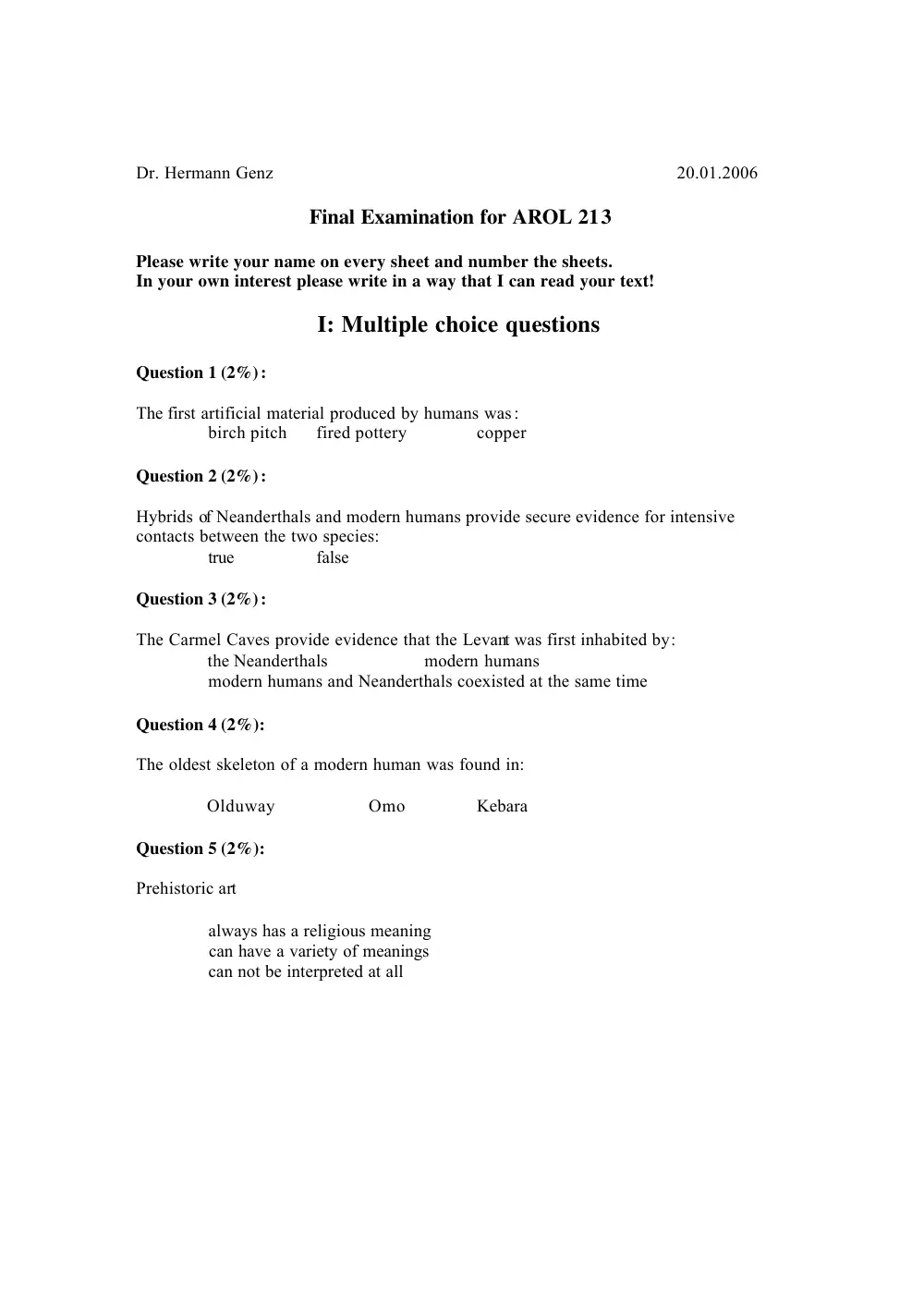
Dr. Hermann Genz
20.01.2006
Final Examination for AROL 213
Please write your name on every sheet and number the sheets.
In your own interest please write in a way that I can read your text!
I: Multiple choice questions
Question 1 (2%):
The first artificial material produced by humans was:
birch pitch
fired pottery
copper
Question 2 (2%):
Hybrids of Neanderthals and modern humans provide secure evidence for intensive
contacts between the two species:
true
false
Question 3 (2%):
The Carmel Caves provide evidence that the Levant was first inhabited by:
the Neanderthals
modern humans
modern humans and Neanderthals coexisted at the same time
Question 4 (2%):
The oldest skeleton of a modern human was found in:
Olduway
Omo
Kebara
Question 5 (2%):
Prehistoric art
always has a religious meaning
can have a variety of meanings
can not be interpreted at all
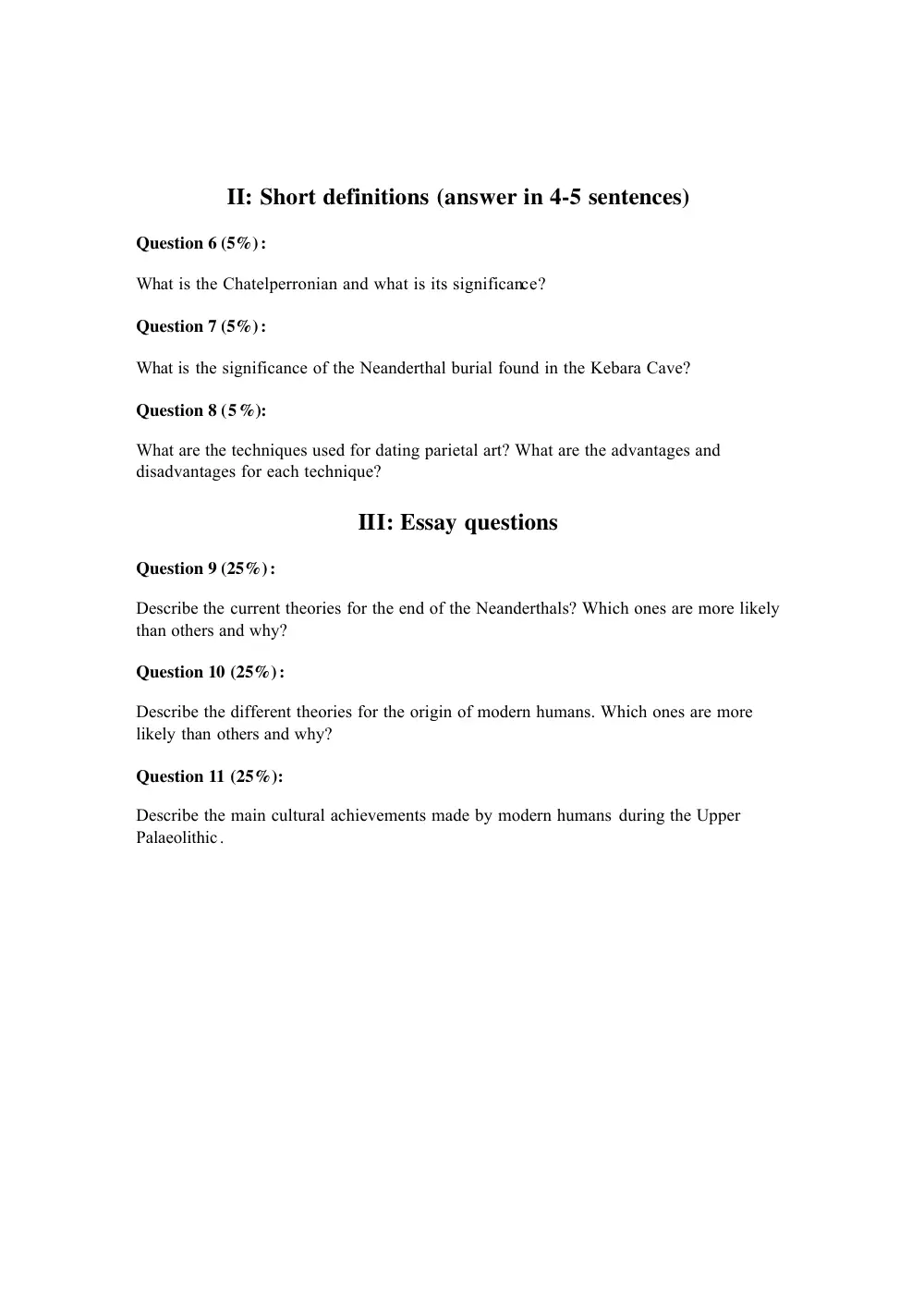
II: Short definitions (answer in 4-5 sentences)
Question 6 (5%):
What is the Chatelperronian and what is its significance?
Question 7 (5%):
What is the significance of the Neanderthal burial found in the Kebara Cave?
Question 8 (5%):
What are the techniques used for dating parietal art? What are the advantages and
disadvantages for each technique?
III: Essay questions
Question 9 (25%):
Describe the current theories for the end of the Neanderthals? Which ones are more likely
than others and why?
Question 10 (25%):
Describe the different theories for the origin of modern humans. Which ones are more
likely than others and why?
Question 11 (25%):
Describe the main cultural achievements made by modern humans during the Upper
Palaeolithic.