
CIVE 310 Exam 1, Fall 2016
American University of Beirut · Mechanics of Materials · 2 pages

More CIVE 310 files
- Exam 1 All Exam 1 Previouses · Fall 2015ExamView
- Exam 1 Previouses (Zip File) · Fall 2015ExamView
- Exam 3 Previouses Zip File (No Solution) · Fall 2015Exam · with solutionView
- Exam 2 Quiz 2 Previouses Zip File (No Solution) · Fall 2015Exam · with solutionView
- Exam 1 · Spring 2013ExamView
- Exam 1 · Fall 2012ExamView
- Exam 1 · Spring 2011ExamView
- Exam 1 Solution · Fall 2010Exam · with solutionView
Show the text of this exam
MECH 310 Thermodynamics I
November 20, 2007
American University of Beirut, Fall 2007
Handout # Quiz 1
Quiz 1
• This is a closed book exam.
• You have 90 minutes.
• Write your name and section number on both the question and answer sheets.
• It is recommended that you read the whole exam before you start solving.
Problem 1 (25 points)
Two kilograms of water are contained within a piston-cylinder arrangement. The piston
is weightless and undergoes frictionless motion. See Figure 1. At the initial state, there
are equal masses of liquid and vapor initially. The system is (process 1) slowly heated to
a position where the piston is locked, and then (process 2) the system is cooled to the
saturated vapor state at 50 ◦C. The atmospheric pressure is pa = 101.4 kPa.
(a) Is process 1 isothermal, isobaric, or isochoric? Why? What about process 2? why?
(b) Draw the processes on a p − v diagram, and
(c) Evaluate the work done during the process.
H2O
H2O
vacuum
H2O
pa
pa
Figure 1: Schematic for problem 1.
Problem 2 (25 points)
Steam occupies one-half of the partitioned insulated chamber shown in Figure 2. The
initial pressure and temperature of the steam are 0.3 MPa and 360 ◦C. The other half of
the chamber contains a vacuum. The partition is removed, and the steam fills the entire
volume at the end of the process. Determine the final temperature of the steam.
1
H2O
H2O
vacuum
partition
Figure 2: Schematic for problem 2.
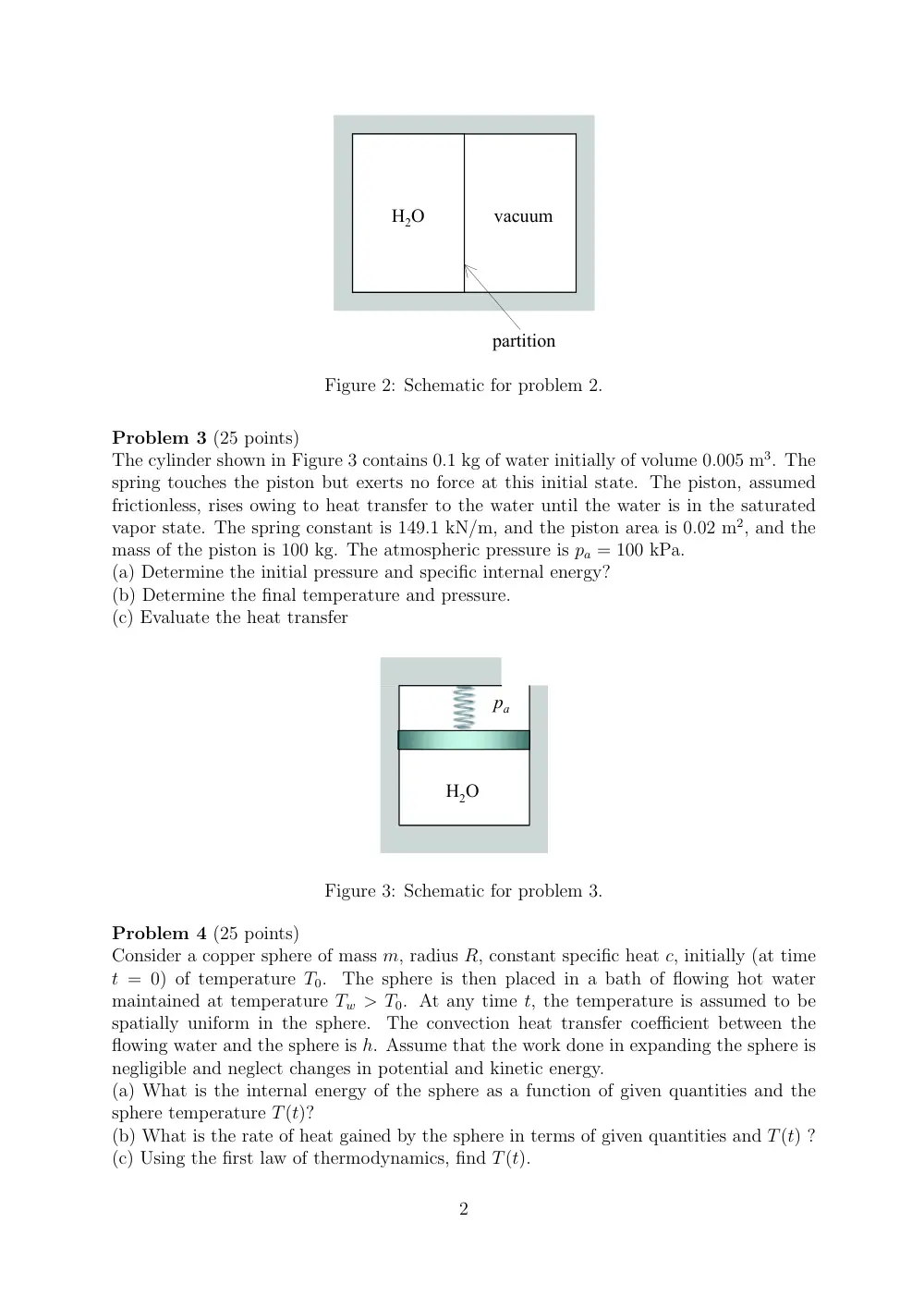
Problem 3 (25 points)
The cylinder shown in Figure 3 contains 0.1 kg of water initially of volume 0.005 m3. The
spring touches the piston but exerts no force at this initial state. The piston, assumed
frictionless, rises owing to heat transfer to the water until the water is in the saturated
vapor state. The spring constant is 149.1 kN/m, and the piston area is 0.02 m2, and the
mass of the piston is 100 kg. The atmospheric pressure is pa = 100 kPa.
(a) Determine the initial pressure and specific internal energy?
(b) Determine the final temperature and pressure.
(c) Evaluate the heat transfer
H2O
H2O
vacuum
partition
H2O
pa
pa
Figure 3: Schematic for problem 3.
Problem 4 (25 points)
Consider a copper sphere of mass m, radius R, constant specific heat c, initially (at time
t = 0) of temperature T0.
The sphere is then placed in a bath of flowing hot water
maintained at temperature Tw > T0. At any time t, the temperature is assumed to be
spatially uniform in the sphere.
The convection heat transfer coefficient between the
flowing water and the sphere is h. Assume that the work done in expanding the sphere is
negligible and neglect changes in potential and kinetic energy.
(a) What is the internal energy of the sphere as a function of given quantities and the
sphere temperature T(t)?
(b) What is the rate of heat gained by the sphere in terms of given quantities and T(t) ?
(c) Using the first law of thermodynamics, find T(t).
2