
CIVE 310 Exam 1, Spring 2011
American University of Beirut · Mechanics of Materials · 5 pages

More CIVE 310 files
- Exam 1 · Fall 2016ExamView
- Exam 1 All Exam 1 Previouses · Fall 2015ExamView
- Exam 1 Previouses (Zip File) · Fall 2015ExamView
- Exam 3 Previouses Zip File (No Solution) · Fall 2015Exam · with solutionView
- Exam 2 Quiz 2 Previouses Zip File (No Solution) · Fall 2015Exam · with solutionView
- Exam 1 · Spring 2013ExamView
- Exam 1 · Fall 2012ExamView
- Exam 1 · Fall 2010ExamView
Show the text of this exam
AMERICAN UNIVERSITY OF BEIRUT
CIVE 310-MECHANICS OF MATERIALS
Spring term 2011- quiz I (grade from 100)
Student Name: ID:
----------------------------------------------------------------------------------------------------------
Problem 1. Strain (15 PTS). A belt and a pulley system in a VCR (Video Casette recorder) has
the dimensions shown in Figure 1. To ensure adequate but not excessive tension in the belts, the
average normal strain in the belts must be min of 0.019 mm/mm and a maxi of 0.034 mm/mm.
Figure 1. Belt and
pulley in a VCR
What should be the minimum and maximum undeformed lengths of the belt to the nearest
millimeter? (Formula: + geometry/trigonometry are the only equations to be used).
PLAN. The belt must be tangent at the point where
it
comes in contact with the pulley. The deformed
length of the belt is the length of belt between the
tangent points on the pulleys, plus the length of belt
wrapped around the pulleys. Once we calculate the
deformed length of the belt using geometry, we can
find the original length using the classic formula of
strain and the given limits on normal strain
Problem 2.(35 PTS) Multi-axial loading (Part a-15pts)/Axial Loading (Part b-15 pts) -Parts a and b
are independent
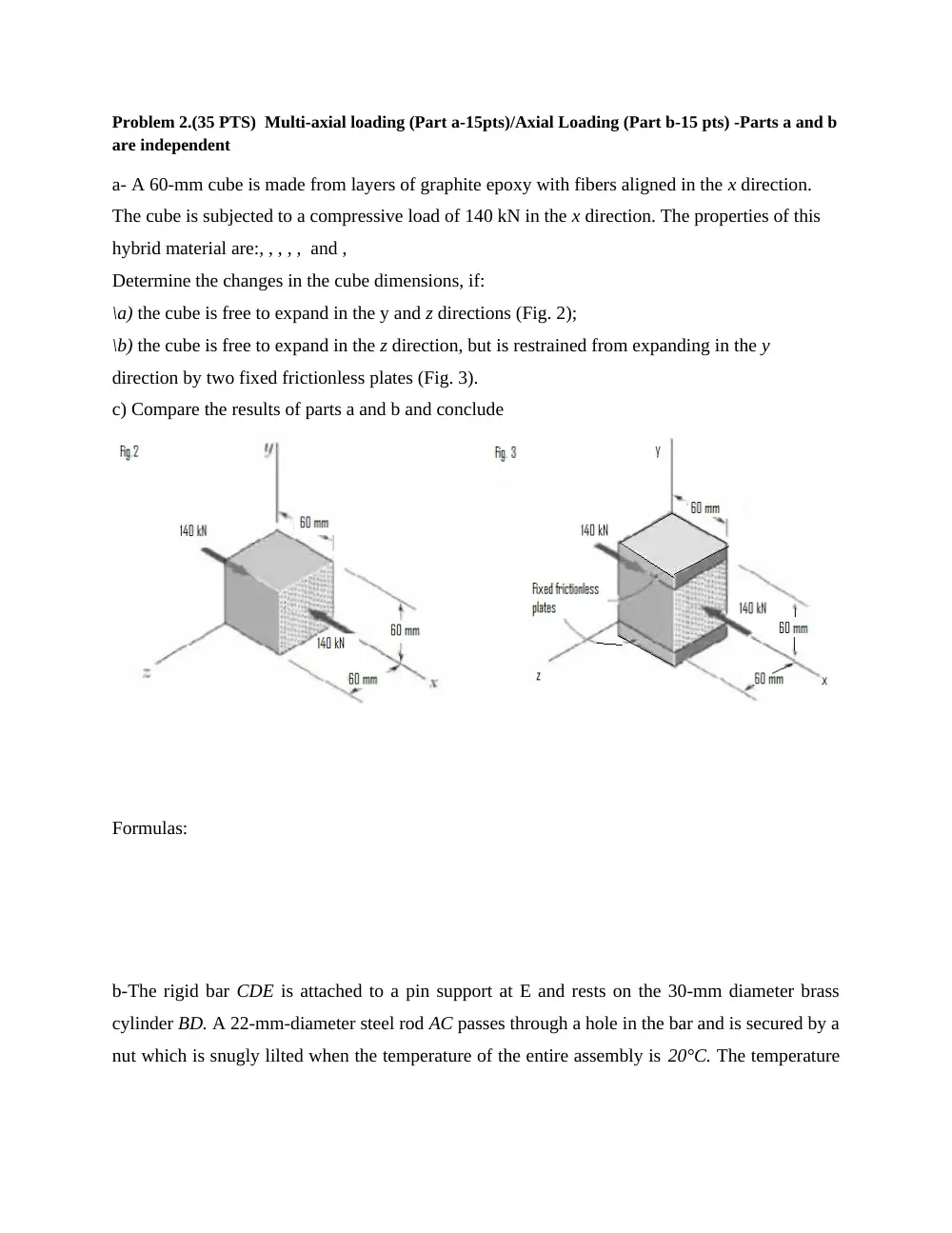
a- A 60-mm cube is made from layers of graphite epoxy with fibers aligned in the x direction.
The cube is subjected to a compressive load of 140 kN in the x direction. The properties of this
hybrid material are:, , , , , and ,
Determine the changes in the cube dimensions, if:
\a) the cube is free to expand in the y and z directions (Fig. 2);
\b) the cube is free to expand in the z direction, but is restrained from expanding in the y
direction by two fixed frictionless plates (Fig. 3).
c) Compare the results of parts a and b and conclude
Formulas:
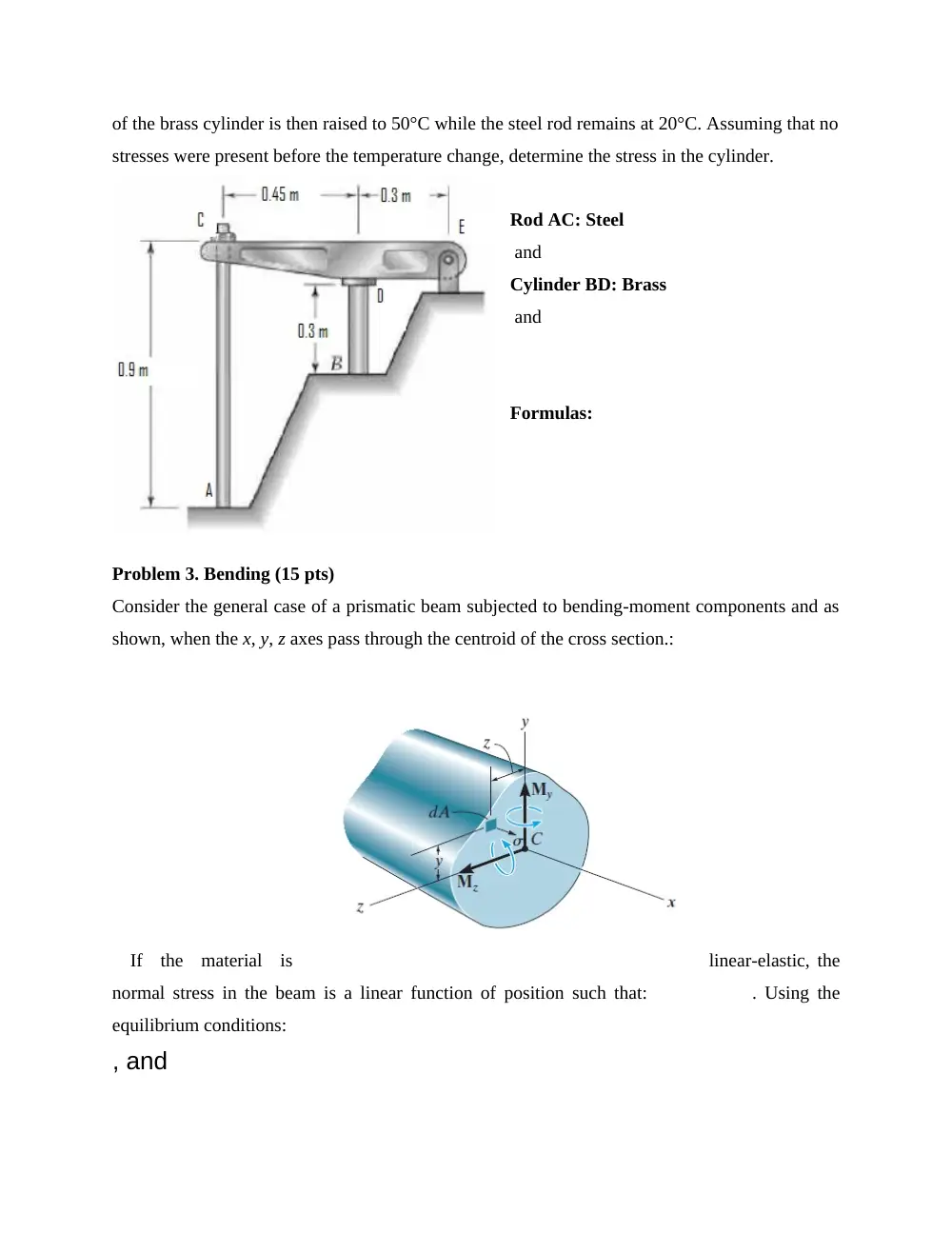
b-The rigid bar CDE is attached to a pin support at E and rests on the 30-mm diameter brass
cylinder BD. A 22-mm-diameter steel rod AC passes through a hole in the bar and is secured by a
nut which is snugly lilted when the temperature of the entire assembly is 20°C. The temperature
of the brass cylinder is then raised to 50°C while the steel rod remains at 20°C. Assuming that no
stresses were present before the temperature change, determine the stress in the cylinder.
Rod AC: Steel
and
Cylinder BD: Brass
and
Formulas:
Problem 3. Bending (15 pts)
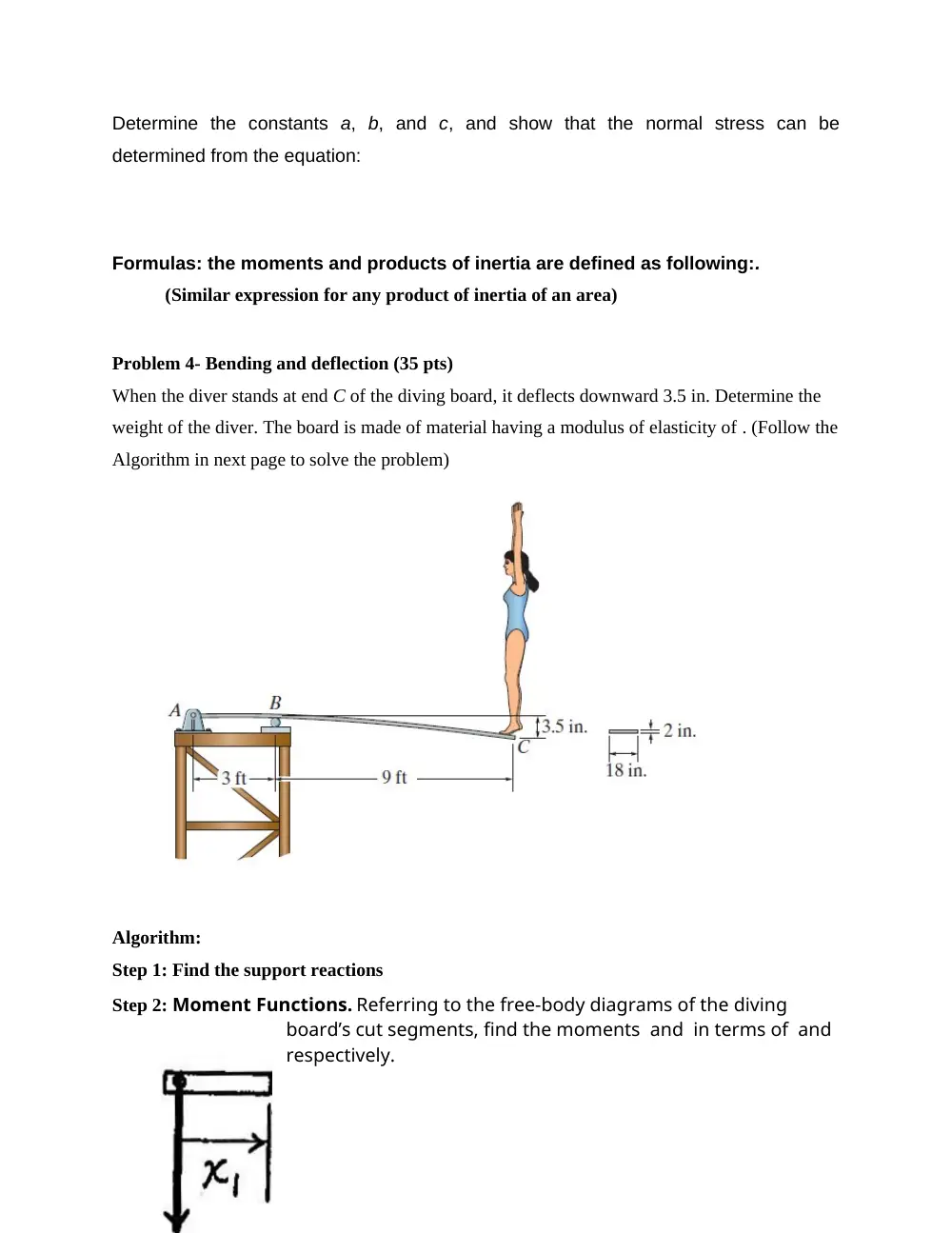
Consider the general case of a prismatic beam subjected to bending-moment components and as
shown, when the x, y, z axes pass through the centroid of the cross section.:
If the material is
linear-elastic, the
normal stress in the beam is a linear function of position such that: . Using the
equilibrium conditions:
, and
Determine the constants a, b, and c, and show that the normal stress can be
determined from the equation:
Formulas: the moments and products of inertia are defined as following:.
(Similar expression for any product of inertia of an area)
Problem 4- Bending and deflection (35 pts)
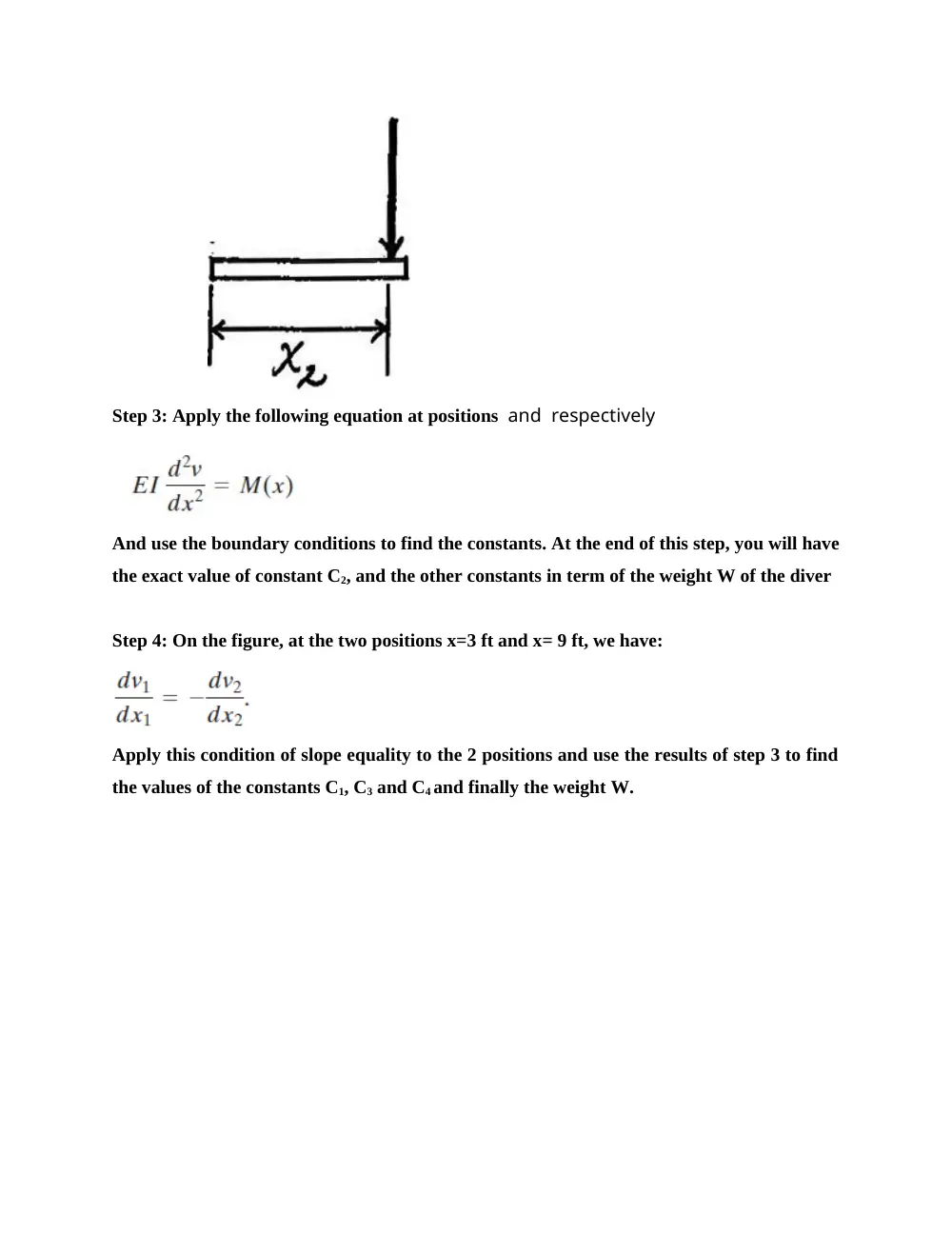
When the diver stands at end C of the diving board, it deflects downward 3.5 in. Determine the
weight of the diver. The board is made of material having a modulus of elasticity of . (Follow the
Algorithm in next page to solve the problem)
Algorithm:
Step 1: Find the support reactions
Step 2: Moment Functions. Referring to the free-body diagrams of the diving
board’s cut segments, find the moments and in terms of and
respectively.
Step 3: Apply the following equation at positions and respectively
And use the boundary conditions to find the constants. At the end of this step, you will have
the exact value of constant C2, and the other constants in term of the weight W of the diver
Step 4: On the figure, at the two positions x=3 ft and x= 9 ft, we have:
Apply this condition of slope equality to the 2 positions and use the results of step 3 to find
the values of the constants C1, C3 and C4 and finally the weight W.