
CIVE 310 Exam 1, Spring 2013
American University of Beirut · Mechanics of Materials · 2 pages · Prof. George Saad
More CIVE 310 files
- Exam 1 · Fall 2016ExamView
- Exam 1 All Exam 1 Previouses · Fall 2015ExamView
- Exam 1 Previouses (Zip File) · Fall 2015ExamView
- Exam 3 Previouses Zip File (No Solution) · Fall 2015Exam · with solutionView
- Exam 2 Quiz 2 Previouses Zip File (No Solution) · Fall 2015Exam · with solutionView
- Exam 1 · Fall 2012ExamView
- Exam 1 · Spring 2011ExamView
- Exam 1 · Fall 2010ExamView
Show the text of this exam
AUB-CEE-CIVE 310 Mechanics of Materials
Saad – Spring 2012-13
1
Exam 1
March 12, 2013
90 minutes
Problem 1 (20 Points)
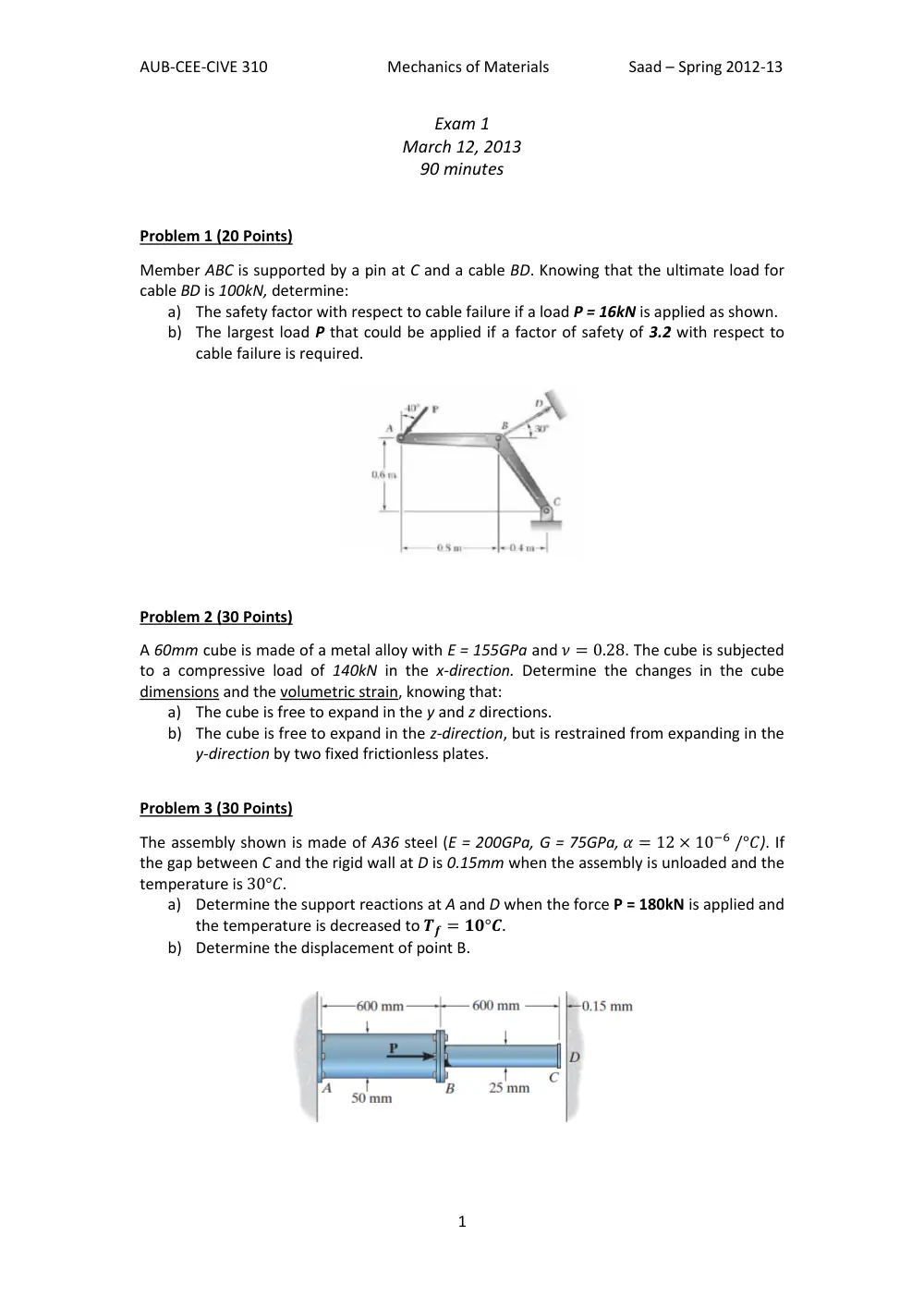
Member ABC is supported by a pin at C and a cable BD. Knowing that the ultimate load for
cable BD is 100kN, determine:
a) The safety factor with respect to cable failure if a load P = 16kN is applied as shown.
b) The largest load P that could be applied if a factor of safety of 3.2 with respect to
cable failure is required.
Problem 2 (30 Points)
A 60mm cube is made of a metal alloy with E = 155GPa and . The cube is subjected
to a compressive load of 140kN in the x-direction. Determine the changes in the cube
dimensions and the volumetric strain, knowing that:
a) The cube is free to expand in the y and z directions.
b) The cube is free to expand in the z-direction, but is restrained from expanding in the
y-direction by two fixed frictionless plates.
Problem 3 (30 Points)
The assembly shown is made of A36 steel (E = 200GPa, G = 75GPa, ). If
the gap between C and the rigid wall at D is 0.15mm when the assembly is unloaded and the
temperature is .
a) Determine the support reactions at A and D when the force P = 180kN is applied and
the temperature is decreased to
b) Determine the displacement of point B.
AUB-CEE-CIVE 310 Mechanics of Materials
Saad – Spring 2012-13
2
Problem 4 (20 Points)
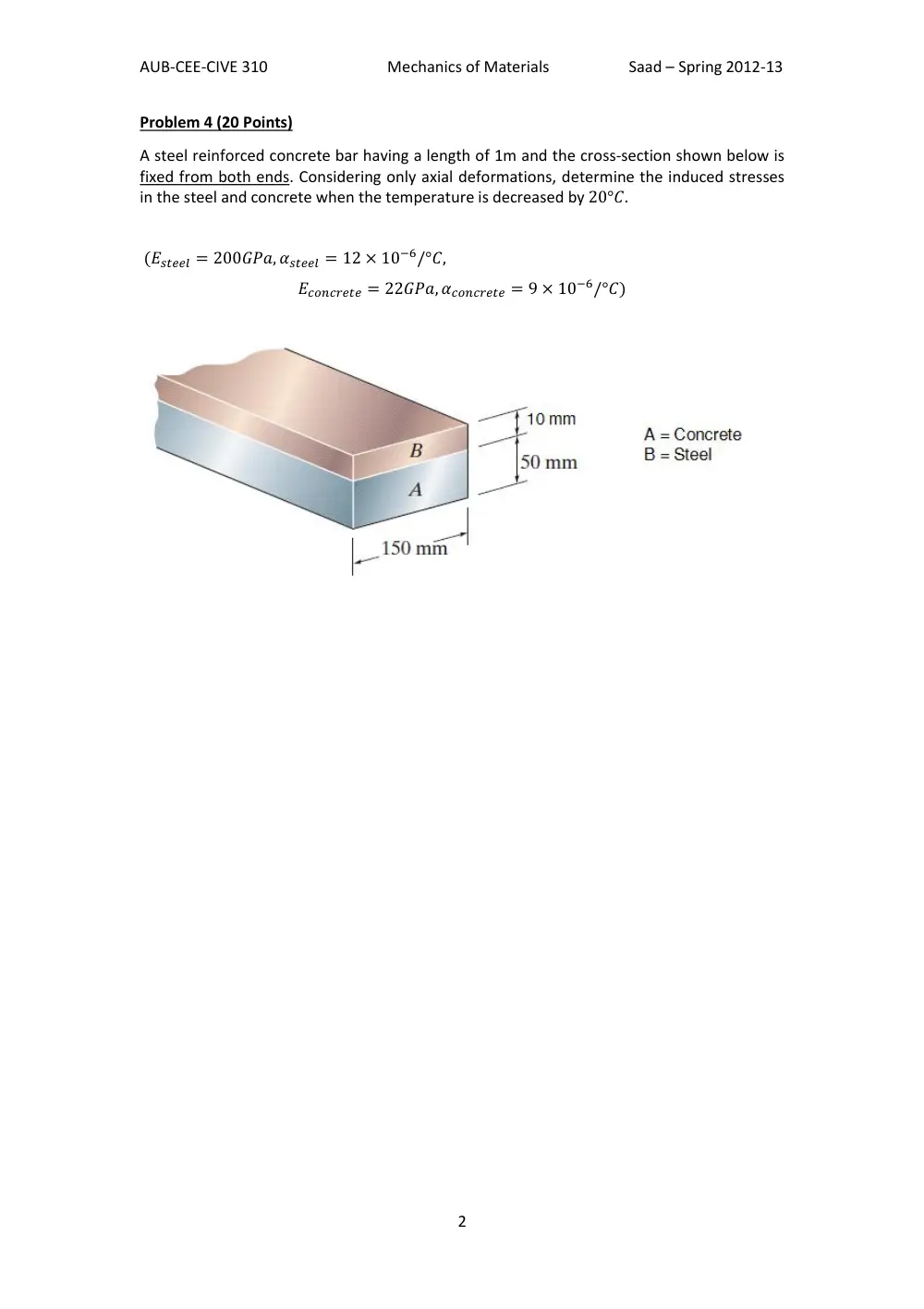
A steel reinforced concrete bar having a length of 1m and the cross-section shown below is
fixed from both ends. Considering only axial deformations, determine the induced stresses
in the steel and concrete when the temperature is decreased by