
CMPS 256 Problems, Spring 2008
American University of Beirut · Advanced Algorithms and Data Structures · 12 pages






Showing the first 10 of 12 pages. Download the PDF to see all of it.
More CMPS 256 files
- Midterm Exam · Fall 2017ExamView
- Midterm With Solution · Fall 2015Exam · with solutionView
- Lecture CMPS 256 Lecture 1 · Fall 2013LabView
- Final · Fall 2013Final examView
- Final Solutions · Fall 2013Final exam · with solutionView
- Exam 1 With Solutions · Fall 2012Exam · with solutionView
- Final Solutions · Fall 2012Final exam · with solutionView
- Midterm With Solutions · Summer 2012Exam · with solutionView
Show the text of this problems
CMPS 256: Advanced Algorithms
and Data Structures
Chapter 3
Exercises & Solutions
Feb. 23, 2006
Spring 2005-06
Chiraz BenAbdelkader
Exercise 1
5n2 + 100n
3n2 + 2
f = ?(g)
log3(n2)
lg(n3)
f = ?(g)
nlg4
3lg n
f = ?(g)
lg2n
n1/2
f = ?(g)
f
g
Compare the rate of growth of each pair of functions f and g below.
Solution
5n2 + 100n
3n2 + 2
5/3
f = Θ(g)
log3(n2)
lg(n3)
2/3*lg3
f = Θ(g)
nlg4
3lg n
∞
f = ω(g)
lg2n
n1/2
0
f = o(g)
limn → ∞f(n)/g(n)
f
g
Answer
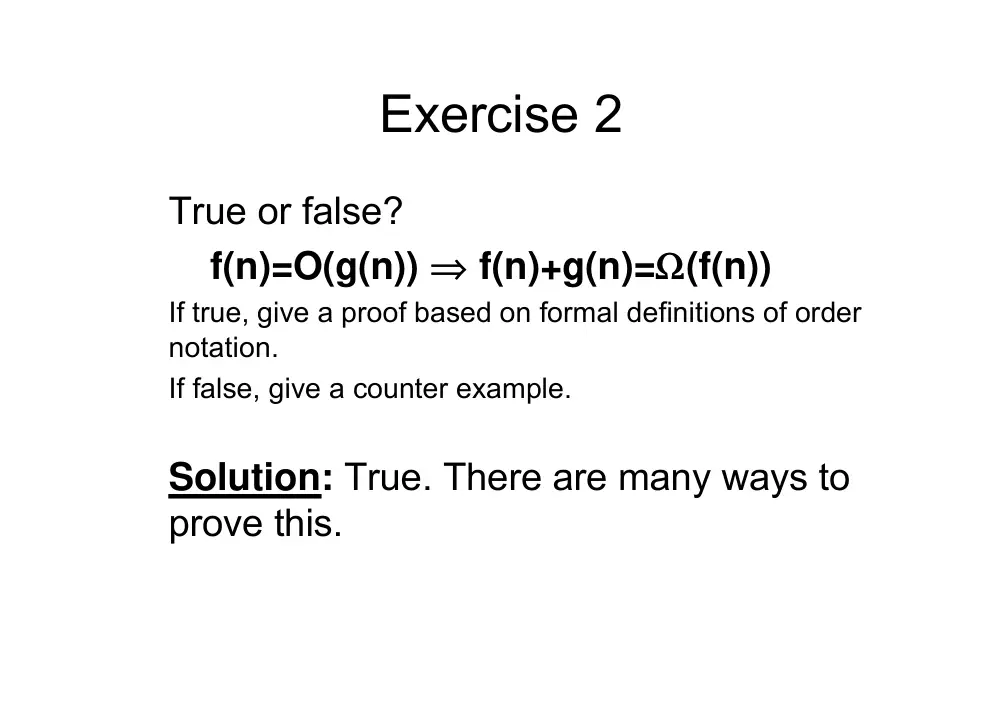
Exercise 2
True or false?
f(n)=O(g(n)) ⇒
⇒ f(n)+g(n)=ΩΩ(f(n))
If true, give a proof based on formal definitions of order
notation.
If false, give a counter example.
Solution: True. There are many ways to
prove this.
Exercise 2 (Cont.)
First proof method:
Second proof method:
( ( ))
( )
( )
0
( )
( )
( )
lim
0
1
( )
( )
lim
0
1
( )
( )
lim
0
( )
( )
lim
( ( ))
( )
( ( ))
)
(
f n
f n
g n
f n
f n
g n
f n
n
g
f n
g n
f n
g n
f n
g n
O g n
n
f
n
n
n
n
= Ω
+
⇔
>
+
⇒
>
+
⇒
+ >
⇒
>
⇔
= Ω
⇔
=
→∞
∞
→
→∞
∞
→
( ( )) is closed under addition)
( ( )) (
( )
)
(
( ( ))
( )
Also,
( ( )) (transpose symmetry)
( )
( ( ))
)
(
f n
f n
g n
n
f
f n
n
f
f n
g n
O g n
n
f
Ω
= Ω
+
∴
Ω
=
= Ω
⇔
=
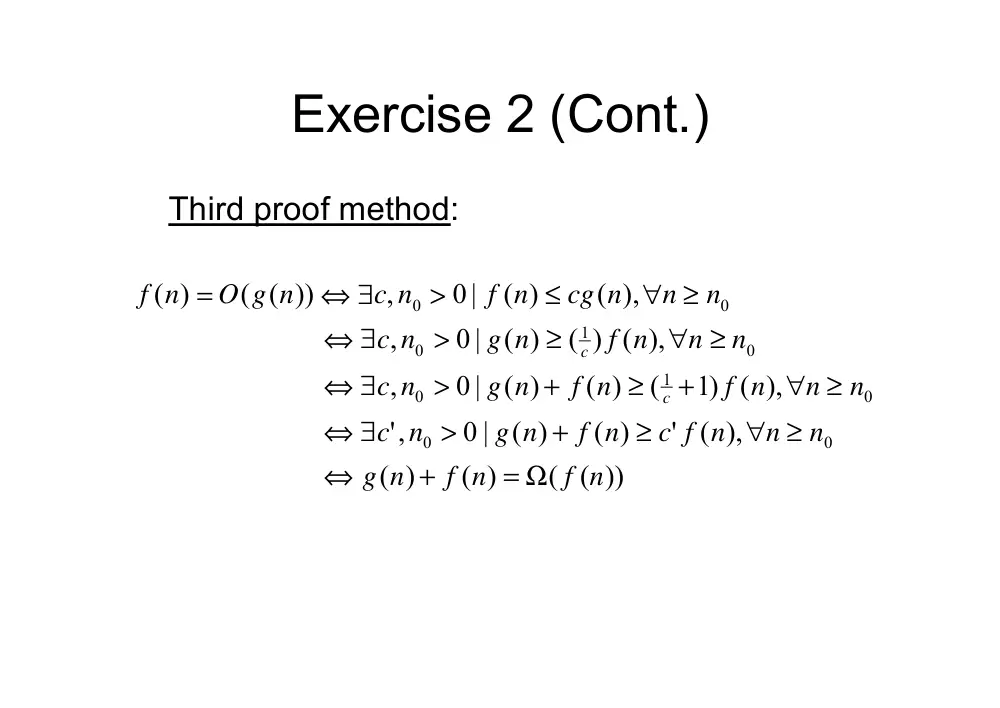
Exercise 2 (Cont.)
Third proof method:
( ( ))
( )
( )
( ),
'
( )
( )
0 |
,'
( ),
)1
(
( )
( )
0 |
,
( ) ( ),
( )
0 |
,
( ),
( )
0 |
,
( ( ))
)
(
0
0
0
1
0
0
1
0
0
0
f n
f n
n
g
n
n
c f n
f n
g n
n
c
n
n
f n
f n
g n
n
c
n
n
f n
g n
n
c
n
n
cg n
f n
c n
O g n
n
f
c
c
= Ω
+
⇔
∀ ≥
≥
+
>
∃
⇔
∀ ≥
+
≥
+
>
∃
⇔
∀ ≥
≥
>
∃
⇔
∀ ≥
≤
>
⇔ ∃
=
Exercise 3
Order these functions asymptotically from
slowest to fastest rate of growth:
n
n
n
n
n
n
n
n
n
n
n
n
n
n
n
n
lg
lg
3
6.0
2
4
/ lg
1
999
.2
4
2
10.
100)!
(
9.
/ lg
8.
3lg
7.
6.
lg
/)!
lg(
5.
5
4.
3.
)
20lg(5
2.
lg
1.
−
+
+
Exercise 3 (Cont.)
Solution Strategy:
In any question of this form, first simplify each function
as much as possible
Typically, simplify to well-known functions such as
polynomial, poly-log, exponential, or factorial
Use following rules from formula sheet to sort functions
Polynomials are easy to compare: for any a,b>0, if a>b then
na=ω(nb)
So are exponentials: for any a,b>1, if a>b then an=ω(bn)
Also we know that: for any c>1, a>0, b>0
nn = ωω(n!) = ωω(cn) = ωω(nb) = ωω(logan)
If cannot use any of these rules, compare functions by
computing the limit of their ratio
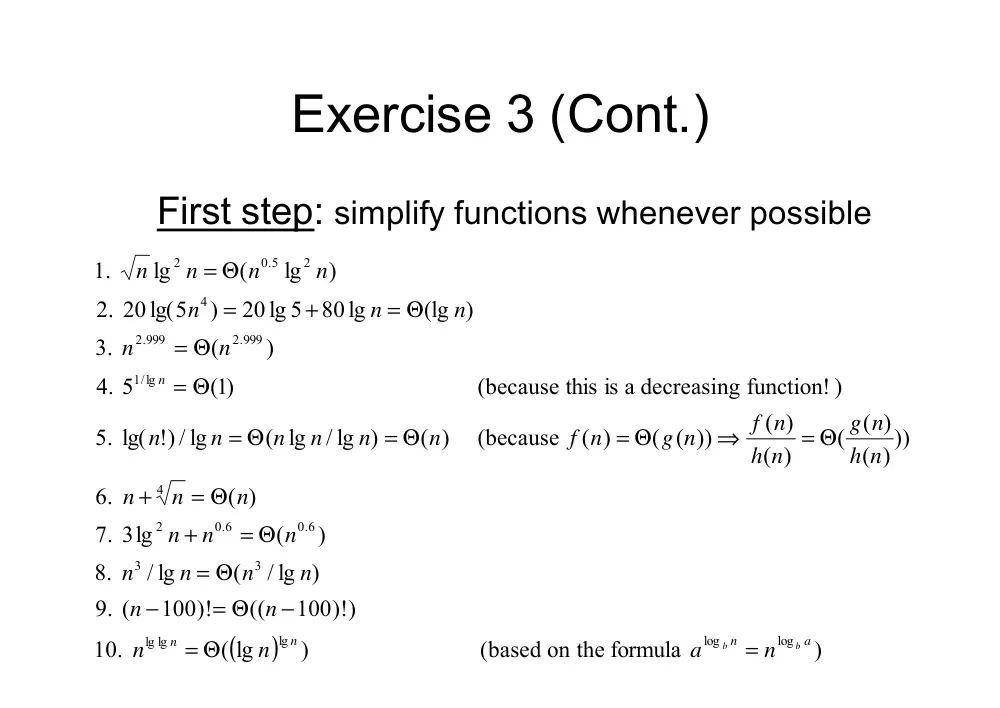
Exercise 3 (Cont.)
First step: simplify functions whenever possible
(
)
)
) (based on the formula
( lg
10.
100)!)
((
100)!
(
9.
/ lg )
(
/ lg
8.
)
(
3lg
7.
( )
6.
( ) ))
( ( )
( )
( )
( ( ))
( ) (because ( )
/ lg )
( lg
lg
/)!
lg(
5.
)1( (because this is a decreasing function! )
5
4.
)
(
3.
(lg )
80 lg
20 lg 5
)
20 lg(5
2.
)
lg
(
lg
1.
log
log
lg
lg
lg
3
3
6.0
6.0
2
4
/lg
1
.2 999
999
.2
4
2
5.0
2
a
n
n
n
n
b
b
n
a
n
n
n
n
n
n
n
n
n
n
n
n
n
n
h n
g n
h n
f n
g n
f n
n
n
n
n
n
n
n
n
n
n
n
n
n
n
n
=
Θ
=
−
= Θ
−
Θ
=
= Θ
+
= Θ
+
= Θ
⇒
= Θ
= Θ
Θ
=
Θ
=
Θ
=
= Θ
+
=
= Θ
Exercise 3 (Cont.)
Second step: separate the functions into
homogeneous groups in increasing order
of growth
(
)
n
n
n
n
n
n
n
n
n
n
n
lg
3
2
5.0
.2 999
6.0
lg
/ lg )
) (
lg
(
:
Other
100)!
(
:
Factorials
ls : None
Exponentia
)
) (
(
)
(
s :
Polynomial
-logs : None
Poly
(lg )
Logarithms :
)1(
:
Constants
Θ
Θ
Θ
−
Θ
Θ
Θ
Θ
Θ
Θ
Exercise 3 (Cont.)
Third step: sort the functions in each group
Use theorems (in formula sheet); otherwise
compute the limit of ratio of pairs of functions
For example, we have the following:
[
]
(
)
[
]
(
)
[
]
[
] ⇒
=
⇒
=
−
=
−
=
= ∞ ⇒
=
→∞
→∞
∞
→
→∞
∞
→
)
/ lg
(lg
lg lg
0
lg
1
lglg
3
lim
lg lglg
lglg
lim 3lg
lg lg
/ lg
lg
lim
lim lg
lg
/ lg
lim
3
lg
lg
3
3
5.
2
2
5.
0
3
n
n
n
n
n
n
n
n
n
n
n
n
n
n
n
n
n
n
n
n
n
n
n
n
n
ω
)
lg
(
/ lg
2
0 5.
3
n
n
n
n
ω
=
(
)
/lg )
(
lg
3
lg
n
n
n
n
= ω
Exercise 4
Given two functions f(n) and g(n), let
h(n) = max(f(n),g(n))
Prove that: h(n) = ΘΘ(f(n)+g(n))
Solution:
Like in Exercise 2, you should use formal
definitions of order notation in your proof.
Hint: use this definition of Θ-notation
h(n)=Θ(f(n)+g(n)) ⇔
∃c1,c2,n0>0 | c1(g(n)+f(n)) ≤ h(n) ≤ c2(f(n)+g(n))
(to be finished as homework)