
CMPS 256 Final, Fall 2013
American University of Beirut · Advanced Algorithms and Data Structures · 10 pages · Dr. Fatima Abu Salem


More CMPS 256 files
- Final Solutions · Fall 2013Final exam · with solutionView
- Final Solutions · Fall 2012Final exam · with solutionView
- Final · Fall 2005Final examView
- Final · Spring 2004Final examView
- Final · Fall 2004Final examView
- Final · Fall 2004Final examView
- Final · Fall 2003Final examView
- Final · Fall 2003Final examView
Show the text of this final exam
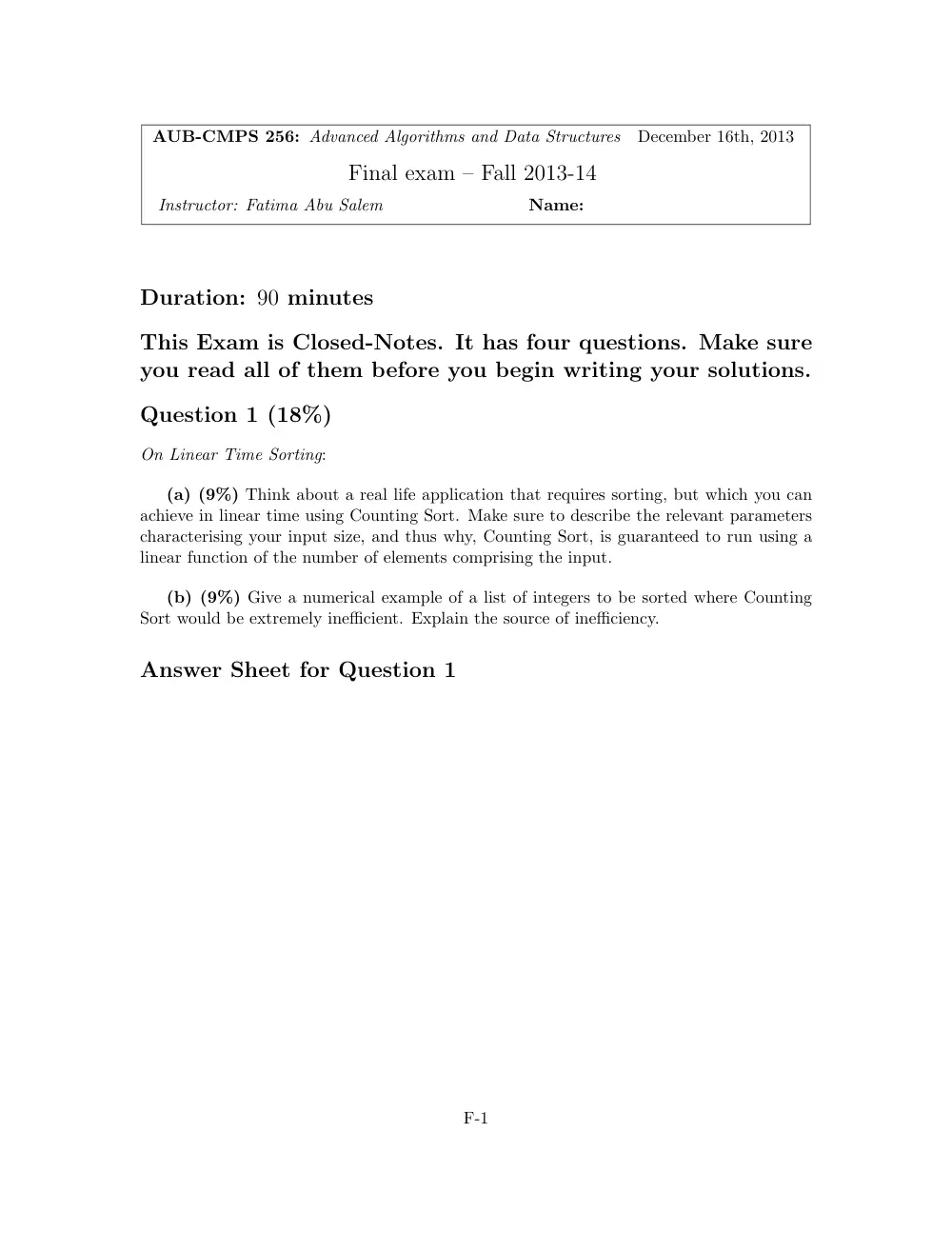
AUB-CMPS 256: Advanced Algorithms and Data Structures
December 16th, 2013
Final exam – Fall 2013-14
Instructor: Fatima Abu Salem
Name:
Duration: 90 minutes
This Exam is Closed-Notes. It has four questions. Make sure
you read all of them before you begin writing your solutions.
Question 1 (18%)
On Linear Time Sorting:
(a) (9%) Think about a real life application that requires sorting, but which you can
achieve in linear time using Counting Sort. Make sure to describe the relevant parameters
characterising your input size, and thus why, Counting Sort, is guaranteed to run using a
linear function of the number of elements comprising the input.
(b) (9%) Give a numerical example of a list of integers to be sorted where Counting
Sort would be extremely inefficient. Explain the source of inefficiency.
Answer Sheet for Question 1
F-1
Answer Sheet for Question 1
F-2
Question 2 (25%)
On Priority Queues Using a Max-heap
Suppose you’re given a list of integers that is known to contain duplicates. Suppose you
also build a Max-heap using this list of integers.
(a) (8%) Let max denote the value of the largest integer appearing in the list. Where
would the duplicates of max reside in the heap?
(b) (8%) Suppose now that there are duplicates of another integer that is not equal to
max. Where would those duplicates reside in the heap?
(c) (8%) Would you recommend using a Max-heap priority queue for a generic (random)
search query? Justify why or why not.
Answer Sheet for Question 2
F-3
Answer Sheet for Question 2
F-4
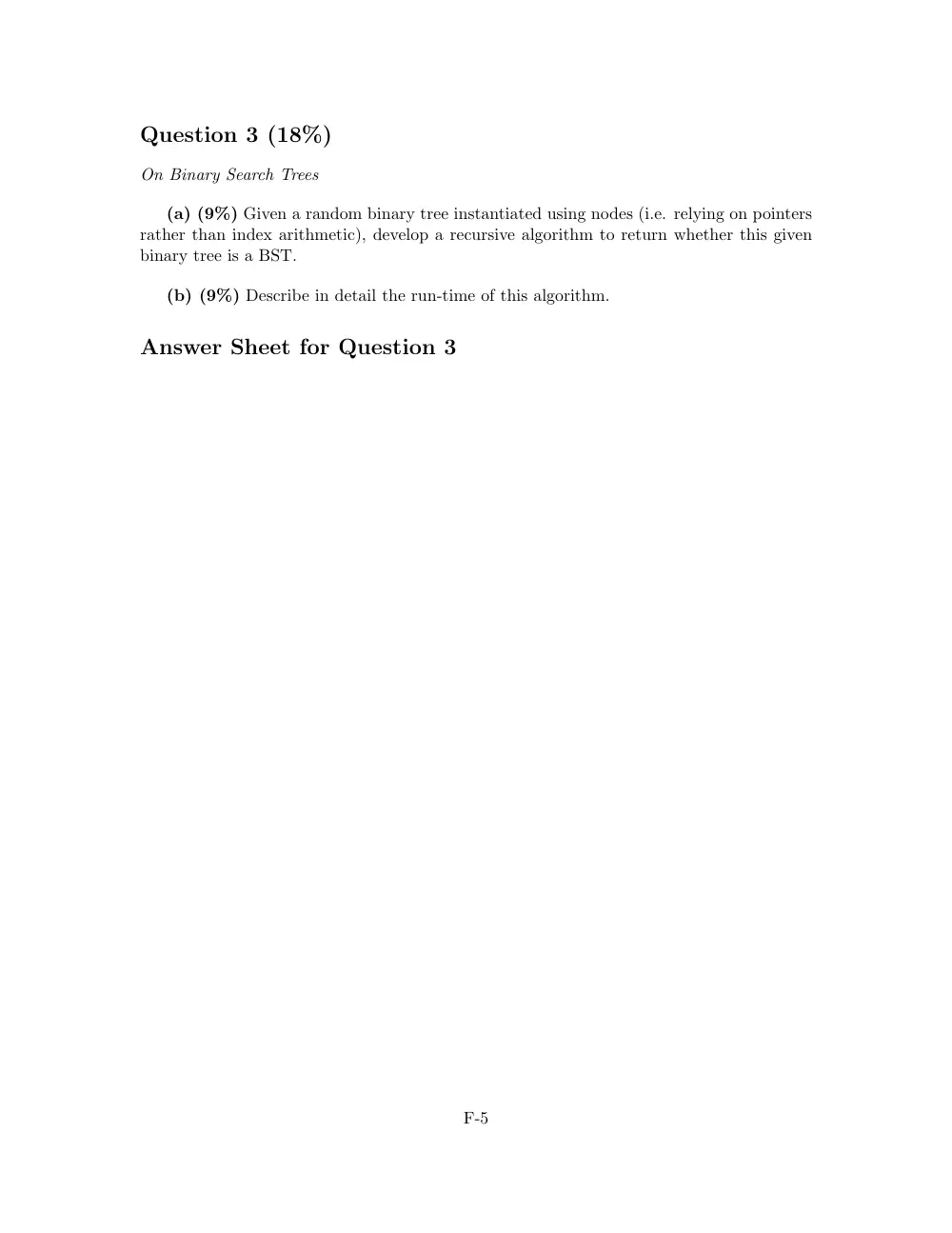
Question 3 (18%)
On Binary Search Trees
(a) (9%) Given a random binary tree instantiated using nodes (i.e. relying on pointers
rather than index arithmetic), develop a recursive algorithm to return whether this given
binary tree is a BST.
(b) (9%) Describe in detail the run-time of this algorithm.
Answer Sheet for Question 3
F-5
Answer Sheet for Question 3
F-6
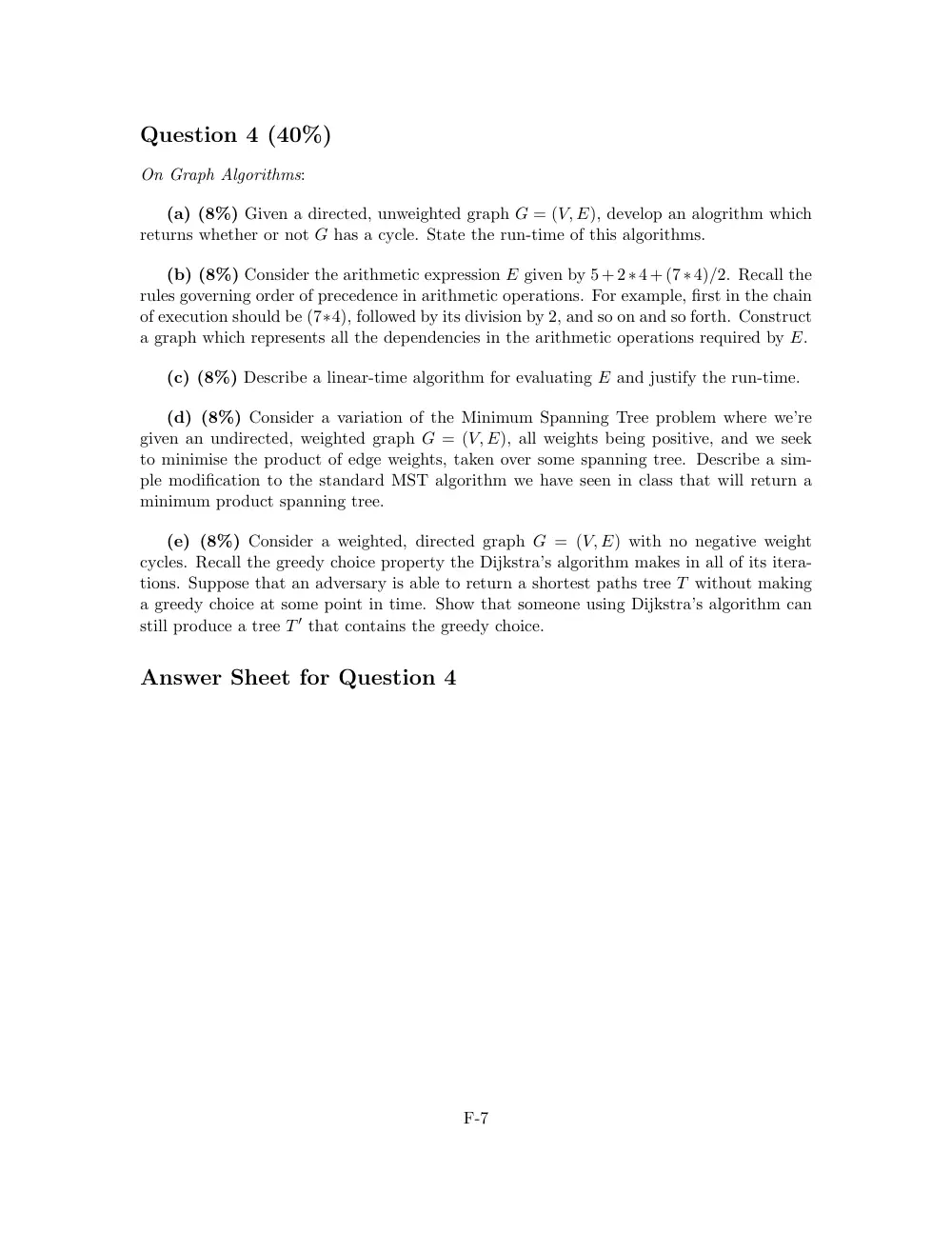
Question 4 (40%)
On Graph Algorithms:
(a) (8%) Given a directed, unweighted graph G = (V, E), develop an alogrithm which
returns whether or not G has a cycle. State the run-time of this algorithms.
(b) (8%) Consider the arithmetic expression E given by 5+2∗4+(7∗4)/2. Recall the
rules governing order of precedence in arithmetic operations. For example, first in the chain
of execution should be (7∗4), followed by its division by 2, and so on and so forth. Construct
a graph which represents all the dependencies in the arithmetic operations required by E.
(c) (8%) Describe a linear-time algorithm for evaluating E and justify the run-time.
(d) (8%) Consider a variation of the Minimum Spanning Tree problem where we’re
given an undirected, weighted graph G = (V, E), all weights being positive, and we seek
to minimise the product of edge weights, taken over some spanning tree. Describe a sim-
ple modification to the standard MST algorithm we have seen in class that will return a
minimum product spanning tree.
(e) (8%) Consider a weighted, directed graph G = (V, E) with no negative weight
cycles. Recall the greedy choice property the Dijkstra’s algorithm makes in all of its itera-
tions. Suppose that an adversary is able to return a shortest paths tree T without making
a greedy choice at some point in time. Show that someone using Dijkstra’s algorithm can
still produce a tree T ′ that contains the greedy choice.
Answer Sheet for Question 4
F-7
Answer Sheet for Question 4
F-8
Answer Sheet for Question 4
F-9
Answer Sheet for Question 4
F-10