
CMPS 256 Final Solutions, Fall 2013
American University of Beirut · Advanced Algorithms and Data Structures · 3 pages · Dr. Paul Atie · with solution
More CMPS 256 files
Show the text of this final exam
CMPS 256 — ADVANCED ALGORITHMS AND DATA STRUCTURES
Summer 2013 – 14
Final Examination
Monday July 14, Bliss 105, 8:00 – 10:00 a.m.
Instructions.
This quiz is scored out of 100.
This quiz is open book and open notes: you can use the textbook, notes you have taken in class,
and your homework solutions.
Show your work, as partial credit will be given.
You may use any algorithm that was covered in class. Just give the name of the algorithm and
the chapter or page number in the book where the algorithm is given. If taken from your lecture
notes, just say “lecture notes.”
For questions that require you to write an algorithm, you must prove that your algorithm has
the required running time.
Please draw a horizontal line to separate each answer from the next.
Best of luck!
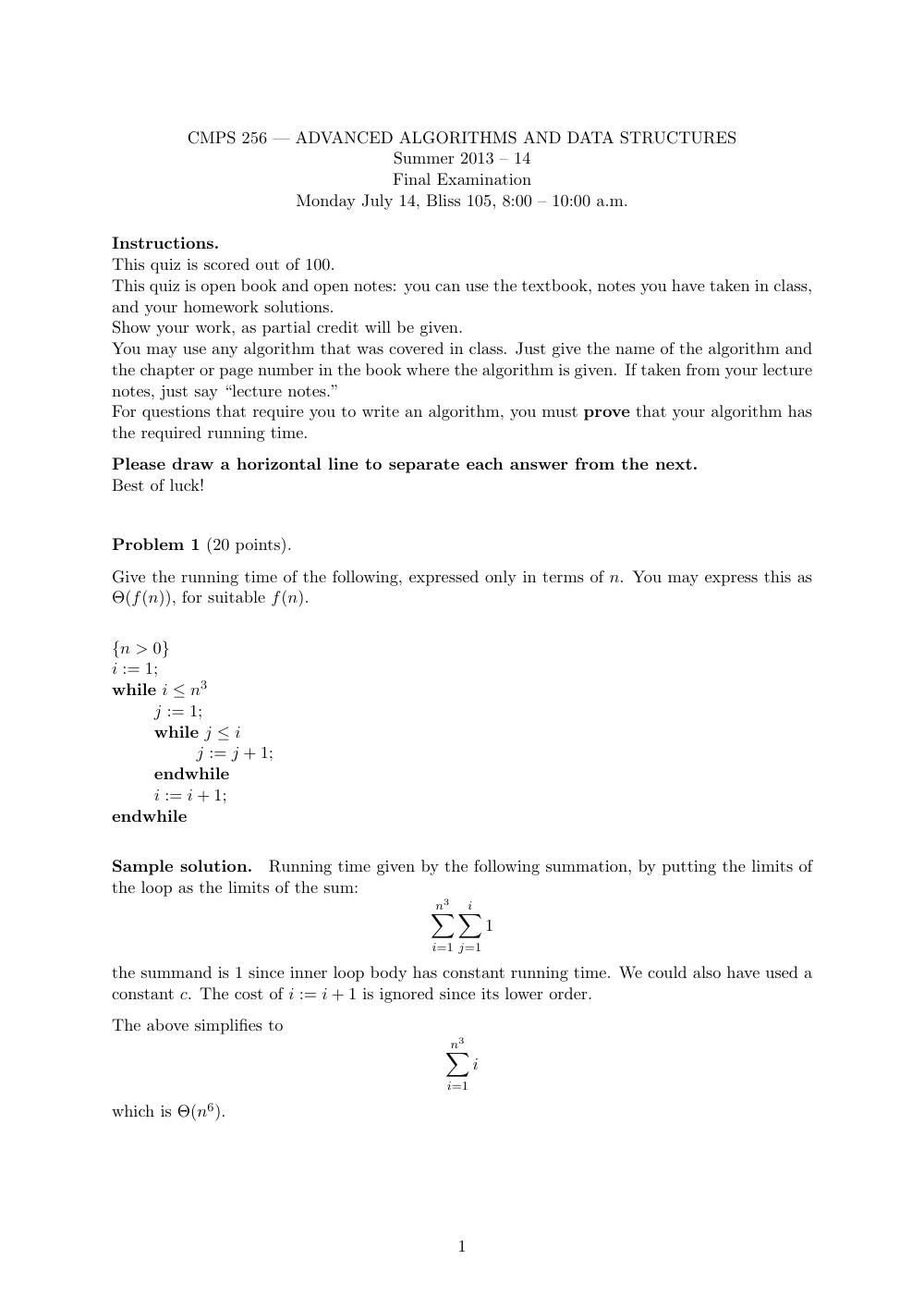
Problem 1 (20 points).
Give the running time of the following, expressed only in terms of n. You may express this as
Θ(f(n)), for suitable f(n).
{n > 0}
i := 1;
while i ≤ n3
j := 1;
while j ≤ i
j := j + 1;
endwhile
i := i + 1;
endwhile
Sample solution.
Running time given by the following summation, by putting the limits of
the loop as the limits of the sum:
n3
�
i=1
i
�
j=1
1
the summand is 1 since inner loop body has constant running time. We could also have used a
constant c. The cost of i := i + 1 is ignored since its lower order.
The above simplifies to
n3
�
i=1
i
which is Θ(n6).
1
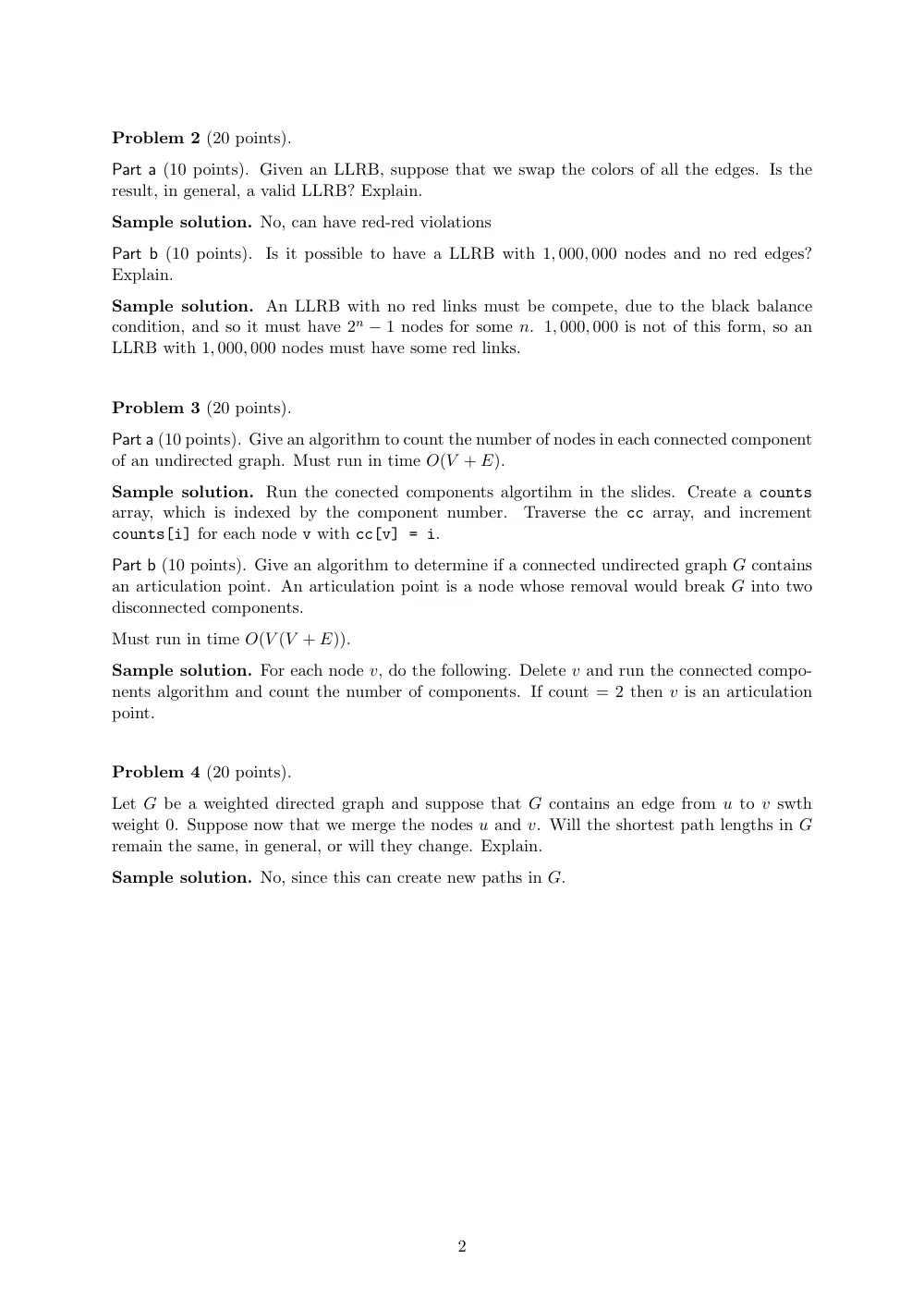
Problem 2 (20 points).
Part a (10 points). Given an LLRB, suppose that we swap the colors of all the edges. Is the
result, in general, a valid LLRB? Explain.
Sample solution. No, can have red-red violations
Part b (10 points). Is it possible to have a LLRB with 1, 000, 000 nodes and no red edges?
Explain.
Sample solution. An LLRB with no red links must be compete, due to the black balance
condition, and so it must have 2n − 1 nodes for some n. 1, 000, 000 is not of this form, so an
LLRB with 1, 000, 000 nodes must have some red links.
Problem 3 (20 points).
Part a (10 points). Give an algorithm to count the number of nodes in each connected component
of an undirected graph. Must run in time O(V + E).
Sample solution. Run the conected components algortihm in the slides. Create a counts
array, which is indexed by the component number.
Traverse the cc array, and increment
counts[i] for each node v with cc[v] = i.
Part b (10 points). Give an algorithm to determine if a connected undirected graph G contains
an articulation point. An articulation point is a node whose removal would break G into two
disconnected components.
Must run in time O(V (V + E)).
Sample solution. For each node v, do the following. Delete v and run the connected compo-
nents algorithm and count the number of components. If count = 2 then v is an articulation
point.
Problem 4 (20 points).
Let G be a weighted directed graph and suppose that G contains an edge from u to v swth
weight 0. Suppose now that we merge the nodes u and v. Will the shortest path lengths in G
remain the same, in general, or will they change. Explain.
Sample solution. No, since this can create new paths in G.
2
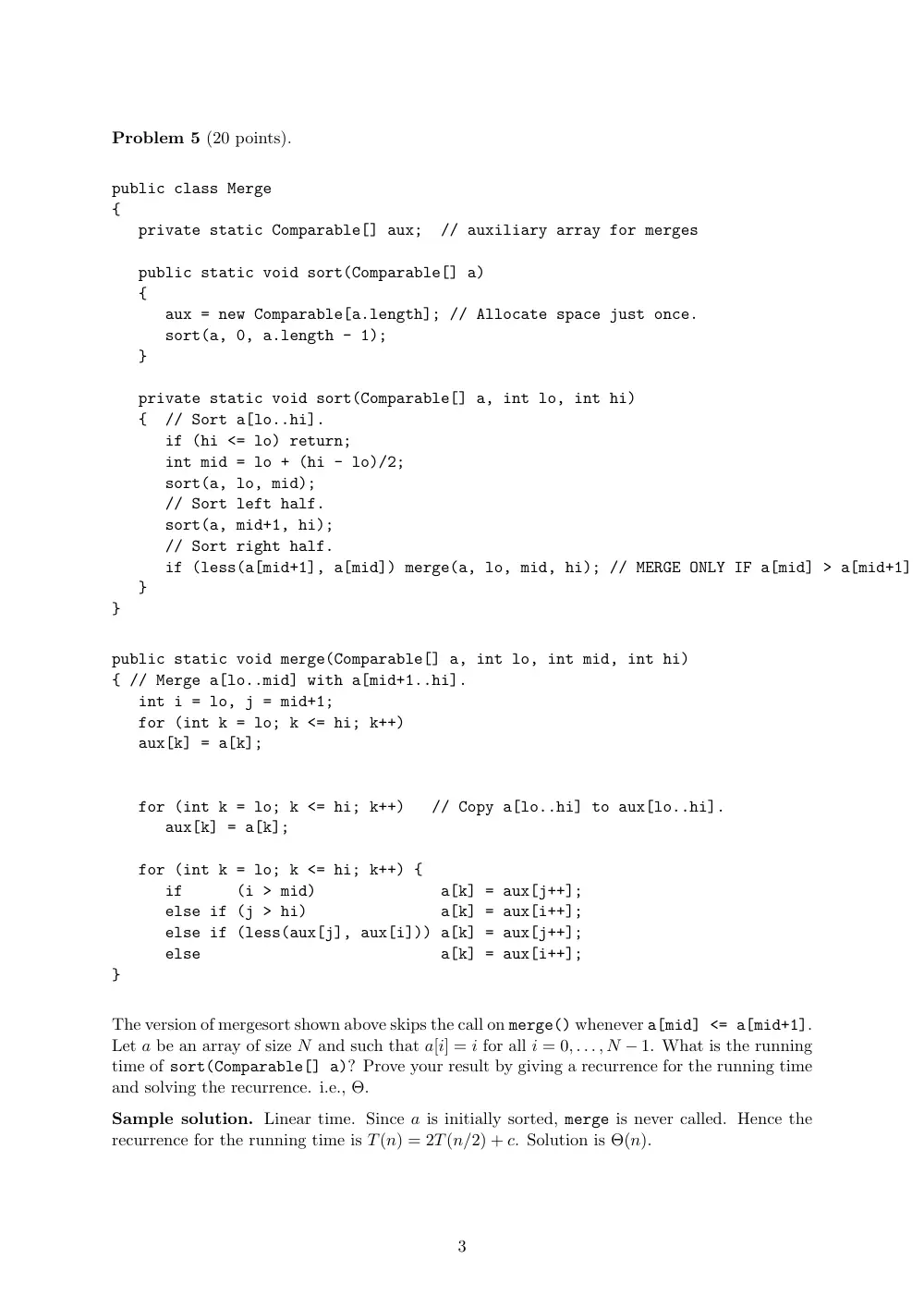
Problem 5 (20 points).
public class Merge
{
private static Comparable[] aux;
// auxiliary array for merges
public static void sort(Comparable[] a)
{
aux = new Comparable[a.length]; // Allocate space just once.
sort(a, 0, a.length - 1);
}
private static void sort(Comparable[] a, int lo, int hi)
{
// Sort a[lo..hi].
if (hi <= lo) return;
int mid = lo + (hi - lo)/2;
sort(a, lo, mid);
// Sort left half.
sort(a, mid+1, hi);
// Sort right half.
if (less(a[mid+1], a[mid]) merge(a, lo, mid, hi); // MERGE ONLY IF a[mid] > a[mid+1]
}
}
public static void merge(Comparable[] a, int lo, int mid, int hi)
{ // Merge a[lo..mid] with a[mid+1..hi].
int i = lo, j = mid+1;
for (int k = lo; k <= hi; k++)
aux[k] = a[k];
for (int k = lo; k <= hi; k++)
// Copy a[lo..hi] to aux[lo..hi].
aux[k] = a[k];
for (int k = lo; k <= hi; k++) {
if
(i > mid)
a[k] = aux[j++];
else if (j > hi)
a[k] = aux[i++];
else if (less(aux[j], aux[i])) a[k] = aux[j++];
else
a[k] = aux[i++];
}
The version of mergesort shown above skips the call on merge() whenever a[mid] <= a[mid+1].
Let a be an array of size N and such that a[i] = i for all i = 0, . . . , N − 1. What is the running
time of sort(Comparable[] a)? Prove your result by giving a recurrence for the running time
and solving the recurrence. i.e., Θ.
Sample solution. Linear time. Since a is initially sorted, merge is never called. Hence the
recurrence for the running time is T(n) = 2T(n/2) + c. Solution is Θ(n).
3