
CMPS 272 Final, Spring 2005
American University of Beirut · Operating Systems · 4 pages
More CMPS 272 files
Show the text of this final exam
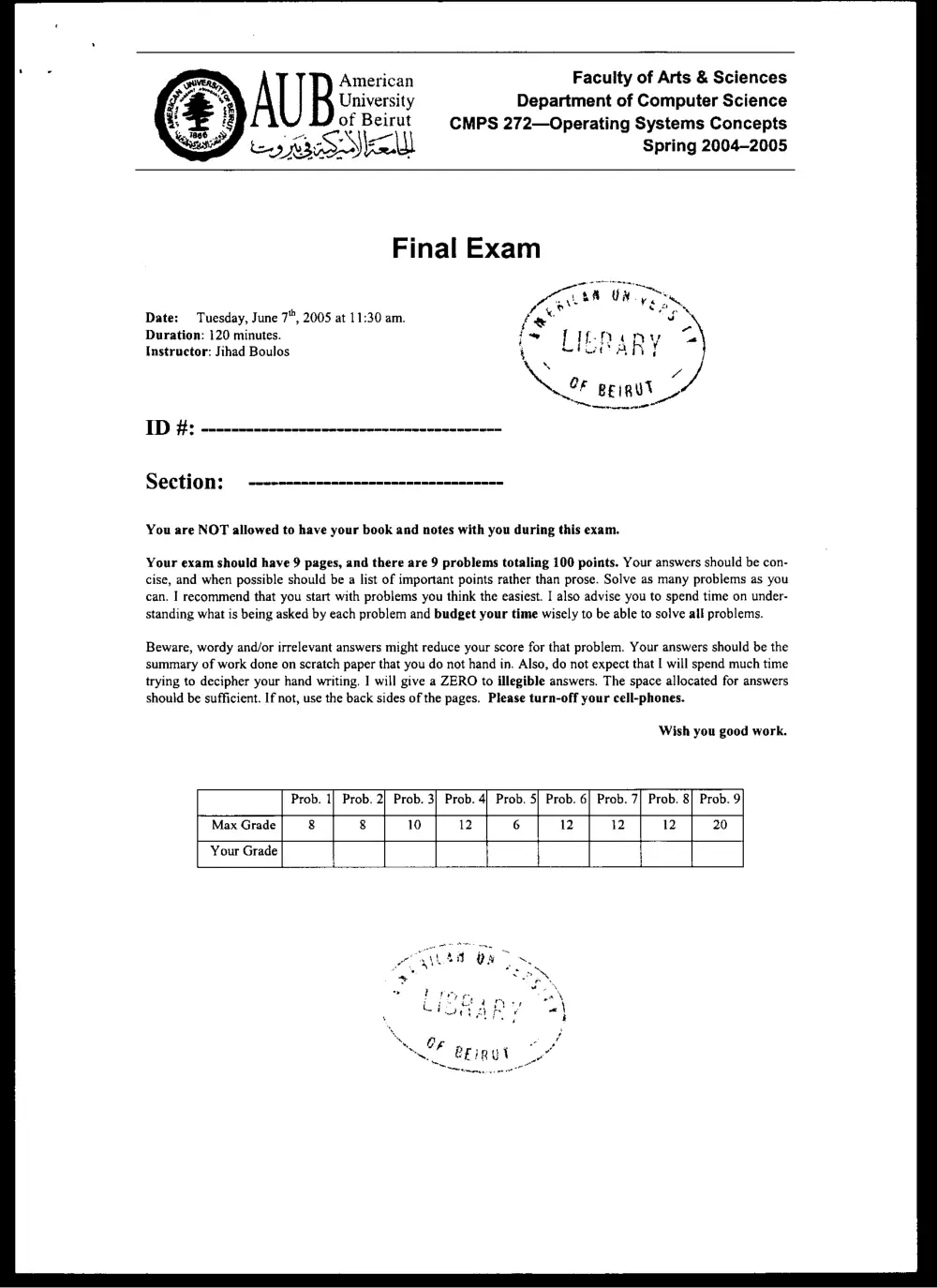
American Faculty of Arts & Sciences
University Department of Computer Science
SS Beirut CMPS 272—Operating Systems Concepts
Spring 2004-2005
Date: Tuesday, June 7, 2005 at 11:30 am.
Duration: 120 minutes.
Instructor: Jihad Boulos
Section:
You are NOT allowed to have your book and notes with you during this exam.
Your exam should have 9 pages, and there are 9 problems totaling 100 points. Your answers should be con-
cise, and when possible should be a list of important points rather than prose. Solve as many problems as you
can. I recommend that you start with problems you think the easiest. I also advise you to spend time on under-
standing what is being asked by each problem and budget your time wisely to be able to solve all problems.
Beware, wordy and/or irrelevant answers might reduce your score for that problem. Your answers should be the
summary of work done on scratch paper that you do not hand in. Also, do not expect that I will spend much time
trying to decipher your hand writing. I will give a ZERO to illegible answers. The space allocated for answers
should be sufficient. If not, use the back sides of the pages. Please turn-off your cell-phones.
Wish you good work.
Max Grade
Your Grade
Final Exam CMPS 272
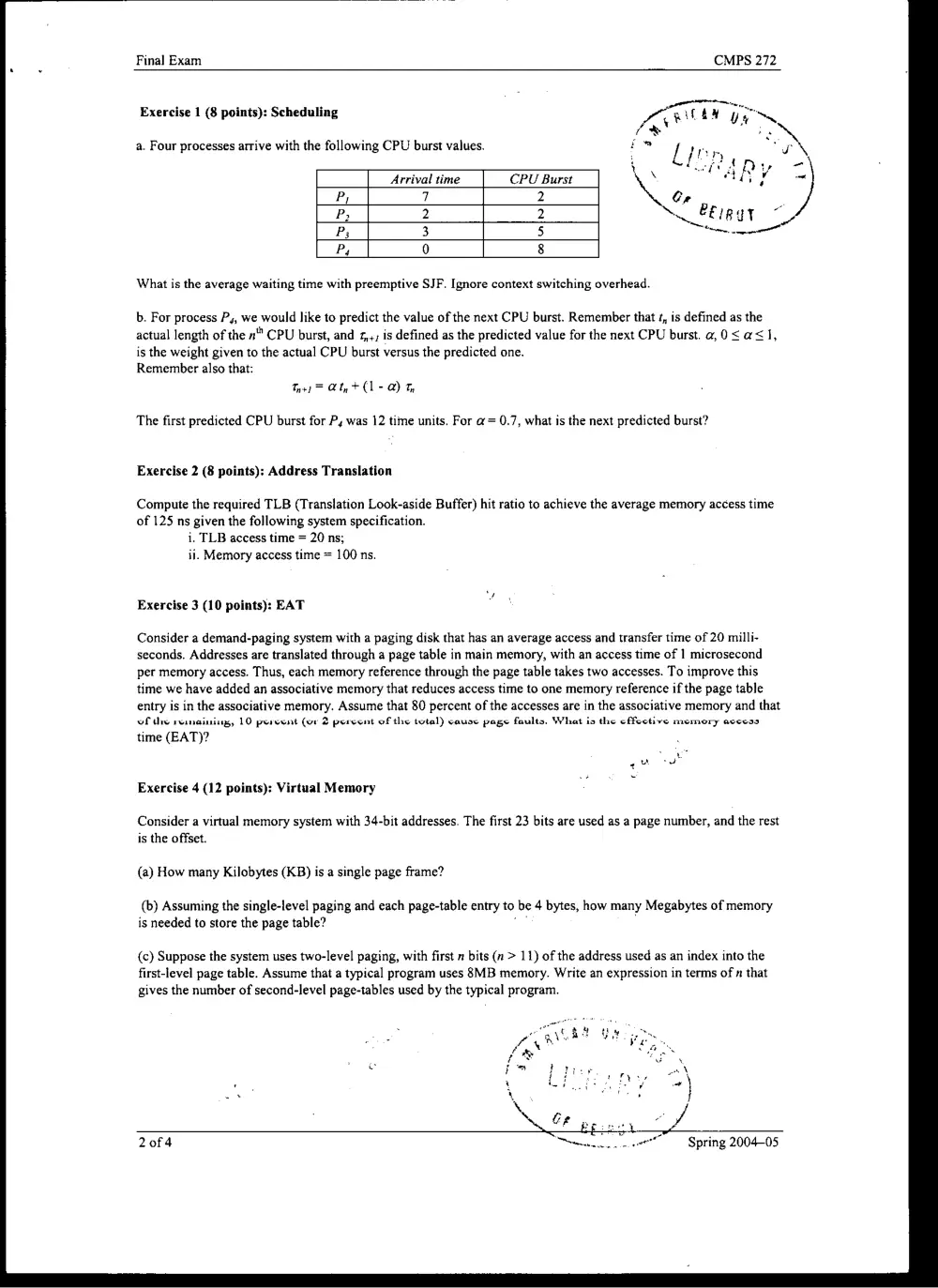
Exercise 1 (8 points): Scheduling
a. Four processes arrive with the following CPU burst values.
Arrival time CPU Burst
P; 7 2
P; 2 2
P; 3 5
Py 0 8
What is the average waiting time with preemptive SJF. Ignore context switching overhead.
b. For process Py, we would like to predict the value of the next CPU burst. Remember that ¢, is defined as the
actual length of the a" CPU burst, and 4,,; is defined as the predicted value for the next CPU burst. a, 0<a@<l,
is the weight given to the actual CPU burst versus the predicted one.
Remember also that:
Typ = At, + (1 - @) t
The first predicted CPU burst for Py was 12 time units. For a= 0.7, what is the next predicted burst?
Exercise 2 (8 points): Address Translation
Compute the required TLB (Translation Look-aside Buffer) hit ratio to achieve the average memory access time
of 125 ns given the following system specification.
i. TLB access time = 20 ns;
ii. Memory access time = 100 ns.
Exercise 3 (10 points): EAT
Consider a demand-paging system with a paging disk that has an average access and transfer time of 20 milli-
seconds. Addresses are translated through a page table in main memory, with an access time of 1 microsecond
per memory access. Thus, each memory reference through the page table takes two accesses. To improve this
time we have added an associative memory that reduces access time to one memory reference if the page table
entry is in the associative memory. Assume that 80 percent of the accesses are in the associative memory and that
of dhe remaining, 10 percent (or 2 percent of the tutal) cause page faults. What is the effective memory access
3 F P Pos Ty
time (EAT)?
word
Exercise 4 (12 points): Virtual Memory
Consider a virtual memory system with 34-bit addresses. The first 23 bits are used as a page number, and the rest
is the offset.
(a) How many Kilobytes (KB) is a single page frame?
(b) Assuming the single-level paging and each page-table entry to be 4 bytes, how many Megabytes of memory
is needed to store the page table? .
({c) Suppose the system uses two-level paging, with first n bits (7 > 11) of the address used as an index into the
first-level page table. Assume that a typical program uses 8MB memory. Write an expression in terms of n that
gives the number of second-level page-tables used by the typical program.
20f4 Spring 2004-05
CMPS 272 Final Exam
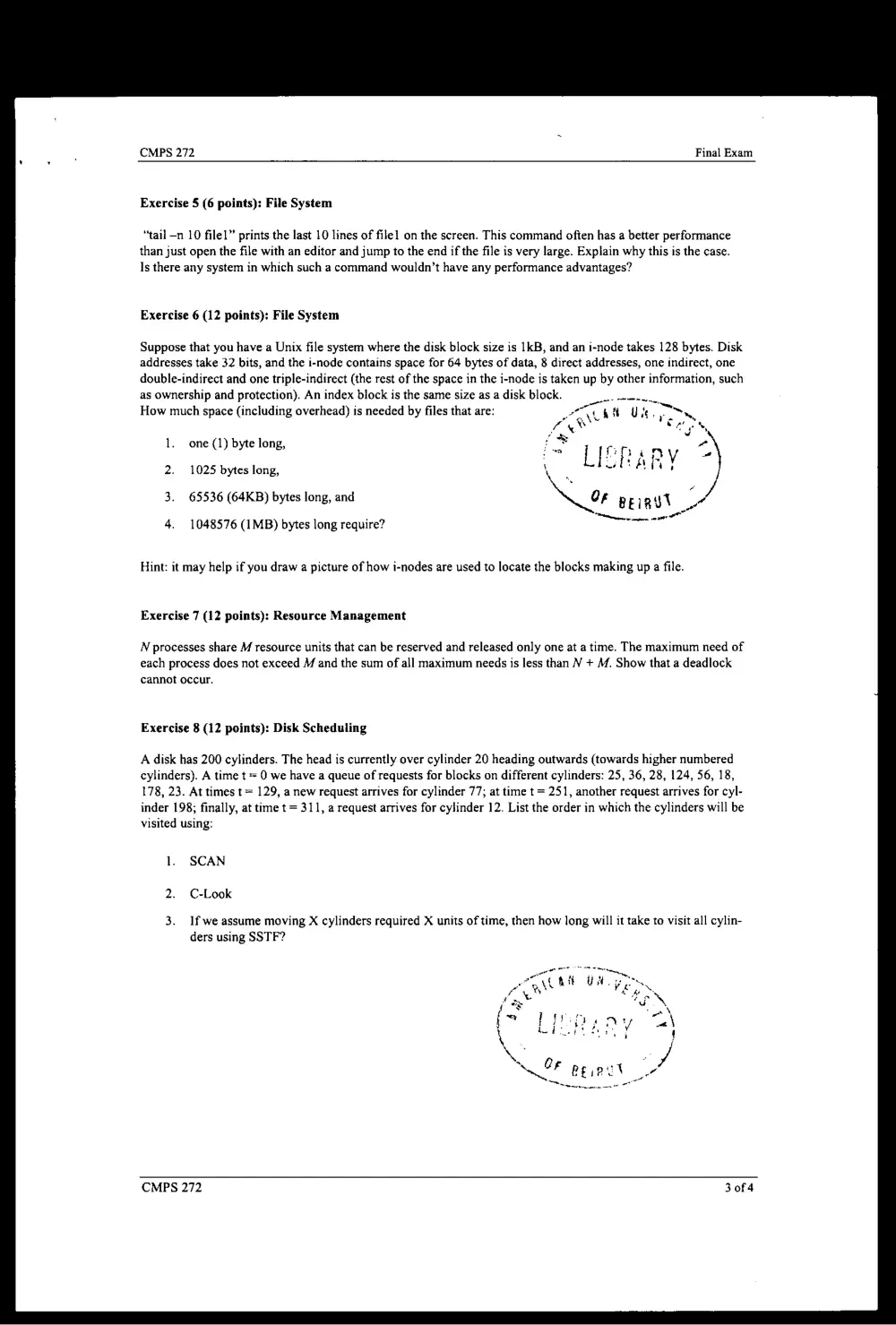
Exercise 5 (6 points): File System
“tail —n 10 filel” prints the last 10 lines of filei on the screen. This command often has a better performance
than just open the file with an editor and jump to the end if the file is very large. Explain why this is the case.
Is there any system in which such a command wouldn’t have any performance advantages?
Exercise 6 (12 points): File System
Suppose that you have a Unix file system where the disk block size is 1kB, and an i-node takes 128 bytes. Disk
addresses take 32 bits, and the i-node contains space for 64 bytes of data, 8 direct addresses, one indirect, one
double-indirect and one triple-indirect (the rest of the space in the i-node is taken up by other information, such
as ownership and protection). An index block is the same size as a disk block.
How much space (including overhead) is needed by files that are:
1. one (1) byte long,
2. 1025 bytes long,
3. 65536 (64KB) bytes long, and
4. 1048576 (1MB) bytes long require?
Hint: it may help if you draw a picture of how i-nodes are used to locate the blocks making up a file.
Exercise 7 (12 points): Resource Management
N processes share M resource units that can be reserved and released only one at a time. The maximum need of
each process does not exceed M and the sum of all maximum needs is less than NV + M. Show that a deadlock
cannot occur.
Exercise 8 (12 points): Disk Scheduling
A disk has 200 cylinders. The head is currently over cylinder 20 heading outwards (towards higher numbered
cylinders). A time t = 0 we have a queue of requests for blocks on different cylinders: 25, 36, 28, 124, 56, 18,
178, 23. At times t= 129, a new request arrives for cylinder 77; at time t = 251, another request arrives for cyl-
inder 198; finally, at time t = 311, a request arrives for cylinder 12. List the order in which the cylinders will be
visited using:
SCAN
C-Look
If we assume moving X cylinders required X units of time, then how long will it take to visit all cylin-
ders using SSTF?
CMPS 272
Final Exam fe [OD apy “emps272
< CSA TT
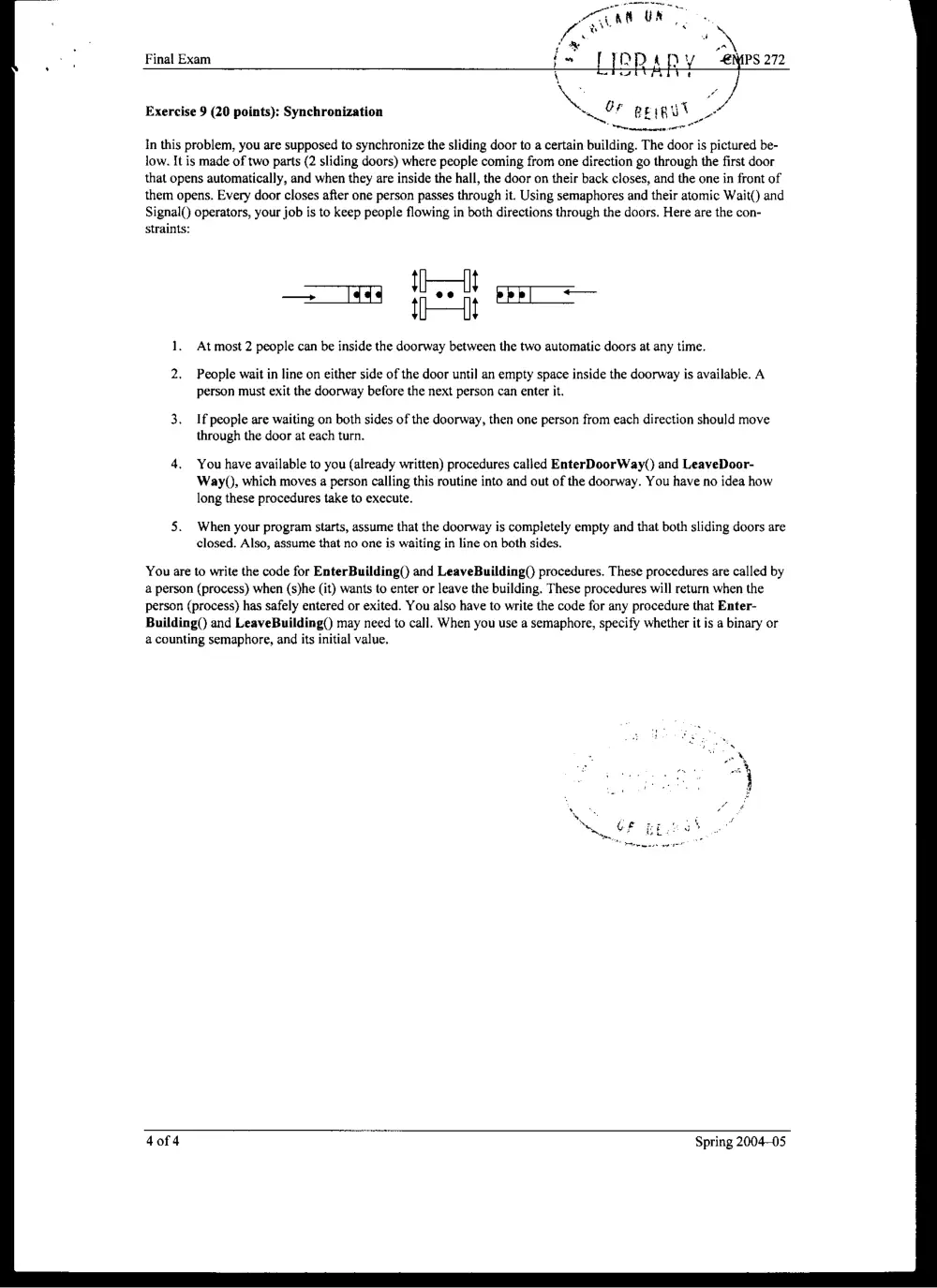
Exercise 9 (20 points): Synchronization \ or BEB at a
In this problem, you are supposed to synchronize the sliding door to a certain building. The door is pictured be-
low. It is made of two parts (2 sliding doors) where people coming from one direction go through the first door
that opens automatically, and when they are inside the hall, the door on their back closes, and the one in front of
them opens. Every door closes after one person passes through it. Using semaphores and their atomic Wait() and
Signal() operators, your job is to keep people flowing in both directions through the doors. Here are the con-
straints:
ttt
ce |e
1. At most 2 people can be inside the doorway between the two automatic doors at any time.
2. People wait in line on either side of the door until an empty space inside the doorway is available. A
person must exit the doorway before the next person can enter it.
3. Ifpeople are waiting on both sides of the doorway, then one person from each direction should move
through the door at each turn.
4. You have available to you (already written) procedures called EnterDoorWay() and LeaveDoor-
Way(), which moves a person calling this routine into and out of the doorway. You have no idea how
long these procedures take to execute.
5. When your program starts, assume that the doorway is completely empty and that both sliding doors are
closed. Also, assume that no one is waiting in line on both sides.
You are to write the code for EnterBuilding() and LeaveBuilding() procedures. These procedures are called by
a person (process) when (s)he (it) wants to enter or leave the building. These procedures will return when the
person (process) has safely entered or exited. You also have to write the code for any procedure that Enter-
Building() and LeaveBuilding() may need to call. When you use a semaphore, specify whether it is a binary or
a counting semaphore, and its initial value,
4o0f4 Spring 2004-05