
CMPS 272 Midterm, Fall 2001
American University of Beirut · Operating Systems · 5 pages

More CMPS 272 files
Show the text of this exam
CMPS 272-Operating Systems
Midterm Make-up - Fall 2001-2002
Time: 25 Minutes
Walid Keyrouz and Ahmad Nasri
Student Id
Student Name
Instructor Name
Signature
Question
G. General
H. Scheduling
I. Concurrency !
Total
Good Work & Good Luck
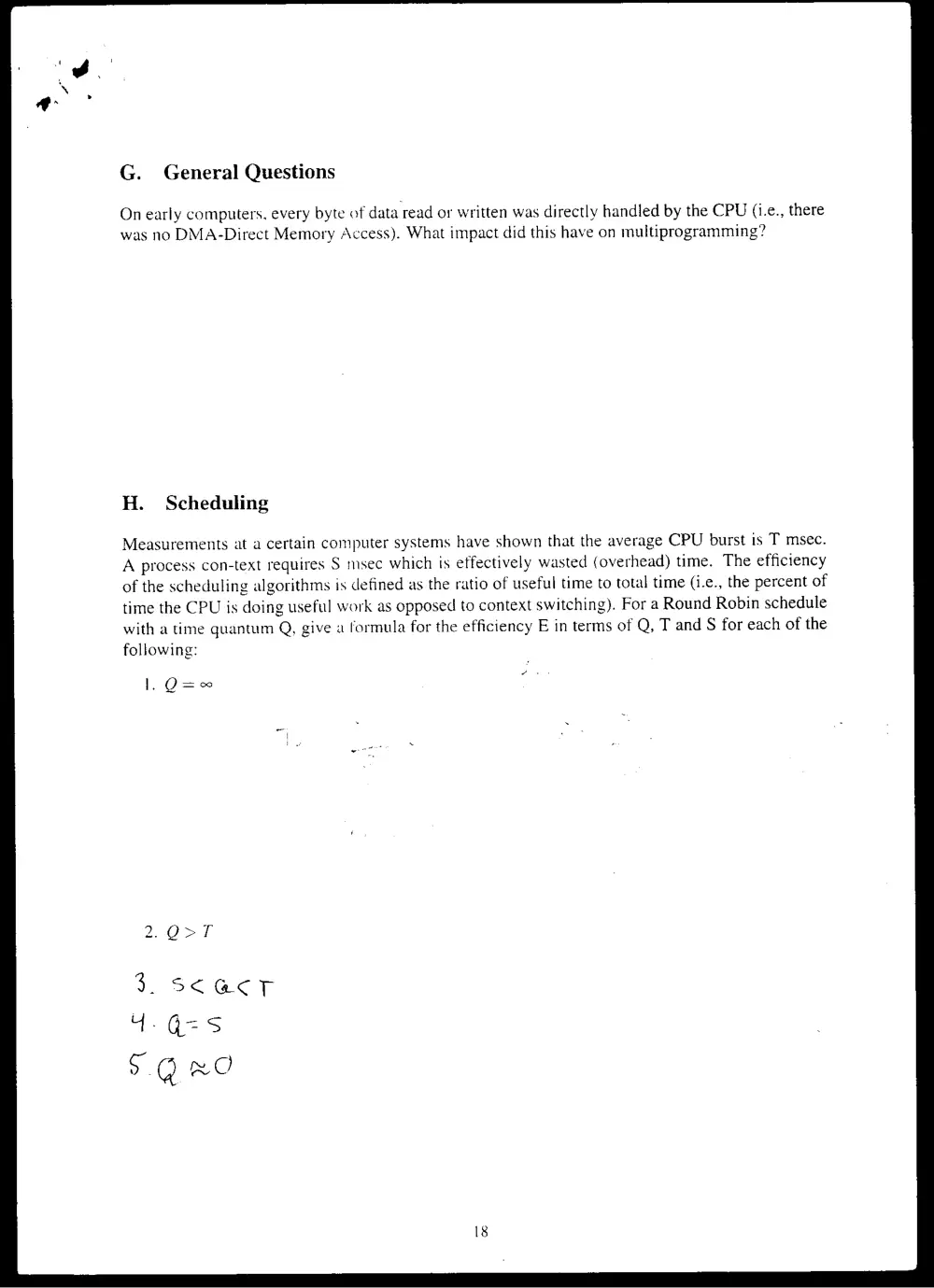
G. General Questions
On early computers, every byte of data read or written was directly handled by the CPU (ie., there
was no DMA-Direct Memory Access). What impact did this have on multiprogramming?
H. Scheduling
Measurements at a certain computer systems have shown that the average CPU burst is T msec.
A process con-text requires S msec which is effectively wasted (overhead) time. The efficiency
of the scheduling algorithms is defined as the ratio of useful time to total time (i.¢., the percent of
time the CPU is doing useful work as opposed to context switching). For a Round Robin schedule
with a time quantum Q, give a formula for the efficiency E in terms of Q, T and S for each of the
following:
1. Qa
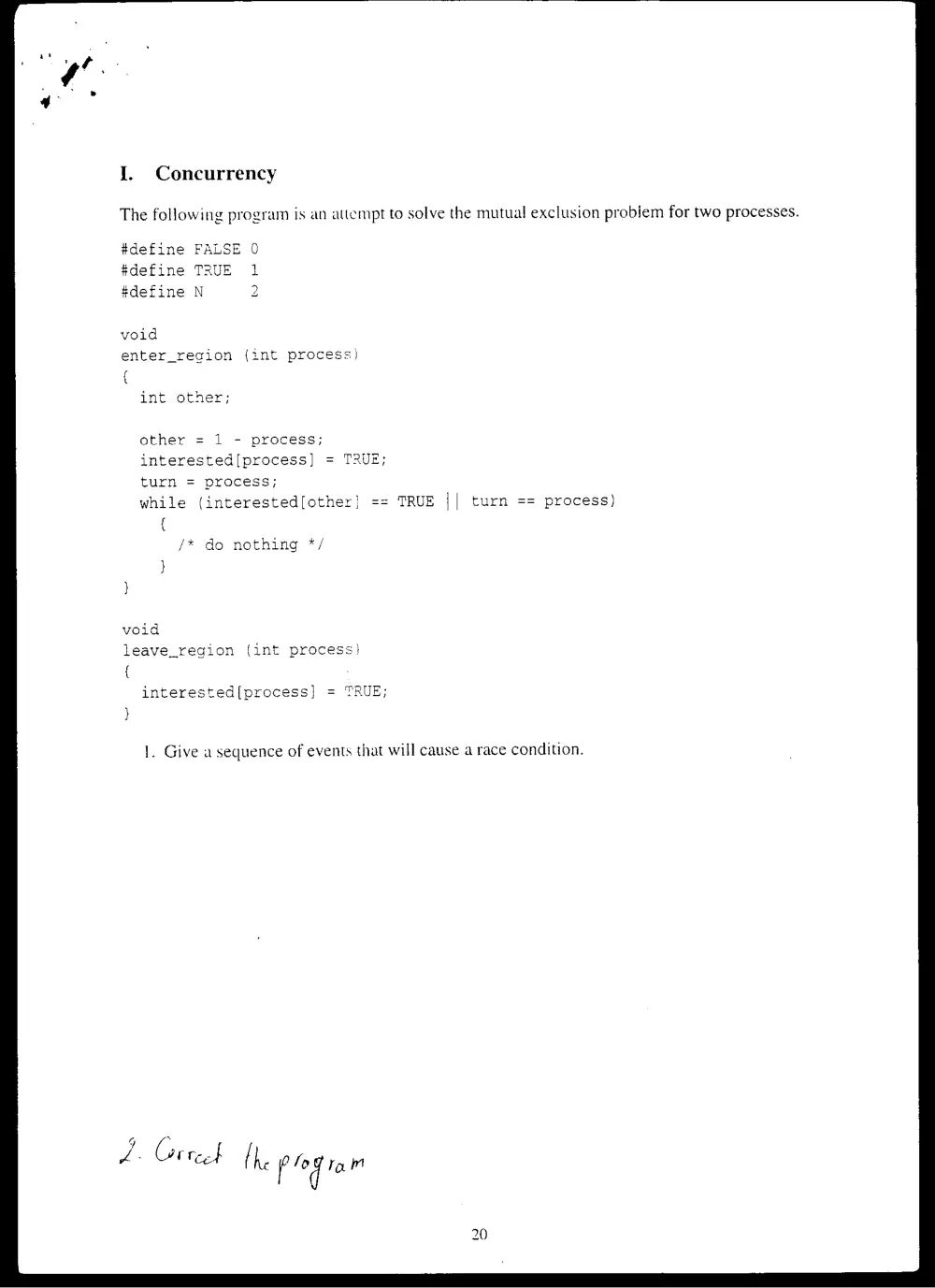
J. Concurrency
The following program is an attempt to solve the mutual exclusion problem for two processes.
#define FALSE 0
#define TRUE 1
#define N 2
void
enter_region (int process)
{
int other;
other = 1 - process;
interested[process] = TRUE;
turn = process;
while (interested[other} == TRUE || turn == process)
{
/* do nothing */
void
leave_region (int process}
{
interested[process]
1. Give a sequence of events that will cause a race condition.
2. Correct the program.