
CMPS 272 Midterm, Fall 2005
American University of Beirut · Operating Systems · 10 pages

More CMPS 272 files
Show the text of this exam
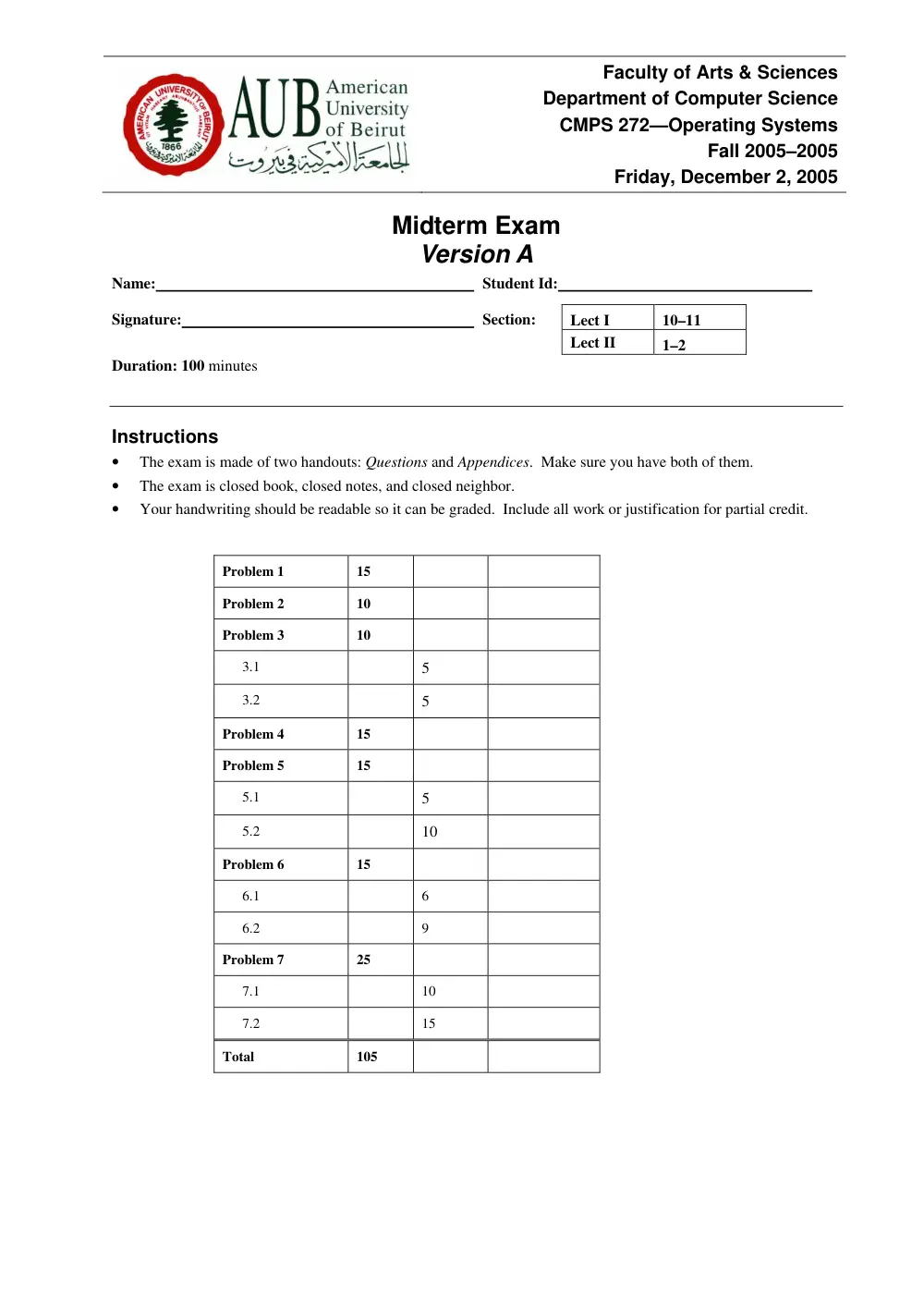
Faculty of Arts & Sciences
Department of Computer Science
CMPS 272—Operating Systems
Fall 2005–2005
Friday, December 2, 2005
Midterm Exam
Version A
Name:
Student Id:
Signature:
Duration: 100 minutes
Section:
Lect I
10–11
Lect II
1–2
Instructions
•
The exam is made of two handouts: Questions and Appendices. Make sure you have both of them.
•
The exam is closed book, closed notes, and closed neighbor.
•
Your handwriting should be readable so it can be graded. Include all work or justification for partial credit.
Problem 1
15
Problem 2
10
Problem 3
10
3.1
5
3.2
5
Problem 4
15
Problem 5
15
5.1
5
5.2
10
Problem 6
15
6.1
6
6.2
9
Problem 7
25
7.1
10
7.2
15
Total
105
Midterm Exam (2004-11-6)
Initials:
CMPS 272
2 of 10
Problem 1. True/False Questions
(15 = 15 × 1)
Mark your answer in the table below. Note that there is a –1 penalty associated with each wrong answer!
1
2
3
4
5
6
7
8
9
10
11
12
13
14
15
T
F
1. A thread is a lightweight process.
2. The priority inversion problem is caused by a high priority process running inside its critical section.
3. A system call is an interface between the OS and the user.
4. Interrupt handlers can be modified by user programs.
5. A shell is a command interpreter but not a process.
6. An unsafe state is a deadlocked state.
7. Interrupt handlers execute in user space.
8. Atomic operations mean concurrent operations.
9. All signals can be disabled.
10. Signals cannot be used in interprocess communication.
11. “fork()” is a Unix system call that creates two new child processes.
12. Process scheduling has to do with moving processes back and forth between the running and blocked states.
13. Swapping has to do with process scheduling.
14. The critical section of a process is a private segment of code of that process.
15. One of the solutions for the race condition problem is to have one process run faster than the other.
Midterm Exam (2004-11-6)
Initials:
CMPS 272
3 of 10
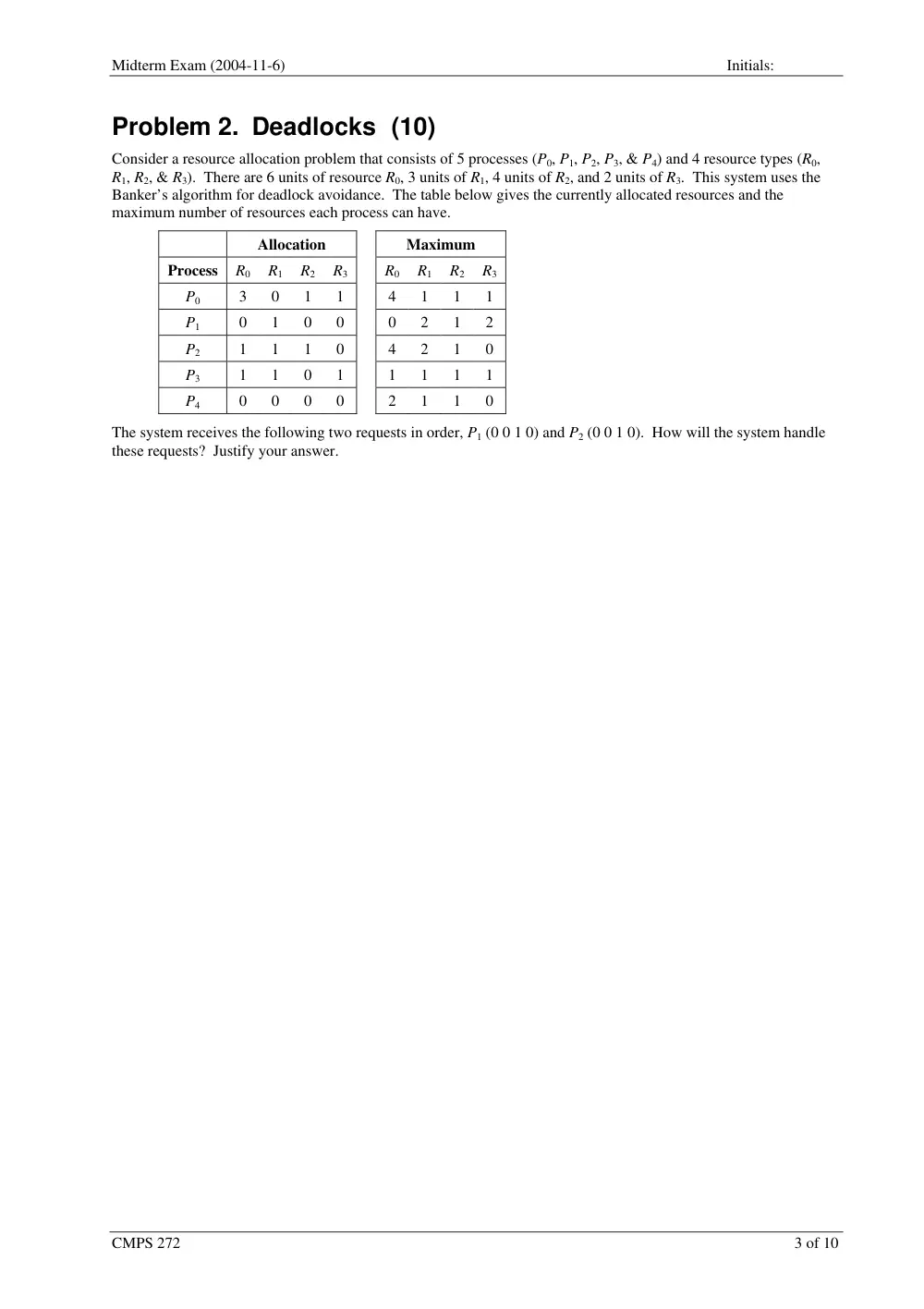
Problem 2. Deadlocks (10)
Consider a resource allocation problem that consists of 5 processes (P0, P1, P2, P3, & P4) and 4 resource types (R0,
R1, R2, & R3). There are 6 units of resource R0, 3 units of R1, 4 units of R2, and 2 units of R3. This system uses the
Banker’s algorithm for deadlock avoidance. The table below gives the currently allocated resources and the
maximum number of resources each process can have.
Allocation
Maximum
Process
R0
R1
R2
R3
R0
R1
R2
R3
P0
3
0
1
1
4
1
1
1
P1
0
1
0
0
0
2
1
2
P2
1
1
1
0
4
2
1
0
P3
1
1
0
1
1
1
1
1
P4
0
0
0
0
2
1
1
0
The system receives the following two requests in order, P1 (0 0 1 0) and P2 (0 0 1 0). How will the system handle
these requests? Justify your answer.
Midterm Exam (2004-11-6)
Initials:
CMPS 272
4 of 10
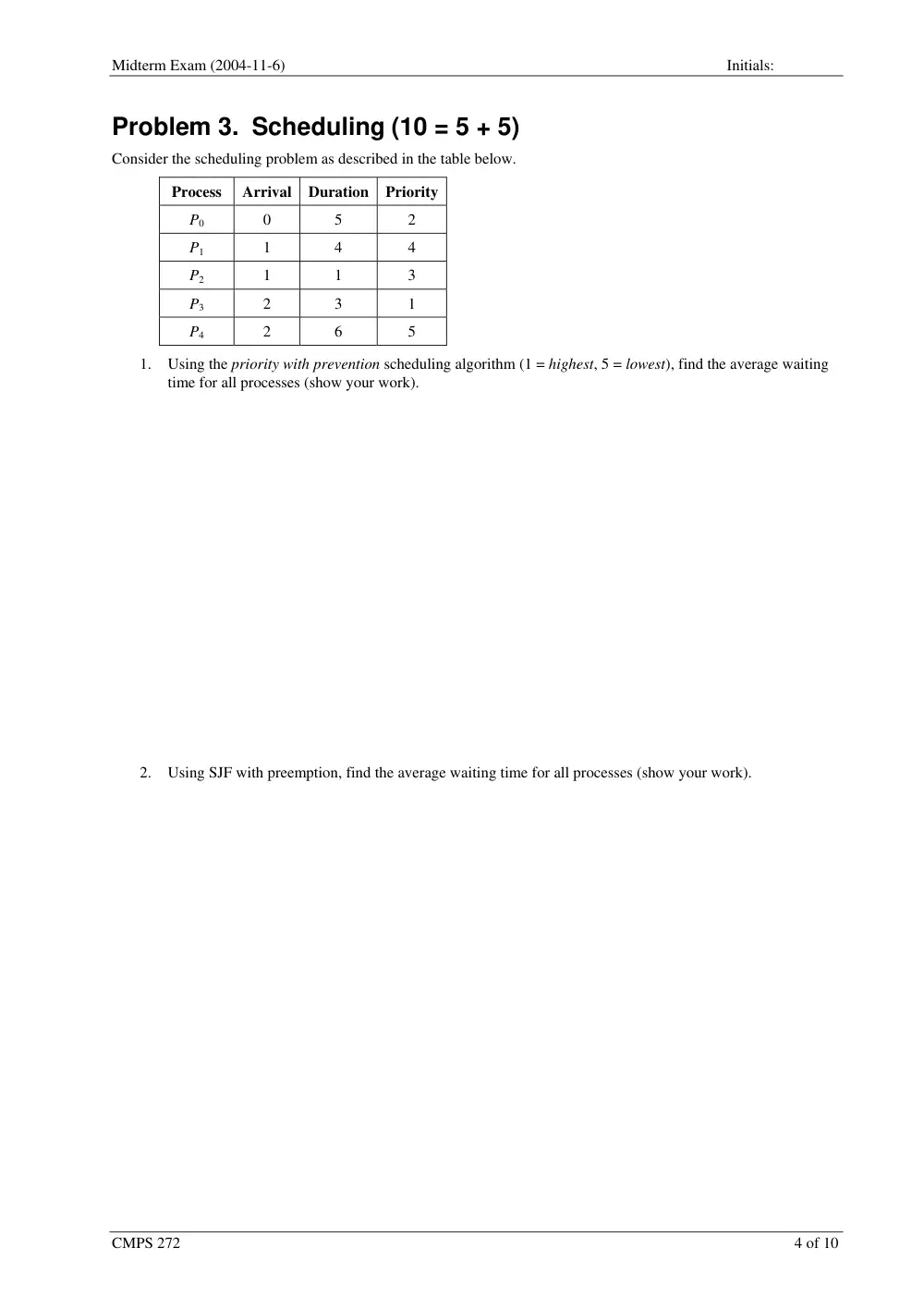
Problem 3. Scheduling (10 = 5 + 5)
Consider the scheduling problem as described in the table below.
Process
Arrival
Duration
Priority
P0
0
5
2
P1
1
4
4
P2
1
1
3
P3
2
3
1
P4
2
6
5
1. Using the priority with prevention scheduling algorithm (1 = highest, 5 = lowest), find the average waiting
time for all processes (show your work).
2. Using SJF with preemption, find the average waiting time for all processes (show your work).
Midterm Exam (2004-11-6)
Initials:
CMPS 272
5 of 10
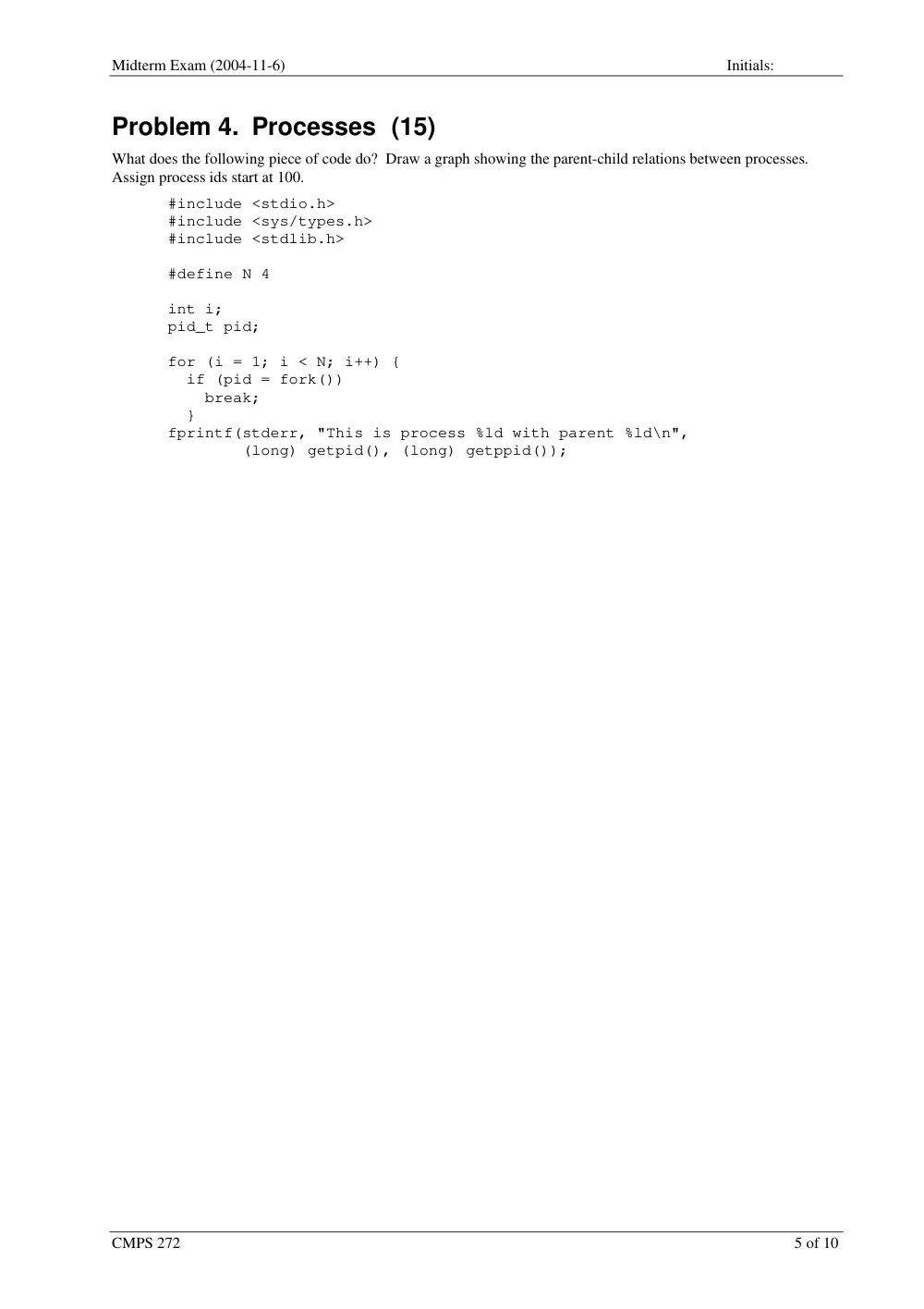
Problem 4. Processes (15)
What does the following piece of code do? Draw a graph showing the parent-child relations between processes.
Assign process ids start at 100.
#include <stdio.h>
#include <sys/types.h>
#include <stdlib.h>
#define N 4
int i;
pid_t pid;
for (i = 1; i < N; i++) {
if (pid = fork())
break;
}
fprintf(stderr, "This is process %ld with parent %ld\n",
(long) getpid(), (long) getppid());
Midterm Exam (2004-11-6)
Initials:
CMPS 272
6 of 10
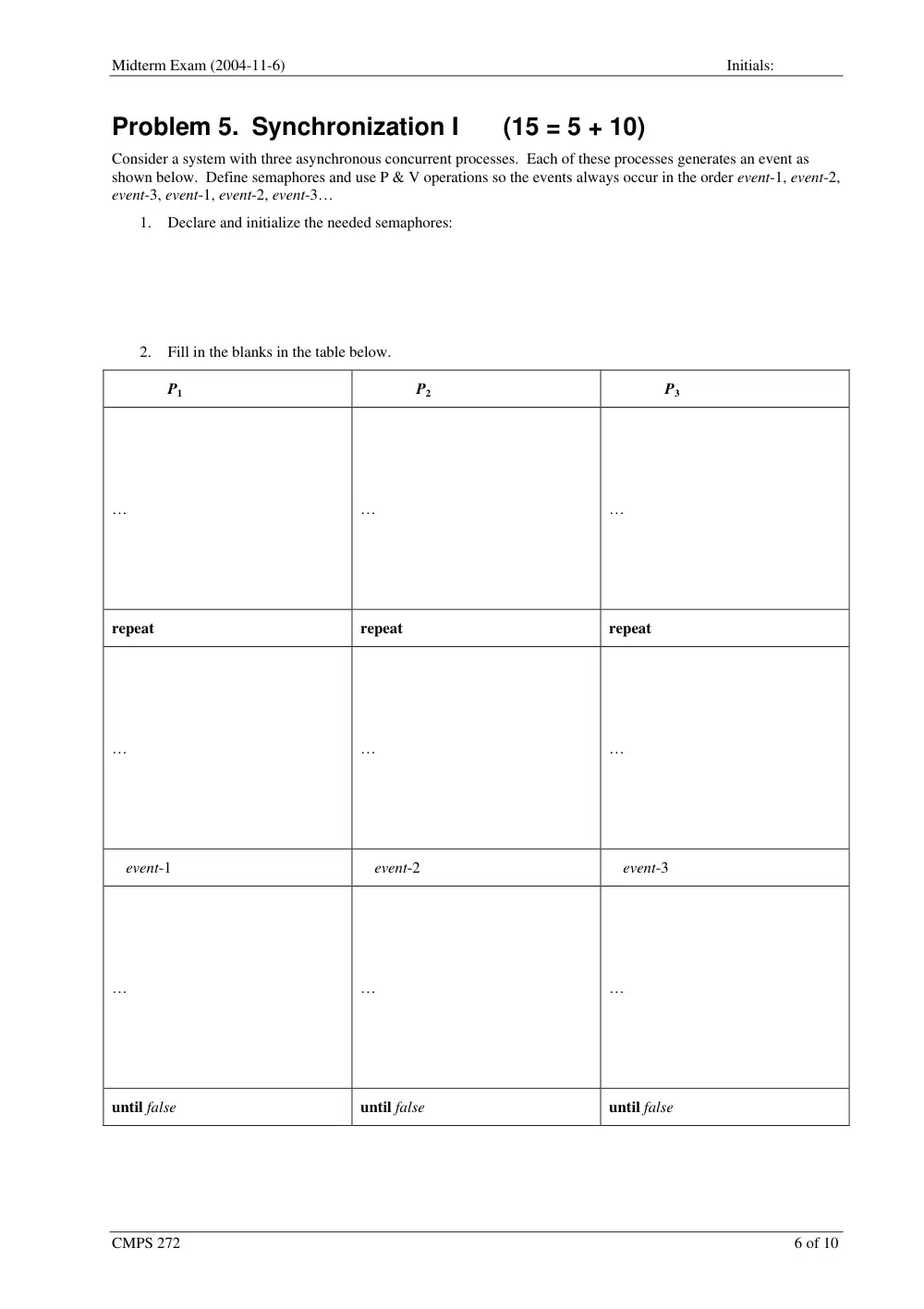
Problem 5. Synchronization I
(15 = 5 + 10)
Consider a system with three asynchronous concurrent processes. Each of these processes generates an event as
shown below. Define semaphores and use P & V operations so the events always occur in the order event-1, event-2,
event-3, event-1, event-2, event-3…
1. Declare and initialize the needed semaphores:
2. Fill in the blanks in the table below.
P1
P2
P3
…
…
…
repeat
repeat
repeat
…
…
…
event-1
event-2
event-3
…
…
…
until false
until false
until false
Midterm Exam (2004-11-6)
Initials:
CMPS 272
7 of 10
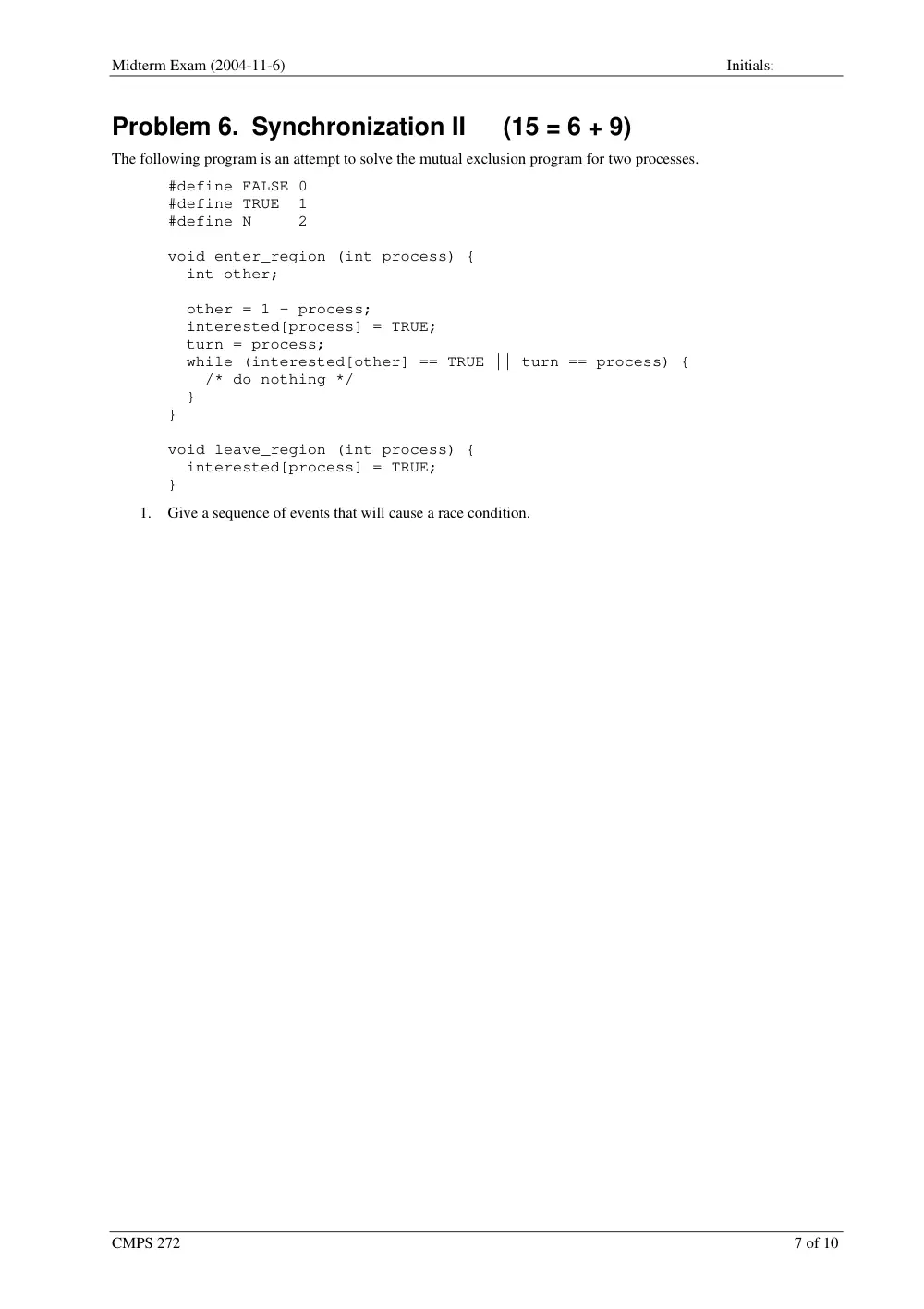
Problem 6. Synchronization II
(15 = 6 + 9)
The following program is an attempt to solve the mutual exclusion program for two processes.
#define FALSE 0
#define TRUE 1
#define N 2
void enter_region (int process) {
int other;
other = 1 - process;
interested[process] = TRUE;
turn = process;
while (interested[other] == TRUE || turn == process) {
/* do nothing */
}
}
void leave_region (int process) {
interested[process] = TRUE;
}
1. Give a sequence of events that will cause a race condition.
Midterm Exam (2004-11-6)
Initials:
CMPS 272
8 of 10
2. Correct the program so as to avoid the race condition.
Midterm Exam (2004-11-6)
Initials:
CMPS 272
9 of 10
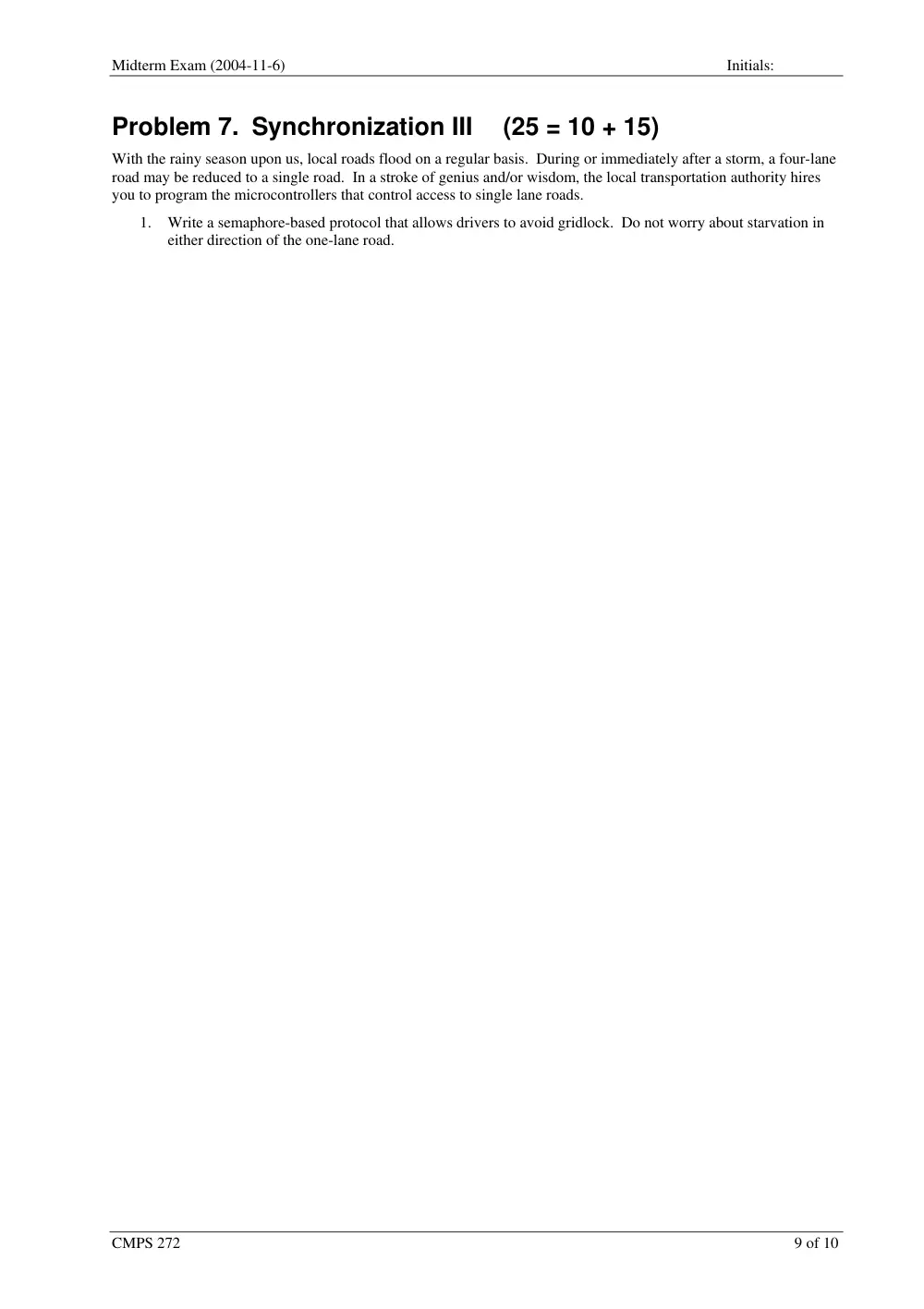
Problem 7. Synchronization III
(25 = 10 + 15)
With the rainy season upon us, local roads flood on a regular basis. During or immediately after a storm, a four-lane
road may be reduced to a single road. In a stroke of genius and/or wisdom, the local transportation authority hires
you to program the microcontrollers that control access to single lane roads.
1. Write a semaphore-based protocol that allows drivers to avoid gridlock. Do not worry about starvation in
either direction of the one-lane road.
Midterm Exam (2004-11-6)
Initials:
CMPS 272
10 of 10
2. Modify your protocol to maximize throughput while ensuring fairness. In this solution, a car traveling in a
particular direction can enter the one-lane road provided (1) there are other cars traveling in the same
direction in the one lane road and (2) there are no cars waiting at the other end of the one-lane road to enter
it in the opposite direction.