
CMPS 272 Midterm, Fall 2004
American University of Beirut · Operating Systems · 21 pages

Showing the first 10 of 21 pages. Download the PDF to see all of it.
More CMPS 272 files
Show the text of this exam
oN IN oa ee sees
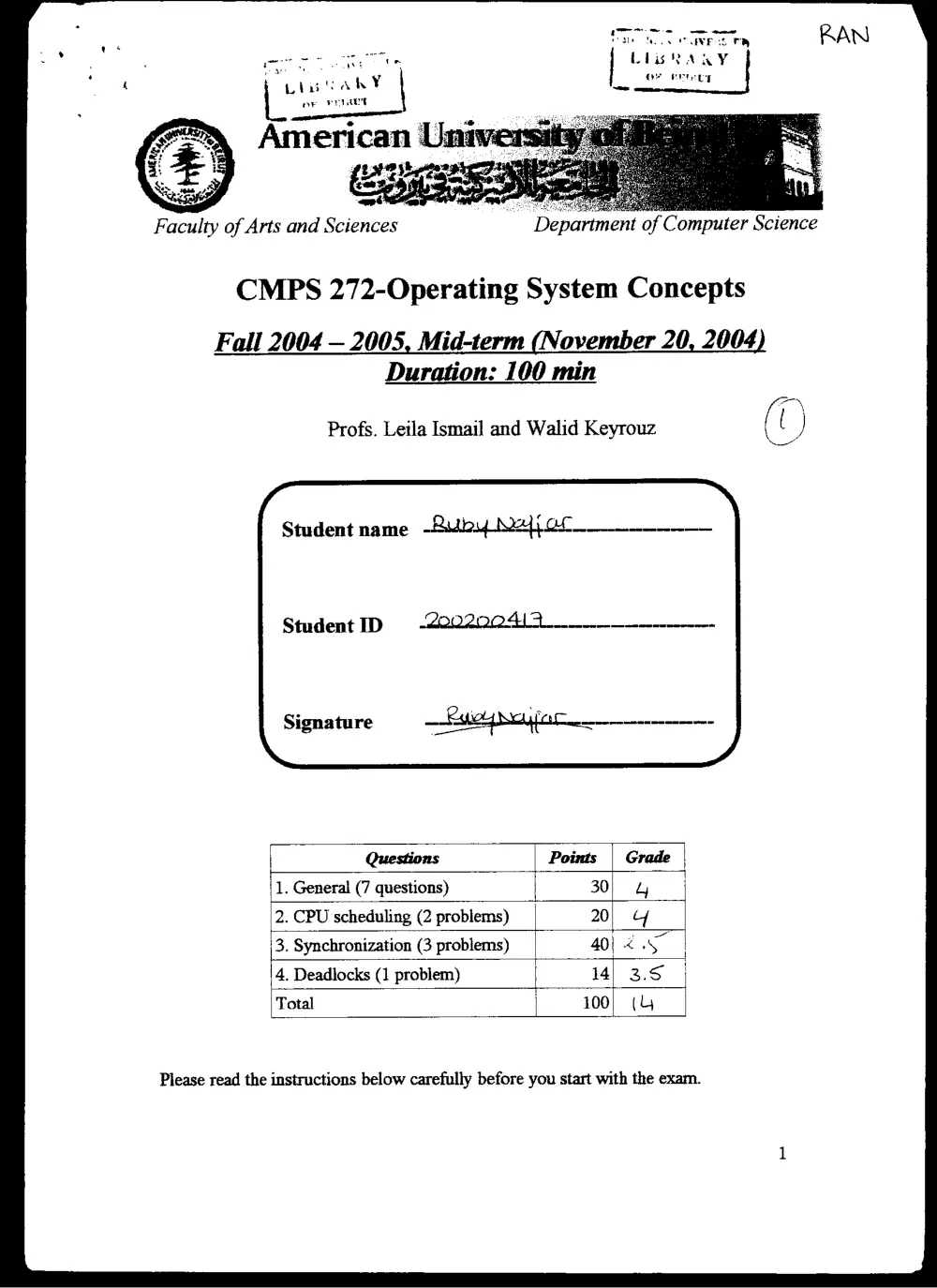
Faculty of Arts and Sciences Department of Computer Science
CMPS 272-Operating System Concepts
Fall 2004 — 2005, Mid-term (November 20, 2004)
Duration: 100 min
Profs. Leila Ismail and Walid Keyrouz
Student name -RWby Naor
Student ID 2ee2re413
Signature Rag ciiar ——--------—--
Questions
1. General (7 questions)
2. CPU scheduling (2 problems)
3. Synchronization (3 problems)
4. Deadlocks (1 problem)
Total
Please read the instructions below carefully before you start with the exam.
IMPORTANT INSTRUCTIONS
. You MUST fill in your name, student ID, and your signature on the first page, and your
initials on all the pages, including the first one.
. You MUST explain your answers clearly to get points. Your handwriting MUST also be
readible to be graded.
_ You MUST NOT look at your neighbor's sheet. This will be considered as a cheating
attempt.
| You MUST NOT talk during the exam. Any communication will be considered as a
cheating attempt.
. Any cheating will result in a zero on the test and possibly in failing the course and may
also lead to disciplinary actions against you.
6. Use your time carefully. If you feel you are stuck, skip to the next question.
7. Use the back side of a page if the space provided for a question is not enough.
. There is a total of 21 pages.
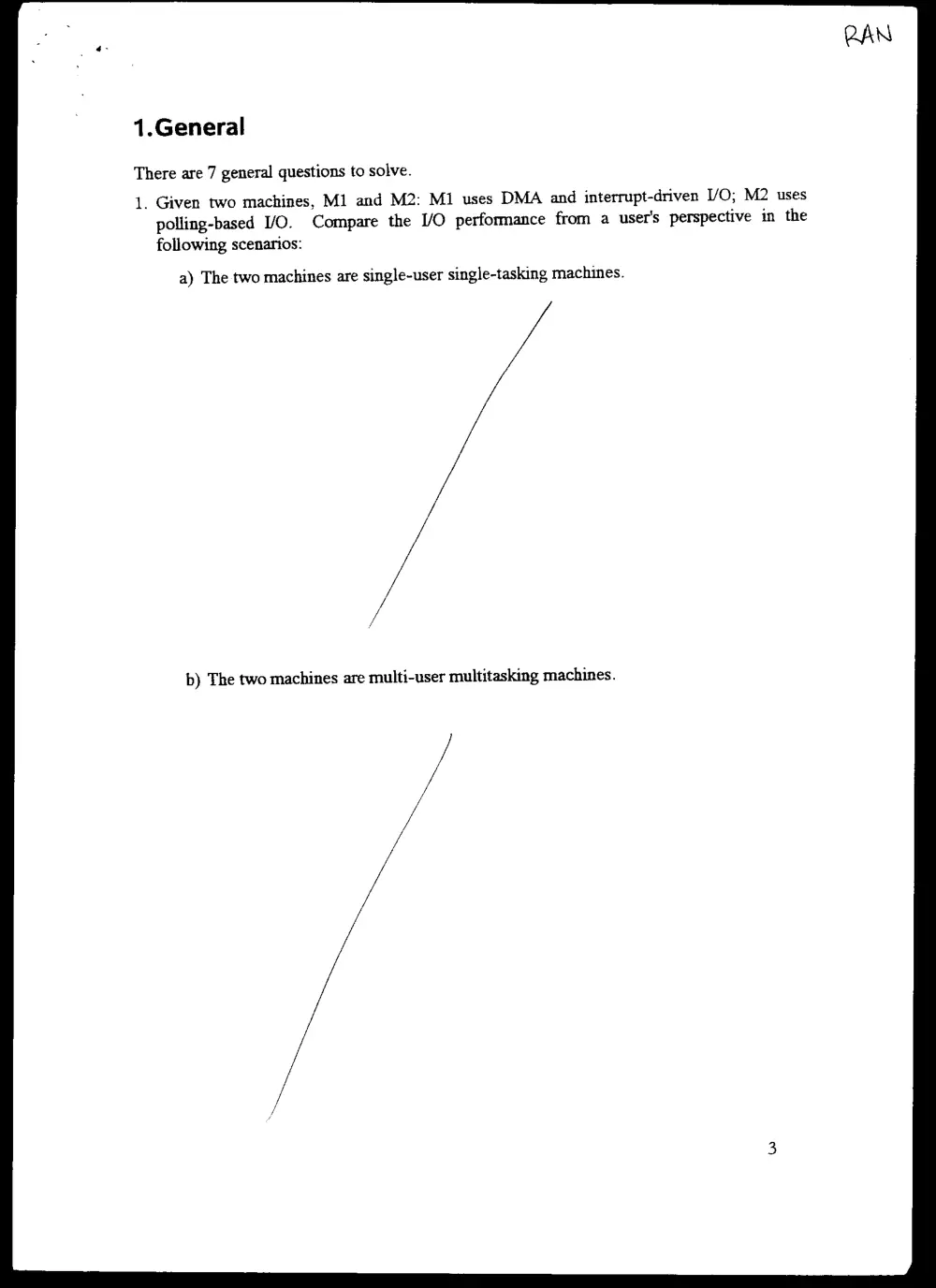
1.General
There are 7 general questions to solve.
1. Given two machines, M1 and M2: M1 uses DMA and interrupt-driven I/O; M2 uses
polling-based VO. Compare the I/O performance from a user's perspective in the
following scenarios:
a) The two machines are single-user single-tasking machines.
b) The two machines are multi-user multitasking machines.
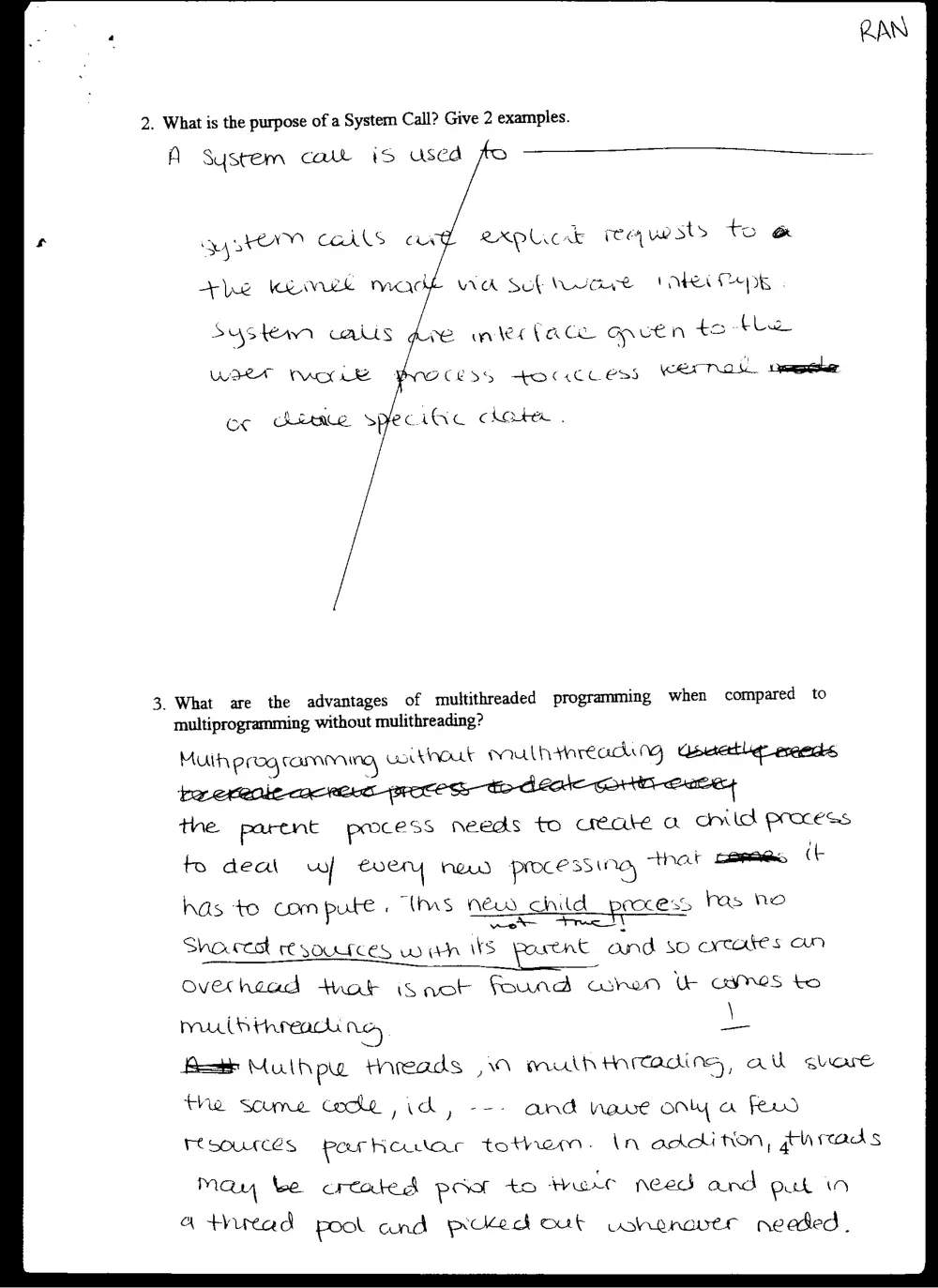
2. What is the purpose of a System Call? Give 2 examples.
RAO LCE ree uwsts to &
Wa Sof beceere MRA Cee
Te mle Lace Aven to bo
OCESS fo c§ccess WENA omepetacr
oc Chiewe S eciQWe choker .
3. What are the advantages of multithreaded programming when compared to
multiprogramming without mulithreading?
ee woullhout pliner eee aes
co
the parent process needs to create a cid pracess
to dea uf euery new Proce SS UN) thet aie cb
has to com pute © UMS New chid _precess has no
Shorea resources uo en WS rent and so cxtates an
overhead that ack Found caren U canes to
muctBirrenchi ney J
far Uuihpw treads 10 mulhHoitading, ath
Tre some cot pid, --- and nave only a fens
in acdchition, ith rad §
Guiare
Te SOLLICES Pour Kewtar totam -
Many be create A Por to Ware need and pu vay
a tread pool and puéed cut Cohenaver needed.
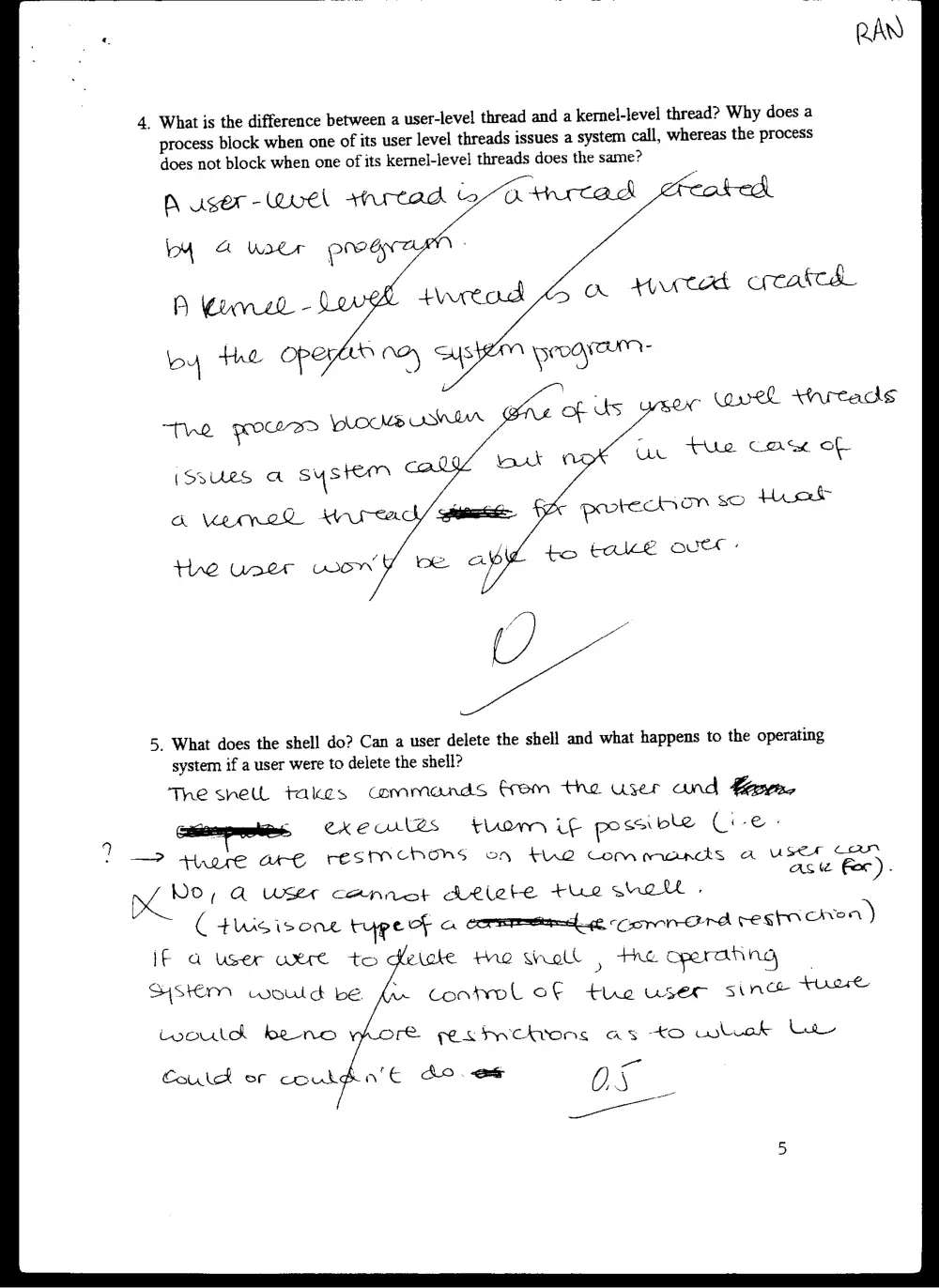
4, What is the difference between a user-level thread and a kernel-level thread? Why does a
process block when one of its user level threads issues a system call, whereas the process
does not block when one of its kernel-level threads does the same?
(SSULS A system
a Kemeko
5. What does the shell do? Can a user delete the shell and what happens to the operating
system if a user were to delete the shell?
The spetL takes Commands From the user ond Fore,
- : 5 exectlh@s flew ie poss ble Ci-e -
J > anere are rEsSTHCDONS on FHKE Commancks a USA TOD
AG be fer).
ni Rex QA User cannot delete tue shell |
C tuisisone tupe OF CO Compton 66 Cor rd pest chen)
iF a User ake to
HSE Loouid be.
Looutch keno re festwekvons as *O eolrak La
Coutd or coutdin'& Ao. es OS
a
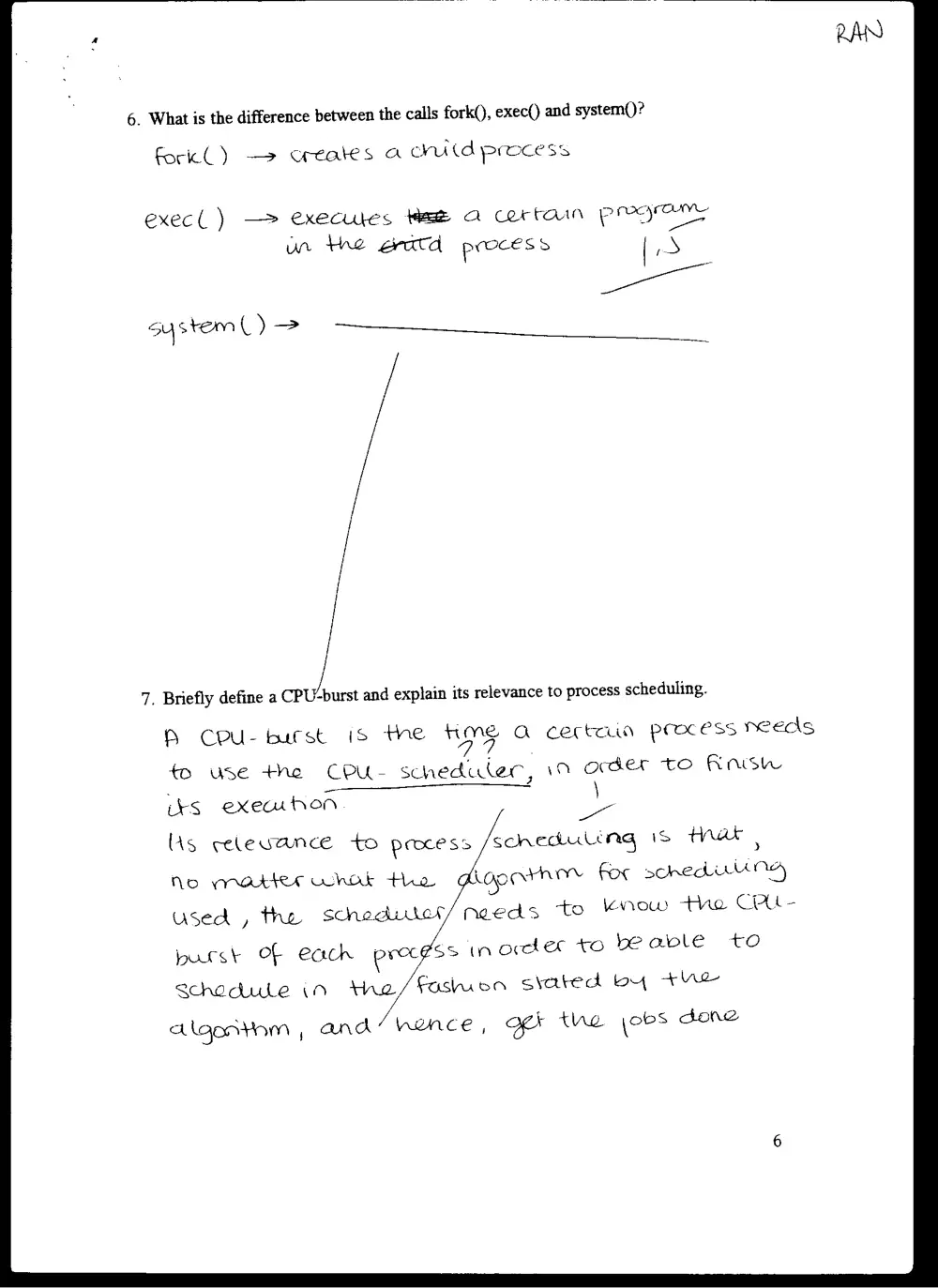
6. What is the difference between the calls fork(), exec() and system()?
fori) —> creates a crud process
exec( ) —> executes RE A Certain PON
- . 7 a
un the gratd process | i>
an
system () >
7. Briefly define a CPU-burst and explain its relevance to process scheduling.
fH CPu- burst is the Wns Q certciian process Needs
to use the CPU schediler, 19 Order tO ANSW
irks execuh \
ur ecitnon -
scheduling 1S Hak ;
lis relevance to process
No matter whok te Lap For schediuuiney
Used » the Scheditel/ needs to know the CPU-
clec to ve able +o
pours’ OF each prec SS IN OC
gchactute (A mae/Fashuon siated b4 1%
Algantom , andd hence , ogk the obs done
2.CPU Scheduling
There are 2 problems to solve in this section.
\2] —» Problem 1
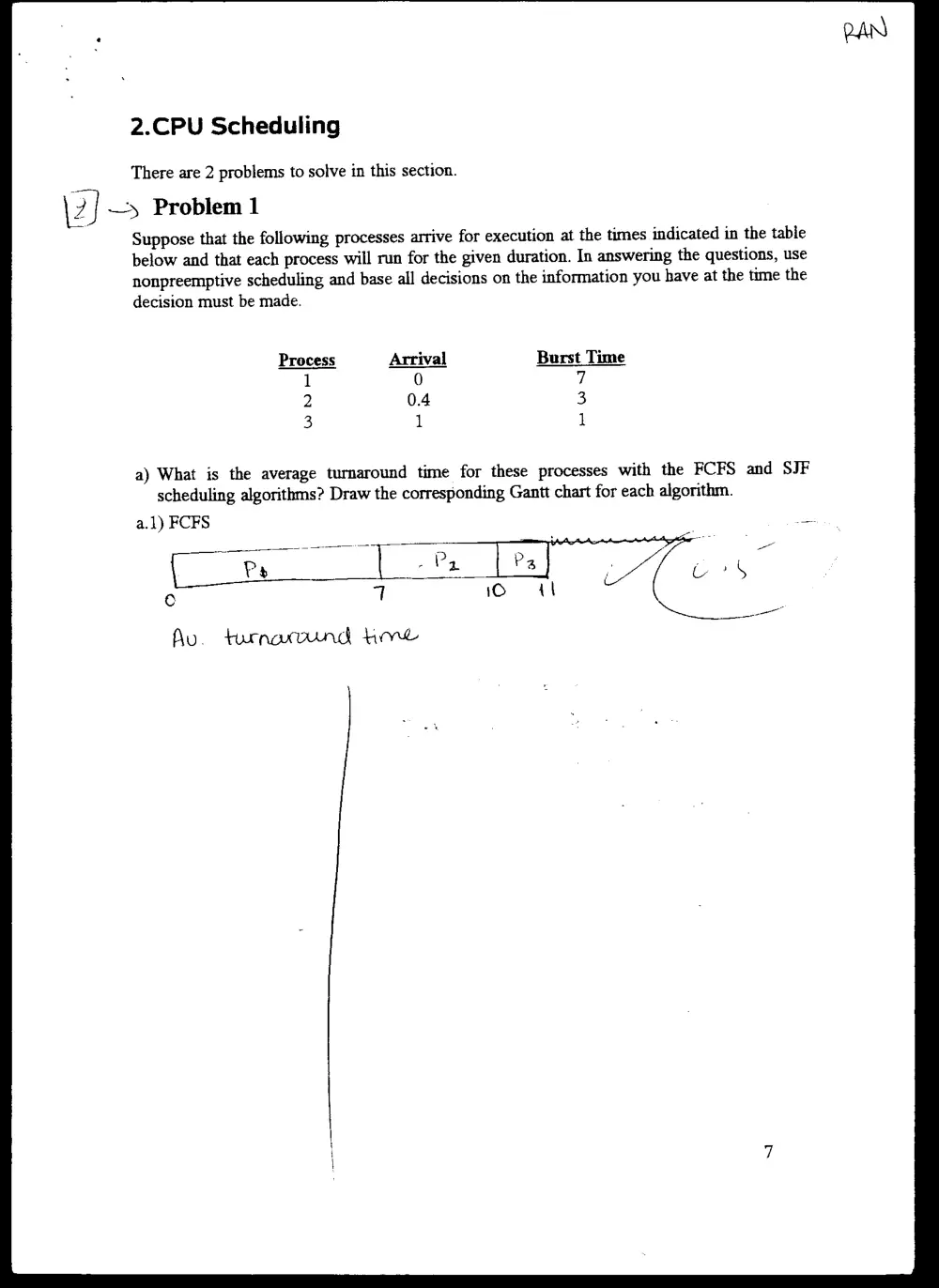
Suppose that the following processes arrive for execution at the times indicated in the table
below and that each process will run for the given duration. In answering the questions, use
nonpreemptive scheduling and base all decisions on the information you have at the time the
decision must be made.
Process Arrival Burst Time
1 0 7
0.4 3
1 1
a) What is the average turnaround time for these processes with the FCFS and SJF
scheduling algorithms? Draw the corresponding Gantt chart for each algorithm.
a.1) FCFS
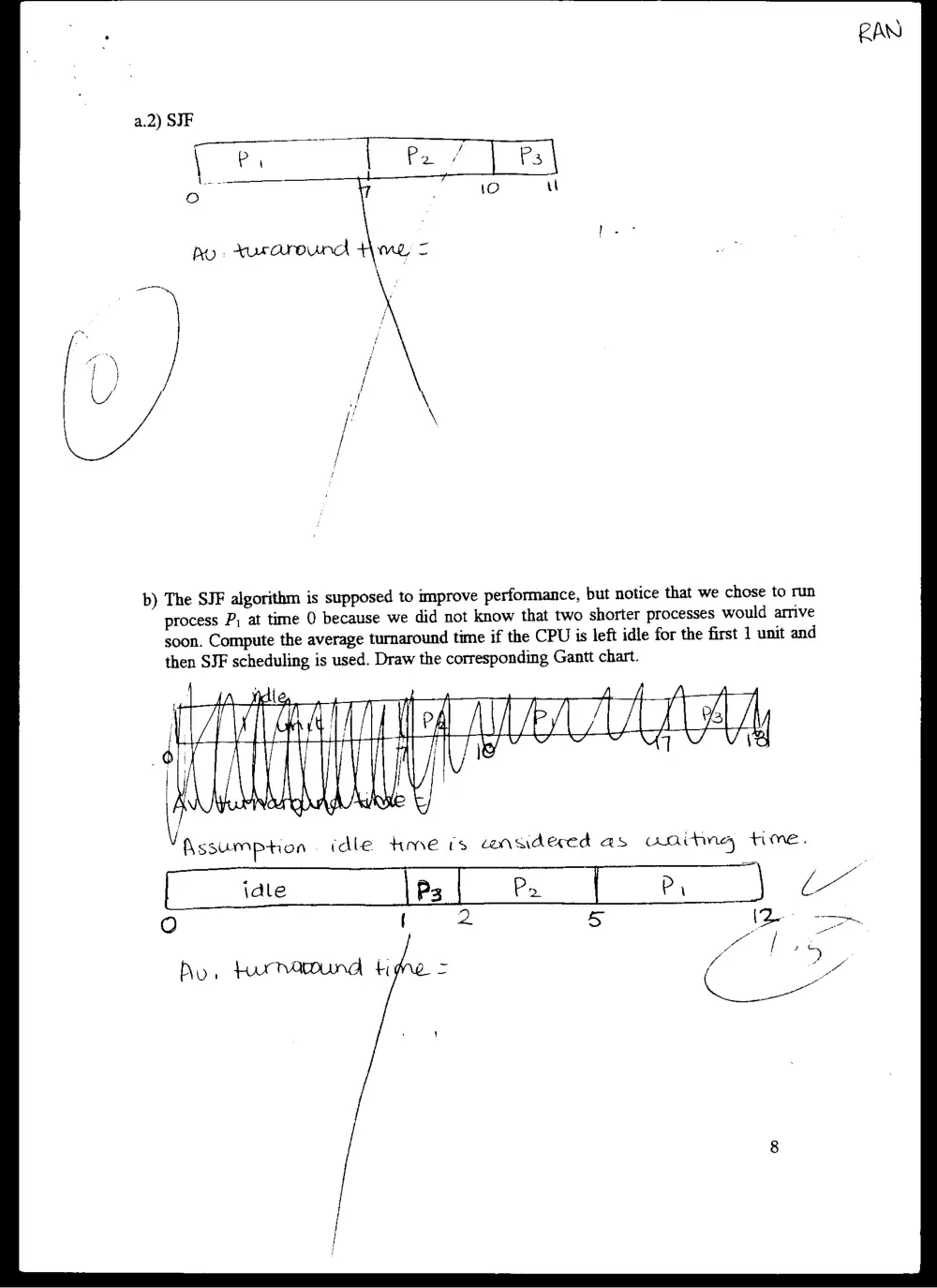
a.2) SIF
b) The SJF algorithm is supposed to improve performance, but notice that we chose to run
process P, at time 0 because we did not know that two shorter processes would arrive
soon. Compute the average turnaround time if the CPU is left idle for the first 1 unit and
then SJF scheduling is used. Draw the corresponding Gantt chart.
Assumption . idle Hme rs ensideced as aihneg time.
[ idle lps | Po 1 Py | a |
(2 -
O ( 2 5
—
Zobos
Do, dumamund time = / .
Co
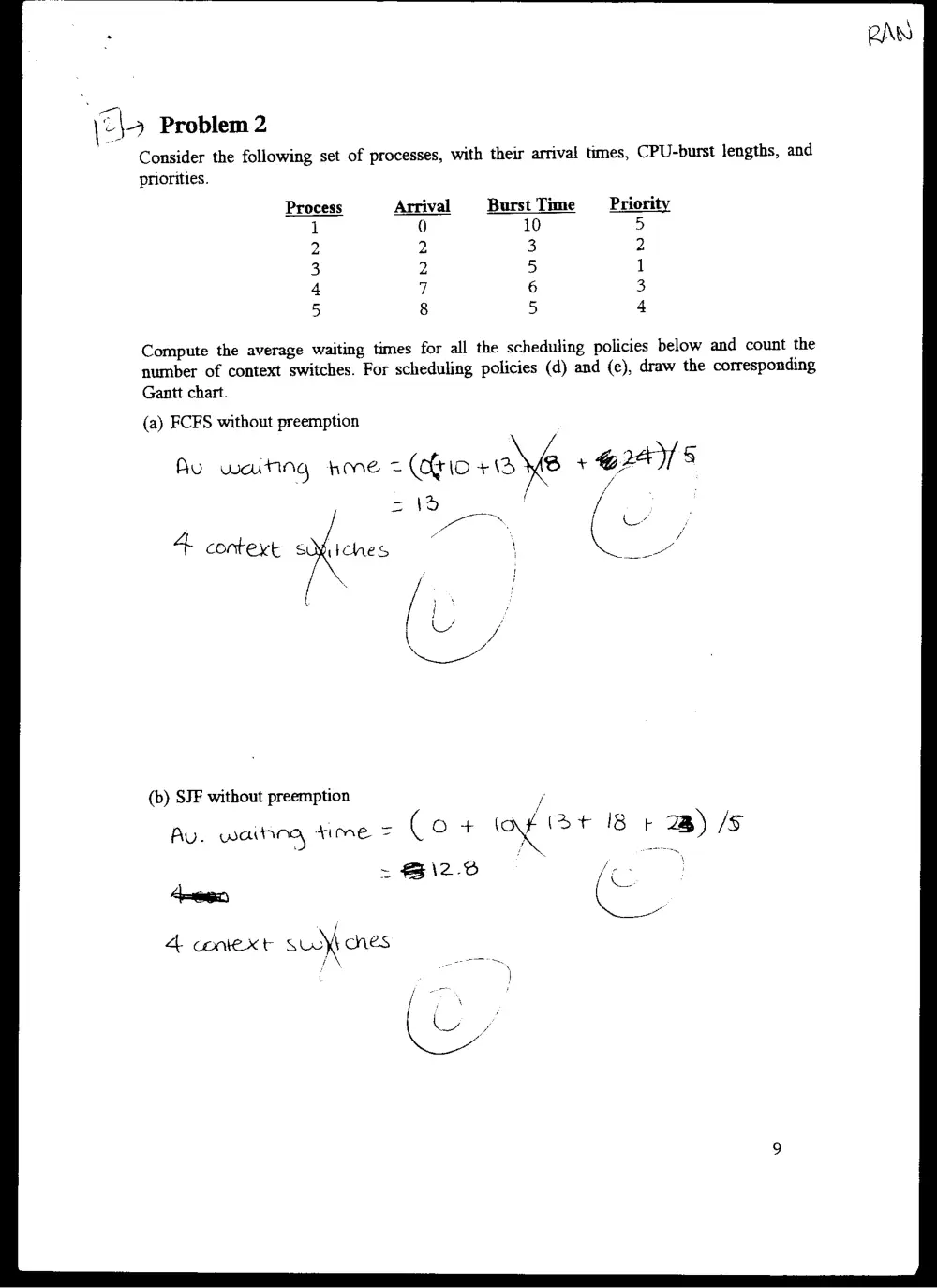
(elo Problem 2
Consider the following set of processes, with their arrival times, CPU-burst lengths, and
priorities.
Process Arrival Burst Time Priority
10
Compute the average waiting times for all the scheduling policies below and count the
number of context switches. For scheduling policies (d) and (e), draw the corresponding
Gantt chart.
(a) FCFS without preemption
Av wating hone = (dfrio «aye + 24) 8
f .
comm Re) — /{ .
4 context sd¥iches
(b) SIF without preemption /
nu. wainng tne = CO + SE
~ €\2.9
Anes
4 context su ches
RAN
(c) SJF with preemption
Av. waiting tina = (14 42 £54 10816 )/F ae
(d) Priority with preemption (lyghest proaty is Lewest yum er 1. 4 here)
(2 +3 + erte neo 17.
Xx