
CVSP 202 Final, Fall 2002
American University of Beirut · Ancient, Medieval and Renaissance Culture · 2 pages

More CVSP 202 files
Show the text of this final exam
| LIBLARY
oF 4
a BEIRUT
Civilization Sequence 202
Final Interpretation Exercise
A.U.B. Jan. 29, 03
2002-03 S. Khoury
OPEN BOOKS - OPEN NOTES — OPEN MINDS
REMEMBER:
A. — Quality is more convincing than quantity.....
B. Don’t ‘talk’ when you write, present a systematical coherent
analysis according to the instructions...
Answer Two questions Only:
. THE TRUTH
“Do not know the truth by men, but rather, know the truth and you will
know its adherents”. (Al-Ghazzali, p. 40).
1. Analyze the above quotation within its context, with particular
emphasis on its significance for Al-Ghazzali’s attitude towards
knowledge and seekers of the Truth.
Respond to the above quotation from the point of view of two (2) of
the following:
Augustine, OR Aquinas, OR Luther, OR Ibn Rushd, OR Ibn
Tufayl, OR Ibn Khaldun.
Conclude by stating clearly the effects of this quotation on our
human relations.
“The gulf between how one should live and how one does live...”
Interpret Chapter XV of ‘The Prince” by elaborating the
consequences of the “guif’ — concept:
a. with regard to the author’s recommendations to the prince.
b. In view of Machiavelli’s own moral consciousness.
React to this statement from Ibn Khaldun’s or Ghazzali’s or Ibn
Tufayl’s point of view
State your own opinion.
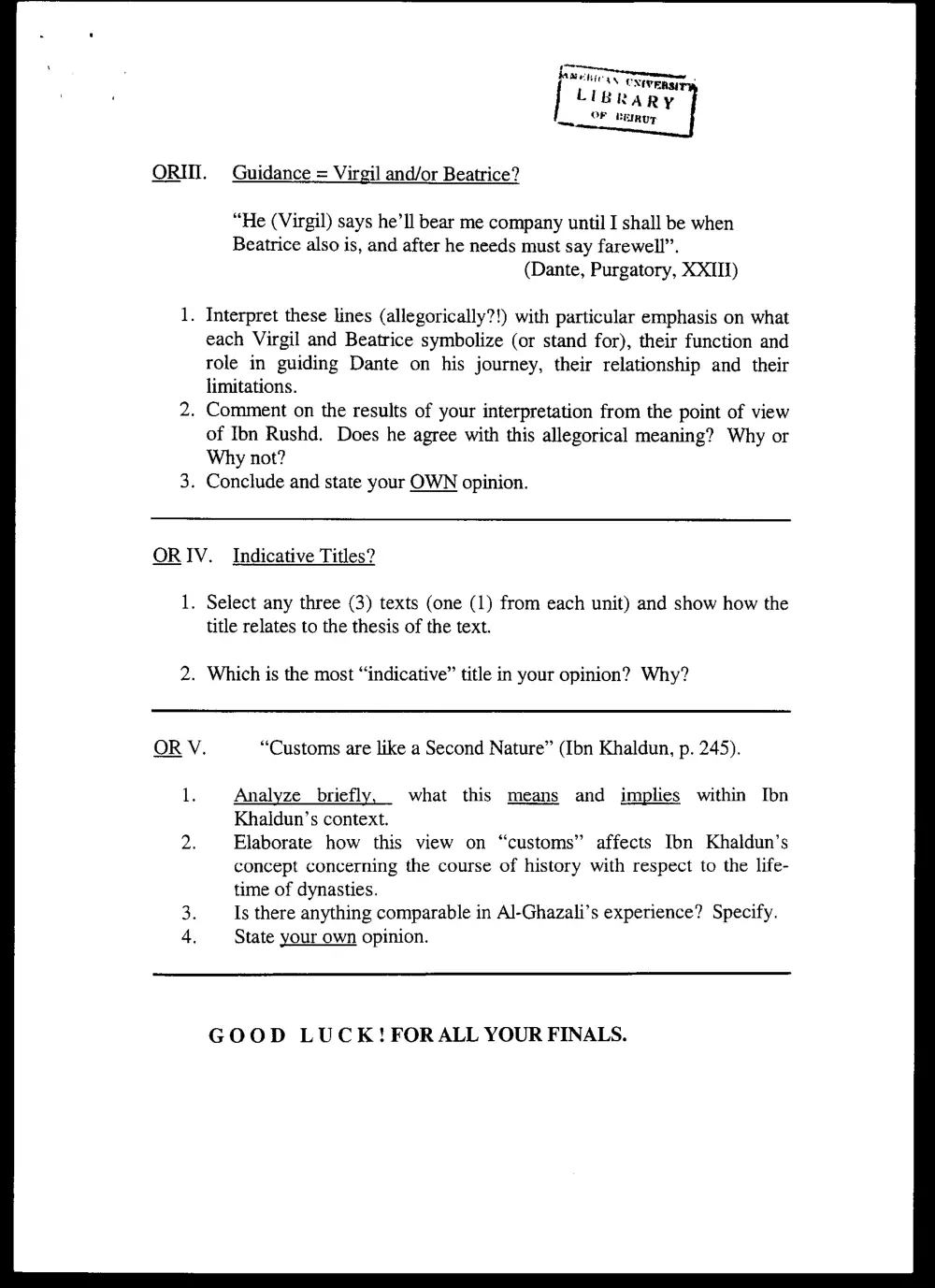
ORI. Guidance = Virgil and/or Beatrice?
“He (Virgil) says he’ll bear me company until I shall be when
Beatrice also is, and after he needs must say farewell”.
(Dante, Purgatory, XXIII)
1. Interpret these lines (allegorically?!) with particular emphasis on what
each Virgil and Beatrice symbolize (or stand for), their function and
role in guiding Dante on his journey, their relationship and their
limitations.
. Comment on the results of your interpretation from the point of view
of Ibn Rushd. Does he agree with this allegorical meaning? Why or
Why not?
3. Conclude and state your OWN opinion.
ORIV. Indicative Titles?
1. Select any three (3) texts (one (1) from each unit) and show how the
title relates to the thesis of the text.
2. Which is the most “indicative” title in your opinion? Why?
OR V. “Customs are like a Second Nature” (Ibn Khaldun, p. 245).
1. Analyze briefly, what this means and implies within Ibn
Khaldun’s context.
2. Elaborate how this view on “customs” affects Ibn Khaldun’s
concept concerning the course of history with respect to the life-
time of dynasties.
Is there anything comparable in Al-Ghazali’s experience? Specify.
State your own opinion.
GOOD LUCK! FORALL YOUR FINALS.