
CVSP 202 Final, Fall 2003
American University of Beirut · Ancient, Medieval and Renaissance Culture · 2 pages

More CVSP 202 files
Show the text of this final exam
FINAL EXAM
CVSP 202: Sections 6 & 7
Jan. 22, 2004
Prof. Pinto
Time 2 hrs
!!!DO NOT PUT YOUR NAME ON THE EXAM!!!
***ONLY YOUR ID NO.***
PART I: ESSAY QUESTIONS (50% EACH)
Write two in depth essays on ANY 2 of the following questions. Each essay
should be at least 5 pages. Feel free to draw upon other readings and your own
perspective where necessary.
1) "In class we discussed Dante's Purgatorio from a number of perspectives:
political; visual; Roman mythology (specifically Virgil's Aeneid and Ovid's
Metamorphoses); Christian theology; Islam; Aviary symbolism; and Dante's
imaginative inventions.
Pick two of these perspectives and discuss them as fully as possible.
2) "Luther decried "works" and thus brought about the Protestant split from the
Roman Catholic Church. Explain the basis of his actions. Discuss the pro's and
con's of his interpretation of "works." How and why did his attacks on “works”
result in the Protestant Reformation?
3) “Employing different approaches Ibn Tufayl and Aquinas communicated the
same message. Present the conclusions that these two reached and explain the
method each one of them used to arrive at the same "truth."
4) After a long fight with your spouse regarding marriage problems, you rush
out of the house in anger on your way to work. With the rage still fresh in your
anit
LIbAwaAk®
OF BEIRUT
ID No.:
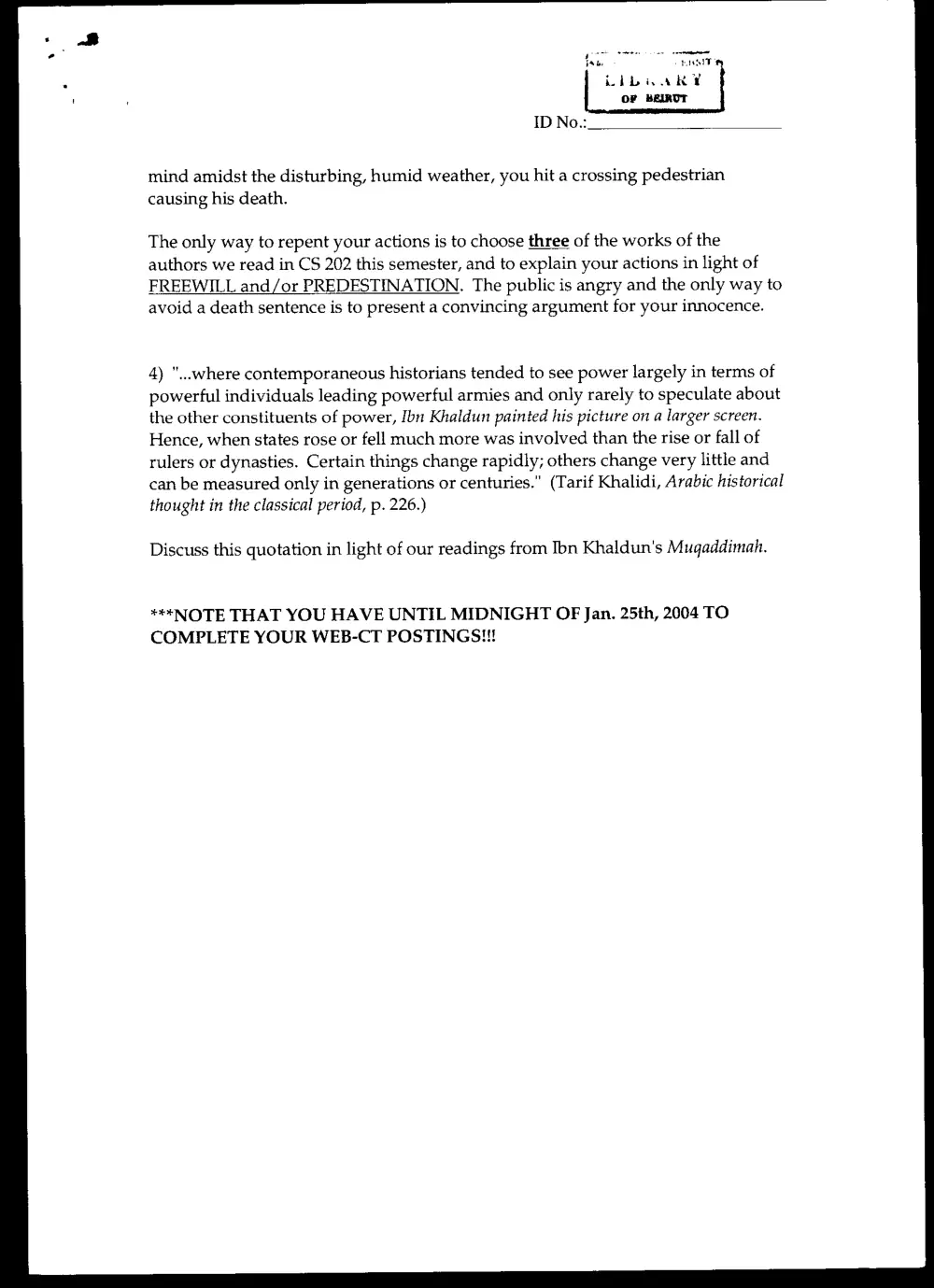
mind amidst the disturbing, humid weather, you hit a crossing pedestrian
causing his death.
The only way to repent your actions is to choose three of the works of the
authors we read in CS 202 this semester, and to explain your actions in light of
FREEWILL and/or PREDESTINATION. The public is angry and the only way to
avoid a death sentence is to present a convincing argument for your innocence.
4) "...where contemporaneous historians tended to see power largely in terms of
powerful individuals leading powerful armies and only rarely to speculate about
the other constituents of power, Ibn Khaldun painted his picture on a larger screen.
Hence, when states rose or fell much more was involved than the rise or fall of
rulers or dynasties. Certain things change rapidly; others change very little and
can be measured only in generations or centuries." (Tarif Khalidi, Arabic historical
thought in the classical period, p. 226.)
Discuss this quotation in light of our readings from Ibn Khaldun's Mugaddimah.
***NOTE THAT YOU HAVE UNTIL MIDNIGHT OF Jan. 25th, 2004 TO
COMPLETE YOUR WEB-CT POSTINGS!!!