
CVSP 202 Final, Spring 2000
American University of Beirut · Ancient, Medieval and Renaissance Culture · 2 pages

More CVSP 202 files
Show the text of this final exam
CIVILIZATION SEQUENCE 202
FINAL EXAMINATION
TIME: Two Hours June 6,2000
Ms. R. Fakhry
Choose ONE of the following essay questions; read it
carefully and make sure you answer it as completely as
you can.
Many of the writings in C.S. 202 have focused on the concepts of
revelation, faith and reason. Briefly describe how you understand
each concept. Now describe the views of three of the writers we
have studied on whether there is a need for faith and revelation in
addition to reason, and, if so, why, or, if not, why not ?
Compare the following two thinkers on the role of holy scriptures in
the life of the believer: Ibn Tufayl and Ibn Rushd.
How would each answer the following questions: What is the
purpose of holy scriptures ? What good do they serve ? Should
everyone be allowed to interpret them ?
Answer the following question (Obligatory Question)
Both Machiavelli and Ibn Khaldun outline the desirable and
necessary qualities in any leader for effective rule.
Discuss the major differences between the two political models by
referring to their unique goals. ;
II.
Answer ONE of the following questions:
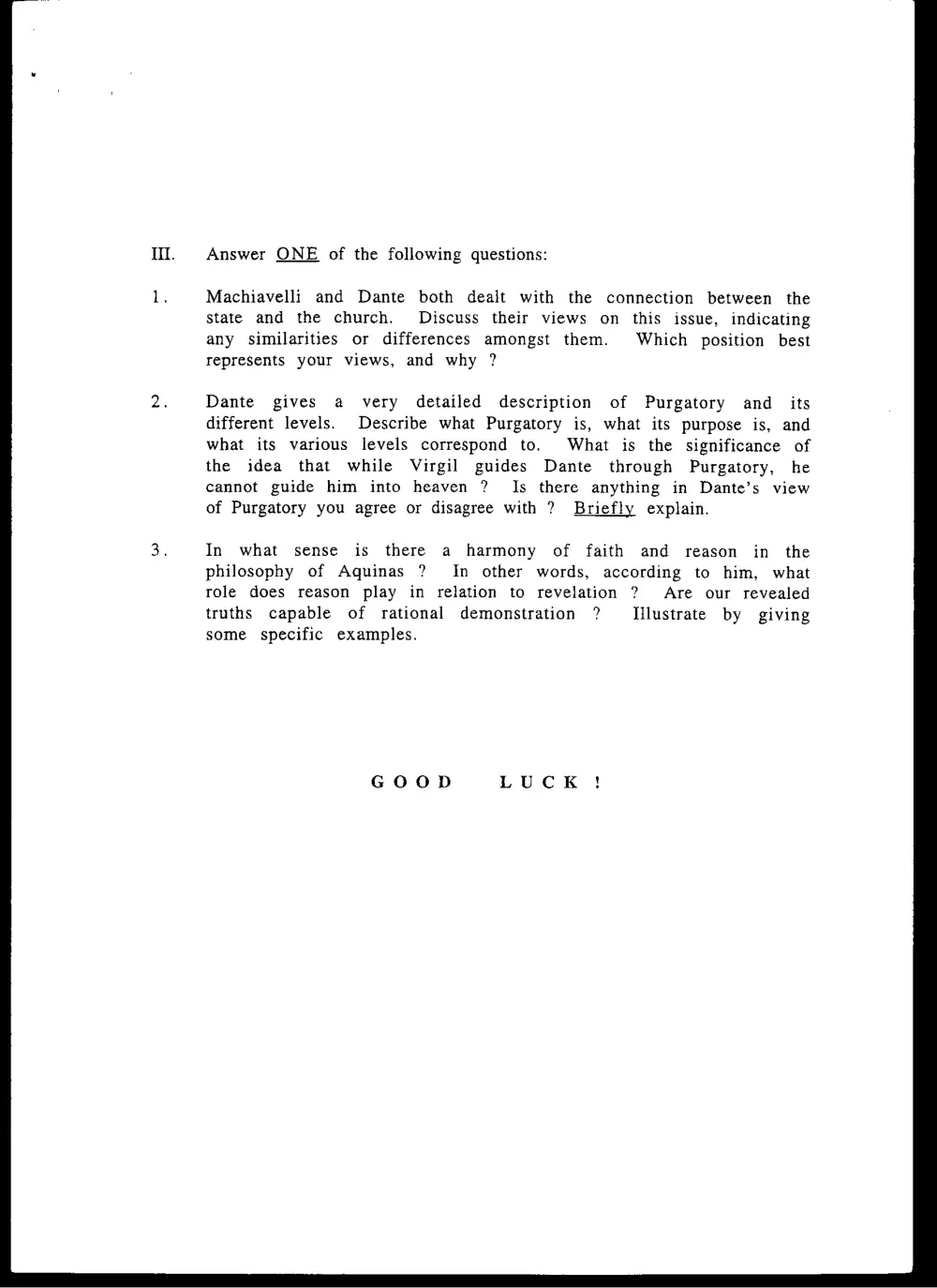
Machiavelli and Dante both dealt with the connection between the
State and the church. Discuss their views on this issue, indicating
any similarities or differences amongst them. Which position best
represents your views, and why ?
Dante gives a very detailed description of Purgatory and _ its
different levels. Describe what Purgatory is, what its purpose is, and
what its various levels correspond to. What is the significance of
the idea that while Virgil guides Dante through Purgatory, he
cannot guide him into heaven ? Is there anything in Dante’s view
of Purgatory you agree or disagree with ? Briefly explain.
In what sense is there a harmony of faith and reason in the
philosophy of Aquinas ? In other words, according to him, what
role does reason play in relation to revelation ? Are our revealed
truths capable of rational demonstration ? [llustrate by giving
some specific examples.
GOoD LUCK !}