
CVSP 202 Final, Spring 2001
American University of Beirut · Ancient, Medieval and Renaissance Culture · 2 pages
More CVSP 202 files
Show the text of this final exam
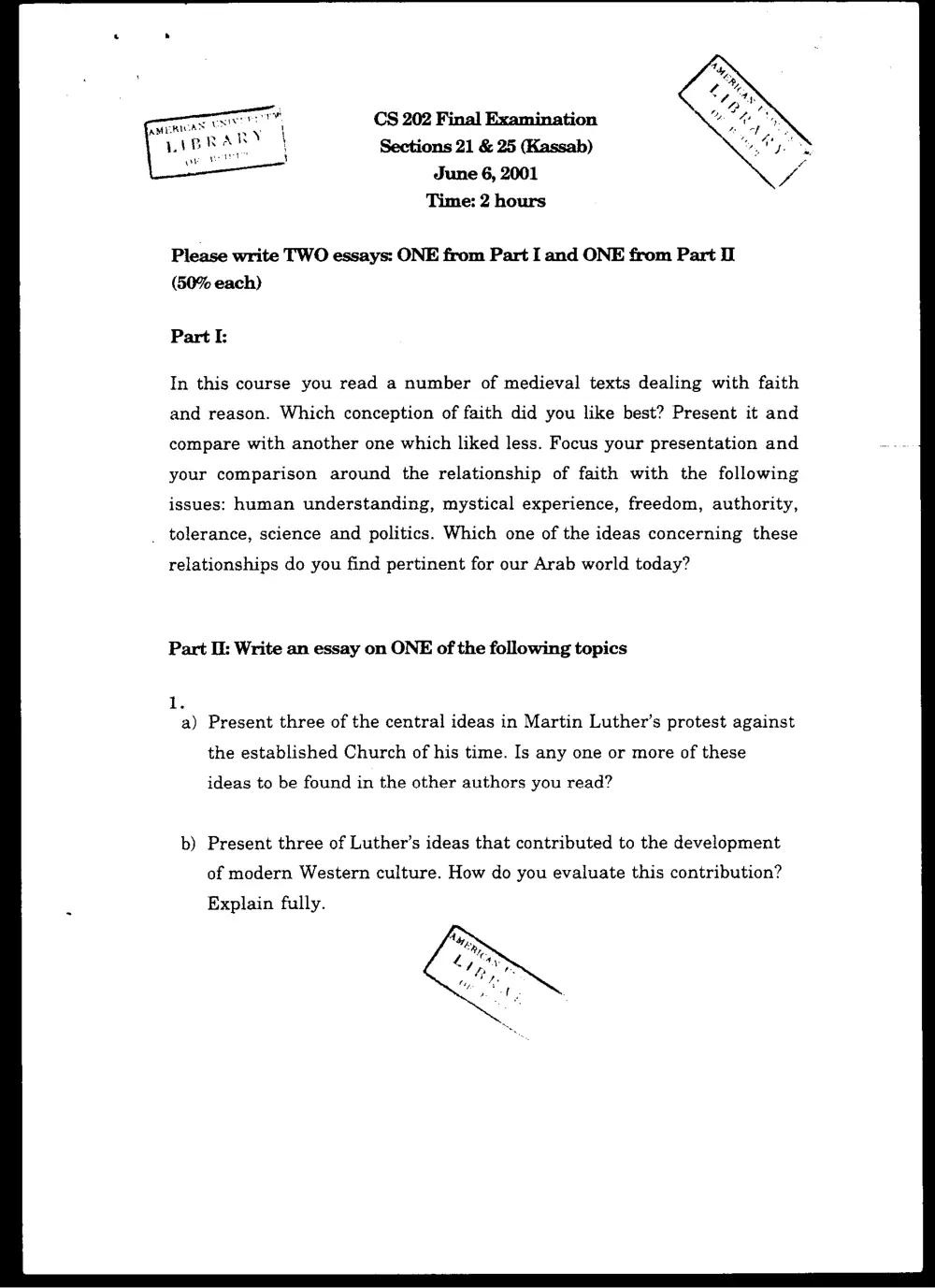
CS 202 Final Examination
Sections 21 & 25 (Kassab)
June 6, 2001
Time: 2 hours
Please write TWO essays: ONE from Part I and ONE from Part I
(50% each)
Part I:
In this course you read a number of medieval texts dealing with faith
and reason. Which conception of faith did you like best? Present it and
compare with another one which liked less. Focus your presentation and
your comparison around the relationship of faith with the following
issues: human understanding, mystical experience, freedom, authority,
_ tolerance, science and politics. Which one of the ideas concerning these
relationships do you find pertinent for our Arab world today?
Part I: Write an essay on ONE of the following topics
1
a) Present three of the central ideas in Martin Luther’s protest against
the established Church of his time. Is any one or more of these
ideas to be found in the other authors you read?
b) Present three of Luther’s ideas that contributed to the development
of modern Western culture. How do you evaluate this contribution?
Explain fully.
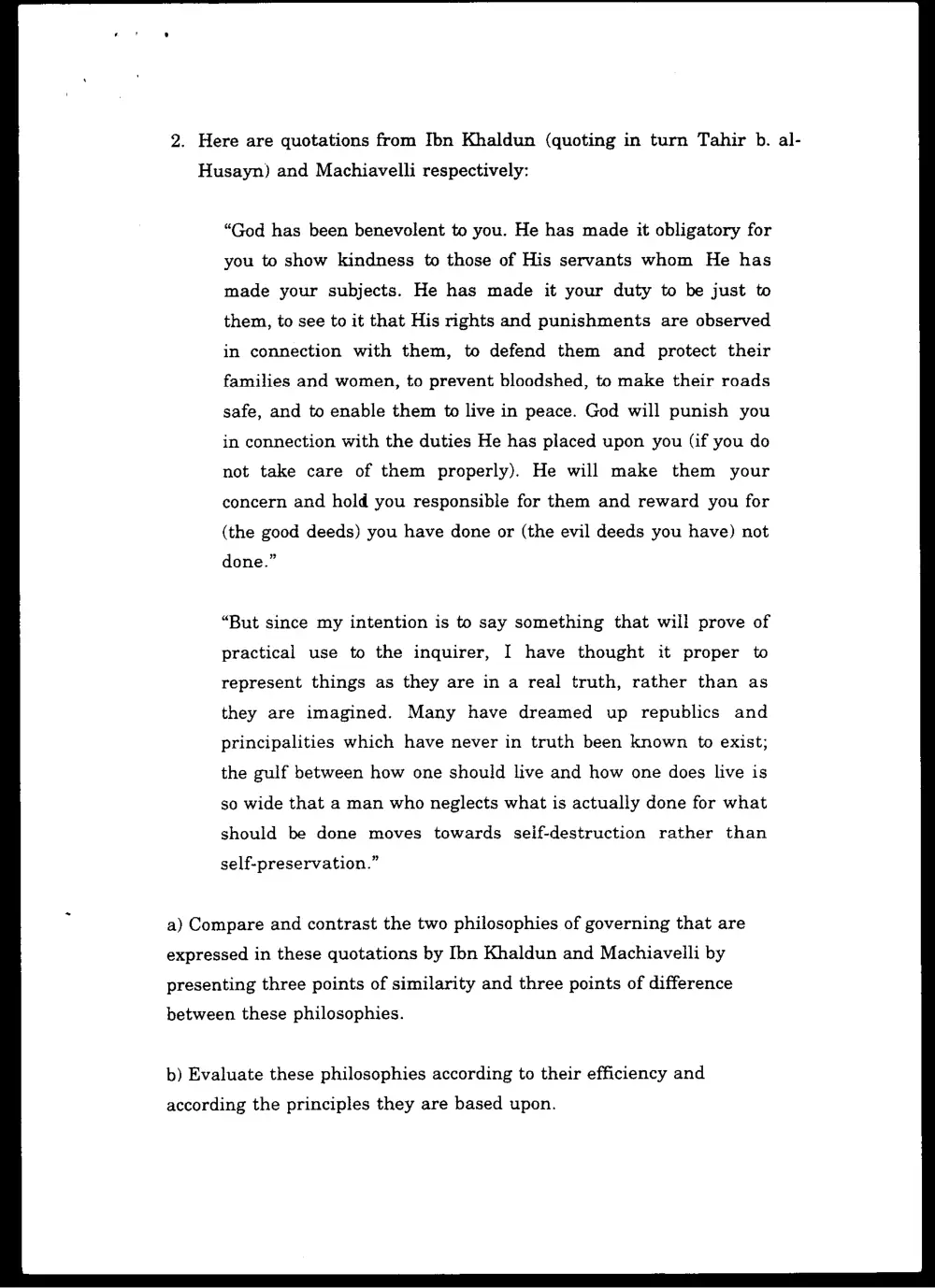
2. Here are quotations from Ibn Khaldun (quoting in turn Tahir b. al-
Husayn) and Machiavelli respectively:
“God has been benevolent to you. He has made it obligatory for
you to show kindness to those of His servants whom He has
made your subjects. He has made it your duty to be just to
them, to see to it that His rights and punishments are observed
in connection with them, to defend them and protect their
families and women, to prevent bloodshed, to make their roads
safe, and to enable them to live in peace. God will punish you
in connection with the duties He has placed upon you (if you do
not take care of them properly). He will make them your
concern and hold you responsible for them and reward you for
(the good deeds) you have done or (the evil deeds you have) not
done.”
“But since my intention is to say something that will prove of
practical use to the inquirer, I have thought it proper to
represent things as they are in a real truth, rather than as
they are imagined. Many have dreamed up republics and
principalities which have never in truth been known to exist;
the gulf between how one should live and how one does live is
so wide that a man who neglects what is actually done for what
should be done moves towards seif-destruction rather than
self-preservation.”
a) Compare and contrast the two philosophies of governing that are
expressed in these quotations by Ibn Khaldun and Machiavelli by
presenting three points of similarity and three points of difference
between these philosophies.
b) Evaluate these philosophies according to their efficiency and
according the principles they are based upon.