
CVSP 202 Final, Spring 2001
American University of Beirut · Ancient, Medieval and Renaissance Culture · 3 pages
More CVSP 202 files
Show the text of this final exam
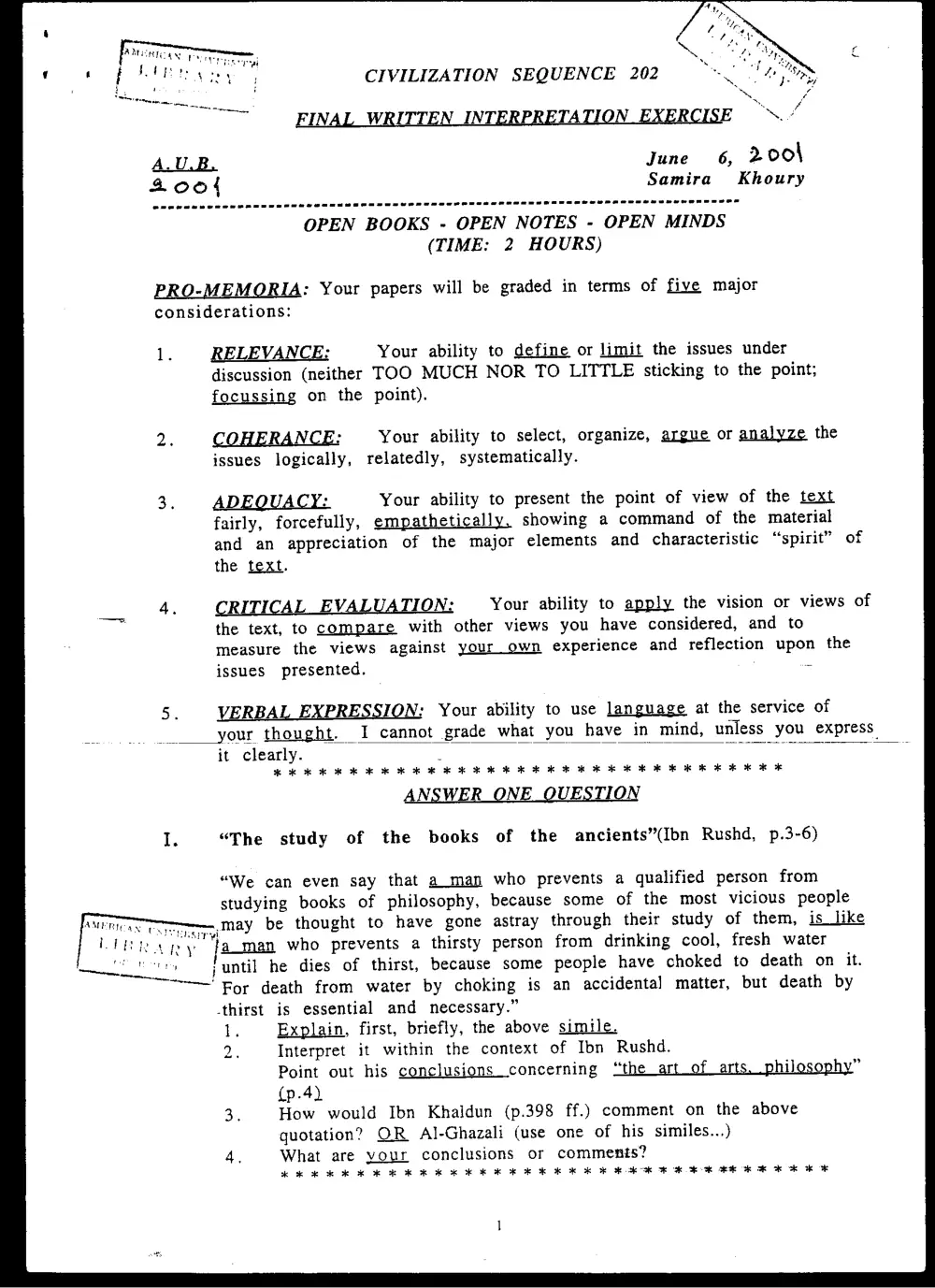
CIVILIZATION SEQUENCE 202
WRITT. INTERPRETA N_EXER
June 6, 200\
Samira Khoury
OPEN BOOKS - OPEN NOTES - OPEN MINDS
(TIME: 2 HOURS)
PRO-MEMORIA: Your papers will be graded in terms of five major
considerations:
1. RELEVANCE: Your ability to define or limit the issues under
discussion (neither TOO MUCH NOR TO LITTLE sticking to the point;
focussing on the point).
COHERANCE: Your ability to select, organize, argue or analyze the
issues logically, relatedly, systematically.
ADEQUACY: Your ability to present the point of view of the text
fairly, forcefully, empathetically. showing a command of the material
and an appreciation of the major elements and characteristic “spirit” of
the text.
CRITICAL _ EVALUATION: Your ability to apply the vision or views of
the text, to compare with other views you have considered, and to
measure the views against your own experience and reflection upon the
issues presented. -
5. VERBAL EXPRESSION: Your ability to use language at the service of
a your thought. I cannot grade what you have in mind, unless you express
it clearly. . ~ ~ ~
ok OK ROK OR Rok ck ok ok ck ok ak ook kook ok ok ok ok dk Ok ck oR Rok kk Ok kk
ANSWER_ONE_ QUESTION
“The study of the books of the ancients”(Ibn Rushd, p.3-6)
“We can even say that a_man who prevents a qualified person from
studying books of philosophy, because some of the most vicious people
Toy may be thought to have gone astray through their study of them, is like
la_man who prevents a thirsty person from drinking cool, fresh water
j until he dies of thirst, because some people have choked to death on it.
“For death from water by choking is an accidental matter, but death by
thirst is essential and necessary.”
1. Explain, first, briefly, the above simile.
2. Interpret it within the context of Ibn Rushd.
Point out his conclusions concerning ‘‘the art of ar hiloso
(p.4)
How would Ibn Khaldun (p.398 ff.) comment on the above
quotation? OR Aj-Ghazali (use one of his similes...)
What are vour conclusions or comments?
ORK OR RR OR KOK KK KOR KR KR ROK Rk OK aR SRR OR GR RoR OR ok ROOK OF
AMET CAN pe
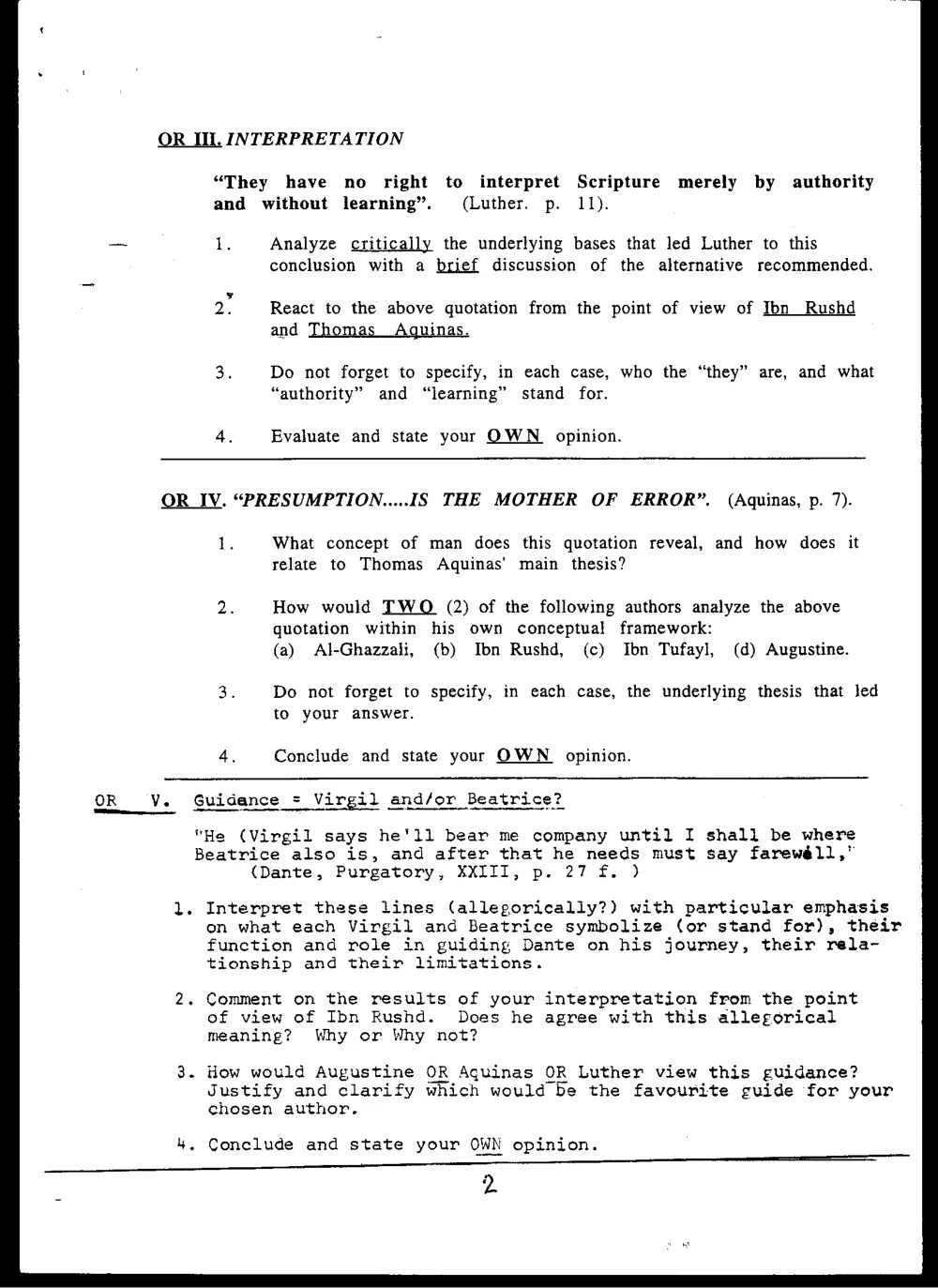
OR Ill. INTERPRETATION
“They have no right to interpret Scripture merely by authority
and without learning”. (Luther. p. 11).
_ 1. Analyze critically the underlying bases that led Luther to this
conclusion with a brief discussion of the alternative recommended.
2. React to the above quotation from the point of view of Ibn Rushd
and Thomas Aquinas.
3. Do not forget to specify, in each case, who the “they” are, and what
“authority” and “learning” stand for.
4. Evaluate and state your OWN opinion.
OR IV. “PRESUMPTION.....1IS THE MOTHER OF ERROR”. (Aquinas, p. 7).
1. What concept of man does this quotation reveal, and how does it
relate to Thomas Aquinas’ main thesis?
2. How would TWO (2) of the following authors analyze the above
quotation within his own conceptual framework:
(a) Al-Ghazzali, (b) Ibn Rushd, (c) Ibn Tufayl, (d) Augustine.
3. Do not forget to specify, in each case, the underlying thesis that led
to your answer.
4, Conclude and state your OWN opinion.
OR V. Guidance = Virgil and/or Beatrice?
See
"He (Virgil says he'll bear me company until I shall be where
Beatrice also is, and after that he needs must say farewéll,”
(Dante, Purgatory, XXIII, p. 27 f. )
1. Interpret these lines (allepgorically?) with particular emphasis
on what each Virgil and Beatrice symbolize (or stand for), their
function and role in guiding Dante on his journey, their rela-
tionship and their limitations.
2. Comment on the results of your interpretation from the point
of view of Ibn Rushd. Does he agree with this allerorical
meaning? Why or Why not?
3. How would Augustine OR Aquinas OR Luther view this guidance?
Justify and clarify which would be the favourite guide for your
chosen author.
4. Conclude and state your OWN opinion.
I
2
OR V
Ww
OR_VI.
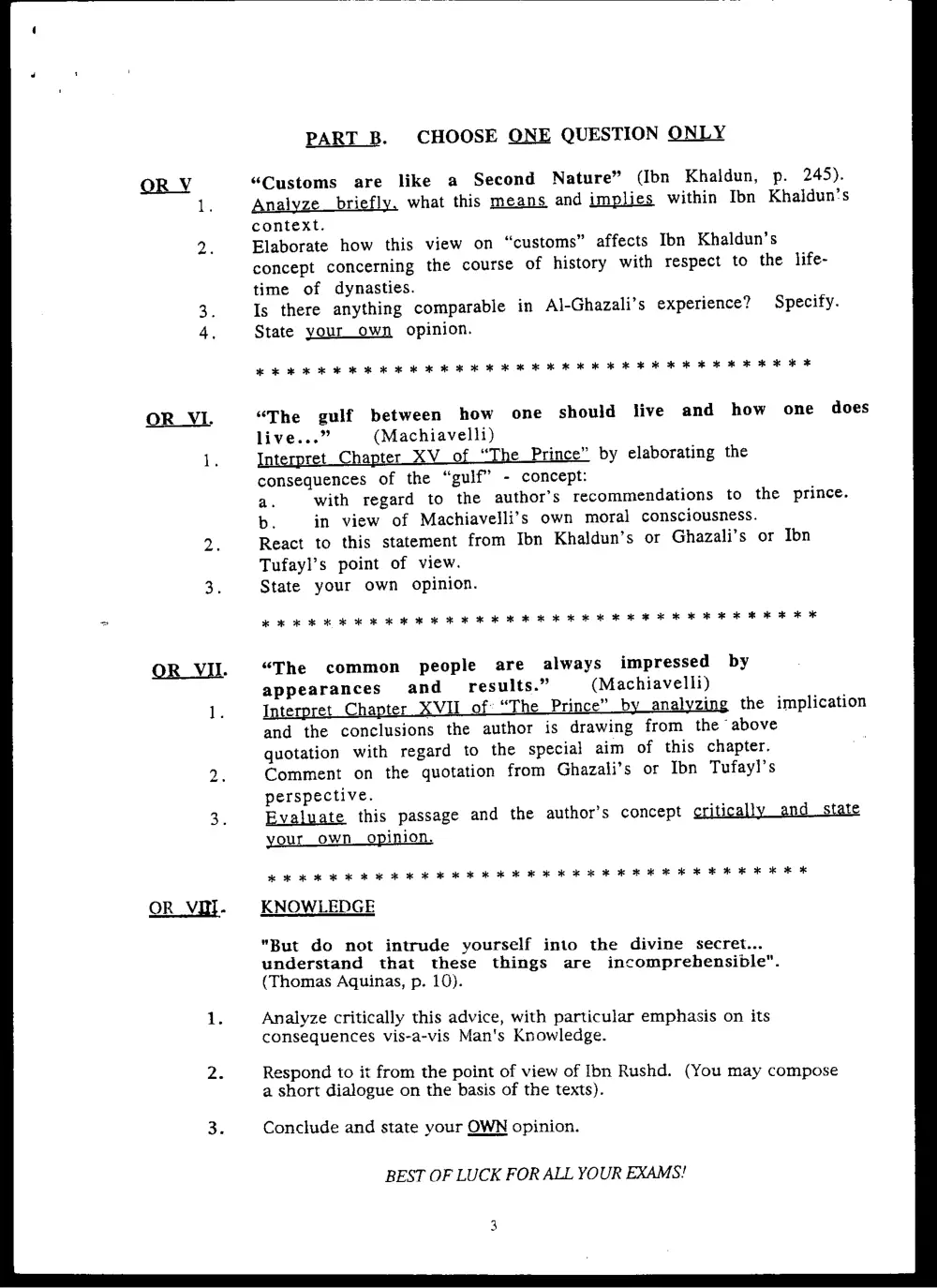
PART B. CHOOSE ONE QUESTION ONLY
“Customs are like a Second Nature” (Ibn Khaldun, p. 245).
Analyze briefly, what this means and implies within Ibn Khaldun’s
context.
Elaborate how this view on “customs” affects Ibn Khaldun’s
concept concerning the course of history with respect to the life-
time of dynasties.
Is there anything comparable in Al-Ghazali’s experience? Specify.
State your_own opinion.
ORR ROR ROR ROR ROR KOR ORR ROR RRR oR Ok oR RR RR FF
“The gulf between how one should live and how one does
live...” (Machiavelli)
Interpret_Chapter XV_of “The Prince” by elaborating the
consequences of the “gulf” - concept:
a. with regard to the author’s recommendations to the prince.
b. in view of Machiavelli’s own moral consciousness.
React to this statement from Ibn Khaldun’s or Ghazali’s or Ton
Tufayl’s point of view.
State your own opinion.
ROR KORO ROR ROK ROR ROR ROR ROR RGR OR RRR ROR ROR ROR ROR ROR KR FOF
“The common people are always impressed by
appearances and results.” (Machiavelli)
Interpret Chapter XVII of: “The Prince” by analyzing the implication
and the conclusions the author is drawing from the ‘above
quotation with regard to the special aim of this chapter.
Comment on the quotation from Ghazali’s or Ibn Tufayl's
perspective.
Evaluate this passage and the author’s concept critically and_ state
sek OR ROR OK RR KK Rok ok Rk RRR kk ok ok Rok ae ae oe kK OR
KNOWLEDGE
"But do not intrude yourself into the divine secret...
understand that these things are incomprehensible”.
(Thomas Aquinas, p. 10).
Analyze critically this advice, with particular emphasis on its
consequences vis-a-vis Man's Knowledge.
Respond to it from the point of view of Ibn Rushd. (You may compose
a short dialogue on the basis of the texts).
Conclude and state your OWN opinion.
BEST OF LUCK FOR ALL YOUR EXAMS!