
CVSP 202 Final, Spring 2001
American University of Beirut · Ancient, Medieval and Renaissance Culture · 1 page
Stuck on a question? A tutor can walk you through it.
More CVSP 202 files
Show the text of this final exam
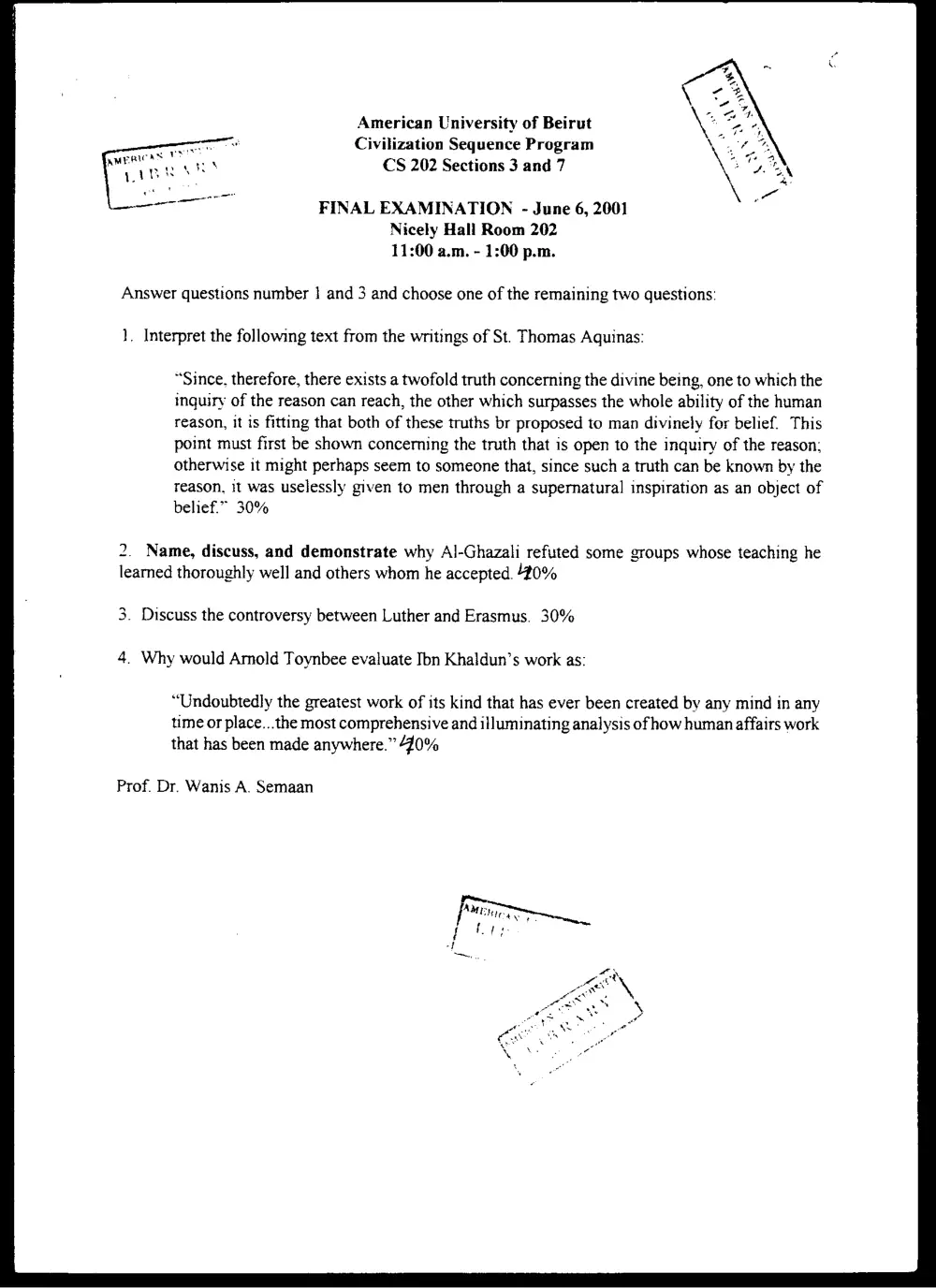
American University of Beirut
Civilization Sequence Program
CS 202 Sections 3 and 7
FINAL EXAMINATION - June 6, 2001
Nicely Hall Room 202
11:00 a.m. - 1:00 p.m.
Answer questions number | and 3 and choose one of the remaining two questions:
1. Interpret the following text from the writings of St. Thomas Aquinas:
“Since, therefore, there exists a twofold truth concerning the divine being, one to which the
inquiry of the reason can reach, the other which surpasses the whole ability of the human
reason, it is fitting that both of these truths br proposed to man divinely for belief. This
point must first be shown concerning the truth that is open to the inquiry of the reason;
otherwise it might perhaps seem to someone that, since such a truth can be known by the
reason, it was uselessly given to men through a supernatural inspiration as an object of
belief.” 30%
2. Name, discuss, and demonstrate why Al-Ghazali refuted some groups whose teaching he
learned thoroughly well and others whom he accepted. 40%
3. Discuss the controversy between Luther and Erasmus. 30%
4. Why would Amold Toynbee evaluate Ibn Khaldun’s work as:
“Undoubtedly the greatest work of its kind that has ever been created by any mind in any
time or place...the most comprehensive and illuminating analysis of how human affairs work
that has been made anywhere.” 420%
Prof. Dr. Wanis A. Semaan