
CVSP 202 Final, Spring 2002
American University of Beirut · Ancient, Medieval and Renaissance Culture · 1 page
Stuck on a question? A tutor can walk you through it.
More CVSP 202 files
Show the text of this final exam
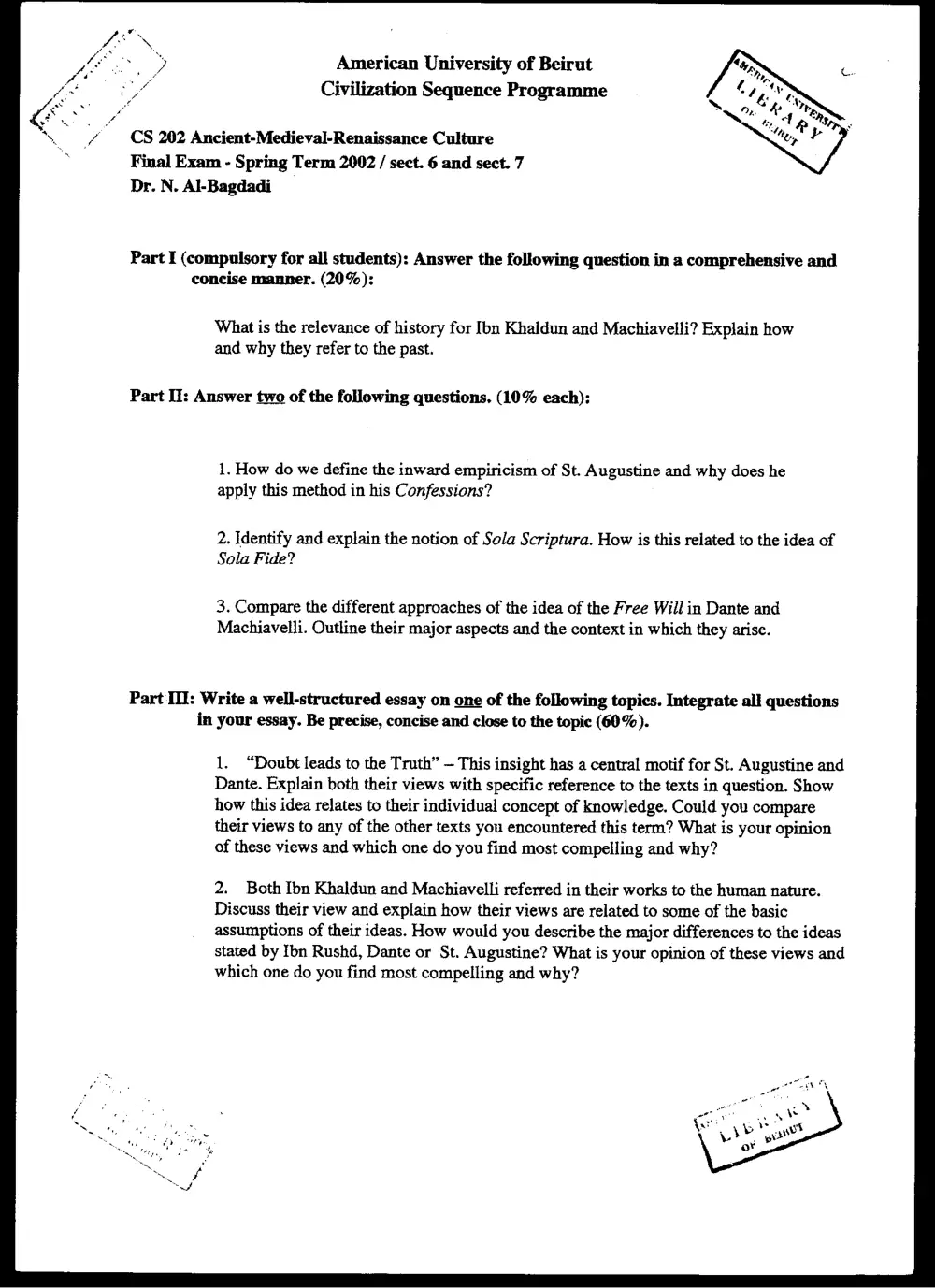
American University of Beirut
Civilization Sequence Programme
CS 202 Ancient-Medieval-Renaissance Culture
Final Exam - Spring Term 2002 / sect. 6 and sect. 7
Dr. N. Al-Bagdadi
Part I (compulsory for all students): Answer the following question in a comprehensive and
concise manner. (20%):
What is the relevance of history for Ibn Khaldun and Machiavelli? Explain how
and why they refer to the past.
Part II: Answer two of the following questions. (10% each):
1. How do we define the inward empiricism of St. Augustine and why does he
apply this method in his Confessions?
2. Identify and explain the notion of Sola Scriptura. How is this related to the idea of
Sola Fide?
3. Compare the different approaches of the idea of the Free Will in Dante and
Machiavelli. Outline their major aspects and the context in which they arise.
Part III: Write a well-structured essay on one of the following topics. Integrate all questions
in your essay. Be precise, concise and close to the topic (60%).
1. “Doubt leads to the Truth” — This insight has a central motif for St. Augustine and
Dante. Explain both their views with specific reference to the texts in question. Show
how this idea relates to their individual concept of knowledge. Could you compare
their views to any of the other texts you encountered this term? What is your opinion
of these views and which one do you find most compelling and why?
2. Both Ibn Khaldun and Machiavelli referred in their works to the human nature.
Discuss their view and explain how their views are related to some of the basic
assumptions of their ideas. How would you describe the major differences to the ideas
stated by Ibn Rushd, Dante or St. Augustine? What is your opinion of these views and
which one do you find most compelling and why?