
CVSP 202 Final, Spring 2002
American University of Beirut · Ancient, Medieval and Renaissance Culture · 1 page
Stuck on a question? A tutor can walk you through it.
More CVSP 202 files
Show the text of this final exam
{rss EnEC AS UNIVER .
' LIBKARY
. . . . OF BEIRUT
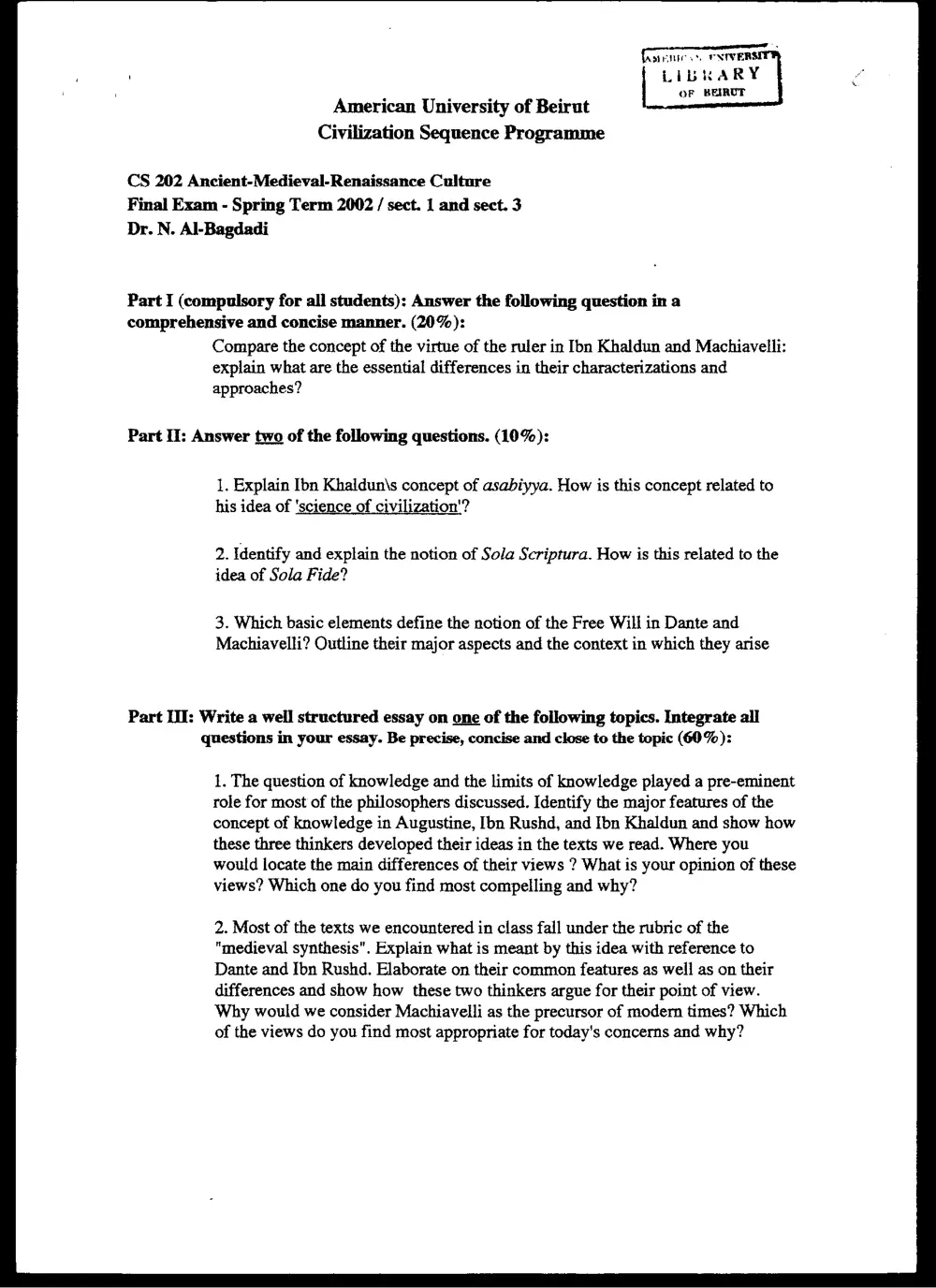
American University of Beirut
Civilization Sequence Programme
CS 202 Ancient-Medieval-Renaissance Cultare
Final Exam - Spring Term 2002 / sect. 1 and sect. 3
Dr. N. Al-Bagdadi
Part I (compulsory for all students): Answer the following question in a
comprehensive and concise manner. (20%):
Compare the concept of the virtue of the ruler in Ibn Khaldun and Machiavelli:
explain what are the essential differences in their characterizations and
approaches?
Part II: Answer two of the following questions. (10%):
1. Explain Ibn Khaldun\s concept of asabiyya. How is this concept related to
his idea of ‘science of civilization'?
2. Identify and explain the notion of Sola Scriptura. How is this related to the
idea of Sola Fide?
3. Which basic elements define the notion of the Free Will in Dante and
Machiavelli? Outline their major aspects and the context in which they arise
Part II: Write a well structured essay on one of the following topics. Integrate all
questions in your essay. Be precise, concise and close to the topic (60%):
1. The question of knowledge and the limits of knowledge played a pre-eminent
role for most of the philosophers discussed. Identify the major features of the
concept of knowledge in Augustine, Ibn Rushd, and Ibn Khaldun and show how
these three thinkers developed their ideas in the texts we read. Where you
would locate the main differences of their views ? What is your opinion of these
views? Which one do you find most compelling and why?
2. Most of the texts we encountered in class fall under the rubric of the
"medieval synthesis". Explain what is meant by this idea with reference to
Dante and Ibn Rushd. Elaborate on their common features as well as on their
differences and show how these two thinkers argue for their point of view.
Why would we consider Machiavelli as the precursor of modern times? Which
of the views do you find most appropriate for today's concerns and why?