
CVSP 202 Final, Spring 2003
American University of Beirut · Ancient, Medieval and Renaissance Culture · 2 pages
More CVSP 202 files
Show the text of this final exam
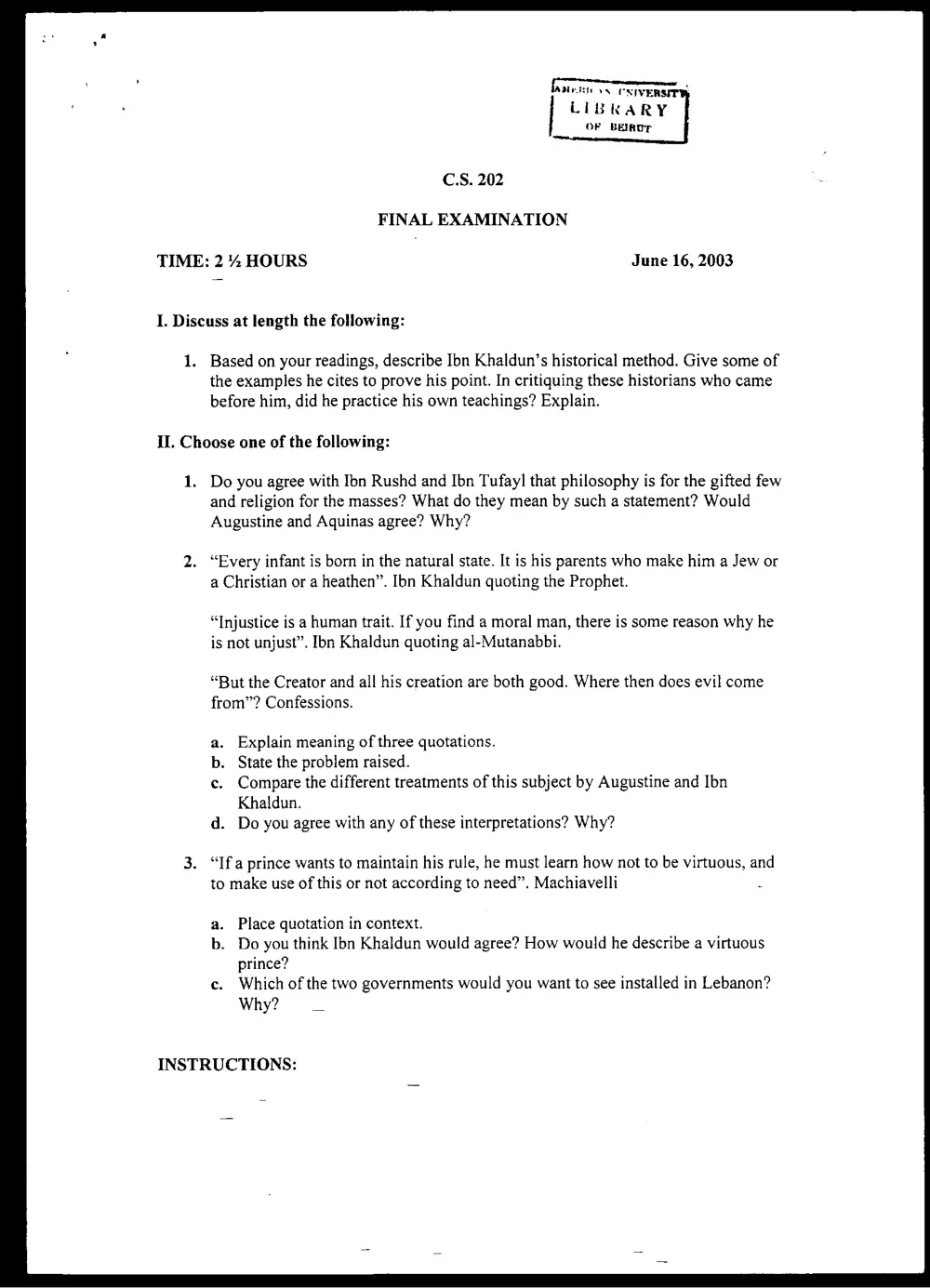
fasten ‘S CNIVERSITY)
LIBKARY
OF BEIROT
C.S. 202
FINAL EXAMINATION
TIME: 2 % HOURS June 16, 2003
I. Discuss at length the following:
1. Based on your readings, describe Ibn Khaldun’s historical method. Give some of
the examples he cites to prove his point. In critiquing these historians who came
before him, did he practice his own teachings? Explain.
II. Choose one of the following:
1. Do you agree with Ibn Rushd and Ibn Tufayl that philosophy is for the gifted few
and religion for the masses? What do they mean by such a statement? Would
Augustine and Aquinas agree? Why?
. “Every infant is born in the natural state. It is his parents who make him a Jew or
a Christian or a heathen”. Ibn Khaldun quoting the Prophet.
“Injustice is a human trait. If you find a moral man, there is some reason why he
is not unjust”. Ibn Khaldun quoting al-Mutanabbi.
“But the Creator and all his creation are both good. Where then does evil come
from”? Confessions.
a. Explain meaning of three quotations.
b. State the problem raised.
c. Compare the different treatments of this subject by Augustine and Ibn
Khaldun.
d. Do you agree with any of these interpretations? Why?
“If a prince wants to maintain his rule, he must learn how not to be virtuous, and
to make use of this or not according to need”. Machiavelli -
a. Place quotation in context.
b. Do you think Ibn Khaldun would agree? How would he describe a virtuous
prince?
Which of the two governments would you want to see installed in Lebanon?
Why?
INSTRUCTIONS:
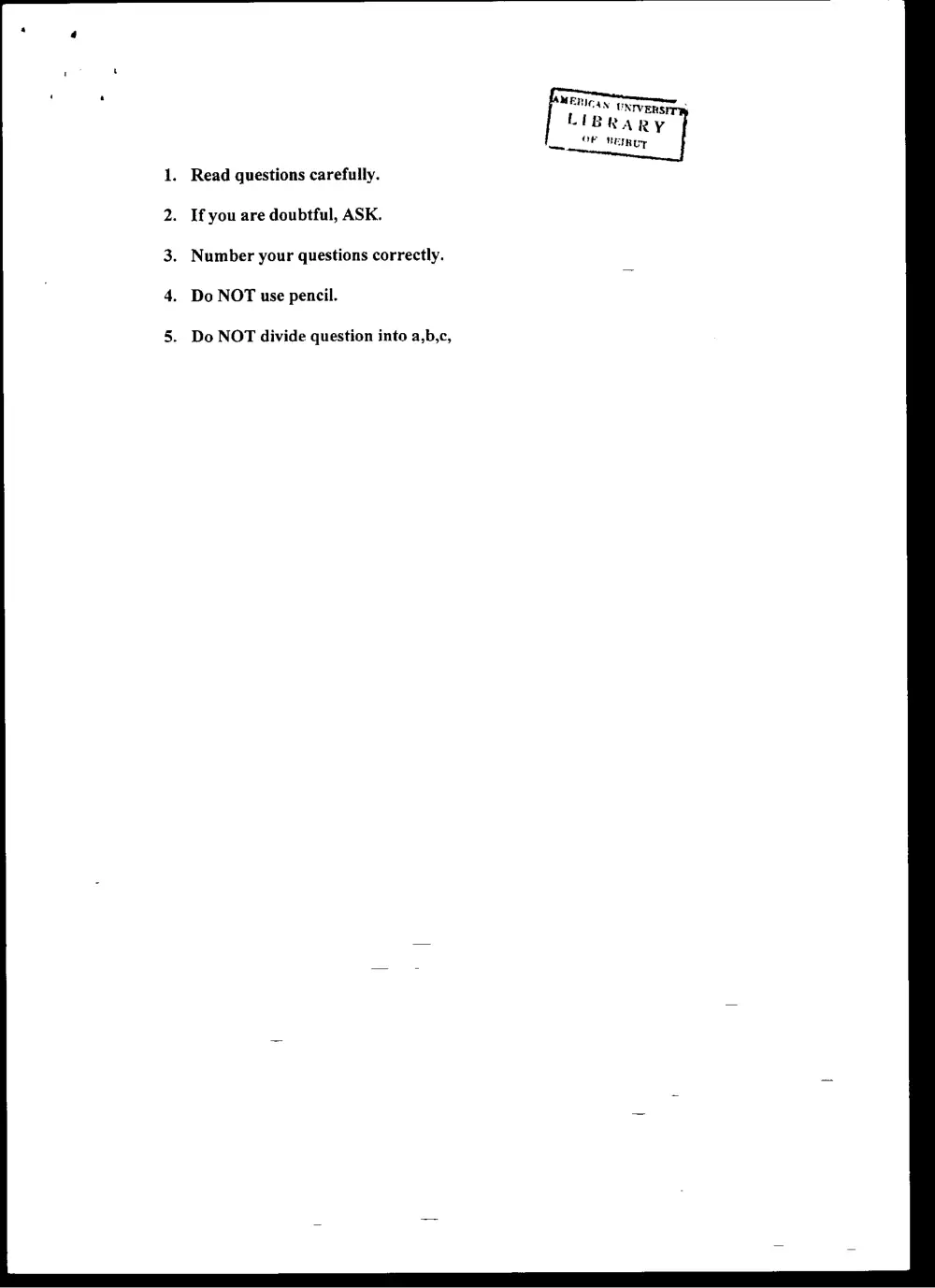
Read guestions carefully.
If you are doubtful, ASK.
. Number your questions correctly.
. Do NOT use pencil.
Do NOT divide question into a,b,c,