
CVSP 202 Final, Spring 2004
American University of Beirut · Ancient, Medieval and Renaissance Culture · 2 pages

More CVSP 202 files
Show the text of this final exam
a
ERICAS ONTO
Lib. .kS
pe ny
ee 3
SPRING 2003-2004
JUNE 3.2004
CVSP 202, SECTIONS 4,5 & 9 i Hassan
FINAL WRITTEN EVALUATION
BASIC CRITERIA OF EVALUATION:
CLARITY OF PRESENTATION: this includes handwriting (since I am not an expert in deciphering coded
messages); but more importantly, it is an issue of you clearly presenting your ideas, avoiding any
vagueness and/or ambiguity.
EXPLANATION AND JUSTIFICATION: never assume I know what you're talking about; it is very essential
that you back up any central statements you make in presenting the ideas of the authors in question,
and more importantly in your critical evaluation of those ideas.
RELEVANCE: it is essential that you present ideas and arguments relevant to the questions asked. Going
into irrelevant discussion is a waste of your valuable time; it could also cause the reader (yours truly)
to lose sight of the relevant discussions you present.
CRITICAL THINKING: this is most important in terms of your critical evaluation discussions; it is vital
that you present ‘evidence’ of critical thinking, and not simply agreeing or disagreeing with ideas and
authors discussed (simply stating: “I don’t like him” or “I love his ideas” is neither evidence of being
critical nor of thinking!)
WHATEVER YOU DO, DO NOT SIMPLY SUMMARIZE!
If at any point you are not clear about what the question is asking or of what is required of you, do not
hesitate to ask me. But whatever you do, do not ask your fellow students (they will always mislead you
by giving you the wrong answer; it’s human nature!)
Finally, and putting it as plainly as J can: CHEATING IS ABSOLUTELY DISGRACEFUL; OFFENDERS WILL BE
SEVERELY PUNISHED.
All the Best...
tay
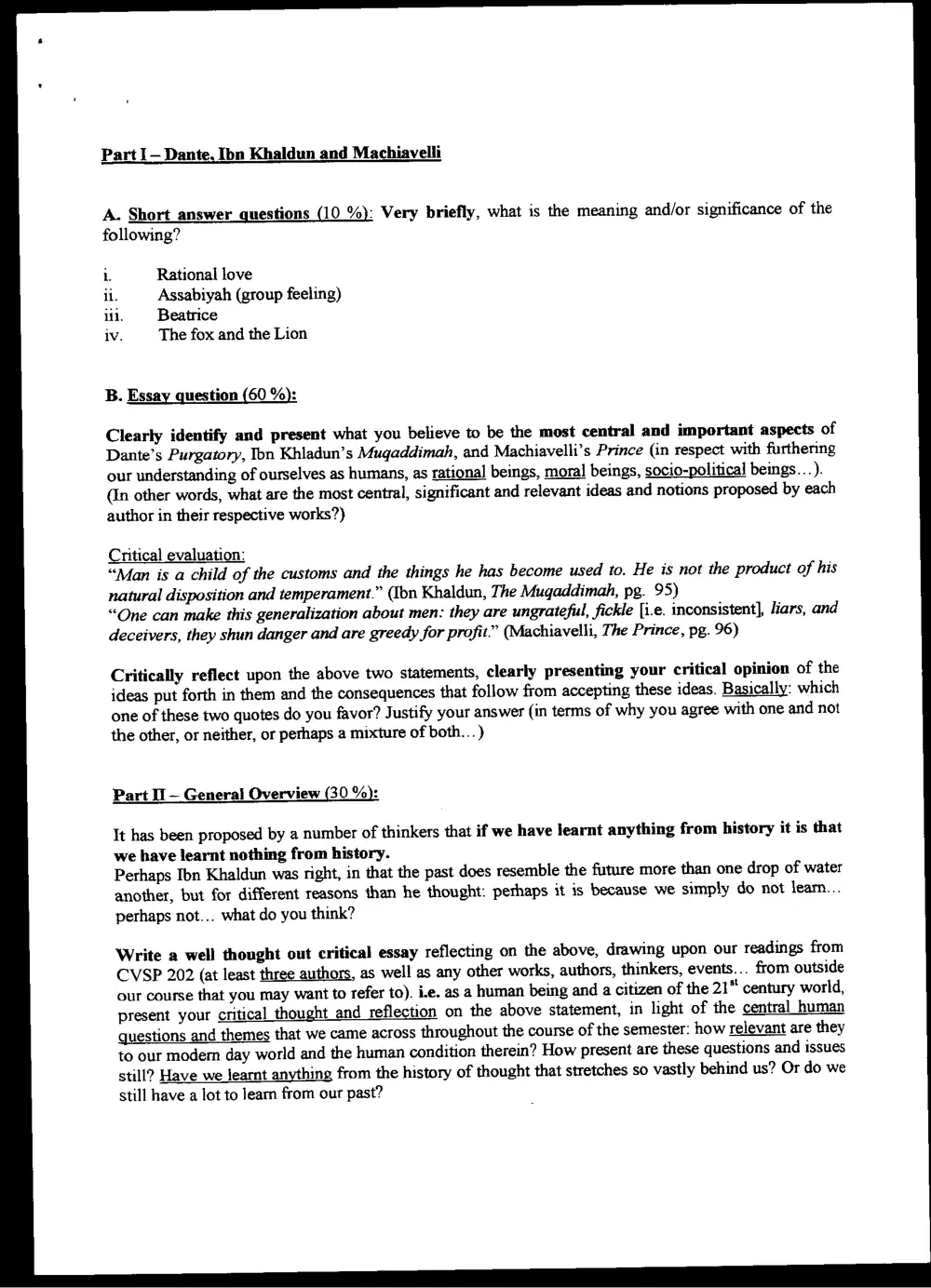
Part I — Dante, Ibn Khaldun and Machiavelli
A. Short answer questions (10%): Very briefly, what is the meaning and/or significance of the
following?
L Rational love
ii Assabiyah (group feeling)
Beatrice
The fox and the Lion
Essay question (60 %):
Clearly identify and present what you believe to be the most central and important aspects of
Dante’s Purgatory, Ibn Khladun’s Mugaddimah, and Machiavelli’s Prince (in respect with furthering
our understanding of ourselves as humans, as rational beings, moral beings, socio-political beings... ).
(In other words, what are the most central, significant and relevant ideas and notions proposed by each
author in their respective works?)
Critical evaluation:
“Man is a child of the customs and the things he has become used to. He is not the product of his
natural disposition and temperament.” (Ibn Khaldun, The Mugaddimah, pg. 95)
“One can make this generalization about men: they are ungrateful, fickle [i.e. inconsistent], liars, and
deceivers, they shun danger and are greedy for profit.” (Machiavelli, The Prince, pg. 96)
Critically reflect upon the above two statements, clearly presenting your critical opinion of the
ideas put forth in them and the consequences that follow from accepting these ideas. Basically: which
one of these two quotes do you favor? Justify your answer (in terms of why you agree with one and not
the other, or neither, or perhaps a mixture of both...)
Part Il — General Overview (30 %):
It has been proposed by a number of thinkers that if we have Jearnt anything from history it is that
we have learnt nothing from history.
Perhaps Ibn Khaldun was right, in that the past does resemble the future more than one drop of water
another, but for different reasons than he thought: perhaps it is because we simply do not learn...
perhaps not... what do you think?
Write a well thought out critical essay reflecting on the above, drawing upon our readings from
CVSP 202 (at least three authors, as well as any other works, authors, thinkers, events... from outside
our course that you may want to refer to). i.e. as a human being and a citizen of the 21" century world,
present your critical thought and reflection on the above statement, in light of the central human
questions and themes that we came across throughout the course of the semester: how relevant are they
to our modem day world and the human condition therein? How present are these questions and issues
still? Have we learnt anything from the history of thought that stretches so vastly behind us? Or do we
still have a lot to learn from our past?