
ECON 217 Final, Fall 2004
American University of Beirut · Intermediate Price Theory · 11 pages

Showing the first 10 of 11 pages. Download the PDF to see all of it.
More ECON 217 files
- Final · Fall 2006Final examView
- Final · Fall 2005Final examView
- Final · Fall 2005Final examView
- Final · Fall 2004Final examView
- Drop Quiz First Part of Course · Spring 2014QuizView
- Problems Test Bank Ch.1 · Spring 2013ProblemsView
- Problems Test Bank · Spring 2013ProblemsView
- Midterm · Fall 2006ExamView
Show the text of this final exam
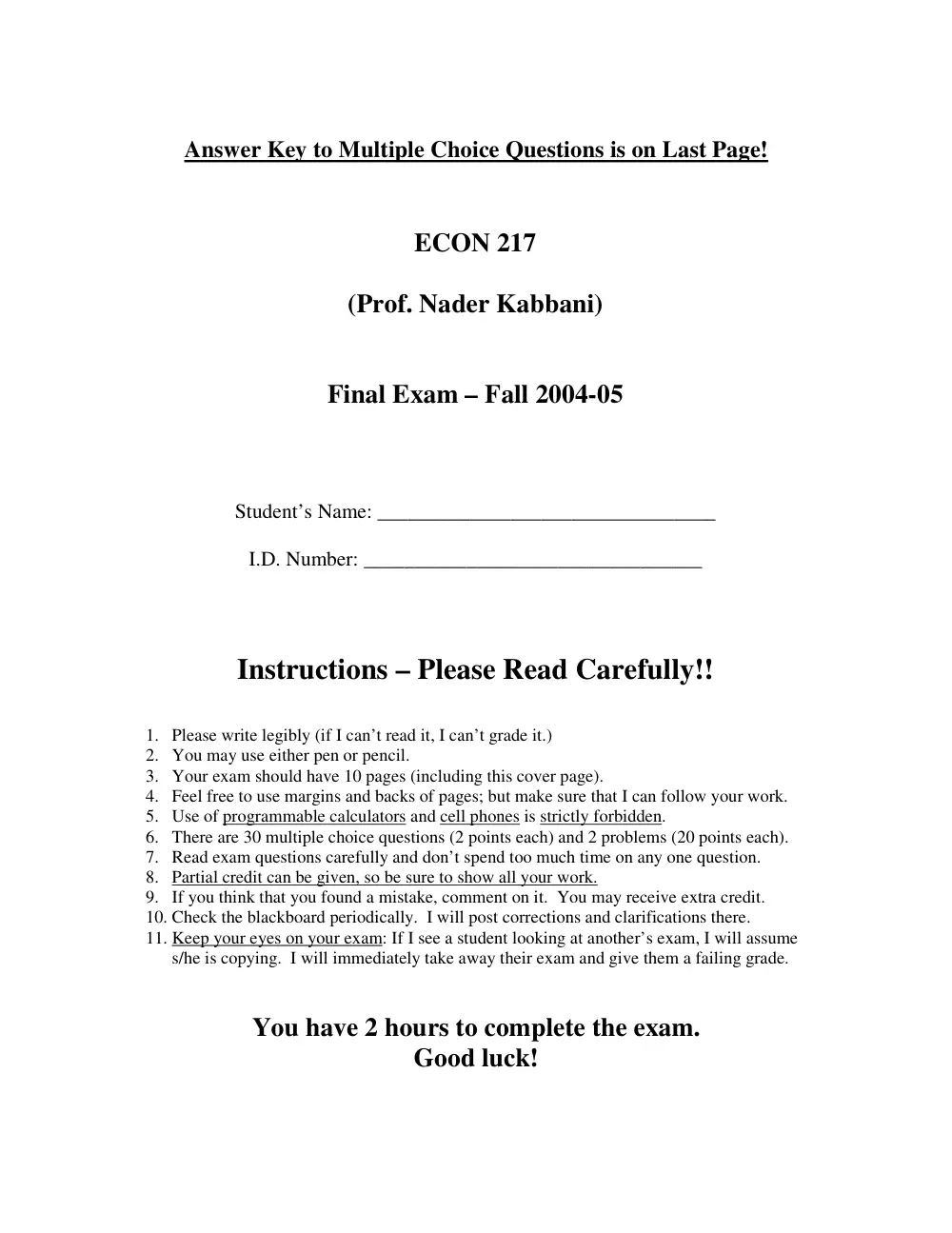
Answer Key to Multiple Choice Questions is on Last Page!
ECON 217
(Prof. Nader Kabbani)
Final Exam – Fall 2004-05
Student’s Name: _________________________________
I.D. Number: _________________________________
Instructions – Please Read Carefully!!
1. Please write legibly (if I can’t read it, I can’t grade it.)
2. You may use either pen or pencil.
3. Your exam should have 10 pages (including this cover page).
4. Feel free to use margins and backs of pages; but make sure that I can follow your work.
5. Use of programmable calculators and cell phones is strictly forbidden.
6. There are 30 multiple choice questions (2 points each) and 2 problems (20 points each).
7. Read exam questions carefully and don’t spend too much time on any one question.
8. Partial credit can be given, so be sure to show all your work.
9. If you think that you found a mistake, comment on it. You may receive extra credit.
10. Check the blackboard periodically. I will post corrections and clarifications there.
11. Keep your eyes on your exam: If I see a student looking at another’s exam, I will assume
s/he is copying. I will immediately take away their exam and give them a failing grade.
You have 2 hours to complete the exam.
Good luck!
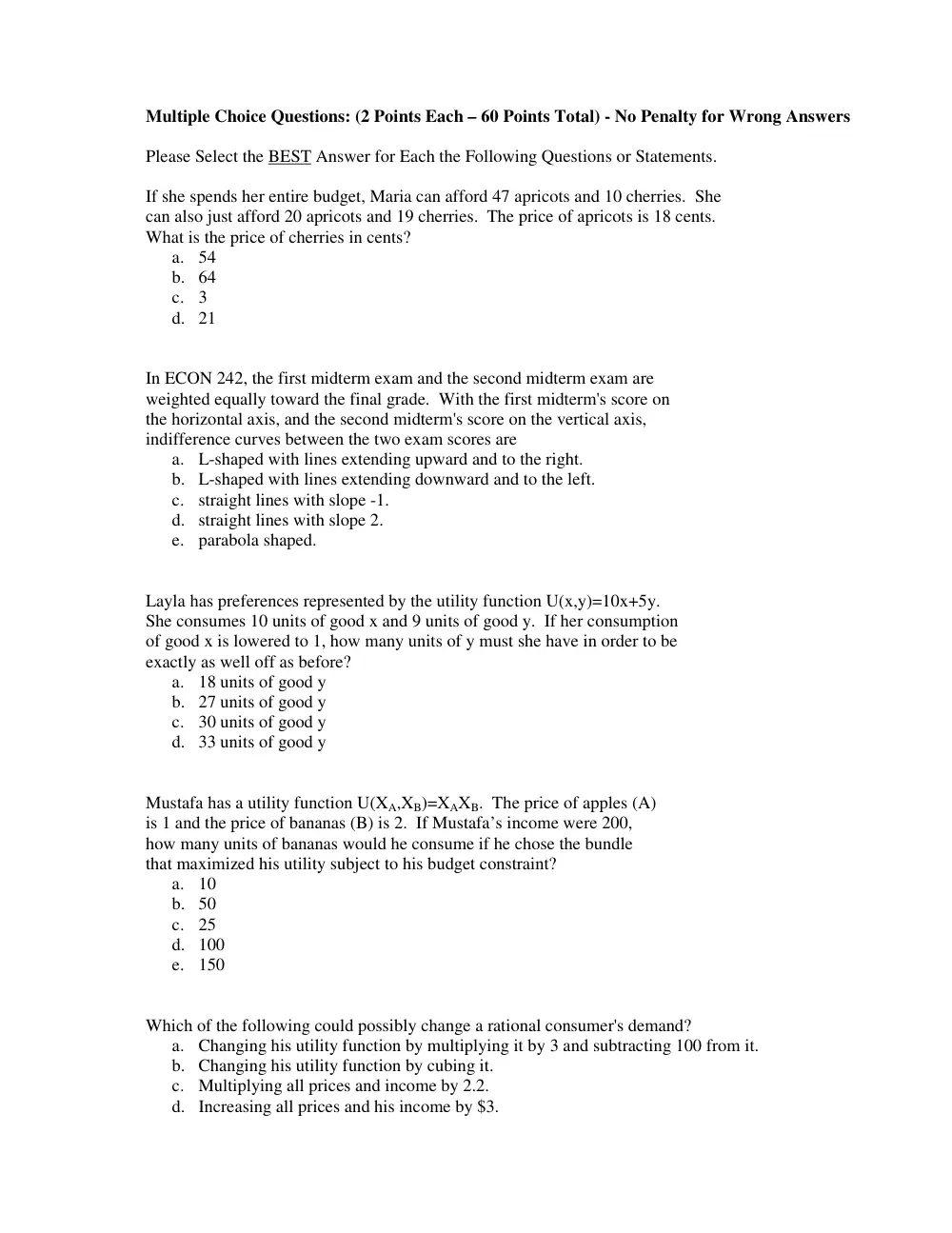
Multiple Choice Questions: (2 Points Each – 60 Points Total) - No Penalty for Wrong Answers
Please Select the BEST Answer for Each the Following Questions or Statements.
If she spends her entire budget, Maria can afford 47 apricots and 10 cherries. She
can also just afford 20 apricots and 19 cherries. The price of apricots is 18 cents.
What is the price of cherries in cents?
a. 54
b. 64
c. 3
d. 21
In ECON 242, the first midterm exam and the second midterm exam are
weighted equally toward the final grade. With the first midterm's score on
the horizontal axis, and the second midterm's score on the vertical axis,
indifference curves between the two exam scores are
a. L-shaped with lines extending upward and to the right.
b. L-shaped with lines extending downward and to the left.
c. straight lines with slope -1.
d. straight lines with slope 2.
e. parabola shaped.
Layla has preferences represented by the utility function U(x,y)=10x+5y.
She consumes 10 units of good x and 9 units of good y. If her consumption
of good x is lowered to 1, how many units of y must she have in order to be
exactly as well off as before?
a. 18 units of good y
b. 27 units of good y
c. 30 units of good y
d. 33 units of good y
Mustafa has a utility function U(XA,XB)=XAXB. The price of apples (A)
is 1 and the price of bananas (B) is 2. If Mustafa’s income were 200,
how many units of bananas would he consume if he chose the bundle
that maximized his utility subject to his budget constraint?
a. 10
b. 50
c. 25
d. 100
e. 150
Which of the following could possibly change a rational consumer's demand?
a. Changing his utility function by multiplying it by 3 and subtracting 100 from it.
b. Changing his utility function by cubing it.
c. Multiplying all prices and income by 2.2.
d. Increasing all prices and his income by $3.
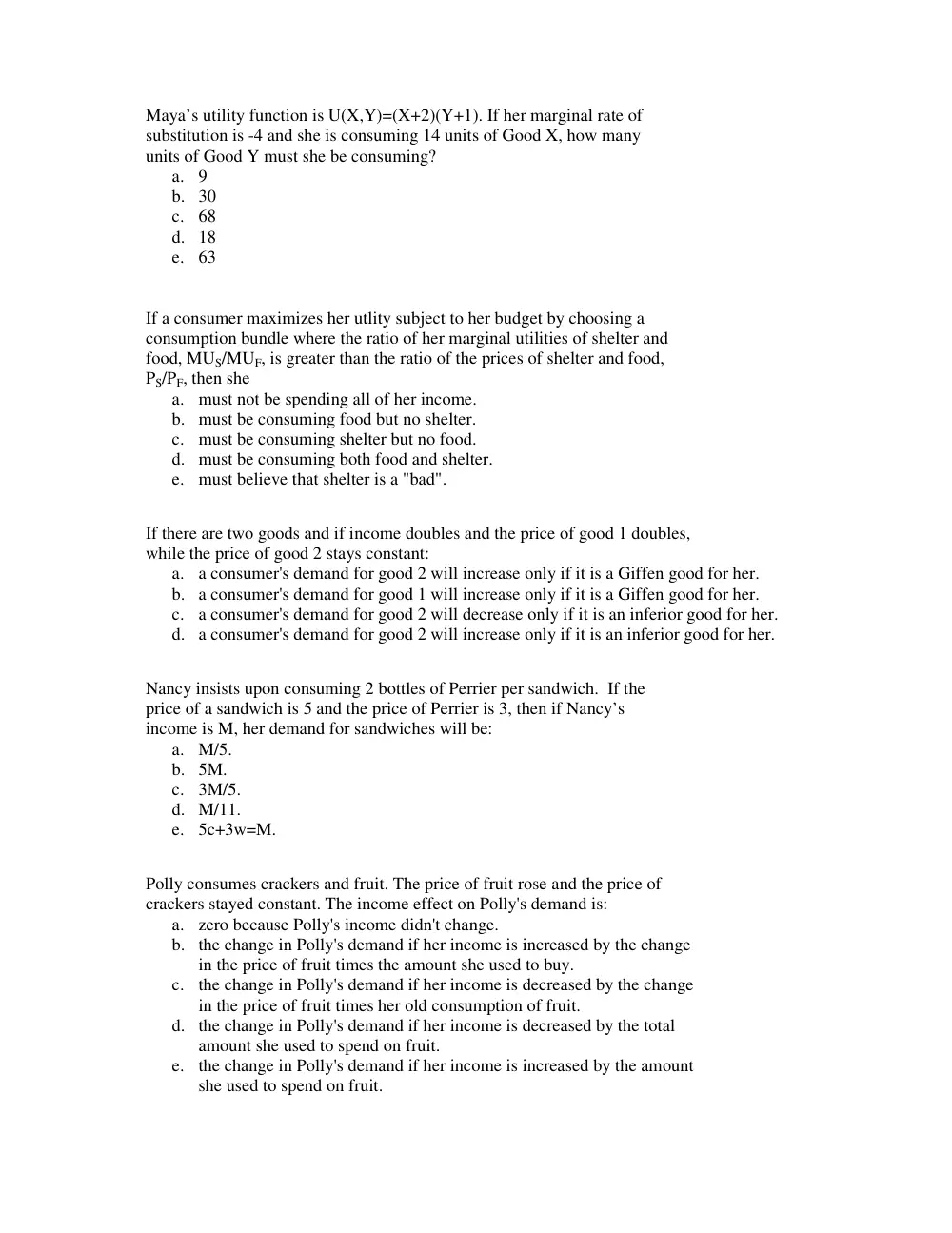
Maya’s utility function is U(X,Y)=(X+2)(Y+1). If her marginal rate of
substitution is -4 and she is consuming 14 units of Good X, how many
units of Good Y must she be consuming?
a. 9
b. 30
c. 68
d. 18
e. 63
If a consumer maximizes her utlity subject to her budget by choosing a
consumption bundle where the ratio of her marginal utilities of shelter and
food, MUS/MUF, is greater than the ratio of the prices of shelter and food,
PS/PF, then she
a. must not be spending all of her income.
b. must be consuming food but no shelter.
c. must be consuming shelter but no food.
d. must be consuming both food and shelter.
e. must believe that shelter is a "bad".
If there are two goods and if income doubles and the price of good 1 doubles,
while the price of good 2 stays constant:
a. a consumer's demand for good 2 will increase only if it is a Giffen good for her.
b. a consumer's demand for good 1 will increase only if it is a Giffen good for her.
c. a consumer's demand for good 2 will decrease only if it is an inferior good for her.
d. a consumer's demand for good 2 will increase only if it is an inferior good for her.
Nancy insists upon consuming 2 bottles of Perrier per sandwich. If the
price of a sandwich is 5 and the price of Perrier is 3, then if Nancy’s
income is M, her demand for sandwiches will be:
a. M/5.
b. 5M.
c. 3M/5.
d. M/11.
e. 5c+3w=M.
Polly consumes crackers and fruit. The price of fruit rose and the price of
crackers stayed constant. The income effect on Polly's demand is:
a. zero because Polly's income didn't change.
b. the change in Polly's demand if her income is increased by the change
in the price of fruit times the amount she used to buy.
c. the change in Polly's demand if her income is decreased by the change
in the price of fruit times her old consumption of fruit.
d. the change in Polly's demand if her income is decreased by the total
amount she used to spend on fruit.
e. the change in Polly's demand if her income is increased by the amount
she used to spend on fruit.
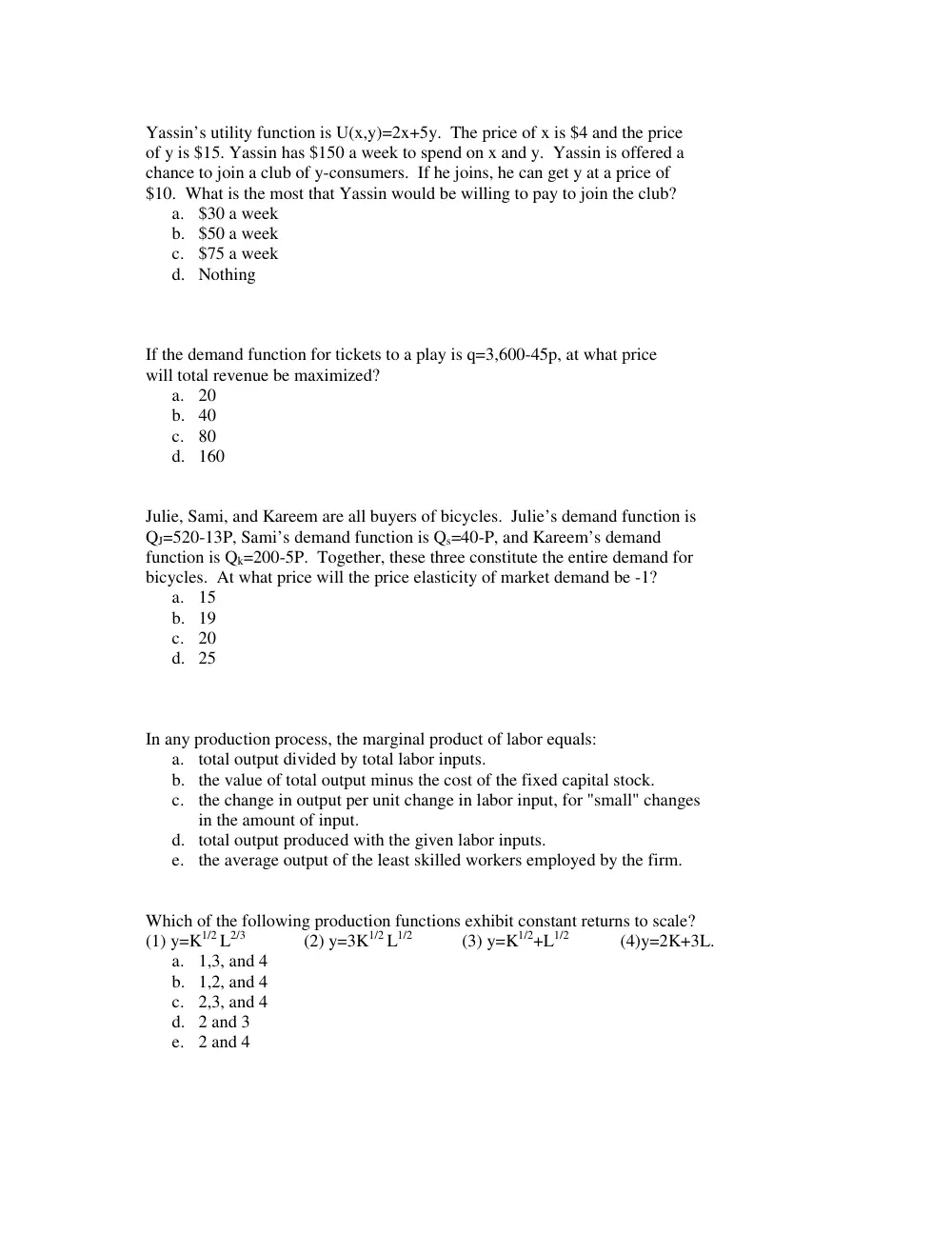
Yassin’s utility function is U(x,y)=2x+5y. The price of x is $4 and the price
of y is $15. Yassin has $150 a week to spend on x and y. Yassin is offered a
chance to join a club of y-consumers. If he joins, he can get y at a price of
$10. What is the most that Yassin would be willing to pay to join the club?
a. $30 a week
b. $50 a week
c. $75 a week
d. Nothing
If the demand function for tickets to a play is q=3,600-45p, at what price
will total revenue be maximized?
a. 20
b. 40
c. 80
d. 160
Julie, Sami, and Kareem are all buyers of bicycles. Julie’s demand function is
QJ=520-13P, Sami’s demand function is Qs=40-P, and Kareem’s demand
function is Qk=200-5P. Together, these three constitute the entire demand for
bicycles. At what price will the price elasticity of market demand be -1?
a. 15
b. 19
c. 20
d. 25
In any production process, the marginal product of labor equals:
a. total output divided by total labor inputs.
b. the value of total output minus the cost of the fixed capital stock.
c. the change in output per unit change in labor input, for "small" changes
in the amount of input.
d. total output produced with the given labor inputs.
e. the average output of the least skilled workers employed by the firm.
Which of the following production functions exhibit constant returns to scale?
(1) y=K1/2 L2/3
(2) y=3K1/2 L1/2
(3) y=K1/2+L1/2
(4)y=2K+3L.
a. 1,3, and 4
b. 1,2, and 4
c. 2,3, and 4
d. 2 and 3
e. 2 and 4
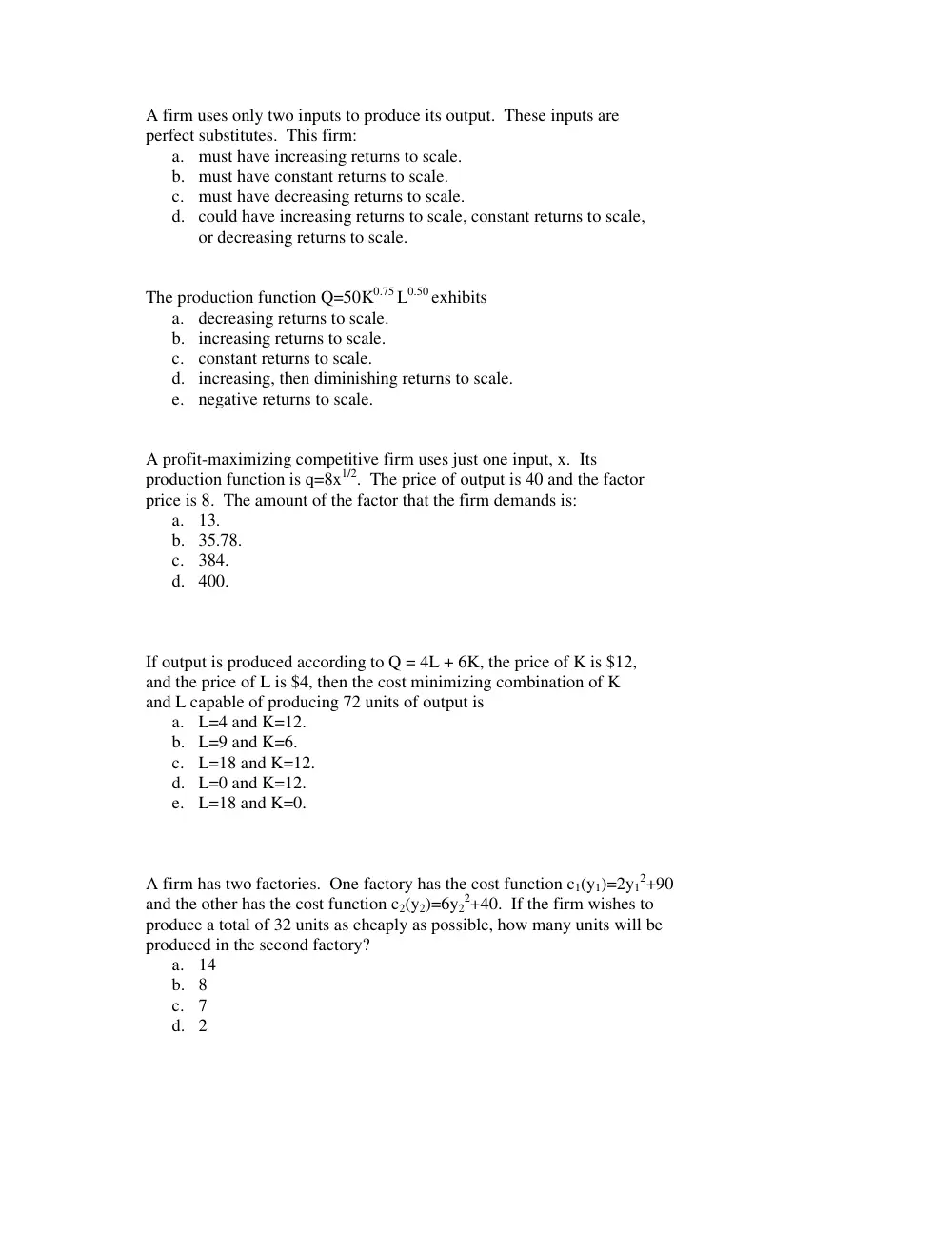
A firm uses only two inputs to produce its output. These inputs are
perfect substitutes. This firm:
a. must have increasing returns to scale.
b. must have constant returns to scale.
c. must have decreasing returns to scale.
d. could have increasing returns to scale, constant returns to scale,
or decreasing returns to scale.
The production function Q=50K0.75 L0.50 exhibits
a. decreasing returns to scale.
b. increasing returns to scale.
c. constant returns to scale.
d. increasing, then diminishing returns to scale.
e. negative returns to scale.
A profit-maximizing competitive firm uses just one input, x. Its
production function is q=8x1/2. The price of output is 40 and the factor
price is 8. The amount of the factor that the firm demands is:
a. 13.
b. 35.78.
c. 384.
d. 400.
If output is produced according to Q = 4L + 6K, the price of K is $12,
and the price of L is $4, then the cost minimizing combination of K
and L capable of producing 72 units of output is
a. L=4 and K=12.
b. L=9 and K=6.
c. L=18 and K=12.
d. L=0 and K=12.
e. L=18 and K=0.
A firm has two factories. One factory has the cost function c1(y1)=2y1
2+90
and the other has the cost function c2(y2)=6y2
2+40. If the firm wishes to
produce a total of 32 units as cheaply as possible, how many units will be
produced in the second factory?
a. 14
b. 8
c. 7
d. 2
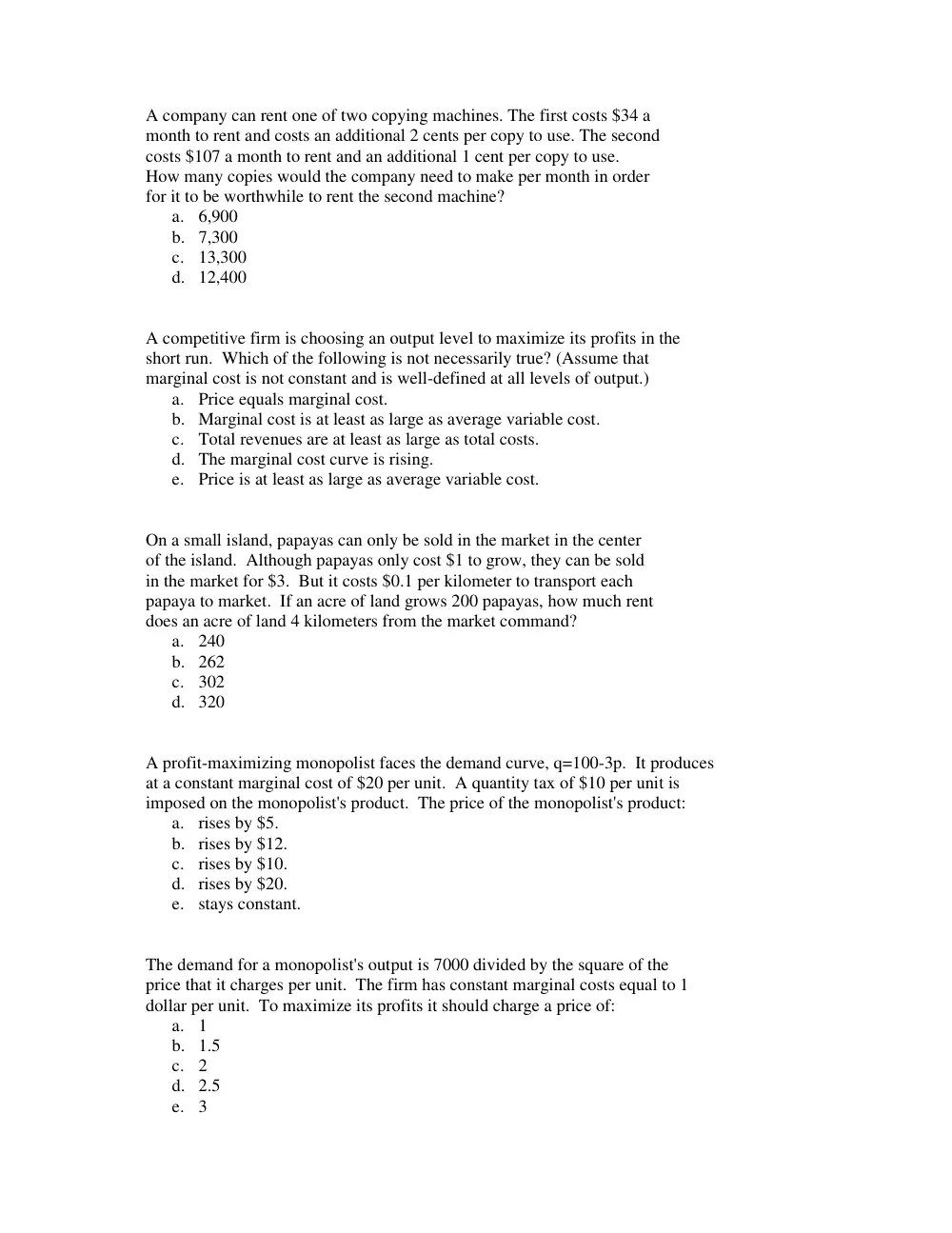
A company can rent one of two copying machines. The first costs $34 a
month to rent and costs an additional 2 cents per copy to use. The second
costs $107 a month to rent and an additional 1 cent per copy to use.
How many copies would the company need to make per month in order
for it to be worthwhile to rent the second machine?
a. 6,900
b. 7,300
c. 13,300
d. 12,400
A competitive firm is choosing an output level to maximize its profits in the
short run. Which of the following is not necessarily true? (Assume that
marginal cost is not constant and is well-defined at all levels of output.)
a. Price equals marginal cost.
b. Marginal cost is at least as large as average variable cost.
c. Total revenues are at least as large as total costs.
d. The marginal cost curve is rising.
e. Price is at least as large as average variable cost.
On a small island, papayas can only be sold in the market in the center
of the island. Although papayas only cost $1 to grow, they can be sold
in the market for $3. But it costs $0.1 per kilometer to transport each
papaya to market. If an acre of land grows 200 papayas, how much rent
does an acre of land 4 kilometers from the market command?
a. 240
b. 262
c. 302
d. 320
A profit-maximizing monopolist faces the demand curve, q=100-3p. It produces
at a constant marginal cost of $20 per unit. A quantity tax of $10 per unit is
imposed on the monopolist's product. The price of the monopolist's product:
a. rises by $5.
b. rises by $12.
c. rises by $10.
d. rises by $20.
e. stays constant.
The demand for a monopolist's output is 7000 divided by the square of the
price that it charges per unit. The firm has constant marginal costs equal to 1
dollar per unit. To maximize its profits it should charge a price of:
a. 1
b. 1.5
c. 2
d. 2.5
e. 3
A monopolist faces the inverse demand curve p= 192-4q. At what level
of output is his total revenue maximized?
a. 12
b. 24
c. 34
d. 36
e. 48
A monopolist has decreasing average costs as output increases. If the
monopolist sets price equal to average cost, it will:
a. produce too much output from the standpoint of efficiency.
b. lose money.
c. maximize its profits.
d. produce too little output from the standpoint of efficiency.
e. face excess demand.
A profit-maximizing monopolist sets:
a. price equal to average cost.
b. price equal to marginal cost.
c. price equal to marginal cost plus a pro-rated share of overhead
d. marginal revenue equal to marginal cost.
e. price equal to marginal revenue.
A monopolist faces a downward-sloping demand curve and has fixed costs so
large that when he maximizes profits with a positive amount of output, he earns
exactly zero profits. At this positive, profit-maximizing output, it must be that:
a. demand is price inelastic.
b. there are decreasing returns to scale.
c. average total cost is greater than marginal cost.
d. marginal revenue is greater than marginal cost.
e. price equals marginal cost.
A monopoly has the demand curve q=10,000-100p. Its total cost function
is c(q)=1000+10q. The government plans to tax the monopoly's profits at
a rate of 50%. If it does so:
a. the monopoly will increase its price by more than 50%.
b. the monopoly will increase its price by 50%.
c. the monopoly will not change its price or the quantity it sells.
d. the monopoly will recover some, but not all of the tax it pays by increasing its price.
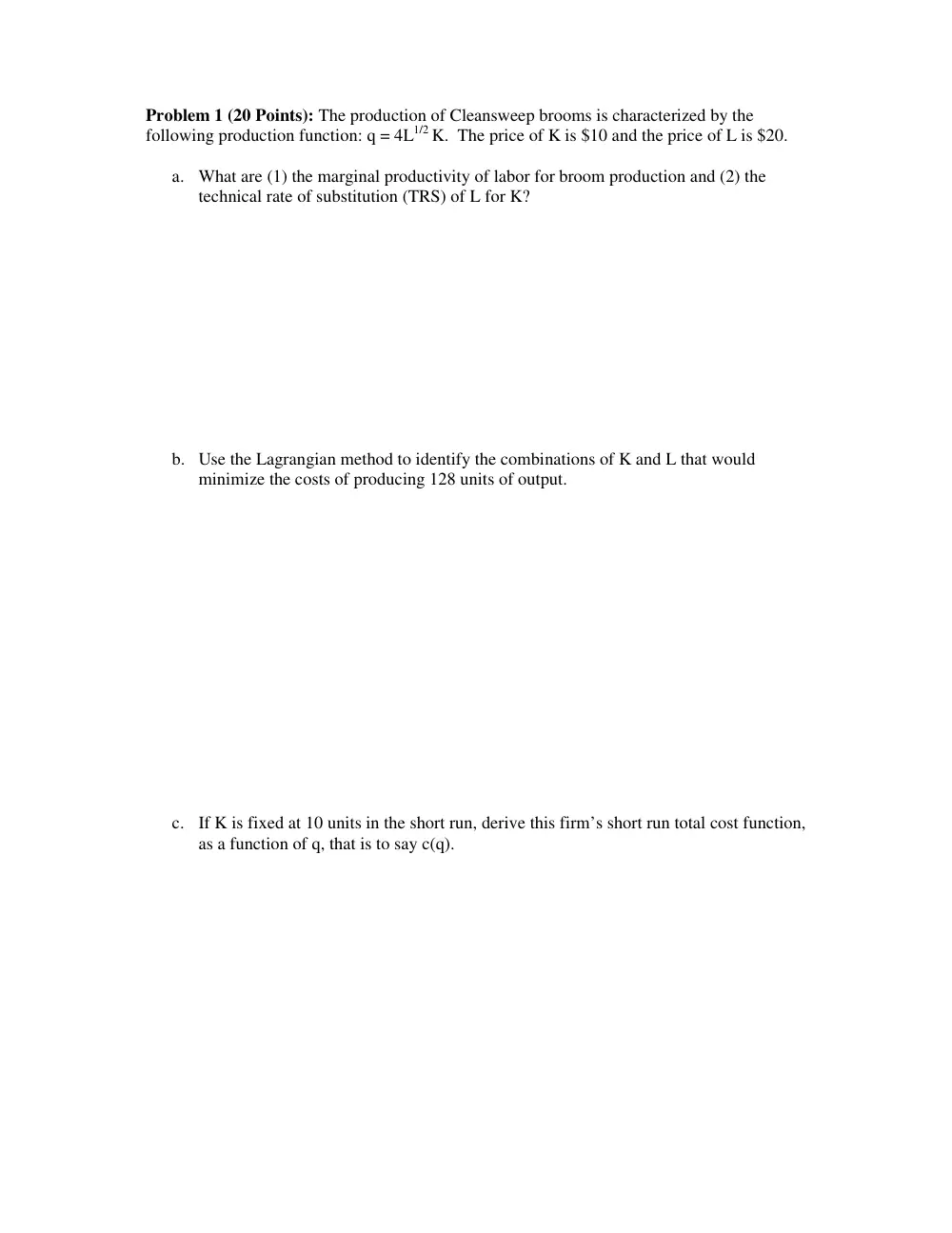
Problem 1 (20 Points): The production of Cleansweep brooms is characterized by the
following production function: q = 4L1/2 K. The price of K is $10 and the price of L is $20.
a. What are (1) the marginal productivity of labor for broom production and (2) the
technical rate of substitution (TRS) of L for K?
b. Use the Lagrangian method to identify the combinations of K and L that would
minimize the costs of producing 128 units of output.
c. If K is fixed at 10 units in the short run, derive this firm’s short run total cost function,
as a function of q, that is to say c(q).
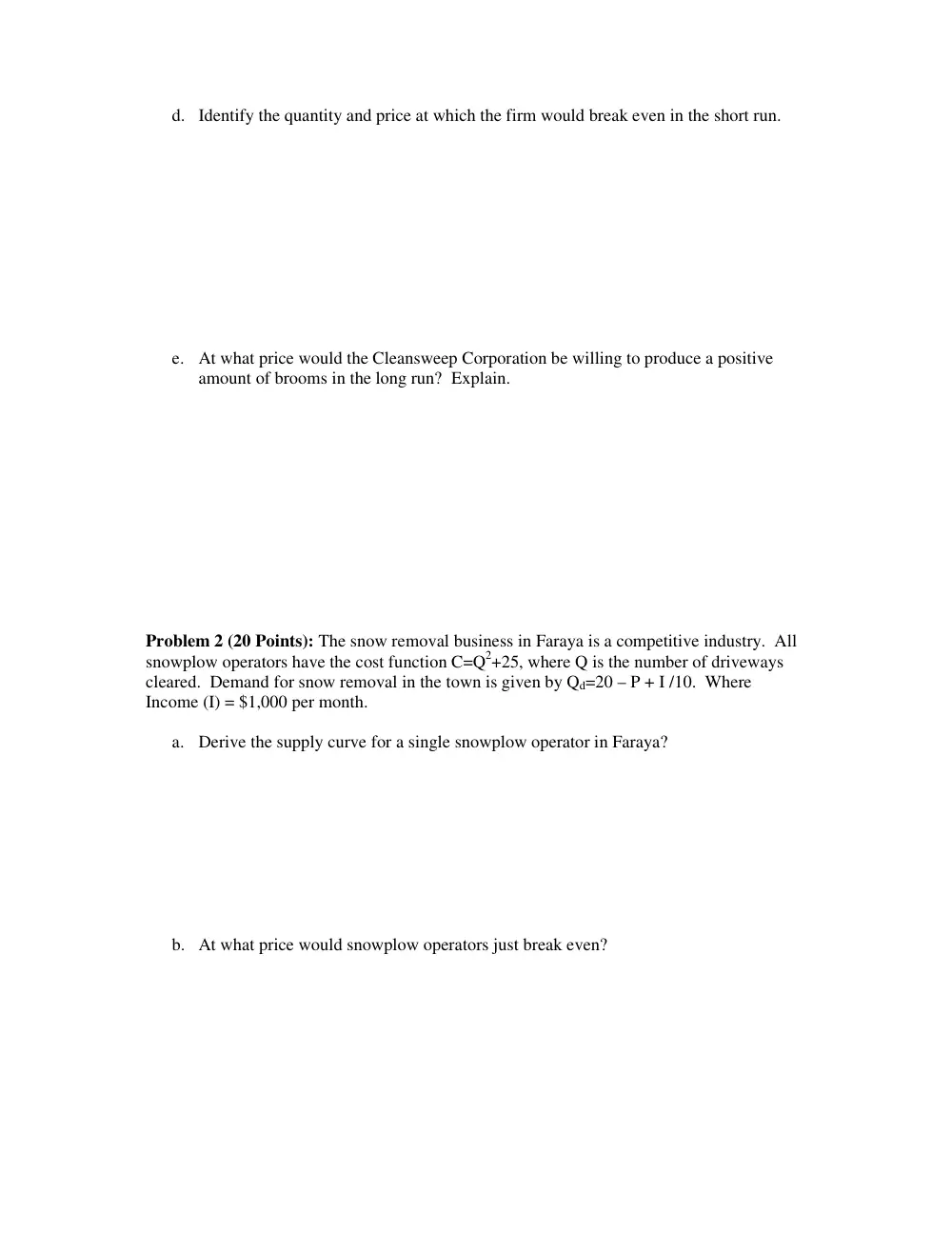
d. Identify the quantity and price at which the firm would break even in the short run.
e. At what price would the Cleansweep Corporation be willing to produce a positive
amount of brooms in the long run? Explain.
Problem 2 (20 Points): The snow removal business in Faraya is a competitive industry. All
snowplow operators have the cost function C=Q2+25, where Q is the number of driveways
cleared. Demand for snow removal in the town is given by Qd=20 – P + I /10. Where
Income (I) = $1,000 per month.
a. Derive the supply curve for a single snowplow operator in Faraya?
b. At what price would snowplow operators just break even?
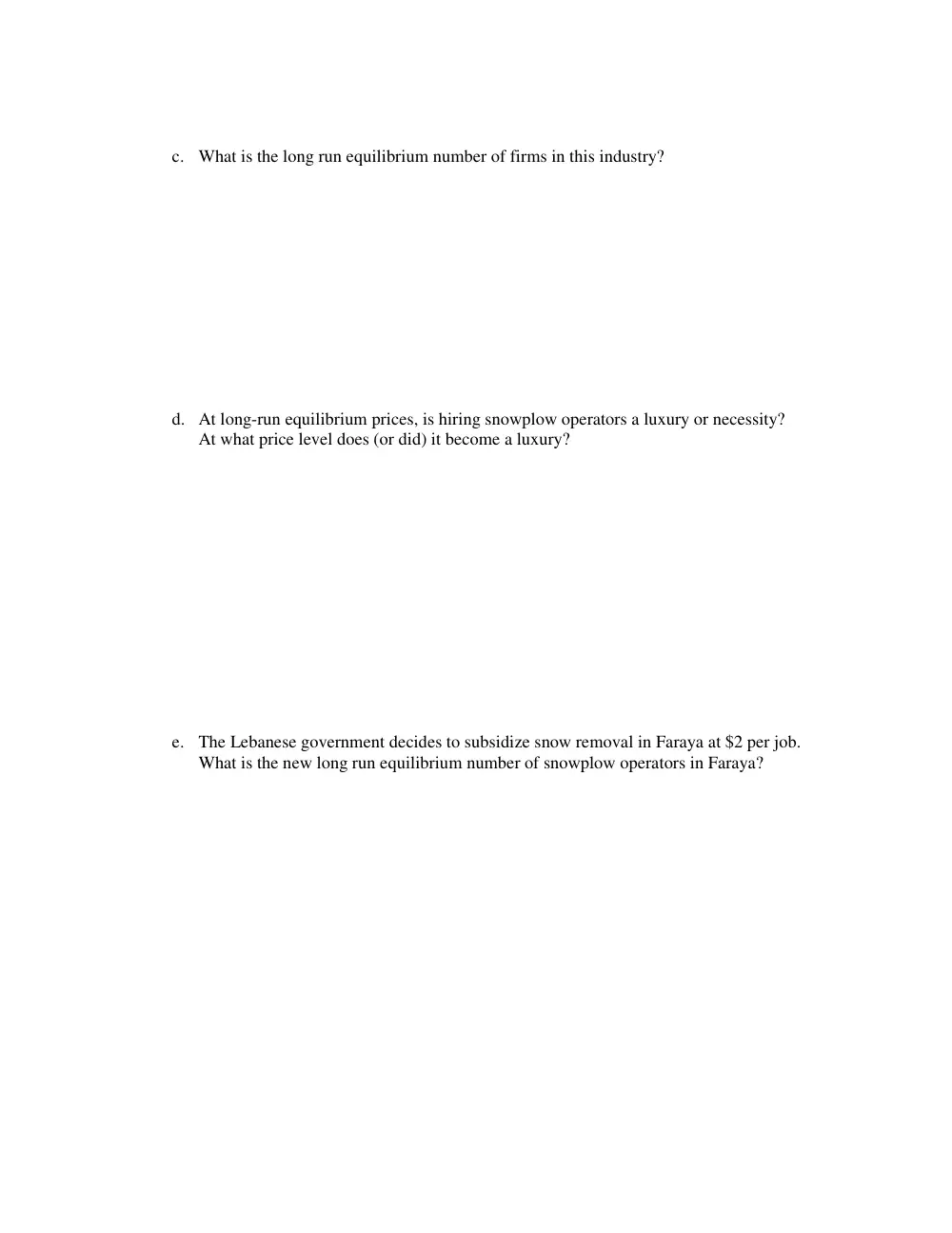
c. What is the long run equilibrium number of firms in this industry?
d. At long-run equilibrium prices, is hiring snowplow operators a luxury or necessity?
At what price level does (or did) it become a luxury?
e. The Lebanese government decides to subsidize snow removal in Faraya at $2 per job.
What is the new long run equilibrium number of snowplow operators in Faraya?
ECON 217
FINAL EXAM (FALL 2004-05)
ANSWER KEY TO MULTIPLE CHOICE QUESTIONS
1. a
2. c
3. b
4. b
5. d
6. e
7. c
8. c
9. d
10. c
11. d
12. b
13. c
14. c
15. e
16. d
17. b
18. d
19. e
20. b
21. b
22. c
23. d
24. a
25. c
26. b
27. d
28. d
29. c
30. c