
ECON 217 Final, Fall 2006
American University of Beirut · Intermediate Price Theory · 10 pages

More ECON 217 files
- Final · Fall 2005Final examView
- Final · Fall 2005Final examView
- Final · Fall 2004Final examView
- Final · Fall 2004Final examView
- Drop Quiz First Part of Course · Spring 2014QuizView
- Problems Test Bank Ch.1 · Spring 2013ProblemsView
- Problems Test Bank · Spring 2013ProblemsView
- Midterm · Fall 2006ExamView
Show the text of this final exam
Ww
mae PANDY
Mot To Be Taken Out
Roasgerve Reacing Room
Please Do Not Turn This Page Until Instructed to Do So!
ECON 217
(Prof. Nader Kabbani)
Final Exam — Fall 2006-2007
Student’s Name:
1.D. Number:
Instructions — Please Read Carefully!
Please check that your exam has 9 pages (including this cover page).
Please write legibly (if I can’t read it, I can’t grade it.)
Please do not use scrap paper. You may use the margins and backs of pages; but make
sure that J can follow your work.
Use of cell phones is strictly forbidden.
There are 20 multiple choice questions (40 points) and 2 questions (30 points each).
Read exam questions carefully. Don’t spend too much time on any one question.
Partial credit can be given, so be sure to show all your work.
Helpful hint: drawing figures can help you understand how to answer a question.
If you think that you found a mistake, comment on it. You may receive extra credit.
0. Check the blackboard periodically. J will post corrections and clarifications there.
1.
Keep your eyes on your exam: If I see a student looking at another’s exam, I will assume
s/he is copying. I will immediately take away their exam and give them a failing grade.
You have 90 minutes to complete the exam.
Good luck!
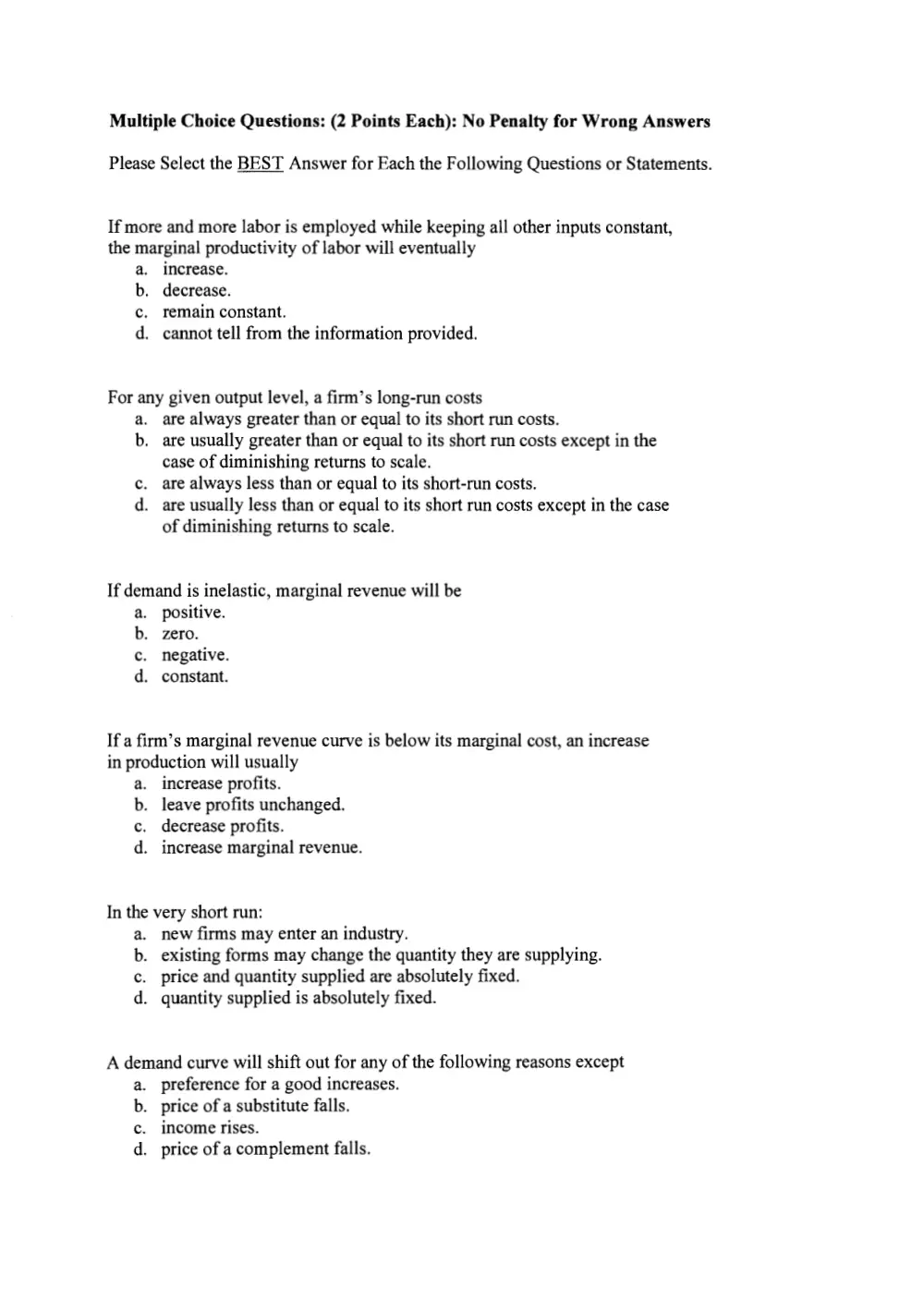
Multiple Choice Questions: (2 Points Each): No Penalty for Wrong Answers
Please Select the BEST Answer for Each the Following Questions or Statements.
If more and more labor is employed while keeping all other inputs constant,
the marginal productivity of labor will eventually
a. increase.
b. decrease.
c. remain constant.
d. cannot tell from the information provided.
For any given output level, a firm’s long-run costs
a. are always greater than or equal to its short run costs.
b. are usually greater than or equal to its short run costs except in the
case of diminishing returns to scale.
c. are always less than or equal to its short-run costs.
d. are usually less than or equal to its short run costs except in the case
of diminishing returns to scale.
If demand is inelastic, marginal revenue will be
positive.
zero.
negative.
constant.
ae rPp
If a firm’s marginal revenue curve is below its marginal cost, an increase
in production will usually
a. increase profits.
b. leave profits unchanged.
c. decrease profits.
d. increase marginal revenue.
In the very short run:
a. new firms may enter an industry.
b. existing forms may change the quantity they are supplying.
c. price and quantity supplied are absolutely fixed.
d. quantity supplied is absolutely fixed.
A demand curve will shift out for any of the following reasons except
preference for a good increases.
price of a substitute falls.
income rises.
price of a complement falls.
ae re
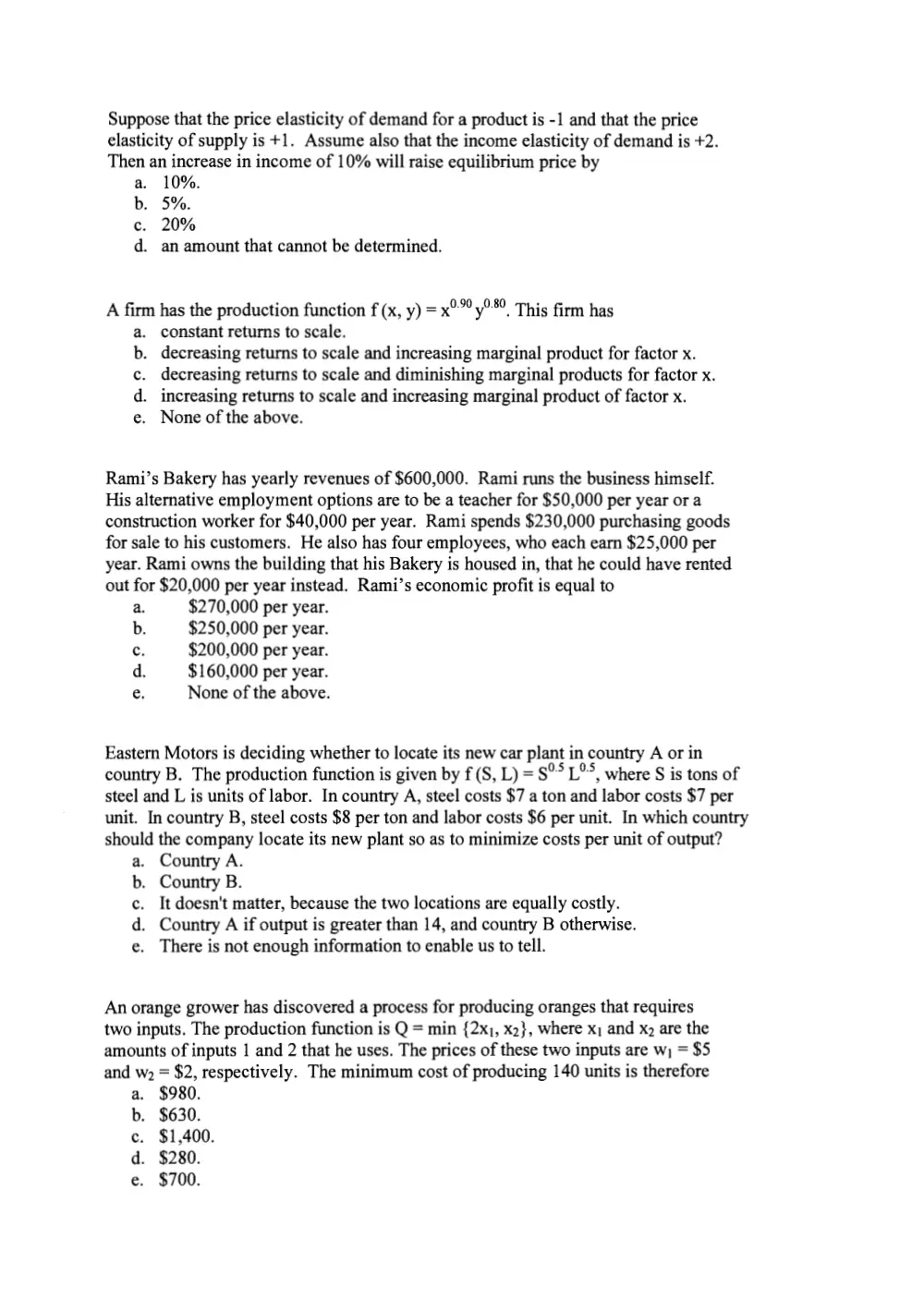
Suppose that the price elasticity of demand for a product is -1 and that the price
elasticity of supply is +1. Assume also that the income elasticity of demand is +2.
Then an increase in income of 10% will raise equilibrium price by
a. 10%.
b. 5%.
c. 20%
d. an amount that cannot be determined.
A firm has the production function f (x, y) =x°"’ y°®. This firm has
a. constant returns to scale.
b. decreasing returns to scale and increasing marginal product for factor x.
c. decreasing returns to scale and diminishing marginal products for factor x.
d. increasing returns to scale and increasing marginal product of factor x.
e. None of the above.
Rami’s Bakery has yearly revenues of $600,000. Rami runs the business himself.
His alternative employment options are to be a teacher for $50,000 per year or a
construction worker for $40,000 per year. Rami spends $230,000 purchasing goods
for sale to his customers. He also has four employees, who each earn $25,000 per
year. Rami owns the building that his Bakery is housed in, that he could have rented
out for $20,000 per year instead. Rami’s economic profit is equal to
a. $270,000 per year.
b. $250,000 per year.
c. $200,000 per year.
d $160,000 per year.
e None of the above.
Eastern Motors is deciding whether to locate its new car plant in country A or in
country B. The production function is given by f (S, L) = S°5 °°, where S is tons of
steel and L is units of labor. In country A, steel costs $7 a ton and labor costs $7 per
unit. In country B, steel costs $8 per ton and labor costs $6 per unit. In which country
should the company locate its new plant so as to minimize costs per unit of output?
Country A.
Country B.
It doesn't matter, because the two locations are equally costly.
Country A if output is greater than 14, and country B otherwise.
There is not enough information to enable us to tell.
sages
An orange grower has discovered a process for producing oranges that requires
two inputs. The production function is Q = min {2x1, x2}, where x; and x2 are the
amounts of inputs 1 and 2 that he uses. The prices of these two inputs are w; = $5
and w2 = $2, respectively. The minimum cost of producing 140 units is therefore
a. $980.
b. $630.
$1,400.
$280.
$700.
eae
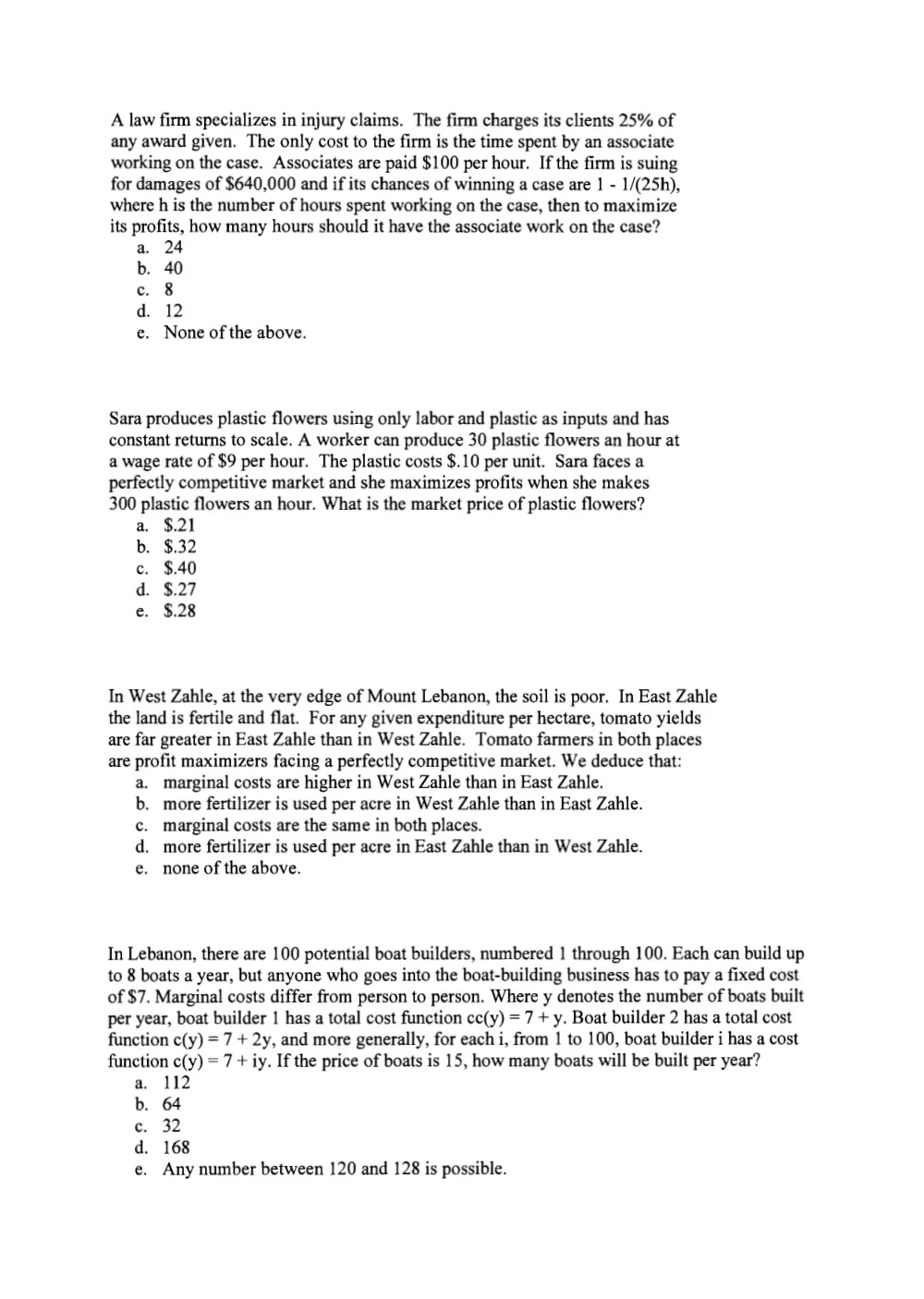
A law firm specializes in injury claims. The firm charges its clients 25% of
any award given. The only cost to the firm is the time spent by an associate
working on the case. Associates are paid $100 per hour. If the firm is suing
for damages of $640,000 and if its chances of winning a case are 1 - 1/(25h),
where h is the number of hours spent working on the case, then to maximize
its profits, how many hours should it have the associate work on the case?
a. 24
b. 40
c. 8
d. 12
e. None of the above.
Sara produces plastic flowers using only labor and plastic as inputs and has
constant returns to scale. A worker can produce 30 plastic flowers an hour at
a wage rate of $9 per hour. The plastic costs $.10 per unit. Sara faces a
perfectly competitive market and she maximizes profits when she makes
300 plastic flowers an hour. What is the market price of plastic flowers?
a. $.21
b. $.32
c. $.40
d. $.27
e. $.28
In West Zahle, at the very edge of Mount Lebanon, the soil is poor. In East Zahle
the land is fertile and flat. For any given expenditure per hectare, tomato yields
are far greater in East Zahle than in West Zahle. Tomato farmers in both places
are profit maximizers facing a perfectly competitive market. We deduce that:
a. marginal costs are higher in West Zahle than in East Zahle.
b. more fertilizer is used per acre in West Zahle than in East Zahle.
c. marginal costs are the same in both places.
d. more fertilizer is used per acre in East Zahle than in West Zahle.
e. none of the above.
In Lebanon, there are 100 potential boat builders, numbered | through 100. Each can build up
to 8 boats a year, but anyone who goes into the boat-building business has to pay a fixed cost
of $7. Marginal costs differ from person to person. Where y denotes the number of boats built
per year, boat builder 1 has a total cost function cc(y) = 7 + y. Boat builder 2 has a total cost
function c(y) = 7 + 2y, and more generally, for each i, from 1 to 100, boat builder i has a cost
function c(y) = 7 + iy. If the price of boats is 15, how many boats will be built per year?
a. 112
b. 64
c. 32
d. 168
e. Any number between 120 and 128 is possible.
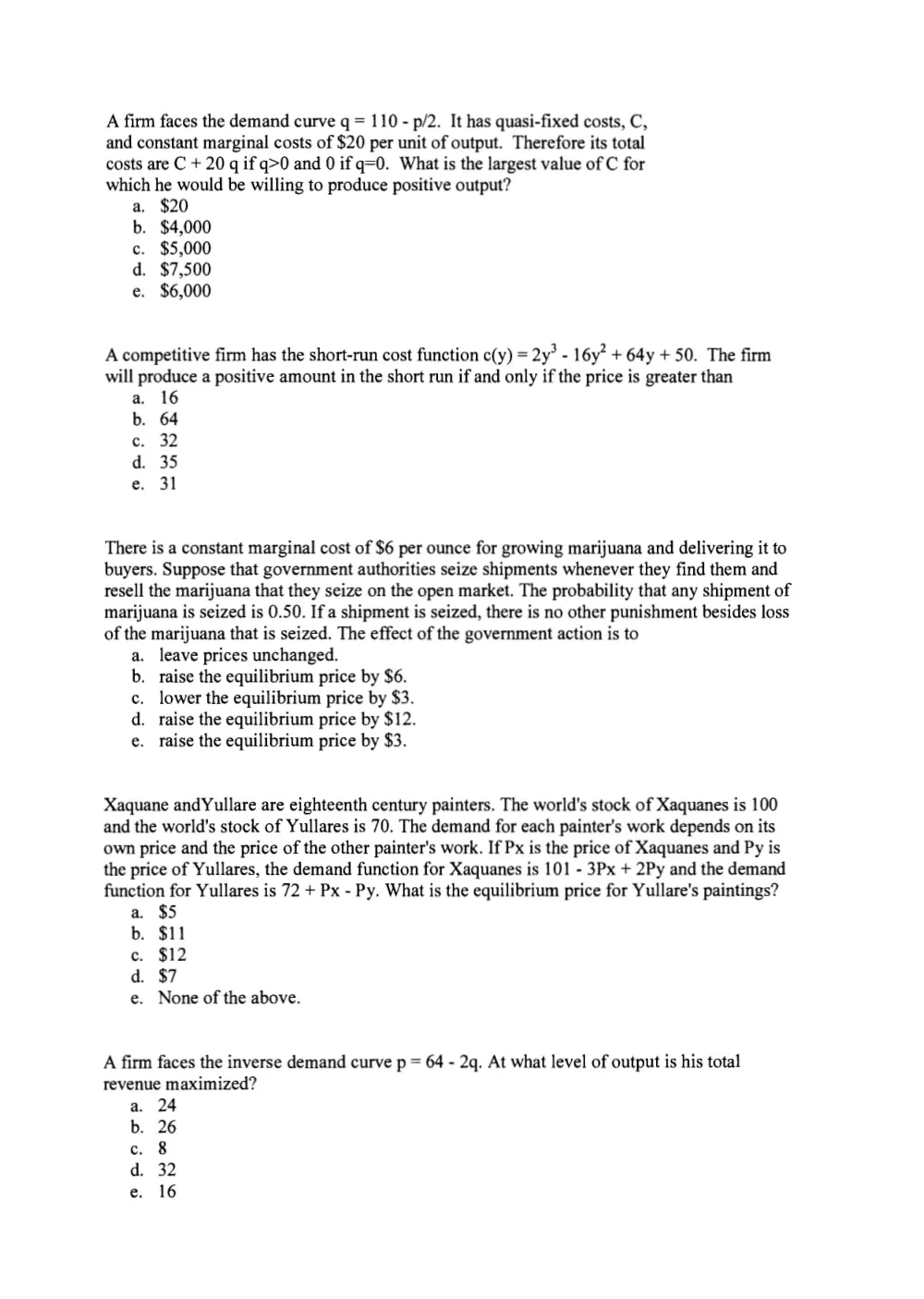
A firm faces the demand curve q = 110 - p/2. It has quasi-fixed costs, C,
and constant marginal costs of $20 per unit of output. Therefore its total
costs are C + 20 q if q>0 and 0 if q=0. What is the largest value of C for
which he would be willing to produce positive output?
$20
$4,000
$5,000
$7,500
$6,000
esaere
A competitive firm has the short-run cost function c(y) = 2y° - 16y” + 64y +50. The firm
will produce a positive amount in the short run if and only if the price is greater than
a. 16
b. 64
c. 32
d, 35
e. 31
There is a constant marginal cost of $6 per ounce for growing marijuana and delivering it to
buyers. Suppose that government authorities seize shipments whenever they find them and
resell the marijuana that they seize on the open market. The probability that any shipment of
marijuana is seized is 0.50. If a shipment is seized, there is no other punishment besides loss
of the marijuana that is seized. The effect of the government action is to
leave prices unchanged.
raise the equilibrium price by $6.
lower the equilibrium price by $3.
raise the equilibrium price by $12.
raise the equilibrium price by $3.
eae ge
Xaquane andYullare are eighteenth century painters. The world's stock of Xaquanes is 100
and the world's stock of Yullares is 70. The demand for each painter's work depends on its
own price and the price of the other painter's work. If Px is the price of Xaquanes and Py is
the price of Yullares, the demand function for Xaquanes is 101 - 3Px + 2Py and the demand
function for Yullares is 72 + Px - Py. What is the equilibrium price for Yullare's paintings?
a. $5
b. $11
c. $12
d. $7
e. None of the above.
A firm faces the inverse demand curve p = 64 - 2q. At what level of output is his total
revenue maximized?
24
26
8
32
16
eae re
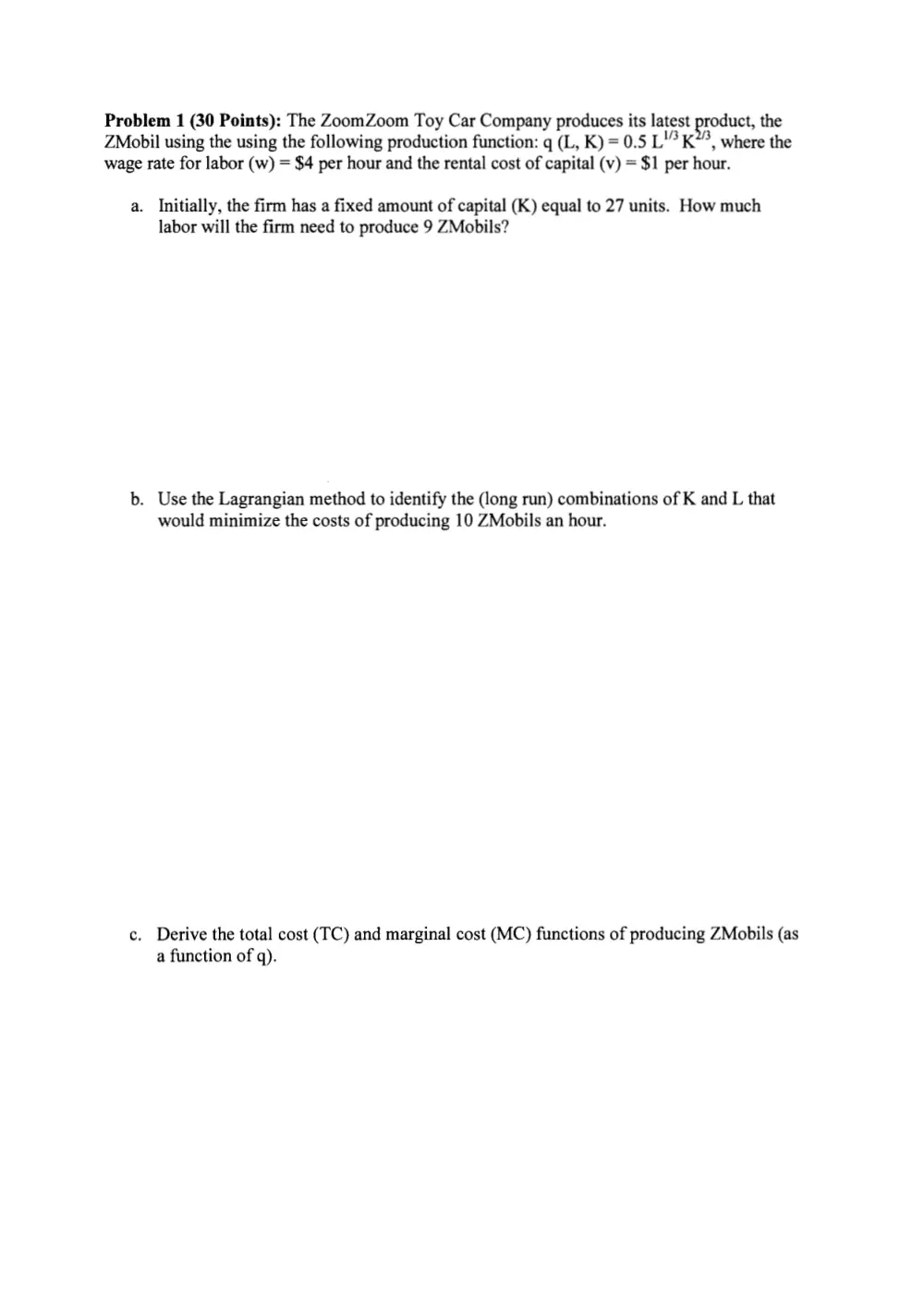
Problem 1 (30 Points): The ZoomZoom Toy Car Company produces its latest product, the
ZMobil using the using the following production function: q (L, K) = 0.5 L'? K*?, where the
wage rate for labor (w) = $4 per hour and the rental cost of capital (v) = $1 per hour.
a. Initially, the firm has a fixed amount of capital (K) equal to 27 units. How much
labor will the firm need to produce 9 ZMobils?
b. Use the Lagrangian method to identify the (long run) combinations of K and L that
would minimize the costs of producing 10 ZMobils an hour.
c. Derive the total cost (TC) and marginal cost (MC) functions of producing ZMobils (as
a function of q).
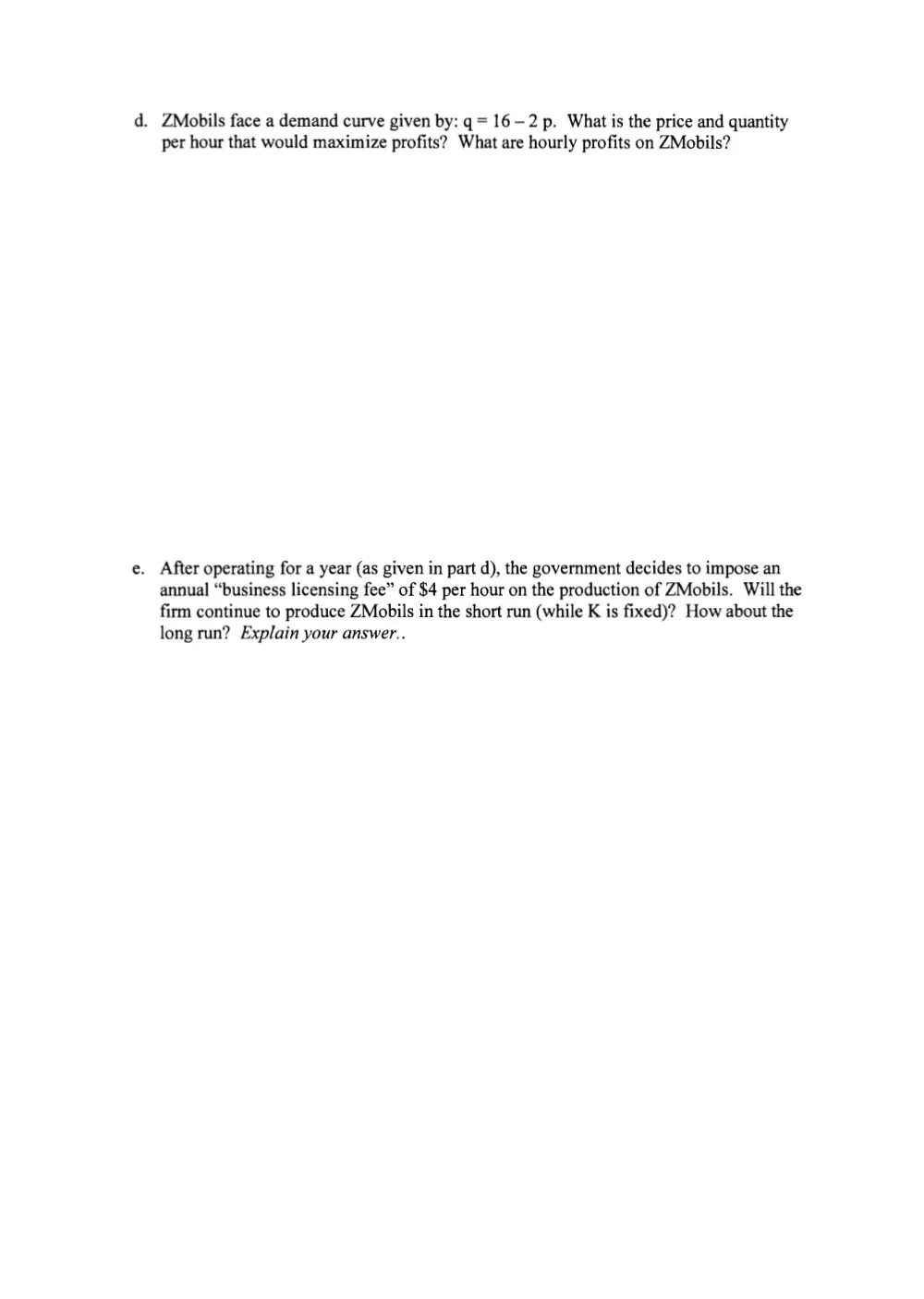
d. ZMobils face a demand curve given by: q= 16-2 p. What is the price and quantity
per hour that would maximize profits? What are hourly profits on ZMobils?
e. After operating for a year (as given in part d), the government decides to impose an
annual “business licensing fee” of $4 per hour on the production of ZMobils. Will the
firm continue to produce ZMobils in the short run (while K is fixed)? How about the
long run? Explain your answer..
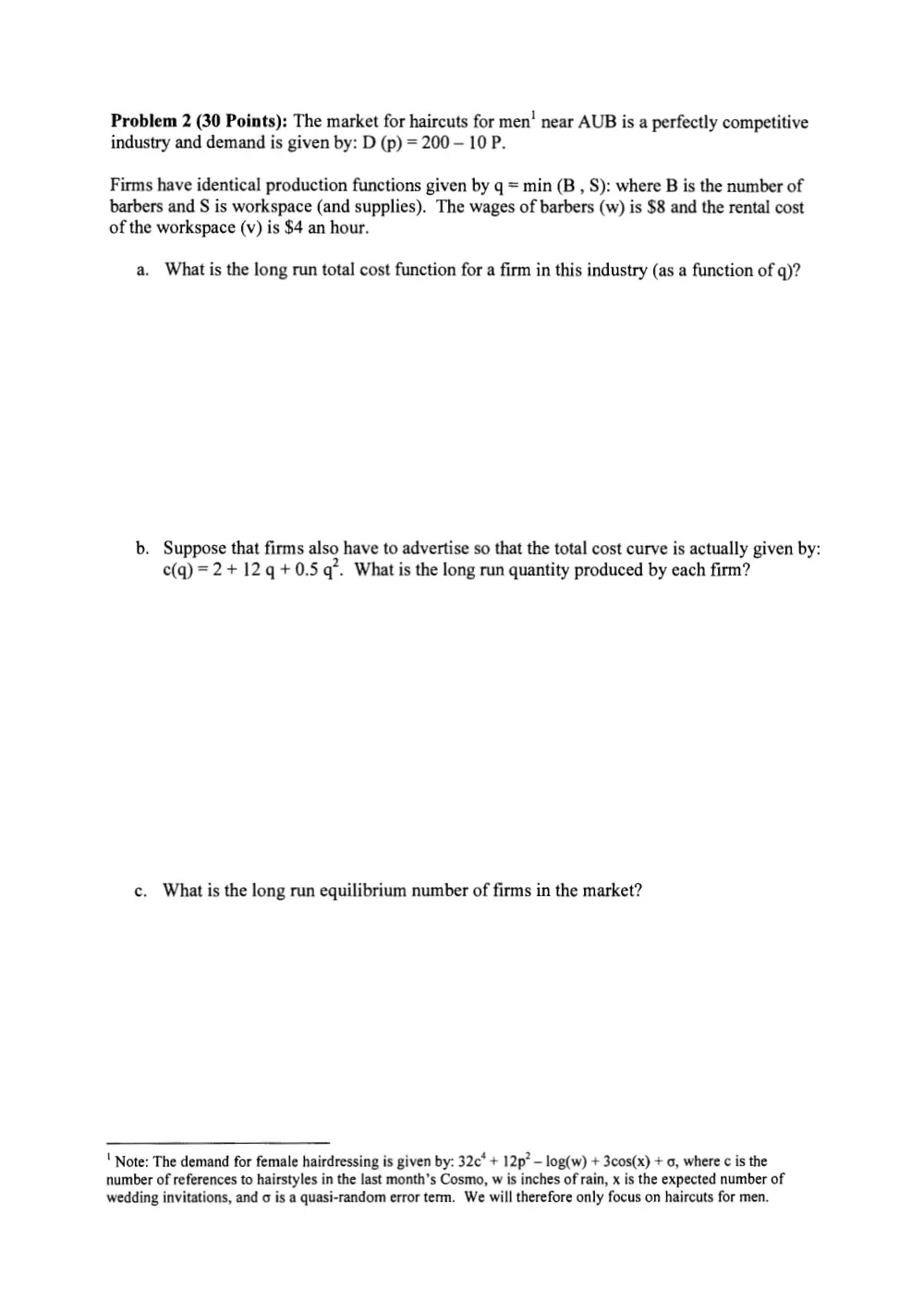
Problem 2 (30 Points): The market for haircuts for men’ near AUB is a perfectly competitive
industry and demand is given by: D (p) = 200 - 10 P.
Firms have identical production functions given by q = min (B, S): where B is the number of
barbers and S is workspace (and supplies). The wages of barbers (w) is $8 and the rental cost
of the workspace (v) is $4 an hour.
a. What is the long run total cost function for a firm in this industry (as a function of q)?
b. Suppose that firms also have to advertise so that the total cost curve is actually given by:
e(q)=2+ 12q+0.5 q’. What is the long run quantity produced by each firm?
c. What is the long run equilibrium number of firms in the market?
' Note: The demand for female hairdressing is given by: 32c* + 12p? — log(w) + 3cos(x) + 6, where c is the
number of references to hairstyles in the last month’s Cosmo, w is inches of rain, x is the expected number of
wedding invitations, and o is a quasi-random error term. We will therefore only focus on haircuts for men.
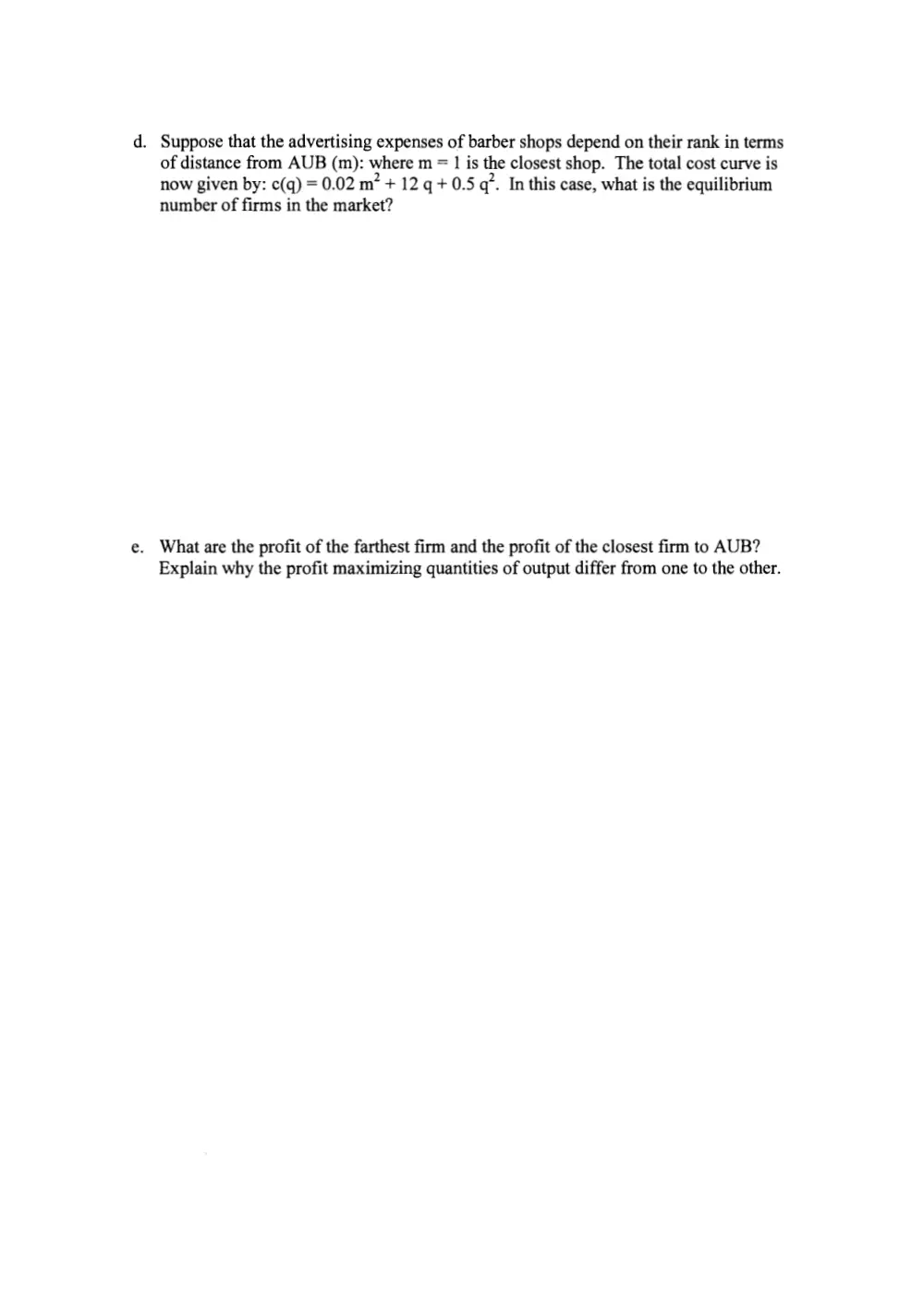
d. Suppose that the advertising expenses of barber shops depend on their rank in terms
of distance from AUB (m): where m = 1 is the closest shop. The total cost curve is
now given by: c(q) = 0.02 m? + 12. q+ 0.5 q’. In this case, what is the equilibrium
number of firms in the market?
e. What are the profit of the farthest firm and the profit of the closest firm to AUB?
Explain why the profit maximizing quantities of output differ from one to the other.
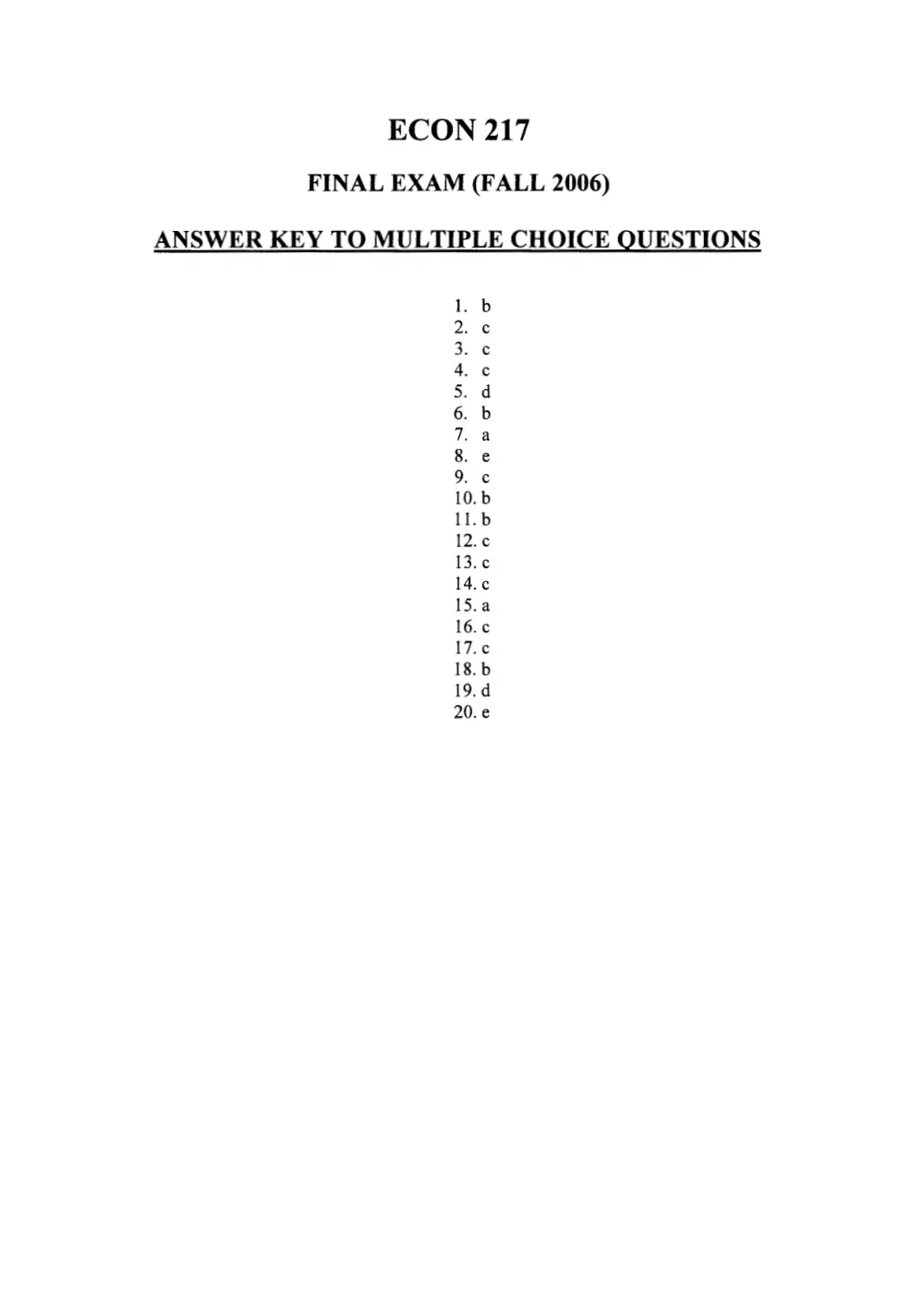
ECON 217
FINAL EXAM (FALL 2006)
ANSWER KEY TO MULTIPLE CHOICE QUESTIONS
WC ANAMPWN>
SO PNAMWPWNES’
_
—
aongmannanagrarvraoorsgmnacananae
N