
ECON 217 Midterm, Fall 2006
American University of Beirut · Intermediate Price Theory · 8 pages
More ECON 217 files
Show the text of this exam
ESM PNAYMAS YN
=)
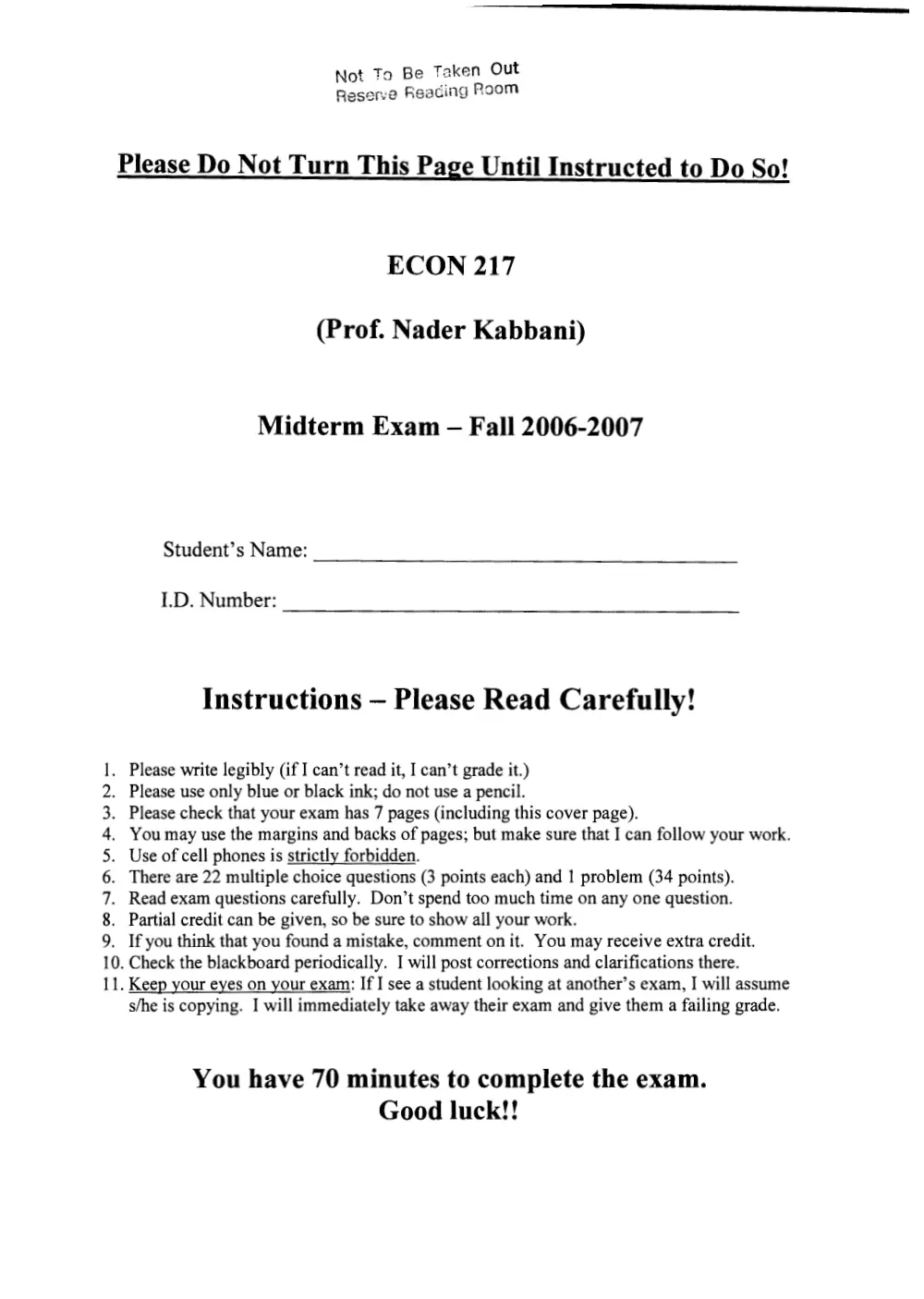
Not To Be Taken Out
Resene Reading ROOM
Please Do Not Turn This Page Until Instructed to Do So!
ECON 217
(Prof. Nader Kabbani)
Midterm Exam — Fall 2006-2007
Student’s Name:
I.D. Number:
Instructions — Please Read Carefully!
Please write legibly (if I can’t read it, I can’t grade it.)
Please use only blue or black ink; do not use a pencil.
Please check that your exam has 7 pages (including this cover page).
You may use the margins and backs of pages; but make sure that I can follow your work.
Use of cell phones is strictly forbidden.
There are 22 multiple choice questions (3 points each) and 1 problem (34 points).
Read exam questions carefully. Don’t spend too much time on any one question.
Partial credit can be given, so be sure to show all your work.
If you think that you found a mistake, comment on it. You may receive extra credit.
. Check the blackboard periodically. I will post corrections and clarifications there.
. Keep your eyes on your exam: If see a student looking at another’s exam, I will assume
s/he is copying. I will immediately take away their exam and give them a failing grade.
You have 70 minutes to complete the exam.
Good luck!!
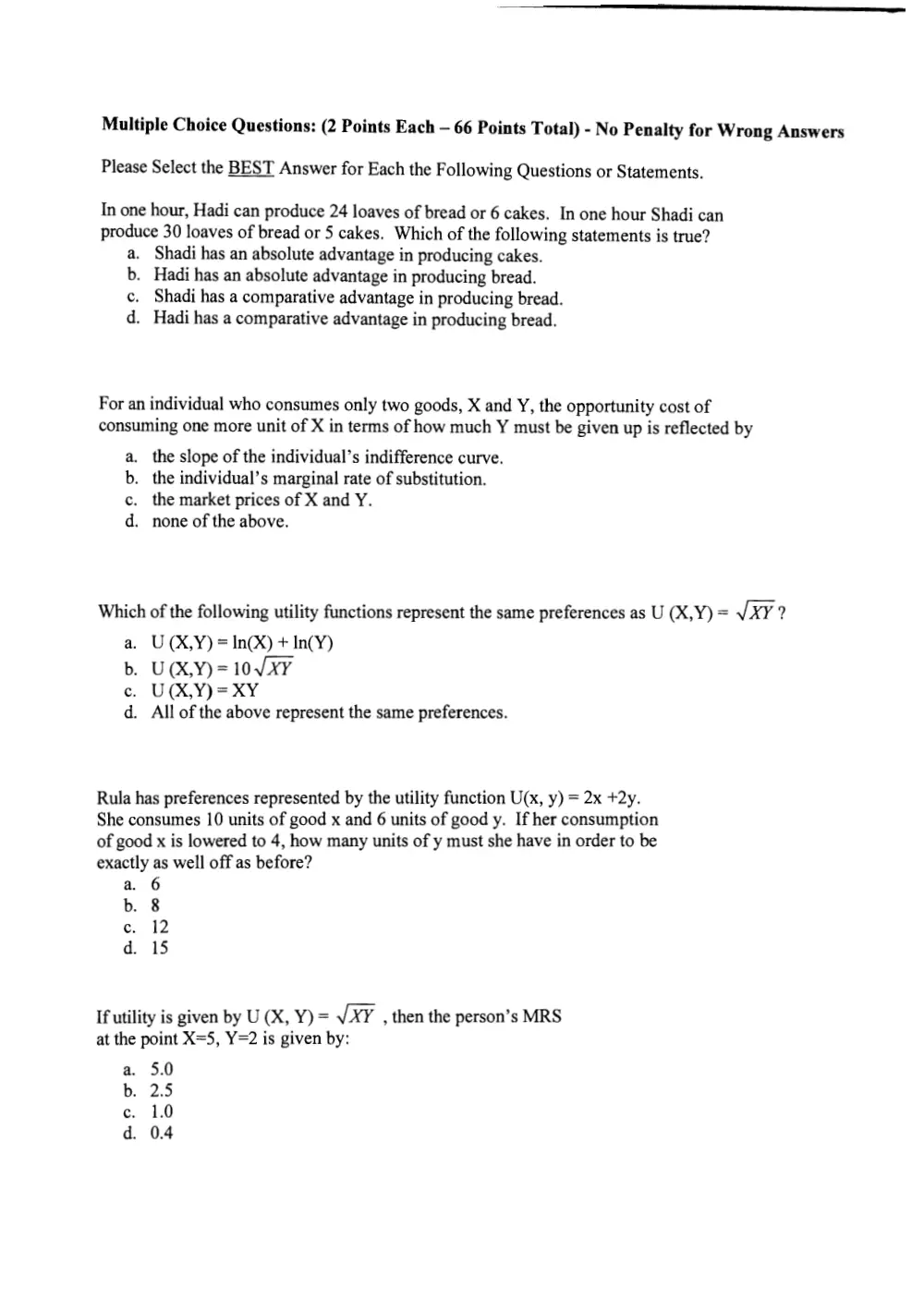
Multiple Choice Questions: (2 Points Each — 66 Points Total) - No Penalty for Wrong Answers
Please Select the BEST Answer for Each the Following Questions or Statements.
In one hour, Hadi can produce 24 loaves of bread or 6 cakes. In one hour Shadi can
produce 30 loaves of bread or 5 cakes. Which of the following statements is true?
Shadi has an absolute advantage in producing cakes.
Hadi has an absolute advantage in producing bread.
Shadi has a comparative advantage in producing bread.
Hadi has a comparative advantage in producing bread.
Be TP
For an individual who consumes only two goods, X and Y, the opportunity cost of
consuming one more unit of X in terms of how much Y must be given up is reflected by
a. the slope of the individual’s indifference curve.
b. the individual’s marginal rate of substitution.
c. the market prices of X and Y.
d. none of the above.
Which of the following utility functions represent the same preferences as U (X,Y) = VXY ?
a. U (X,Y) =In(X) + In(Y)
b. U(X,Y) = 10VXY
c. U(%,Y)=XY
d. All of the above represent the same preferences.
Rula has preferences represented by the utility function U(x, y) = 2x +2y.
She consumes 10 units of good x and 6 units of good y. If her consumption
of good x is lowered to 4, how many units of y must she have in order to be
exactly as well off as before?
a. 6
b. 8
c. 12
d. 15
If utility is given by U (X, Y) = vV-XY , then the person’s MRS
at the point X=5, Y=2 is given by:
a. 5.0
b. 2.5
ce. 1.0
d. 0.4
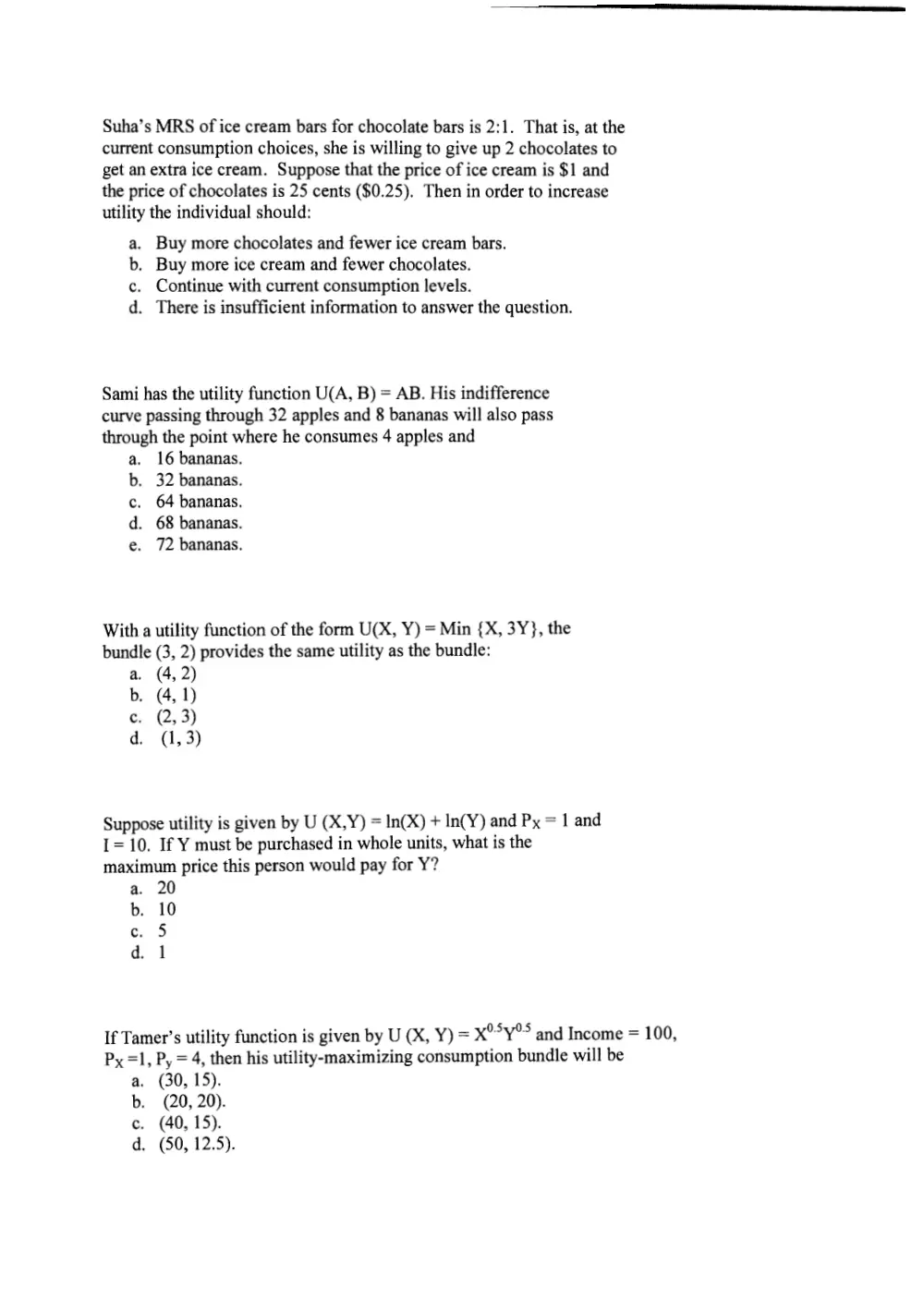
Suha’s MRS of ice cream bars for chocolate bars is 2:1. That is, at the
current consumption choices, she is willing to give up 2 chocolates to
get an extra ice cream. Suppose that the price of ice cream is $1 and
the price of chocolates is 25 cents ($0.25). Then in order to increase
utility the individual should:
Buy more chocolates and fewer ice cream bars.
Buy more ice cream and fewer chocolates.
Continue with current consumption levels.
There is insufficient information to answer the question.
Be rP
Sami has the utility function U(A, B) = AB. His indifference
curve passing through 32 apples and 8 bananas will also pass
through the point where he consumes 4 apples and
16 bananas.
32 bananas.
64 bananas.
68 bananas.
72 bananas.
ene ge
With a utility function of the form U(X, Y) = Min {X, 3Y}, the
bundle (3, 2) provides the same utility as the bundle:
a. (4, 2)
b. (4, 1)
c. (2,3)
d. (1,3)
Suppose utility is given by U (X,Y) = In(X) + In(Y) and Px = | and
I= 10. If Y must be purchased in whole units, what is the
maximum price this person would pay for Y?
a. 20
b. 10
ce. 5
d. 1
If Tamer’s utility function is given by U (X, Y) = x°y°> and Income = 100,
Px =1, Py = 4, then his utility-maximizing consumption bundle will be
a. (30, 15).
b. (20, 20).
c. (40, 15).
d. (50, 12.5).
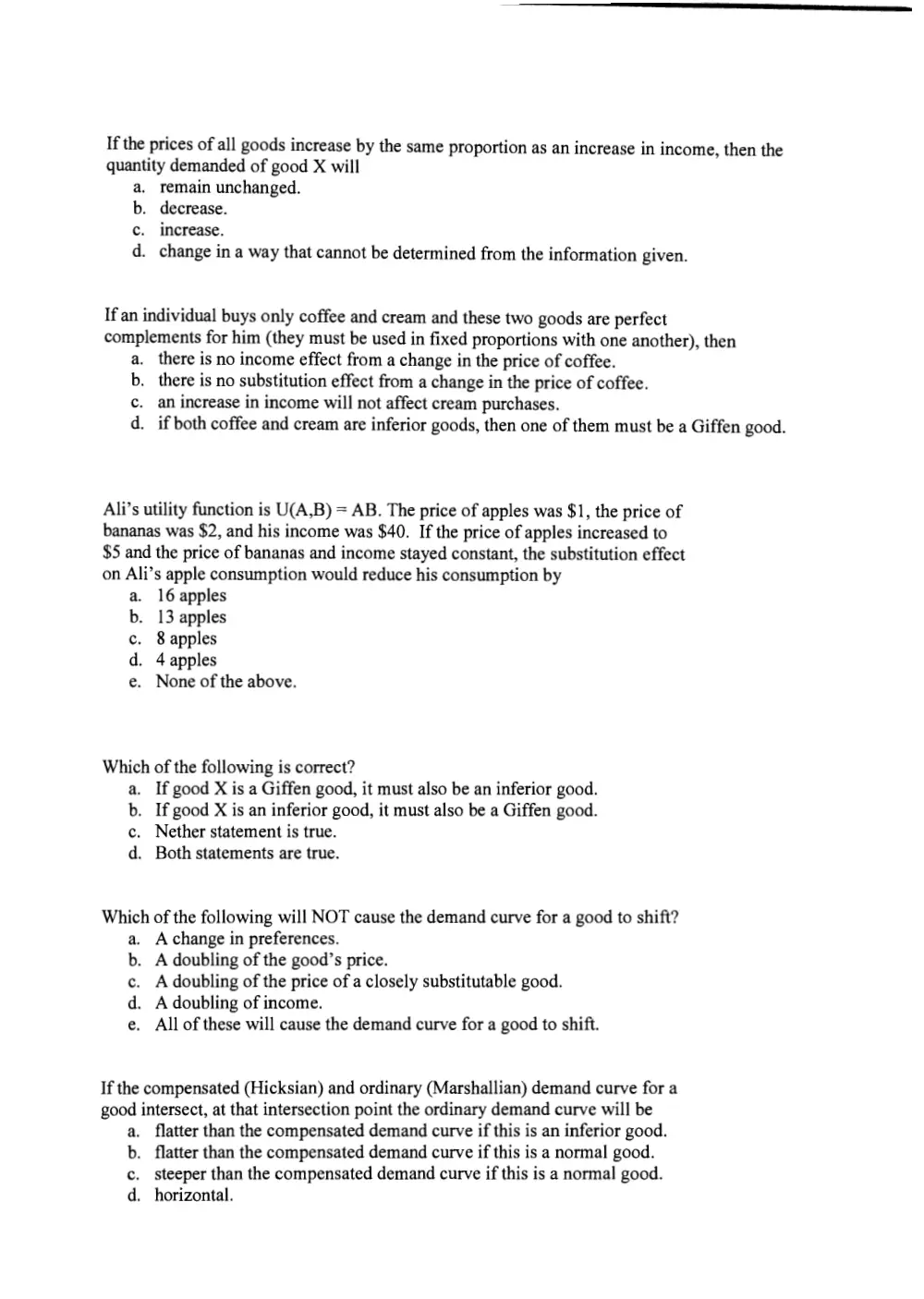
If the prices of all goods increase by the same proportion as an increase in income, then the
quantity demanded of good X will
a. remain unchanged.
b. decrease.
c. increase.
d. change in a way that cannot be determined from the information given.
If an individual buys only coffee and cream and these two goods are perfect
complements for him (they must be used in fixed proportions with one another), then
there is no income effect from a change in the price of coffee.
there is no substitution effect from a change in the price of coffee.
an increase in income will not affect cream purchases.
if both coffee and cream are inferior goods, then one of them must be a Giffen good.
ae op
Ali’s utility function is U(A,B) = AB. The price of apples was $1, the price of
bananas was $2, and his income was $40. If the price of apples increased to
$5 and the price of bananas and income stayed constant, the substitution effect
on Ali’s apple consumption would reduce his consumption by
a. 16 apples
b. 13 apples
c. 8 apples
d. 4 apples
e. None of the above.
Which of the following is correct?
a. If good X is a Giffen good, it must also be an inferior good.
b. If good X is an inferior good, it must also be a Giffen good.
c. Nether statement is true.
d. Both statements are true.
Which of the following will NOT cause the demand curve for a good to shift?
a. A change in preferences.
b. A doubling of the good’s price.
c. A doubling of the price of a closely substitutable good.
d. A doubling of income.
e. All of these will cause the demand curve for a good to shift.
If the compensated (Hicksian) and ordinary (Marshallian) demand curve for a
good intersect, at that intersection point the ordinary demand curve will be
a. flatter than the compensated demand curve if this is an inferior good.
b. flatter than the compensated demand curve if this is a normal good.
c. steeper than the compensated demand curve if this is a normal good.
d. horizontal.
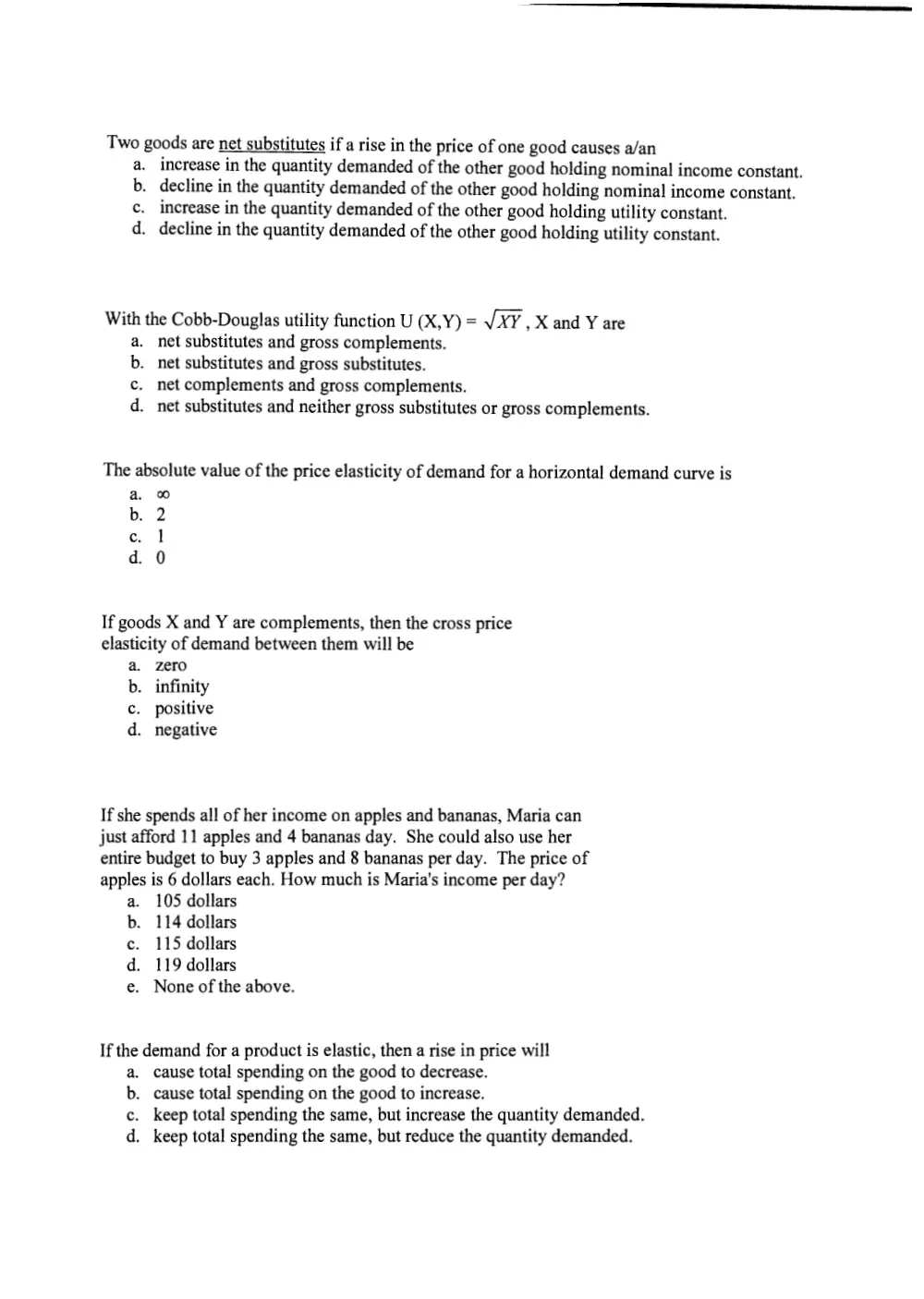
Two goods are net substitutes if a rise in the price of one good causes a/an
a. increase in the quantity demanded of the other good holding nominal income constant.
b. decline in the quantity demanded of the other good holding nominal income constant.
c. increase in the quantity demanded of the other good holding utility constant.
d. decline in the quantity demanded of the other good holding utility constant.
With the Cobb-Douglas utility function U (X,Y) = XY , X and Y are
net substitutes and gross complements.
net substitutes and gross substitutes.
net complements and gross complements.
net substitutes and neither gross substitutes or gross complements.
ao op
The absolute value of the price elasticity of demand for a horizontal demand curve is
Bo TP
oN eg
If goods X and Y are complements, then the cross price
elasticity of demand between them will be
Zero
infinity
positive
negative
Be oP
If she spends all of her income on apples and bananas, Maria can
just afford 11 apples and 4 bananas day. She could also use her
entire budget to buy 3 apples and 8 bananas per day. The price of
apples is 6 dollars each. How much is Maria's income per day?
a. 105 dollars
b. 114 dollars
c. 115 dollars
d. 119 dollars
e. None of the above.
If the demand for a product is elastic, then a rise in price will
a. cause total spending on the good to decrease.
b. cause total spending on the good to increase.
c. keep total spending the same, but increase the quantity demanded.
d. keep total spending the same, but reduce the quantity demanded.
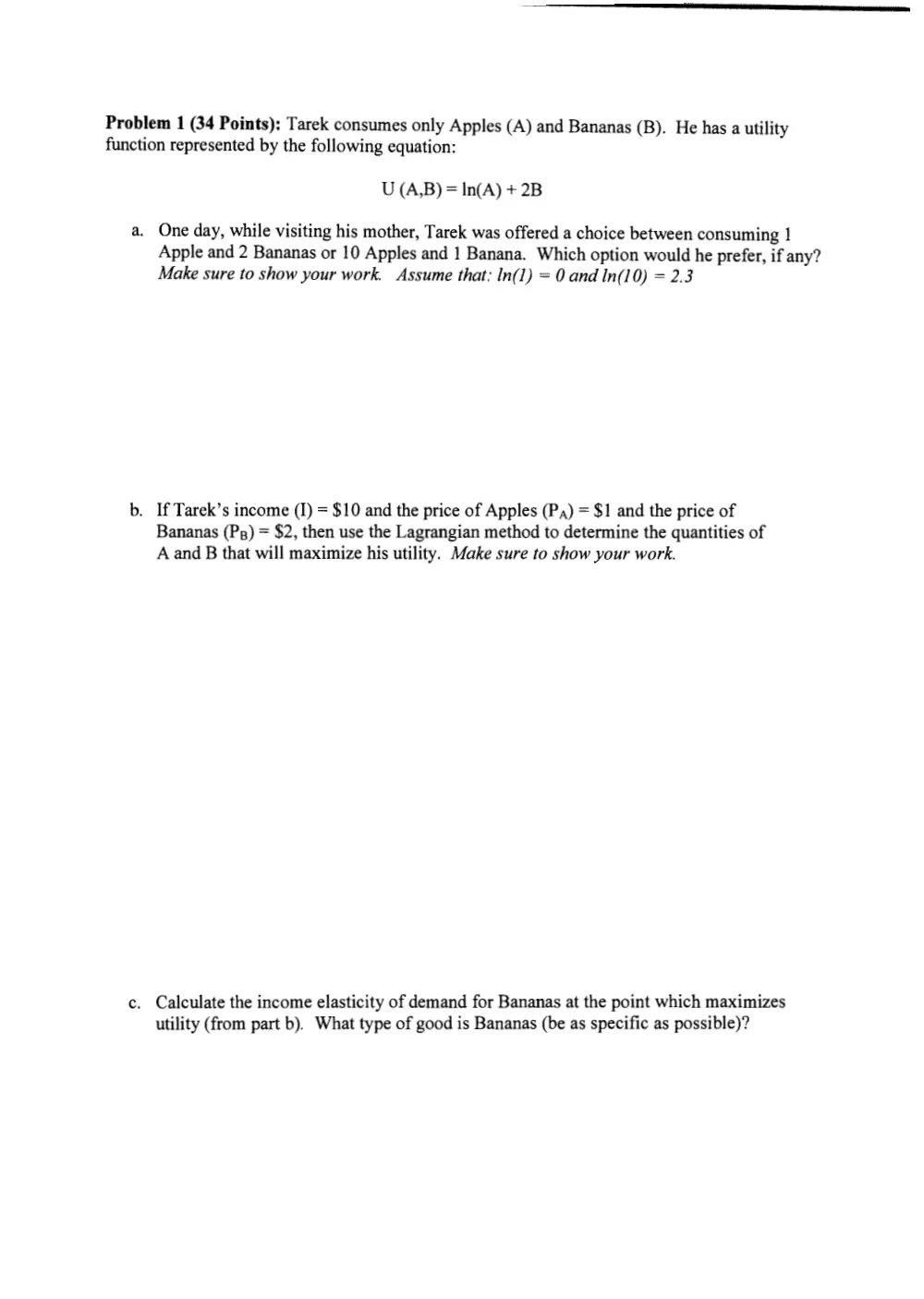
Problem 1 (34 Points): Tarek consumes only Apples (A) and Bananas (B). He has a utility
function represented by the following equation:
U (A,B) = In(A) + 2B
a. One day, while visiting his mother, Tarek was offered a choice between consuming 1
Apple and 2 Bananas or 10 Apples and 1 Banana. Which option would he prefer, if any?
Make sure to show your work. Assume that: In(1) = 0 and In(10) = 2.3
b. If Tarek’s income (I) = $10 and the price of Apples (Pa) = $1 and the price of
Bananas (Pp) = $2, then use the Lagrangian method to determine the quantities of
A and B that will maximize his utility. Make sure to show your work.
c. Calculate the income elasticity of demand for Bananas at the point which maximizes
utility (from part b). What type of good is Bananas (be as specific as possible)?
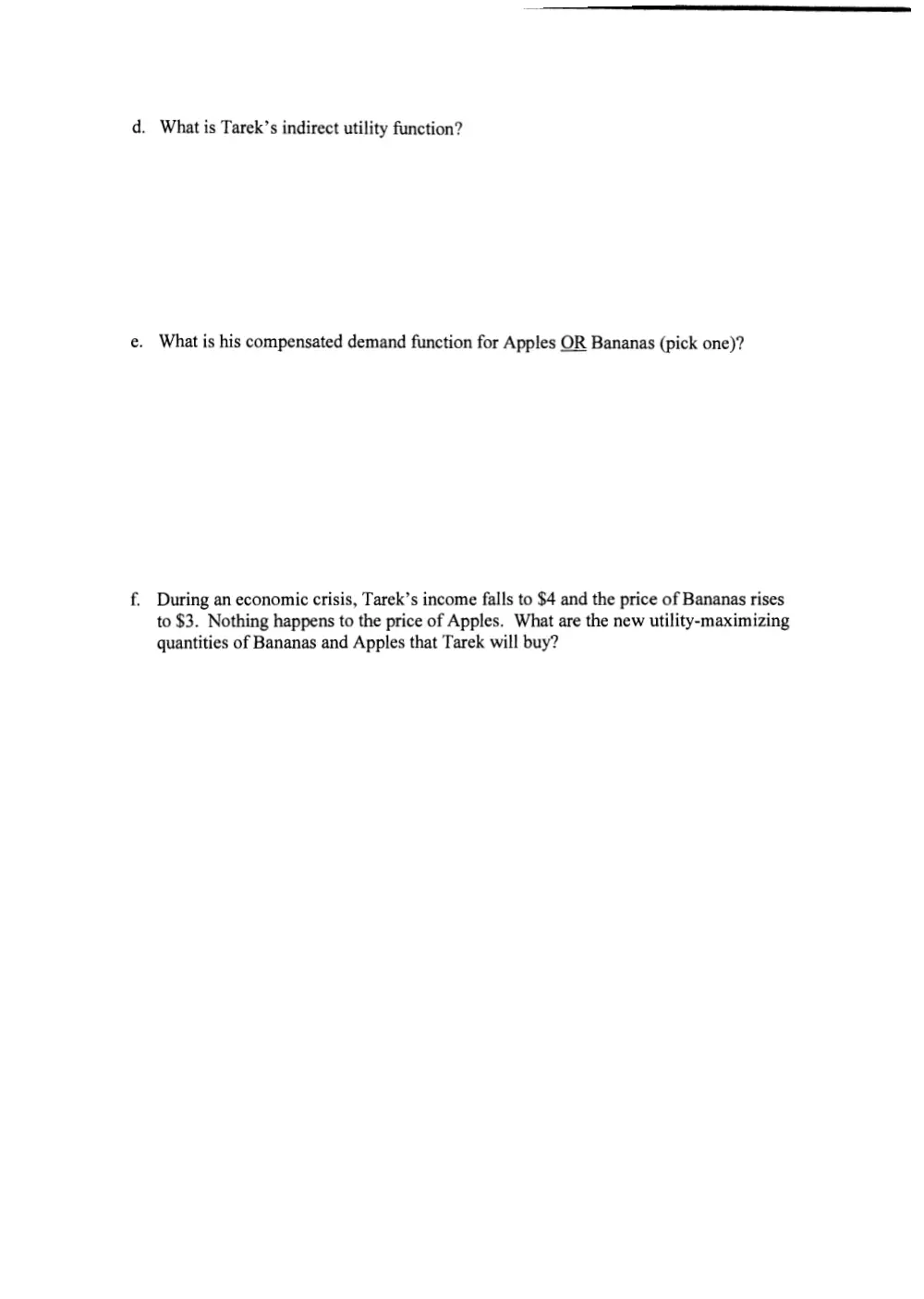
d. What is Tarek’s indirect utility function?
e. What is his compensated demand function for Apples OR Bananas (pick one)?
f. During an economic crisis, Tarek’s income falls to $4 and the price of Bananas rises
to $3. Nothing happens to the price of Apples. What are the new utility-maximizing
quantities of Bananas and Apples that Tarek will buy?
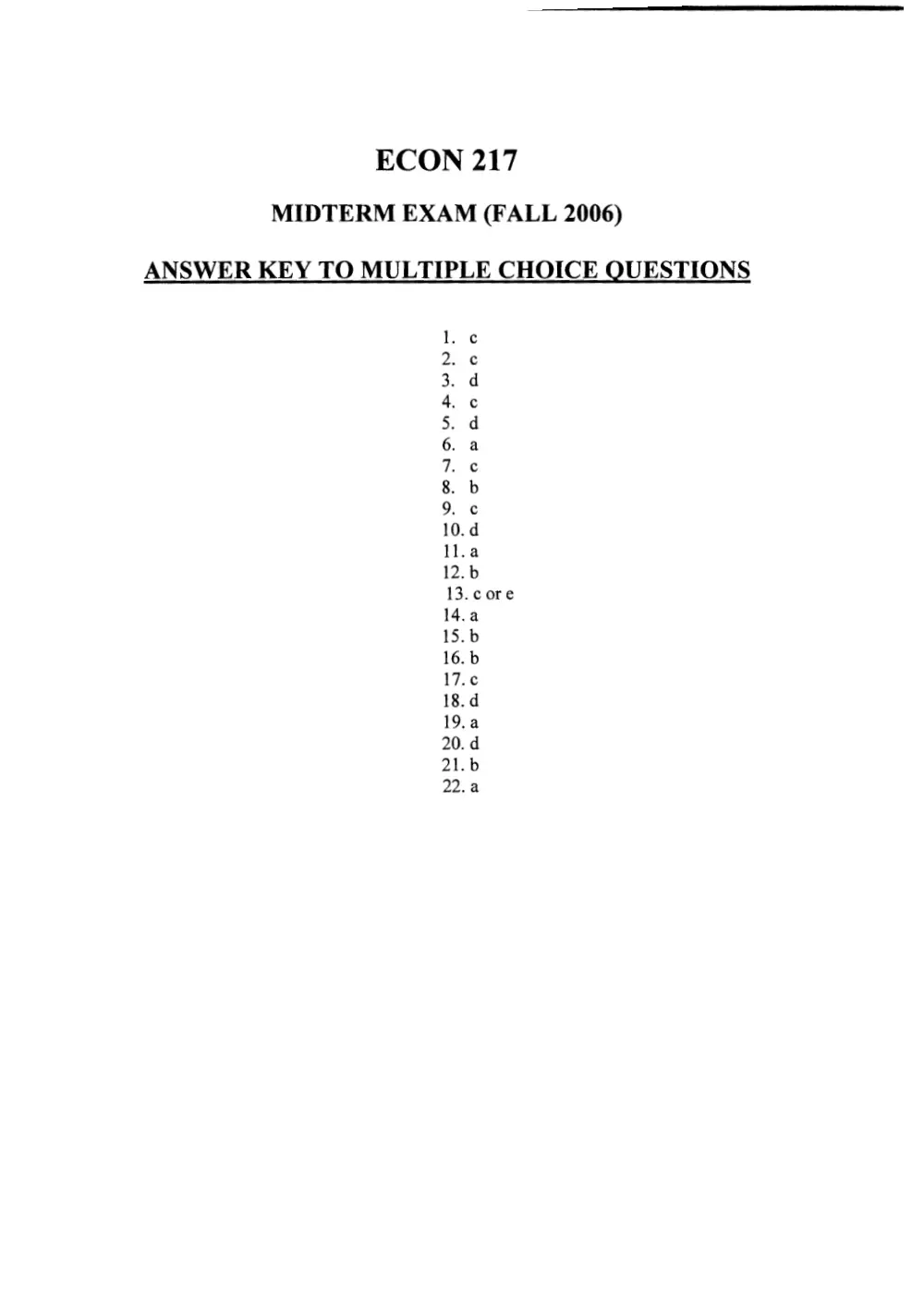
ECON 217
MIDTERM EXAM (FALL 2006)
ANSWER KEY TO MULTIPLE CHOICE QUESTIONS
HSPN AMAYWN SR
- O°
pmaonogmarnrmaamnan
N
o
13.core
l4.a
15.b
16.b
17.¢
18.d
19.a
20. d
21.b
22.a