
ECON 217 Final, Fall 2005
American University of Beirut · Intermediate Price Theory · 12 pages



Showing the first 10 of 12 pages. Download the PDF to see all of it.
More ECON 217 files
- Final · Fall 2006Final examView
- Final · Fall 2005Final examView
- Final · Fall 2004Final examView
- Final · Fall 2004Final examView
- Drop Quiz First Part of Course · Spring 2014QuizView
- Problems Test Bank Ch.1 · Spring 2013ProblemsView
- Problems Test Bank · Spring 2013ProblemsView
- Midterm · Fall 2006ExamView
Show the text of this final exam
Please Do Not Turn This Page Until Instructed to Do So!
ECON 217
(Prof. Nader Kabbani)
Final Exam — Fall 2005-2006
Student’s Name:
I.D. Number:
Instructions — Please Read Carefully!
Please write legibly (if I can’t read it, I can’t grade it.)
Please use only blue or black ink; do not use a pencil.
Please check that your exam has 11 pages (including this cover page).
You may use the margins and backs of pages; but make sure that I can follow your work.
Use of programmable calculators and cell phones is strictly forbidden.
There are 30 multiple choice questions (2 points each) and 2 problems (20 points each).
Read exam questions carefully. Don’t spend too much time on any one question.
Partial credit can be given, so be sure to show all your work.
If you think that you found a mistake, comment on it. You may receive extra credit.
0. Check the blackboard periodically. I will post corrections and clarifications there.
1
. Keep your eyes on your exam: If I see a student looking at another’s exam, [ will assume
s/he is copying. I will immediately take away their exam and give them a failing grade.
You have 120 minutes to complete the exam.
Good luck!
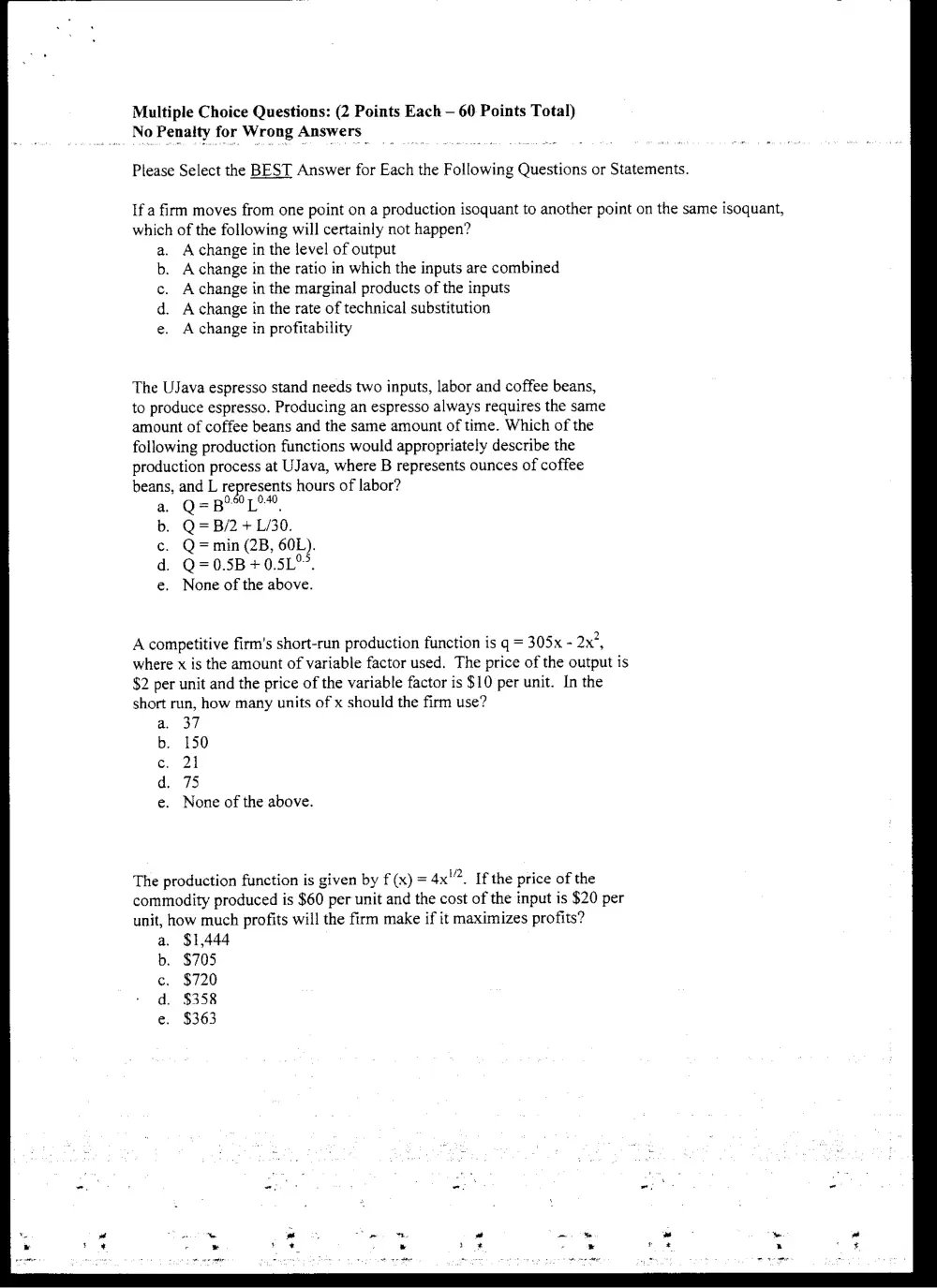
Multiple Choice Questions: (2 Points Each — 60 Points Total)
No Penalty for Wrong Answers"
Please Select the BEST Answer for Each the Following Questions or Statements.
If a firm moves from one point on a production isoquant to another point on the same isoquant,
which of the following will certainly not happen?
A change in the level of output
A change in the ratio in which the inputs are combined
A change in the marginal products of the inputs
A change in the rate of technical substitution
A change in profitability
enor
The UJava espresso stand needs two inputs, labor and coffee beans,
to produce espresso. Producing an espresso always requires the same
amount of coffee beans and the same amount of time. Which of the
following production functions would appropriately describe the
production process at UJava, where B represents ounces of coffee
beans, and L represents hours of labor?
a. Q= BOL 24,
b. Q=B/2+L/30.
c. Q=min (2B, 60L).
d. Q=0.5B+0.5L"°.
e. None of the above.
A competitive firm's short-run production function is q = 305x - 2x2,
where x is the amount of variable factor used. The price of the output is
$2 per unit and the price of the variable factor is $10 per unit. In the
short run, how many units of x should the firm use?
a, 37
b. 150
c. 21
d. 75
e. None of the above.
The production function is given by f (x) = 4x!?_ If the price of the
commodity produced is $60 per unit and the cost of the input is $20 per
unit, how much profits will the firm make if it maximizes profits?
a. $1,444
b. $705
c. $720
d. $358
e. $363
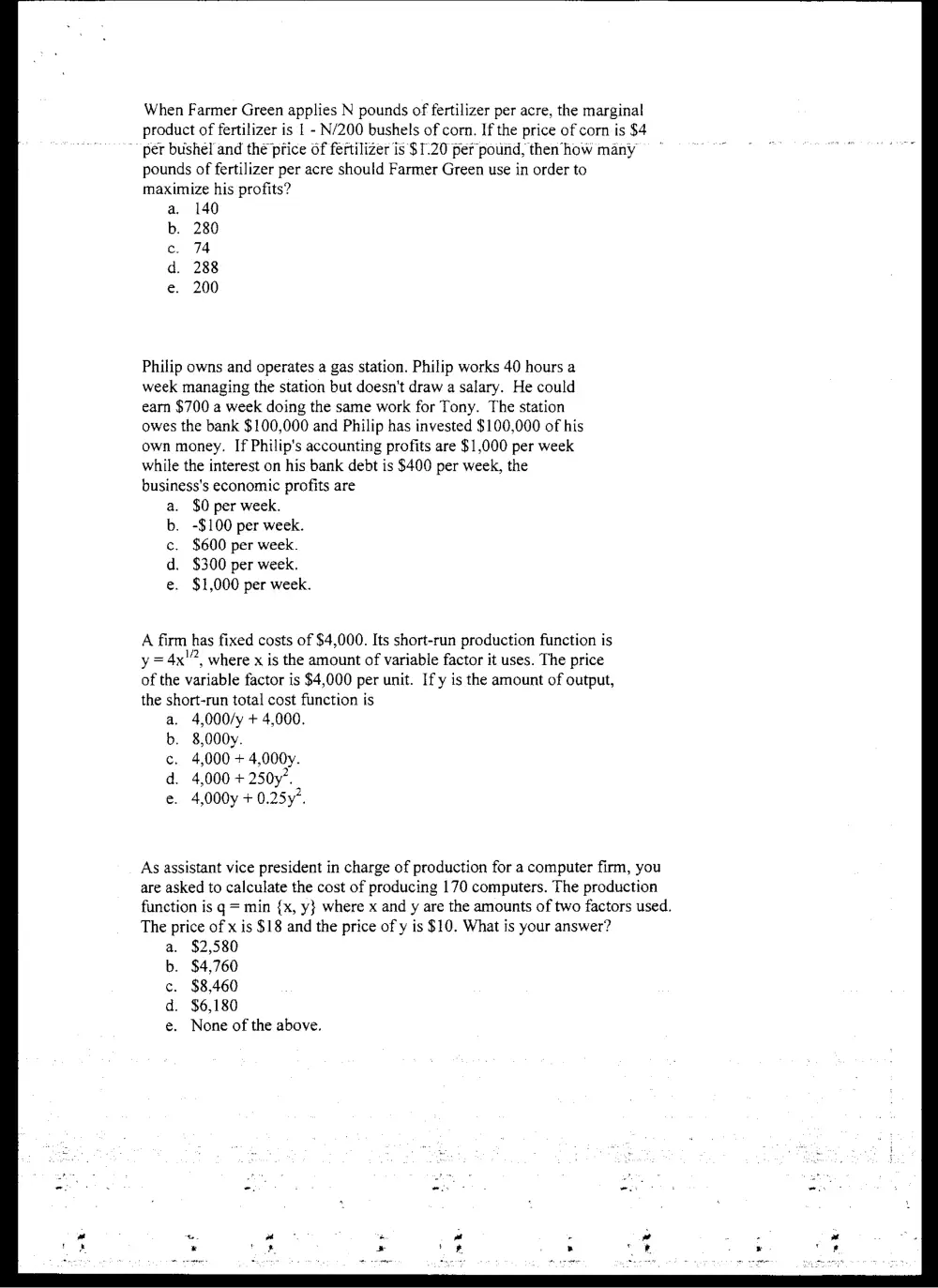
When Farmer Green applies N pounds of fertilizer per acre, the marginal
product of fertilizer is | - N/200 bushels of corn. If the price of corn is $4
per bushel and thé price of fertilizer is $1.20 per pound, then how many ~
pounds of fertilizer per acre should Farmer Green use in order to
maximize his profits?
a. 140
b. 280
c. 74
d. 288
e. 200
Philip owns and operates a gas station. Philip works 40 hours a
week managing the station but doesn't draw a salary. He could
earn $700 a week doing the same work for Tony. The station
owes the bank $100,000 and Philip has invested $100,000 of his
own money. If Philip's accounting profits are $1,000 per week
while the interest on his bank debt is $400 per week, the
business's economic profits are
a. $0 per week.
b. -$100 per week.
c. $600 per week.
d. $300 per week.
e. $1,000 per week.
A firm has fixed costs of $4,000. Its short-run production function is
y= 4x!” where x is the amount of variable factor it uses. The price
of the variable factor is $4,000 per unit. If y is the amount of output,
the short-run total cost function is
4,000/y + 4,000.
8,000y.
4,000 + 4,000y.
4,000 + 250y7.
4,000y + 0.25y7,
esaogce
As assistant vice president in charge of production for a computer firm, you
are asked to calculate the cost of producing 170 computers. The production
function is q = min {x, y} where x and y are the amounts of two factors used.
The price of x is $18 and the price of y is $10. What is your answer?
a. $2,580
b. $4,760
c. $8,460
d. $6,180
e. None of the above.
~ 7 “ *. a ” a”
* * ‘ok » + *
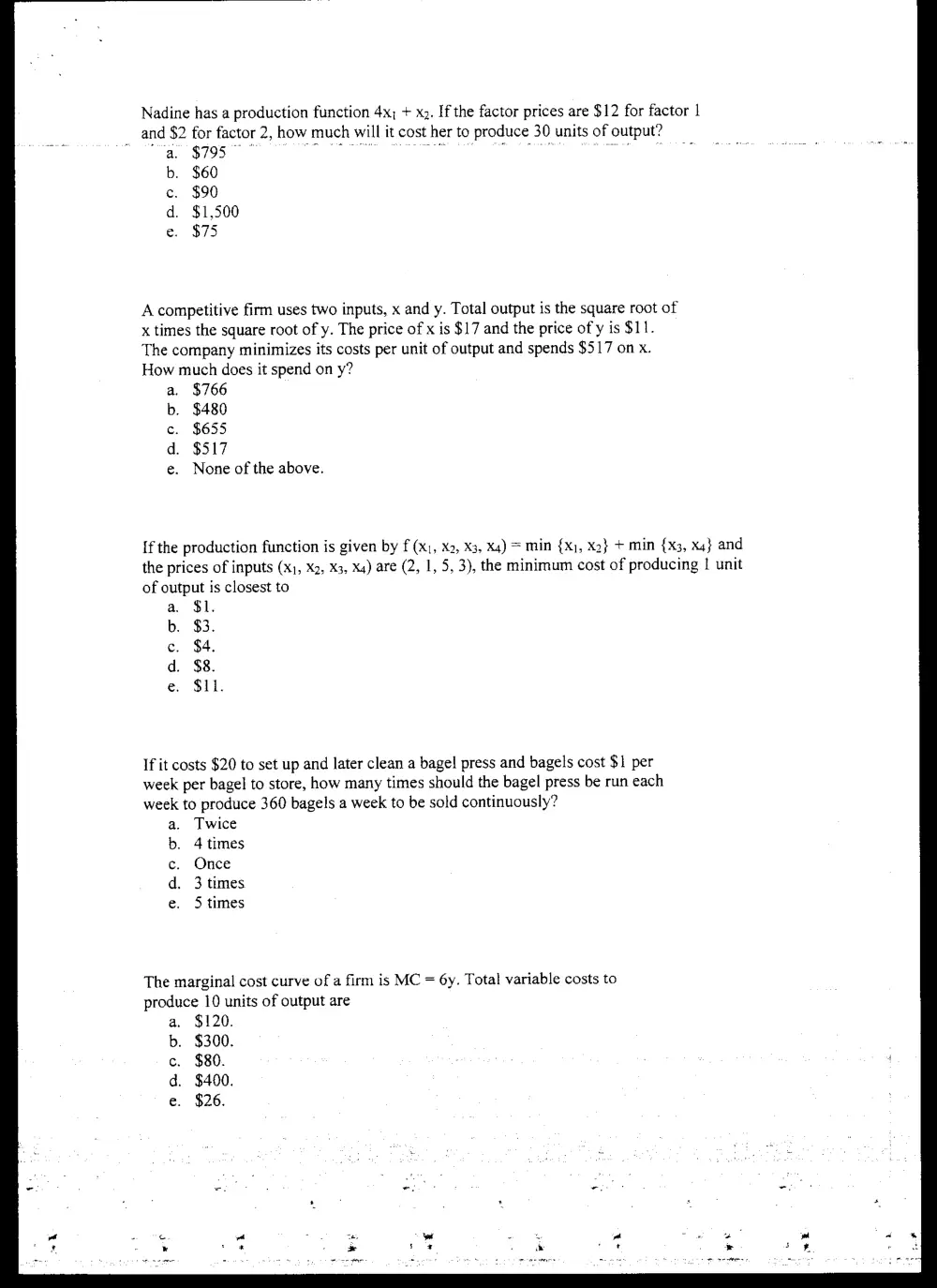
Nadine has a production function 4x; + xa. If the factor prices are $12 for factor |
: and $2 for factor 2, how much will it cost her to produce 30 units of output?
a. $795 -
b. $60
c. $90
d. $1,500
e. $75
A competitive firm uses two inputs, x and y. Total output is the square root of
x times the square root of y. The price of x is $17 and the price of y is $11.
The company minimizes its costs per unit of output and spends $517 on x.
How much does it spend on y?
$766
$480
$655
$517
None of the above.
gs aogre
If the production function is given by f (x1, x2, X3, X4) = min {X), x2} + min {X3, x4} and
the prices of inputs (x1, X2, Xs, X4) are (2, 1, 5, 3), the minimum cost of producing 1 unit
of output is closest to
a. $1.
b. $3.
c. $4,
d. $8.
e. $11.
If it costs $20 to set up and later clean a bagel press and bagels cost $1 per
week per bagel to store, how many times should the bagel press be run each
week to produce 360 bagels a week to be sold continuously?
Twice
4 times
Once
3 times
5 times
pao ge
The marginal cost curve of a firm is MC = 6y. Total variable costs to
produce 10 units of output are
a. $120.
b. $300.
c. $80.
d. $400.
e. $26.
c “ fe. wt i *
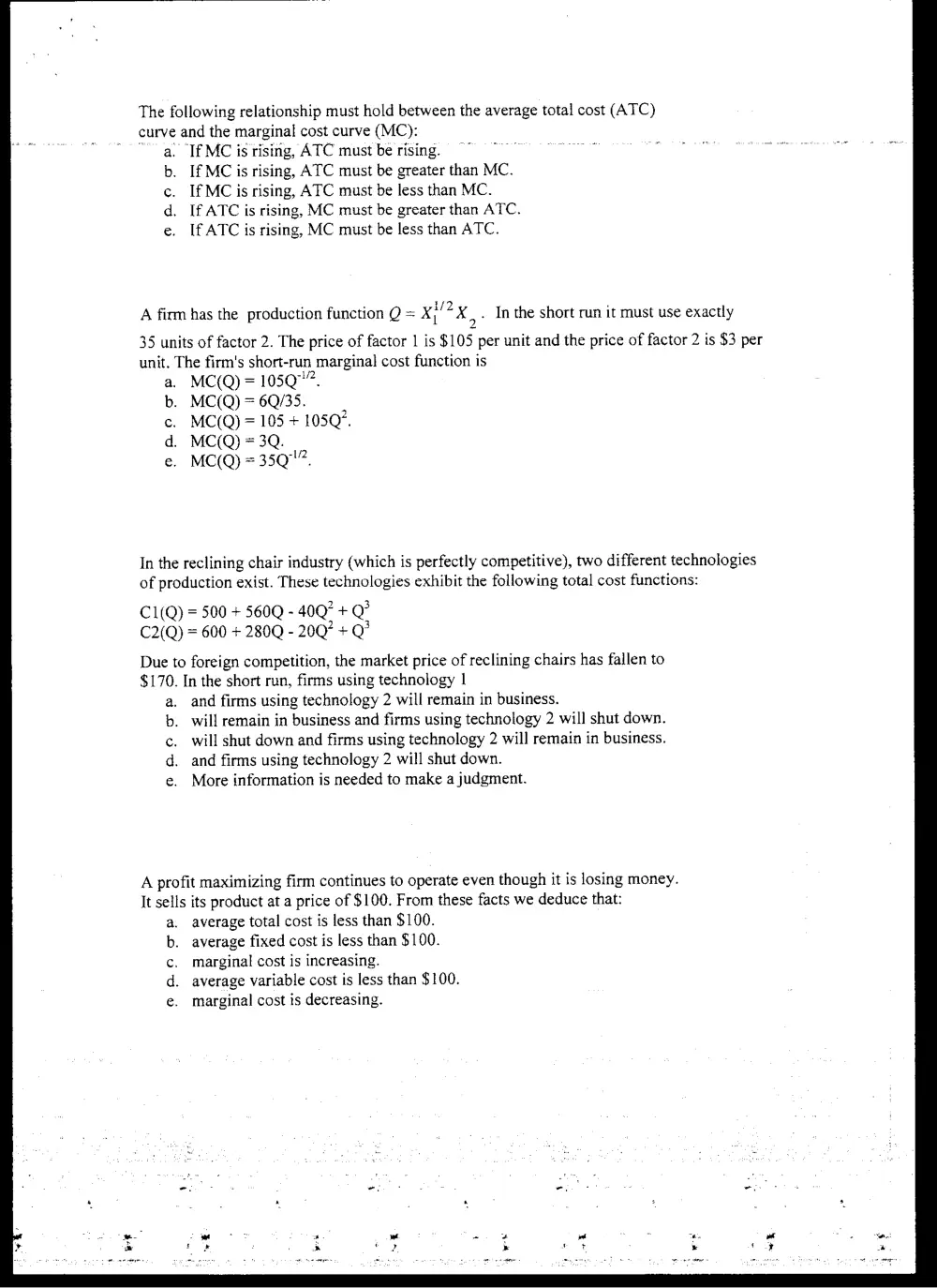
The following relationship must hold between the average total cost (ATC)
curve and the marginal cost curve (MC):
“al “TE MC is rising, ATC must be rising.
If MC is rising, ATC must be greater than MC.
If MC is rising, ATC must be less than MC.
If ATC is rising, MC must be greater than ATC.
If ATC is rising, MC must be less than ATC.
eanogp
A firm has the production function Q = X v 2x 2" In the short run it must use exactly
35 units of factor 2. The price of factor 1 is $105 per unit and the price of factor 2 is $3 per
unit. The firm's short-run marginal cost function is
MC(Q) = 105Q"”.
a.
b. MC(Q) = 60/35.
c. MC(Q)=105 + 105Q’.
d. MC(Q) =3Q.
e. MC(Q)=35Q".
In the reclining chair industry (which is perfectly competitive), two different technologies
of production exist. These technologies exhibit the following total cost functions:
C1(Q) = 500 + 560Q - 40Q? +Q°
C2(Q) = 600 + 280Q - 20Q7 + Q?
Due to foreign competition, the market price of reclining chairs has fallen to
$170. In the short run, firms using technology 1
and firms using technology 2 will remain in business.
will remain in business and firms using technology 2 will shut down.
will shut down and firms using technology 2 will remain in business.
and firms using technology 2 will shut down.
More information is needed to make a judgment.
Pane se
A profit maximizing firm continues to operate even though it is losing money.
It sells its product at a price of $100. From these facts we deduce that:
average total cost is less than $100.
average fixed cost is less than $100.
marginal cost is increasing.
average variable cost is less than $100.
marginal cost is decreasing.
eno rPp
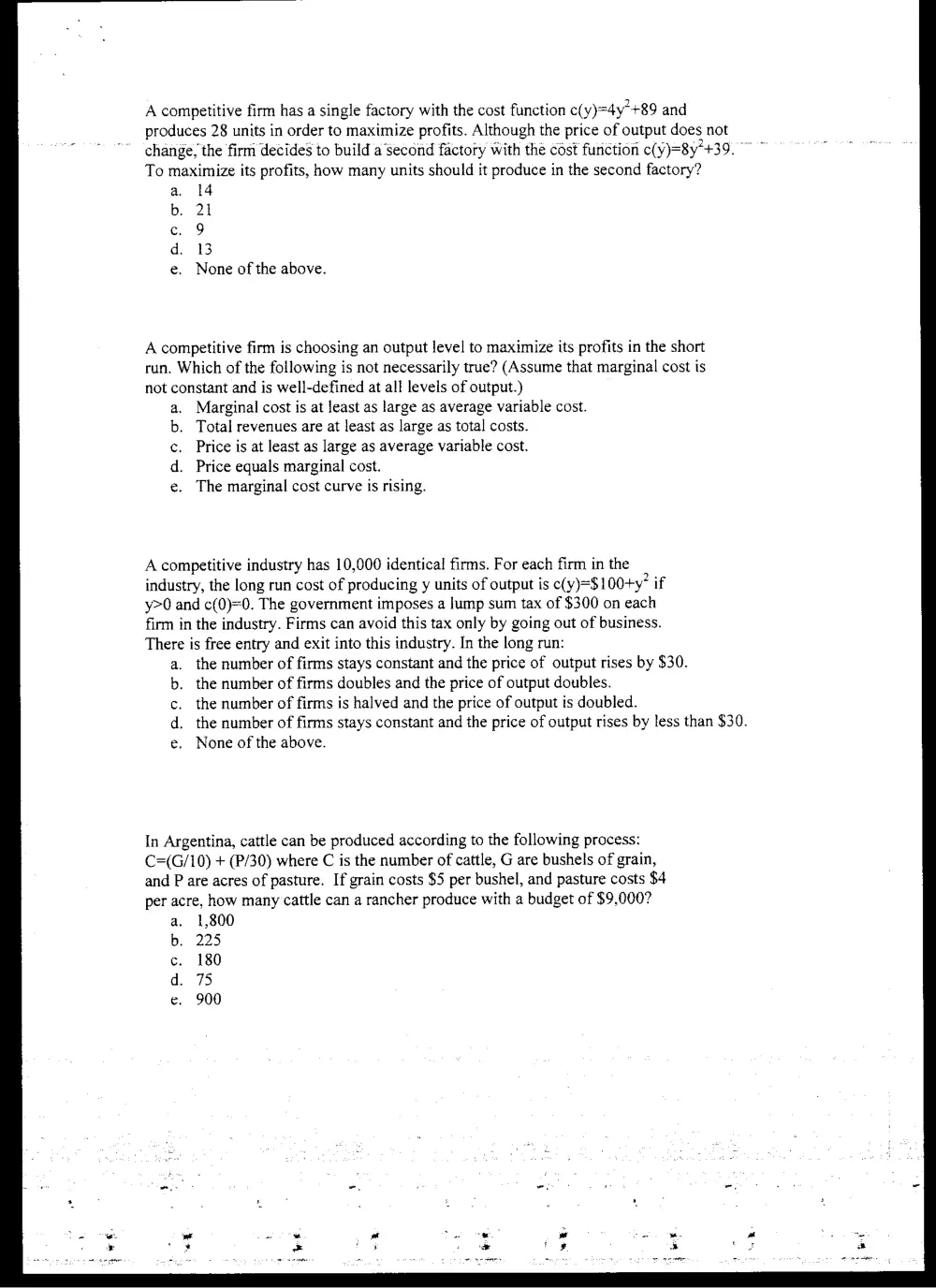
A competitive firm has a single factory with the cost function e(y)=4y"+89 and
produces 28 units in order to maximize profits. Although the price of output does not
change, the firm decides to build a second factory with the cost function c(y)= By7+39.
To maximize its profits, how many units should it produce in the second factory?
a. 14
b. 21
c. 9
d. 13
e. None of the above.
A competitive firm is choosing an output level to maximize its profits in the short
run. Which of the following is not necessarily true? (Assume that marginal cost is
not constant and is well-defined at all levels of output.)
. Marginal cost is at least as large as average variable cost.
. Total revenues are at least as large as total costs.
. Price is at least as large as average variable cost.
. Price equals marginal cost.
. The marginal cost curve is rising.
A competitive industry has 10,000 identical firms. For each firm in the
industry, the long run cost of producing y units of output is c(y)= $100+y? if
y>0 and c(0)=0. The government imposes a lump sum tax of $300 on each
firm in the industry. Firms can avoid this tax only by going out of business.
There is free entry and exit into this industry. In the long run:
. the number of firms stays constant and the price of output rises by $30.
. the number of firms doubles and the price of output doubles.
. the number of firms is halved and the price of output is doubled.
. the number of firms stays constant and the price of output rises by less than $30.
. None of the above.
In Argentina, cattle can be produced according to the following process:
C=(G/10) + (P/30) where C is the number of cattle, G are bushels of grain,
and P are acres of pasture. If grain costs $5 per bushel, and pasture costs $4
per acre, how many cattle can a rancher produce with a budget of $9,000?
a. 1,800
b. 225
c. 180
d. 75
e. 900
yw
A monopolist faces the inverse demand function described by p=32- 5q
where q is output. The monopolist has no fixed cost and his marginal cost
is’7 at all levels Of Gutput.” Which of the following expressés the ="
monopolist's profits as a function of his output?
a. 32-5q-7
b. 32-10q
c. 25q-5q"
d. 32q-5q?-7
e. None of the above.
The demand for a monopolist's output is 2,000/(p+1)2 where p is the price she
charges. At a price of 3, the elasticity of demand for the monopolist's output is:
a. -l.
b. -2.50.
c. -1.50.
d. -2.
e. -l.
A monopolist has constant marginal costs of $1 per unit. The demand for her
output is 1000/p if p is less than or equal to 50. The demand is 0 if p>50.
What is her profit maximizing level of output?
a. 5
b. 10
ce. 15
d. 20
e. 25
A monopolist has decreasing average costs as output increases. If the
monopolist sets price equal to average cost, it will:
produce too much output from the standpoint of efficiency.
lose money.
produce too fittle output from the standpoint of efficiency.
maximize its profits.
face excess demand.
eaoge
An airline has exclusive landing rights at the local airport. The airline flies one
flight per day to New York with a plane that has a seating capacity of 100.
The cost of flying the plane per day is $4,000 +10q where q is the number of
passengers. The number of flights to New York demanded is q=165-.5p. If the
airline maximizes its monopoly profits, the difference between the marginal
cost of flying an extra passenger and the amount the marginal passenger is
willing to pay to fly to New York is:
a. $10.
b. $100.
c.. $140.
d. $160.
e. None of the above.
tk
«
as
x
owt
A monopolist faces a downward-sloping demand curve and has fixed costs so
‘large that when he maximizes profits with a positive amount of output, he earns” ~
exactly zero profits. At this positive, profit-maximizing output, it must be that:
there are decreasing returns to scale.
demand is price inelastic.
marginal revenue is greater than marginal cost.
price equals marginal cost.
average total cost ie greater than marginal cast
eno gee
In a market with inverse demand curve P=10-Q, Brand X is a monopolist
with no fixed costs and with a marginal cost of 2. If marginal cost rises to
4, by how much will the price of Brand X rise?
a. 2
b. 1
c. 3
d. No change, the firm is already charging the monopoly price.
e. None of the above.
A profit-maximizing monopolist faces a demand function given by
q=1000-20p where p is the price of her output in dollars. She has a
constant marginal cost of 20 dollars per unit of output. In an effort
to induce her to increase her output, the government agrees to pay
her a subsidy of 10 dollars for every unit that she produces. In
response to the subsidy, she will:
increase her price and lower her output.
decrease her price by $5 per unit.
decrease her price by $10 per unit.
decrease her price by more than $10 per unit, but by less than $16 per unit.
decrease her price by more than $16 per unit.
pao ge
A monopolist sells in two markets. The demand curve for her product is
given by p;=119-2x; in the first market and po=123-5x2 in the second
market, where x; is the quantity sold in Market i and p; is the price charged
in Market i. She has a constant marginal cost of production, c=3, and no
fixed costs. She can charge different prices in the two markets. What is the
profit-maximizing combination of quantities for this monopolist?
x,=58 and x.=14
X;=29 and x2=12
xi=41 and x,=29
x1=39 and x2=10
xX =49 and x2=22
pao op
¥
ee
«
. 7
,
LJ
Dey
Pa
§
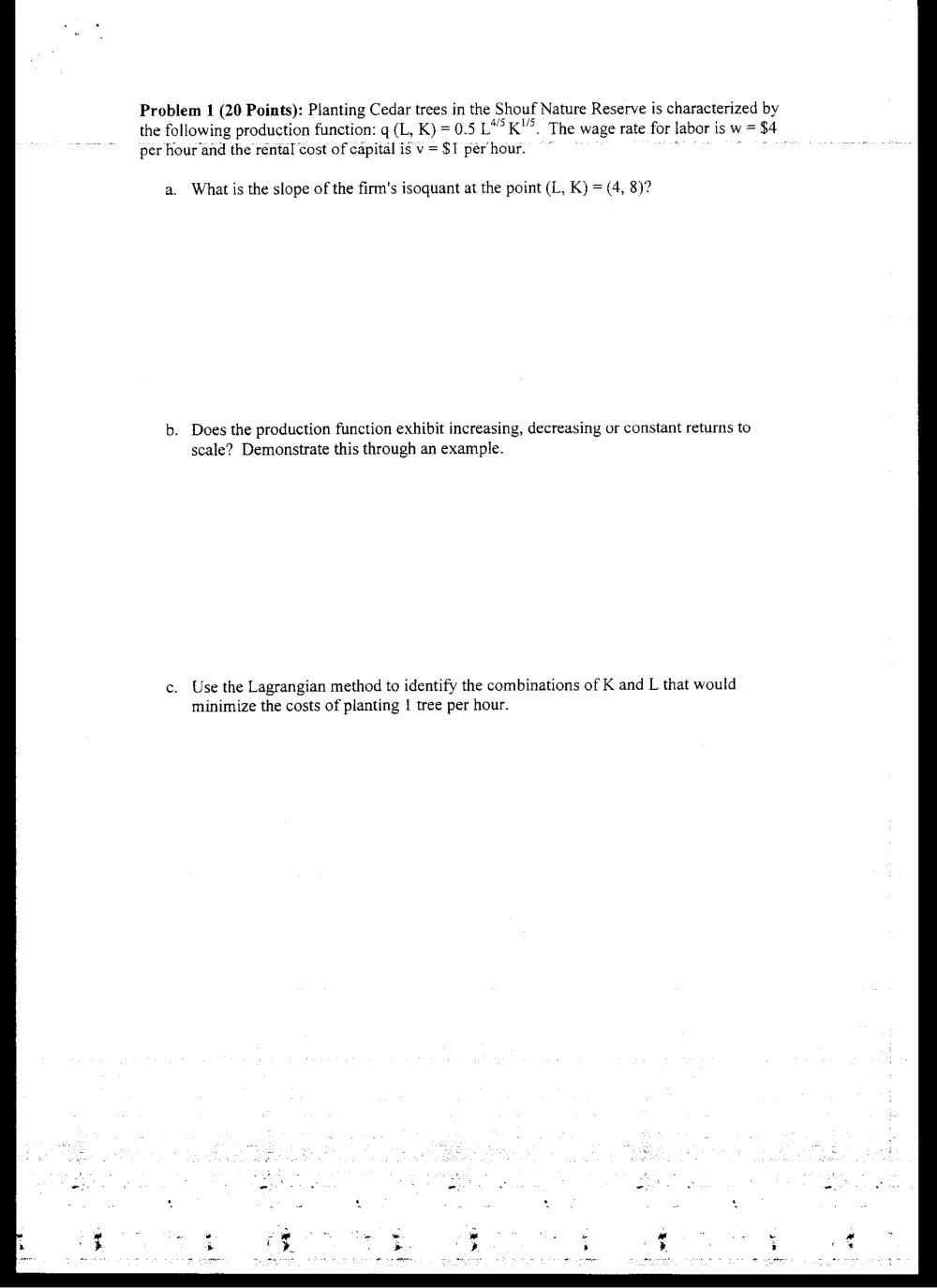
Problem 1 (20 Points): Planting Cedar trees in the Shouf Nature Reserve is characterized by
the following production function: q (L, K) = 0.5 L*K"°, The wage rate for labor is w = $4
per hour and the rental cost of capital is v = $1 per hour.
a. What is the slope of the firm's isoquant at the point (L, K) = (4, 8)?
b. Does the production function exhibit increasing, decreasing or constant returns to
scale? Demonstrate this through an example.
c. Use the Lagrangian method to identify the combinations of K and L that would
minimize the costs of planting | tree per hour.
¥
4 wa
¥
wk
wee
: ~~
.
a |
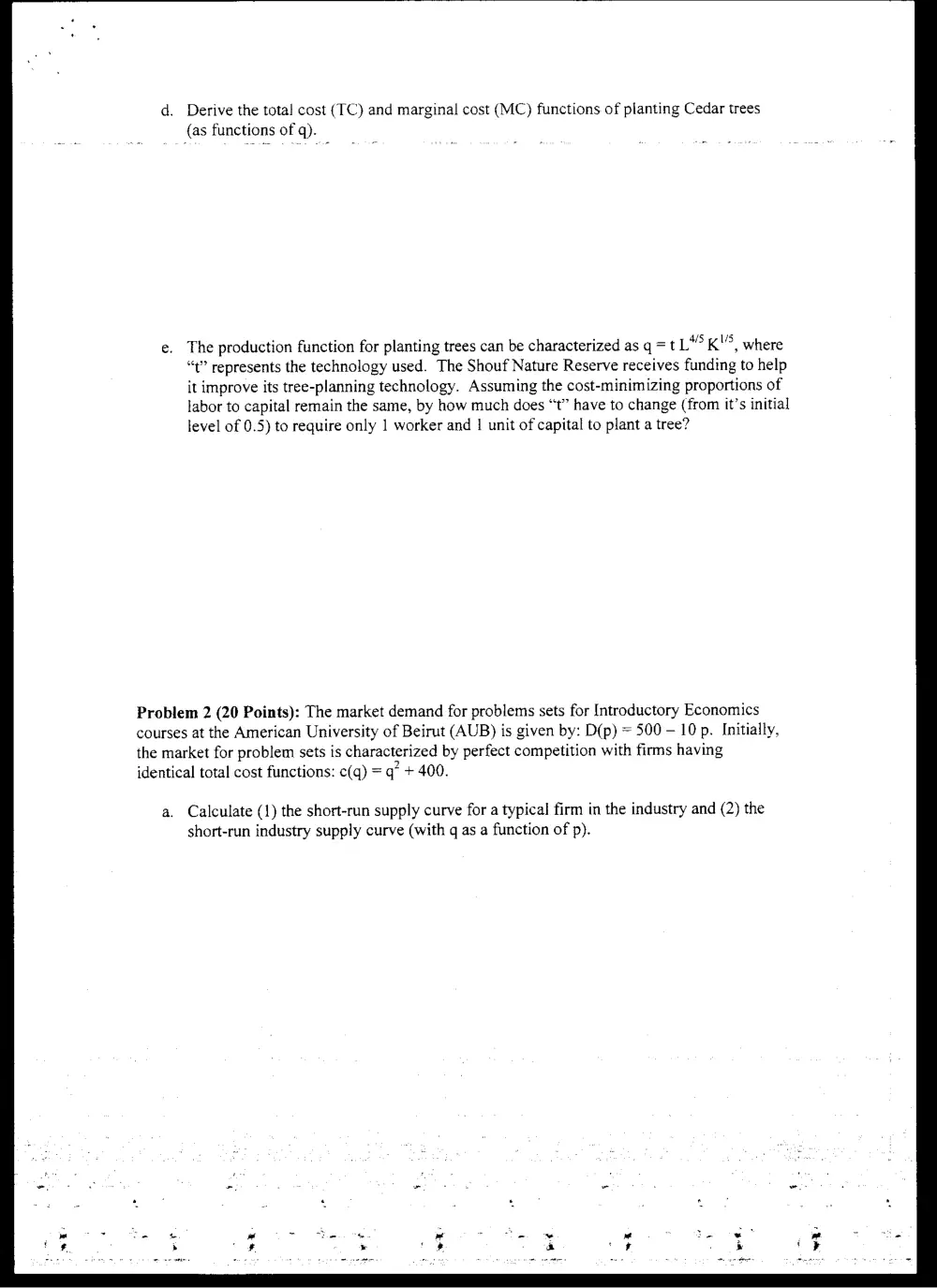
d. Derive the total cost (TC) and marginal cost (MC) functions of planting Cedar trees
(as functions of q).
e. The production function for planting trees can be characterized as q =t LK", where
“t” represents the technology used. The Shouf Nature Reserve receives funding to help
it improve its tree-planning technology. Assuming the cost-minimizing proportions of
labor to capital remain the same, by how much does “t” have to change (from it’s initial
level of 0.5) to require only 1 worker and | unit of capital to plant a tree?
Problem 2 (20 Points): The market demand for problems sets for Introductory Economics
courses at the American University of Beirut (AUB) is given by: D(p) = 500 — 10 p. Initially,
the market for problem sets is characterized by perfect competition with firms having
identical total cost functions: c(q) = q+ 400.
a. Calculate (1) the short-run supply curve for a typical firm in the industry and (2) the
short-run industry supply curve (with q as a function of p).