
ECON 217 Midterm, Fall 2004
American University of Beirut · Intermediate Price Theory · 12 pages



Showing the first 10 of 12 pages. Download the PDF to see all of it.
More ECON 217 files
Show the text of this exam
Please Do Not Turn This Page Until Instructed to Do So!
ECON 217
(Prof. Nader Kabbani)
Midterm Exam — Fall 2004
Student’s Name:
LD. Number:
Instructions — Please Read Carefully!
Please write legibly (if I can’t read it, I can’t grade it.)
You may use either pen or pencil.
Please check that your exam has 11 pages (including this cover page).
Feel free to use the backs of the pages; but make sure that I can follow your work.
Use of programmable calculators and cell phones is strictly forbidden.
There are 30 multiple choice questions (2 points each) and 2 problems (20 points each).
Read exam questions carefully. Don’t spend too much time on any one question.
Partial credit can be given, so be sure to show all your work.
If you think that you found a mistake, comment on it. You may receive extra credit.
_ Check the blackboard periodically. I will post corrections and clarifications there.
. Keep your eyes on your exam: If I see a student looking at another’s exam, I will assume
s/he is copying. | will immediately take away their exam and give them a failing grade.
= SePnNanrswnr
—o°
You have 90 minutes to complete the exam.
Good luck!
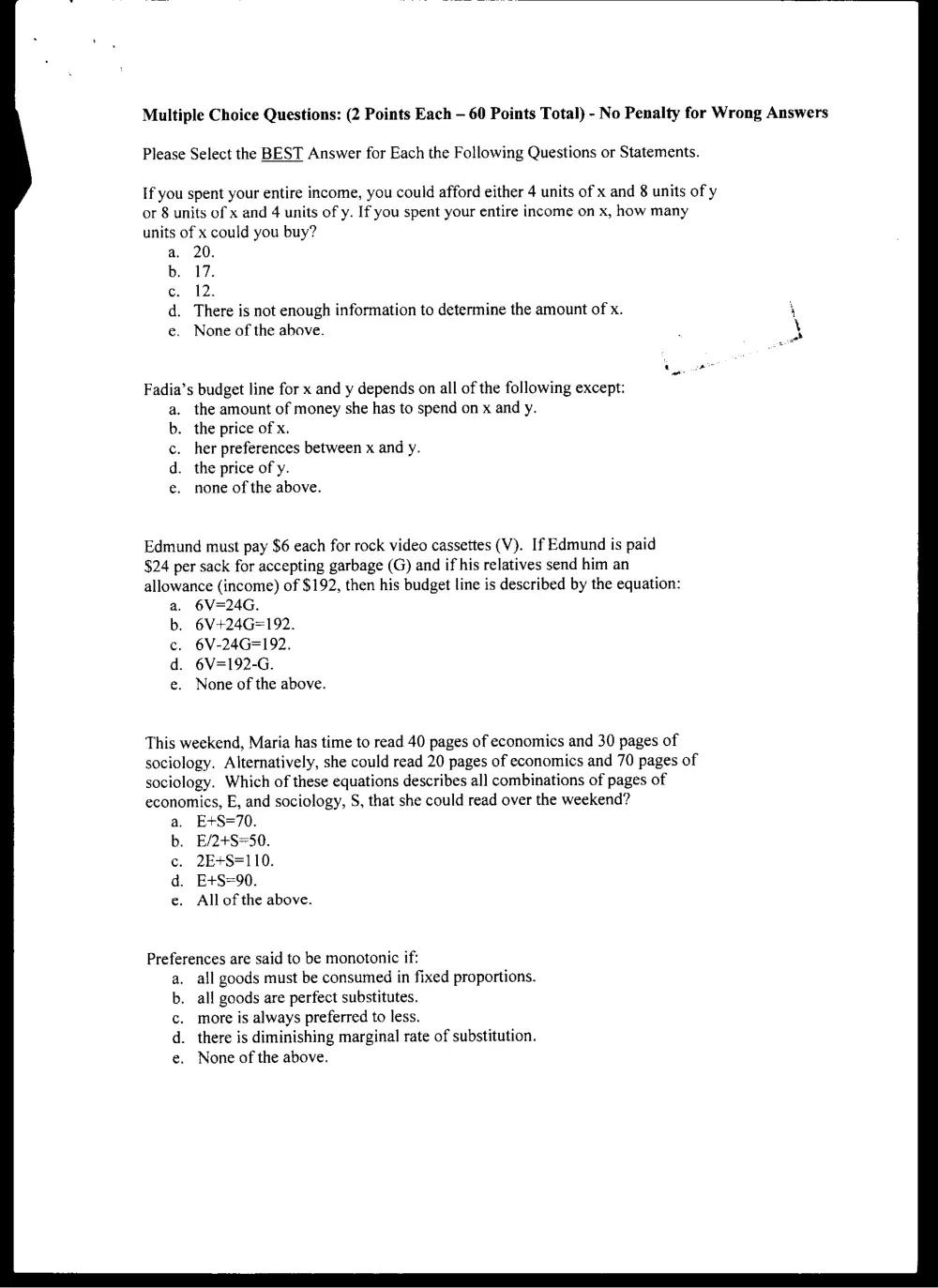
Multiple Choice Questions: (2 Points Each — 60 Points Total) - No Penalty for Wrong Answers
Please Select the BEST Answer for Each the Following Questions or Statements.
If you spent your entire income, you could afford either 4 units of x and 8 units of y
or 8 units of x and 4 units of y. If you spent your entire income on x, how many
units of x could you buy?
a. 20.
b. 17.
c. 12.
d. There is not enough information to determine the amount of x. 4
e
. None of the above. . \
Fadia’s budget line for x and y depends on all of the following except:
the amount of money she has to spend on x and y.
the price of x.
her preferences between x and y.
the price of y.
none of the above.
eno ss
Edmund must pay $6 each for rock video cassettes (V). If Edmund is paid
$24 per sack for accepting garbage (G) and if his relatives send him an
allowance (income) of $192, then his budget line is described by the equation:
6V=24G.
6V+24G=192.
6V-24G=192,
6V=192-G.
None of the above.
eacre
This weekend, Maria has time to read 40 pages of economics and 30 pages of
sociology. Alternatively, she could read 20 pages of economics and 70 pages of
sociology. Which of these equations describes all combinations of pages of
economics, E, and sociology, S, that she could read over the weekend?
E+S=70.
E/2+S$=50.
2E+S=110.
E+S=90.
All of the above.
go a°o FP
Preferences are said to be monotonic if:
all goods must be consumed in fixed proportions.
all goods are perfect substitutes.
more is always preferred to less.
there is diminishing marginal rate of substitution.
None of the above.
oaosP
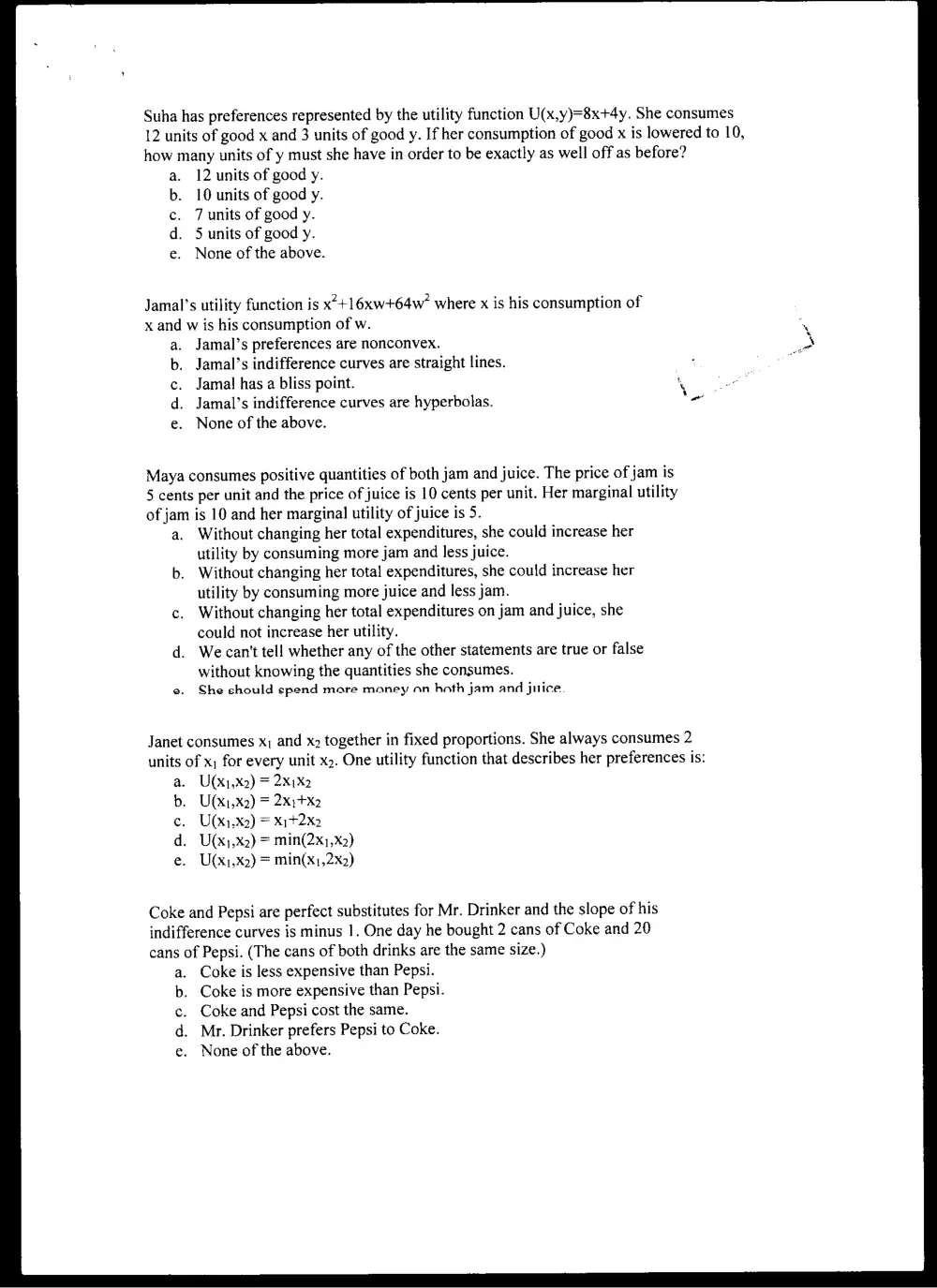
Suha has preferences represented by the utility function U(x,y)=8x+4y. She consumes
12 units of good x and 3 units of good y. If her consumption of good x is lowered to 10,
how many units of y must she have in order to be exactly as well off as before?
a. 12 units of good y.
b. 10 units of good y.
c. 7 units of good y.
d. 5 units of good y.
e. None of the above.
Jamal’s utility function is x°+16xw+64w’ where x is his consumption of
x and w is his consumption of w.
Jamal’s preferences are nonconvex.
. Jamal’s indifference curves are straight lines.
Jama! has a bliss point.
. Jamal’s indifference curves are hyperbolas.
None of the above.
Maya consumes positive quantities of both jam and juice. The price of jam is
5 cents per unit and the price of juice is 10 cents per unit. Her marginal utility
of jam is 10 and her marginal utility of juice is 5.
a. Without changing her total expenditures, she could increase her
utility by consuming more jam and less juice.
b. Without changing her total expenditures, she could increase her
utility by consuming more juice and less jam.
Without changing her total expenditures on jam and juice, she
could not increase her utility.
We can't tell whether any of the other statements are true or false
without knowing the quantities she consumes.
She chould spend mare maney an hoth jam and juice
Janet consumes x, and x; together in fixed proportions. She always consumes 2
units of x; for every unit x2. One utility function that describes her preferences is:
U(Xx1,X2) = 2x1X2
U(x1,X2) = 2x1 4X2
» U(%),xX2) = X1+2x2
. U(x,x2) = min(2x),x2)
U(x1,X2) = min(x|,2x2)
Coke and Pepsi are perfect substitutes for Mr. Drinker and the slope of his
indifference curves is minus 1. One day he bought 2 cans of Coke and 20
cans of Pepsi. (The cans of both drinks are the same size.)
Coke is less expensive than Pepsi.
. Coke is more expensive than Pepsi.
Coke and Pepsi cost the same.
Mr. Drinker prefers Pepsi to Coke.
None of the above.
Samer’s utility function is U(A,B)=AB where A and B are the numbers of apples
and bananas, respectively, that he consumes. When Samer is consuming 15 apples
and 90 bananas, if we put apples on the horizontal axis and bananas on the
vertical axis, the slope of his indifference curve at his current consumption is:
a. -15.
b. -6.
ce. -12.
d. -1/6.
e. -1/12.
*
-
Ali consumes only apples and bananas. He prefers more apples to less, but he gets
tired of bananas. If he consumes fewer than 17 bananas per week, he thinks that one
banana is a perfect substitute for one apple. But you would have to pay him one apple
for each banana beyond 17 that he consumes. The indifference curve that passes
through the consumption bundle with 25 apples and 26 bananas also passes through
the bundle with A apples and 11 bananas, where A equals:
. 21.
. 22.
. 24.
. 26.
. None of the above.
Sara’s utility function is UCX, Y)=(X+2)(Y+1). If her marginal rate of substitution is -4 and
she is consuming 14 units of Good X, how many units of Good Y must she be consuming?
. 30.
. 68
18
. 63
9
Karen has homothetic preferences. When her income was $1,000, she bought 40
books and 60 newspapers. When her income increased to $1,500 and prices did
not change, she bought:
. 60 books and 90 newspapers.
. 80 books and 120 newspapers.
. 60 books and 60 newspapers.
. 40 books and 120 newspapers.
. There is not enough information for us to determine what she would buy.
Bernard considers x and y to be perfect substitutes. They originally cost 10 and 9 respectively.
His income is 720. One day the price of x drops to 8. Which of the following is true?
. The income effect increases the quantity of y by 90.
. The substitution effect increases the quantity of y by 80.
. The substitution effect increases the quantity of x by 90.
. The income effect increases the quantity of x by 80.
None of the above.
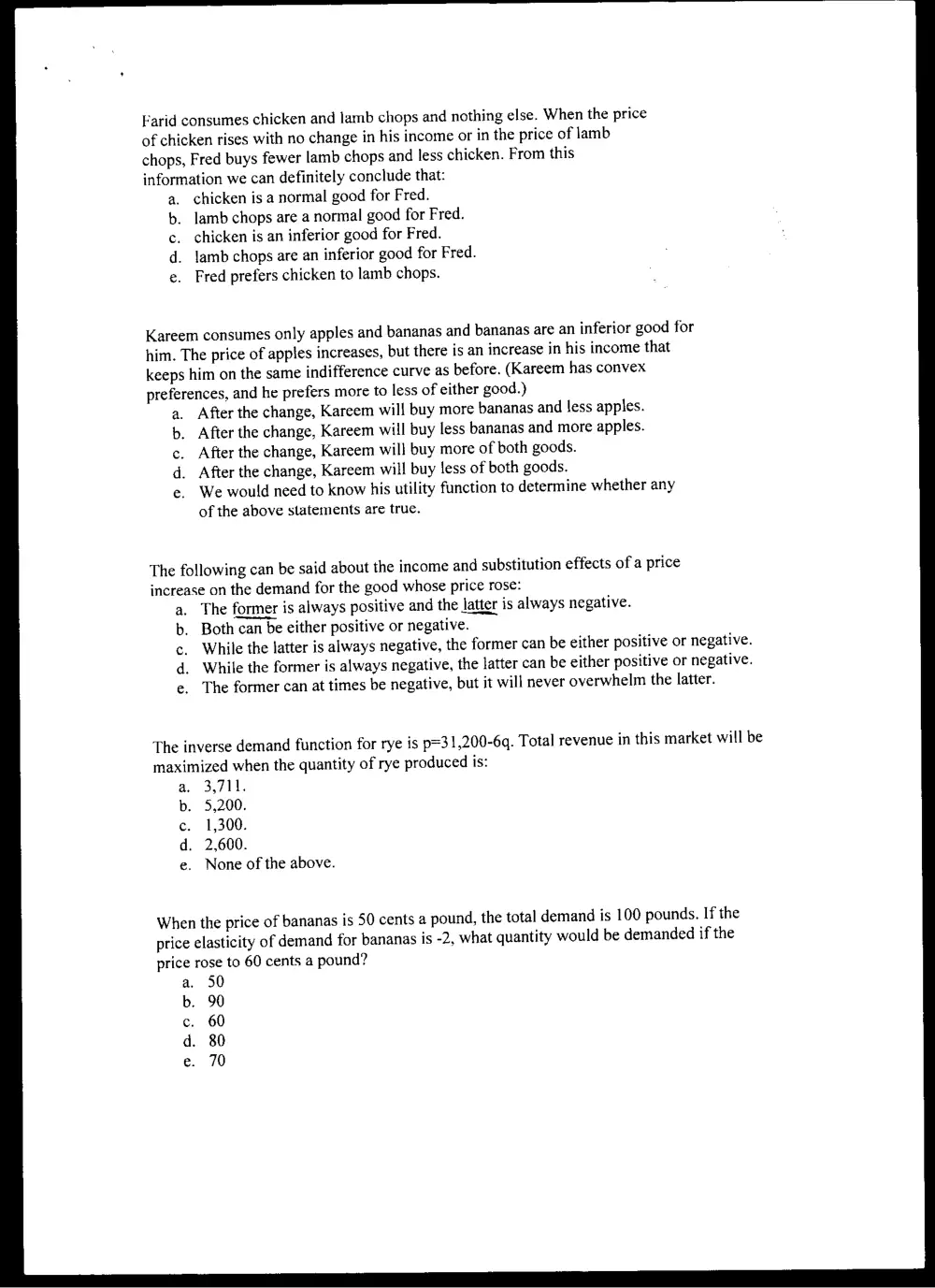
Farid consumes chicken and lamb chops and nothing else. When the price
of chicken rises with no change in his income or in the price of lamb
chops, Fred buys fewer lamb chops and less chicken. From this
information we can definitely conclude that:
. chicken is a normal good for Fred.
. lamb chops are a normal good for Fred.
. chicken is an inferior good for Fred.
lamb chops are an inferior good for Fred.
Fred prefers chicken to lamb chops.
Kareem consumes only apples and bananas and bananas are an inferior good for
him. The price of apples increases, but there is an increase in his income that
keeps him on the same indifference curve as before. (Kareem has convex
preferences, and he prefers more to less of either good.)
_ After the change, Kareem wil! buy more bananas and less apples.
. After the change, Kareem will buy less bananas and more apples.
_ After the change, Kareem will buy more of both goods.
_ After the change, Kareem will buy less of both goods.
We would need to know his utility function to determine whether any
of the above statements are true.
The following can be said about the income and substitution effects of a price
increase on the demand for the good whose price rose:
. The former is always positive and the latter is always negative.
. Both can be either positive or negative.
While the latter is always negative, the former can be either positive or negative.
| While the former is always negative, the latter can be either positive or negative.
_ The former can at times be negative, but it will never overwhelm the latter.
The inverse demand function for rye is p=31,200-6q. Total revenue in this market will be
maximized when the quantity of rye produced is:
. 3,711.
. 5,200.
. 1,300.
. 2,600.
. None of the above.
When the price of bananas is 50 cents a pound, the total demand is 100 pounds. If the
price elasticity of demand for bananas is -2, what quantity would be demanded if the
price rose to 60 cents a pound?
. 50
. 90
60
80
70
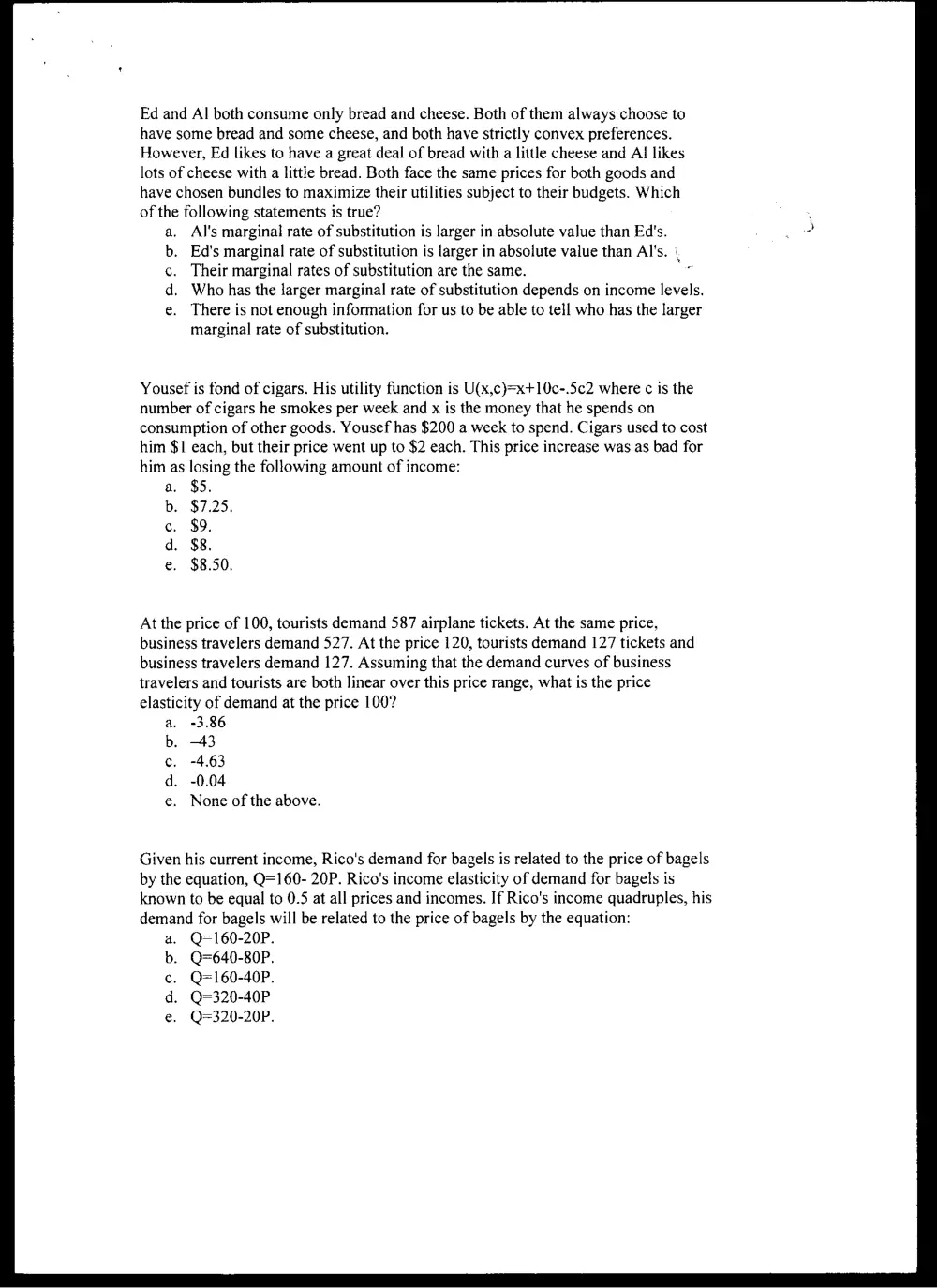
Ed and Al both consume only bread and cheese. Both of them always choose to
have some bread and some cheese, and both have strictly convex preferences.
However, Ed likes to have a great deal of bread with a little cheese and Al likes
lots of cheese with a little bread. Both face the same prices for both goods and
have chosen bundles to maximize their utilities subject to their budgets. Which
of the following statements is true?
Al's marginal rate of substitution is larger in absolute value than Ed's.
. Ed's marginal rate of substitution is larger in absolute value than Al's. i,
Their marginal rates of substitution are the same.
Who has the larger marginal rate of substitution depends on income levels.
There is not enough information for us to be able to tell who has the larger
marginal rate of substitution.
Yousef is fond of cigars. His utility function is U(x,c)=x+10c-.5c2 where c is the
number of cigars he smokes per week and x is the money that he spends on
consumption of other goods. Yousef has $200 a week to spend. Cigars used to cost
him $1 each, but their price went up to $2 each. This price increase was as bad for
him as losing the following amount of income:
. $5.
. $7.25.
. $9.
. $8.
$8.50.
At the price of 100, tourists demand 587 airplane tickets. At the same price,
business travelers demand 527. At the price 120, tourists demand 127 tickets and
business travelers demand 127. Assuming that the demand curves of business
travelers and tourists are both linear over this price range, what is the price
elasticity of demand at the price 100?
. 3,86
. 43
. 4.63
. 0.04
None of the above.
Given his current income, Rico's demand for bagels is related to the price of bagels
by the equation, Q=160- 20P. Rico's income elasticity of demand for bagels is
known to be equal to 0.5 at all prices and incomes. If Rico's income quadruples, his
demand for bagels will be related to the price of bagels by the equation:
. Q=160-20P.
. Q=640-80P.
. Q=160-40P.
. Q=320-40P
Q=320-20P.
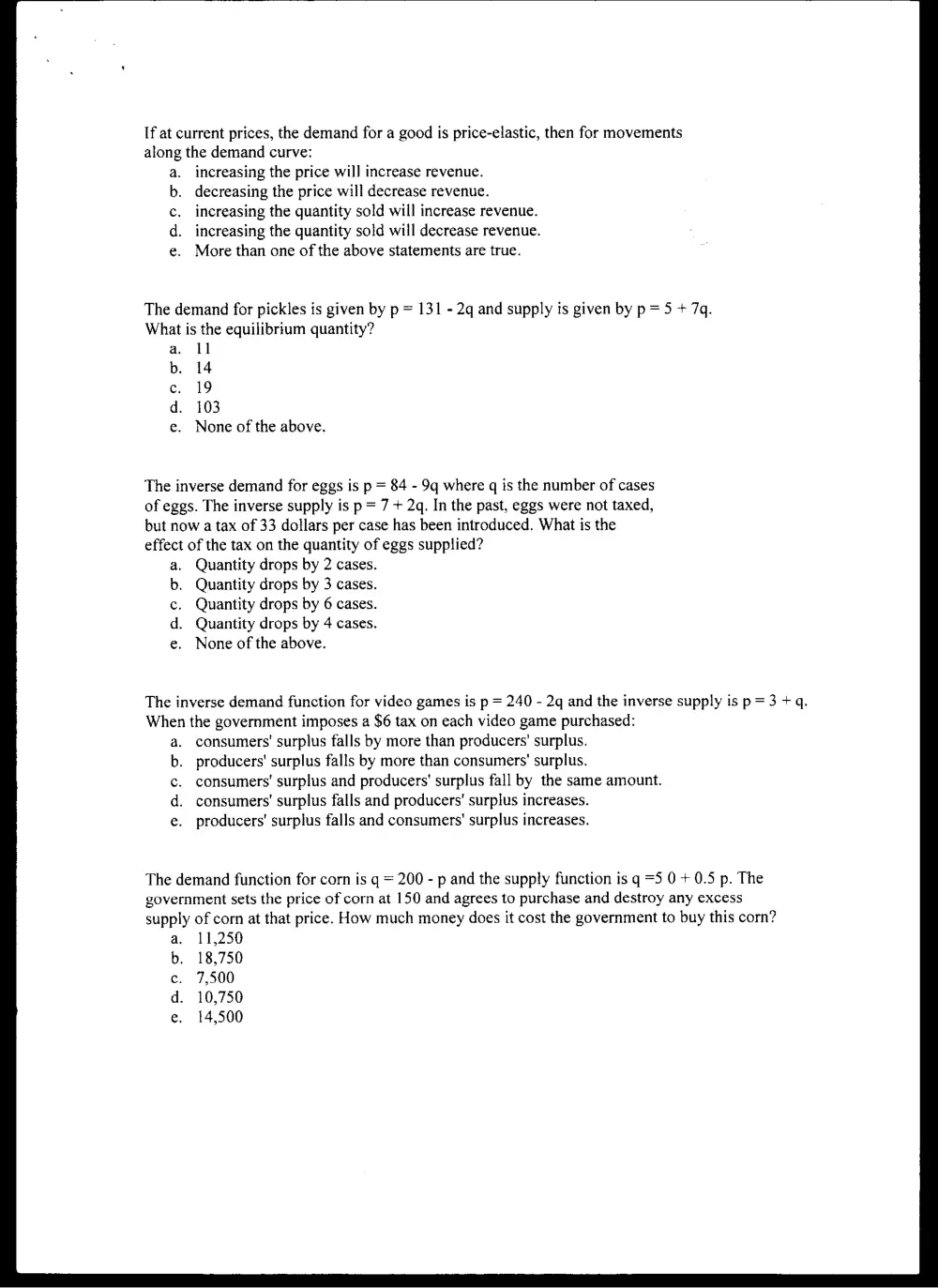
If at current prices, the demand for a good is price-elastic, then for movements
along the demand curve:
increasing the price will increase revenue.
decreasing the price will decrease revenue.
increasing the quantity sold will increase revenue.
increasing the quantity sold will decrease revenue.
More than one of the above statements are true.
sae oP
The demand for pickles is given by p = 131 - 2q and supply is given by p = 5 + 7q.
What is the equilibrium quantity?
a. Il
b. 14
ce. 19
d. 103
e. None of the above.
The inverse demand for eggs is p = 84 - 9q where q is the number of cases
of eggs. The inverse supply is p = 7 + 2q. In the past, eggs were not taxed,
but now a tax of 33 dollars per case has been introduced. What is the
effect of the tax on the quantity of eggs supplied?
Quantity drops by 2 cases.
Quantity drops by 3 cases.
Quantity drops by 6 cases.
Quantity drops by 4 cases.
None of the above.
eacge
The inverse demand function for video games is p = 240 - 2q and the inverse supply is p=3 + q.
When the government imposes a $6 tax on each video game purchased:
consumers’ surplus falls by more than producers’ surplus.
producers’ surplus falls by more than consumers’ surplus.
consumers’ surplus and producers’ surplus fall by the same amount.
consumers’ surplus falls and producers’ surplus increases.
producers’ surplus falls and consumers’ surplus increases.
eae oP
The demand function for corn is q = 200 - p and the supply function is q =5 0 + 0.5 p. The
government sets the price of corn at 150 and agrees to purchase and destroy any excess
supply of corn at that price. How much money does it cost the government to buy this corn?
a, 11,250
b. 18,750
c. 7,500
d. 10,750
e. 14,500
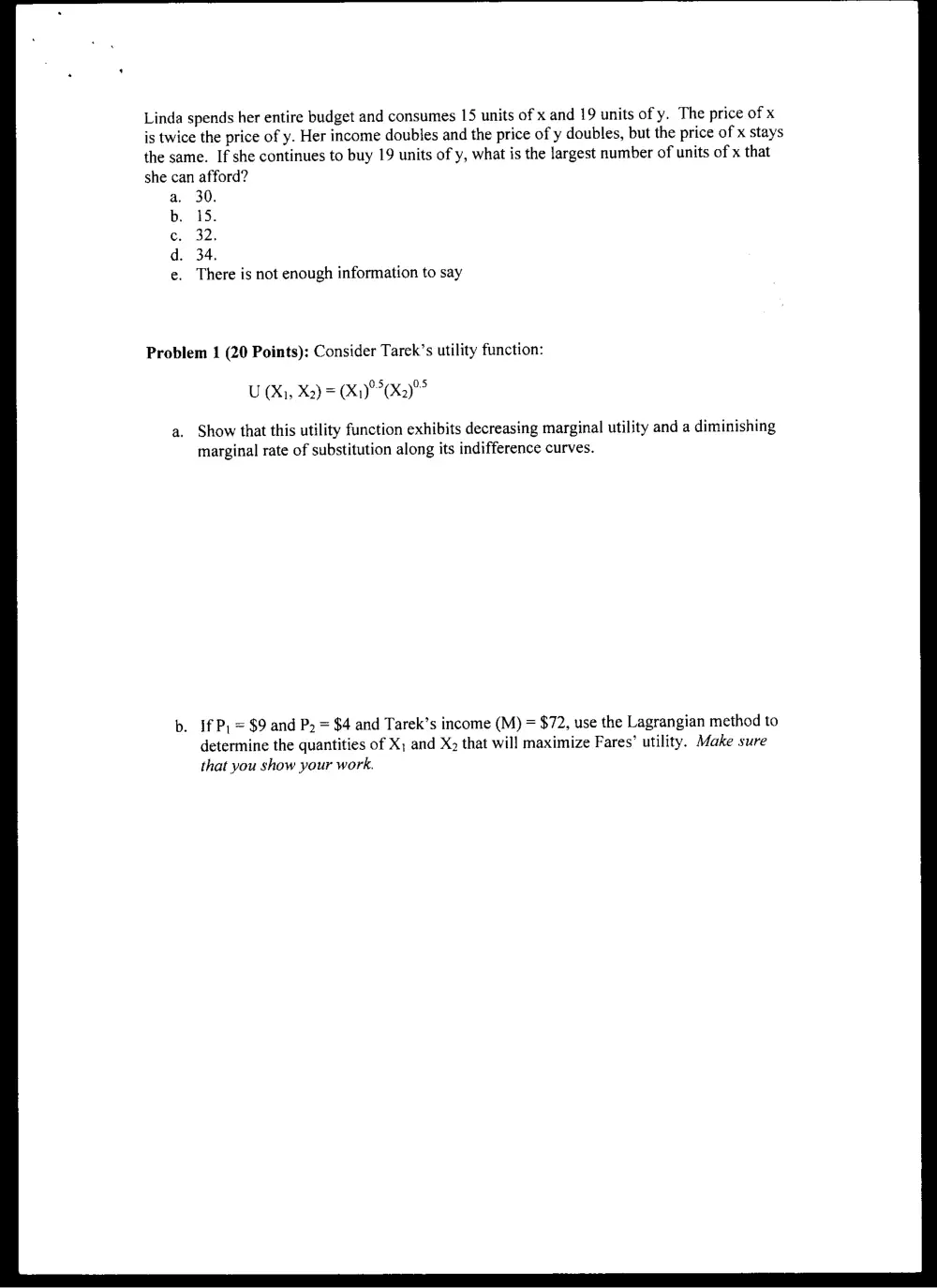
Linda spends her entire budget and consumes 15 units of x and 19 units of y. The price of x
is twice the price of y. Her income doubles and the price of y doubles, but the price of x stays
the same. If she continues to buy 19 units of y, what is the largest number of units of x that
she can afford?
30.
J 4S.
. 32.
. 34.
. There is not enough information to say
Problem 1 (20 Points): Consider Tarek’s utility function:
U (Xi, Xz) = (Xi)?*(X2)"*
a. Show that this utility function exhibits decreasing marginal utility and a diminishing
marginal rate of substitution along its indifference curves.
b. If P, = $9 and P2 = $4 and Tarek’s income (M) = $72, use the Lagrangian method to
determine the quantities of X; and X2 that will maximize Fares’ utility. Make sure
that you show your work.
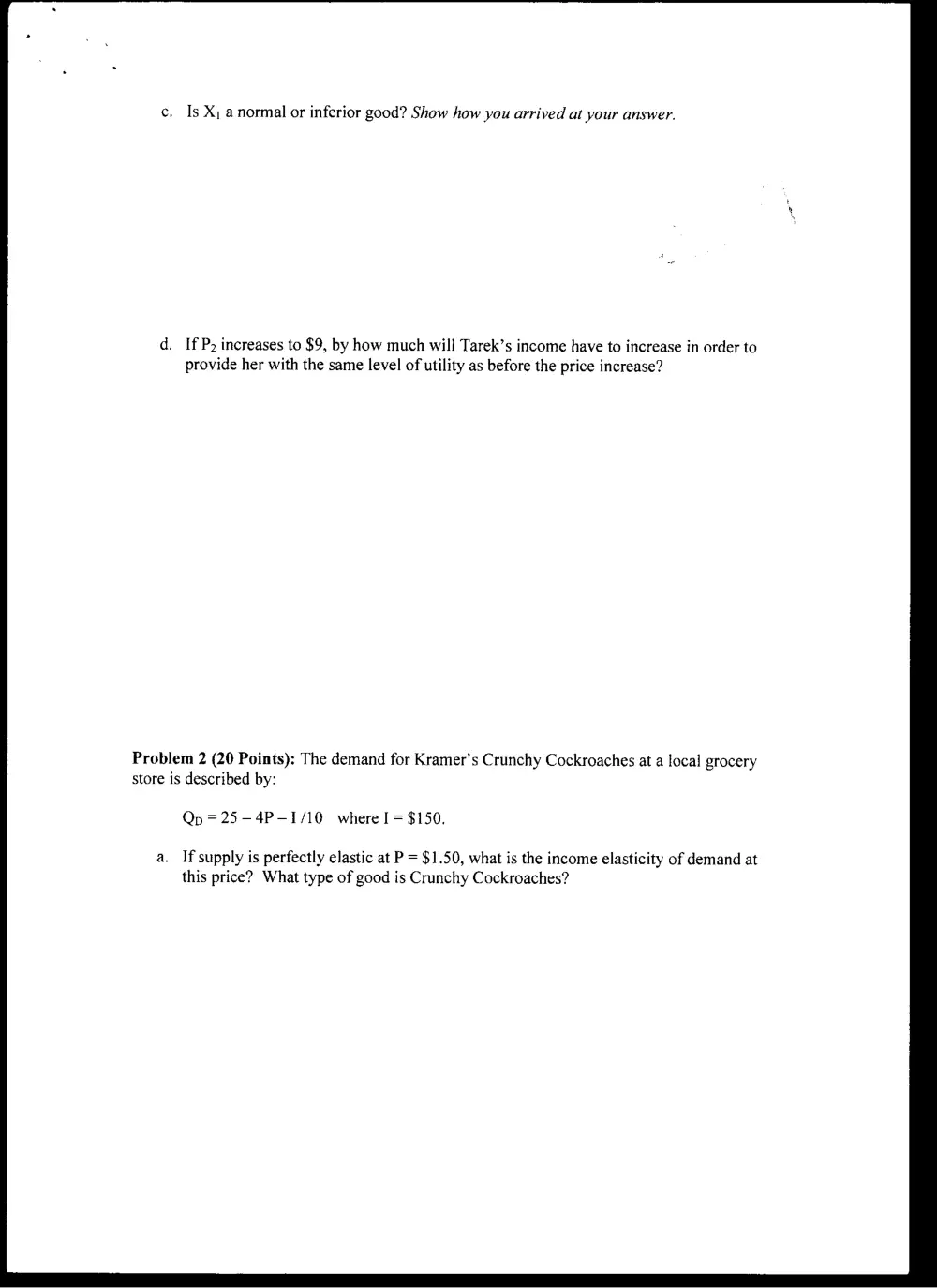
c. Is X; anormal or inferior good? Show how you arrived at your answer.
d. If P2 increases to $9, by how much will Tarek’s income have to increase in order to
provide her with the same level of utility as before the price increase?
Problem 2 (20 Points): The demand for Kramer’s Crunchy Cockroaches at a local grocery
store is described by:
Qp = 25-4P—-1/10 where I = $150.
a. Ifsupply is perfectly elastic at P = $1.50, what is the income elasticity of demand at
this price? What type of good is Crunchy Cockroaches?
b. What is the marginal revenue at this price?
c. At what quantity is revenue maximized?
d. If Kramer raises his prices to P = $2.00, what is the change in consumer surplus as a
result of the price change?