
ECON 217 Midterm, Fall 2005
American University of Beirut · Intermediate Price Theory · 10 pages

More ECON 217 files
Show the text of this exam
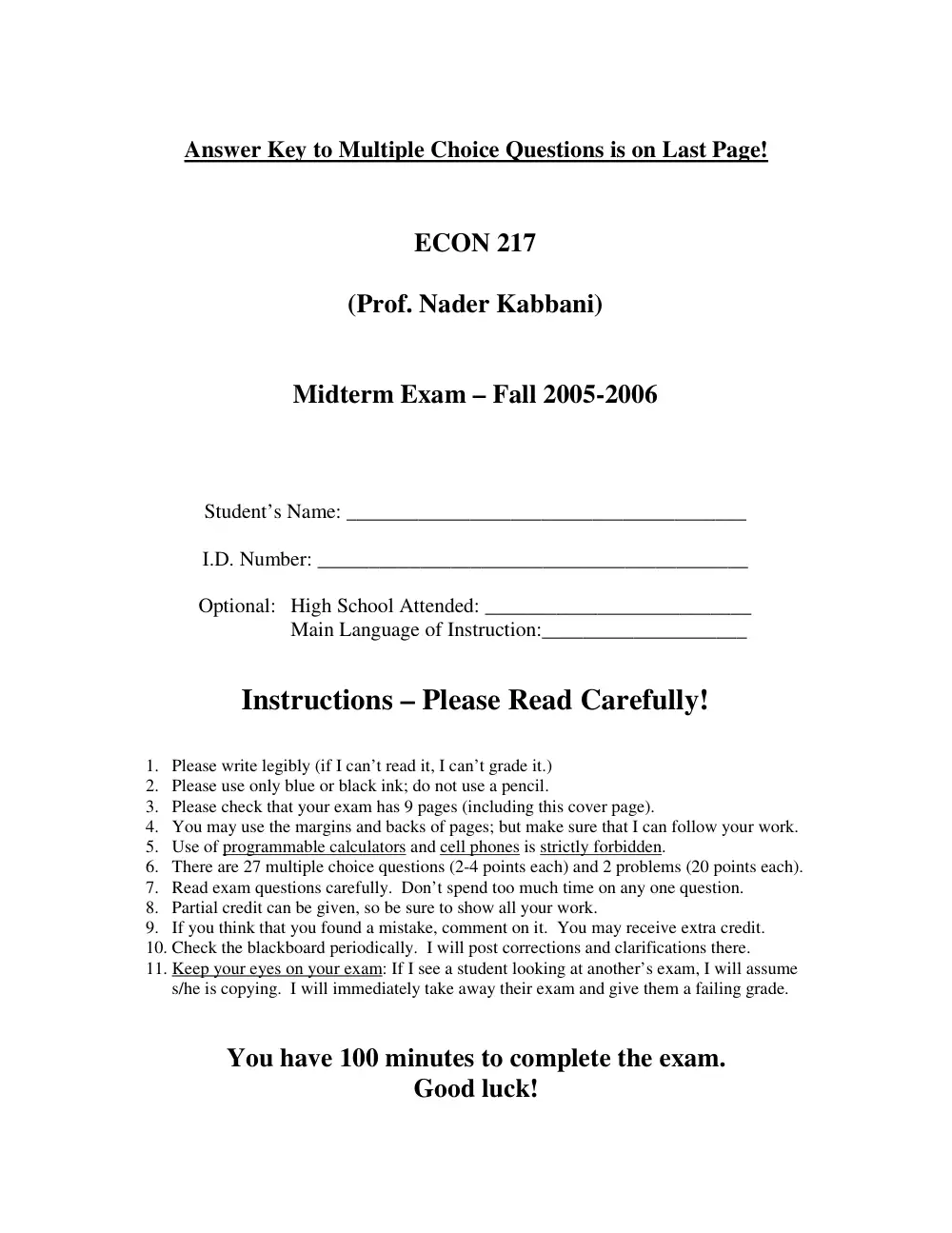
Answer Key to Multiple Choice Questions is on Last Page!
ECON 217
(Prof. Nader Kabbani)
Midterm Exam – Fall 2005-2006
Student’s Name: _______________________________________
I.D. Number: __________________________________________
Optional: High School Attended: __________________________
Main Language of Instruction:____________________
Instructions – Please Read Carefully!
1. Please write legibly (if I can’t read it, I can’t grade it.)
2. Please use only blue or black ink; do not use a pencil.
3. Please check that your exam has 9 pages (including this cover page).
4. You may use the margins and backs of pages; but make sure that I can follow your work.
5. Use of programmable calculators and cell phones is strictly forbidden.
6. There are 27 multiple choice questions (2-4 points each) and 2 problems (20 points each).
7. Read exam questions carefully. Don’t spend too much time on any one question.
8. Partial credit can be given, so be sure to show all your work.
9. If you think that you found a mistake, comment on it. You may receive extra credit.
10. Check the blackboard periodically. I will post corrections and clarifications there.
11. Keep your eyes on your exam: If I see a student looking at another’s exam, I will assume
s/he is copying. I will immediately take away their exam and give them a failing grade.
You have 100 minutes to complete the exam.
Good luck!
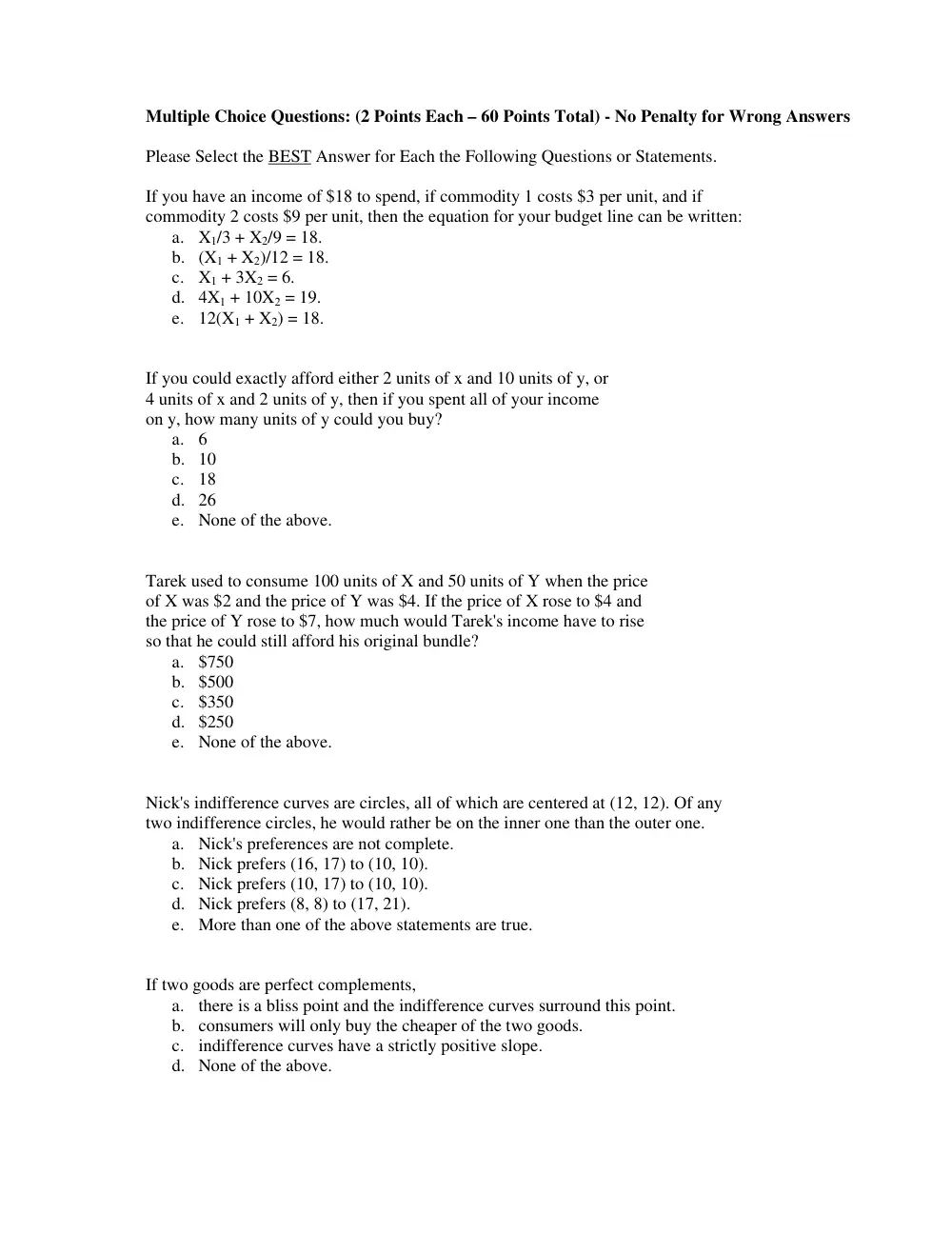
Multiple Choice Questions: (2 Points Each – 60 Points Total) - No Penalty for Wrong Answers
Please Select the BEST Answer for Each the Following Questions or Statements.
If you have an income of $18 to spend, if commodity 1 costs $3 per unit, and if
commodity 2 costs $9 per unit, then the equation for your budget line can be written:
a. X1/3 + X2/9 = 18.
b. (X1 + X2)/12 = 18.
c. X1 + 3X2 = 6.
d. 4X1 + 10X2 = 19.
e. 12(X1 + X2) = 18.
If you could exactly afford either 2 units of x and 10 units of y, or
4 units of x and 2 units of y, then if you spent all of your income
on y, how many units of y could you buy?
a. 6
b. 10
c. 18
d. 26
e. None of the above.
Tarek used to consume 100 units of X and 50 units of Y when the price
of X was $2 and the price of Y was $4. If the price of X rose to $4 and
the price of Y rose to $7, how much would Tarek's income have to rise
so that he could still afford his original bundle?
a. $750
b. $500
c. $350
d. $250
e. None of the above.
Nick's indifference curves are circles, all of which are centered at (12, 12). Of any
two indifference circles, he would rather be on the inner one than the outer one.
a. Nick's preferences are not complete.
b. Nick prefers (16, 17) to (10, 10).
c. Nick prefers (10, 17) to (10, 10).
d. Nick prefers (8, 8) to (17, 21).
e. More than one of the above statements are true.
If two goods are perfect complements,
a. there is a bliss point and the indifference curves surround this point.
b. consumers will only buy the cheaper of the two goods.
c. indifference curves have a strictly positive slope.
d. None of the above.
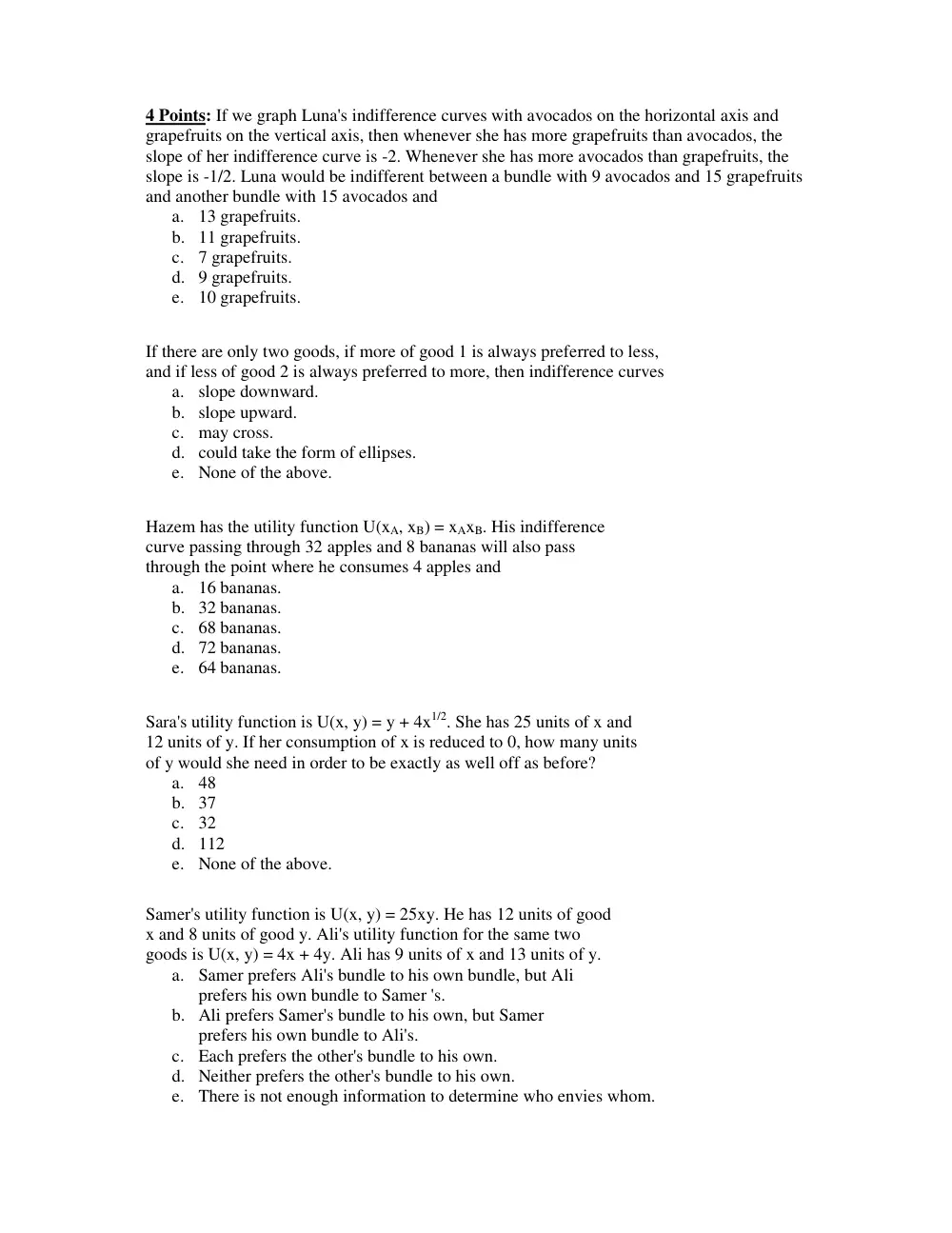
4 Points: If we graph Luna's indifference curves with avocados on the horizontal axis and
grapefruits on the vertical axis, then whenever she has more grapefruits than avocados, the
slope of her indifference curve is -2. Whenever she has more avocados than grapefruits, the
slope is -1/2. Luna would be indifferent between a bundle with 9 avocados and 15 grapefruits
and another bundle with 15 avocados and
a. 13 grapefruits.
b. 11 grapefruits.
c. 7 grapefruits.
d. 9 grapefruits.
e. 10 grapefruits.
If there are only two goods, if more of good 1 is always preferred to less,
and if less of good 2 is always preferred to more, then indifference curves
a. slope downward.
b. slope upward.
c. may cross.
d. could take the form of ellipses.
e. None of the above.
Hazem has the utility function U(xA, xB) = xAxB. His indifference
curve passing through 32 apples and 8 bananas will also pass
through the point where he consumes 4 apples and
a. 16 bananas.
b. 32 bananas.
c. 68 bananas.
d. 72 bananas.
e. 64 bananas.
Sara's utility function is U(x, y) = y + 4x1/2. She has 25 units of x and
12 units of y. If her consumption of x is reduced to 0, how many units
of y would she need in order to be exactly as well off as before?
a. 48
b. 37
c. 32
d. 112
e. None of the above.
Samer's utility function is U(x, y) = 25xy. He has 12 units of good
x and 8 units of good y. Ali's utility function for the same two
goods is U(x, y) = 4x + 4y. Ali has 9 units of x and 13 units of y.
a. Samer prefers Ali's bundle to his own bundle, but Ali
prefers his own bundle to Samer 's.
b. Ali prefers Samer's bundle to his own, but Samer
prefers his own bundle to Ali's.
c. Each prefers the other's bundle to his own.
d. Neither prefers the other's bundle to his own.
e. There is not enough information to determine who envies whom.
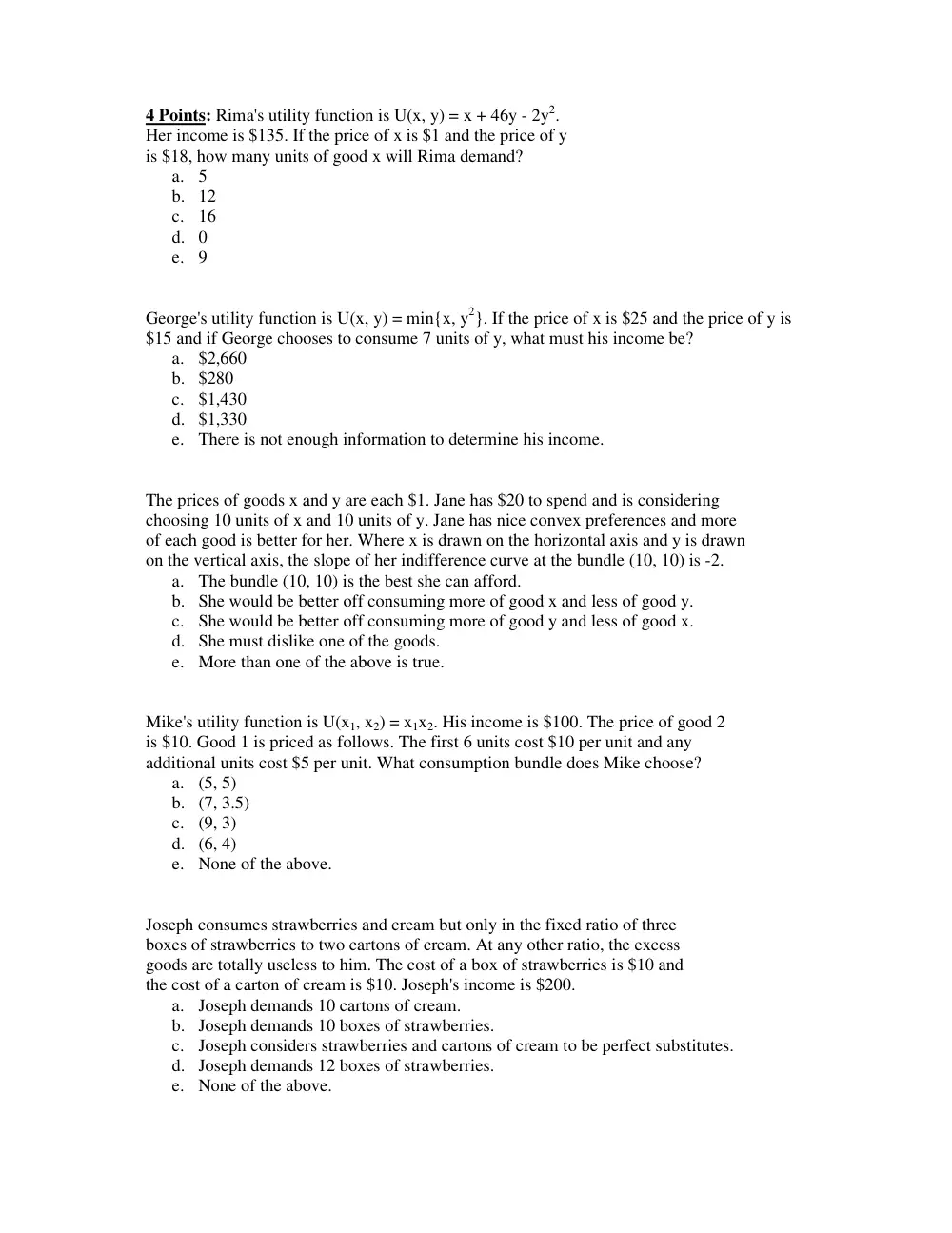
4 Points: Rima's utility function is U(x, y) = x + 46y - 2y2.
Her income is $135. If the price of x is $1 and the price of y
is $18, how many units of good x will Rima demand?
a. 5
b. 12
c. 16
d. 0
e. 9
George's utility function is U(x, y) = min{x, y2}. If the price of x is $25 and the price of y is
$15 and if George chooses to consume 7 units of y, what must his income be?
a. $2,660
b. $280
c. $1,430
d. $1,330
e. There is not enough information to determine his income.
The prices of goods x and y are each $1. Jane has $20 to spend and is considering
choosing 10 units of x and 10 units of y. Jane has nice convex preferences and more
of each good is better for her. Where x is drawn on the horizontal axis and y is drawn
on the vertical axis, the slope of her indifference curve at the bundle (10, 10) is -2.
a. The bundle (10, 10) is the best she can afford.
b. She would be better off consuming more of good x and less of good y.
c. She would be better off consuming more of good y and less of good x.
d. She must dislike one of the goods.
e. More than one of the above is true.
Mike's utility function is U(x1, x2) = x1x2. His income is $100. The price of good 2
is $10. Good 1 is priced as follows. The first 6 units cost $10 per unit and any
additional units cost $5 per unit. What consumption bundle does Mike choose?
a. (5, 5)
b. (7, 3.5)
c. (9, 3)
d. (6, 4)
e. None of the above.
Joseph consumes strawberries and cream but only in the fixed ratio of three
boxes of strawberries to two cartons of cream. At any other ratio, the excess
goods are totally useless to him. The cost of a box of strawberries is $10 and
the cost of a carton of cream is $10. Joseph's income is $200.
a. Joseph demands 10 cartons of cream.
b. Joseph demands 10 boxes of strawberries.
c. Joseph considers strawberries and cartons of cream to be perfect substitutes.
d. Joseph demands 12 boxes of strawberries.
e. None of the above.
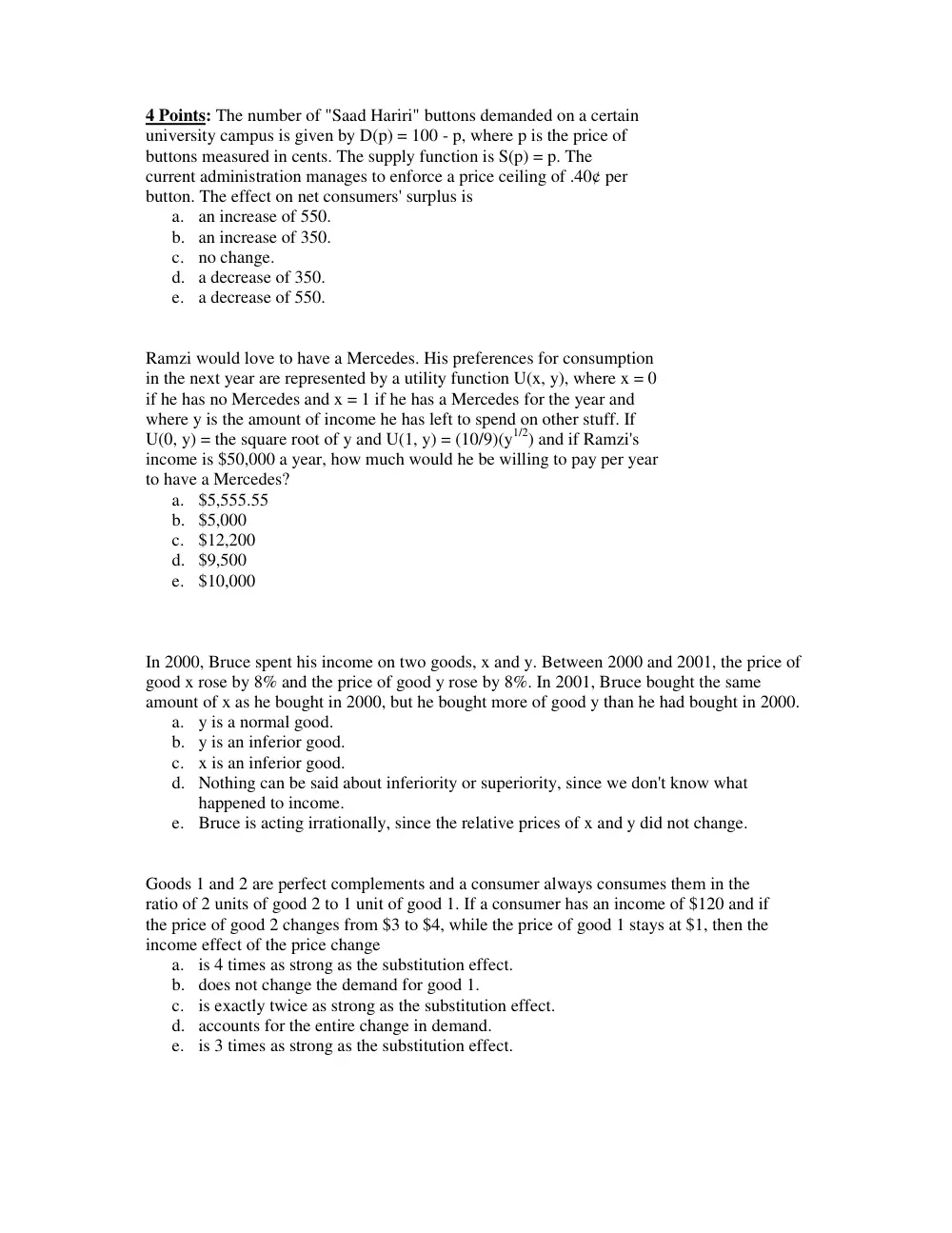
4 Points: The number of "Saad Hariri" buttons demanded on a certain
university campus is given by D(p) = 100 - p, where p is the price of
buttons measured in cents. The supply function is S(p) = p. The
current administration manages to enforce a price ceiling of .40¢ per
button. The effect on net consumers' surplus is
a. an increase of 550.
b. an increase of 350.
c. no change.
d. a decrease of 350.
e. a decrease of 550.
Ramzi would love to have a Mercedes. His preferences for consumption
in the next year are represented by a utility function U(x, y), where x = 0
if he has no Mercedes and x = 1 if he has a Mercedes for the year and
where y is the amount of income he has left to spend on other stuff. If
U(0, y) = the square root of y and U(1, y) = (10/9)(y1/2) and if Ramzi's
income is $50,000 a year, how much would he be willing to pay per year
to have a Mercedes?
a. $5,555.55
b. $5,000
c. $12,200
d. $9,500
e. $10,000
In 2000, Bruce spent his income on two goods, x and y. Between 2000 and 2001, the price of
good x rose by 8% and the price of good y rose by 8%. In 2001, Bruce bought the same
amount of x as he bought in 2000, but he bought more of good y than he had bought in 2000.
a. y is a normal good.
b. y is an inferior good.
c. x is an inferior good.
d. Nothing can be said about inferiority or superiority, since we don't know what
happened to income.
e. Bruce is acting irrationally, since the relative prices of x and y did not change.
Goods 1 and 2 are perfect complements and a consumer always consumes them in the
ratio of 2 units of good 2 to 1 unit of good 1. If a consumer has an income of $120 and if
the price of good 2 changes from $3 to $4, while the price of good 1 stays at $1, then the
income effect of the price change
a. is 4 times as strong as the substitution effect.
b. does not change the demand for good 1.
c. is exactly twice as strong as the substitution effect.
d. accounts for the entire change in demand.
e. is 3 times as strong as the substitution effect.
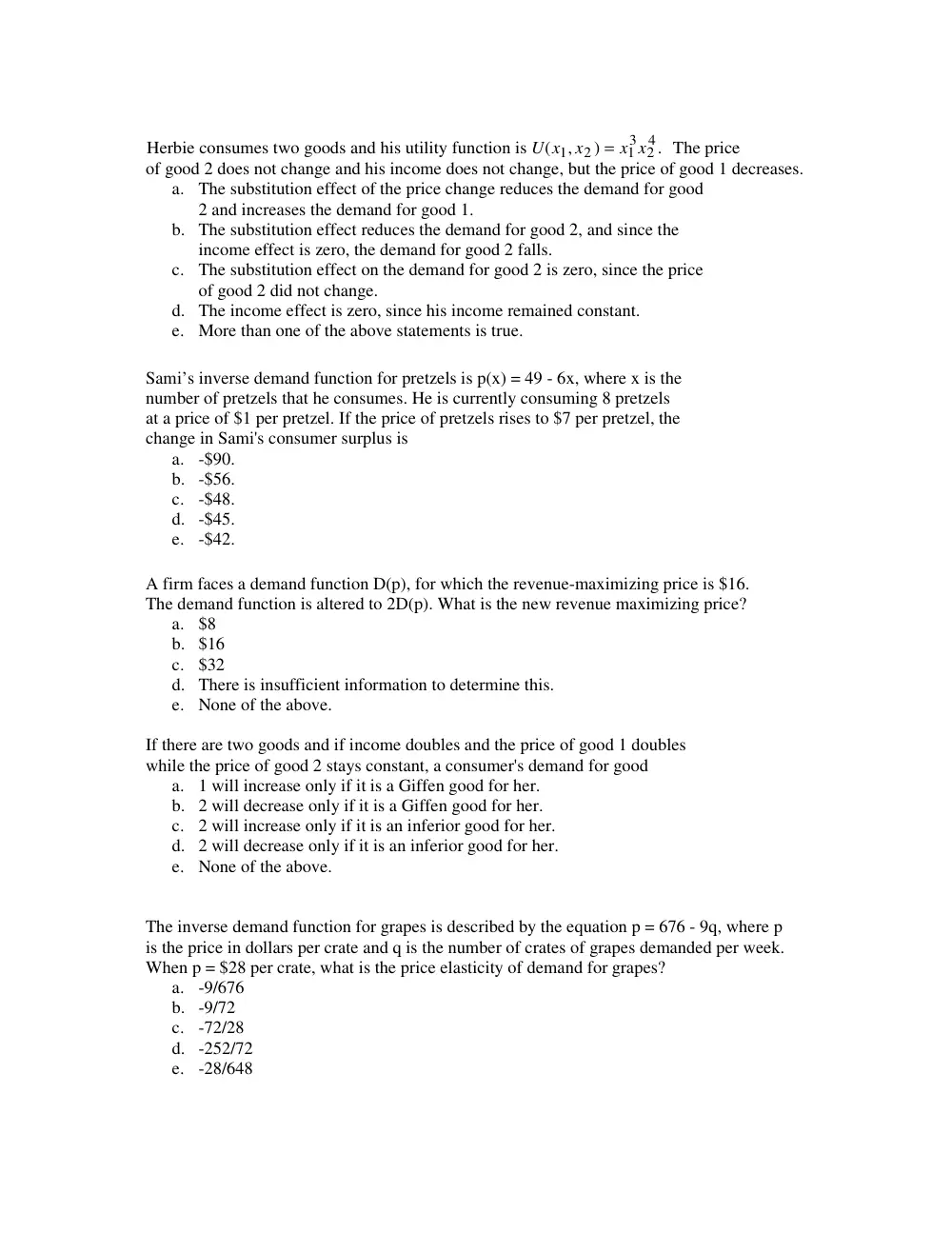
Herbie consumes two goods and his utility function is
The price
U x
x
x x
(
,
)
.
1
2
1
3
2
4
=
of good 2 does not change and his income does not change, but the price of good 1 decreases.
a. The substitution effect of the price change reduces the demand for good
2 and increases the demand for good 1.
b. The substitution effect reduces the demand for good 2, and since the
income effect is zero, the demand for good 2 falls.
c. The substitution effect on the demand for good 2 is zero, since the price
of good 2 did not change.
d. The income effect is zero, since his income remained constant.
e. More than one of the above statements is true.
Sami’s inverse demand function for pretzels is p(x) = 49 - 6x, where x is the
number of pretzels that he consumes. He is currently consuming 8 pretzels
at a price of $1 per pretzel. If the price of pretzels rises to $7 per pretzel, the
change in Sami's consumer surplus is
a. -$90.
b. -$56.
c. -$48.
d. -$45.
e. -$42.
A firm faces a demand function D(p), for which the revenue-maximizing price is $16.
The demand function is altered to 2D(p). What is the new revenue maximizing price?
a. $8
b. $16
c. $32
d. There is insufficient information to determine this.
e. None of the above.
If there are two goods and if income doubles and the price of good 1 doubles
while the price of good 2 stays constant, a consumer's demand for good
a. 1 will increase only if it is a Giffen good for her.
b. 2 will decrease only if it is a Giffen good for her.
c. 2 will increase only if it is an inferior good for her.
d. 2 will decrease only if it is an inferior good for her.
e. None of the above.
The inverse demand function for grapes is described by the equation p = 676 - 9q, where p
is the price in dollars per crate and q is the number of crates of grapes demanded per week.
When p = $28 per crate, what is the price elasticity of demand for grapes?
a. -9/676
b. -9/72
c. -72/28
d. -252/72
e. -28/648
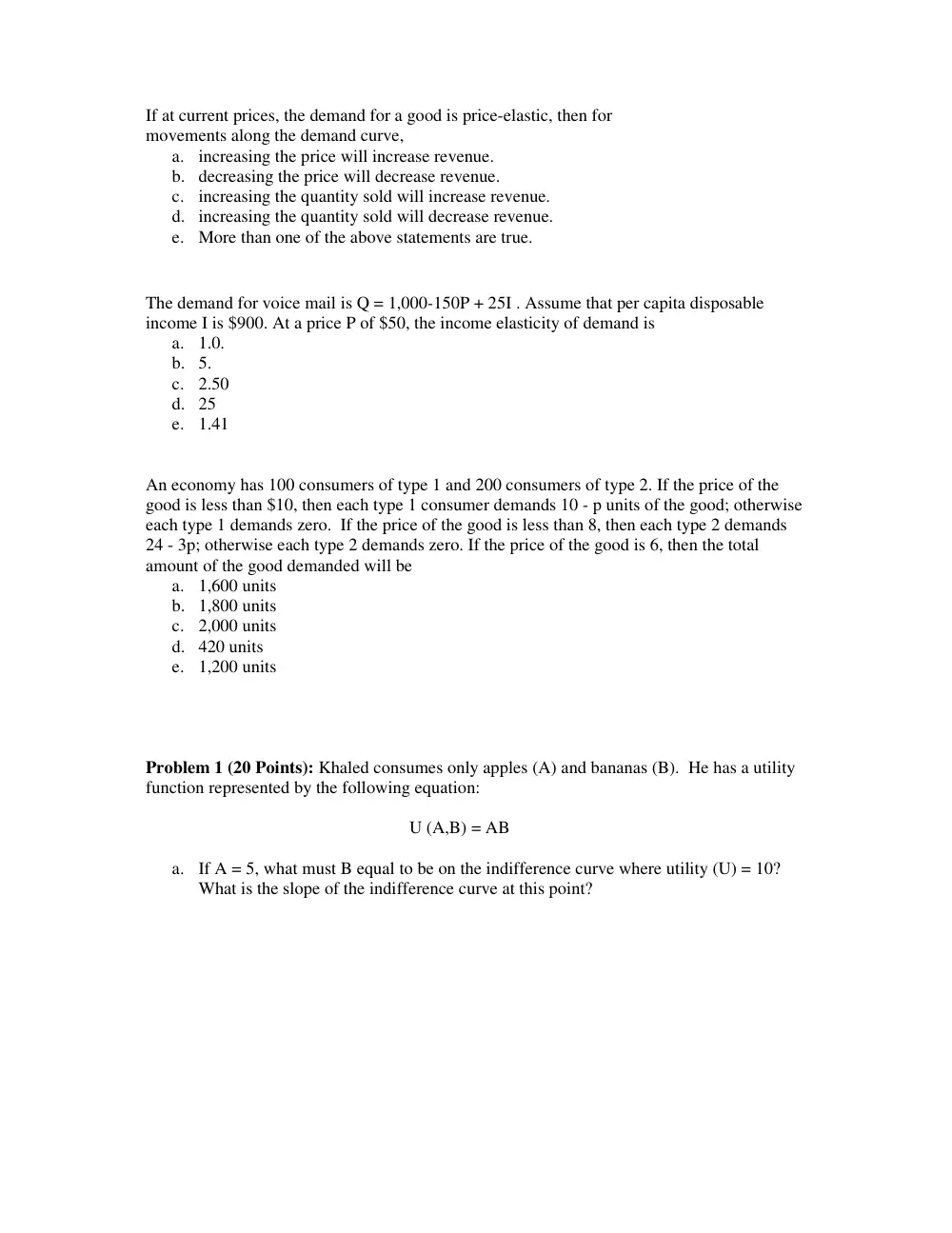
If at current prices, the demand for a good is price-elastic, then for
movements along the demand curve,
a. increasing the price will increase revenue.
b. decreasing the price will decrease revenue.
c. increasing the quantity sold will increase revenue.
d. increasing the quantity sold will decrease revenue.
e. More than one of the above statements are true.
The demand for voice mail is Q = 1,000-150P + 25I . Assume that per capita disposable
income I is $900. At a price P of $50, the income elasticity of demand is
a. 1.0.
b. 5.
c. 2.50
d. 25
e. 1.41
An economy has 100 consumers of type 1 and 200 consumers of type 2. If the price of the
good is less than $10, then each type 1 consumer demands 10 - p units of the good; otherwise
each type 1 demands zero. If the price of the good is less than 8, then each type 2 demands
24 - 3p; otherwise each type 2 demands zero. If the price of the good is 6, then the total
amount of the good demanded will be
a. 1,600 units
b. 1,800 units
c. 2,000 units
d. 420 units
e. 1,200 units
Problem 1 (20 Points): Khaled consumes only apples (A) and bananas (B). He has a utility
function represented by the following equation:
U (A,B) = AB
a. If A = 5, what must B equal to be on the indifference curve where utility (U) = 10?
What is the slope of the indifference curve at this point?
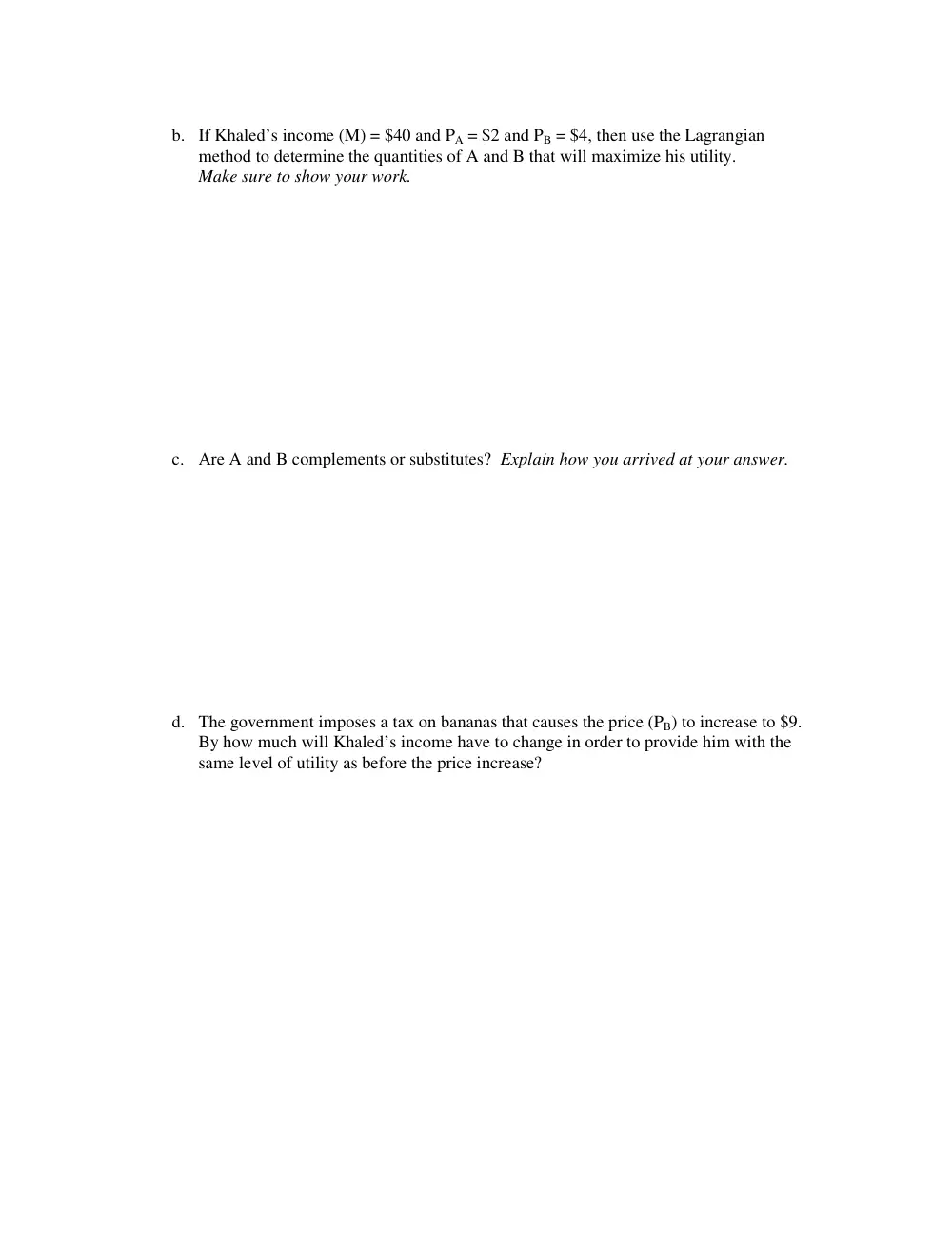
b. If Khaled’s income (M) = $40 and PA = $2 and PB = $4, then use the Lagrangian
method to determine the quantities of A and B that will maximize his utility.
Make sure to show your work.
c. Are A and B complements or substitutes? Explain how you arrived at your answer.
d. The government imposes a tax on bananas that causes the price (PB) to increase to $9.
By how much will Khaled’s income have to change in order to provide him with the
same level of utility as before the price increase?
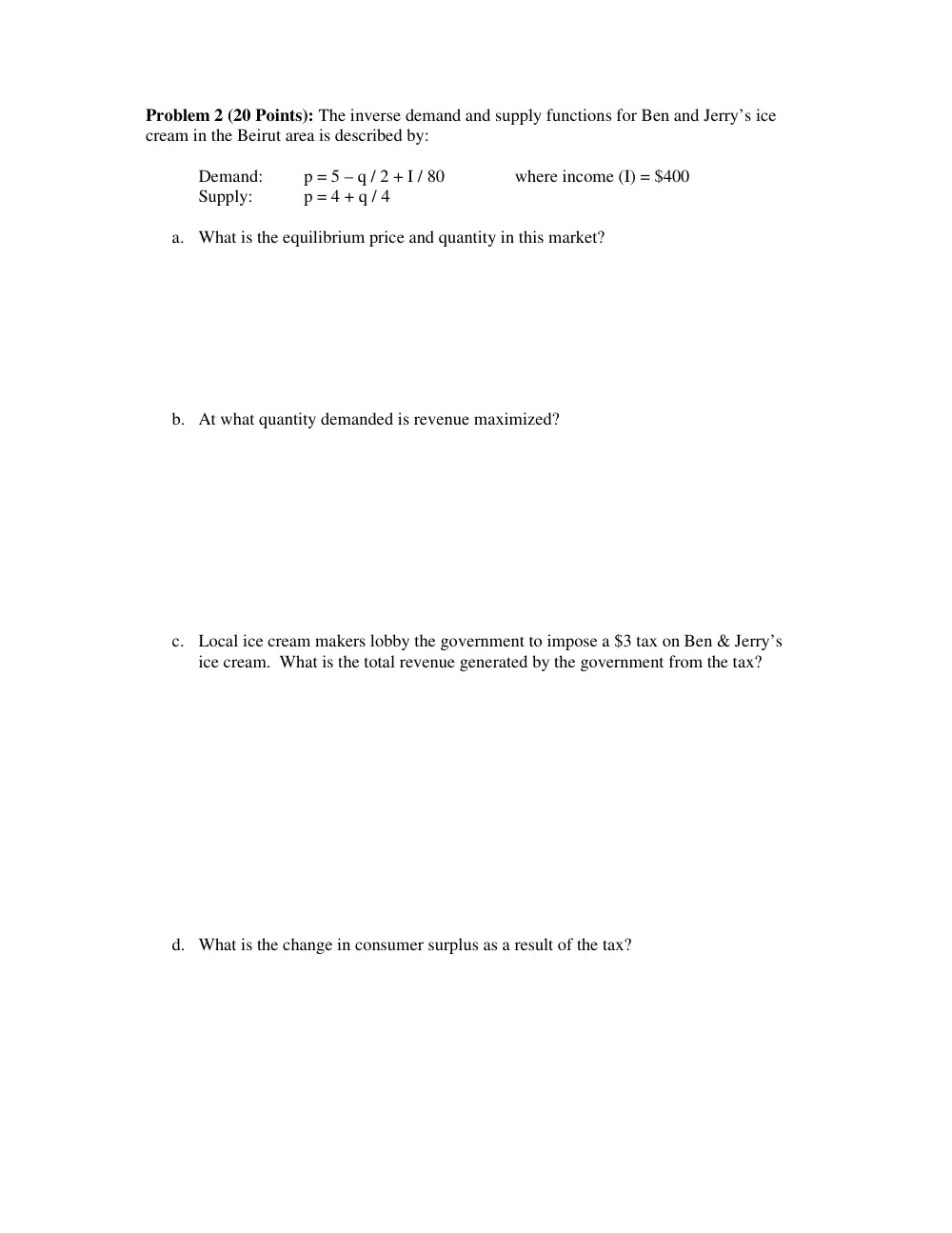
Problem 2 (20 Points): The inverse demand and supply functions for Ben and Jerry’s ice
cream in the Beirut area is described by:
Demand:
p = 5 – q / 2 + I / 80
where income (I) = $400
Supply:
p = 4 + q / 4
a. What is the equilibrium price and quantity in this market?
b. At what quantity demanded is revenue maximized?
c. Local ice cream makers lobby the government to impose a $3 tax on Ben & Jerry’s
ice cream. What is the total revenue generated by the government from the tax?
d. What is the change in consumer surplus as a result of the tax?
ECON 217
MIDTERM EXAM (FALL 2005-2006)
ANSWER KEY TO MULTIPLE CHOICE QUESTIONS
1. c
2. c
3. c
4. d
5. d
6. d
7. b
8. e
9. c
10. a
11. e
12. d
13. b
14. a
15. d
16. b
17. d
18. a
19. d
20. a
21. d
22. b
23. d
24. e
25. c
26. e
27. a