
EECE 200 Project Proposal, Fall 2010
American University of Beirut · Introduction to Electrical and Computer Engineering · 12 pages


Showing the first 10 of 12 pages. Download the PDF to see all of it.
More EECE 200 files
- Lecture Project Managment · Fall 2013ProjectView
- Project Proposal · Fall 2011ProjectView
- Project Proposal · Fall 2011ProjectView
- Report Design Project · Fall 2010ProjectView
- Project Proposal · Fall 2009ProjectView
- Project · Spring 2008ProjectView
- Project · Spring 2008ProjectView
- Homework 2 · Fall 2014HomeworkView
Show the text of this project
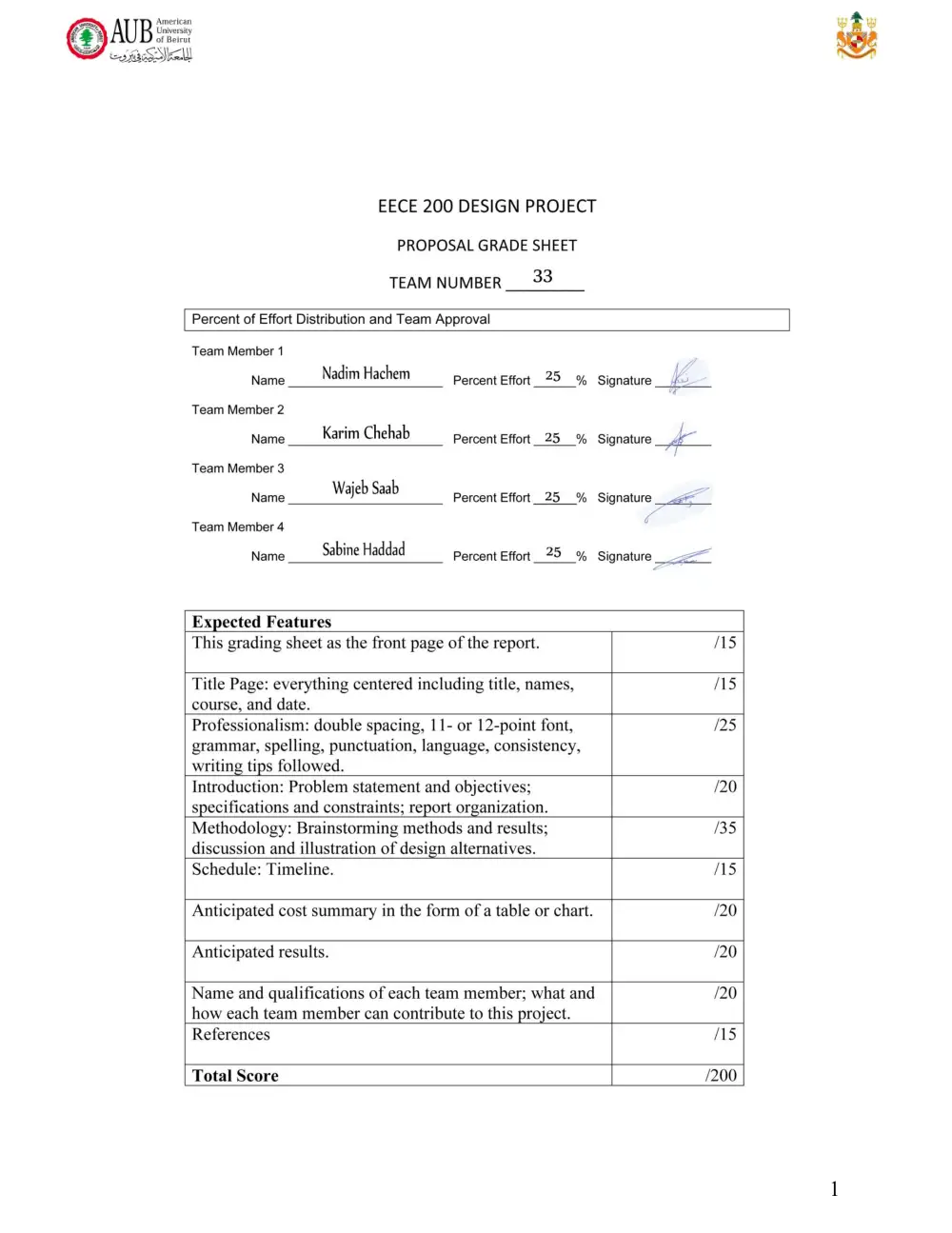
1
Green Office
Team Number: 33
Nadim Hachem
Karim Chehab
Wajeb Saab
Sabine Haddad
Course: EECE 200
Friday, December 7th 2010
2
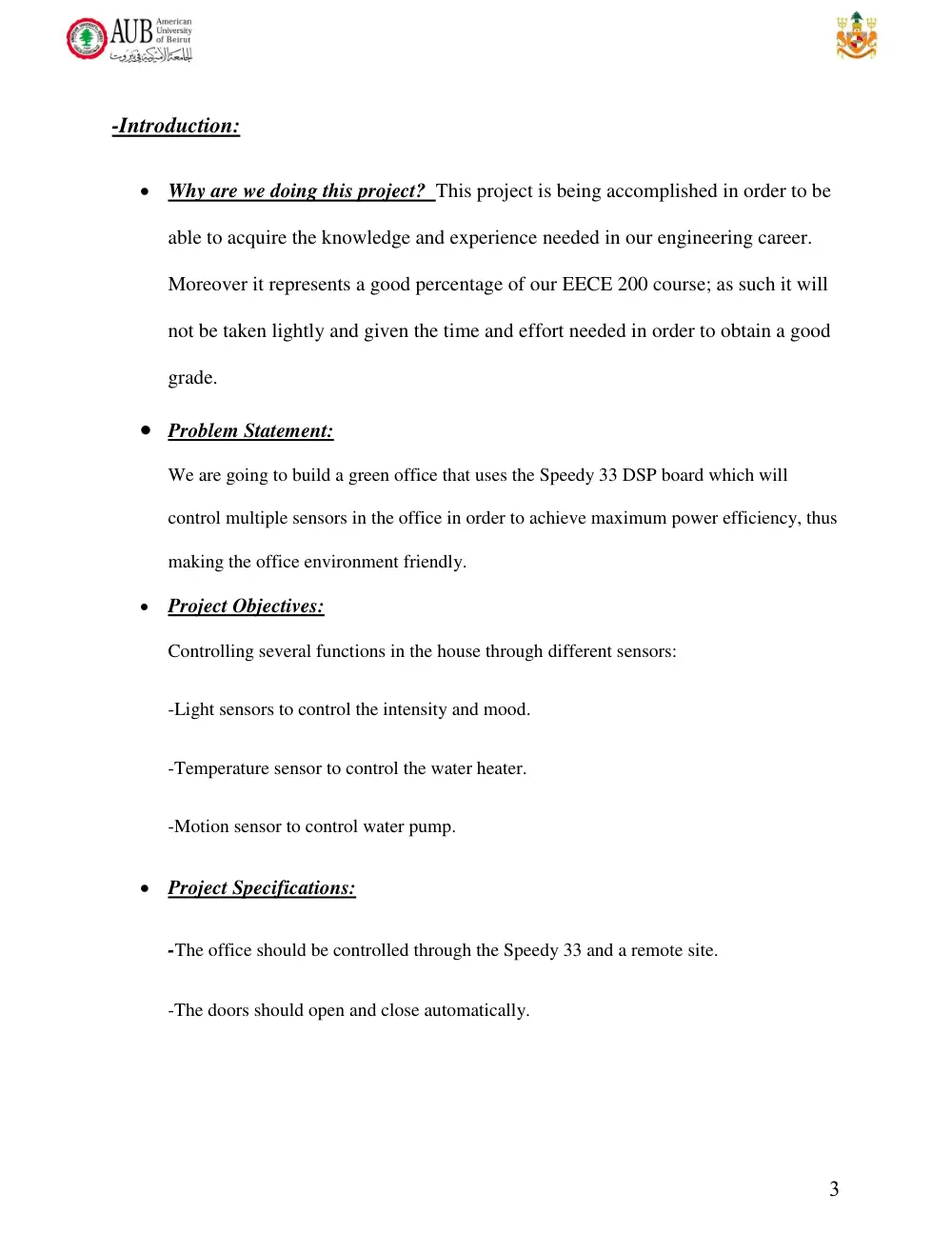
-Introduction:
Why are we doing this project? This project is being accomplished in order to be
able to acquire the knowledge and experience needed in our engineering career.
Moreover it represents a good percentage of our EECE 200 course; as such it will
not be taken lightly and given the time and effort needed in order to obtain a good
grade.
Problem Statement:
We are going to build a green office that uses the Speedy 33 DSP board which will
control multiple sensors in the office in order to achieve maximum power efficiency, thus
making the office environment friendly.
Project Objectives:
Controlling several functions in the house through different sensors:
-Light sensors to control the intensity and mood.
-Temperature sensor to control the water heater.
-Motion sensor to control water pump.
Project Specifications:
-The office should be controlled through the Speedy 33 and a remote site.
-The doors should open and close automatically.
3
-The intensity of the external light should control the number of LEDs that are ON; the
mood should control the color of working LEDs.
-The water pump should turn on automatically when detecting motion.
-The water heater should keep the water temperature within a constant range.
-A seven segment display should display either the number of LEDs that is on or the
amount of power consumed.
-A remote site should display the status of the doors and control a special function.
-The functionality of the remote site should be tested by an independent switch.
Constraints:
-The project will be accomplished by the combined efforts of 4 students.
-The SPEEDY-33 board is to be used in this project and kept hidden, as well as the wiring
and cables.
4
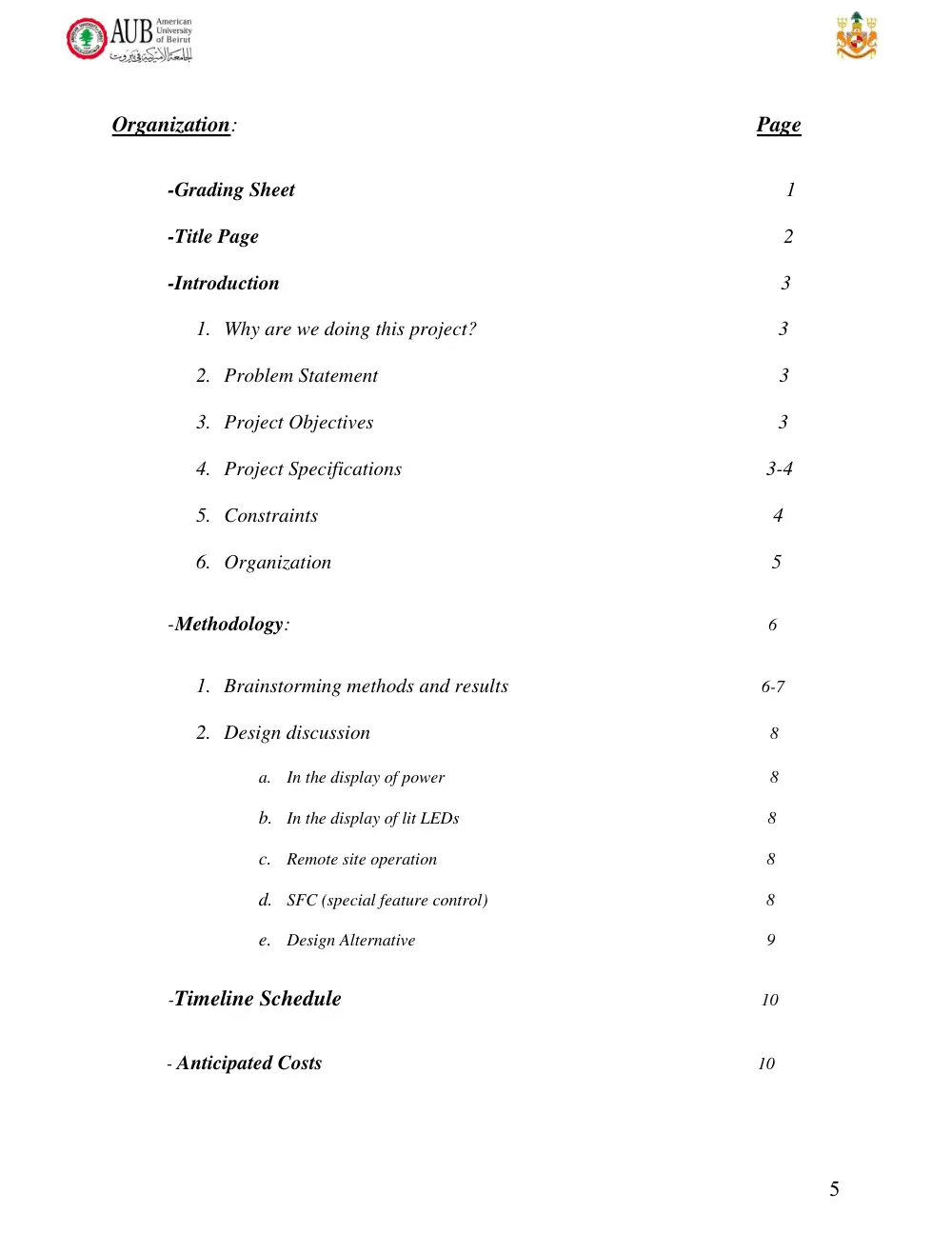
Organization: Page
-Grading Sheet 1
-Title Page
2
-Introduction 3
1. Why are we doing this project?
3
2. Problem Statement 3
3. Project Objectives 3
4. Project Specifications 3-4
5. Constraints 4
6. Organization 5
- Methodology:
6
1. Brainstorming methods and results 6-7
2. Design discussion 8
a. In the display of power 8
b. In the display of lit LEDs 8
c. Remote site operation 8
d. SFC (special feature control) 8
e. Design Alternative 9
-Timeline Schedule 10
- Anticipated Costs 10
5
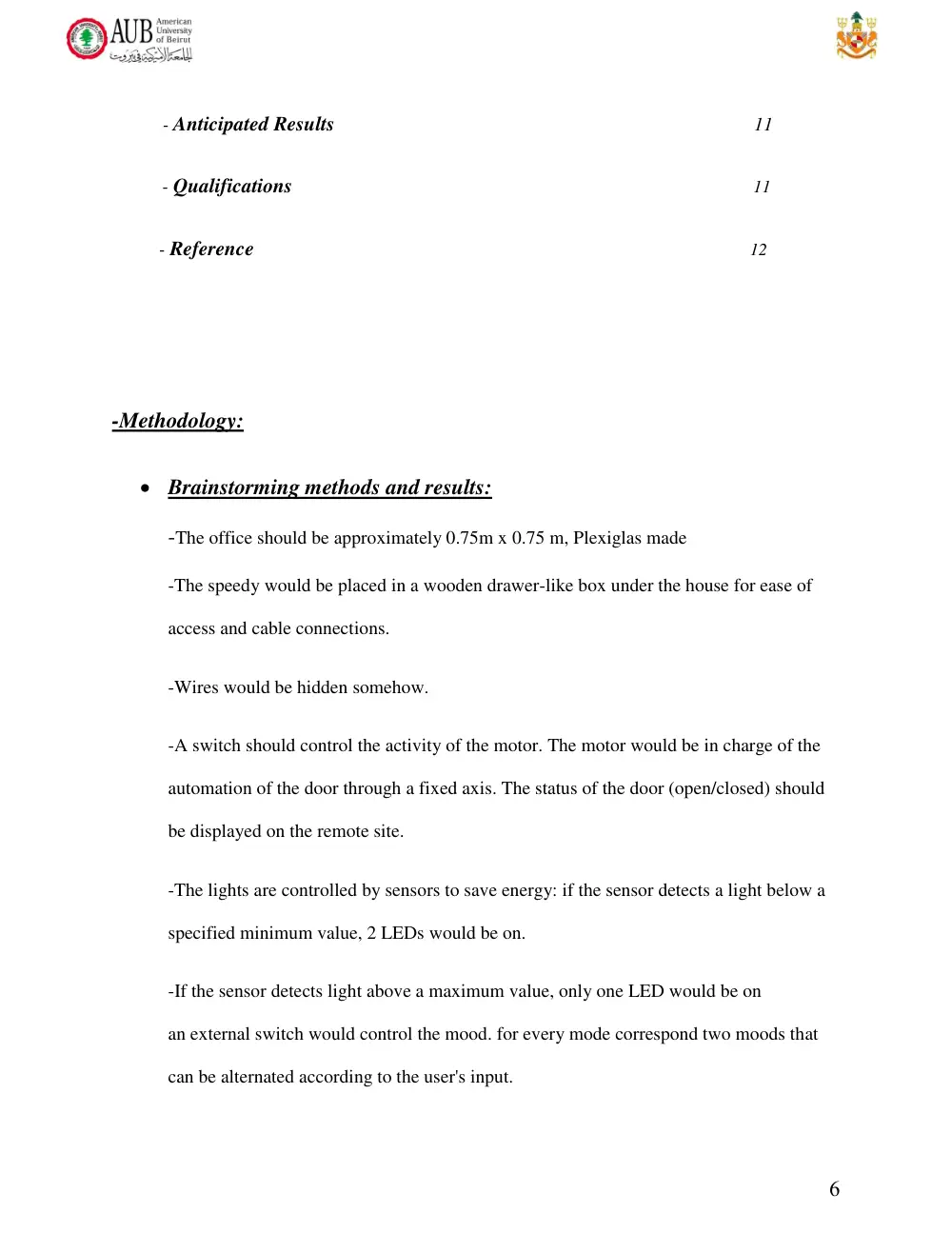
- Anticipated Results 11
- Qualifications
11
- Reference 12
-Methodology:
Brainstorming methods and results:
-The office should be approximately 0.75m x 0.75 m, Plexiglas made
-The speedy would be placed in a wooden drawer-like box under the house for ease of
access and cable connections.
-Wires would be hidden somehow.
-A switch should control the activity of the motor. The motor would be in charge of the
automation of the door through a fixed axis. The status of the door (open/closed) should
be displayed on the remote site.
-The lights are controlled by sensors to save energy: if the sensor detects a light below a
specified minimum value, 2 LEDs would be on.
-If the sensor detects light above a maximum value, only one LED would be on
an external switch would control the mood. for every mode correspond two moods that
can be alternated according to the user's input.
6
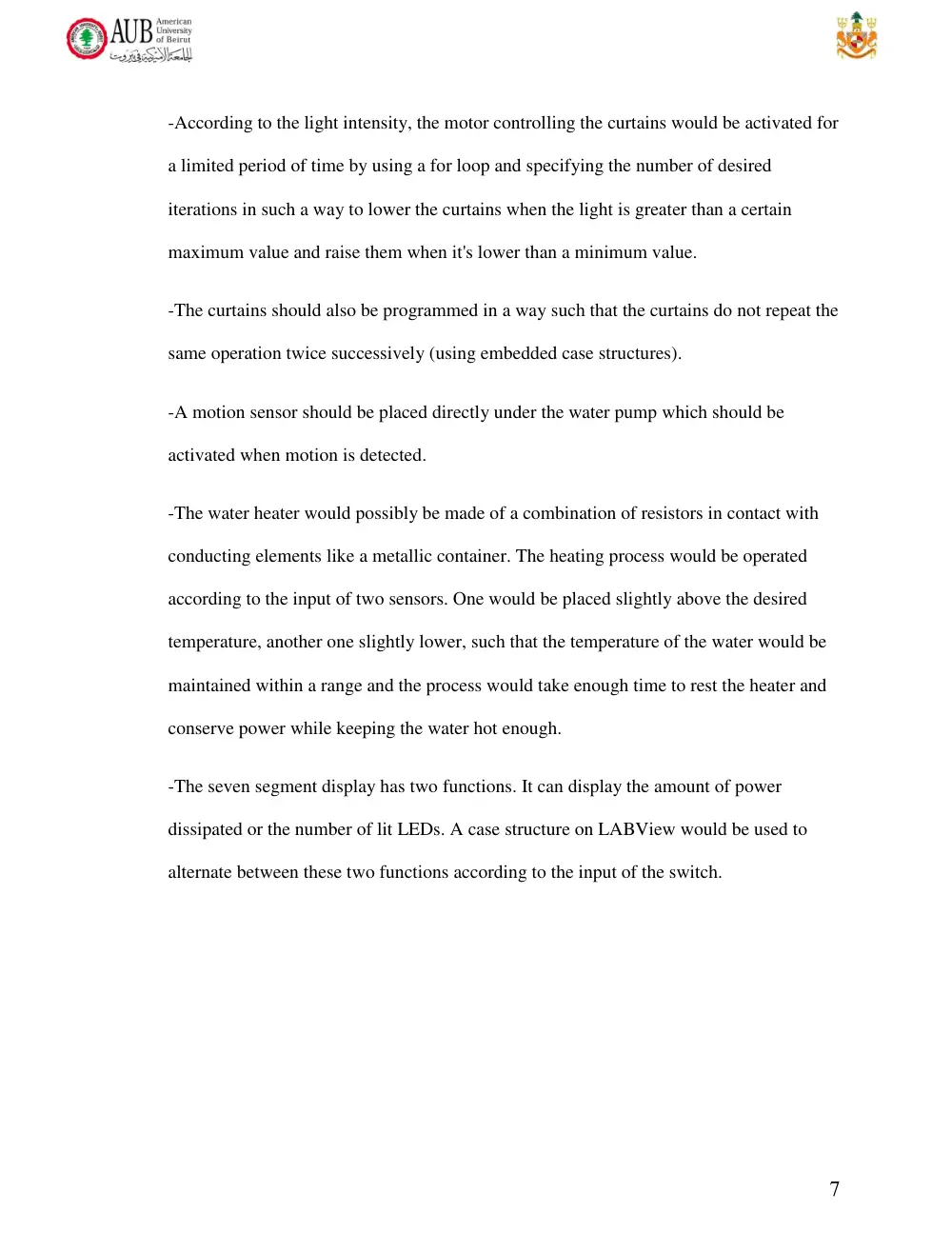
-According to the light intensity, the motor controlling the curtains would be activated for
a limited period of time by using a for loop and specifying the number of desired
iterations in such a way to lower the curtains when the light is greater than a certain
maximum value and raise them when it's lower than a minimum value.
-The curtains should also be programmed in a way such that the curtains do not repeat the
same operation twice successively (using embedded case structures).
-A motion sensor should be placed directly under the water pump which should be
activated when motion is detected.
-The water heater would possibly be made of a combination of resistors in contact with
conducting elements like a metallic container. The heating process would be operated
according to the input of two sensors. One would be placed slightly above the desired
temperature, another one slightly lower, such that the temperature of the water would be
maintained within a range and the process would take enough time to rest the heater and
conserve power while keeping the water hot enough.
-The seven segment display has two functions. It can display the amount of power
dissipated or the number of lit LEDs. A case structure on LABView would be used to
alternate between these two functions according to the input of the switch.
7
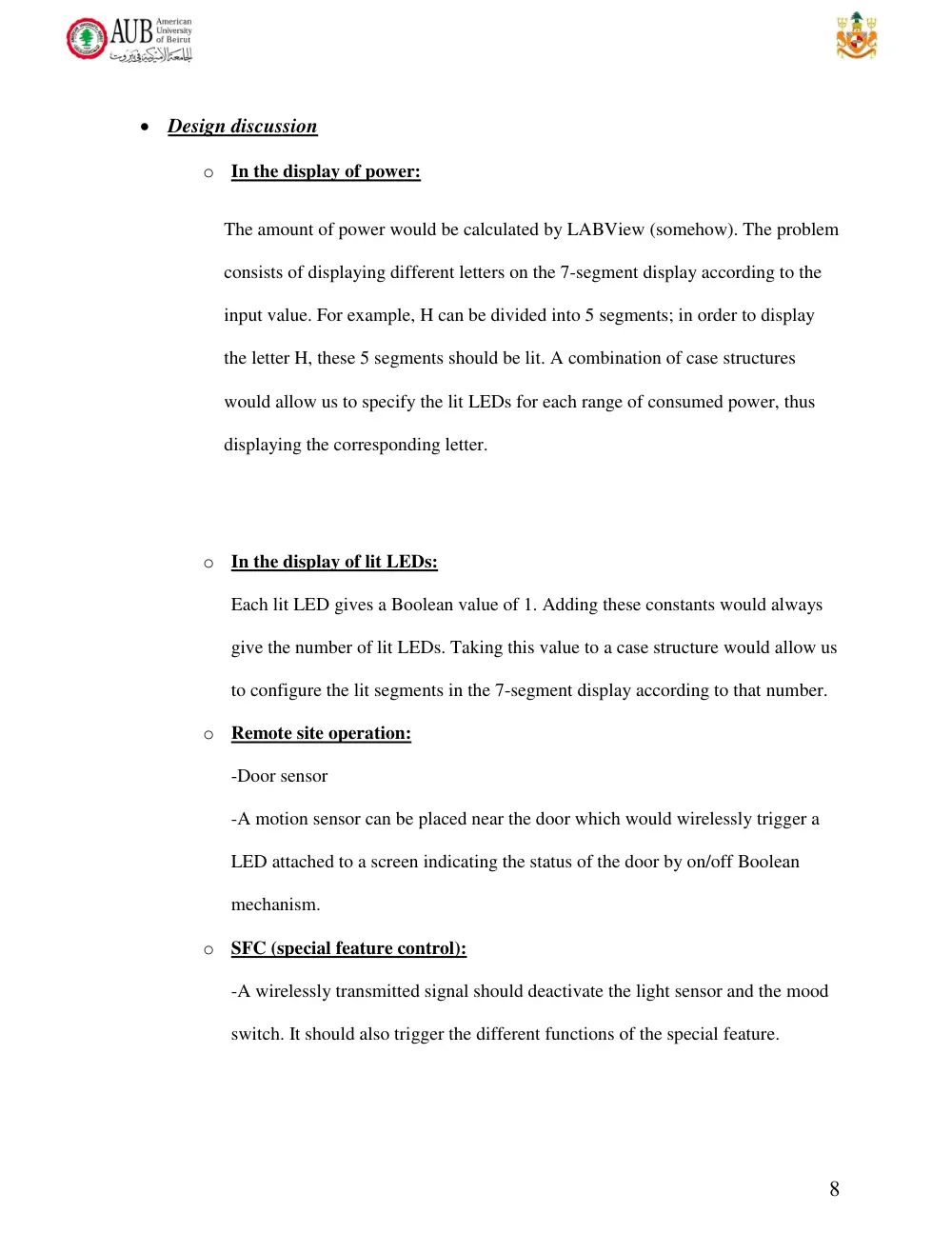
Design discussion
o In the display of power:
The amount of power would be calculated by LABView (somehow). The problem
consists of displaying different letters on the 7-segment display according to the
input value. For example, H can be divided into 5 segments; in order to display
the letter H, these 5 segments should be lit. A combination of case structures
would allow us to specify the lit LEDs for each range of consumed power, thus
displaying the corresponding letter.
o In the display of lit LEDs:
Each lit LED gives a Boolean value of 1. Adding these constants would always
give the number of lit LEDs. Taking this value to a case structure would allow us
to configure the lit segments in the 7-segment display according to that number.
o Remote site operation:
-Door sensor
-A motion sensor can be placed near the door which would wirelessly trigger a
LED attached to a screen indicating the status of the door by on/off Boolean
mechanism.
o SFC (special feature control):
-A wirelessly transmitted signal should deactivate the light sensor and the mood
switch. It should also trigger the different functions of the special feature.
8
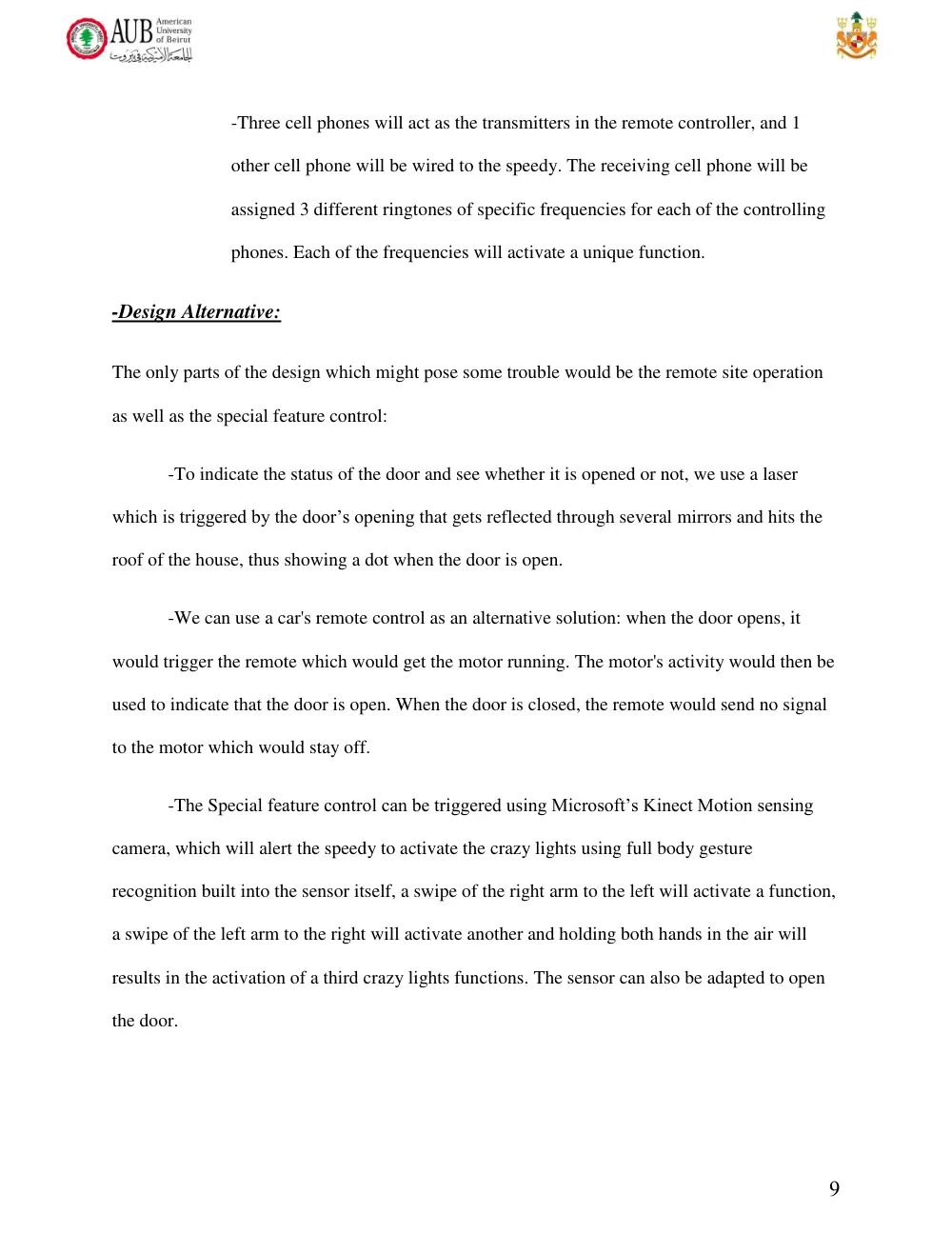
-Three cell phones will act as the transmitters in the remote controller, and 1
other cell phone will be wired to the speedy. The receiving cell phone will be
assigned 3 different ringtones of specific frequencies for each of the controlling
phones. Each of the frequencies will activate a unique function.
-Design Alternative:
The only parts of the design which might pose some trouble would be the remote site operation
as well as the special feature control:
-To indicate the status of the door and see whether it is opened or not, we use a laser
which is triggered by the door’s opening that gets reflected through several mirrors and hits the
roof of the house, thus showing a dot when the door is open.
-We can use a car's remote control as an alternative solution: when the door opens, it
would trigger the remote which would get the motor running. The motor's activity would then be
used to indicate that the door is open. When the door is closed, the remote would send no signal
to the motor which would stay off.
-The Special feature control can be triggered using Microsoft’s Kinect Motion sensing
camera, which will alert the speedy to activate the crazy lights using full body gesture
recognition built into the sensor itself, a swipe of the right arm to the left will activate a function,
a swipe of the left arm to the right will activate another and holding both hands in the air will
results in the activation of a third crazy lights functions. The sensor can also be adapted to open
the door.
9
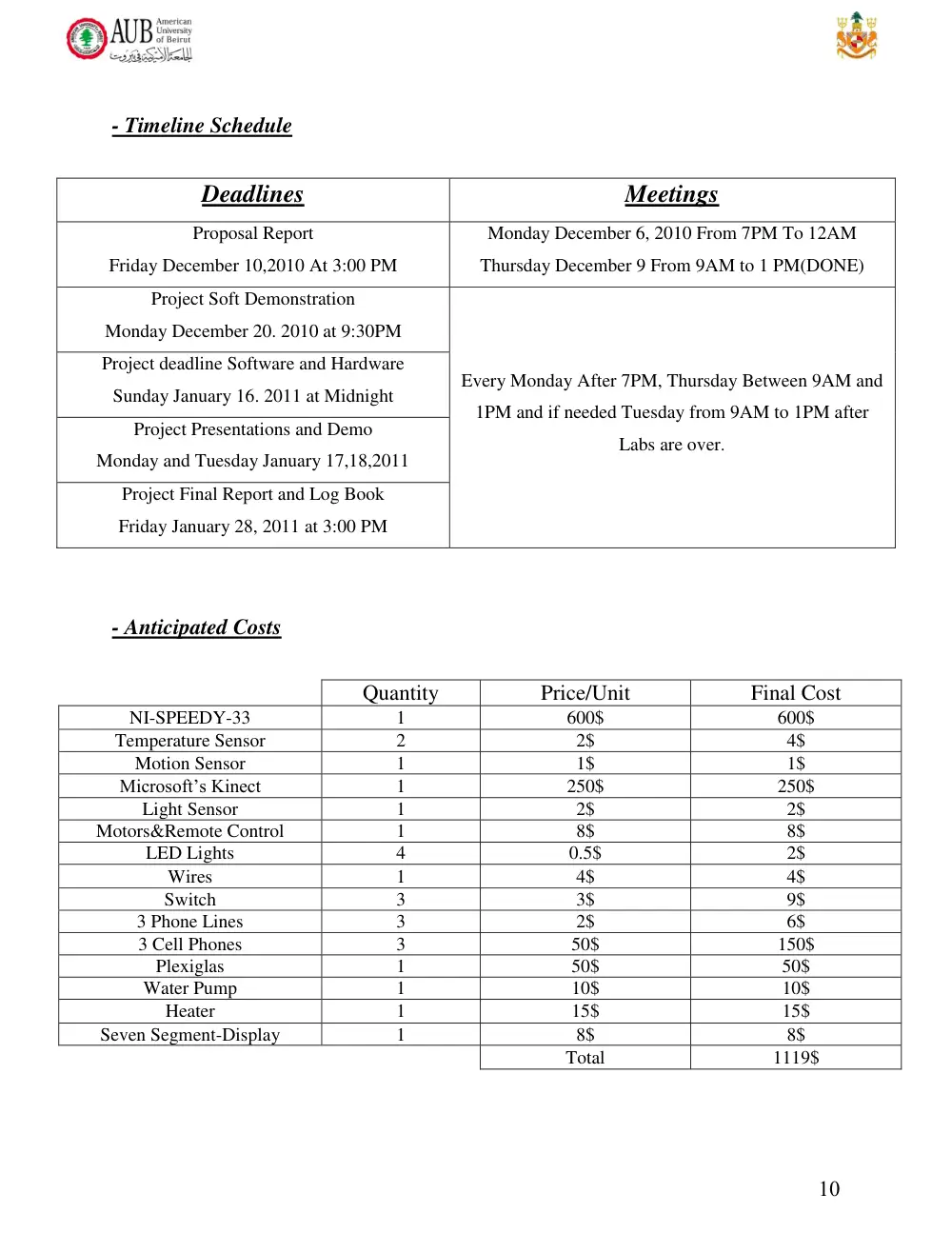
- Timeline Schedule
Deadlines
Meetings
Proposal Report
Friday December 10,2010 At 3:00 PM
Monday December 6, 2010 From 7PM To 12AM
Thursday December 9 From 9AM to 1 PM(DONE)
Project Soft Demonstration
Monday December 20. 2010 at 9:30PM
Every Monday After 7PM, Thursday Between 9AM and
1PM and if needed Tuesday from 9AM to 1PM after
Labs are over.
Project deadline Software and Hardware
Sunday January 16. 2011 at Midnight
Project Presentations and Demo
Monday and Tuesday January 17,18,2011
Project Final Report and Log Book
Friday January 28, 2011 at 3:00 PM
- Anticipated Costs
Quantity
Price/Unit
Final Cost
NI-SPEEDY-33
1
600$
600$
Temperature Sensor
2
2$
4$
Motion Sensor
1
1$
1$
Microsoft’s Kinect
1
250$
250$
Light Sensor
1
2$
2$
Motors&Remote Control
1
8$
8$
LED Lights
4
0.5$
2$
Wires
1
4$
4$
Switch
3
3$
9$
3 Phone Lines
3
2$
6$
3 Cell Phones
3
50$
150$
Plexiglas
1
50$
50$
Water Pump
1
10$
10$
Heater
1
15$
15$
Seven Segment-Display
1
8$
8$
Total
1119$
10
- Anticipated Results:
In the end we are going to have a fully functional green office which uses its sensors and
automation control to adjust component work in order to achieve a power efficient home which
does its best to use the less energy possible, that in order to consume less electricity and thus
decreasing pollution indirectly.
-Qualifications:
Nadim HACHEM: Solving design problems, as well as finding solutions for Vis
Karim CHEHAB: Will writing reports and keeping track of the team’s progress, he will
be responsible of trying to adapt the Kinect for use in the project.
Wajeb SAAB: Proposes ideas to get the design schematics done, as well as showing
management skills. He will try to adapt the motor and the remote control for use on the
door.
Sabine HADDAD: finding the needed material as well as helping in the design and
construction of the house
11
-References:
http://www.ni.com/pdf/manuals/371577d.pdf
Speedy 33 Manual
http://www.ni.com/pdf/manuals/320999e.pdf
LABView Manual
http://www.ladyada.net/learn/diykinect/#introduction Kinect USB Hack
12