
EECE 200 Project Proposal, Fall 2011
American University of Beirut · Introduction to Electrical and Computer Engineering · 12 pages
Showing the first 10 of 12 pages. Download the PDF to see all of it.
More EECE 200 files
- Lecture Project Managment · Fall 2013ProjectView
- Project Proposal · Fall 2011ProjectView
- Project Proposal · Fall 2010ProjectView
- Report Design Project · Fall 2010ProjectView
- Project Proposal · Fall 2009ProjectView
- Project · Spring 2008ProjectView
- Project · Spring 2008ProjectView
- Homework 2 · Fall 2014HomeworkView
Show the text of this project
Project Proposal:
LABVIEW-Simulated Elevator (Three Floors)
By:
Course: EECE 200
Monday, November 28, 2011
2
Problem Statement:
In the shadow of the constant evolution of constructions and the ever-evolving phenomenon of
skyscrapers, modern buildings have been constantly towering higher and higher with the will to fit more
families and individuals. Ten, fifty, and even hundred floor buildings have been successfully
constructed, which raises a question: How will the residents (of all types: too old, too young
unhealthy…) be able to “climb” to their apartments? Well the answer is the use of elevators of course.
As simple as this answer might seem, its complexity of building and programming overwhelms its
simplicity in saying. In short, a three floor elevator project simulated by LABVIEW would represent a
resemblance to all elevators that we rely on each day, which are problem-solvers for mankind. It’s time
to find out the complex language that the elevator speaks to itself as a result of a simple push of a button.
Project Objectives:
Curricular Objectives:
1- Designing a fully-functional elevator.
2- Controlling the following in the designed elevator:
a.
The doors: They must open automatically by the application of motion
sensors.
b. The motor: It must respond correctly to the desired motion of the elevator,
according to the floor where the “CALL” button was pressed. That is, the
motor must have the ability to rotate in both ways.
c.
The fan: It must operate automatically when needed, by applying heat sensors.
3- Creating a suitable LABVIEW VI to control the designed elevator through SPEEDY.
4- Linking the VI and the elevator and testing them to ensure functionality.
3
Extracurricular Objectives:
1- Learning the value of teamwork in the workplace and the necessity to trust others as
individuals to get their part done, and not to disappoint them by getting your
recommended part done as well.
2- Learning to be independent and not to be spoon-fed or take everything for granted:
Obviously, this project is no simple one, and not all steps will be taught in the given
courses, which pushes the group to do some researching and trial-and-error
experiments to discover the right methods by themselves.
3- Simply having fun and feeling the pleasure of being an engineer! It might not seem
professional to say this but it has to be said nonetheless: The real pleasure of
engineering is not memorizing solid formulas and dealing with resulting numbers, the
pleasure of engineering lies in building a project with your bare hands and staying up
late to make it work properly.
Specifications:
1- Inputs:
a.
A motion sensor digital input installed on the door of the elevator to detect motion and
open.
b. A temperature sensor installed in the elevator to detect increase in temperature and turn
on the fan.
c.
One digital input per floor to determine the position of the elevator cabin.
d. One digital input per floor to act as the “CALL” button.
4
e.
An analog audio input from inside the elevator allowing it to move according to the order
given from inside the cabin.
2- Outputs:
a.
A digital output that turns the motor of the elevator on and off.
b. A digital output to turn the ventilation system (fan) on and off.
c.
Two digital outputs to display the floor number the elevator is currently on.
d. One digital output per floor to open and close the elevator doors.
e.
One digital output which controls the direction of rotation of the motor (lifting the
elevator up or down)
Project Constraints:
1- Only one SPEEDY is allowed per group which makes it a challenge to fit all the needed inputs
and outputs on such a limited board.
2- It is not allowed to borrow the SPEEDY but required to work with it during university and that is
an obstacle.
3- All the wires and connections must be well hidden to seem like a realistic design.
5
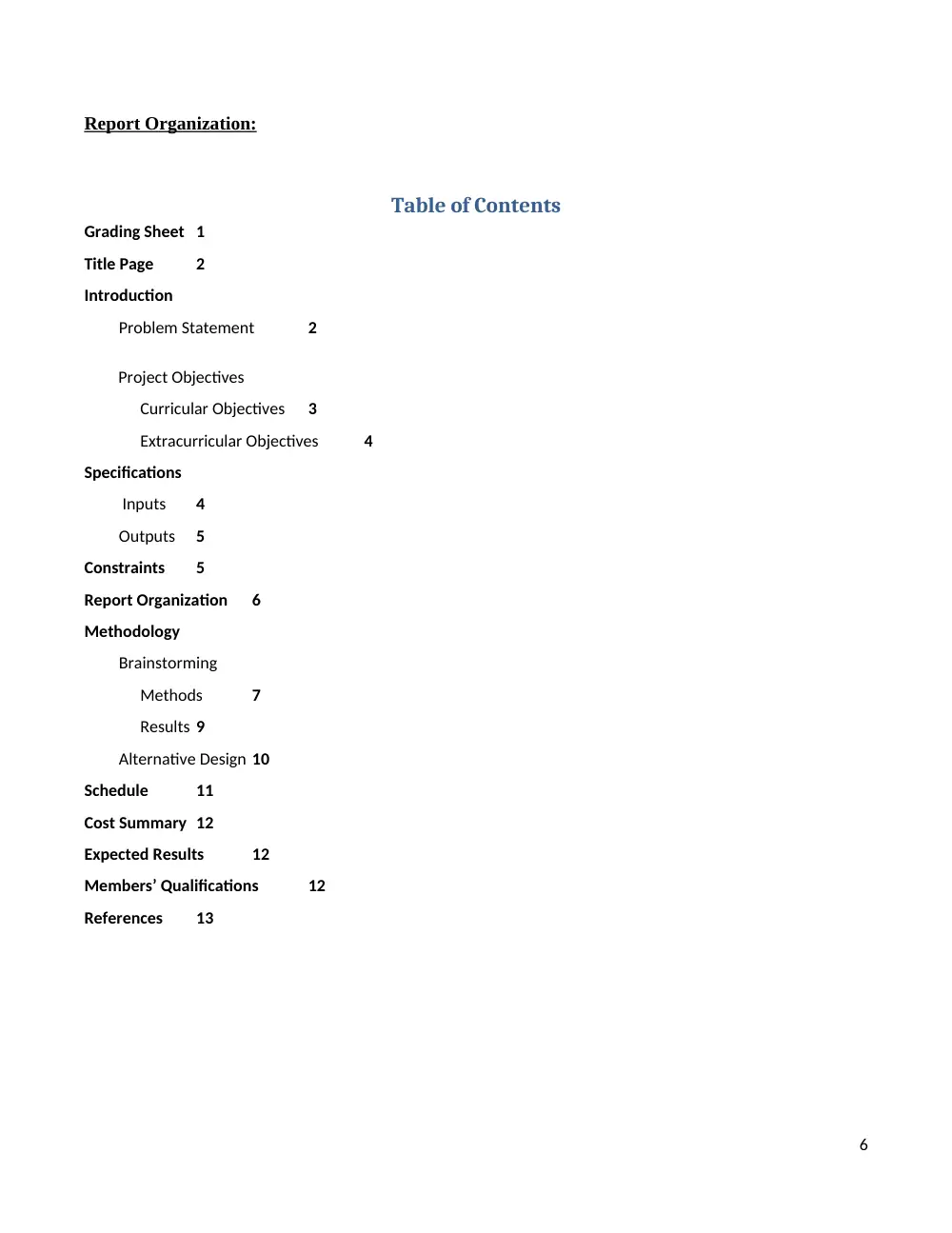
Report Organization:
Table of Contents
Grading Sheet 1
Title Page
2
Introduction
Problem Statement
2
Project Objectives
Curricular Objectives
3
Extracurricular Objectives
4
Specifications
Inputs
4
Outputs
5
Constraints
5
Report Organization
6
Methodology
Brainstorming
Methods
7
Results 9
Alternative Design 10
Schedule
11
Cost Summary 12
Expected Results
12
Members’ Qualifications
12
References
13
6
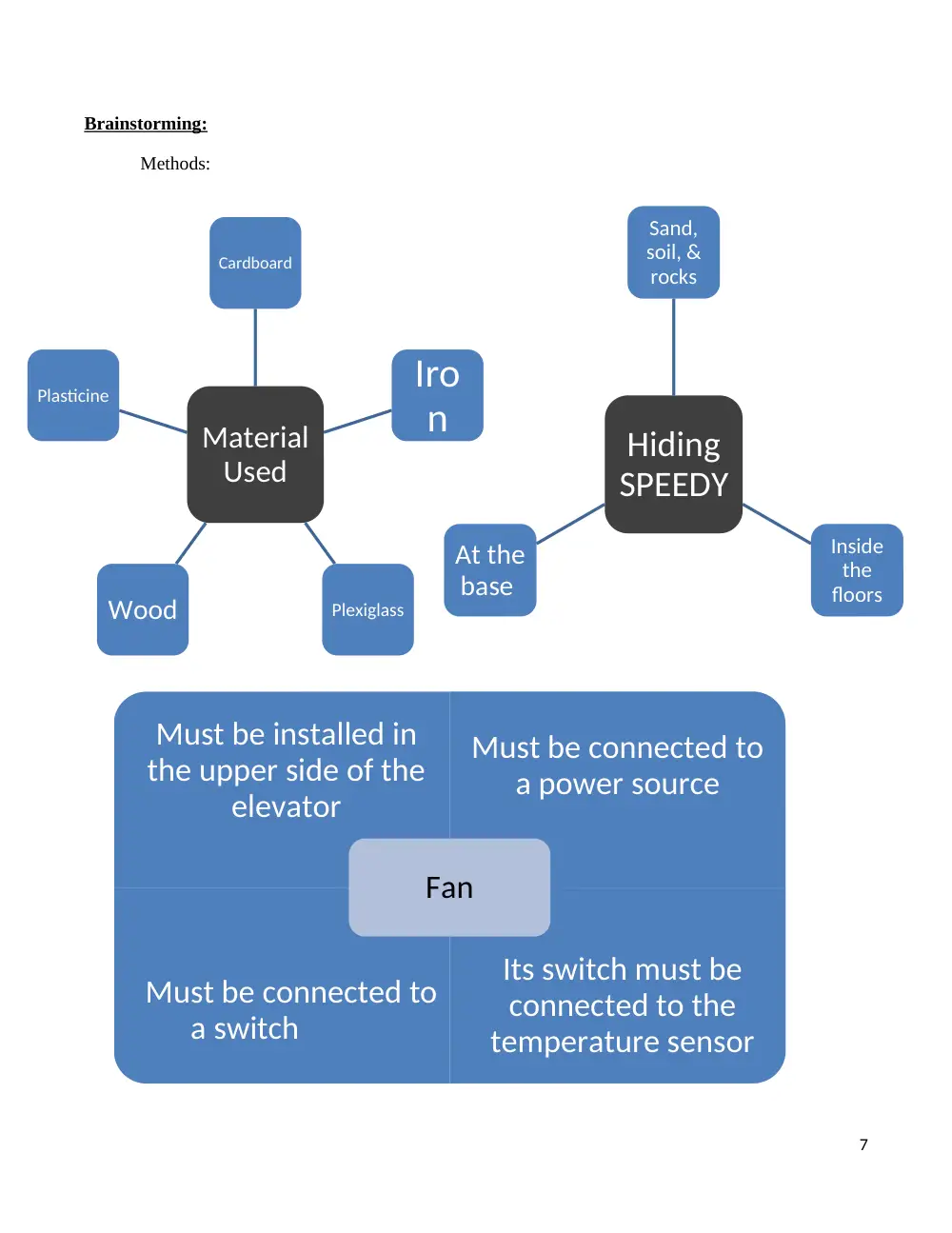
Brainstorming:
Methods:
7
Material
Used
Cardboard
Iro
n
Plexiglass
Wood
Plasticine
Hiding
SPEEDY
Sand,
soil, &
rocks
Inside
the
floors
At the
base
Must be installed in
the upper side of the
elevator
Must be connected to
a power source
Must be connected to
a switch
Its switch must be
connected to the
temperature sensor
Fan
8
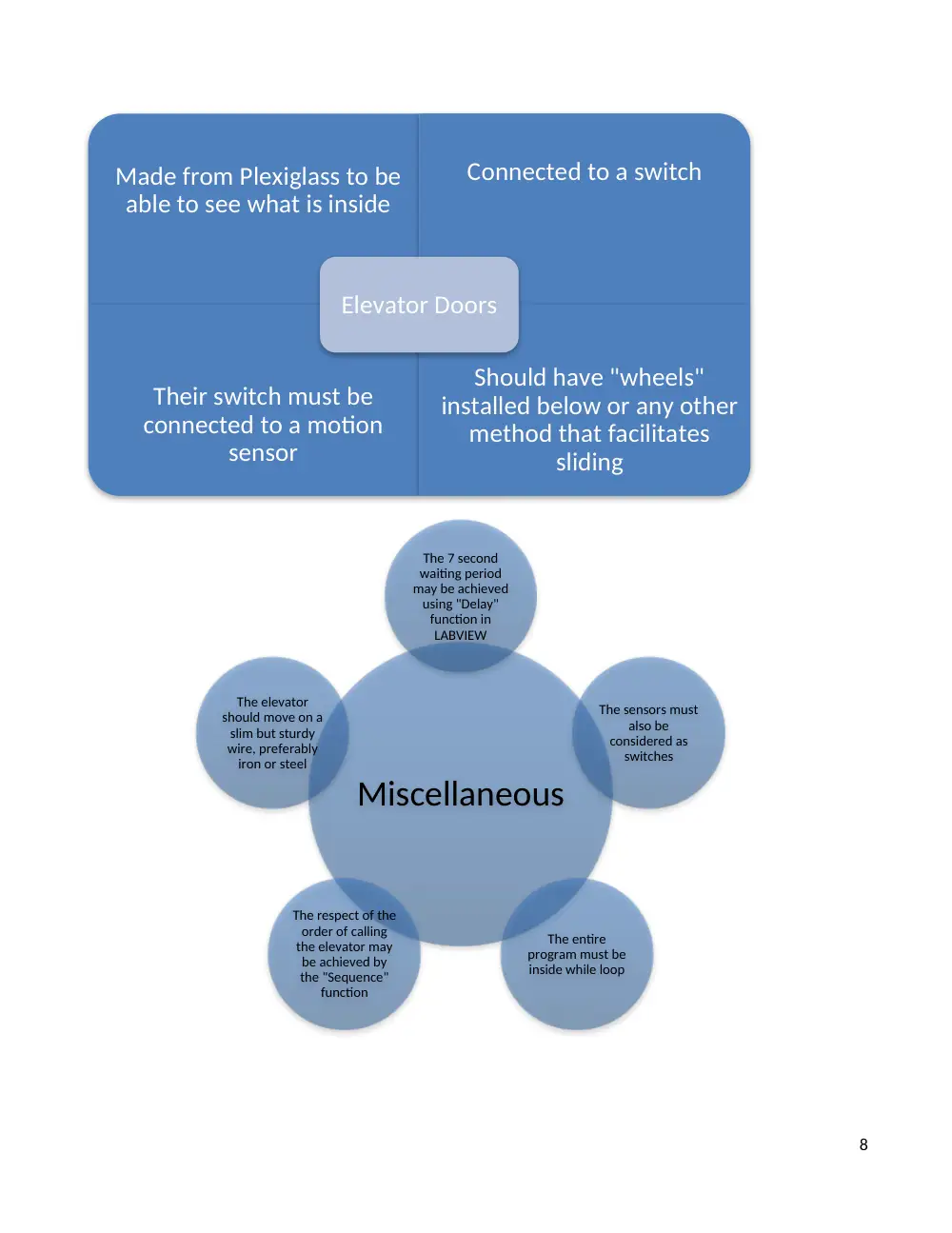
Made from Plexiglass to be
able to see what is inside
Connected to a switch
Their switch must be
connected to a motion
sensor
Should have "wheels"
installed below or any other
method that facilitates
sliding
Elevator Doors
Miscellaneous
The 7 second
waiting period
may be achieved
using "Delay"
function in
LABVIEW
The sensors must
also be
considered as
switches
The entire
program must be
inside while loop
The respect of the
order of calling
the elevator may
be achieved by
the "Sequence"
function
The elevator
should move on a
slim but sturdy
wire, preferably
iron or steel
As for software and logic, we have come up with the following:
-
Sub-VI’s will be heavily implemented due to the large scale of the project.
-
Case structured will be used to control the state of lamps.
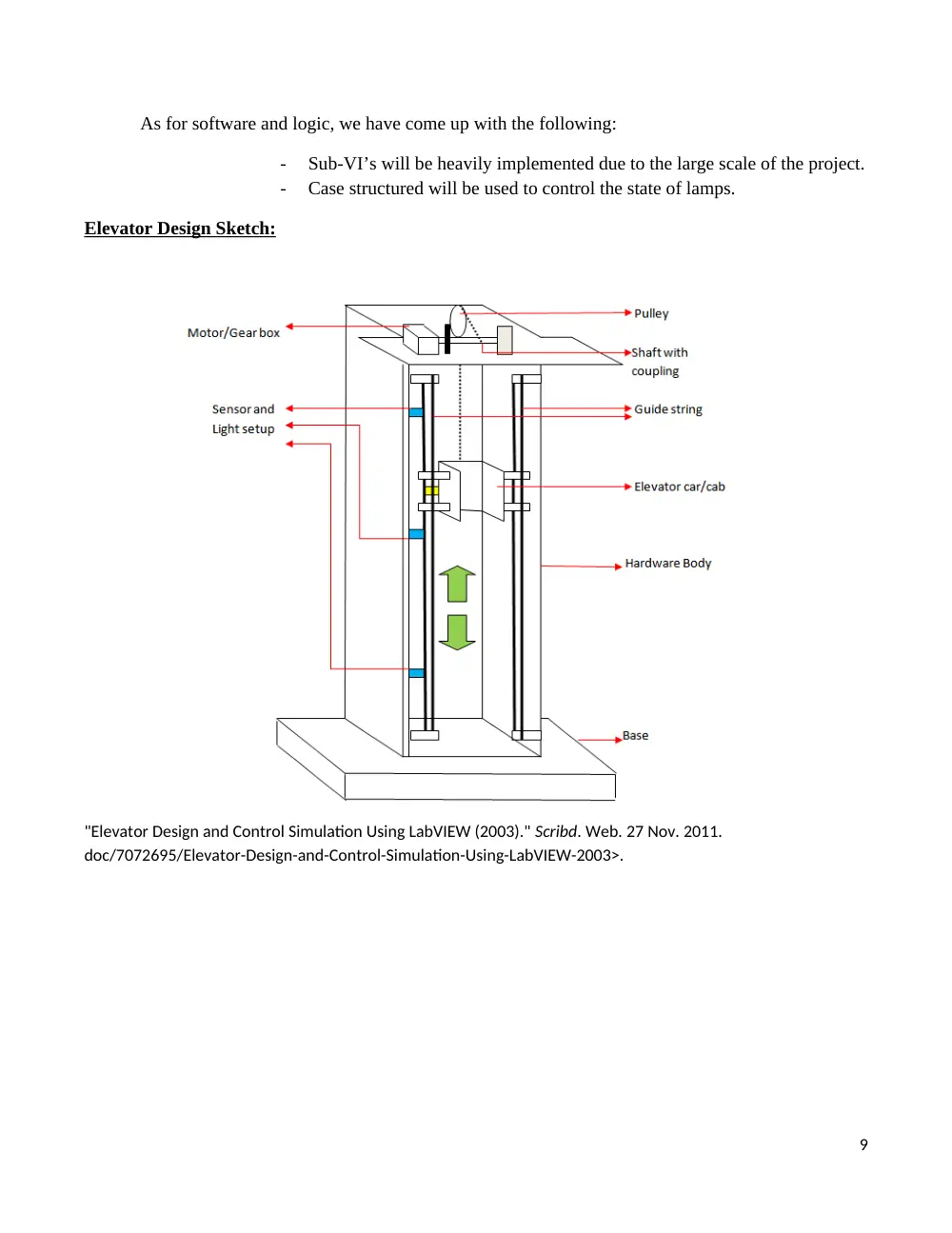
Elevator Design Sketch:
"Elevator Design and Control Simulation Using LabVIEW (2003)." Scribd. Web. 27 Nov. 2011.
doc/7072695/Elevator-Design-and-Control-Simulation-Using-LabVIEW-2003>.
9
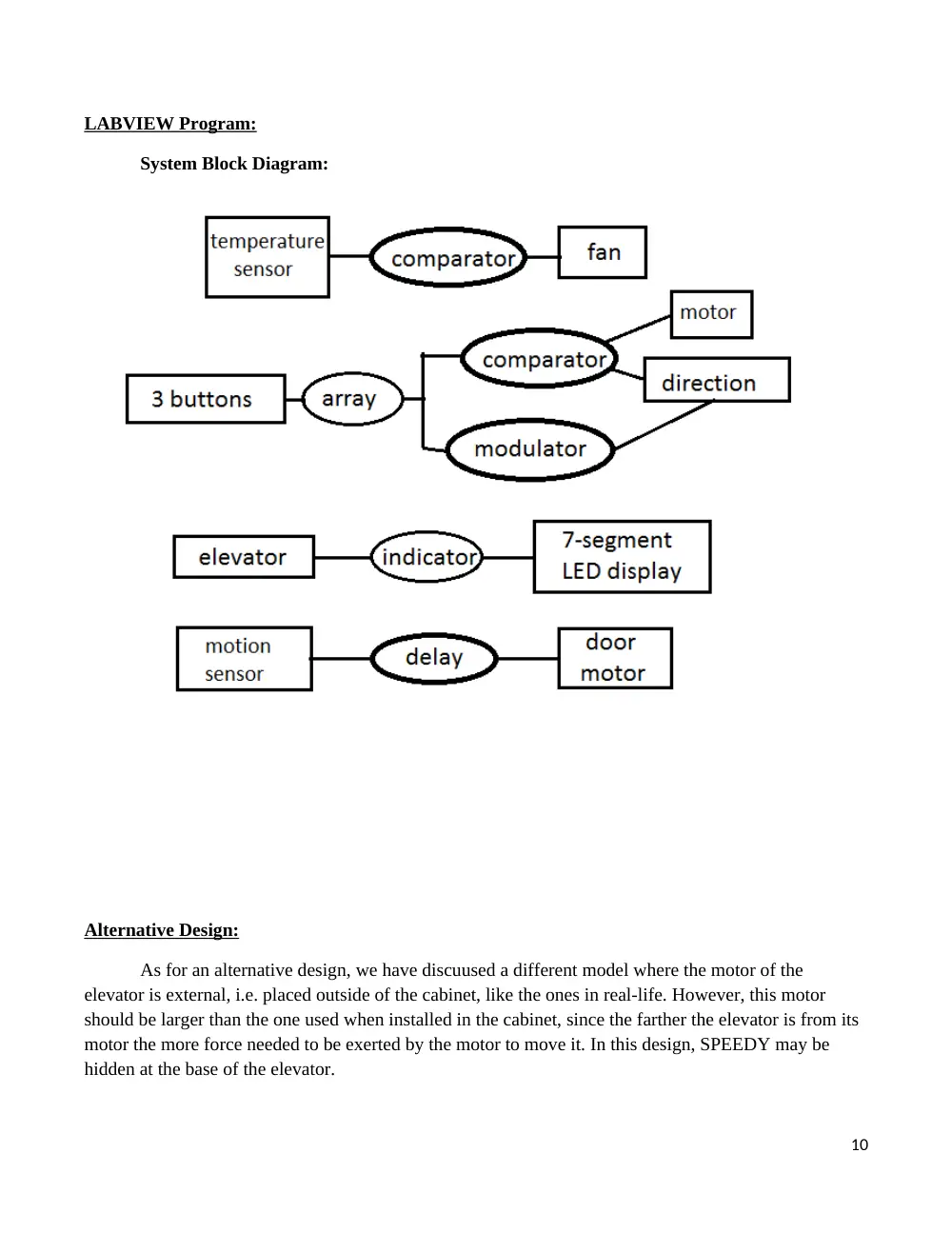
LABVIEW Program:
System Block Diagram:
Alternative Design:
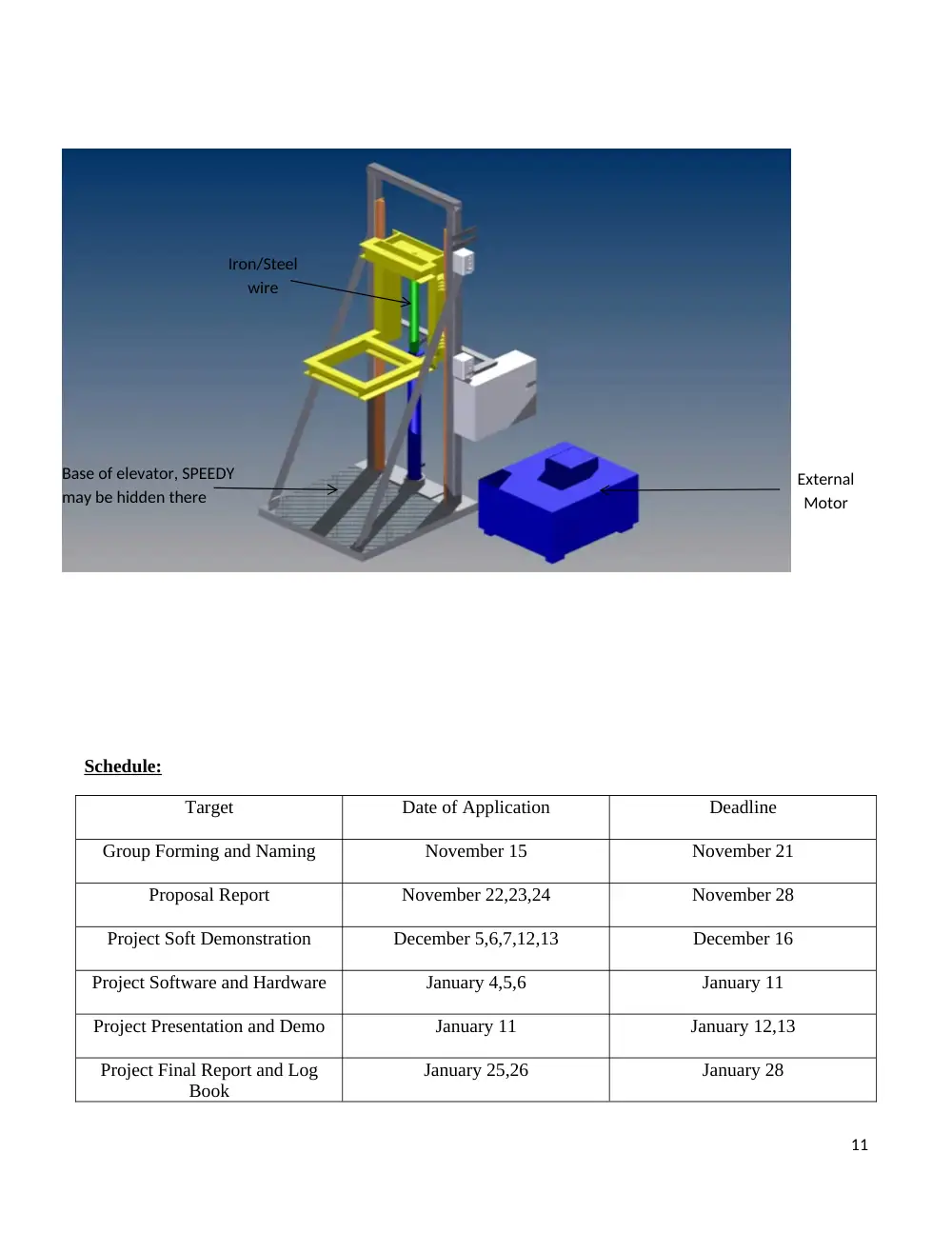
As for an alternative design, we have discuused a different model where the motor of the
elevator is external, i.e. placed outside of the cabinet, like the ones in real-life. However, this motor
should be larger than the one used when installed in the cabinet, since the farther the elevator is from its
motor the more force needed to be exerted by the motor to move it. In this design, SPEEDY may be
hidden at the base of the elevator.
10
Schedule:
Target
Date of Application
Deadline
Group Forming and Naming
November 15
November 21
Proposal Report
November 22,23,24
November 28
Project Soft Demonstration
December 5,6,7,12,13
December 16
Project Software and Hardware
January 4,5,6
January 11
Project Presentation and Demo
January 11
January 12,13
Project Final Report and Log
Book
January 25,26
January 28
11
External
Motor
Iron/Steel
wire
Base of elevator, SPEEDY
may be hidden there
Cost Summary:
Item
Quantity
Price ($)
Total Price ($)
SPEEDY-33
1
600
600
Plexiglass Model
1
250
250
Wooden Model
1
25
25
Motor
2
3
6
Temperature Sensor
2
2
4
Fan
2
2
4
Bump Sensor
5
0.5
2.5
Motion Sensor
5
1
5
LED
10
0.5
5
Aesthetics
-
15
15
Switch
10
0.5
5
Seven Segment Display
3
0.5
1.5
Total
41
300
923
The total cost of the project was found to be 923$.
Expected Results:
The designed elevator is anticipated to be a miniature copy of a real-life elevator; responding
with accuracy and sequence to every order and every call. Its power consumption should be low yet
reasonable, and its sturdiness should be similar to that of a normal elevator, capable to withstand the
same ratio of its mass over the mass inside its cabin.
Members’ Qualifications:
XXXXXXXXXX: Previous school project experiences, critical thinking skills
XXXXXXXXXX: Construction background, programming background
XXXXXXX: English Skills, electrical background
XXXXXXXXX: Logistic management skills, critical thinking skills
All team members will participate in every aspect of the project, but according to the type of skill
exhibited there would be a leader for each phase.
12
References:
1- B.Neblu: “Project Proposal Writing” (E-Book)
2- Scribd: http://www.scribd.com/doc/7072695/Elevator-Design-and-Control-Simulation-Using-LabVIEW-
2003
3- YouTube: http://www.youtube.com/watch?v=TWlv4MU0vwg
13