
EECE 210C Lecture, Fall 2001
American University of Beirut · Electric Circuits for Civil Engineers · 10 pages



More EECE 210C files
Show the text of this lab
1
Circuit Variables
Assessment Problems
AP 1.1
To solve this problem we use a product of ratios to change units from dollars/year to
dollars/millisecond. We begin by expressing $10 billion in scientific notation:
$100 billion = $100 × 109
Now we determine the number of milliseconds in one year, again using a product of
ratios:
1 year
365.25 days ·
1 day
24 hours · 1 hour
60 mins · 1 min
60 secs ·
1 sec
1000 ms =
1 year
31.5576 × 10⁹ ms
Now we can convert from dollars/year to dollars/millisecond, again with a product
of ratios:
$100 × 109
1 year
·
1 year
31.5576 × 10⁹ ms =
100
31.5576 = $3.17/ms
AP 1.2
First, we recognize that 1 ns = 10−9 s. The question then asks how far a signal will
travel in 10−9 s if it is traveling at 80% of the speed of light. Remember that the
speed of light c = 3 × 10⁸ m/s. Therefore, 80% of c is (0.8)(3 × 10⁸) = 2.4 × 10⁸
m/s. Now, we use a product of ratios to convert from meters/second to
inches/nanosecond:
2.4 × 10⁸ m
1s
·
1 s
109 ns · 100 cm
1 m
·
1 in
2.54 cm = (2.4 × 10⁸)(100)
(109)(2.54)
= 9.45 in
1 ns
Thus, a signal traveling at 80% of the speed of light will travel 9.45′′ in a
nanosecond.
1–1
1–2
CHAPTER 1. Circuit Variables
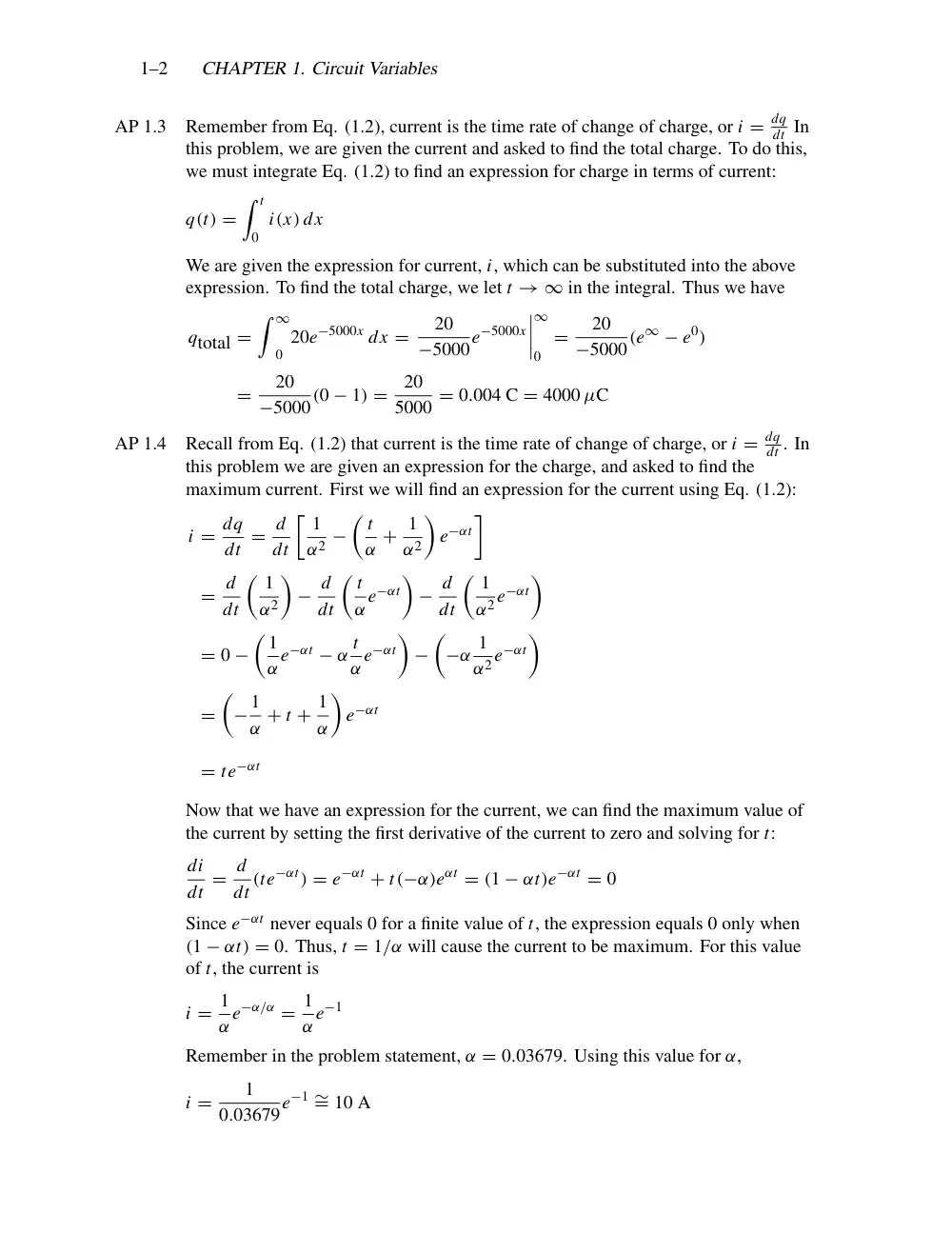
AP 1.3
Remember from Eq. (1.2), current is the time rate of change of charge, or i = dq
dt In
this problem, we are given the current and asked to find the total charge. To do this,
we must integrate Eq. (1.2) to find an expression for charge in terms of current:
q(t) =
� t
0
i(x) dx
We are given the expression for current, i, which can be substituted into the above
expression. To find the total charge, we let t → ∞ in the integral. Thus we have
qtotal =
� ∞
0
20e−5000x dx =
20
−5000e−5000x
����
∞
0
=
20
−5000(e∞ − e0)
=
20
−5000(0 − 1) =
20
5000 = 0.004 C = 4000 µC
AP 1.4
Recall from Eq. (1.2) that current is the time rate of change of charge, or i = dq
dt . In
this problem we are given an expression for the charge, and asked to find the
maximum current. First we will find an expression for the current using Eq. (1.2):
i = dq
dt = d
dt
� 1
α2 −
� t
α + 1
α2
�
e−αt
�
= d
dt
� 1
α2
�
− d
dt
� t
αe−αt
�
− d
dt
� 1
α2e−αt
�
= 0 −
� 1
αe−αt − α t
αe−αt
�
−
�
−α 1
α2e−αt
�
=
�
− 1
α + t + 1
α
�
e−αt
= te−αt
Now that we have an expression for the current, we can find the maximum value of
the current by setting the first derivative of the current to zero and solving for t:
di
dt = d
dt (te−αt) = e−αt + t(−α)eαt = (1 − αt)e−αt = 0
Since e−αt never equals 0 for a finite value of t, the expression equals 0 only when
(1 − αt) = 0. Thus, t = 1/α will cause the current to be maximum. For this value
of t, the current is
i = 1
αe−α/α = 1
αe−1
Remember in the problem statement, α = 0.03679. Using this value for α,
i =
1
0.03679e−1 ∼= 10 A
Problems
1–3
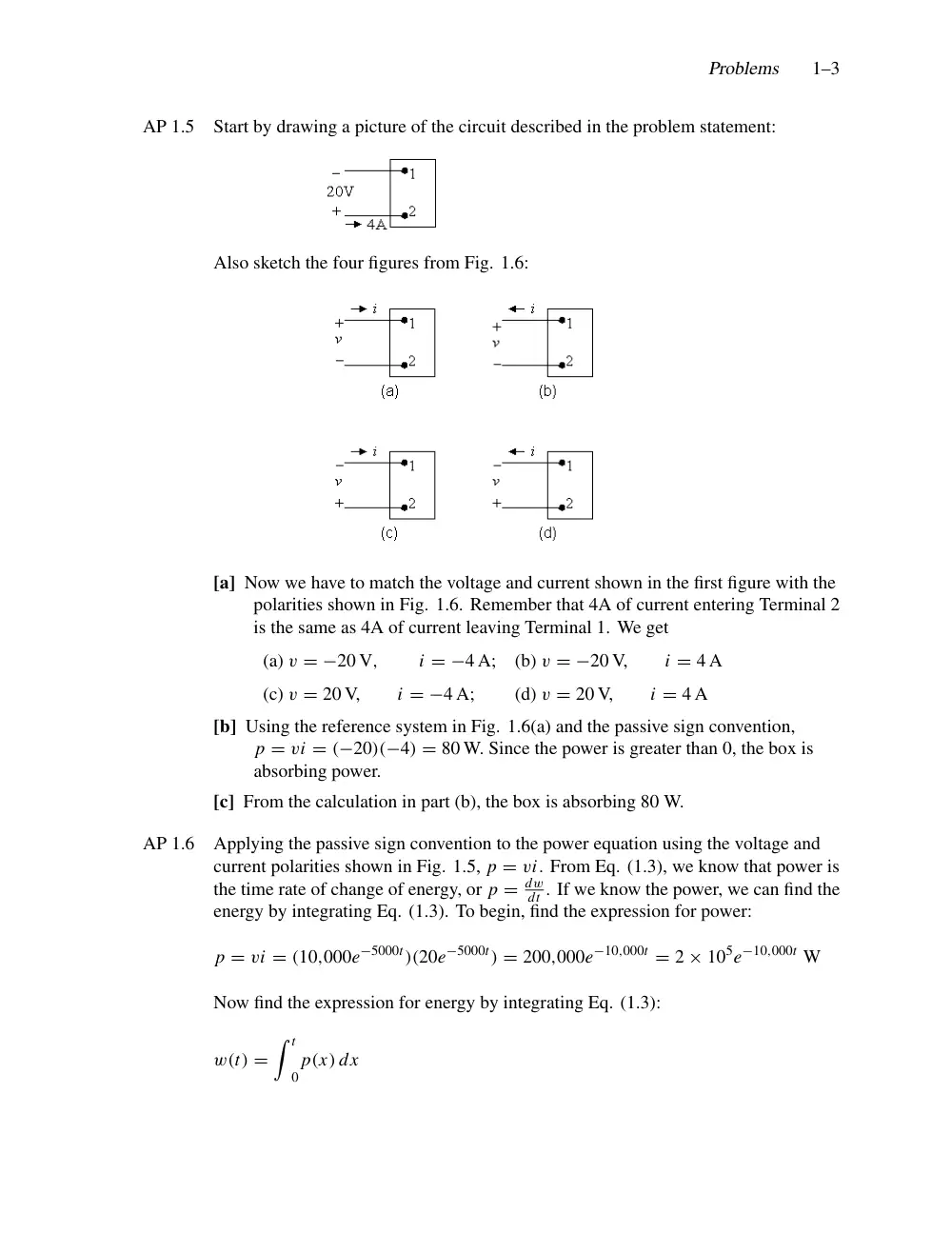
AP 1.5
Start by drawing a picture of the circuit described in the problem statement:
Also sketch the four figures from Fig. 1.6:
[a] Now we have to match the voltage and current shown in the first figure with the
polarities shown in Fig. 1.6. Remember that 4A of current entering Terminal 2
is the same as 4A of current leaving Terminal 1. We get
(a) v = −20 V,
i = −4 A;
(b) v = −20 V,
i = 4 A
(c) v = 20 V,
i = −4 A;
(d) v = 20 V,
i = 4 A
[b] Using the reference system in Fig. 1.6(a) and the passive sign convention,
p = vi = (−20)(−4) = 80 W. Since the power is greater than 0, the box is
absorbing power.
[c] From the calculation in part (b), the box is absorbing 80 W.
AP 1.6
Applying the passive sign convention to the power equation using the voltage and
current polarities shown in Fig. 1.5, p = vi. From Eq. (1.3), we know that power is
the time rate of change of energy, or p = dw
dt . If we know the power, we can find the
energy by integrating Eq. (1.3). To begin, find the expression for power:
p = vi = (10,000e−5000t)(20e−5000t) = 200,000e−10,000t = 2 × 10⁵e−10,000t W
Now find the expression for energy by integrating Eq. (1.3):
w(t) =
� t
0
p(x) dx
1–4
CHAPTER 1. Circuit Variables
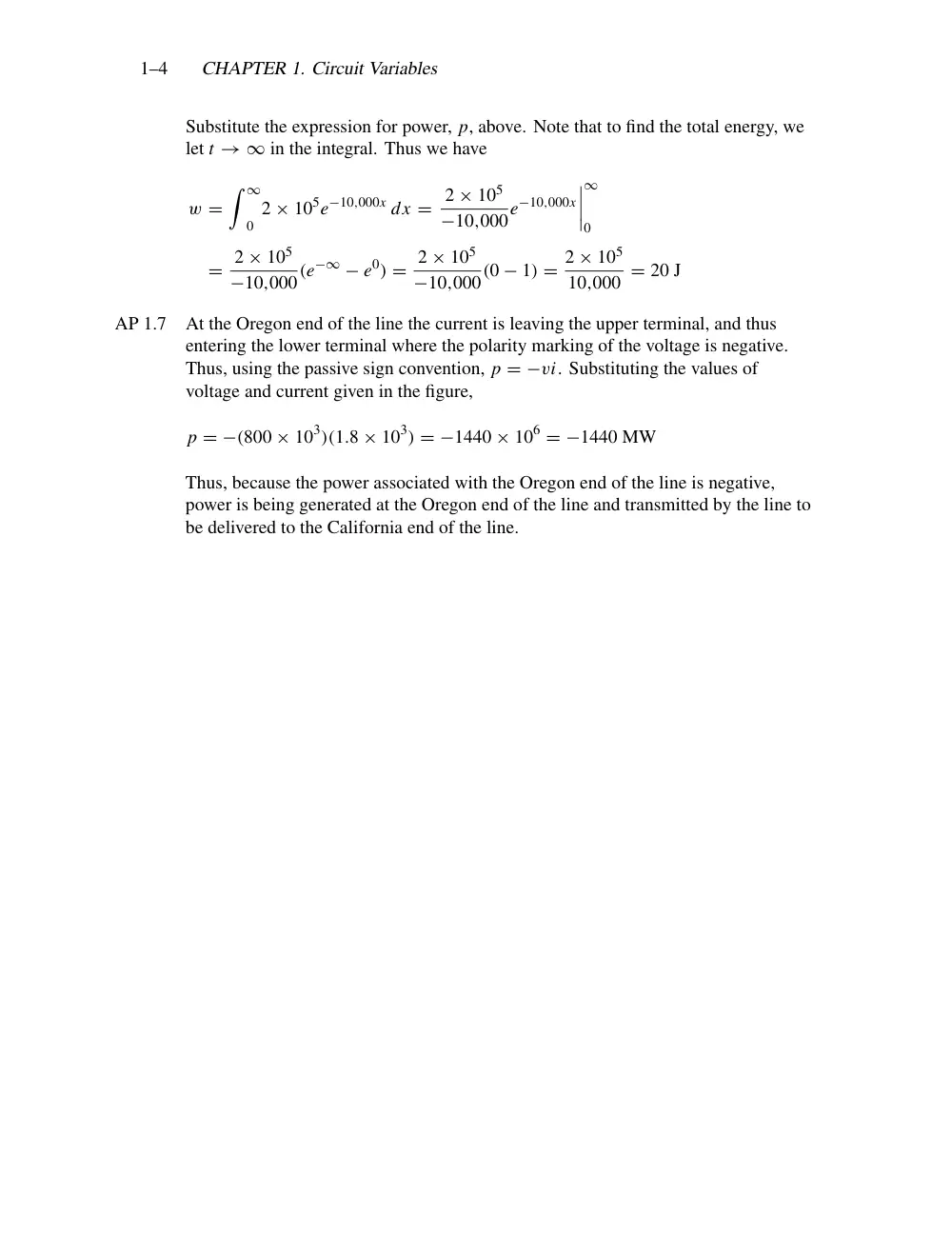
Substitute the expression for power, p, above. Note that to find the total energy, we
let t → ∞ in the integral. Thus we have
w =
� ∞
0
2 × 10⁵e−10,000x dx = 2 × 10⁵
−10,000e−10,000x
����
∞
0
= 2 × 10⁵
−10,000(e−∞ − e0) = 2 × 10⁵
−10,000(0 − 1) = 2 × 10⁵
10,000 = 20 J
AP 1.7
At the Oregon end of the line the current is leaving the upper terminal, and thus
entering the lower terminal where the polarity marking of the voltage is negative.
Thus, using the passive sign convention, p = −vi. Substituting the values of
voltage and current given in the figure,
p = −(800 × 103)(1.8 × 10³) = −1440 × 106 = −1440 MW
Thus, because the power associated with the Oregon end of the line is negative,
power is being generated at the Oregon end of the line and transmitted by the line to
be delivered to the California end of the line.
Problems
1–5
Problems
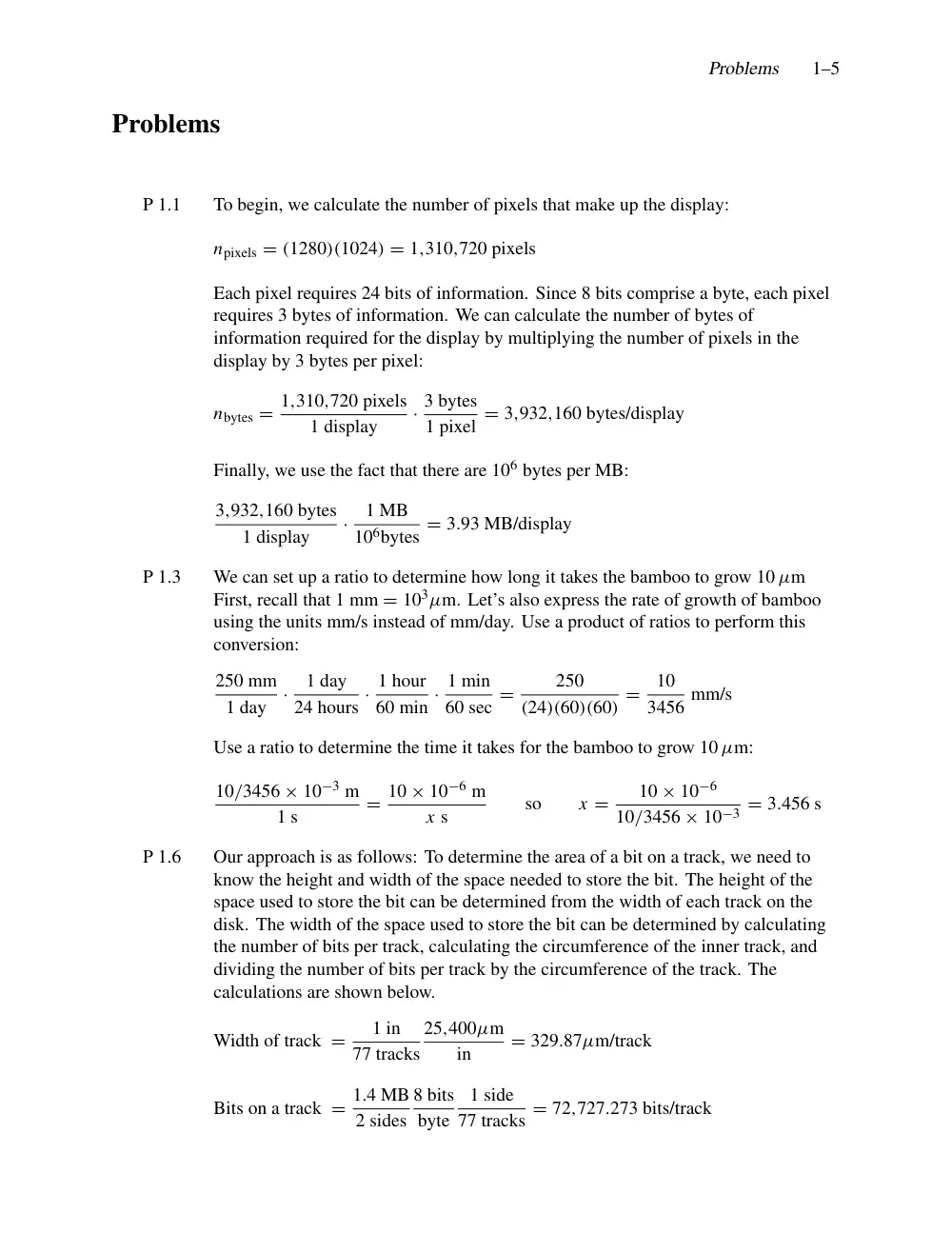
P 1.1
To begin, we calculate the number of pixels that make up the display:
npixels = (1280)(1024) = 1,310,720 pixels
Each pixel requires 24 bits of information. Since 8 bits comprise a byte, each pixel
requires 3 bytes of information. We can calculate the number of bytes of
information required for the display by multiplying the number of pixels in the
display by 3 bytes per pixel:
nbytes = 1,310,720 pixels
1 display
· 3 bytes
1 pixel = 3,932,160 bytes/display
Finally, we use the fact that there are 106 bytes per MB:
3,932,160 bytes
1 display
·
1 MB
106bytes = 3.93 MB/display
P 1.3
We can set up a ratio to determine how long it takes the bamboo to grow 10 µm
First, recall that 1 mm = 103µm. Let’s also express the rate of growth of bamboo
using the units mm/s instead of mm/day. Use a product of ratios to perform this
conversion:
250 mm
1 day
·
1 day
24 hours · 1 hour
60 min · 1 min
60 sec =
250
(24)(60)(60) =
10
3456 mm/s
Use a ratio to determine the time it takes for the bamboo to grow 10 µm:
10/3456 × 10−3 m
1 s
= 10 × 10−6 m
x s
so
x =
10 × 10−6
10/3456 × 10−3 = 3.456 s
P 1.6
Our approach is as follows: To determine the area of a bit on a track, we need to
know the height and width of the space needed to store the bit. The height of the
space used to store the bit can be determined from the width of each track on the
disk. The width of the space used to store the bit can be determined by calculating
the number of bits per track, calculating the circumference of the inner track, and
dividing the number of bits per track by the circumference of the track. The
calculations are shown below.
Width of track =
1 in
77 tracks
25,400µm
in
= 329.87µm/track
Bits on a track = 1.4 MB
2 sides
8 bits
byte
1 side
77 tracks = 72,727.273 bits/track
1–6
CHAPTER 1. Circuit Variables
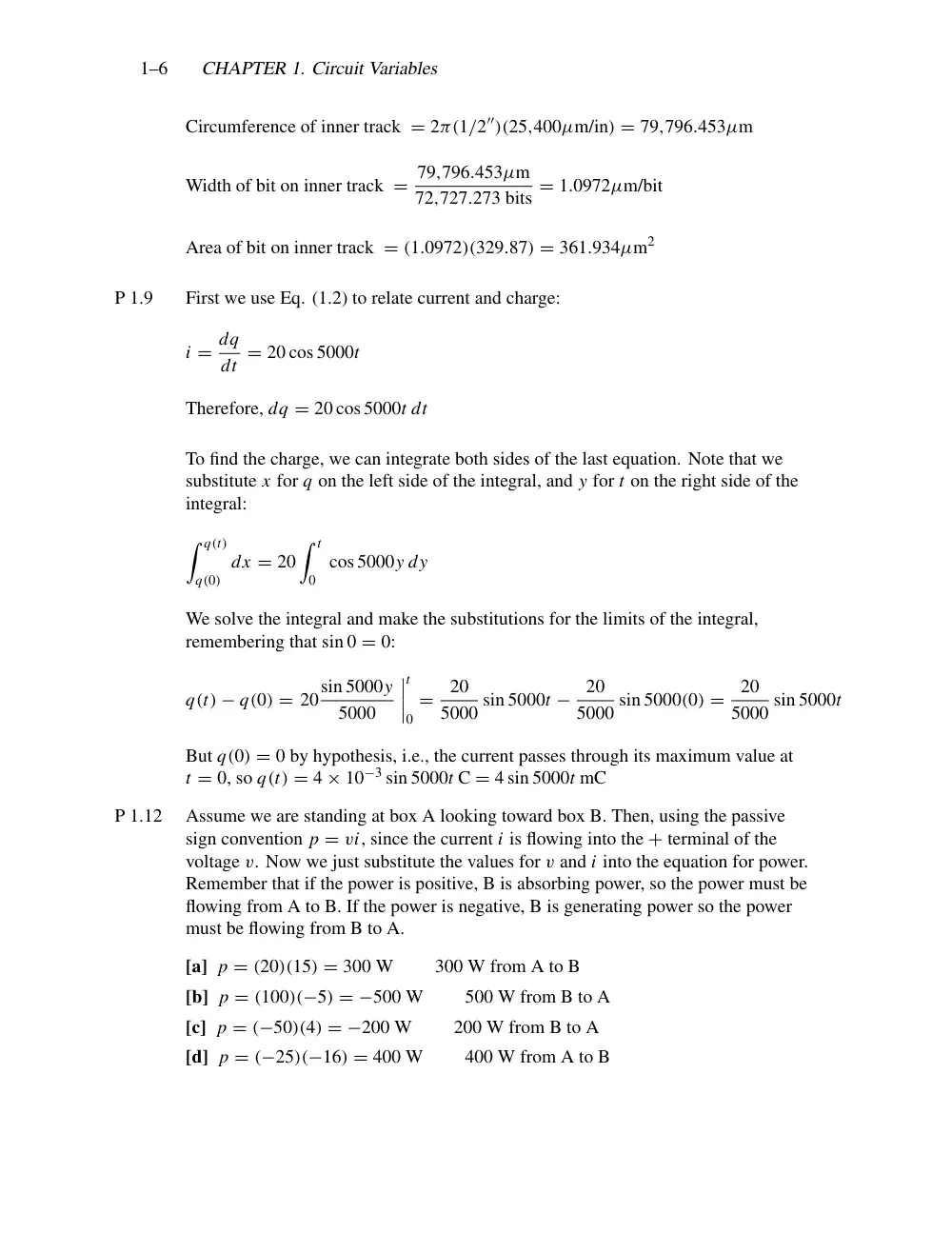
Circumference of inner track = 2π(1/2′′)(25,400µm/in) = 79,796.453µm
Width of bit on inner track = 79,796.453µm
72,727.273 bits = 1.0972µm/bit
Area of bit on inner track = (1.0972)(329.87) = 361.934µm2
P 1.9
First we use Eq. (1.2) to relate current and charge:
i = dq
dt = 20 cos 5000t
Therefore, dq = 20 cos 5000t dt
To find the charge, we can integrate both sides of the last equation. Note that we
substitute x for q on the left side of the integral, and y for t on the right side of the
integral:
� q(t)
q(0)
dx = 20
� t
0
cos 5000y dy
We solve the integral and make the substitutions for the limits of the integral,
remembering that sin 0 = 0:
q(t) − q(0) = 20sin 5000y
5000
����
t
0
=
20
5000 sin 5000t −
20
5000 sin 5000(0) =
20
5000 sin 5000t
But q(0) = 0 by hypothesis, i.e., the current passes through its maximum value at
t = 0, so q(t) = 4 × 10⁻³ sin 5000t C = 4 sin 5000t mC
P 1.12
Assume we are standing at box A looking toward box B. Then, using the passive
sign convention p = vi, since the current i is flowing into the + terminal of the
voltage v. Now we just substitute the values for v and i into the equation for power.
Remember that if the power is positive, B is absorbing power, so the power must be
flowing from A to B. If the power is negative, B is generating power so the power
must be flowing from B to A.
[a] p = (20)(15) = 300 W
300 W from A to B
[b] p = (100)(−5) = −500 W
500 W from B to A
[c] p = (−50)(4) = −200 W
200 W from B to A
[d] p = (−25)(−16) = 400 W
400 W from A to B
Problems
1–7
P 1.17
[a] To find the power at 625 µs, we substitute this value of time into both the
equations for v(t) and i(t) and multiply the resulting numbers to get p(625 µs):
v(625 µs) = 50e−1600(625×10−6) − 50e−400(625×10−6) = 18.394 − 38.94 = −20.546 V
i(625 µs) = 5 × 10⁻³e−1600(625×10−6) − 5 × 10⁻³e−400(625×10−6)
= 0.0018394 − 0.003894 = −0.0020546 A
p(625 µs) = (−20.546)(−0.0020546) = 42.2 mW
[b] To find the energy at 625 µs, we need to integrate the equation for p(t) from 0
to 625 µs. To start, we need an expression for p(t):
p(t) = v(t)i(t) = (50)(5 × 10⁻³)(e−1600t − e−400t)(e−1600t − e−400t)
= 1
4(e−3200t − 2e−2000t + e−800t)
Now we integrate this expression for p(t) to get an expression for w(t). Note
we substitute x for t on the right side of the integral.
w(t) = 1
4
� t
0
(e−3200x − 2e−2000x + e−800x)dx
= 1
4
�e−3200x
−3200 + e−2000x
1000
− e−800x
800
�����
t
0
= 1
4
�e−3200t
−3200 + e−2000t
1000 − e−800t
800
−
�
1
−3200 +
1
1000 −
1
800
��
= 1
4
�e−3200t
−3200 + e−2000t
1000 − e−800t
800
+ 5.625 × 10⁻⁴
�
Finally, substitute t = 625 µs into the equation for w(t):
w(625 µs) = 1
4[−4.2292 × 10⁻⁵ + 2.865 × 10⁻⁴ − 7.5816 × 10⁻⁴ + 5.625 × 10⁻⁴]
= 12.137 µJ
[c] To find the total energy, we let t → ∞ in the above equation for w(t). Note that
this will cause all expressions of the form e−nt to go to zero, leaving only the
constant term 5.625 × 10⁻⁴. Thus,
wtotal = 1
4[5.625 × 10⁻⁴] = 140.625 µJ
1–8
CHAPTER 1. Circuit Variables
P 1.24
[a] We can find the time at which the power is a maximum by writing an expression
for p(t) = v(t)i(t), taking the first derivative of p(t) and setting it to zero,
then solving for t. The calculations are shown below:
p
=
0
t < 0,
p = 0
t > 40 s
p
=
vi = (t − 0.025t2)(4 − 0.2t) = 4t − 0.3t2 + 0.005t3 W
0 < t < 40 s
dp
dt
=
4 − 0.6t + 0.015t2 = 0
Use a calculator to find the two solutions to this quadratic equation:
t1 = 8.453 s;
t2 = 31.547 s
Now we must find which of these two times gives the minimum power by
substituting each of these values for t into the equation for p(t):
p(t1)
=
(8.453 − 0.025(8.453)2)(4 − 0.2 · 8.453) = 15.396 W
p(t2)
=
(31.547 − 0.025(31.547)2)(4 − 0.2 · 31.547) = −15.396 W
Therefore, maximum power is being delivered at t = 8.453 s.
[b] The maximum power was calculated in part (a) to determine the time at which
the power is maximum: pmax = 15.396 W (delivered)
[c] As we saw in part (a), the other “maximum” power is actually a minimum, or
the maximum negative power. As we calculated in part (a), maximum power is
being extracted at t = 31.547 s.
[d] This maximum extracted power was calculated in part (a) to determine the time
at which power is maximum: pmaxext = 15.396 W (extracted)
[e] w =
� t
0
pdx =
� t
0
(4x − 0.3x2 + 0.005x3)dx = 2t2 − 0.1t3 + 0.00125t4
w(0)
=
0 J
w(30)
=
112.50 J
w(10)
=
112.50 J
w(40)
=
0 J
w(20)
=
200 J
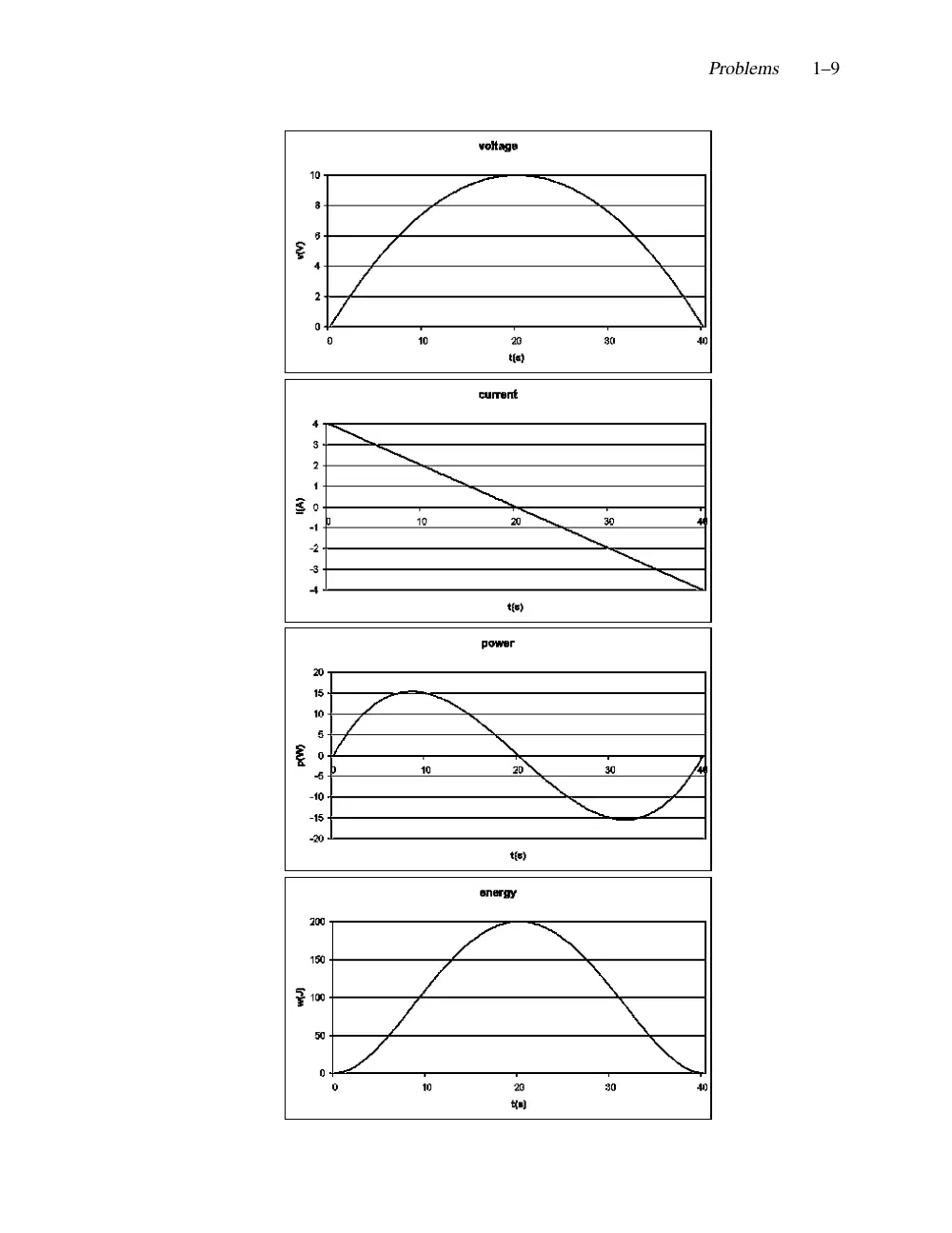
To give you a feel for the quantities of voltage, current, power, and energy and
their relationships among one another, they are plotted below:
Problems
1–9
1–10
CHAPTER 1. Circuit Variables
P 1.26
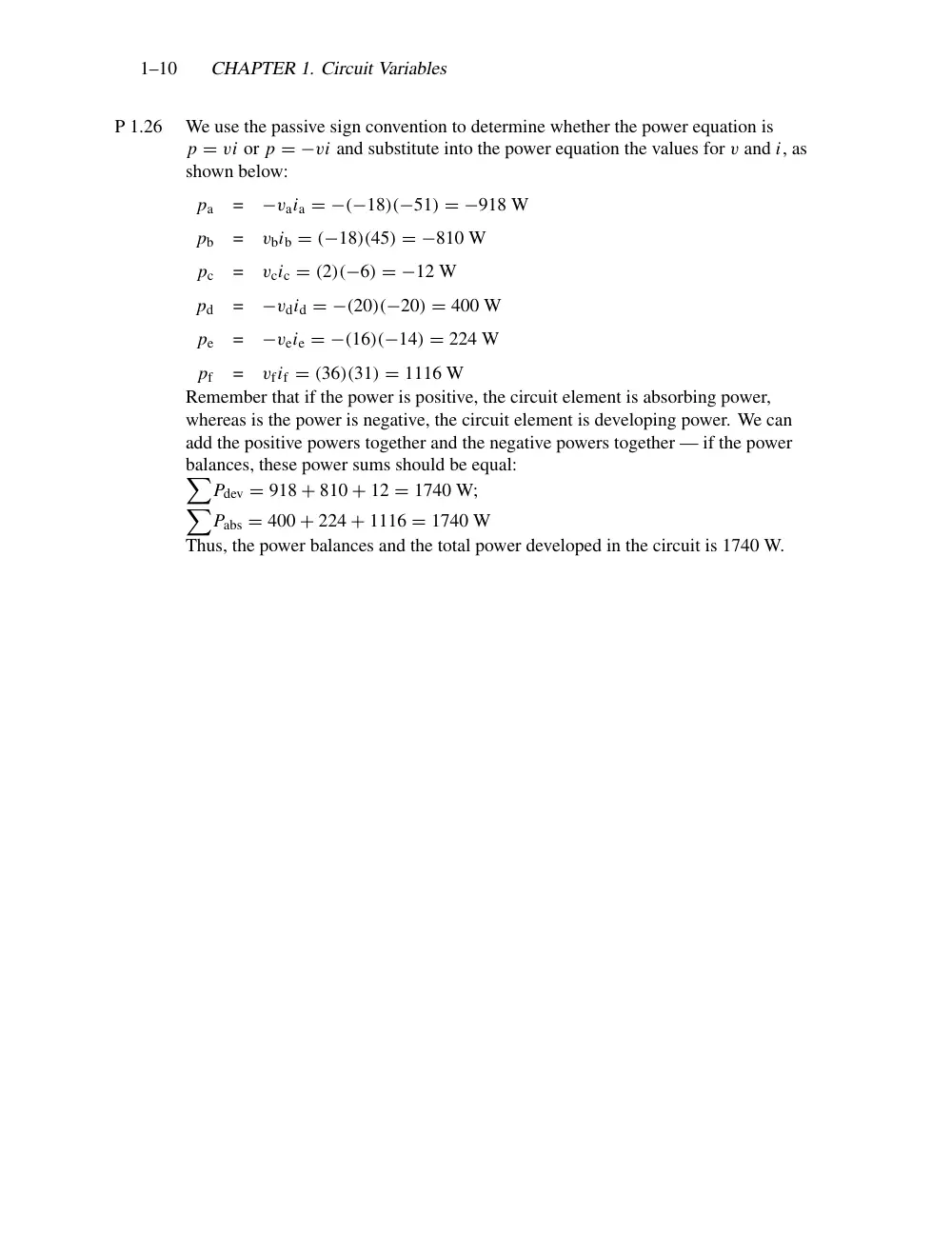
We use the passive sign convention to determine whether the power equation is
p = vi or p = −vi and substitute into the power equation the values for v and i, as
shown below:
pa
=
−vaia = −(−18)(−51) = −918 W
pb
=
vbib = (−18)(45) = −810 W
pc
=
vcic = (2)(−6) = −12 W
pd
=
−vdid = −(20)(−20) = 400 W
pe
=
−veie = −(16)(−14) = 224 W
pf
=
vfif = (36)(31) = 1116 W
Remember that if the power is positive, the circuit element is absorbing power,
whereas is the power is negative, the circuit element is developing power. We can
add the positive powers together and the negative powers together — if the power
balances, these power sums should be equal:
�
�Pdev = 918 + 810 + 12 = 1740 W;
Pabs = 400 + 224 + 1116 = 1740 W
Thus, the power balances and the total power developed in the circuit is 1740 W.