
EECE 310 Homework 1 with Solution, Fall 2007
American University of Beirut · Electronics · 4 pages · with solution
More EECE 310 files
- Homework Spice2 Solution · Summer 2012Homework · with solutionView
- Homework Spice3 Solution · Summer 2012Homework · with solutionView
- Homework Spice1 Solution · Summer 2012Homework · with solutionView
- Homework 1 Solution · Fall 2011Homework · with solutionView
- Homework 1 · Fall 2011HomeworkView
- Homework 1 · Fall 2011HomeworkView
- Homework 1 Solution · Fall 2011Homework · with solutionView
- Homework 10 · Fall 2011HomeworkView
Show the text of this homework
American University of Beirut
Department of Electrical and Computer Engineering
EECE 310 – Electronics
Fall 2007 – 2008
Homework 1
Due Tuesday October 9, 2007
1.
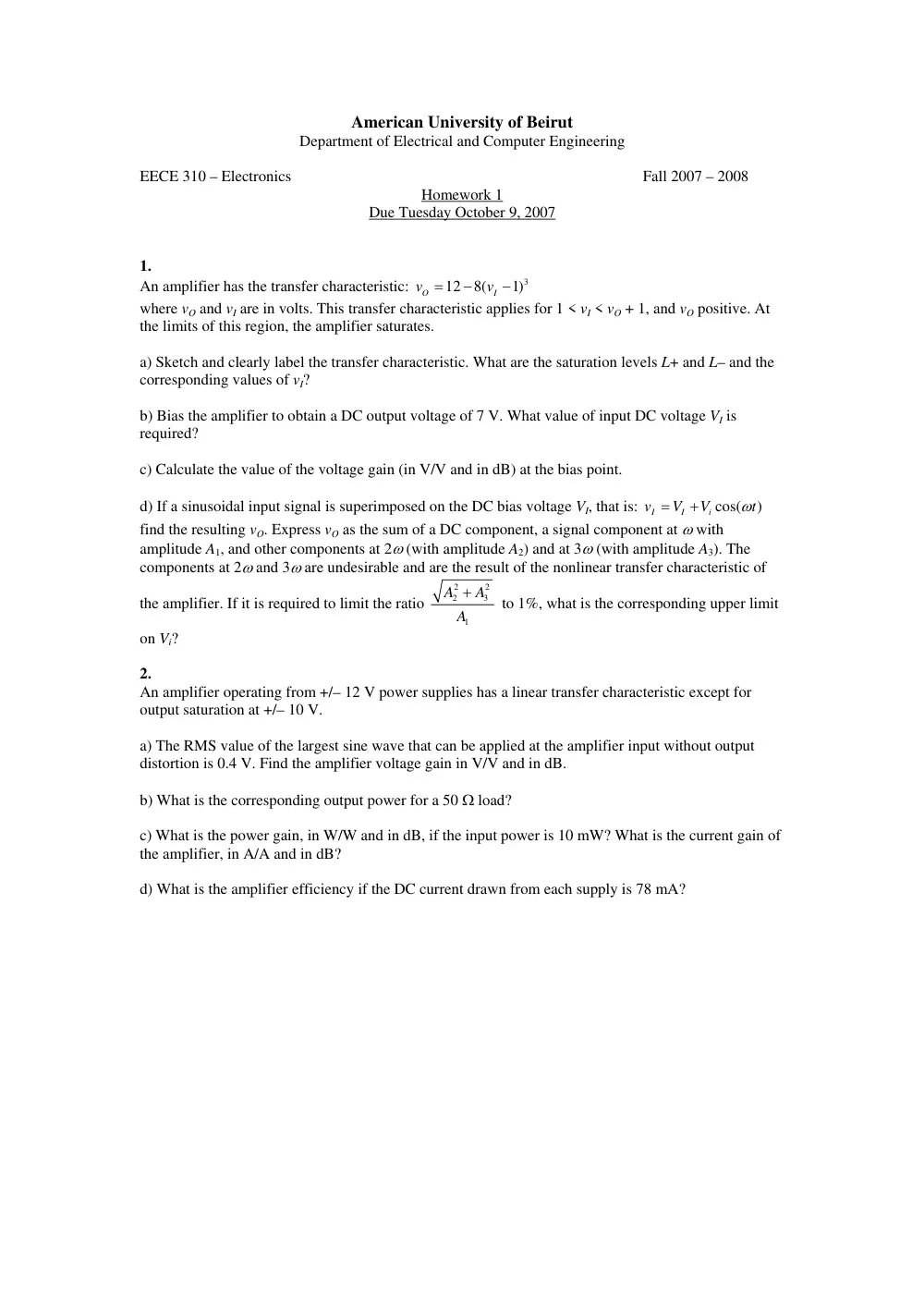
An amplifier has the transfer characteristic:
3
12
8(
1)
O
I
v
v
=
−
−
where vO and vI are in volts. This transfer characteristic applies for 1 < vI < vO + 1, and vO positive. At
the limits of this region, the amplifier saturates.
a) Sketch and clearly label the transfer characteristic. What are the saturation levels L+ and L– and the
corresponding values of vI?
b) Bias the amplifier to obtain a DC output voltage of 7 V. What value of input DC voltage VI is
required?
c) Calculate the value of the voltage gain (in V/V and in dB) at the bias point.
d) If a sinusoidal input signal is superimposed on the DC bias voltage VI, that is:
cos(
)
I
I
i
v
V
V
ωt
=
+
find the resulting vO. Express vO as the sum of a DC component, a signal component at ω with
amplitude A1, and other components at 2ω (with amplitude A2) and at 3ω (with amplitude A3). The
components at 2ω and 3ω are undesirable and are the result of the nonlinear transfer characteristic of
the amplifier. If it is required to limit the ratio
2
2
2
3
1
A
A
A
+
to 1%, what is the corresponding upper limit
on Vi?
2.
An amplifier operating from +/– 12 V power supplies has a linear transfer characteristic except for
output saturation at +/– 10 V.
a) The RMS value of the largest sine wave that can be applied at the amplifier input without output
distortion is 0.4 V. Find the amplifier voltage gain in V/V and in dB.
b) What is the corresponding output power for a 50 Ω load?
c) What is the power gain, in W/W and in dB, if the input power is 10 mW? What is the current gain of
the amplifier, in A/A and in dB?
d) What is the amplifier efficiency if the DC current drawn from each supply is 78 mA?
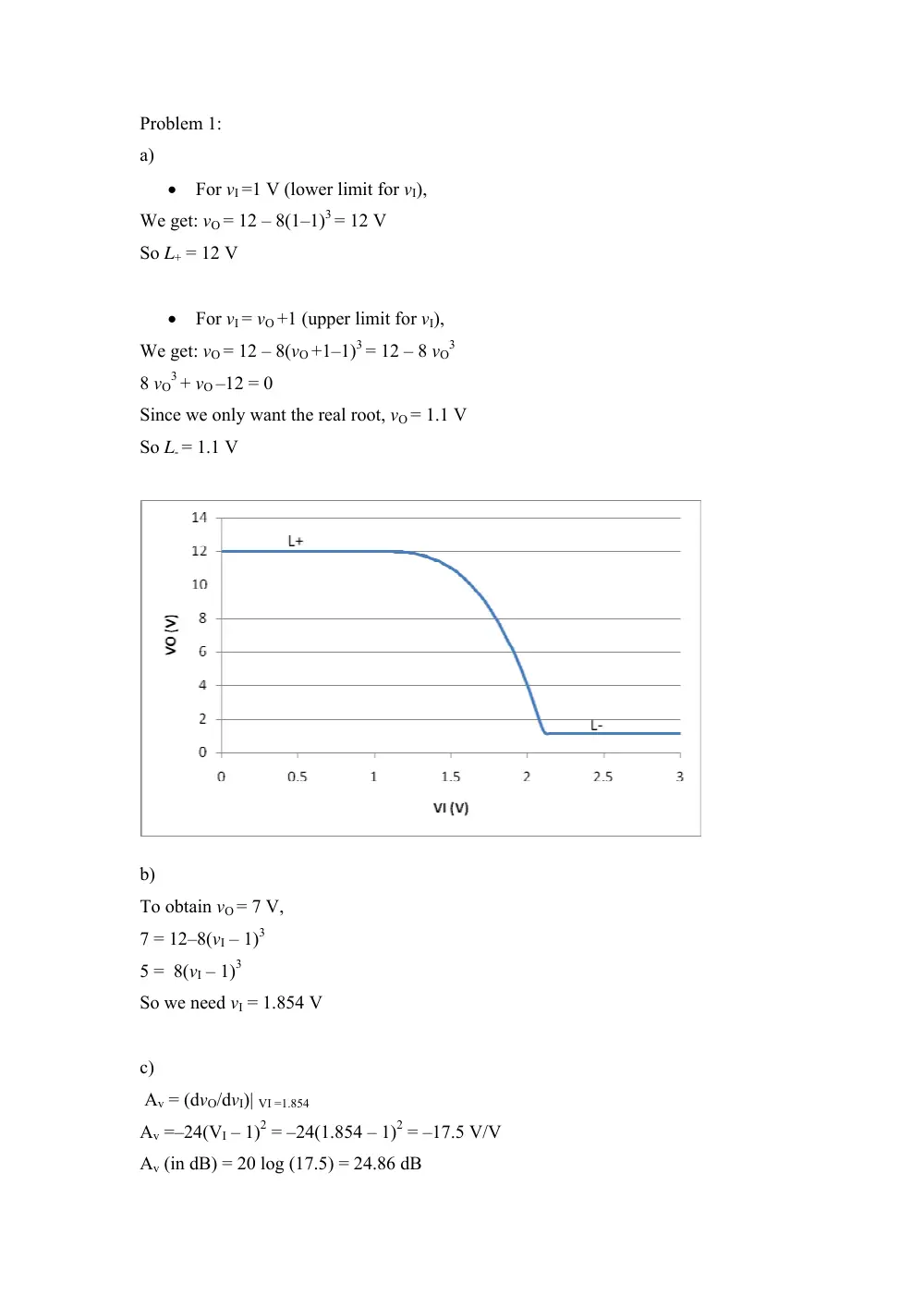
Problem 1:
a)
• For vI =1 V (lower limit for vI),
We get: vO = 12 – 8(1–1)3 = 12 V
So L+ = 12 V
• For vI = vO +1 (upper limit for vI),
We get: vO = 12 – 8(vO +1–1)3 = 12 – 8 vO
3
8 vO
3
+ vO –12 = 0
Since we only want the real root, vO = 1.1 V
So L- = 1.1 V
b)
To obtain vO = 7 V,
7 = 12–8(vI – 1)3
5 = 8(vI – 1)3
So we need vI = 1.854 V
c)
Av = (dvO/dvI)| VI =1.854
Av =–24(VI – 1)2 = –24(1.854 – 1)2 = –17.5 V/V
Av (in dB) = 20 log (17.5) = 24.86 dB
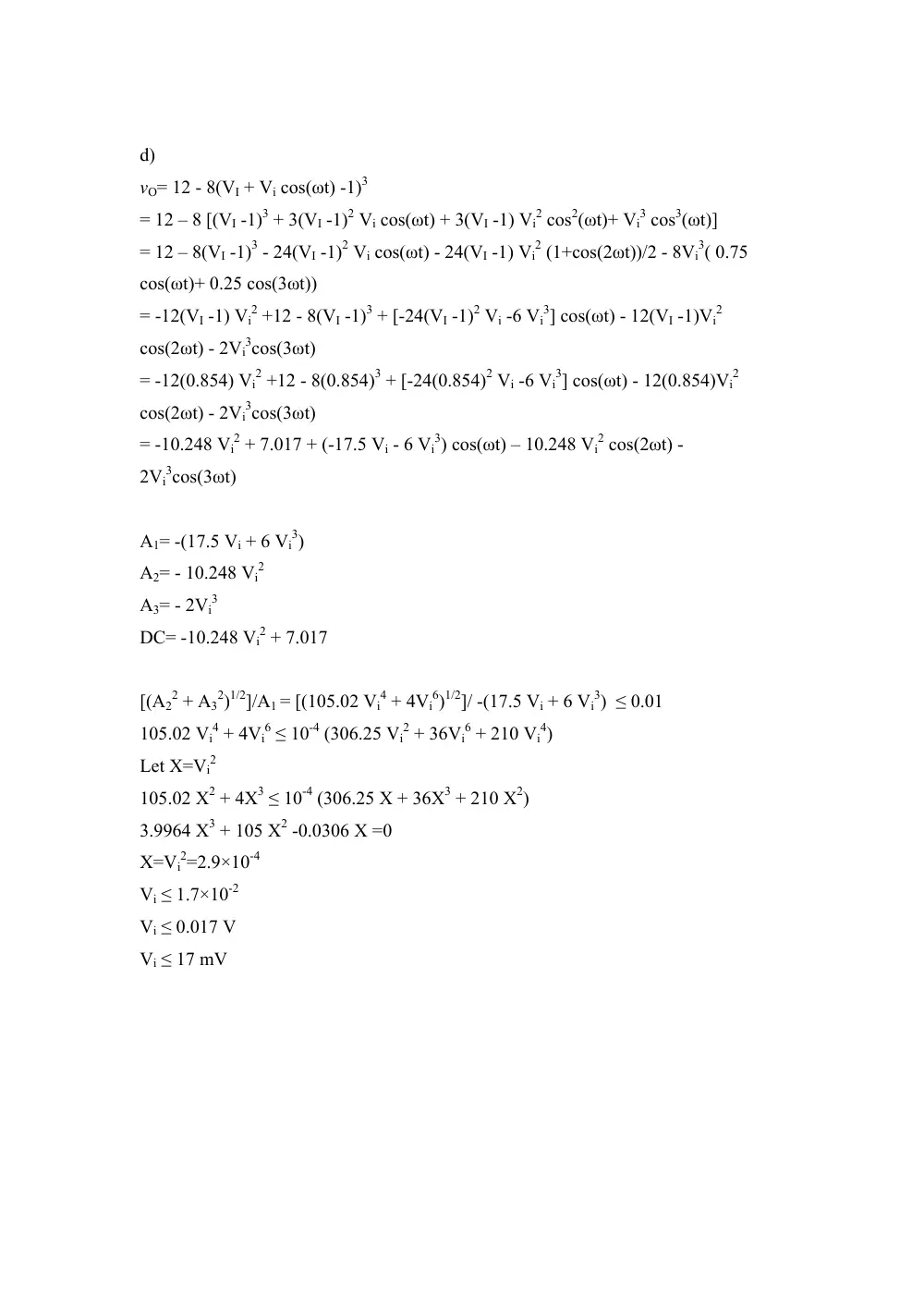
d)
vO= 12 - 8(VI + Vi cos(ωt) -1)3
= 12 – 8 [(VI -1)3 + 3(VI -1)2 Vi cos(ωt) + 3(VI -1) Vi
2 cos2(ωt)+ Vi
3 cos3(ωt)]
= 12 – 8(VI -1)3 - 24(VI -1)2 Vi cos(ωt) - 24(VI -1) Vi
2 (1+cos(2ωt))/2 - 8Vi
3( 0.75
cos(ωt)+ 0.25 cos(3ωt))
= -12(VI -1) Vi
2 +12 - 8(VI -1)3 + [-24(VI -1)2 Vi -6 Vi
3] cos(ωt) - 12(VI -1)Vi
2
cos(2ωt) - 2Vi
3cos(3ωt)
= -12(0.854) Vi
2 +12 - 8(0.854)3 + [-24(0.854)2 Vi -6 Vi
3] cos(ωt) - 12(0.854)Vi
2
cos(2ωt) - 2Vi
3cos(3ωt)
= -10.248 Vi
2 + 7.017 + (-17.5 Vi - 6 Vi
3) cos(ωt) – 10.248 Vi
2 cos(2ωt) -
2Vi
3cos(3ωt)
A1= -(17.5 Vi + 6 Vi
3)
A2= - 10.248 Vi
2
A3= - 2Vi
3
DC= -10.248 Vi
2 + 7.017
[(A2
2 + A3
2)1/2]/A1 = [(105.02 Vi
4 + 4Vi
6)1/2]/ -(17.5 Vi + 6 Vi
3) ≤ 0.01
105.02 Vi
4 + 4Vi
6 ≤ 10-4 (306.25 Vi
2 + 36Vi
6 + 210 Vi
4)
Let X=Vi
2
105.02 X2 + 4X3 ≤ 10-4 (306.25 X + 36X3 + 210 X2)
3.9964 X3 + 105 X2 -0.0306 X =0
X=Vi
2=2.9×10⁻⁴
Vi ≤ 1.7×10⁻²
Vi ≤ 0.017 V
Vi ≤ 17 mV
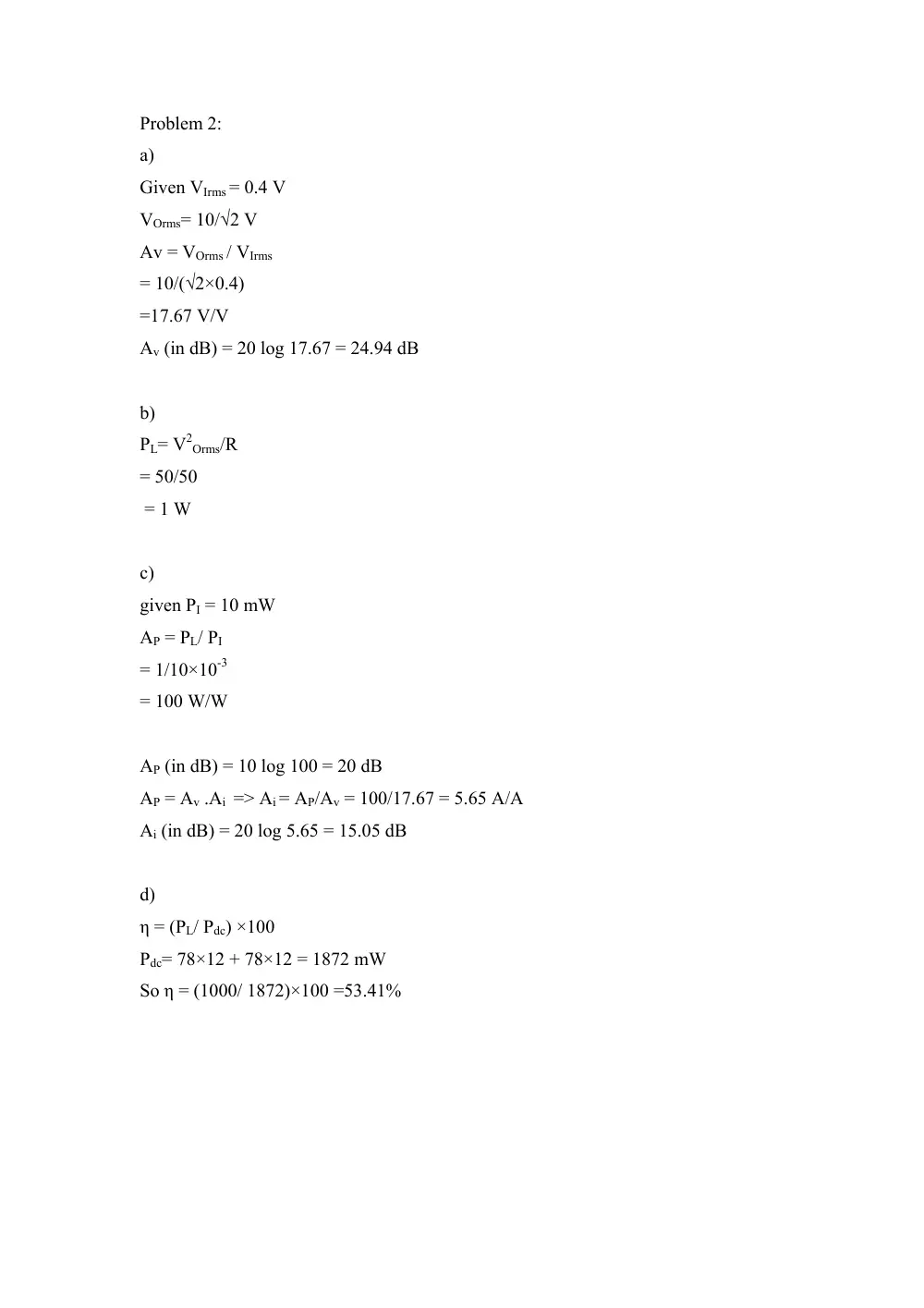
Problem 2:
a)
Given VIrms = 0.4 V
VOrms= 10/√2 V
Av = VOrms / VIrms
= 10/(√2×0.4)
=17.67 V/V
Av (in dB) = 20 log 17.67 = 24.94 dB
b)
PL= V2
Orms/R
= 50/50
= 1 W
c)
given PI = 10 mW
AP = PL/ PI
= 1/10×10-3
= 100 W/W
AP (in dB) = 10 log 100 = 20 dB
AP = Av .Ai => Ai = AP/Av = 100/17.67 = 5.65 A/A
Ai (in dB) = 20 log 5.65 = 15.05 dB
d)
η = (PL/ Pdc) ×100
Pdc= 78×12 + 78×12 = 1872 mW
So η = (1000/ 1872)×100 =53.41%