
EECE 320 Exam, Fall 2004
American University of Beirut · Digital Systems Design · 13 pages






Showing the first 10 of 13 pages. Download the PDF to see all of it.
More EECE 320 files
Show the text of this exam
A. CHEHAB
DEPARTMENT OF ELECTRICAL AND COMPUTER EGINEERING
M. MANSOUR
AMERICAN UNIVERSITY OF BEIRUT
FALL TERM 2004-2005
MIDTERM
EE/CCE 2007
EECE320 - DIGITAL SYTEMS DESIGN
NOVEMBER 23, 2003
UNAMEU: _____________________
ID: _____________________
UCOURSE SECTIONU: SECTION 1 (PROF. CHEHAB)
SECTION 2 (PROF. MANSOUR)
INSTRUCTIONS:
o BE AS NEAT AND CLEAR AS POSSIBLE.
o THE SCRATCH BOOKLET UWILL NOTU BE CONSIDERED IN GRADING.
o PROVIDE YOUR ANSWERS IN THE SPACE PROVIDED ON THE QUESTION SHEET.
o INDICATE THE SECTION YOU ARE REGISTERED IN.
o WRITE YOUR NAME AND ID NUMBER IN THE SPACE PROVIDED ABOVE.
o CALCULATORS ARE NOT ALLOWED.
o THE EXAM IS CLOSED BOOK/CLOSED NOTES. THE DURATION IS UTWO HOURSU.
Problem
Total Points
Earned Points
1
20
2
8
3
6
4
10
5
10
6
10
7
8
8
10
9
8
10
16
11
16
Total
122
Page 1 of 13
UProblem 1U: Short questions [20 points]
Answer the following questions:
(CORRECT answer = +1point, NO answer = 0 point, WRONG answer = -1 point)
1. The acronym VHDL stands for ____________________________________________________
________________________________________________________________________________.
2. In logic minimization, a minimal sum can be the canonical sum. True / False (Circle one).
3. Any Boolean function can be built using NAND gates. True / False (Circle one).
4. State the consensus theorem: _______________________________________________________.
5. Consider the binary number 1010111 represented in signed-magnitude notation. The corresponding
2’s complement representation is _____________________________________.
6. The sum of AB.CB16
B and 56.7B8
B in base 4 is ____________________________________________.
7. The decimal value of the smallest n-bit signed-magnitude integer is smaller than the decimal value of
the smallest n-bit 2’s complement integer. True / False (Circle one).
8. Consider the unsigned n-bit integer X. Let Y be the unsigned integer obtained by shifting X p
positions to the left and inserting ones on the right. Determine Y in terms of X and p.
Answer; Y = ____________________________________________.
9. In Boolean algebra, if X = X + Y, then Y = 0. True / False (Circle one).
10. Within a process in VHDL, statements execute sequentially. True / False (Circle one).
11. A with-select construct can be used within a process statement in VHDL. True / False (Circle one).
12. How many pairs of Boolean functions F(a,b,c,d) and G(a,b,c,d) are there that are complements of
each other? (Don’t count a pair more than once.) Answer: _________________________________.
13. Write the entity declaration of a 2-to-4 decoder with input a and output b assuming standard logic
vectors.
Page 2 of 13
14. Complete the following architecture definition for the prime-number detector using select signal
assignment, where N is a 4-bit input and F is the output that is asserted if N is prime:
ARCHITECTURE prime4_arch OF prime IS
BEGIN
END prime4 arch;
15. Co
6. What is the dual of F=ΣBX,Y,Z
B(1,3,5,7)? Answer: ______________________________________.
_______________________________________________________________________________.
8. A function of n variables that includes all the 2Pn
P minterms is equal to ______________________.
9. State the Prime-Implicant theorem: ___________________________________________________.
___________________________________________________________________________________.
mplete the following architecture definition for decoder with output Y:
ARCHITECTURE V2to4dec_b OF V2to4dec IS
SIGNAL Y_s : STD_LOGIC_VECTOR(0 TO 3) ;
BEGIN
PROCESS(IN, EN)
BEGIN
CASE IN IS
WHEN “00” => Y_s <= “1000” ;
_______________________________;
_______________________________;
_______________________________;
_______________________________;
END CASE ;
IF EN = ‘1’ THEN _____________;
ELSE _____________;
END IF ;
END PROCESS;
END V2to4dec_b;
1
17. Define a static 1 hazard: Answer: _________________________________________________
_
1
1
20. What property does a Gray code have? ________________________________________________
Page 3 of 13
UProblem 2 [8 points]
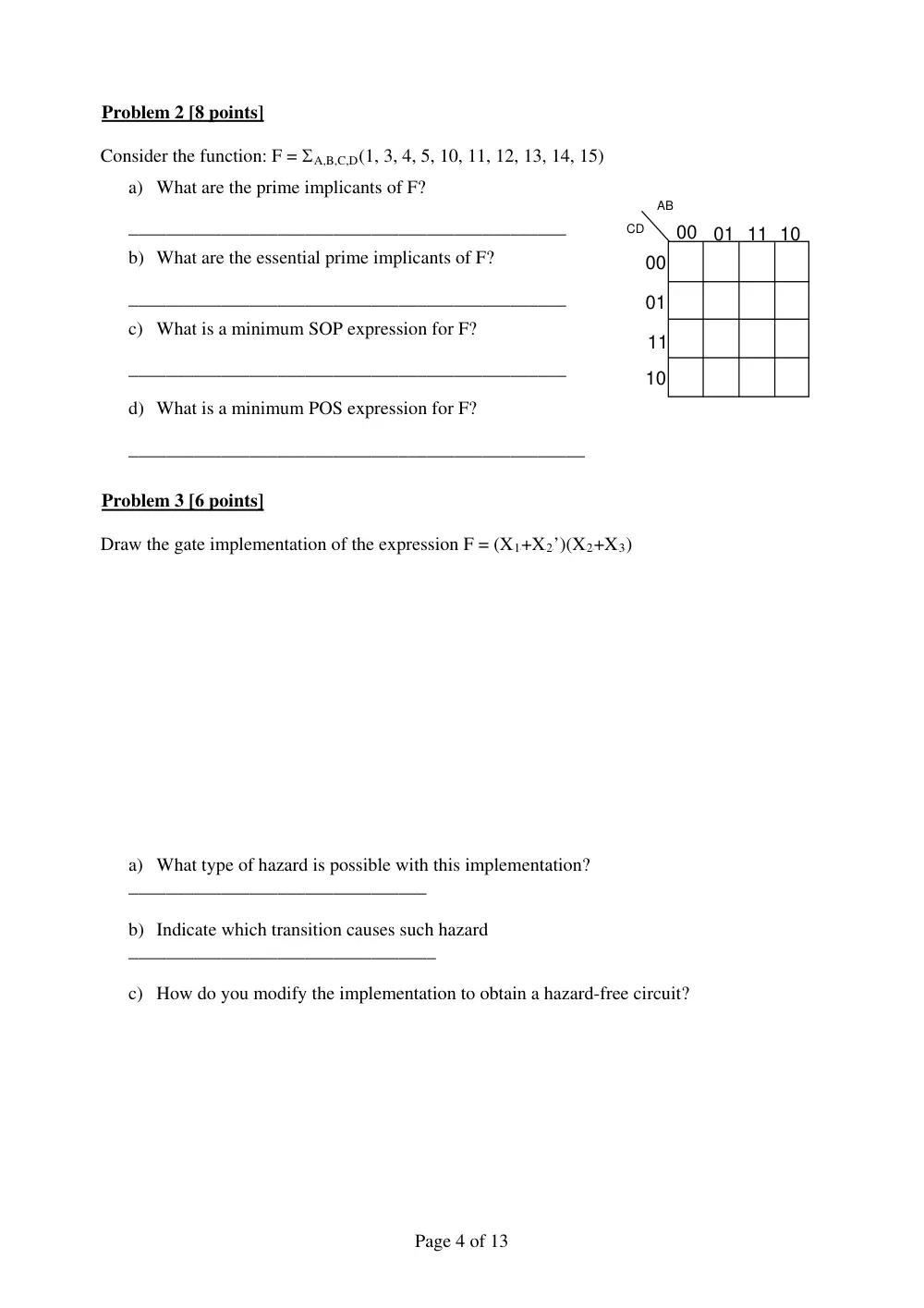
Consider the function: F = ΣBA,B,C,D
B(1, 3, 4, 5, 10, 11, 12, 13, 14, 15)
a) What are the prime implicants of F?
CD
AB
00 01 11 10
00
01
11
10
_______________________________________________
b) What are the essential prime implicants of F?
_______________________________________________
c) What is a minimum SOP expression for F?
_______________________________________________
d) What is a minimum POS expression for F?
_________________________________________________
UProblem 3 [6 points]
Draw the gate implementation of the expression F = (XB1
B+XB2
B’)(XB2
B+XB3
B)
a) What type of hazard is possible with this implementation?
________________________________
b) Indicate which transition causes such hazard
_________________________________
c) How do you modify the implementation to obtain a hazard-free circuit?
Page 4 of 13
UProblem 4U: Boolean Function Implementations [10 points]
a) Implement the Boolean function F = A XOR B using NAND gates. You should use the minimum
number of NAND gates in your implementation. Label all inputs and outputs. First use the scratch
booklet, and then write your final answer clearly below.
b) Consider the 1-bit full adder gate (FA) shown below. It takes as inputs A and B and a carry input
Cin, and generates the sum S of A, B, and Cin, and a carry output Cout. Implement each of the
following functions
Uusing one FA gateU. Label all your inputs and outputs clearly according to the
function to be implemented. Any unused outputs should be connected to ground.
FA
A B
Cin
Cout
S
FB1
B = X.Y
FB2
B = X + Y
FB3
B = X XORY
FB4
B = X XNOR Y
FB5
B = X’
FB6
B = X XNOR Y XNOR Z
Page 5 of 13
UProblem 5U: Shannon’s Theorem [10 points]
Consider the Boolean function F(a,b,c,d,e,f,g,h) = a’b’c’d + ag’h+ ag + a’b’ce + a’bf’’. Using Boolean
algebra, show that F can be implemented with 2-to-1 multiplexers only (no other gates or inverters).
Inputs to the circuit are the variables a, b, c ,... and the constants 0 and 1. Draw the resulting logic
circuit.
Page 6 of 13
UProblem 6U: Majority Function [10 points]
An n-bit majority function generates a 1 if more than half the input bits are one (i.e., n/2 or more bits are
one assuming n even). Design a 4-bit majority function F using a single 4-to-1 multiplexer and minimal
extra gates.
Page 7 of 13
UProblem 7U: Look-Up Tables [8 points]
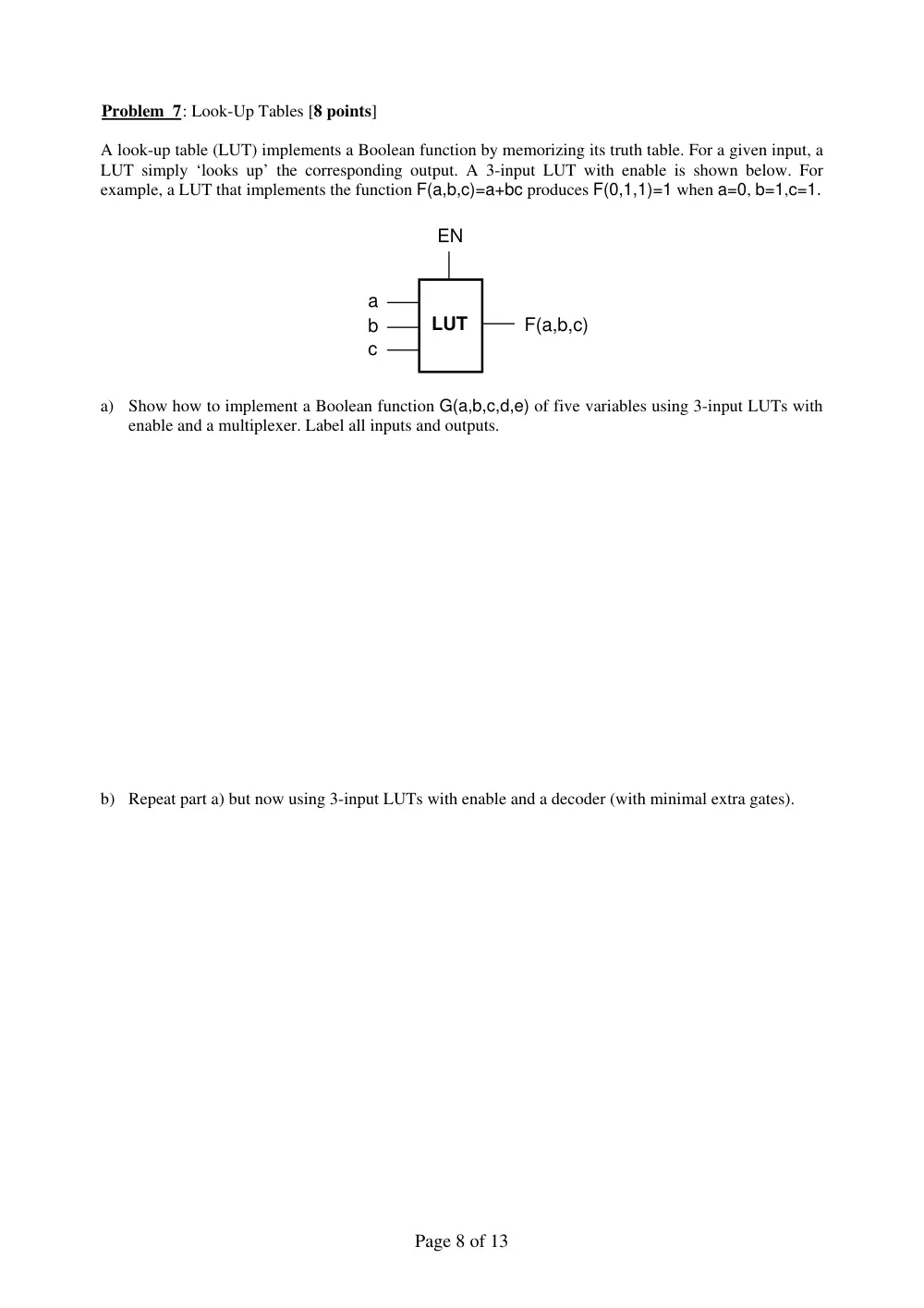
A look-up table (LUT) implements a Boolean function by memorizing its truth table. For a given input, a
LUT simply ‘looks up’ the corresponding output. A 3-input LUT with enable is shown below. For
example, a LUT that implements the function F(a,b,c)=a+bc produces F(0,1,1)=1 when a=0, b=1,c=1.
LUT
EN
F(a,b,c)
a
b
c
a) Show how to implement a Boolean function G(a,b,c,d,e) of five variables using 3-input LUTs with
enable and a multiplexer. Label all inputs and outputs.
b) Repeat part a) but now using 3-input LUTs with enable and a decoder (with minimal extra gates).
Page 8 of 13
UProblem 8U: Absolute Value Computer [10 points]
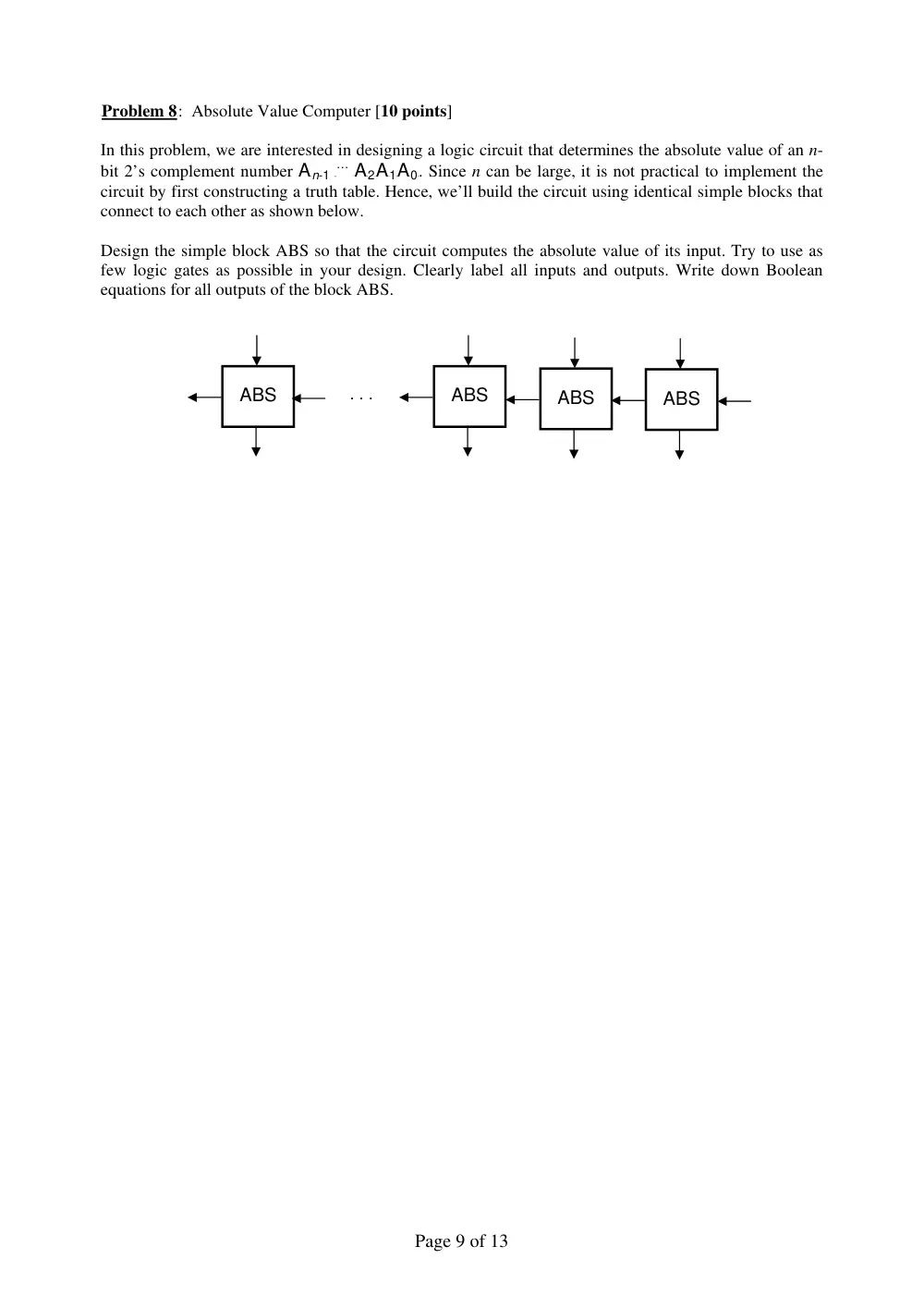
In this problem, we are interested in designing a logic circuit that determines the absolute value of an n-
bit 2’s complement number ABn-1
PB…
PAB2
BAB1
BAB0
B. Since n can be large, it is not practical to implement the
circuit by first constructing a truth table. Hence, we’ll build the circuit using identical simple blocks that
connect to each other as shown below.
Design the simple block ABS so that the circuit computes the absolute value of its input. Try to use as
few logic gates as possible in your design. Clearly label all inputs and outputs. Write down Boolean
equations for all outputs of the block ABS.
ABS
ABS
ABS
ABS
. . .
Page 9 of 13
UProblem 9U: Algebraic Manipulations [8 points]
Prove the identity of the following Boolean equation
Uusing algebraic manipulationsU. Justify each
simplifying step you make by stating the corresponding theorem or axiom you use.
WY + W’YZ’ + WXZ + W’XY’ = WY + W’XZ’ + X’YZ’ + XY’Z
Proof:
Page 10 of 13
UProblem 10U: Dual Priority Encoder [16 points]
In this problem, you are asked to design an 8-to-3 priority encoder that identifies the inputs with highest
and second highest priorities using regular 4-to-2 priority encoders with enable. The inputs of the 4-to-2
encoder are defined as follows:
EN: When asserted, block functions as an encoder; otherwise, outputs are zero.
AB3
B,AB2
B,AB1
B,AB0
B: Data inputs where AB3
Bhas highest priority.
BB1
B,BB0
B: Outputs identifying highest priority input.
EO: Asserted if EN=1 and at least one is ABi
Bone.
The output signals BB2
B, BB1
B, BB0
Bof the 8-to-3 dual priority encoder identify the inputs with highest priority
respectively. The output signals CB2
B, C1, C0B
B identify the inputs with second highest priority. The signal
EOB is asserted if a highest priority input is detected, and EOC is asserted if a second-highest priority
input is detected.
In your design, you can use standard logic gates (AND, OR, NOT) as well as 2-to-4 decoders with
enable.
EN
AB3
B
AB2
B
AB1
B
AB0
B
BB1
B
BB0
B
EO
4-to-2
Priority
Encoder
EN
AB7
B
AB6
B
AB5
B
AB4
B
BB1
B
BB0
B
EOB
8-to-3
Dual
Priority
Encoder
AB3
B
AB2
B
AB1
B
AB0
B
BB2
B
CB1
B
CB0
B
CB2
B
EOC
Page 11 of 13
UProblem 11U: VHDL [16 points]
We would like to design a comparator that compares two 8-bit inputs and produces one output
that is set to one if the numbers are equal and 0 otherwise. The design is to be iterative. So, first
design a 1-bit comparator that takes two input data bits and one cascaded input, and produces
one cascaded output. Find the expression of the output in terms of the inputs.
Write a VHDL entity and architecture that implements the 1-bit comparator. Then, write a
VHDL entity and architecture that implements the 8-bit comparator by cascading 1-bit
comparators. Finally, write a testbench that tests the implementation with the following inputs:
A = 0x23 and B = 0x32
A = 0x34 and B = 0x34
A = 0xFF and B = 0x00
Page 12 of 13
Page 13 of 13