
EECE 320 Midterm, Fall 2004
American University of Beirut · Digital Systems Design · 11 pages · Prof. Ali Chehab

Showing the first 10 of 11 pages. Download the PDF to see all of it.
More EECE 320 files
Show the text of this exam
Page 1 of 11
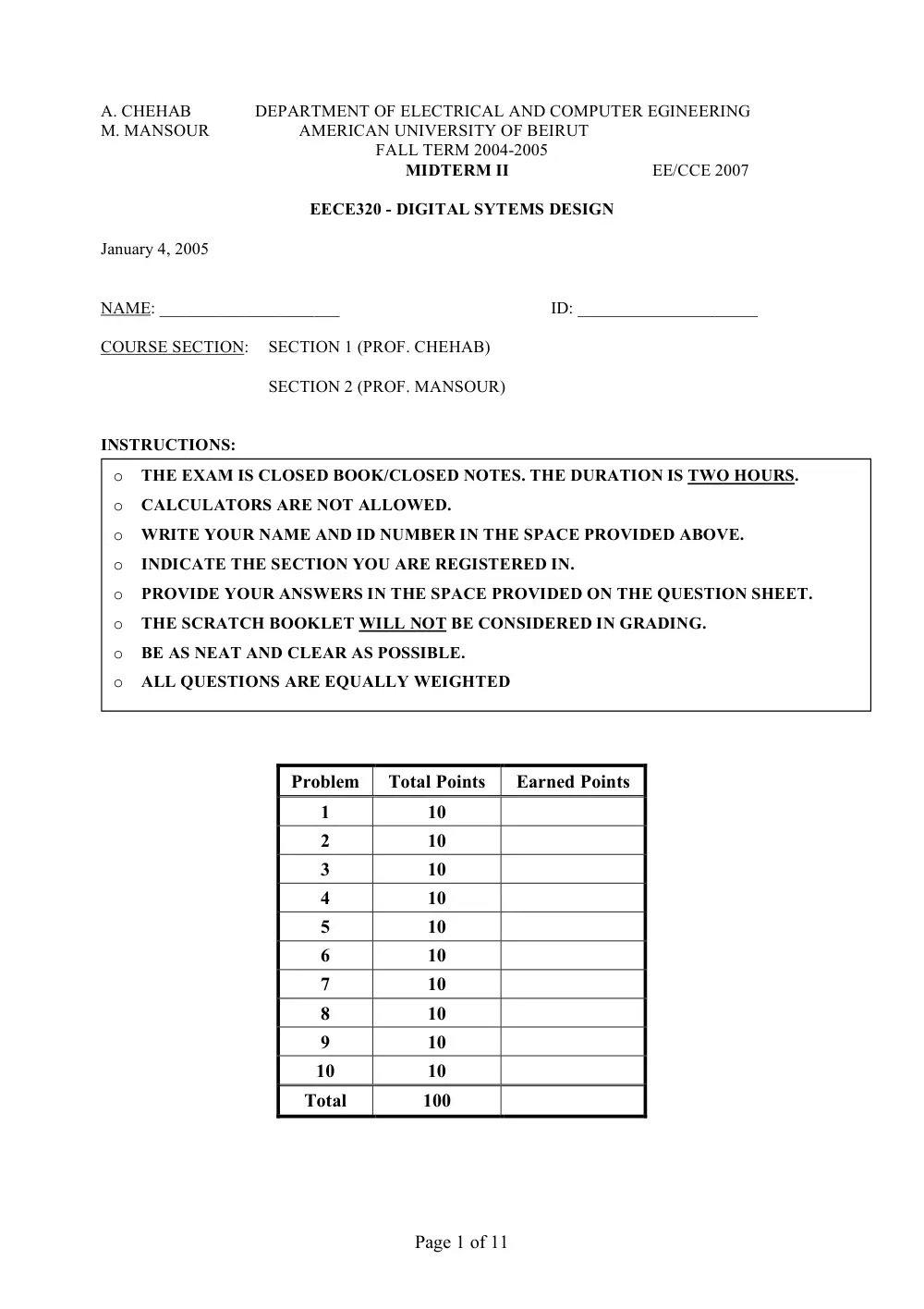
A. CHEHAB
DEPARTMENT OF ELECTRICAL AND COMPUTER EGINEERING
M. MANSOUR
AMERICAN UNIVERSITY OF BEIRUT
FALL TERM 2004-2005
MIDTERM II
EE/CCE 2007
EECE320 - DIGITAL SYTEMS DESIGN
January 4, 2005
NAME: _____________________
ID: _____________________
COURSE SECTION:
SECTION 1 (PROF. CHEHAB)
SECTION 2 (PROF. MANSOUR)
INSTRUCTIONS:
Problem
Total Points
Earned Points
1
10
2
10
3
10
4
10
5
10
6
10
7
10
8
10
9
10
10
10
Total
100
o THE EXAM IS CLOSED BOOK/CLOSED NOTES. THE DURATION IS TWO HOURS.
o CALCULATORS ARE NOT ALLOWED.
o WRITE YOUR NAME AND ID NUMBER IN THE SPACE PROVIDED ABOVE.
o INDICATE THE SECTION YOU ARE REGISTERED IN.
o PROVIDE YOUR ANSWERS IN THE SPACE PROVIDED ON THE QUESTION SHEET.
o THE SCRATCH BOOKLET WILL NOT BE CONSIDERED IN GRADING.
o BE AS NEAT AND CLEAR AS POSSIBLE.
o ALL QUESTIONS ARE EQUALLY WEIGHTED
Page 2 of 11
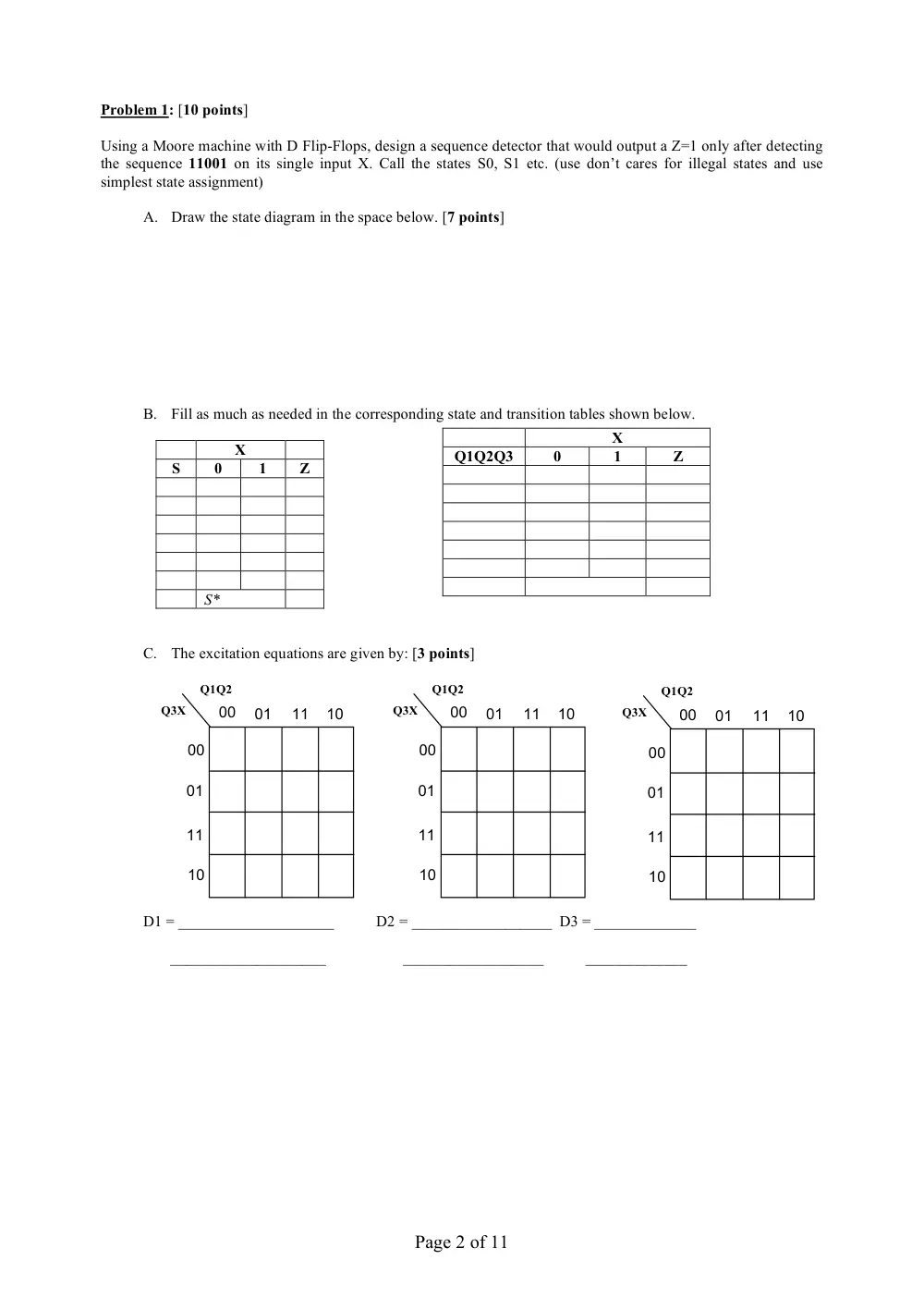
Problem 1: [10 points]
Using a Moore machine with D Flip-Flops, design a sequence detector that would output a Z=1 only after detecting
the sequence 11001 on its single input X. Call the states S0, S1 etc. (use don’t cares for illegal states and use
simplest state assignment)
A. Draw the state diagram in the space below. [7 points]
B. Fill as much as needed in the corresponding state and transition tables shown below.
X
S
0
1
Z
S*
C. The excitation equations are given by: [3 points]
D1 = ____________________ D2 = __________________ D3 = _____________
____________________ __________________ _____________
X
Q1Q2Q3
0
1
Z
Q3X
Q1Q2
00
01
11
10
00
01
11
10
Q3X
Q1Q2
00
01
11
10
00
01
11
10
Q3X
Q1Q2
00
01
11
10
00
01
11
10
Page 3 of 11
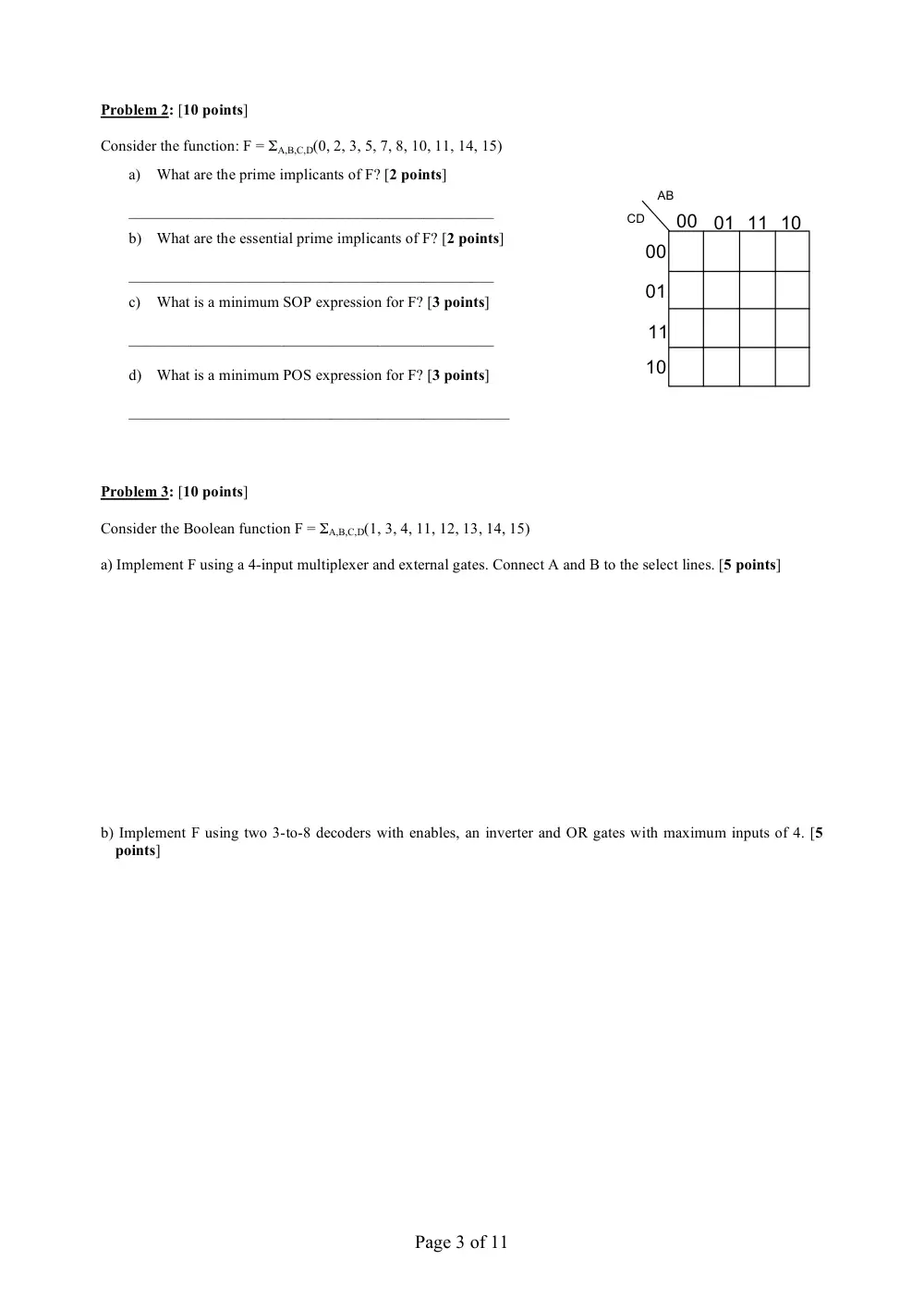
Problem 2: [10 points]
Consider the function: F = ΣA,B,C,D(0, 2, 3, 5, 7, 8, 10, 11, 14, 15)
a) What are the prime implicants of F? [2 points]
_______________________________________________
b) What are the essential prime implicants of F? [2 points]
_______________________________________________
c) What is a minimum SOP expression for F? [3 points]
_______________________________________________
d) What is a minimum POS expression for F? [3 points]
_________________________________________________
Problem 3: [10 points]
Consider the Boolean function F = ΣA,B,C,D(1, 3, 4, 11, 12, 13, 14, 15)
a) Implement F using a 4-input multiplexer and external gates. Connect A and B to the select lines. [5 points]
b) Implement F using two 3-to-8 decoders with enables, an inverter and OR gates with maximum inputs of 4. [5
points]
CD
AB
00 01 11 10
00
01
11
10
Page 4 of 11
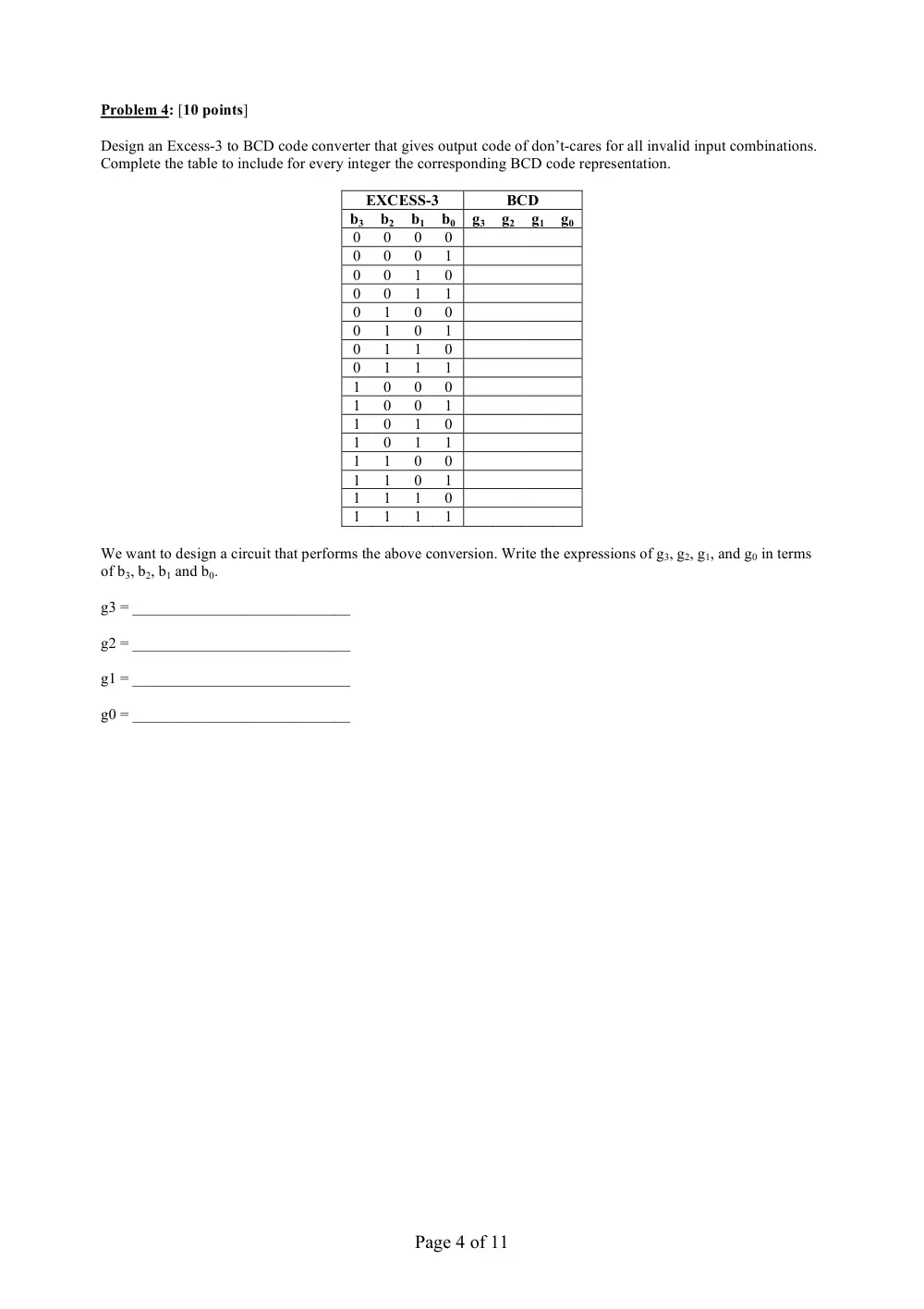
Problem 4: [10 points]
Design an Excess-3 to BCD code converter that gives output code of don’t-cares for all invalid input combinations.
Complete the table to include for every integer the corresponding BCD code representation.
EXCESS-3
BCD
b3
b2
b1
b0
g3
g2
g1
g0
0
0
0
0
0
0
0
1
0
0
1
0
0
0
1
1
0
1
0
0
0
1
0
1
0
1
1
0
0
1
1
1
1
0
0
0
1
0
0
1
1
0
1
0
1
0
1
1
1
1
0
0
1
1
0
1
1
1
1
0
1
1
1
1
We want to design a circuit that performs the above conversion. Write the expressions of g3, g2, g1, and g0 in terms
of b3, b2, b1 and b0.
g3 = ____________________________
g2 = ____________________________
g1 = ____________________________
g0 = ____________________________
Page 5 of 11
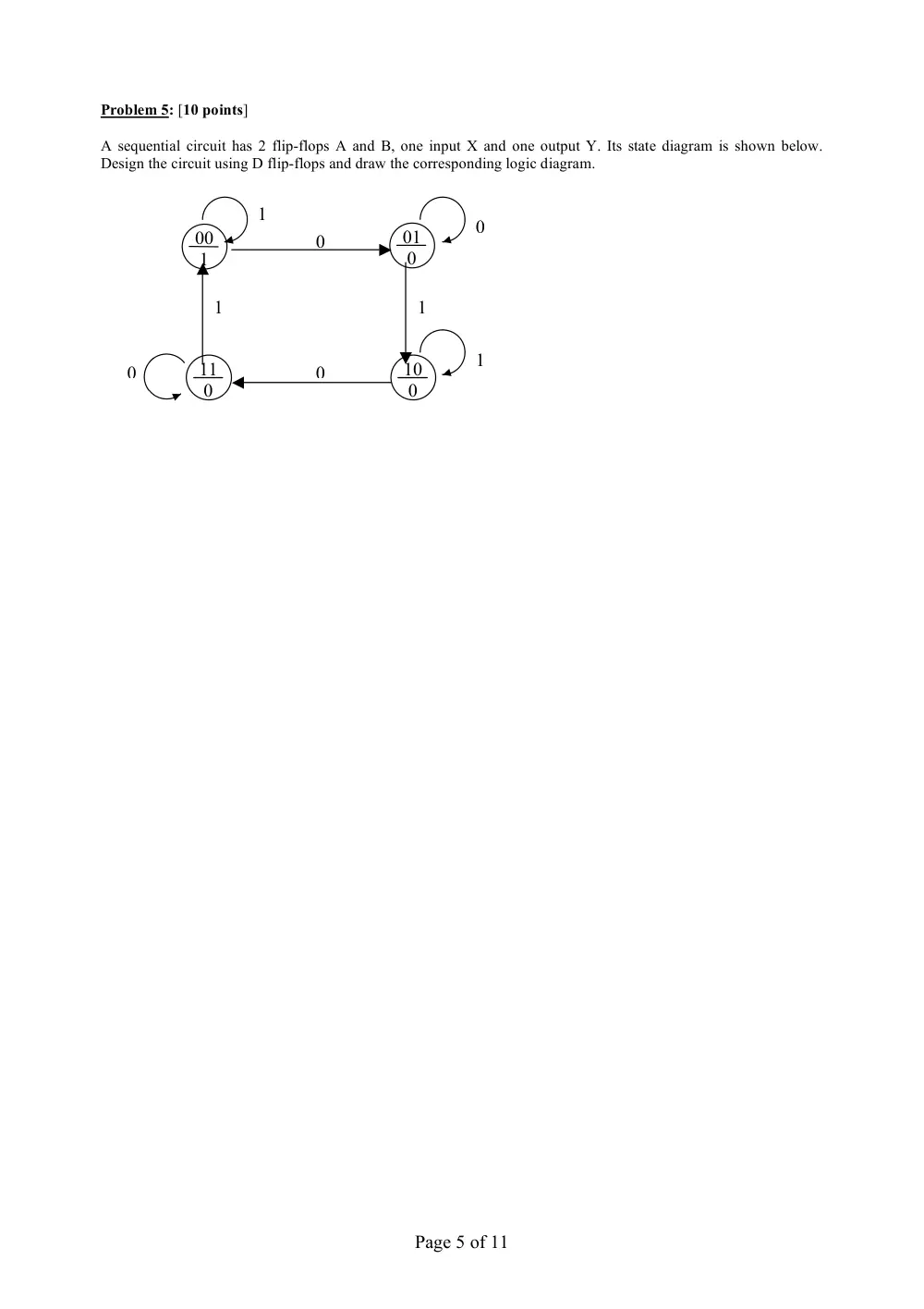
Problem 5: [10 points]
A sequential circuit has 2 flip-flops A and B, one input X and one output Y. Its state diagram is shown below.
Design the circuit using D flip-flops and draw the corresponding logic diagram.
1
0
0
1
1
1
0
0
00
1
01
0
11
0
10
0
Page 6 of 11
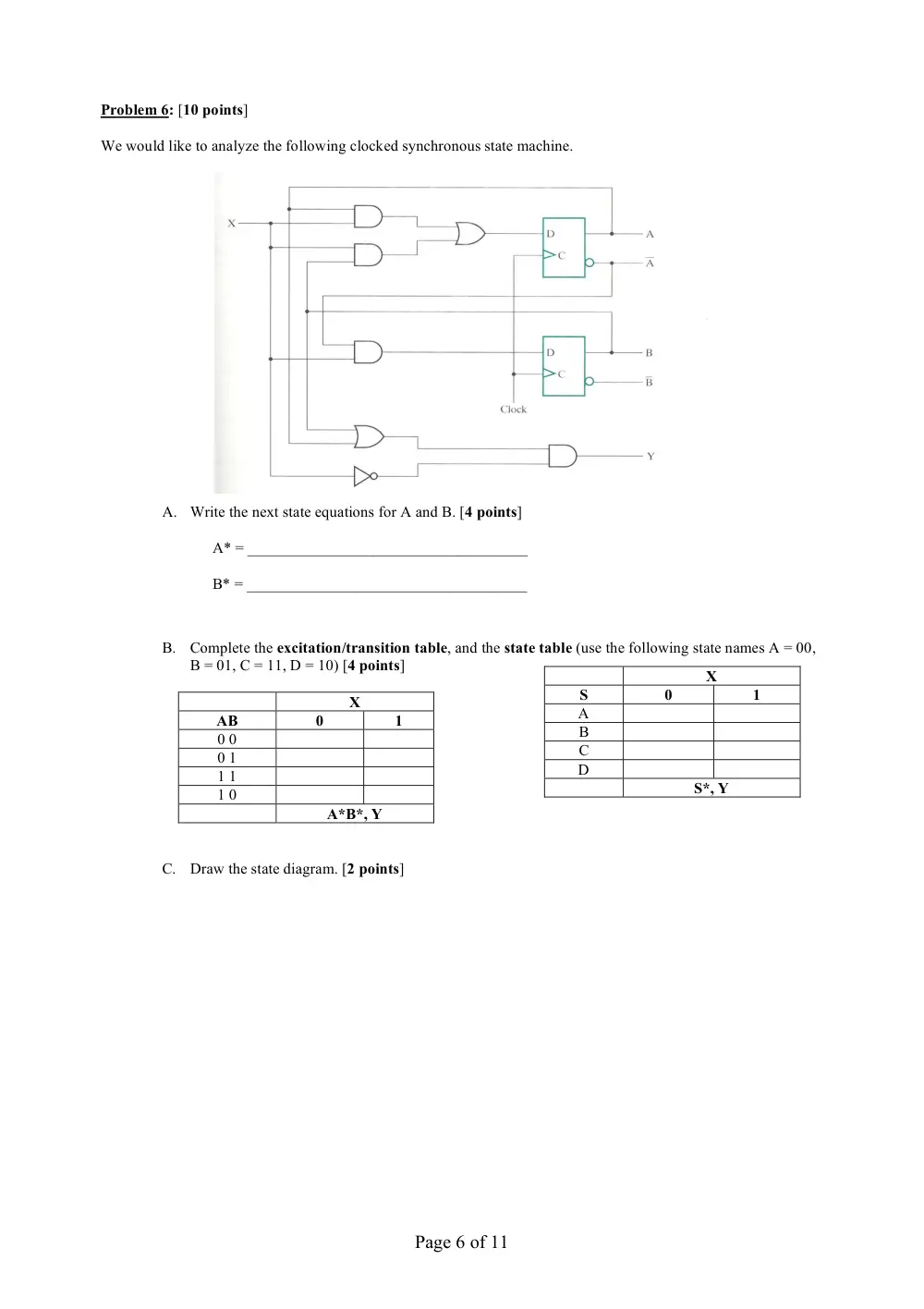
Problem 6: [10 points]
We would like to analyze the following clocked synchronous state machine.
A. Write the next state equations for A and B. [4 points]
A* = ____________________________________
B* = ____________________________________
B. Complete the excitation/transition table, and the state table (use the following state names A = 00,
B = 01, C = 11, D = 10) [4 points]
X
AB
0
1
0 0
0 1
1 1
1 0
A*B*, Y
C. Draw the state diagram. [2 points]
X
S
0
1
A
B
C
D
S*, Y
Page 7 of 11
S
R
Q
Q
C
J
K
S
R
Q
Q
C
Q
QN
QM
QM_L
C
J
K
C
QM
QM_L
Q
QN
SM
RM
SM
RM
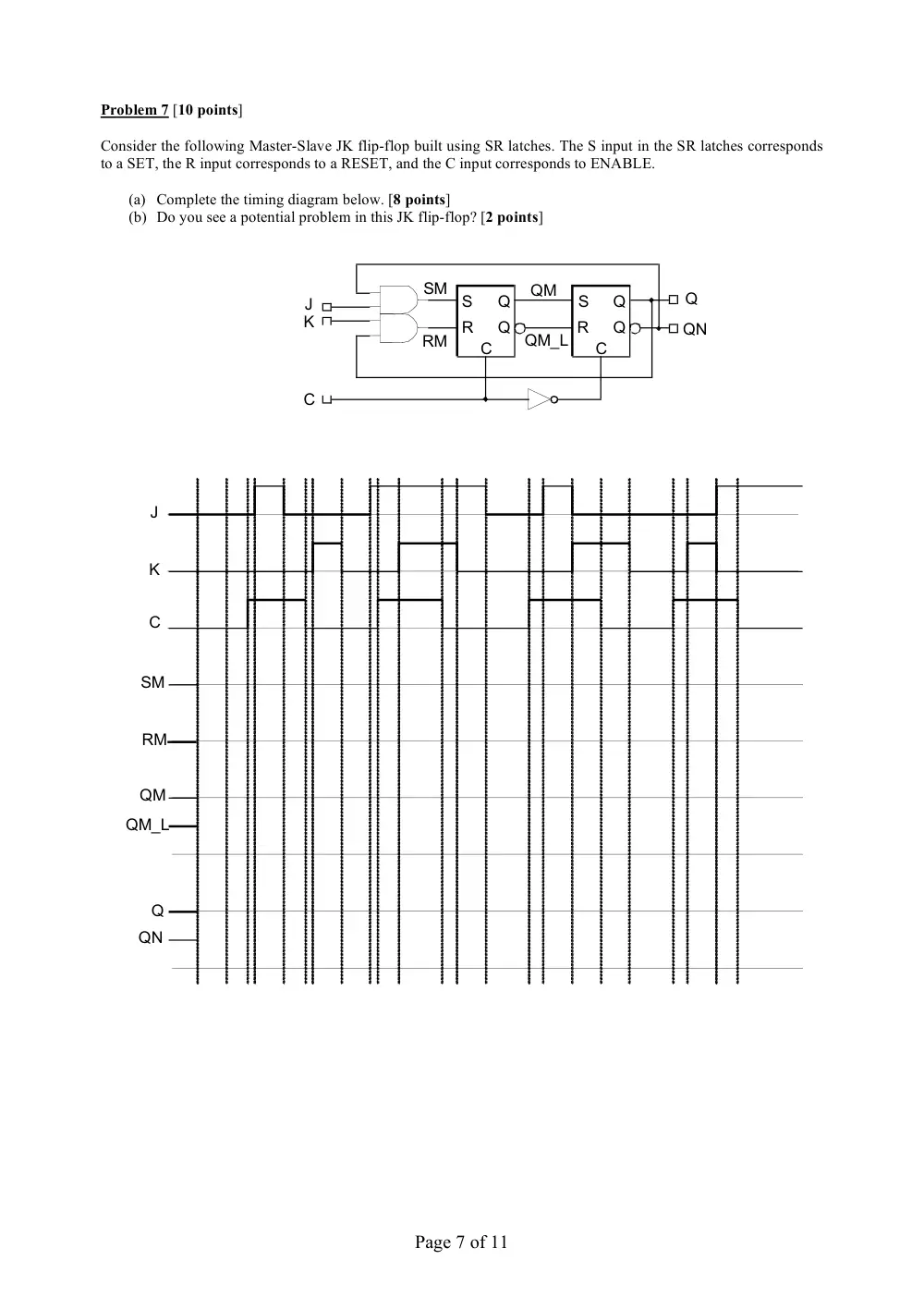
Problem 7 [10 points]
Consider the following Master-Slave JK flip-flop built using SR latches. The S input in the SR latches corresponds
to a SET, the R input corresponds to a RESET, and the C input corresponds to ENABLE.
(a) Complete the timing diagram below. [8 points]
(b) Do you see a potential problem in this JK flip-flop? [2 points]
Page 8 of 11
Problem 8: [10 points]
An MN flip-flop has four operations: clear to 0, no change, toggle, and set to 1, when inputs M and N are 00, 01, 10,
and 11, respectively.
a) Determine the characteristic equation of an MN flip-flop. [2 points]
b) Design an MN flip-flop using a T flip-flop with enable and extra logic gates. [4 points]
c) Design a JK flip-flop using an MN flip-flop and extra logic gates. [4 points]
Page 9 of 11
Problem 9: [10 points]
Design a 4-bit Johnson counter using D flip-flops.
Answer:
Page 10 of 11
001
010
100
011
110
111
101
State = Q 3Q2Q1
D
Q
D
Q
CLK
D
Q
Q3
Q2
Q1
001
010
100
011
110
111
101
State = Q 3Q2Q1
000
Problem 10: [10 points]
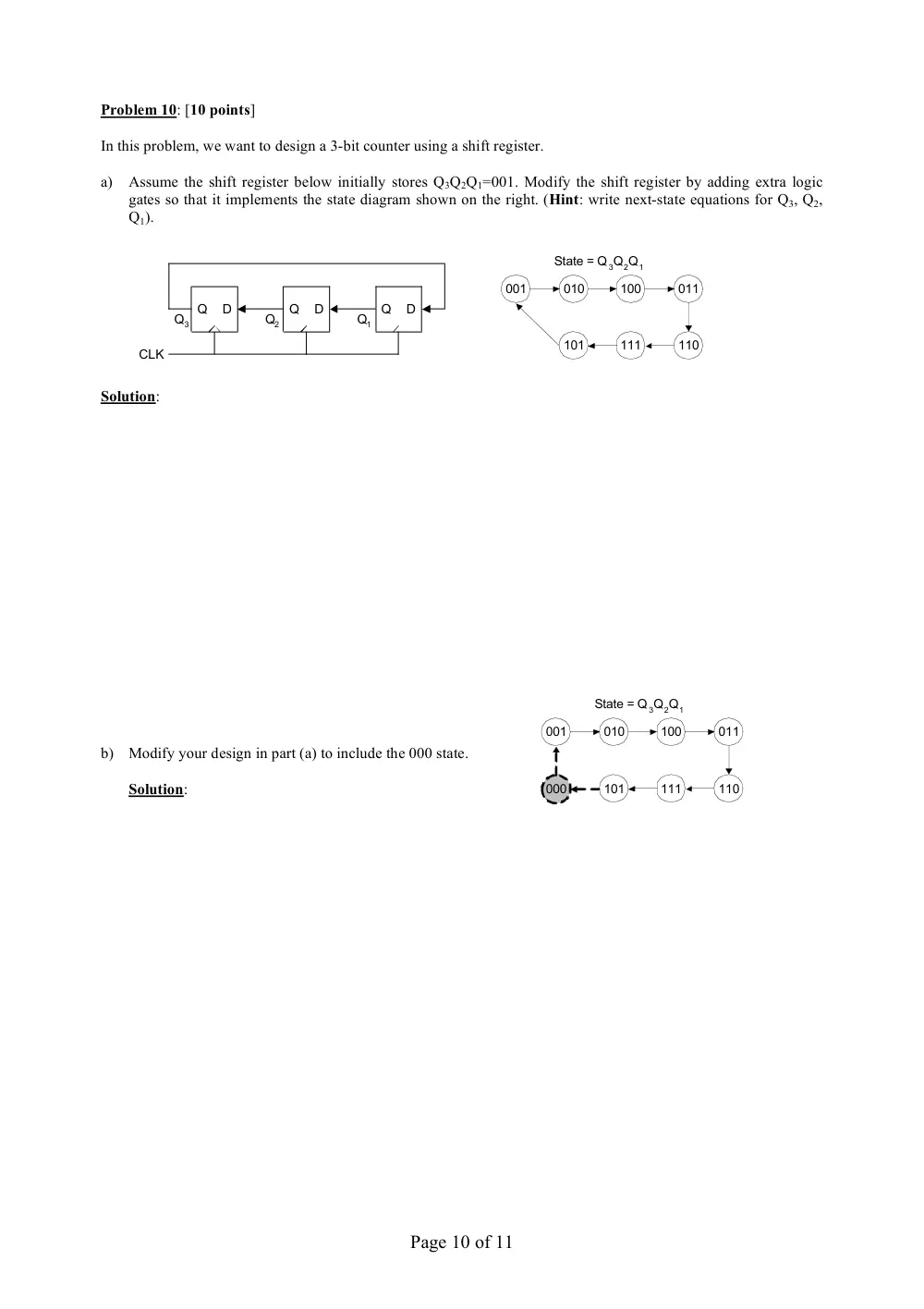
In this problem, we want to design a 3-bit counter using a shift register.
a) Assume the shift register below initially stores Q3Q2Q1=001. Modify the shift register by adding extra logic
gates so that it implements the state diagram shown on the right. (Hint: write next-state equations for Q3, Q2,
Q1).
Solution:
b) Modify your design in part (a) to include the 000 state.
Solution:
Page 11 of 11
counter
from
part (b)
Q3
Q2
Q1
CLK
c) The counter you designed in part (b) is shown below as a black box that produces the sequence 000, 001, 010,
100, 011, 110, 111, 101 and then repeats. Describe what you would add to your counter so that it produces the
sequence 000, 001, 010, 011, 100, 101, 110, 111 and then repeats.