
EECE 330 Chapter 2 Sorting, Summer 2014
American University of Beirut · Data Structures and Algorithms · 27 pages

Showing the first 10 of 27 pages. Download the PDF to see all of it.
More EECE 330 files
Show the text of this chapter
H. Artail, EECE 330
Internal sorting
Rearranging Records
Each record contains a field called the key.
– Linear order: comparison.
Measures of cost:
– Comparisons
– Swaps
H. Artail, EECE 330
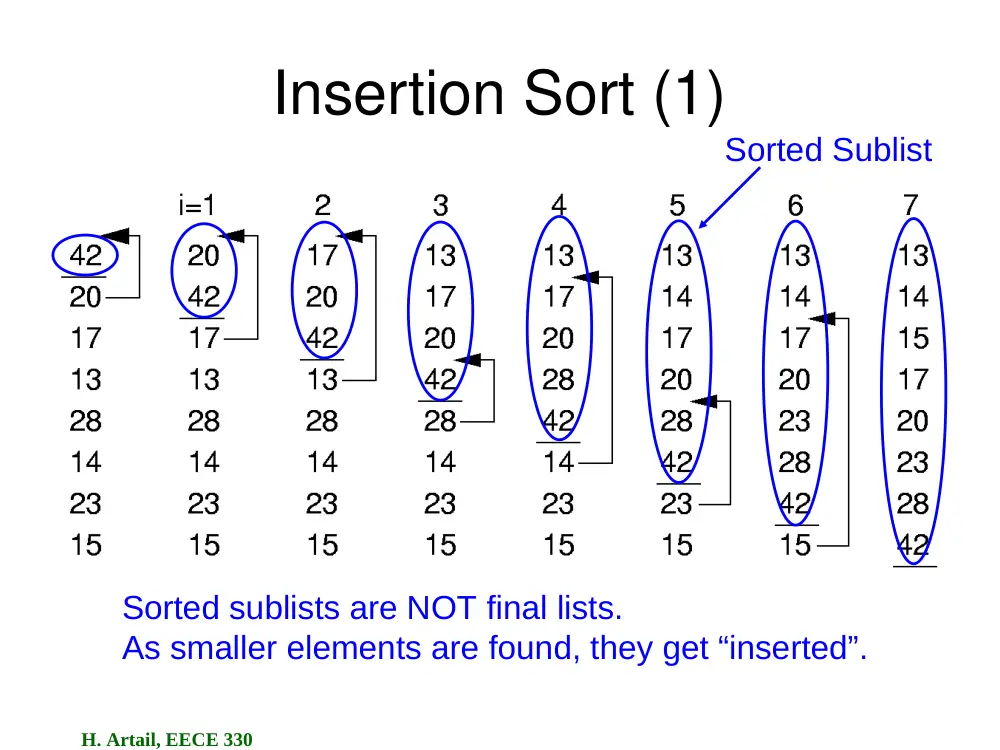
Insertion Sort (1)
Sorted sublists are NOT final lists.
As smaller elements are found, they get “inserted”.
Sorted Sublist
H. Artail, EECE 330
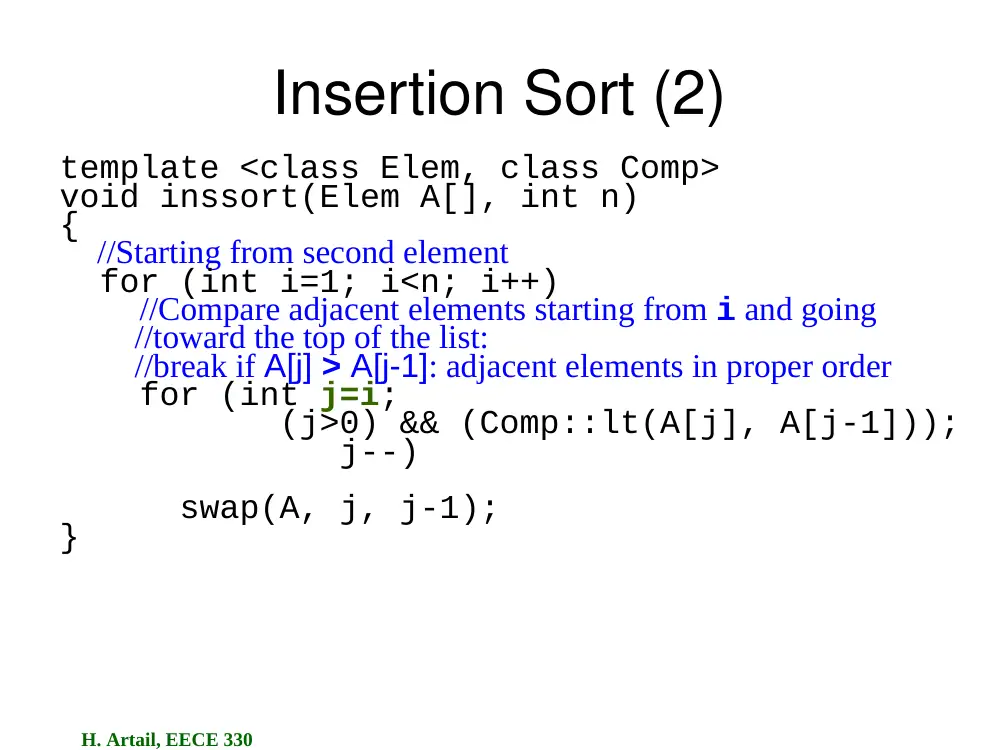
Insertion Sort (2)
template <class Elem, class Comp>
void inssort(Elem A[], int n)
{
//Starting from second element
for (int i=1; i<n; i++)
//Compare adjacent elements starting from i and going
//toward the top of the list:
//break if A[j] > A[j-1]: adjacent elements in proper order
for (int j=i;
(j>0) && (Comp::lt(A[j], A[j-1]));
j--)
swap(A, j, j-1);
}
H. Artail, EECE 330
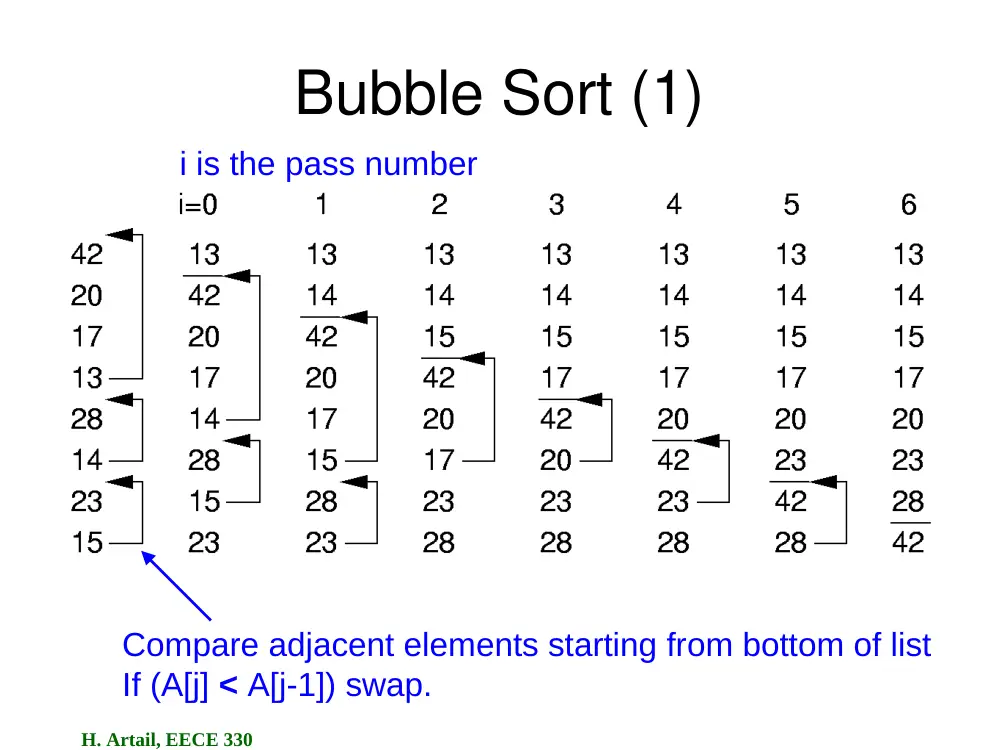
Bubble Sort (1)
i is the pass number
Compare adjacent elements starting from bottom of list
If (A[j] < A[j-1]) swap.
H. Artail, EECE 330
Bubble Sort (2)
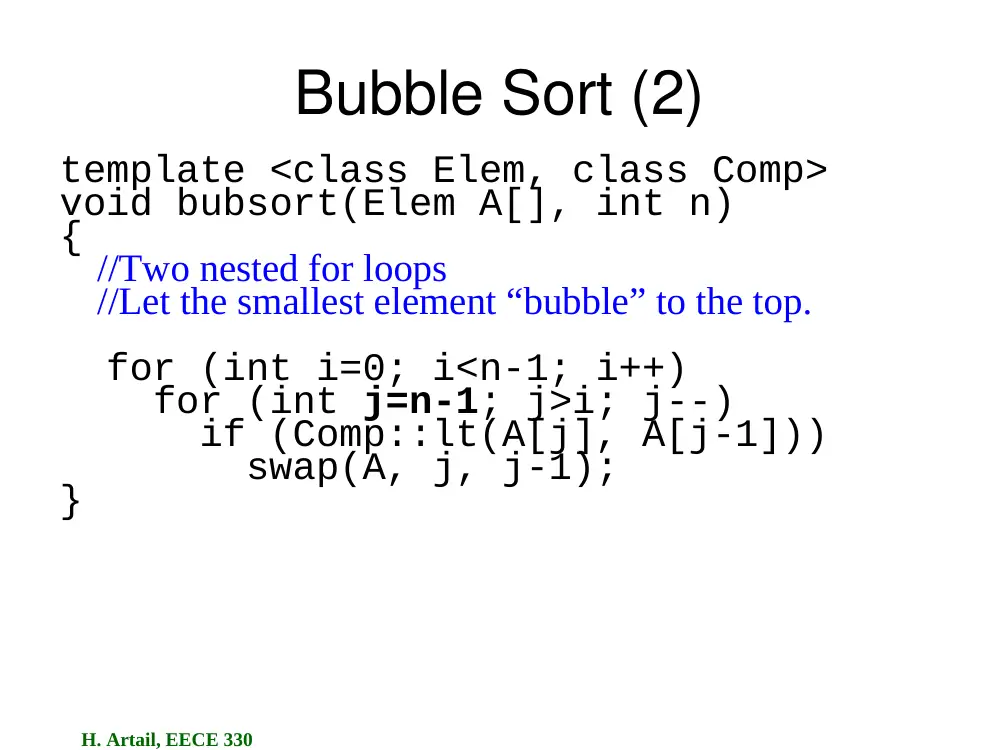
template <class Elem, class Comp>
void bubsort(Elem A[], int n)
{
//Two nested for loops
//Let the smallest element “bubble” to the top.
for (int i=0; i<n-1; i++)
for (int j=n-1; j>i; j--)
if (Comp::lt(A[j], A[j-1]))
swap(A, j, j-1);
}
H. Artail, EECE 330
Selection Sort (1)
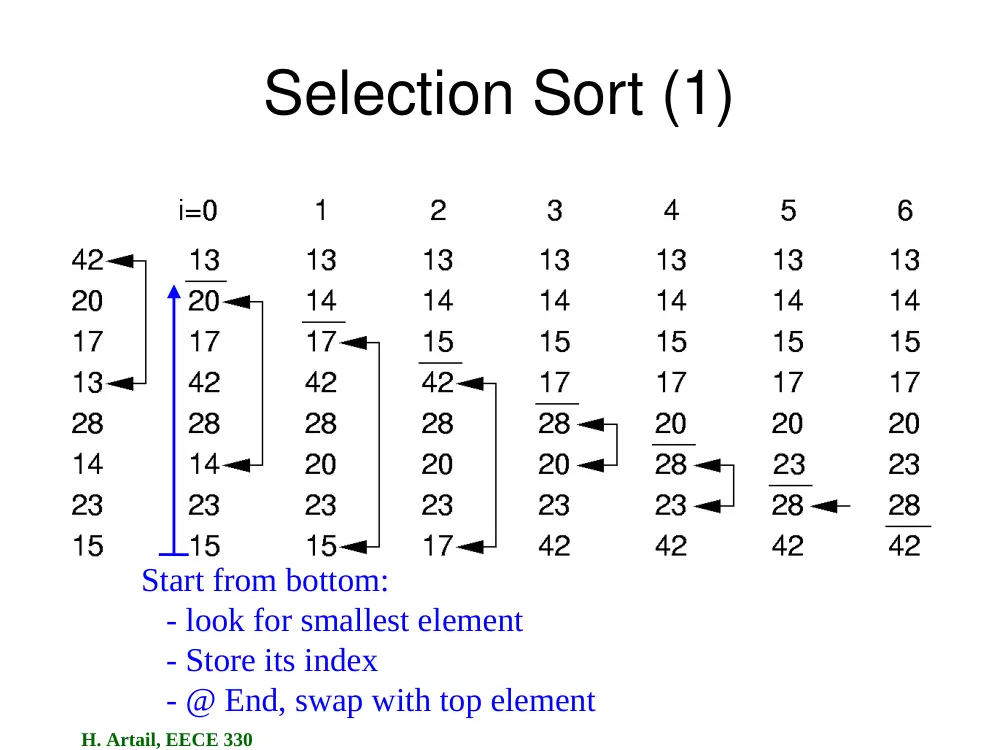
Start from bottom:
- look for smallest element
- Store its index
- @ End, swap with top element
H. Artail, EECE 330
Selection Sort (2)
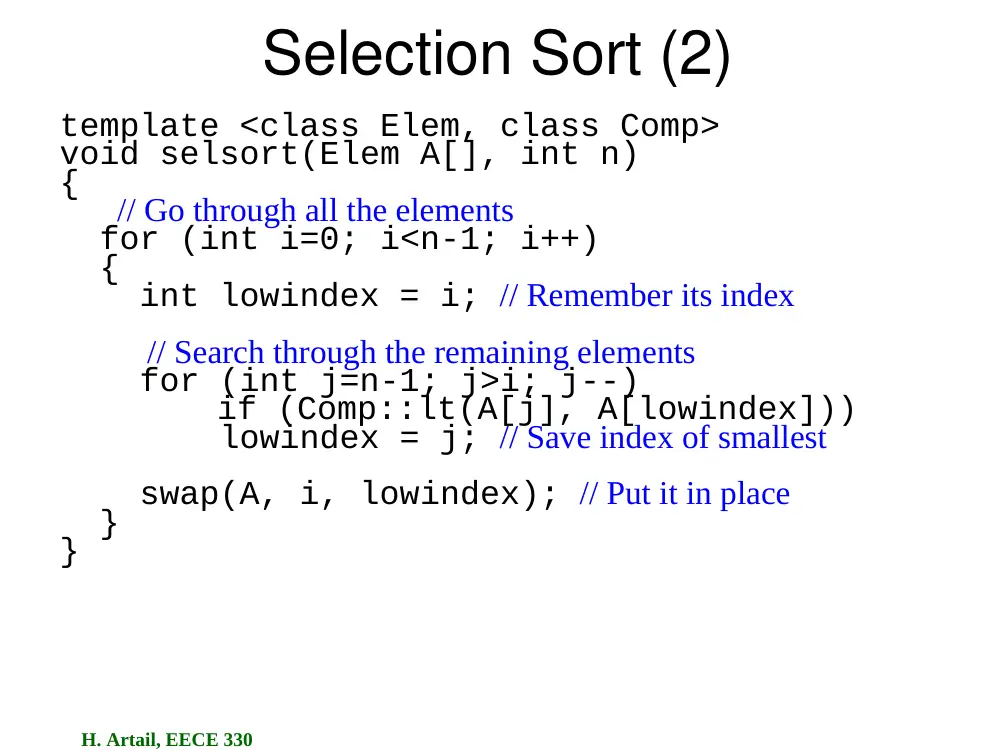
template <class Elem, class Comp>
void selsort(Elem A[], int n)
{
// Go through all the elements
for (int i=0; i<n-1; i++)
{
int lowindex = i; // Remember its index
// Search through the remaining elements
for (int j=n-1; j>i; j--)
if (Comp::lt(A[j], A[lowindex]))
lowindex = j; // Save index of smallest
swap(A, i, lowindex); // Put it in place
}
}
H. Artail, EECE 330
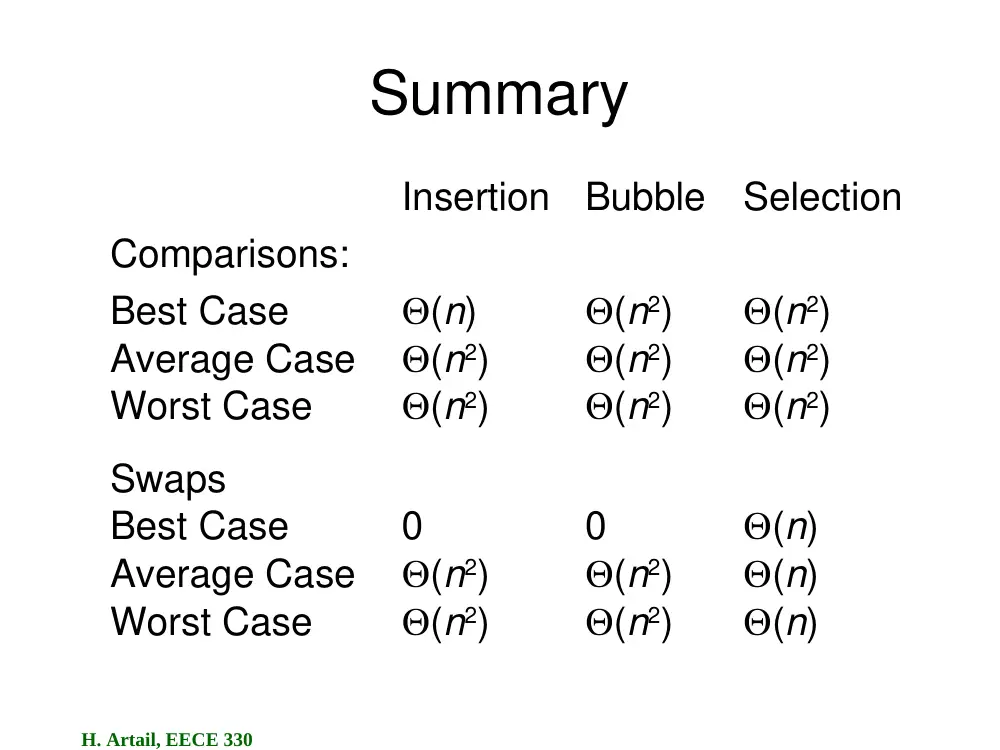
Summary
Insertion
Bubble
Selection
Comparisons:
Best Case
(n)
(n2)
(n2)
Average Case
(n2)
(n2)
(n2)
Worst Case
(n2)
(n2)
(n2)
Swaps
Best Case
0
0
(n)
Average Case
(n2)
(n2)
(n)
Worst Case
(n2)
(n2)
(n)
H. Artail, EECE 330
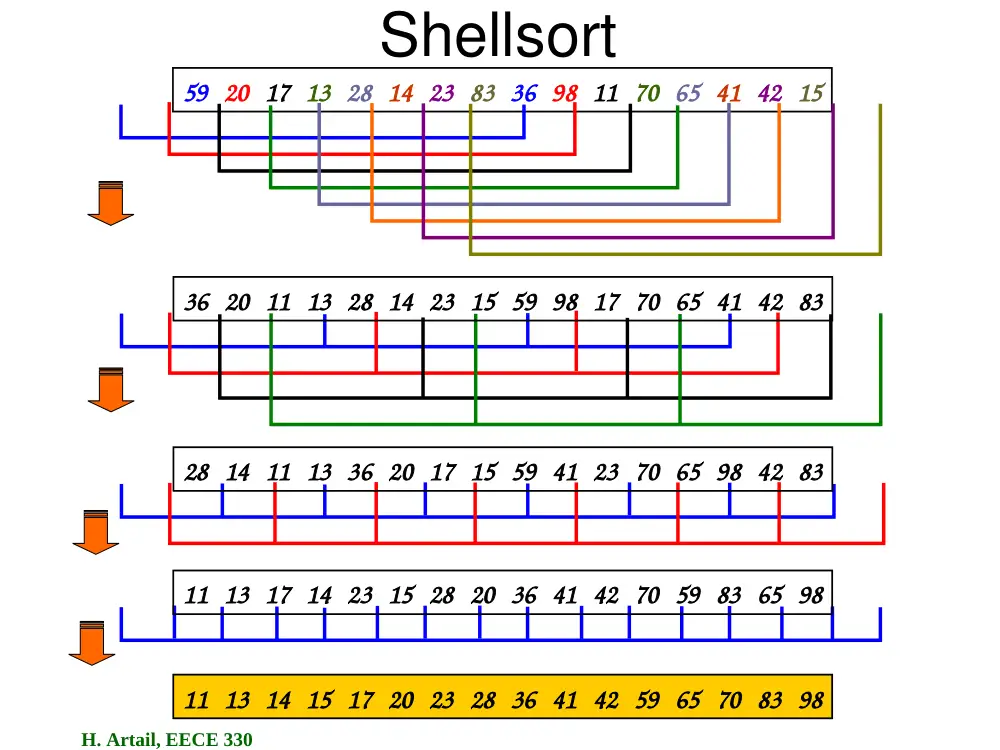
Shellsort
59 20 17 13 28 14 23 83 36 98 11 70 65 41 42 15
36 20 11 13 28 14 23 15 59 98 17 70 65 41 42 83
28 14 11 13 36 20 17 15 59 41 23 70 65 98 42 83
11 13 17 14 23 15 28 20 36 41 42 70 59 83 65 98
11 13 14 15 17 20 23 28 36 41 42 59 65 70 83 98
H. Artail, EECE 330
Shellsort
// Modified version of Insertion Sort
template <class Elem, class Comp>
void inssort2(Elem A[], int n, int incr)
{
for (int i=incr; i<n; i+=incr)
for (int j=i;
(j>=incr)&&(Comp::lt(A[j], A[j-incr]));
j-=incr)
swap(A, j, j-incr);
}
template <class Elem, class Comp>
void shellsort(Elem A[], int n)
{ // Shellsort
for (int i=n/2; i>2; i/=2) // For each incr
for (int j=0; j<i; j++) // Sort sublists
inssort2<Elem,Comp>(&A[j], n-j, i);
inssort2<Elem,Comp>(A, n, 1);
}
H. Artail, EECE 330
Quicksort- Example
72 6 57 88 60 42 83 73 48 85
1
Select an arbitrary element as
the Pivot: Select middle one
72 6 57 88 60 42 83 73 48 85
l
2
Move pivot to end of list
72 6 57 88 42 83 73 48 85 60
r
1. Move l right while A[l] < pivot
2. Move r left while A[r] > pivot
3. Swap A[l] and A[r]
4. Repeat 1-3 until l and r meet
5. Position of l becomes new position for pivot
85 88 83
72
Single Element:
Pivot is in its
final position
85 83
83
48 6 57 42
Sublist
6 42 57 48
Repeat above process to position pivot
88 83 73 72 85
42 48
48
83 85
85 83 88
42 48 57
42 48
Chose pivot and find
its final position
72 73 85 88 83
48 6 57 42 60 88 83 73 72 85
Permanent position
for this element
3
42 57 48
H. Artail, EECE 330
Quicksort
template <class Elem, class Comp>
void qsort(Elem A[], int i, int j)
{ // For the original array, i=0 and j=n-1
if (j <= i) return; // List is one element: too small
// Find pivot
int pivotindex = findpivot(A, i, j);
swap(A, pivotindex, j); // Put pivot temporarily at end
// Make two partitions; k will be position of the pivot
int k = partition<Elem,Comp>(A, i-1, j, A[j]);
// Put pivot in permanent place
swap(A, k, j);
// Repeat above process for both partitions, excluding pivot
qsort<Elem,Comp>(A, i, k-1);
qsort<Elem,Comp>(A, k+1, j);
}
template <class Elem>
int findpivot(Elem A[], int i, int j)
{ return (i+j)/2; }
H. Artail, EECE 330
Quicksort Partition
template <class Elem, class Comp>
int partition(Elem A[], int l, int r,
Elem& pivot)
{
do
{ // Move the bounds inward until they meet
while (Comp::lt(A[++l], pivot)); // Move l right
while ((r != 0) &&
Comp::gt(A[--r], pivot)); // Move r left
swap(A, l, r); // Swap out-of-place values
} while (l < r); // Stop when they cross
swap(A, l, r); // Reverse last swap
return l; // Return first pos on right
}
The cost for partition is (n).
H. Artail, EECE 330
Partition Example
do
{
// Increment l and then check if A[l]<pivot
while (Comp::lt(A[++l], pivot));
// Decrement l and then check if A[r]>pivot
while ((r != 0) &&
Comp::gt(A[--r], pivot));
// Swap out-of-place values
swap(A, l, r);
// after this swap, A[l]≤pivot and A[r]≥pivot
} while (l < r); // Stop when they cross
swap(A, l, r); // Reverse last swap
H. Artail, EECE 330
Cost of Quicksort
Best case: Always partition in half.
Worst case: Bad partition.
Average case:
T(n) = n + 1 + 1/(n-1) (T(k) + T(n-k))
Optimizations for Quicksort:
– Better Pivot
– Better algorithm for small sublists
– Eliminate recursion
k=1
n-1
H. Artail, EECE 330
Mergesort- Example
Replace
Replace
sort
20 36
4
13 17 20 36
sort
6
36 20 17 13 28 14 23 15
14 15 23 28
sort
Replace
Replace
5
20 36 13 17
17
13
Replace
Replace
13 17
sort
17 13
7
13 17 20 36 14 15 23 28
8
13 14 15 17 20 23 28 36
sort
1
36 20 17 13
Split in two halves
2
36 20
Split
36
20
3
Split
H. Artail, EECE 330
Mergesort Implementation
template <class Elem, class Comp>
void mergesort(Elem A[], Elem temp[],
int left, int right)
{
int mid = (left+right)/2;
if (left == right) return; // We have one element
// Recursive calls on the two halves
mergesort<Elem,Comp>(A, temp, left, mid);
mergesort<Elem,Comp>(A, temp, mid+1, right);
for (int i=left; i<=right; i++) // Copy to a temporary
temp[i] = A[i];
// below, we sort the two merged sorted sublists
int i1 = left; int i2 = mid + 1;
for (int curr=left; curr<=right; curr++)
{
if (i1 == mid+1) // Left exhausted
A[curr] = temp[i2++];
else if (i2 > right) // Right exhausted
A[curr] = temp[i1++];
else if (Comp::lt(temp[i1], temp[i2]))
A[curr] = temp[i1++];
else A[curr] = temp[i2++];
}
}
H. Artail, EECE 330
Mergesort Cost
Mergesort cost:
n Arrays of size 1 are merged
n/2 arrays of size 2 are merged
…..
log(n) levels of recursion: (n) work is done.
Total Cost = (nlog(n))
Holds true for best, average, and worst cases.
Mergsort is typical for sorting linked lists:
Does not required random access.
H. Artail, EECE 330
Heapsort - Example
57
83
60
6
48
85
88
42
73
72
73 6 57 88 60 42 83 72 48 85
Original Numbers
83
57
73
85
48
60
72
42
88
6
88 85 83 72 73 42 57 6 48 60
Build Heap
83
57
60
73
72
42
85
48
6
85 73 83 72 60 42 57 6 48 88
Remove 88
83 73 57 72 60 42 48 6 85 88
Remove 85
57
48
60
73
72
42
83
6
H. Artail, EECE 330
Heapsort Example (continued)
57
48
60
72
6
42
73
73 72 57 6 60 42 48 83 85 88
Remove 83
57
48
60
6
42
72
72 60 57 6 42 48 73 83 85 88
Remove 73
57
48
6
42
60
60 6 57 42 48 72 73 83 85 88
Remove 72
48
6
42
57
57 6 48 42 60 72 73 83 85 88
Remove 60
42
6
48
48 6 42 57 60 72 73 83 85 88
Remove 57
6
42
42 6 48 57 60 72 73 83 85 88
Remove 48
6
6 42 48 57 60 72 73 83 85 88
Remove 42
H. Artail, EECE 330
Heapsort
template <class Elem, class Comp>
void heapsort(Elem A[], int n)
{
Elem mval;
// Use max-heap constructor (it calls the function buildheap)
maxheap<Elem,Comp> H(A, n, n);
// call the member function removemax (see chapter 5)
for (int i=0; i<n; i++)
H.removemax(mval);// Put max at end
}
Use a max-heap, so that elements end up
sorted within the array.
Cost of heapsort:
Cost of finding K largest elements:
H. Artail, EECE 330
Binsort
for (i=0; i<n; i++)
B[A[i]] = A[i]; //puts m in the (m+1)th position
A simple, efficient sort
Good for permutations of size n
Ways to generalize:
– Make each bin the head of a list.
• To accommodate duplicate keys (values)
– Allow more keys than records.
H. Artail, EECE 330
Binsort
template <class Elem>
void binsort(Elem A[], int n)
{
//if MaxKeyValue is very large, we create a very large array!!!
List<Elem> B[MaxKeyValue]; //array of lists
Elem item;
for (i=0; i<n; i++)
B[A[i]].append(A[i]);//puts duplicates in same list
//Now, we retrieve the records sequentially
//by going through each list
for (i=0; i<MaxKeyValue; i++)
for (B[i].setStart();
B[i].getValue(item); B[i].next())
output(item); //display, write to a file, etc.
}
H. Artail, EECE 330
Radix Sort - Example
Pick from list
Generated after
First pass
H. Artail, EECE 330
Radix Sort–Example: Implementation
cumulative index array
No element with a right digit = 0
Position according to right digit
Position according to next digit
Two elements with next (left) digit = 0
cumulative index array
This is 05
Bin:
Simulates
nodes of
a linked
list
H. Artail, EECE 330
Radix Sort
template <class Elem, class Comp>
void radix(Elem A[], Elem B[],
int n, int k, int r, int cnt[])
{//A[ ]=records array, B[ ]=temporary array, n= # records,
//k= # digits, r=radix, cnt[ ]=count array
for (int i=0, rtok=1; i<k; i++, rtok*=r)
{ // initialize the count array
for (int j=0; j<r; j++) cnt[j] = 0;
// count the number of records for each bin on this pass
for(j=0; j<n; j++) cnt[(A[j]/rtok)%r]++;
// make cnt[ ] cumulative (to use later as indices for array)
for (j=1; j<r; j++)
cnt[j] = cnt[j-1] + cnt[j];
// put records into bins, working from bottom of each bin
// bins fill from bottom => j counts backward
for (j=n-1; j>=0; j--)
// decrement to convert from counts to indices
B[--cnt[(A[j]/rtok)%r]] = A[j];
for (j=0; j<n; j++) A[j] = B[j]; // put back in A[ ]
}
}
H. Artail, EECE 330
0.001
0.01
0.1
1
10
100
1000
10000
shell
quick
merge
heap
radix/8
10 100 1K 10K 100K 1M
Number of records (integer values)
time (milliseconds)
logarithmic scale
Experiments were run on a 450MHz, PIII
Running Linux using arrays of data
quick
insertion
bubble
selection
shell
merge
radix/4
radix/8
heap
0
0.01
0.02
0.03
0.04
0.05
time (milliseconds)
Trend is generally true for sizes in the range [10, 100]
Comparison Using Empirical Data