
EECE 330 Chapter, Fall 2011
American University of Beirut · Data Structures and Algorithms · 23 pages · Prof. Hassan Artail

Showing the first 10 of 23 pages. Download the PDF to see all of it.
More EECE 330 files
Show the text of this chapter
EECE 330
Data Structures & Algorithms
Doubly-Linked Lists
Doubly-Linked Lists
Stacks & Queues
Stacks & Queues
© Hassan Artail
American University of Beirut
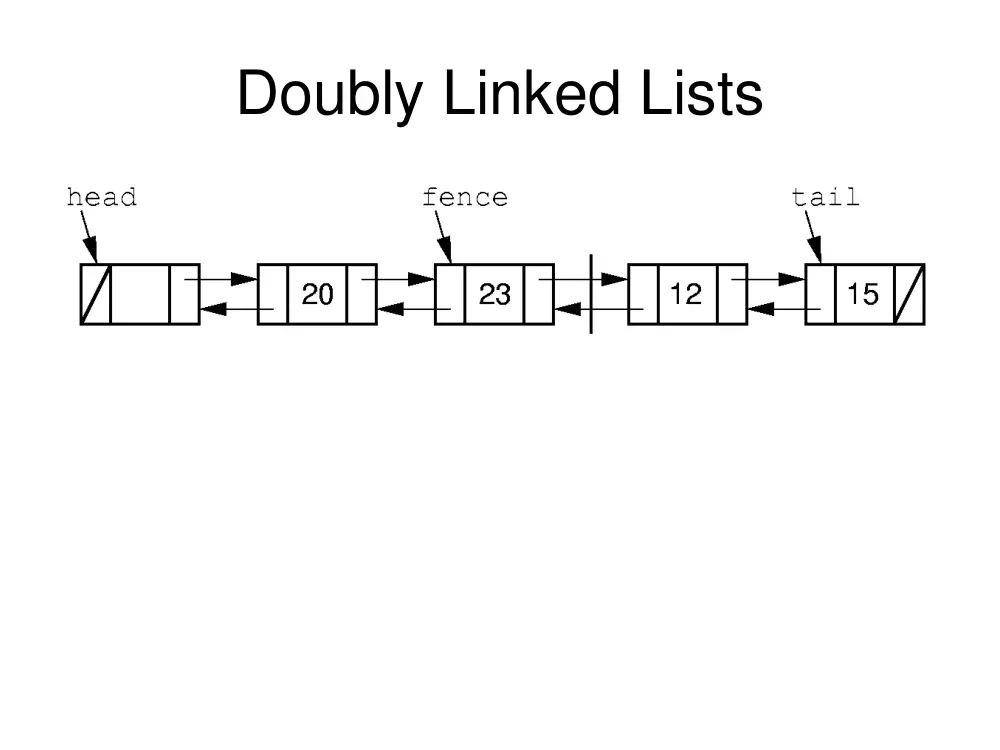
Doubly Linked Lists
Simplify insertion and deletion: Add a prev pointer.
// Doubly-linked list link node
template <class Elem> class Link
{
public:
Elem element; // Value for this node
Link *next; // Pointer to next node
Link *prev; // Pointer to previous node
Link(const Elem& e, Link* prevp
=NULL,
Link* nextp =NULL)
{ element=e; prev=prevp;
next=nextp; }
Link(Link* prevp =NULL,
Link* nextp =NULL)
{ prev = prevp; next = nextp; }
};
Doubly Linked Lists
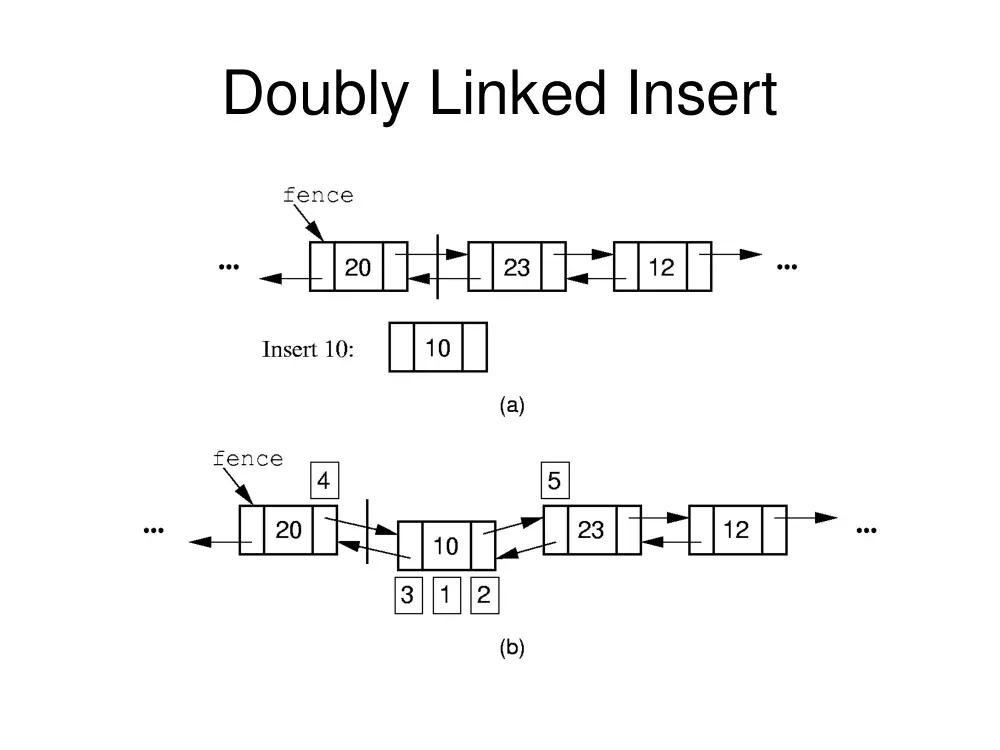
Doubly Linked Insert
Doubly Linked Insert
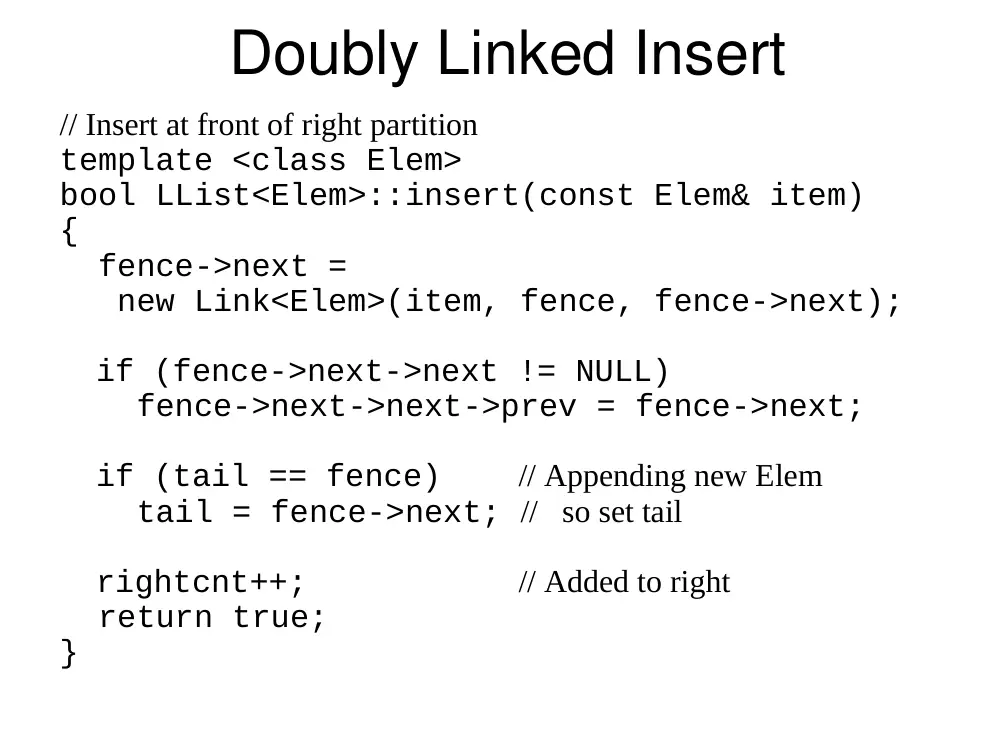
// Insert at front of right partition
template <class Elem>
bool LList<Elem>::insert(const Elem& item)
{
fence->next =
new Link<Elem>(item, fence, fence->next);
if (fence->next->next != NULL)
fence->next->next->prev = fence->next;
if (tail == fence) // Appending new Elem
tail = fence->next; // so set tail
rightcnt++; // Added to right
return true;
}
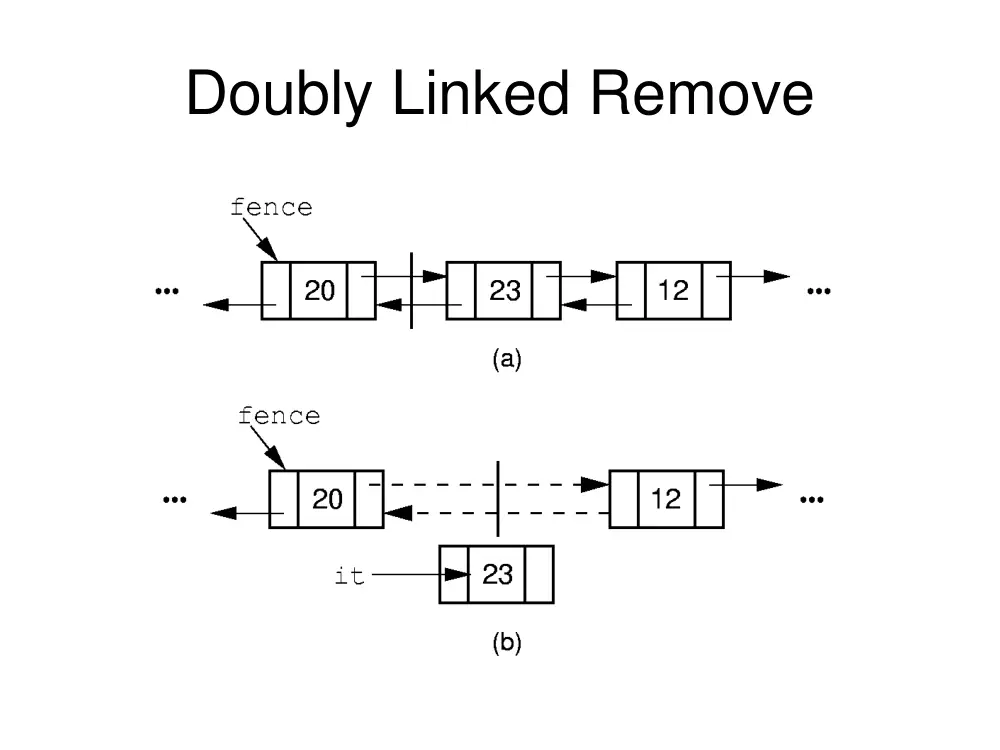
Doubly Linked Remove
Doubly Linked Remove
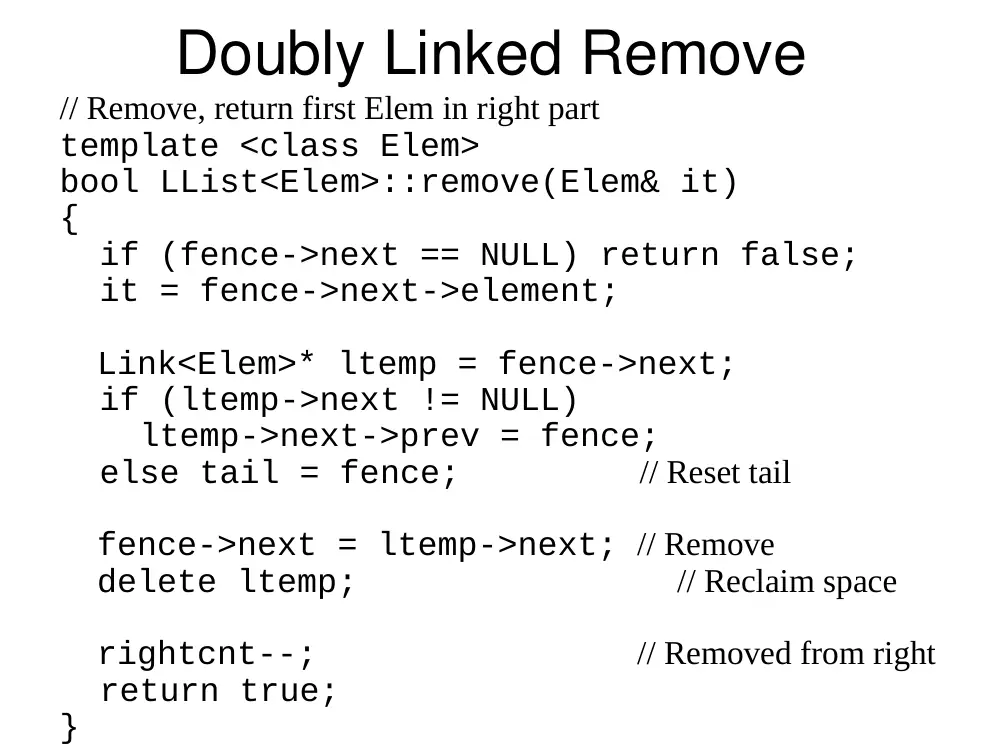
// Remove, return first Elem in right part
template <class Elem>
bool LList<Elem>::remove(Elem& it)
{
if (fence->next == NULL) return false;
it = fence->next->element;
Link<Elem>* ltemp = fence->next;
if (ltemp->next != NULL)
ltemp->next->prev = fence;
else tail = fence; // Reset tail
fence->next = ltemp->next; // Remove
delete ltemp;
// Reclaim space
rightcnt--; // Removed from right
return true;
}
Dictionary
Often want to insert records, delete records,
search for records.
Required concepts:
• Search key: Describe what we are looking
for
• Key comparison
– Equality: sequential search
– Relative order: sorting
• Record comparison
Comparator Class
How do we generalize comparison?
• Use ==, <=, >=: Disastrous
• Overload ==, <=, >=: Disastrous
• Define a function with a standard name
– Implied obligation
– Breaks down with multiple key fields/indices
for same object
• Pass in a function
– Explicit obligation
– Function parameter
– Template parameter
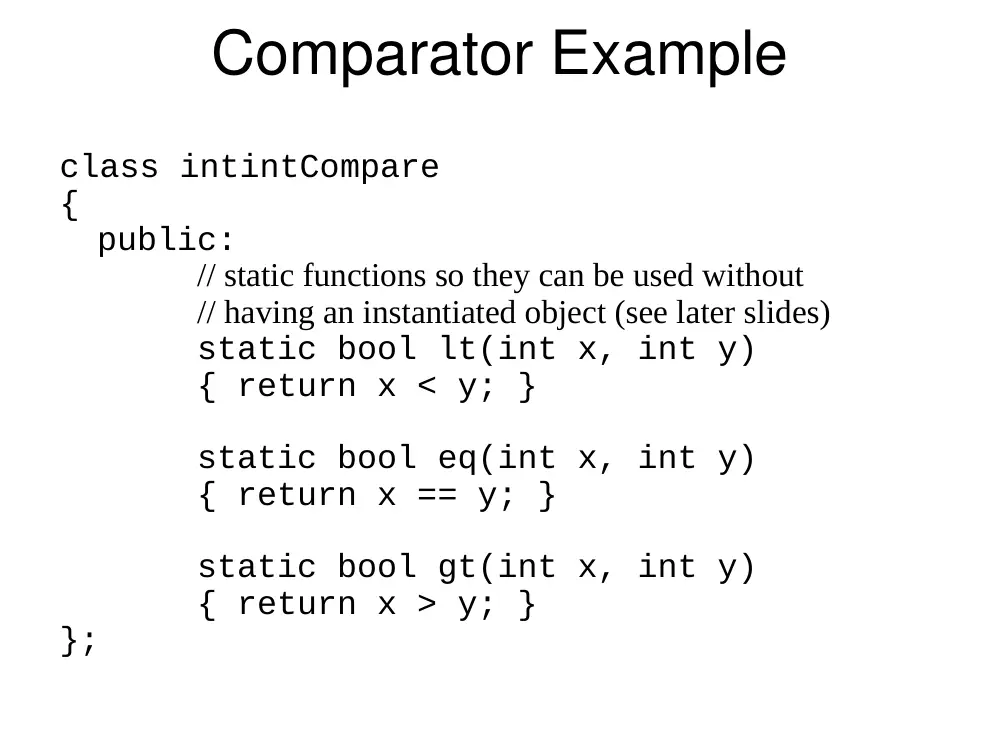
Comparator Example
class intintCompare
{
public:
// static functions so they can be used without
// having an instantiated object (see later slides)
static bool lt(int x, int y)
{ return x < y; }
static bool eq(int x, int y)
{ return x == y; }
static bool gt(int x, int y)
{ return x > y; }
};
Comparator Example (2)
class Payroll
{
public:
int ID;
char* name;
};
// The examples below only show the lt method for brevity
class IDCompare
{
public:
static bool lt(Payroll& x, Payroll& y)
{ return x.ID < y.ID; }
};
class NameCompare
{
public:
static bool lt(Payroll& x, Payroll& y)
{ return strcmp(x.name, y.name) < 0; }
};
Dictionary ADT
// The Dictionary abstract class – Template (interface) parameters:
// Key=search key: record, record element, or record sub-element
// Elem=record: simple element or a group of elements
// KEComp=key to record or sub-record comparator
// EEComp=record to record (sub-record to sub-record) comparator
template <class Key, class Elem,
class KEComp, class EEComp>
class Dictionary
{
public:
virtual void clear() = 0;
virtual bool insert(const Elem&) = 0;
virtual bool remove(const Key&, Elem&) = 0;
virtual bool removeAny(Elem&) = 0;
virtual bool find(const Key&, Elem&)
const = 0;
virtual int size() = 0;
};
Comparator Example
A Dictionary that contains Employee Records:
First Name
// string
Last Name
//string
Address
//array of strings
Position
//integer (code)
Years of Service
//short integer
…
KEComp: Years of Service comparison (with the supplied Key)
Compares two integers (eq, gt, lt)
EEComp: Employee Record comparison, used to detect identical records
it suffices to compare first names and last names
Application: produce a list of employees who are eligible for retirement
(based on years of service) but exclude duplicate records
Comparator Example (2)
A Dictionary that contains Employee Records:
First Name
// string
Last Name
//string
Address
//array of strings
Position
//integer (code)
Years of Service
//short integer
…
KEComp: Position comparison (same as in the previous example)
EEComp: Last Name comparison (different than the previous example)
Application: produce a list of employees who are eligible for a bonus
and sort it by last name
Unsorted List Dictionary
template <class Key, class Elem,
class KEComp, class EEComp>
class UALdict : public
Dictionary<Key,Elem,KEComp,EEComp>
{
private:
AList<Elem>* list;
public:
bool remove(const Key& K, Elem& e)
{
for(list->setStart(); list->getValue(e);
list->next())
if (KEComp::eq(K, e))
{
list->remove(e);// ::AList remove method
return true;
}
return false;
}
};
Moves the fence
Removes from the right of the fence
Note that we are not passing the value of e to remove().
The function remove() supplies us with the value
It is the same value obtained from getValue() above
Stacks
LIFO: Last In, First Out.
Restricted form of list: Insert and remove
only at front of list.
Notation:
• Insert: PUSH
• Remove: POP
• The accessible element is called TOP.
Array-Based Stack
// Array-based stack implementation
template <class Elem> class AStack:
public Stack<Elem>
{
private:
int size; // Maximum size of stack
int top; // Index for top element
Elem *listArray; // Array holding elements
public:
AStack(int sz =DefaultListSize)
{
size = sz; top = 0;
listArray = new Elem[sz];
}
~AStack() { delete [] listArray; }
void clear() { top = 0; }
Array-Based Stack (2)
bool push(const Elem& item)
{
if (top == size) return false; // full
else { listArray[top++] = item;
return true; }
}
bool pop(Elem& it)
{ // Pop top element
if (top == 0) return false;
else {it = listArray[--top]; return
true;}
}
// Return top element
bool topValue(Elem& it) const
{
if (top == 0) return false;
else {it = listArray[top-1]; return
true;}
}
int length() const { return top; }
Linked Stack (1)
template <class Elem> class LStack:
public Stack<Elem>
{
private:
Link<Elem>* top; // Pointer to first elem
int size; // Count number of elems
public:
LStack(int sz =DefaultListSize)
{ top = NULL; size = 0; }
bool push(const Elem& item)
{
top = new Link<Elem>(item, top);
size++;
return true;
}
Linked Stack (2)
bool pop(Elem& it)
{
if (size == 0) return false;
it = top->element;
Link<Elem>* ltemp = top->next;
delete top;
top = ltemp;
size--;
return true;
}
bool topValue(Elem& it) const
{
if (size == 0) return false;
it = top->element;
return true;
}
Queues
FIFO: First in, First Out
Restricted form of list: Insert at one end,
remove from the other.
Notations:
• Insert: Enqueue
• Delete: Dequeue
• First element: Front
• Last element: Rear
Queue Implementation (1)
Queue Implementation (2)