
EECE 330 Chapter, Fall 2011
American University of Beirut · Data Structures and Algorithms · 33 pages · Prof. Hassan Artail


Showing the first 10 of 33 pages. Download the PDF to see all of it.
More EECE 330 files
Show the text of this chapter
EECE 330
Data Structures & Algorithms
Binary Search Trees
Binary Search Trees
© Hassan Artail
American University of Beirut
Binary Search Trees
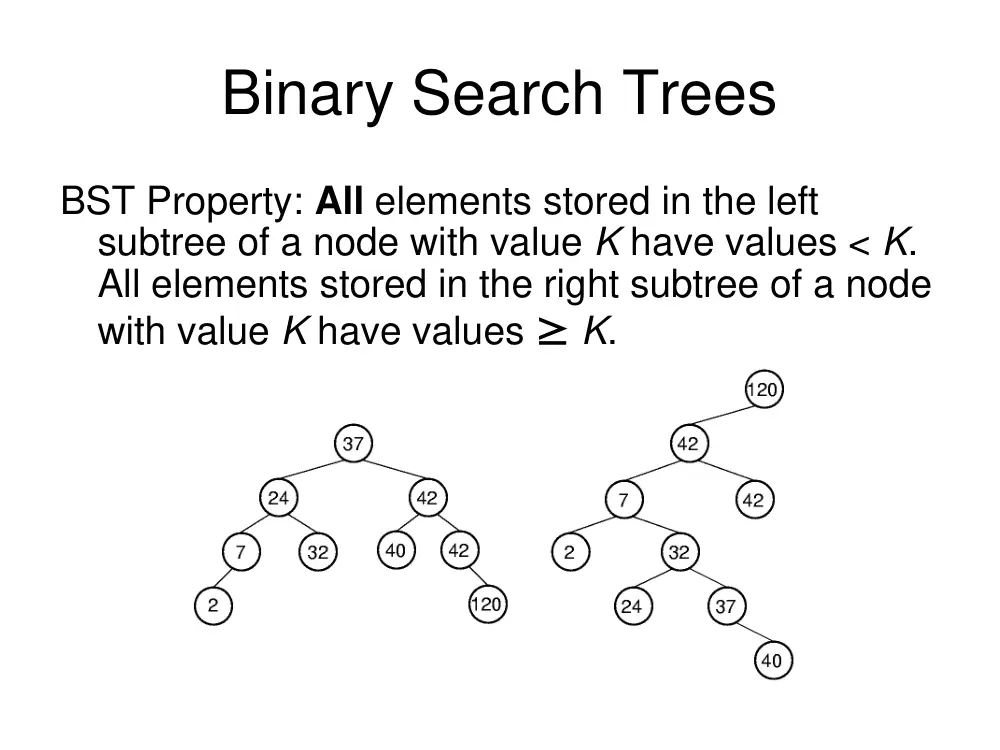
BST Property: All elements stored in the left
subtree of a node with value K have values < K.
All elements stored in the right subtree of a node
with value K have values K.
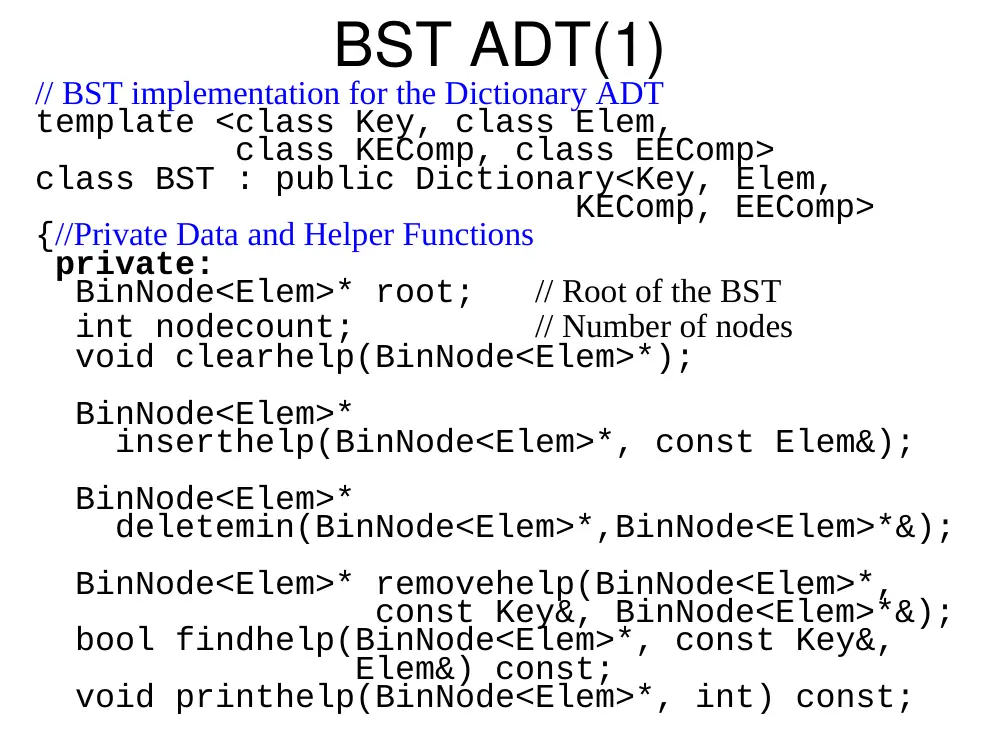
BST ADT(1)
// BST implementation for the Dictionary ADT
template <class Key, class Elem,
class KEComp, class EEComp>
class BST : public Dictionary<Key, Elem,
KEComp, EEComp>
{//Private Data and Helper Functions
private:
BinNode<Elem>* root; // Root of the BST
int nodecount; // Number of nodes
void clearhelp(BinNode<Elem>*);
BinNode<Elem>*
inserthelp(BinNode<Elem>*, const Elem&);
BinNode<Elem>*
deletemin(BinNode<Elem>*,BinNode<Elem>*&);
BinNode<Elem>* removehelp(BinNode<Elem>*,
const Key&, BinNode<Elem>*&);
bool findhelp(BinNode<Elem>*, const Key&,
Elem&) const;
void printhelp(BinNode<Elem>*, int) const;
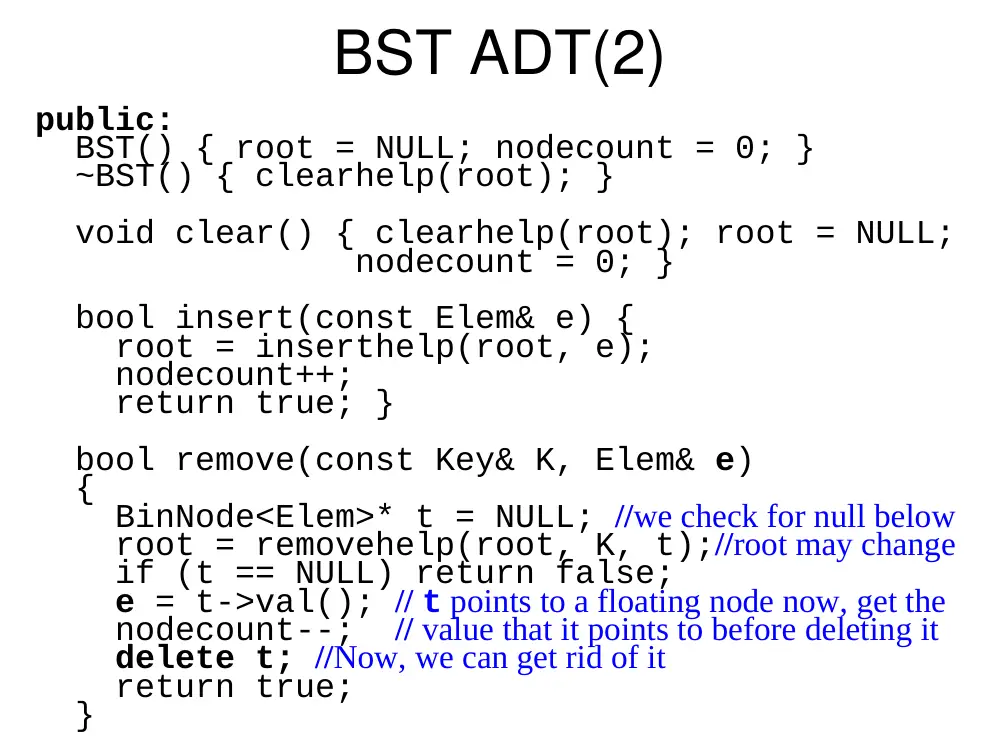
BST ADT(2)
public:
BST() { root = NULL; nodecount = 0; }
~BST() { clearhelp(root); }
void clear() { clearhelp(root); root = NULL;
nodecount = 0; }
bool insert(const Elem& e) {
root = inserthelp(root, e);
nodecount++;
return true; }
bool remove(const Key& K, Elem& e)
{
BinNode<Elem>* t = NULL; //we check for null below
root = removehelp(root, K, t);//root may change
if (t == NULL) return false;
e = t->val(); // t points to a floating node now, get the
nodecount--; // value that it points to before deleting it
delete t; //Now, we can get rid of it
return true;
}
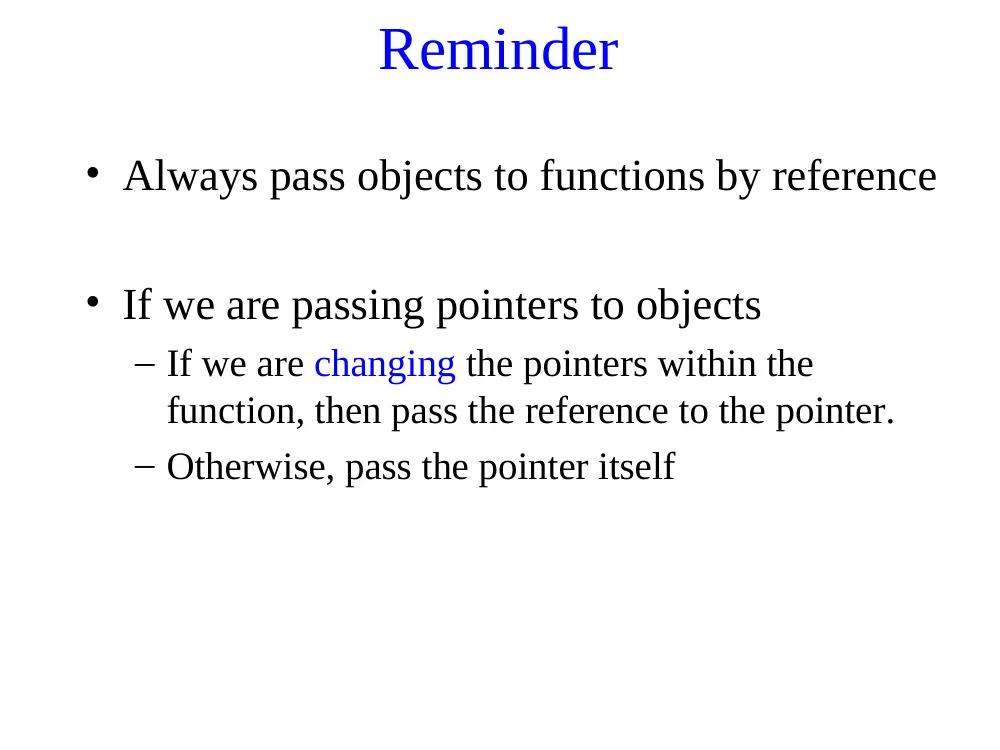
Reminder
• Always pass objects to functions by reference
• If we are passing pointers to objects
– If we are changing the pointers within the
function, then pass the reference to the pointer.
– Otherwise, pass the pointer itself
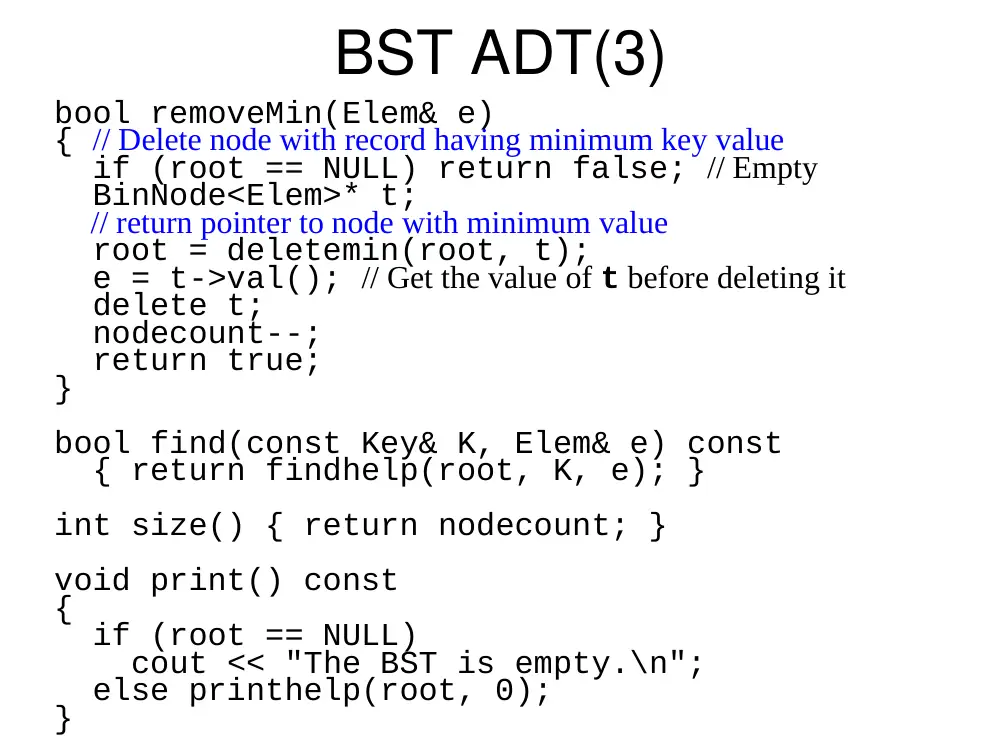
BST ADT(3)
bool removeMin(Elem& e)
{ // Delete node with record having minimum key value
if (root == NULL) return false; // Empty
BinNode<Elem>* t;
// return pointer to node with minimum value
root = deletemin(root, t);
e = t->val(); // Get the value of t before deleting it
delete t;
nodecount--;
return true;
}
bool find(const Key& K, Elem& e) const
{ return findhelp(root, K, e); }
int size() { return nodecount; }
void print() const
{
if (root == NULL)
cout << "The BST is empty.\n";
else printhelp(root, 0);
}
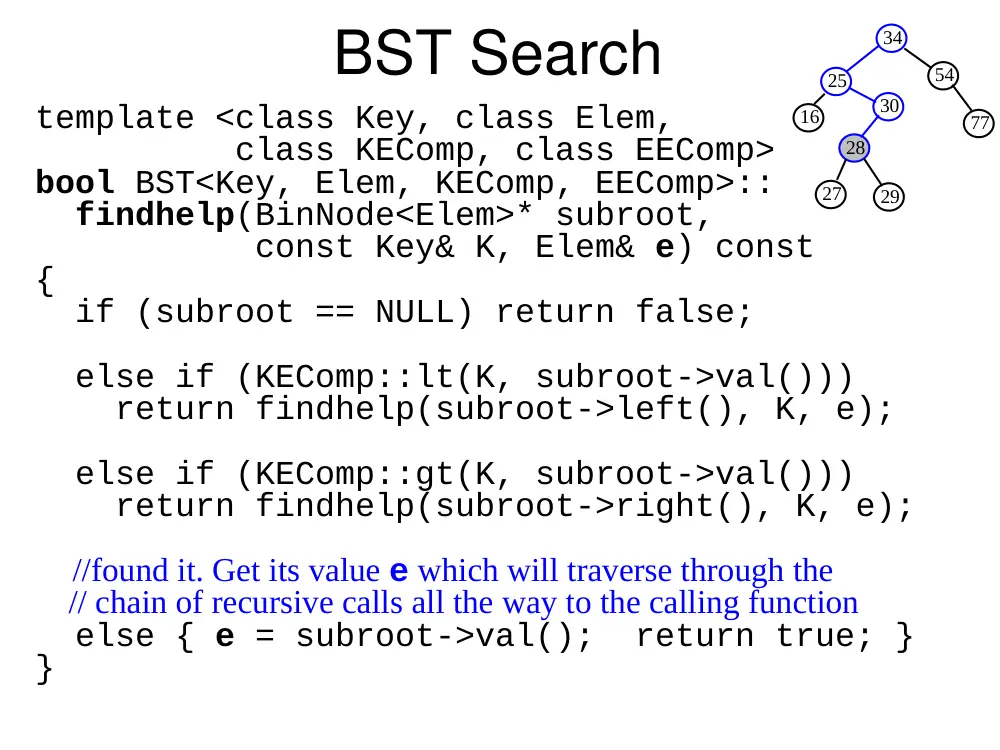
BST Search
template <class Key, class Elem,
class KEComp, class EEComp>
bool BST<Key, Elem, KEComp, EEComp>::
findhelp(BinNode<Elem>* subroot,
const Key& K, Elem& e) const
{
if (subroot == NULL) return false;
else if (KEComp::lt(K, subroot->val()))
return findhelp(subroot->left(), K, e);
else if (KEComp::gt(K, subroot->val()))
return findhelp(subroot->right(), K, e);
//found it. Get its value e which will traverse through the
// chain of recursive calls all the way to the calling function
else { e = subroot->val(); return true; }
}
34
54
77
30
25
28
27
16
29
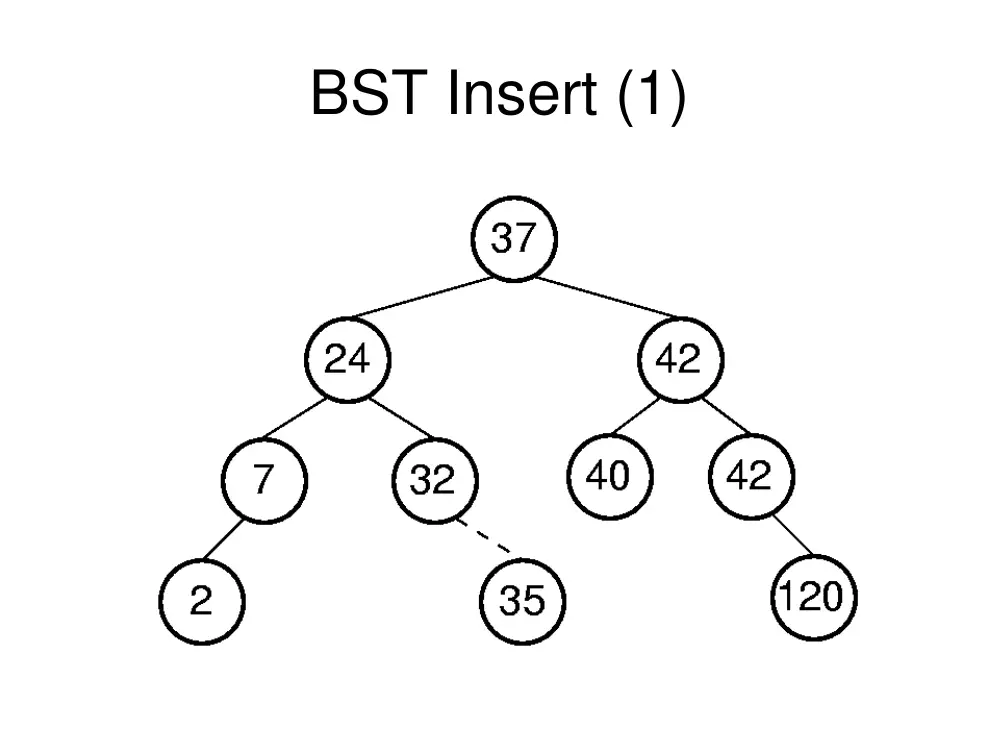
BST Insert (1)
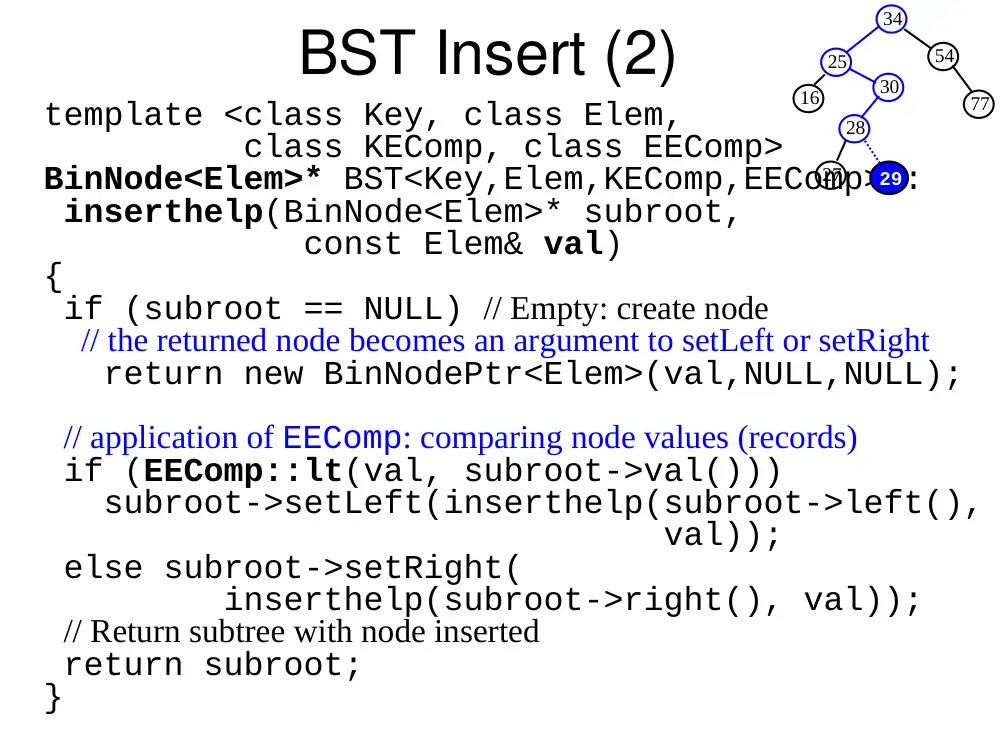
BST Insert (2)
template <class Key, class Elem,
class KEComp, class EEComp>
BinNode<Elem>* BST<Key,Elem,KEComp,EEComp>::
inserthelp(BinNode<Elem>* subroot,
const Elem& val)
{
if (subroot == NULL) // Empty: create node
// the returned node becomes an argument to setLeft or setRight
return new BinNodePtr<Elem>(val,NULL,NULL);
// application of EEComp: comparing node values (records)
if (EEComp::lt(val, subroot->val()))
subroot->setLeft(inserthelp(subroot->left(),
val));
else subroot->setRight(
inserthelp(subroot->right(), val));
// Return subtree with node inserted
return subroot;
}
34
54
77
30
25
28
27
16
29
Remove Minimum Value
template <class Key, class Elem,
class KEComp, class EEComp>
BinNode<Elem>* BST<Key, Elem,
KEComp, EEComp>::
deletemin(BinNode<Elem>* subroot,
BinNode<Elem>*& min)
{
if (subroot->left() == NULL)
{
min = subroot;
return subroot->right();
}
else
{ // Minimum value is always found as the left-most node
subroot->setLeft(
deletemin(subroot->left(), min));
return subroot; // in the last step into the recursion, the original subroot will
be returned
}
}
20
9
5
5
10
subroot
BST Remove (1)
BST Remove (2)
template <class Key, class Elem,
class KEComp, class EEComp>
BinNode<Elem>* BST<Key,Elem,KEComp,EEComp>::
removehelp(BinNode<Elem>* subroot,
const Key& K, BinNode<Elem>*& t)
{ //t is the node to remove (if we find it using K)
if (subroot == NULL) return NULL;
else if (KEComp::lt(K, subroot->val()))
subroot->setLeft(
removehelp(subroot->left(), K, t));
else if (KEComp::gt(K, subroot->val()))
subroot->setRight(
removehelp(subroot->right(), K, t));
BST Remove (2)
else
{ // Found it: remove it
BinNode<Elem>* temp;
t = subroot;
if (subroot->left() == NULL) //replace it with
subroot = subroot->right();//its right child
else if (subroot->right() == NULL)//replace it
subroot = subroot->left(); //with its left child
else
{ // Both children are non-empty; look for min in right subtree
deletemin(subroot->right(), temp);
Elem te = subroot->val();
subroot->setVal(temp->val());
temp->setVal(te);
t = temp;
}
}
return subroot;
}
Cost of BST Operations
Find: O (log n) in a close-to-balanced tree
Insert: O (log n) if nodes arrive randomly
O (n) if nodes arrive in increasing value
Delete: 2O(log n)
involves finding the node and then replacing
it
with the node with minimum in the right
sub-tree
Array Implementation
Node
0
1
2
3
4
5
6
7
8
9
10 11
Parent
--
0
0
1
1
2
2
3
3
4
4
5
Left Child
1
3
5
7
9
11
--
--
--
--
--
--
Right Child
2
4
6
8
10
--
--
--
--
--
--
--
Left Sibling
--
--
1
--
3
--
5
--
7
--
9
--
Right Sibling
--
2
--
4
--
6
--
8
-- 10
--
--
Array Implementation
Parent (r) = (r-1)/2 if r 0
Leftchild(r) = 2r+1 if 2r+1 < n
Rightchild(r) = 2r+2 if 2r+2 < n
Leftsibling(r) = r-1 if r is even
Rightsibling(r) = r+1 if r is odd and r+1 < n
Heaps
Heap: Complete binary tree with the heap
property:
• Min-heap: All values in parent are less than child
values.
• Max-heap: All values in parent are greater than
child values.
The values are partially ordered.
Heap representation: Normally the array-
based complete binary tree
representation.
Heap ADT
template<class Elem,class Comp> class maxheap
{
private:
Elem* Heap; // Pointer to the heap array
int size; // Maximum size of the heap
int n; // Number of elems now in heap
void siftdown(int); // Put element in place
public:
maxheap(Elem* h, int num, int max);
int heapsize() const;
bool isLeaf(int pos) const;
int leftchild(int pos) const;
int rightchild(int pos) const;
int parent(int pos) const;
bool insert(const Elem&);
bool removemax(Elem&);
bool remove(int, Elem&);
void buildHeap();
};
Siftdown
For fast heap construction:
•
Work from high end of array to low end.
•
Call
Call siftdown
siftdown for each item
for each item,
except leaf nodes.
template <class Elem,
class Comp>
void maxheap<Elem,Comp>::
siftdown(int pos)
{
while (!isLeaf(pos))
{
int j = leftchild(pos);
int rc = rightchild(pos);
//get index of child with maximum value
if ((rc<n) && Comp::lt(Heap[j],Heap[rc]))
j = rc; //j is always made to be the index of greater child
if (!Comp::lt(Heap[pos], Heap[j])) return;
swap(Heap, pos, j);
pos = j; //position becomes the index of child with
} //greater value
}
11
10
9
8
7
6
5
4
3
2
1
0
12
Value
--
--
--
--
--
--
12
10
8
6
4
2
Right Child
--
--
--
--
--
--
11
9
7
5
3
1
Left Child
5
4
4
3
3
2
2
1
1
0
0
--
Parent
Node Position
--
--
5
Leaf Nodes
50
8
16
10
2
70
66
40
13
4
18
20
3
18
66
2
50 40 13
10
70
8
16
3
4
20
50
8
16
10
2
70
66
40
13
4
18
20
3
18
66
2
50 40 13
10
70
8
16
3
4
20
50
8
16
10
2
70
66
40
13
20
18
4
3
18
66
2
50 40 13
10
70
8
16
3
20
4
50
8
16
10
2
70
66
40
13
20
18
4
3
18
66
2
50 40 13
10
70
8
16
3
20
4
50
8
16
66
2
70
10
40
13
20
18
4
3
18
10
2
50 40 13
66
70
8
16
3
20
4
50
8
16
66
2
70
10
40
13
20
18
4
3
18
10
2
50 40 13
66
70
8
16
3
20
4
8
50
16
66
2
70
10
40
13
20
18
4
3
18
10
2
40 13
8
66
50 70
16
3
20
4
8
50
16
66
2
70
10
40
13
20
18
4
3
18
10
2
40 13
8
66
50 70
16
3
20
4
8
50
70
66
2
16
10
40
13
20
18
4
3
18
10
2
40 13
8
66
50 16
70
3
20
4
8
50
70
66
2
16
10
40
13
20
18
4
3
18
10
2
40 13
8
66
50 16
70
3
20
4
8
50
70
66
2
40
10
16
13
20
18
4
3
18
10
2
16 13
8
66
50 40
70
3
20
4
8
50
70
66
2
40
10
16
13
20
18
4
3
18
10
2
16 13
8
66
50 40
70
3
20
4
8
50
3
66
2
40
10
16
13
20
18
4
70
18
10
2
16 13
8
66
50 40
3
70
20
4
8
50
3
66
2
40
10
16
13
20
18
4
70
18
10
2
16 13
8
66
50 40
3
70
20
4
8
50
66
3
2
40
10
16
13
20
18
4
70
18
10
2
16 13
8
3
50 40
66
70
20
4
8
50
66
3
2
40
10
16
13
20
18
4
70
18
10
2
16 13
8
3
50 40
66
70
20
4
8
50
66
10
2
40
3
16
13
20
18
4
70
18
3
2
16 13
8
10
50 40
66
70
20
4
8
50
66
10
2
40
3
16
13
20
18
4
70
18
10
2
3
16
8
13
50 40
66
70
20
4
Buildheap Cost
Cost for heap construction:
log n
(i - 1) n/2i n.
i=1
Insert
template <class Elem, class Comp>
bool maxheap<Elem, Comp>::
insert (const Elem& it)
{
if (n>=size)
return false;
// Heap full
Heap[n++] = it;
// put the value at the end
for (i=floor(n/2.0)-1; i>=0; i--)
siftdown(i);
// This restores the order
return true;
}
Remove
template <class Elem, class Comp>
bool maxheap<Elem, Comp>::
remove (int i, Elem& it)
{
if (i>=n || n==0)
return false;
// invalid index or Heap
empty
swap(Heap, i, --n); // Swap max with end
if (n != 0)
siftdown(i);
// This restores the order
it = Heap[n];
// Return max value
return true;
}
Remove Max Value
template <class Elem, class Comp>
bool maxheap<Elem, Comp>::
removemax(Elem& it)
{
if (n == 0)
return false;
// Heap empty
swap(Heap, 0, --n); // Swap max with end
if (n != 0)
siftdown(0);
// This restores the order
it = Heap[n];
// Return max value
return true;
}
Priority Queues (1)
A priority queue stores objects, and on request
releases the object with greatest value.
Example: Scheduling jobs in a multi-tasking
operating system.
The priority of a job may change, requiring some
reordering of the jobs.
Implementation: Use a heap to store the priority
queue.
Priority Queues (2)
To support priority reordering (change the priority of a
certain item), we may need to know the index of the object in
question, and then remove it and reinsert it.
template <class Elem, class Comp>
bool maxheap<Elem, Comp>::remove(int pos,
Elem& it)
{
if ((pos < 0) || (pos >= n)) return false;
swap(Heap, pos, --n); //swap with last value
while ((pos != 0) && (Comp::gt(Heap[pos],
Heap[parent(pos)])))
swap(Heap, pos, parent(pos));
siftdown(pos); //restore order if needed
it = Heap[n];
return true;
}
Huffman Coding Trees
ASCII codes: 8 bits per character.
• Fixed-length coding.
Can take advantage of relative frequency (weight)
of letters to save space.
• Variable-length coding
Assign shorter codes to characters that are used
more commonly, and thus save space
Compression
Z
K
F
C
U
D
L
E
2
7
24
32
37
42
42
120
Huffman Coding Trees
• Huffman code for each letter is derived from a
full binary tree called Huffman coding tree.
• Each leaf of the tree corresponds to a letter
weight of the leaf node is the weight (frequency)
of its associated letter.
• Goal is to build a tree with the minimum external
path weight (MEPW).
– For a leaf, the MEPW is its weight times its depth.
– The binary tree with the MEPW is the one with the
minimum sum of weighted path lengths for the given
set of leaves.
– A letter with high weight should have low depth, so it
counts the least against the total path weight
another letter should be pushed deeper into the tree if
it has less weight
Building a Huffman Coding Tree
1.
Having a string of n letters,
2.
Create a collection of n initial Huffman trees, each of
which is a single leaf node containing one of the letters.
3.
Put the n partial trees in a list in ascending order by
weight.
4.
Remove the first two trees
5.
Join these two trees to create a new one whose root
has the two trees as children and whose weight is the
sum of weights of the two trees
6.
Put this tree back in the list in the correct place
necessary to preserve the order of the list
7.
Repeat steps 4 through 6 until all of the partial trees
have been combined into one.
Huffman Tree Construction for 8
selected letters
Huffman Tree Construction (2)
Assigning Codes
Letter
Freq
Code
Bits
C
32
D
42
E
120
K
7
L
42
M
24
U
37
Z
2
1110 4
1111 3
0 1
111101 6
110 3
11111 5
11112 3
111100 6
Assigning and Using Huffman Codes
•
Once the tree has been constructed, we need to assign codes to
individual letters.
•
Beginning at the root, we assign either a ‘0’ or a ‘1’ to each edge
in the tree: ‘0’ to the left child and ‘1’ to the right child.
•
The Huffman code for a letter is a binary number determined by
the path from the root to the leaf corresponding to that letter.
•
Decoding the message is done by looking at the bits in the coded
string from left to right until a letter is decoded.
•
This is done by using the Huffman tree in a reverse process
compared to that used in the generation process.
•
Decoding the bit string begins at the root of the tree
•
Take branches depending on the bit value: left for ‘0’ and right for ‘1’
until reaching a leaf node.
•
This leaf contains the first character in the message.
•
Next, process the following bit in the code starting at the new root to begin
the next character
Decoding a code
•
Consider the code string 1011001110111101.
•
Begin at the root, taking a right branch, left branch, right branch
(101) we reach a leaf corresponding to the letter D.
–
The remaining code is 1001110111101
•
Begin at the root, taking a right branch, left branch, left branch
(100) we reach a leaf corresponding to the letter U.
–
The remaining code is 1110111101
•
Begin at the root, taking a right branch, right branch, right branch,
left branch (1110) we reach a leaf corresponding to the letter C.
–
The remaining code is 111101
•
Begin at the root, taking a right branch, right branch, right branch,
right branch, left branch, and then a right branch (111101) we
reach a leaf corresponding to the letter K.
–
The code is exhausted
•
The decoded message is “DUCK”