
EECE 330 Chapter, Fall 2011
American University of Beirut · Data Structures and Algorithms · 26 pages · Prof. Hassan Artail

Showing the first 10 of 26 pages. Download the PDF to see all of it.
More EECE 330 files
Show the text of this chapter
EECE 330
Data Structures & Algorithms
Singly-Linked Lists
Singly-Linked Lists
© Hassan Artail
American University of Beirut
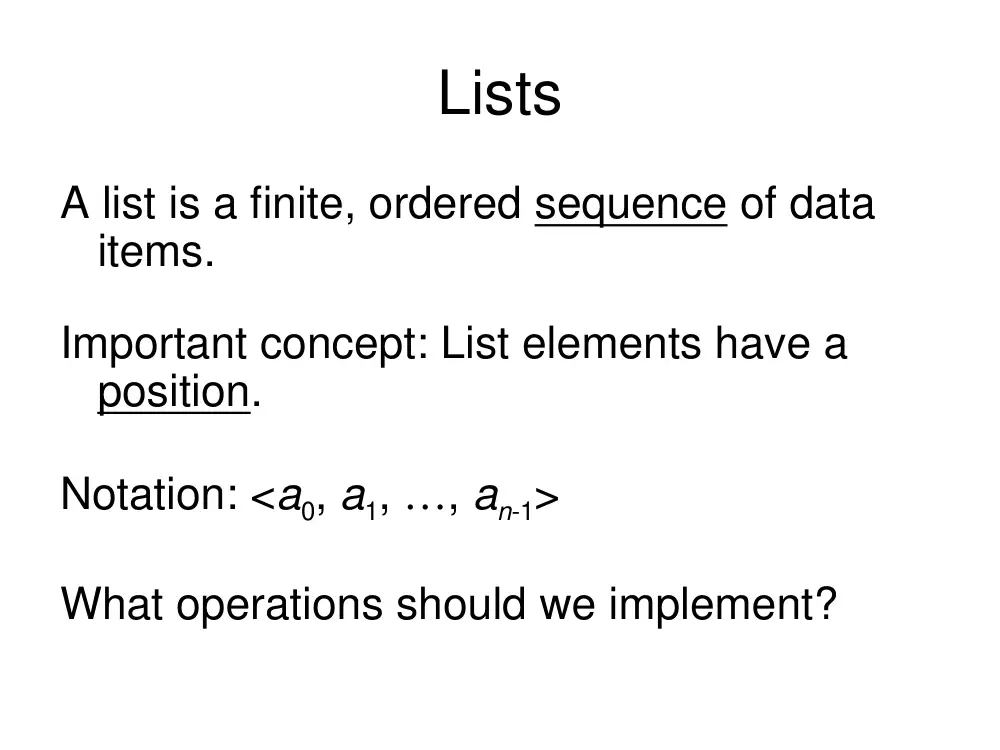
Lists
A list is a finite, ordered sequence of data
items.
Important concept: List elements have a
position.
Notation: <a0, a1, …, an-1>
What operations should we implement?
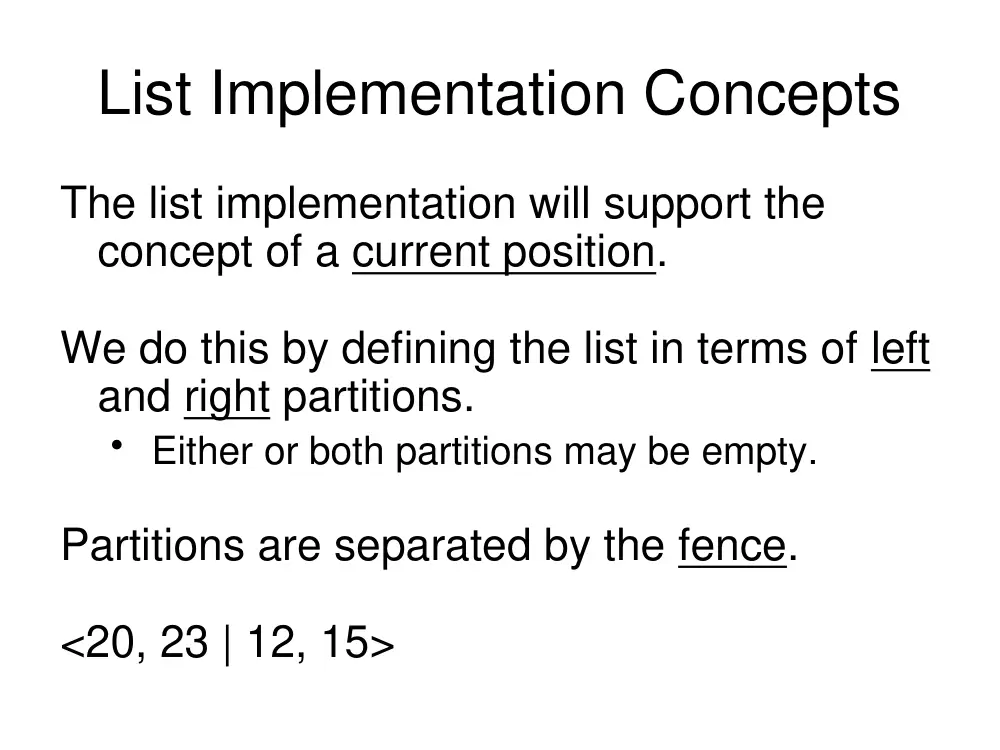
List Implementation Concepts
The list implementation will support the
concept of a current position.
We do this by defining the list in terms of left
and right partitions.
• Either or both partitions may be empty.
Partitions are separated by the fence.
<20, 23 | 12, 15>
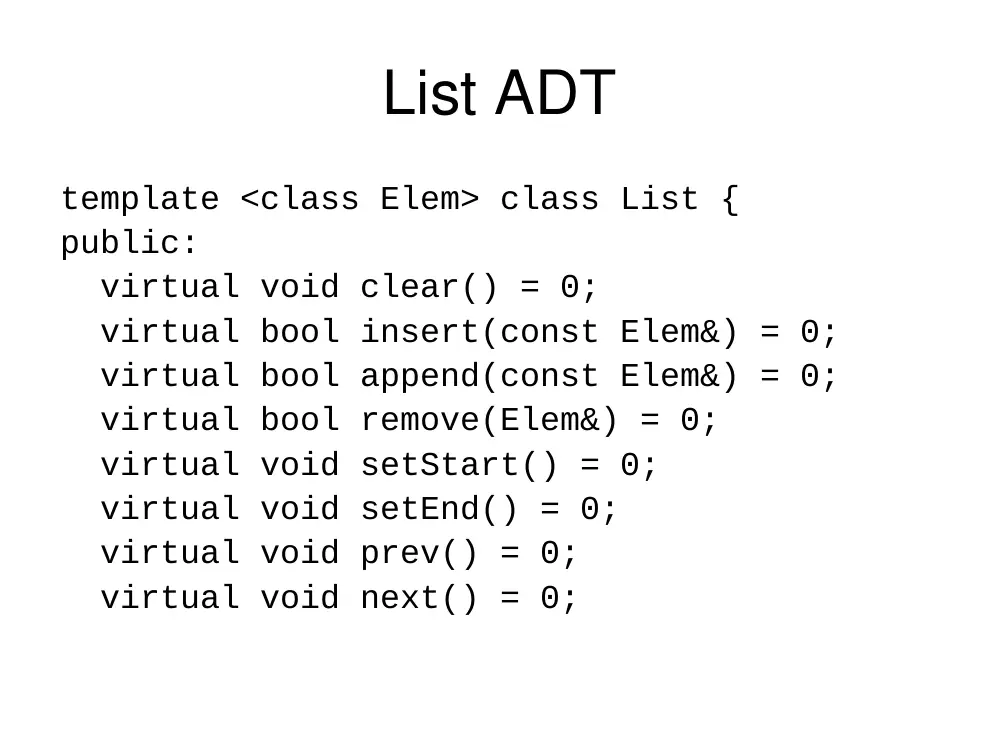
List ADT
template <class Elem> class List {
public:
virtual void clear() = 0;
virtual bool insert(const Elem&) = 0;
virtual bool append(const Elem&) = 0;
virtual bool remove(Elem&) = 0;
virtual void setStart() = 0;
virtual void setEnd() = 0;
virtual void prev() = 0;
virtual void next() = 0;
List ADT (cont)
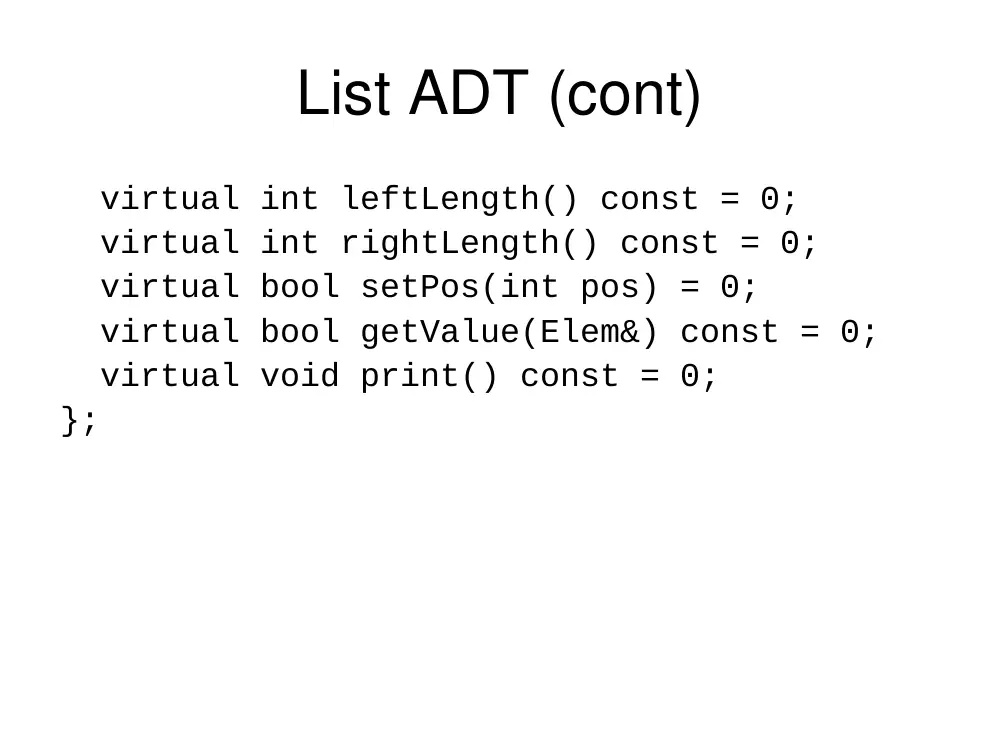
virtual int leftLength() const = 0;
virtual int rightLength() const = 0;
virtual bool setPos(int pos) = 0;
virtual bool getValue(Elem&) const = 0;
virtual void print() const = 0;
};
List ADT Examples
List: < , 32, 15>
MyList.insert(99);
Result: < , 99, 32, 15>
Iterate through the whole list:
for (MyList.setStart();
MyList.getValue(it);
MyList.next())
DoSomething(it);
12
12
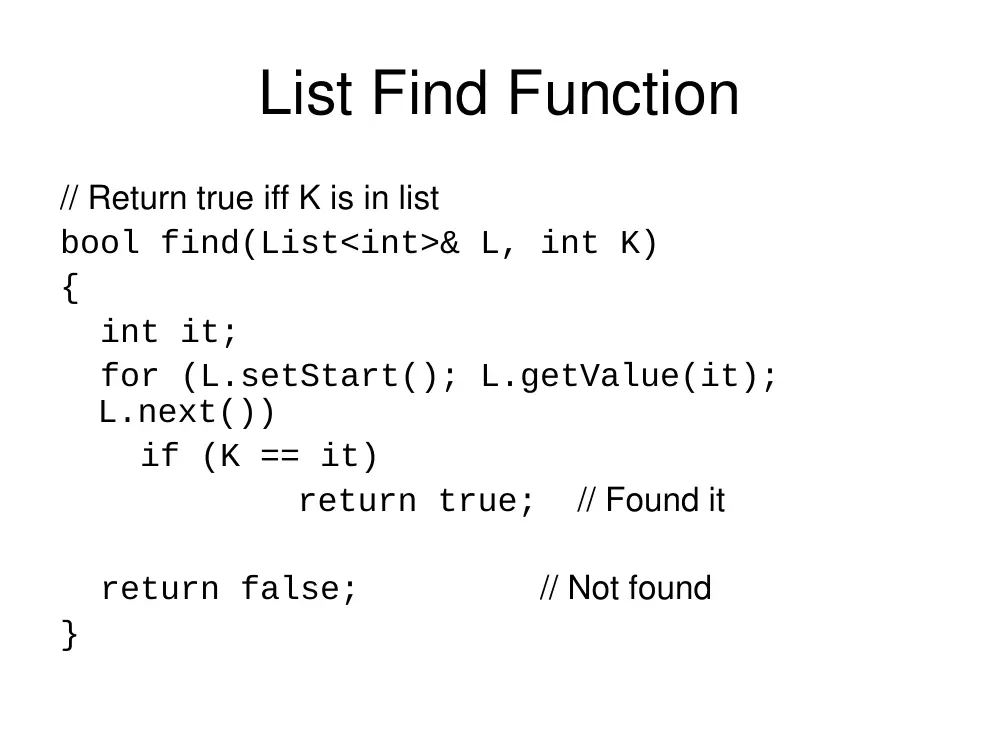
List Find Function
// Return true iff K is in list
bool find(List<int>& L, int K)
{
int it;
for (L.setStart(); L.getValue(it);
L.next())
if (K == it)
return true; // Found it
return false; // Not found
}
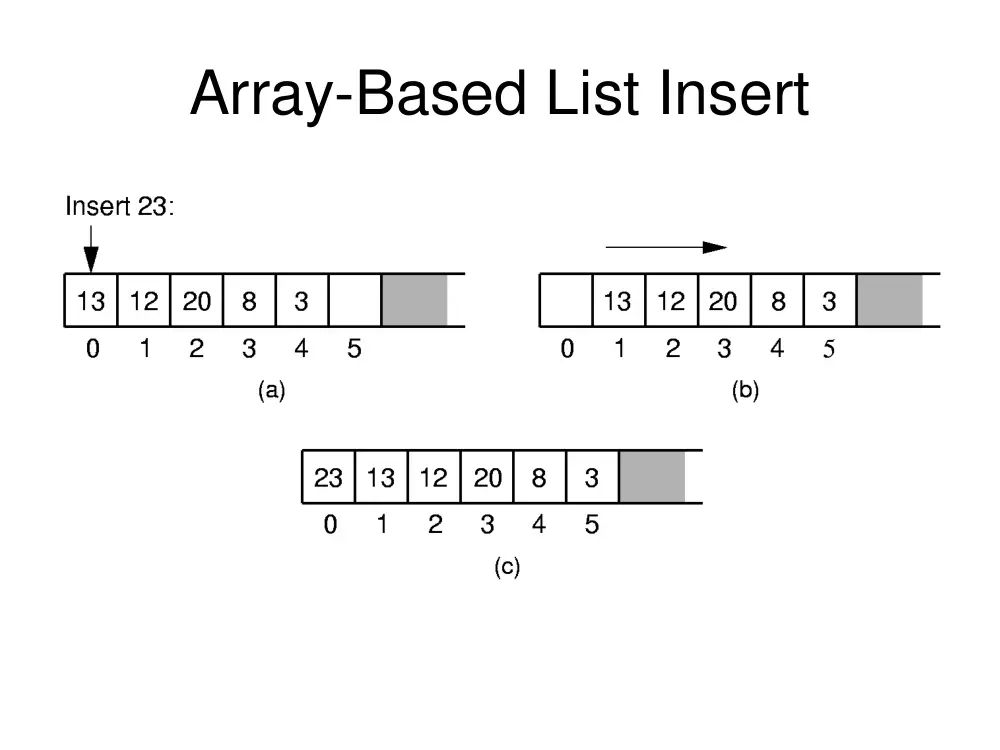
Array-Based List Insert
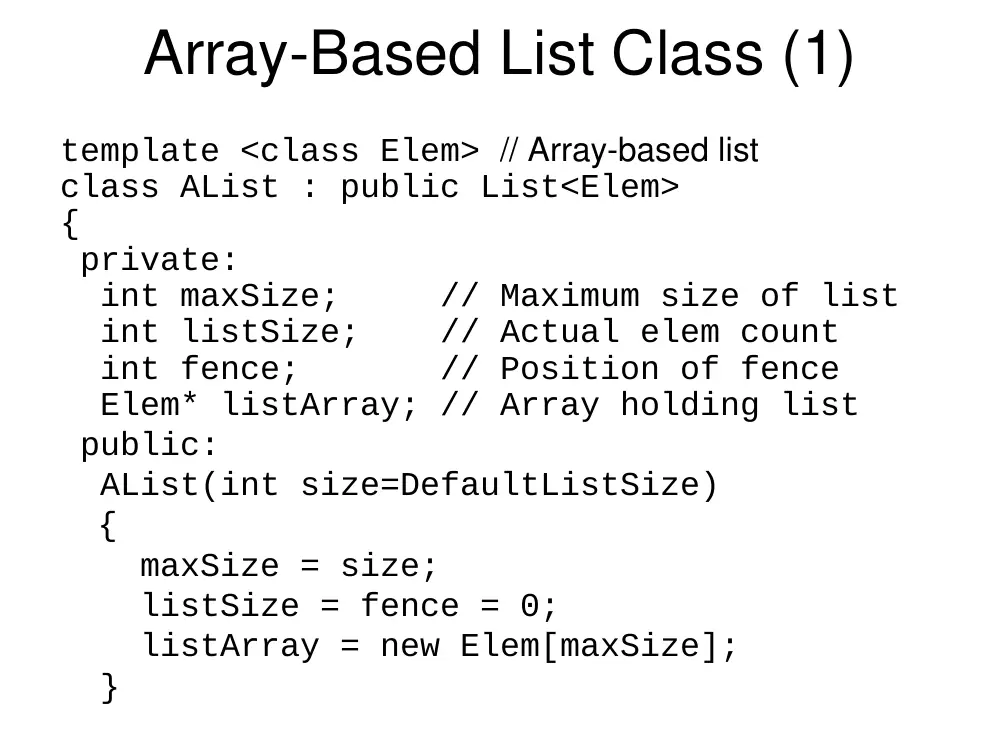
Array-Based List Class (1)
template <class Elem> // Array-based list
class AList : public List<Elem>
{
private:
int maxSize; // Maximum size of list
int listSize; // Actual elem count
int fence; // Position of fence
Elem* listArray; // Array holding list
public:
AList(int size=DefaultListSize)
{
maxSize = size;
listSize = fence = 0;
listArray = new Elem[maxSize];
}
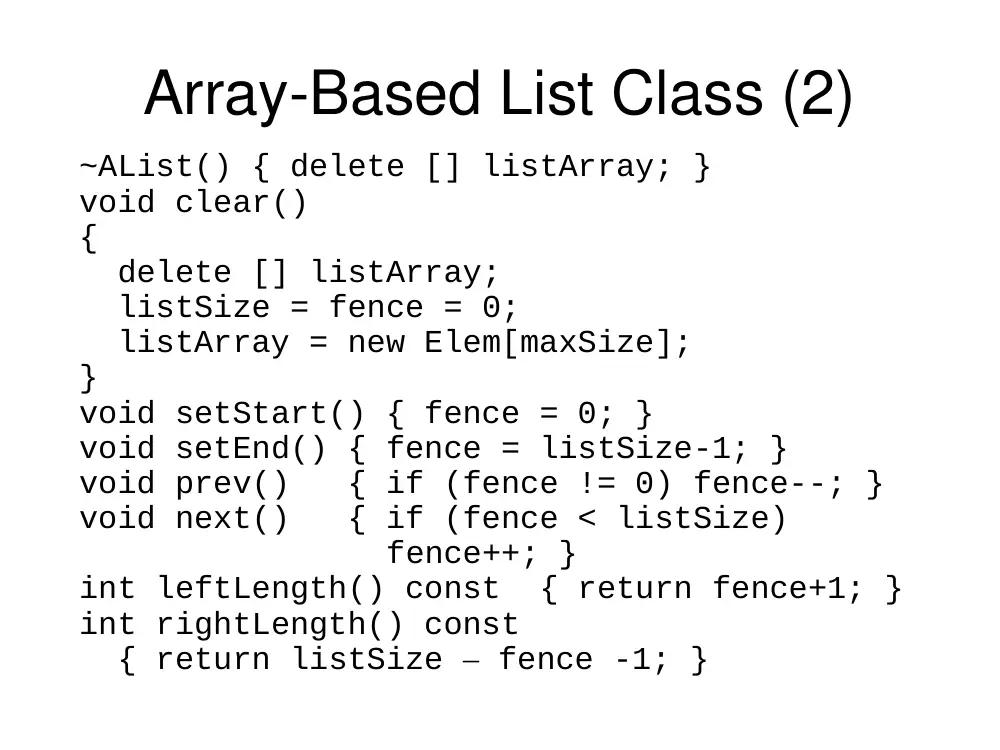
Array-Based List Class (2)
~AList() { delete [] listArray; }
void clear()
{
delete [] listArray;
listSize = fence = 0;
listArray = new Elem[maxSize];
}
void setStart() { fence = 0; }
void setEnd() { fence = listSize-1; }
void prev() { if (fence != 0) fence--; }
void next() { if (fence < listSize)
fence++; }
int leftLength() const { return fence+1; }
int rightLength() const
{ return listSize – fence -1; }
Array-Based List Class (3)
bool setPos(int pos)
{
if ((pos >= 0) && (pos < listSize))
fence = pos;
return (pos >= 0) && (pos < listSize);
}
bool getValue(Elem& it) const
{
if (rightLength() == 0) return false;
else { it = listArray[fence+1];
return true; }
}
};
Insert
// Insert at front of right partition
template <class Elem>
bool AList<Elem>::insert(const Elem& item)
{
if (listSize == maxSize) return false;
for(int i=listSize; i>fence; i--)
// Shift Elems up to make room
listArray[i] = listArray[i-1];
listArray[fence+1] = item;
listSize++; // Increment list size
return true;
}
Append
// Append Elem to end of the list
template <class Elem>
bool AList<Elem>::append(const Elem& item)
{
if (listSize == maxSize) return false;
listArray[listSize++] = item;
return true;
}
Remove
// Remove and return first Elem in right partition
template <class Elem> bool
AList<Elem>::remove(Elem& it)
{
if (rightLength() == 0) return false;
it = listArray[fence]; // Copy Elem
for(int i=fence; i<listSize-1; i++)
// Shift them down
listArray[i] = listArray[i+1];
// Decrement size
listSize--;
return true;
}
Link Class
Dynamic allocation of new list elements
// Singly-linked list node
template <class Elem> class Link
{
public:
Elem element; // Value for this node
Link *next; // Pointer to next node
//First Constructor
Link(const Elem& elemval,
Link* nextval =NULL)
{ element = elemval; next =
nextval; }
//Overloaded Constructor
Link(Link* nextval =NULL)
{ next = nextval; }
};
Linked List Position (2)
Linked List Class (1)
// Linked list implementation
template <class Elem> class LList: public
List<Elem>
{
private:
Link<Elem>* head; // Point to list header
Link<Elem>* tail; // Pointer to last Elem
Link<Elem>* fence;// Last element on left
int leftcnt; // Size of left
int rightcnt; // Size of right
void init()
{ // Intialization routine
fence = tail = head = new Link<Elem>;
leftcnt = rightcnt = 0;
}
Linked List Class (2)
void removeall()
{ // Return link nodes to free store
while(head != NULL) {
fence = head;
head = head->next;
delete fence;
}
}
public:
LList(int size=DefaultListSize)
{ init(); }
~LList() { removeall(); } // Destructor
void clear() { removeall(); init(); }
Linked List Class (3)
void setStart()
{
fence = head; rightcnt += leftcnt;
leftcnt = 0;
}
void setEnd()
{
fence = tail; leftcnt += rightcnt;
rightcnt = 0;
}
void next()
{
// Don't move fence if right empty
if (fence != tail) {
fence = fence->next; rightcnt--;
leftcnt++; }
}
int leftLength() const { return leftcnt; }
int rightLength() const { return rightcnt; }
bool getValue(Elem& it) const
{
if(rightLength() == 0) return false;
it = fence->next->element;
return true;
}
};
Insertion
Insert/Append
// Insert at front of right partition
template <class Elem>
bool LList<Elem>::insert(const Elem& item)
{
fence->next =
new Link<Elem>(item, fence->next);
if (tail == fence) tail = fence->next;
rightcnt++;
return true;
}
// Append Elem to end of the list
template <class Elem>
bool LList<Elem>::append(const Elem& item)
{
tail = tail->next =
new Link<Elem>(item, NULL);
rightcnt++;
return true;
}
Removal
Remove
// Remove and return first Elem in right partition
template <class Elem> bool
LList<Elem>::remove(Elem& it)
{
if (fence->next == NULL) return false;
it = fence->next->element; // Remember value
// Remember link node
Link<Elem>* ltemp = fence->next;
fence->next = ltemp->next; // Remove
if (tail == ltemp) // Reset tail
tail = fence;
delete ltemp; // Reclaim space
rightcnt--;
return true;
}
Prev
// Move fence one step left; no change if left is empty
template <class Elem> void
LList<Elem>::prev()
{
Link<Elem>* temp = head;
if (fence == head) return; // No prev Elem
while (temp->next!=fence)
temp=temp->next;
fence = temp;
leftcnt--;
rightcnt++;
}
Setpos
// Set the size of left partition to pos
template <class Elem> bool
LList<Elem>::setPos(int pos)
{
if ((pos < 0) || (pos >
rightcnt+leftcnt))
return false;
fence = head;
for(int i=0; i<pos; i++)
fence = fence->next;
return true;
}
Comparison of Implementations
Array-Based Lists:
• Insertion and deletion are (n).
• Prev and direct access are (1).
• Array must be allocated in advance.
• No overhead if all array positions are full.
Linked Lists:
• Insertion and deletion are (1).
• Prev and direct access are (n).
• Space grows with number of elements.
• Every element requires overhead.