
ENG 102 Final, Spring 2004
American University of Beirut · Enrichment Course in English · 8 pages

More ENG 102 files
Show the text of this final exam
BRICAN ONIVERSIT
LIB
ENGLISH 102 oe MARY
FINAL EXAM _——
SPRING 2003-04
E Moy.
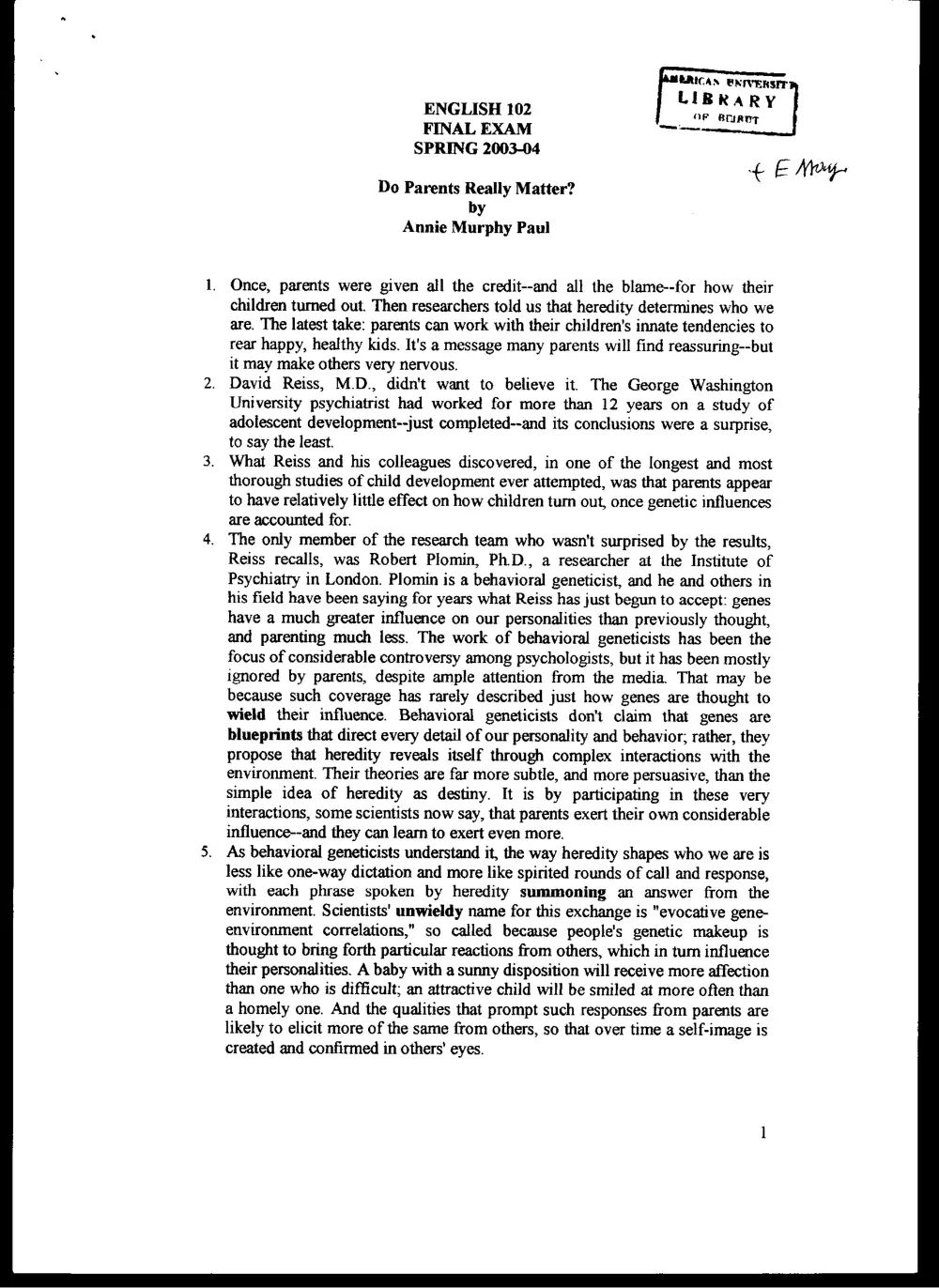
Do Parents Really Matter?
by
Annie Murphy Paul
1. Once, parents were given all the credit--and all the blame--for how their
children turned out. Then researchers told us that heredity determines who we
are. The latest take: parents can work with their children's innate tendencies to
rear happy, healthy kids. It's a message many parents will find reassuring--but
it may make others very nervous.
2. David Reiss, M.D., didn't want to believe it. The George Washington
University psychiatrist had worked for more than 12 years on a study of
adolescent development--just completed--and its conclusions were a surprise,
to say the least.
3. What Reiss and his colleagues discovered, in one of the longest and most
thorough studies of child development ever attempted, was that parents appear
to have relatively little effect on how children tum out, once genetic influences
are accounted for.
4. The only member of the research team who wasn't surprised by the results,
Reiss recalls, was Robert Plomin, Ph.D., a researcher at the Institute of
Psychiatry in London. Plomin is a behavioral geneticist, and he and others in
his field have been saying for years what Reiss has just begun to accept: genes
have a much greater influence on our personalities than previously thought,
and parenting much less. The work of behavioral geneticists has been the
focus of considerable controversy among psychologists, but it has been mostly
ignored by parents, despite ample attention from the media. That may be
because such coverage has rarely described just how genes are thought to
wield their influence. Behavioral geneticists don't claim that genes are
blueprints that direct every detail of our personality and behavior; rather, they
propose that heredity reveals itself through complex interactions with the
environment. Their theories are far more subtle, and more persuasive, than the
simple idea of heredity as destiny. It is by participating in these very
interactions, some scientists now say, that parents exert their own considerable
influence--and they can learn to exert even more.
5. As behavioral geneticists understand it, the way heredity shapes who we are is
less like one-way dictation and more like spirited rounds of call and response,
with each phrase spoken by heredity summoning an answer from the
environment. Scientists’ unwieldy name for this exchange is "evocative gene-
environment correlations," so called because people's genetic makeup is
thought to bring forth particular reactions from others, which in tum influence
their personalities. A baby with a sunny disposition will receive more affection
than one who is difficult; an attractive child will be smiled at more often than
a homely one. And the qualities that prompt such responses from parents are
likely to elicit more of the same from others, so that over time a self-image is
created and confirmed in others’ eyes.
ERI as PRIVERSIF
LIER SRY }
oo Maren |
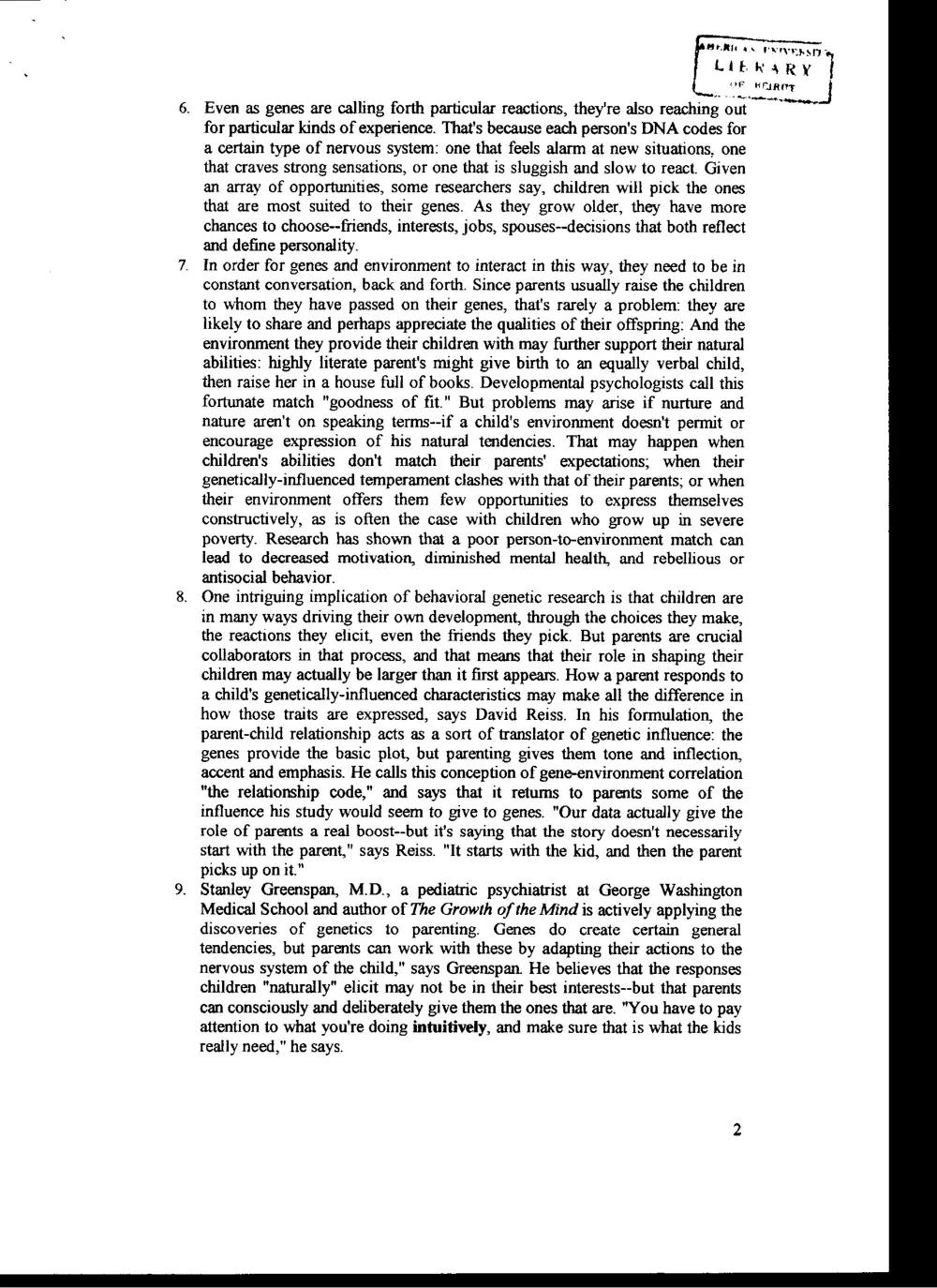
6. Even as genes are calling forth particular reactions, they're also reaching out °
for particular kinds of experience. That's because each person's DNA codes for
a certain type of nervous system: one that feels alarm at new situations, one
that craves strong sensations, or one that is sluggish and slow to react. Given
an array of opportunities, some researchers say, children will pick the ones
that are most suited to their genes. As they grow older, they have more
chances to choose--friends, interests, jobs, spouses--decisions that both reflect
and define personality.
7. In order for genes and environment to interact in this way, they need to be in
constant conversation, back and forth. Since parents usually raise the children
to whom they have passed on their genes, that's rarely a problem: they are
likely to share and perhaps appreciate the qualities of their offspring: And the
environment they provide their children with may further support their natural
abilities: highly literate parent's might give birth to an equally verbal child,
then raise her in a house full of books. Developmental psychologists call this
fortunate match "goodness of fit." But problems may arise if nurture and
nature aren't on speaking terms--if a child's environment doesn't permit or
encourage expression of his natural tendencies. That may happen when
children's abilities don't match their parents’ expectations; when their
genetically-influenced temperament clashes with that of their parents; or when
their environment offers them few opportunities to express themselves
constructively, as is often the case with children who grow up in severe
poverty. Research has shown that a poor person-to-environment match can
lead to decreased motivation, diminished mental health, and rebellious or
antisocial behavior.
8. One intriguing implication of behavioral genetic research is that children are
in many ways driving their own development, through the choices they make,
the reactions they elicit, even the friends they pick. But parents are crucial
collaborators in that process, and that means that their role in shaping their
children may actually be larger than it first appears. How a parent responds to
a child's genetically-influenced characteristics may make all the difference in
how those traits are expressed, says David Reiss. In his formulation, the
parent-child relationship acts as a sort of translator of genetic influence: the
genes provide the basic plot, but parenting gives them tone and inflection,
accent and emphasis. He calls this conception of gene-environment correlation
“the relationship code,” and says that it returns to parents some of the
influence his study would seem to give to genes. "Our data actually give the
role of parents a real boost--but it's saying that the story doesn't necessarily
start with the parent,” says Reiss. "It starts with the kid, and then the parent
picks up on it.”
9. Stanley Greenspan, M.D., a pediatric psychiatrist at George Washington
Medical School and author of The Growth of the Mind is actively applying the
discoveries of genetics to parenting. Genes do create certain general
tendencies, but parents can work with these by adapting their actions to the
nervous system of the child," says Greenspan. He believes that the responses
children "naturally" elicit may not be in their best interests--but that parents
can consciously and deliberately give them the ones that are. "You have to pay
attention to what you're doing intuitively, and make sure that is what the kids
really need,” he says.
en
Me
TEAST ay
LitkayRy
OF BROT
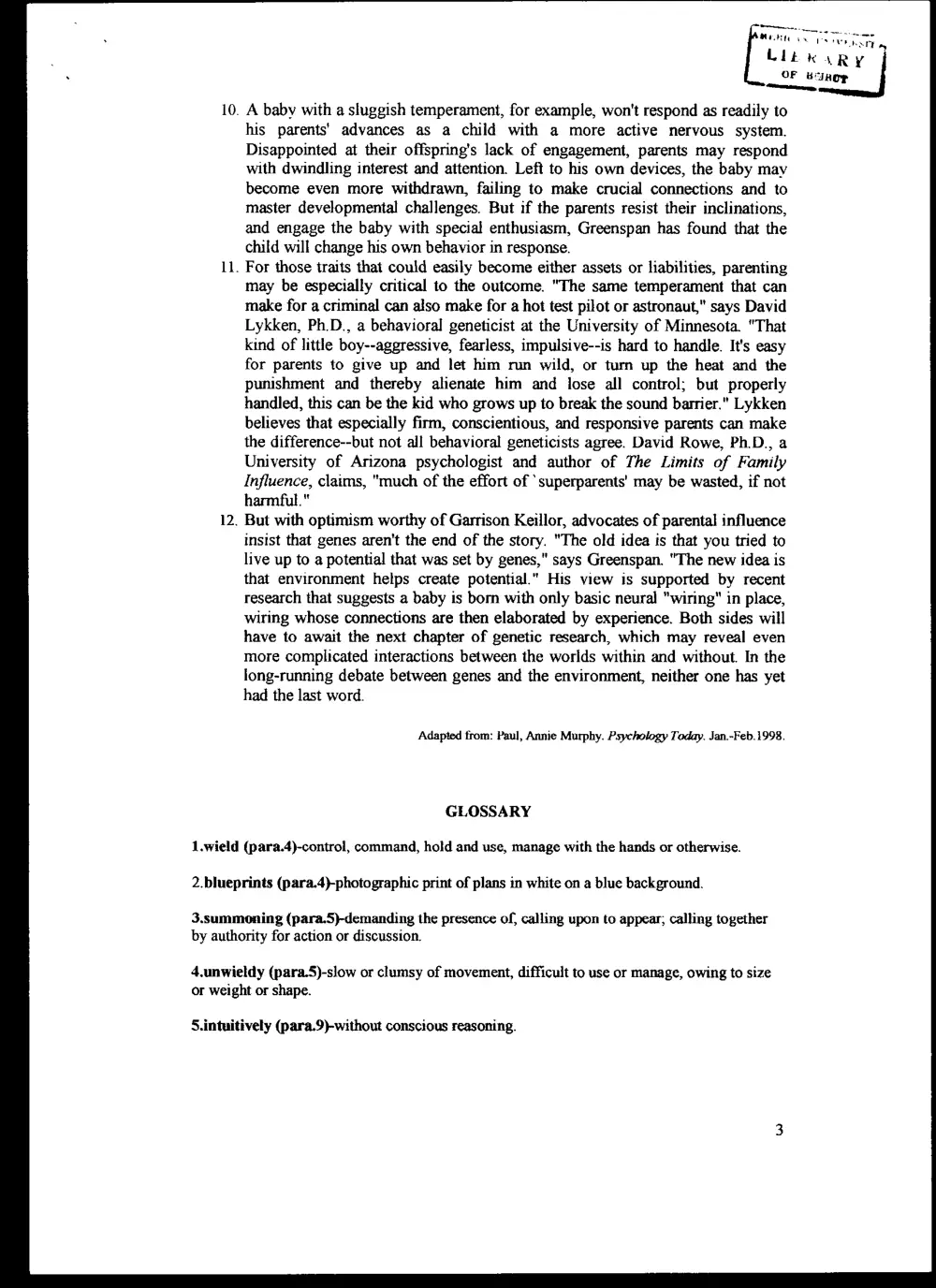
10. A baby with a sluggish temperament, for example, won't respond as readily to
his parents' advances as a child with a more active nervous system.
Disappointed at their offspring’s lack of engagement, parents may respond
with dwindling interest and attention. Left to his own devices, the baby may
become even more withdrawn, failing to make crucial connections and to
master developmental challenges. But if the parents resist their inclinations,
and engage the baby with special enthusiasm, Greenspan has found that the
child will change his own behavior in response.
. For those traits that could easily become either assets or liabilities, parenting
may be especially critical to the outcome. "The same temperament that can
make for a criminal can also make for a hot test pilot or astronaut," says David
Lykken, Ph.D., a behavioral geneticist at the University of Minnesota. "That
kind of little boy--aggressive, fearless, impulsive--is hard to handle. It's easy
for parents to give up and let him min wild, or turn up the heat and the
punishment and thereby alienate him and lose all control; but properly
handled, this can be the kid who grows up to break the sound barrier." Lykken
believes that especially firm, conscientious, and responsive parents can make
the difference--but not ail behavioral geneticists agree. David Rowe, Ph.D., a
University of Arizona psychologist and author of The Limits of Family
Influence, claims, "much of the effort of ‘superparents’ may be wasted, if not
harmful."
. But with optimism worthy of Garrison Keillor, advocates of parental influence
insist that genes aren't the end of the story. "The old idea is that you tried to
live up to a potential that was set by genes," says Greenspan. "The new idea is
that environment helps create potential." His view is supported by recent
research that suggests a baby is born with only basic neural "wiring" in place,
wiring whose connections are then elaborated by experience. Both sides will
have to await the next chapter of genetic research, which may reveal even
more complicated interactions between the worlds within and without. In the
long-running debate between genes and the environment, neither one has yet
had the last word.
Adapted from: Paul, Annie Murphy. Psychology Today. Jan.-Feb.1998.
GLOSSARY
1.wield (para.4)-control, command, hold and use, manage with the hands or otherwise.
2.blueprints (para.4)-photographic print of plans in white on a blue background.
3.summoning (para.5)-demanding the presence of, calling upon to appear; calling together
by authority for action or discussion.
4.unwieldy (para.5)-slow or clumsy of movement, difficult to use or manage, owing to size
or weight or shape.
5.intuitively (para.9)-without conscious reasoning.
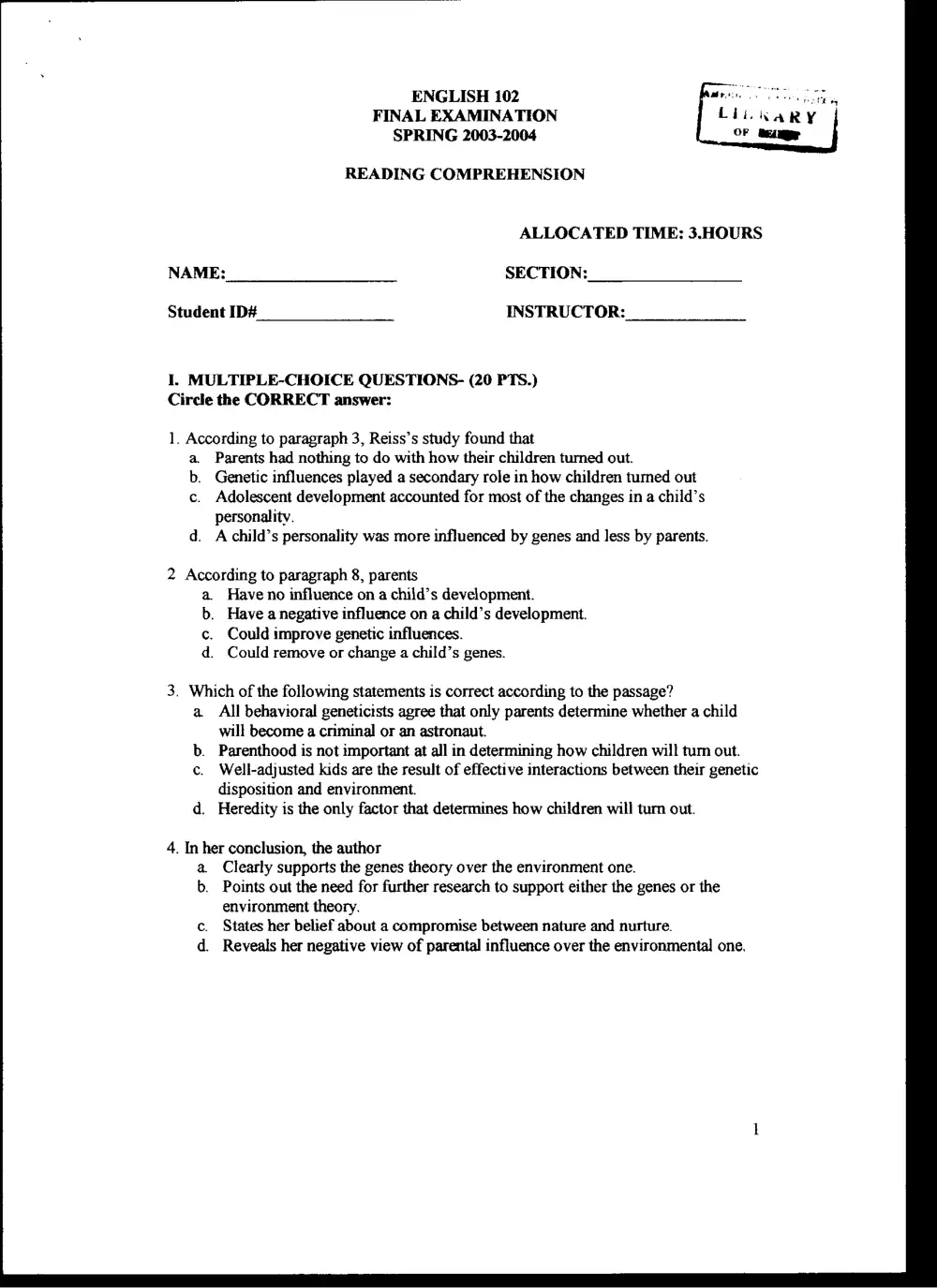
ENGLISH 102
FINAL EXAMINATION
SPRING 2003-2004
READING COMPREHENSION
ALLOCATED TIME: 3.HOURS
NAME: SECTION:
Student ID# INSTRUCTOR:
I. MULTIPLE-CHOICE QUESTIONS- (20 PTS.)
Circle the CORRECT answer:
1. According to paragraph 3, Reiss’s study found that
a
b.
c.
d.
Parents had nothing to do with how their children turned out.
Genetic influences played a secondary role in how children tumed out
Adolescent development accounted for most of the changes in a child’s
personality.
A child’s personality was more influenced by genes and less by parents.
2 According to paragraph 8, parents
a. Have no influence on a child’s development.
b. Have a negative influence on a child’s development.
c. Could improve genetic influences.
d. Could remove or change a child’s genes.
3. Which of the following statements is correct according to the passage?
a
b.
c.
d.
All behavioral geneticists agree that only parents determine whether a child
will become a criminal or an astronaut.
Parenthood is not important at all in determining how children will tum out.
Well-adjusted kids are the result of effective interactions between their genetic
disposition and environment.
Heredity is the only factor that determines how children will turn out.
4. In her conclusion, the author
Clearly supports the genes theory over the environment one.
Points out the need for further research to support either the genes or the
environment theory.
States her belief about a compromise between nature and nurture.
Reveals her negative view of parental influence over the environmental one.
a
b.
IE VOCABULARY: Follow the directions for the following questions. (20 Pts.)
Write synonyms for the following words:
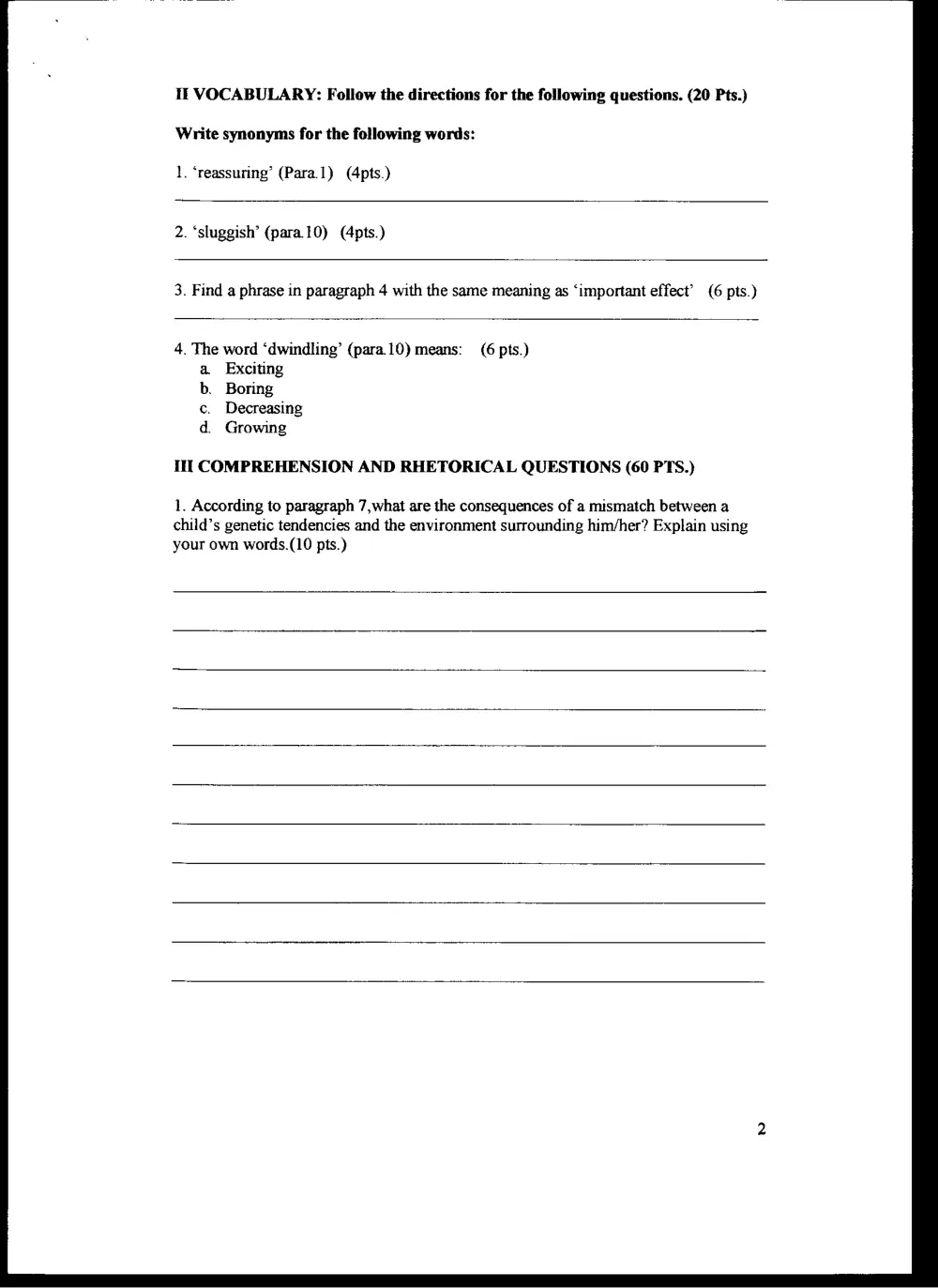
1. ‘reassuring’ (Para.1) (4pts.)
2. ‘sluggish’ (para.10) (4pts.)
3. Find a phrase in paragraph 4 with the same meaning as ‘important effect’ (6 pts.)
4. The word ‘dwindling’ (para.10) means: (6 pts.)
a Exciting
b. Boring
c. Decreasing
d. Growing
IH COMPREHENSION AND RHETORICAL QUESTIONS (60 PTS.)
1. According to paragraph 7,what are the consequences of a mismatch between a
child’s genetic tendencies and the environment surrounding him/her? Explain using
your own words.(10 pts.)
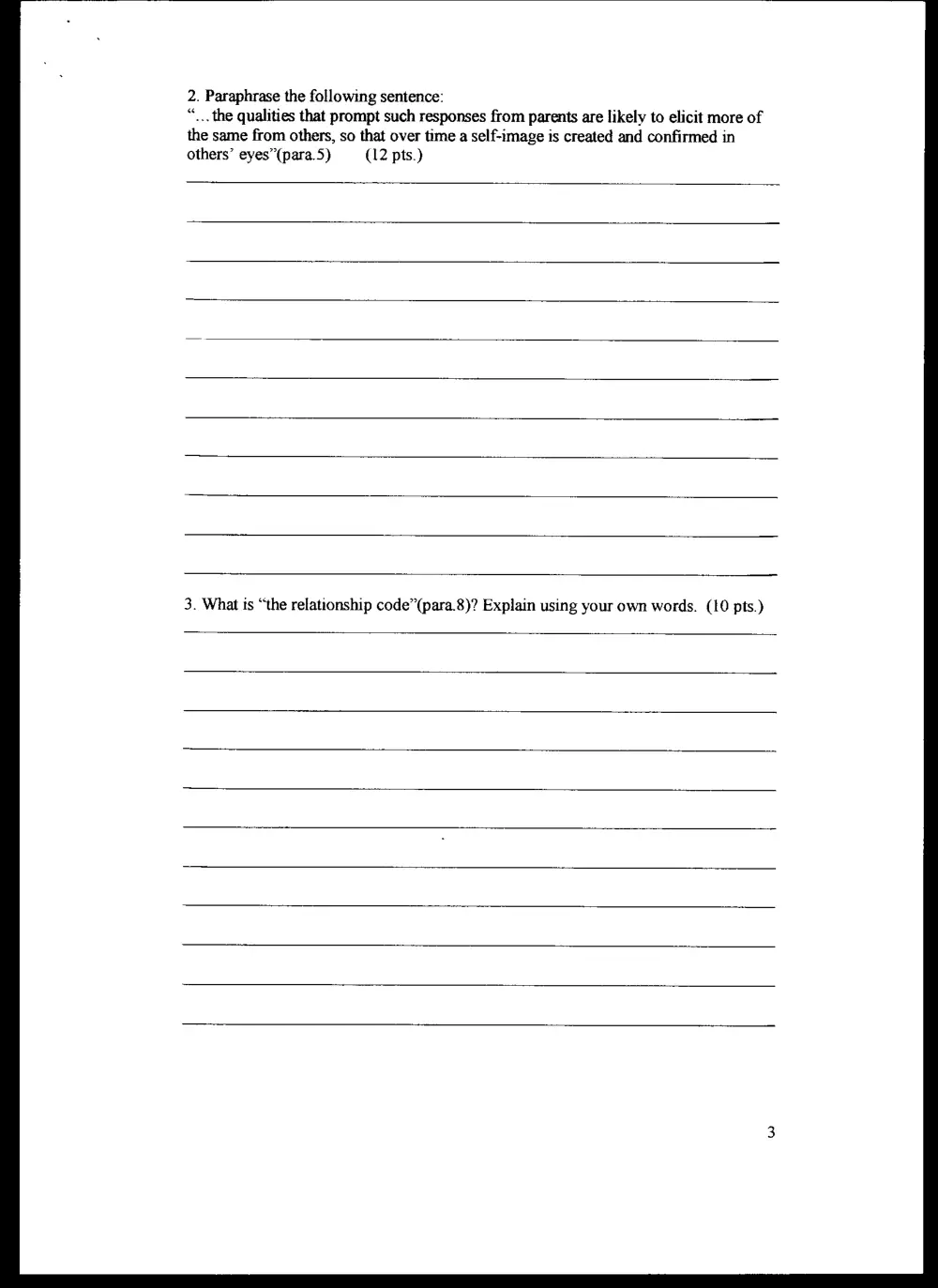
2. Paraphrase the following sentence:
“.. the qualities that prompt such responses from parents are likely to elicit more of
the same from others, so that over time a self-image is created and confirmed in
others’ eyes”(para.5) (12 pts.)
3. What is “the relationship code”(para.8)? Explain using your own words. (10 pts.)
4. According to para.11, what kind of qualities does Lykken find advisable in parents?
Quote your answer from the passage. (5 pts.)
5. Using your own words, reflect on the title and write a thesis statement for this
essay. (10 pts.)
6. Name two types of concrete support used in the passage. (8 pts.)
a. Para,
b. Para.
7. The passage is primarily (5 pts.)
a A description of the process of development in children.
b. A causal analysis of why children develop in certain ways.
c. A comparison of the behavior of parents and that of their children.
d. Anarrative of the number of studies done on behavioral genetic research.
ENGLISH 102
FINAL EXAMINATION
SPRING 2003-2004
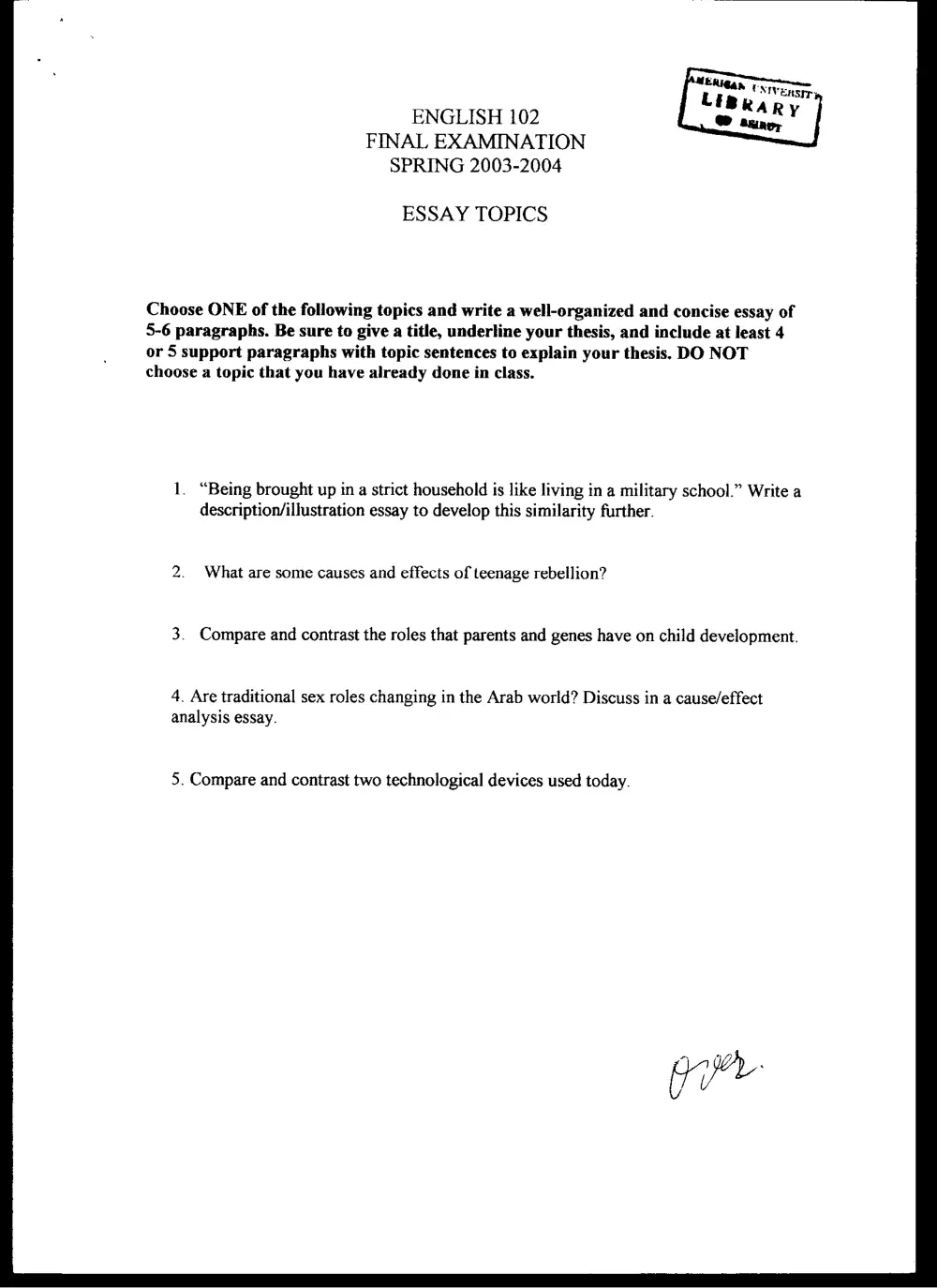
ESSAY TOPICS
Choose ONE of the following topics and write a well-organized and concise essay of
5-6 paragraphs. Be sure to give a title, underline your thesis, and include at least 4
or 5 support paragraphs with topic sentences to explain your thesis. DO NOT
choose a topic that you have already done in class.
1. “Being brought up in a strict household is like living in a military school.” Write a
description/illustration essay to develop this similarity further.
2. What are some causes and effects of teenage rebellion?
3. Compare and contrast the roles that parents and genes have on child development.
4. Are traditional sex roles changing in the Arab world? Discuss in a cause/effect
analysis essay.
5. Compare and contrast two technological devices used today.