
ENG 102 Final, Fall 2004
American University of Beirut · Enrichment Course in English · 5 pages
More ENG 102 files
Show the text of this final exam
ERICAN ONIVERSIT
LIBRARY
oF BEIRTT
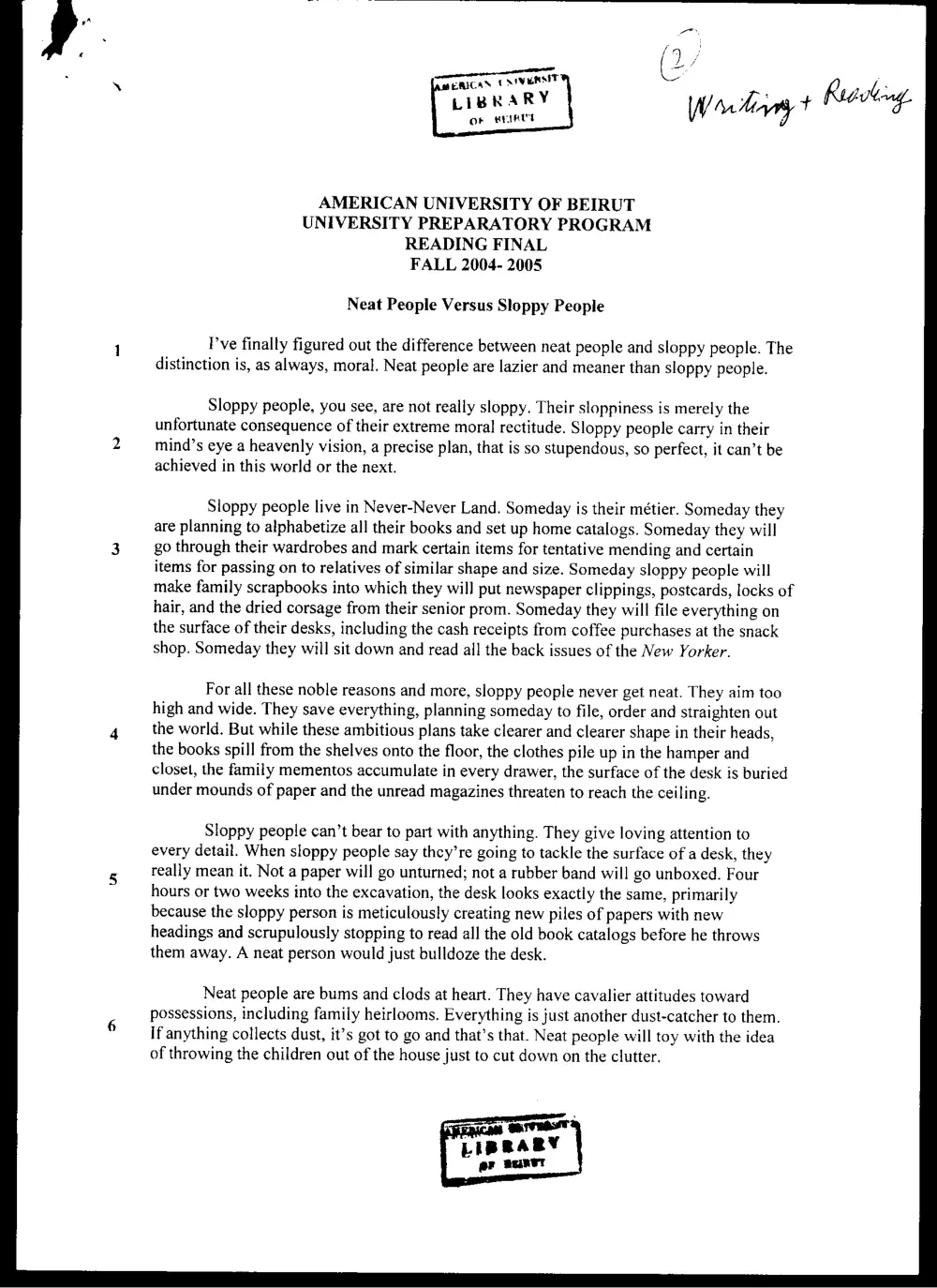
AMERICAN UNIVERSITY OF BEIRUT
UNIVERSITY PREPARATORY PROGRAM
READING FINAL
FALL 2004- 2005
Neat People Versus Sloppy People
Pve finally figured out the difference between neat people and sloppy people. The
distinction is, as always, moral. Neat people are lazier and meaner than sloppy people.
Sloppy people, you see, are not really sloppy. Their sloppiness is merely the
unfortunate consequence of their extreme moral rectitude. Sloppy people carry in their
mind’s eye a heavenly vision, a precise plan, that is so stupendous, so perfect, it can’t be
achieved in this world or the next.
Sloppy people live in Never-Never Land. Someday is their métier. Someday they
are planning to alphabetize all their books and set up home catalogs. Someday they will
go through their wardrobes and mark certain items for tentative mending and certain
items for passing on to relatives of similar shape and size. Someday sloppy people will
make family scrapbooks into which they will put newspaper clippings, postcards, locks of
hair, and the dried corsage from their senior prom. Someday they will file everything on
the surface of their desks, including the cash receipts from coffee purchases at the snack
shop. Someday they will sit down and read all the back issues of the New Yorker.
For all these noble reasons and more, sloppy people never get neat. They aim too
high and wide. They save everything, planning someday to file, order and straighten out
the world. But while these ambitious plans take clearer and clearer shape in their heads,
the books spill from the shelves onto the floor, the clothes pile up in the hamper and
closet, the family mementos accumulate in every drawer, the surface of the desk is buried
under mounds of paper and the unread magazines threaten to reach the ceiling.
Sloppy people can’t bear to part with anything. They give loving attention to
every detail. When sloppy people say thcy’re going to tackle the surface of a desk, they
really mean it. Not a paper will go unturned; not a rubber band will go unboxed. Four
hours or two weeks into the excavation, the desk looks exactly the same, primarily
because the sloppy person is meticulously creating new piles of papers with new
headings and scrupulously stopping to read all the old book catalogs before he throws
them away. A neat person would just bulldoze the desk.
Neat people are bums and clods at heart. They have cavalier attitudes toward
possessions, including family heirlooms. Everything is just another dust-catcher to them.
If anything collects dust, it’s got to go and that’s that. Neat people will toy with the idea
of throwing the children out of the house just to cut down on the clutter.
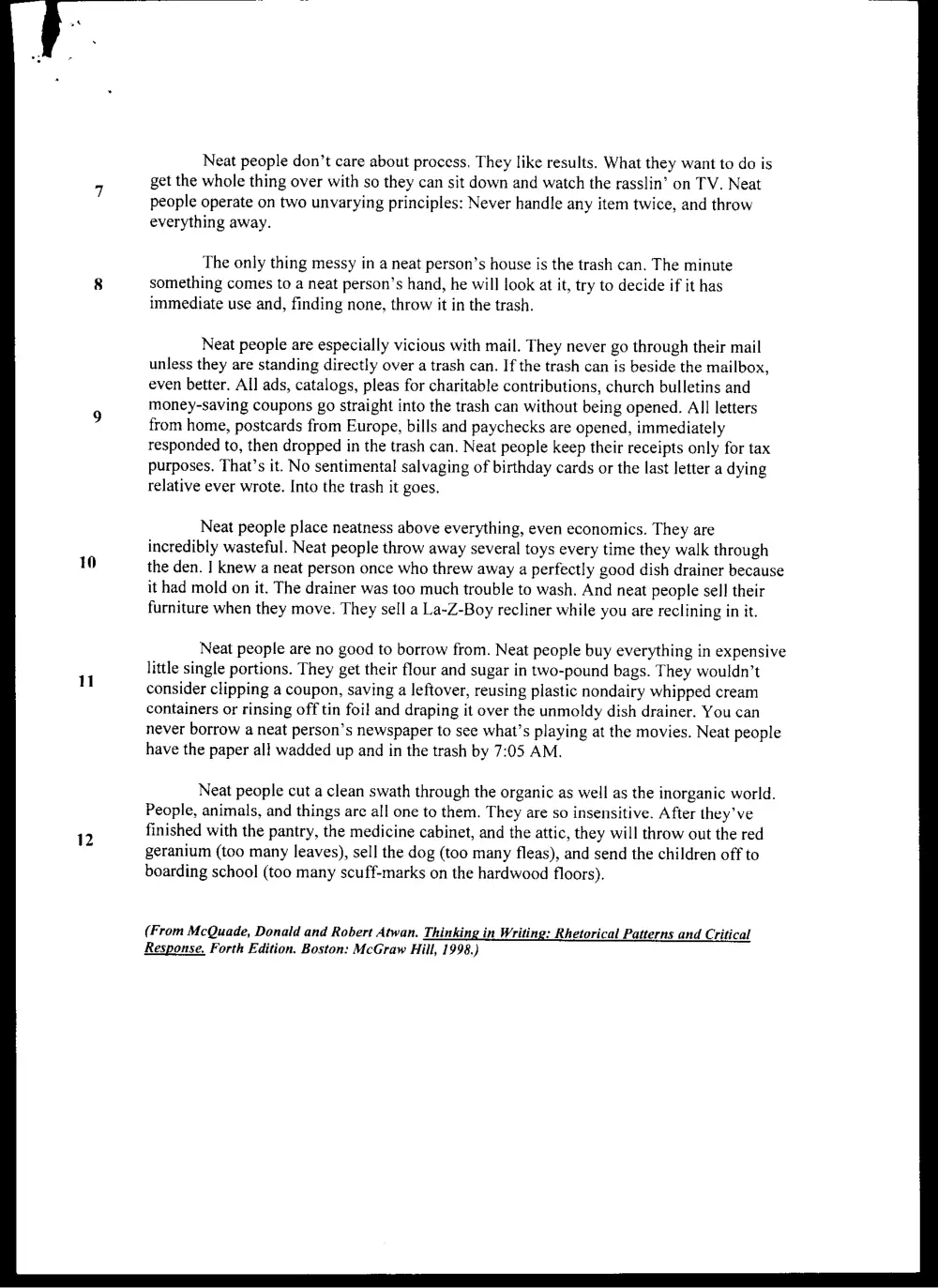
Neat people don’t care about process. They like results. What they want to do is
get the whole thing over with so they can sit down and watch the rasslin’ on TV, Neat
people operate on two unvarying principles: Never handle any item twice, and throw
everything away.
The only thing messy in a neat person’s house is the trash can. The minute
something comes to a neat person’s hand, he will look at it, try to decide if it has
immediate use and, finding none, throw it in the trash.
Neat people are especially vicious with mail. They never go through their mail
unless they are standing directly over a trash can. If the trash can is beside the mailbox,
even better. All ads, catalogs, pleas for charitable contributions, church bulletins and
money-saving coupons go straight into the trash can without being opened. All letters
from home, postcards from Europe, bills and paychecks are opened, immediately
responded to, then dropped in the trash can. Neat people keep their receipts only for tax
purposes. That’s it. No sentimental salvaging of birthday cards or the last letter a dying
relative ever wrote. Into the trash it goes.
Neat people place neatness above everything, even economics. They are
incredibly wasteful. Neat people throw away several toys every time they walk through
the den. I knew a neat person once who threw away a perfectly good dish drainer because
it had mold on it. The drainer was too much trouble to wash. And neat people sell their
furniture when they move. They sell a La-Z-Boy recliner while you are reclining in it.
Neat people are no good to borrow from. Neat people buy everything in expensive
little single portions. They get their flour and sugar in two-pound bags. They wouldn’t
consider clipping a coupon, saving a leftover, reusing plastic nondairy whipped cream
containers or rinsing off tin foil and draping it over the unmoldy dish drainer. You can
never borrow a neat person’s newspaper to see what’s playing at the movies. Neat people
have the paper all wadded up and in the trash by 7:05 AM.
Neat people cut a clean swath through the organic as well as the inorganic world.
People, animals, and things are all one to them. They are so insensitive. After they’ve
finished with the pantry, the medicine cabinet, and the attic, they will throw out the red
geranium (too many leaves), sell the dog (too many fleas), and send the children off to
boarding school (too many scuff-marks on the hardwood floors).
(From McQuade, Donald and Robert Atwan. Thinking in Writing: Rhetorical Patterns and Critical
Response. Forth Edition. Boston: McGraw Hill, 1 998)
Ener aR
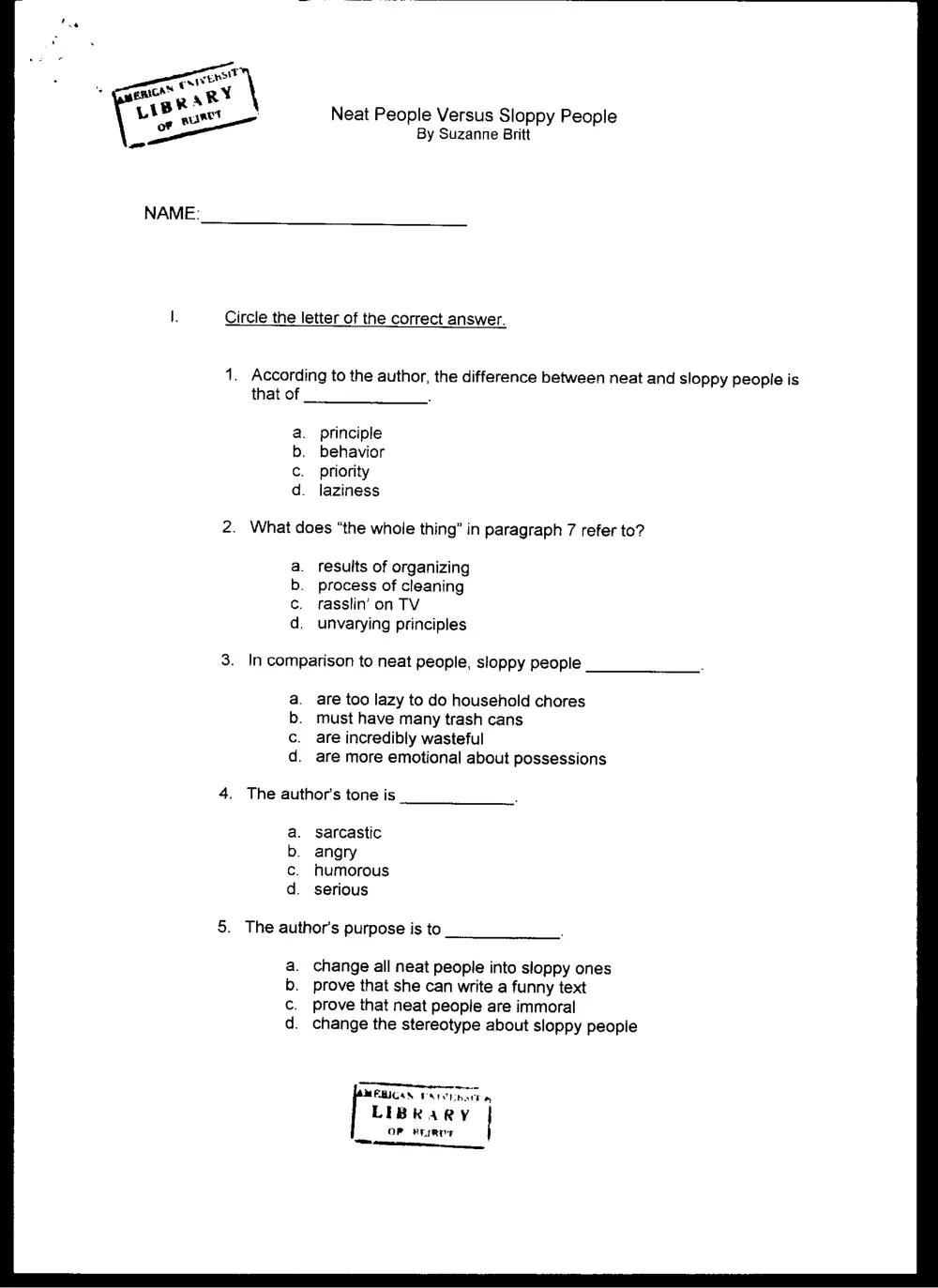
yey unt Neat People Versus Sloppy People
I By Suzanne Britt
-
NAME:
I Circle the letter of the correct answer.
1. According to the author, the difference between neat and sloppy people is
that of
a. principle
b. behavior
c. priority
d. laziness
2. What does “the whole thing” in paragraph 7 refer to?
a. results of organizing
b. process of cleaning
c. rasslin’ on TV
d. unvarying principles
3. In comparison to neat people, sloppy people
are too lazy to do household chores
must have many trash cans
are incredibly wasteful
are more emotional about possessions
ae ow
4. The author's tone is
sarcastic
angry
humorous
serious
Boop
5. The author's purpose is to
change all neat people into sloppy ones
prove that she can write a funny text
prove that neat people are immoral
change the stereotype about sloppy people
aoo®
ata pne ne
MEBICAN ERE HSrt ny
LIBRARY
OF BEIRUT
a eran teneeen,
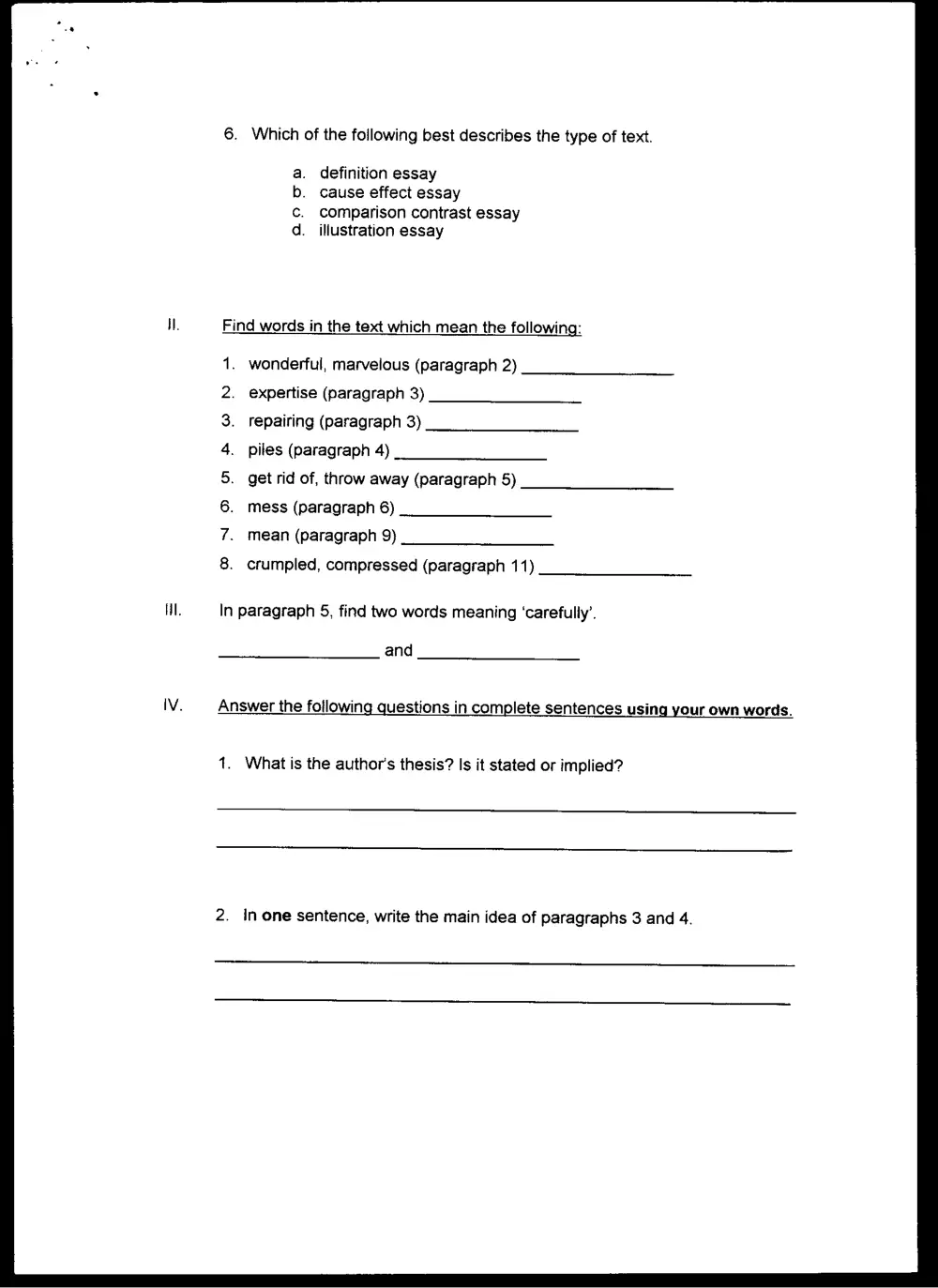
6. Which of the following best describes the type of text.
a. definition essay
b. cause effect essay
c. comparison contrast essay
d. illustration essay
Find words in the text which mean the following:
wonderful, marvelous (paragraph 2)
expertise (paragraph 3)
repairing (paragraph 3)
piles (paragraph 4)
get rid of, throw away (paragraph 5)
mess (paragraph 6)
mean (paragraph 9)
SND AP WON A
crumpled, compressed (paragraph 11)
In paragraph 5, find two words meaning ‘carefully’.
and
Answer the following questions in complete sentences using your own words.
1. What is the author's thesis? Is it stated or implied?
2. In one sentence, write the main idea of paragraphs 3 and 4.
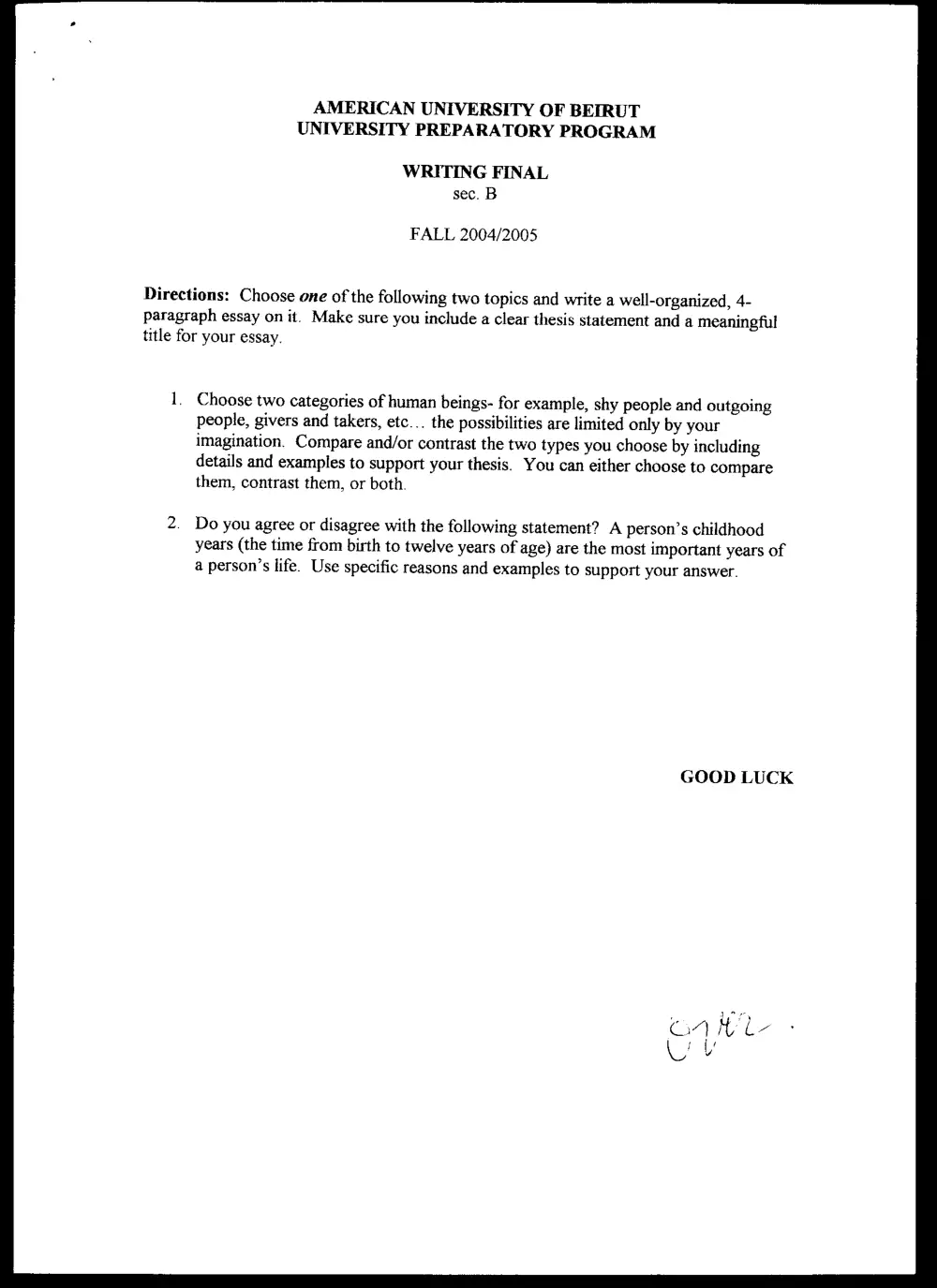
AMERICAN UNIVERSITY OF BEIRUT
UNIVERSITY PREPARATORY PROGRAM
WRITING FINAL
sec. B
FALL 2004/2005
Directions: Choose one of the following two topics and write a well-organized, 4-
paragraph essay on it. Make sure you include a clear thesis statement and a meaningful
title for your essay.
1. Choose two categories of human beings- for example, shy people and outgoing
people, givers and takers, etc... the possibilities are limited only by your
imagination. Compare and/or contrast the two types you choose by including
details and examples to support your thesis. You can either choose to compare
them, contrast them, or both.
Do you agree or disagree with the following statement? A person’s childhood
years (the time from birth to twelve years of age) are the most important years of
a person’s life. Use specific reasons and examples to support your answer.
GOOD LUCK