
ENG 102 Final, Fall 2004
American University of Beirut · Enrichment Course in English · 7 pages


More ENG 102 files
Show the text of this final exam
ENGLISH 102
FINAL EXAM
FALL 2004- 2005
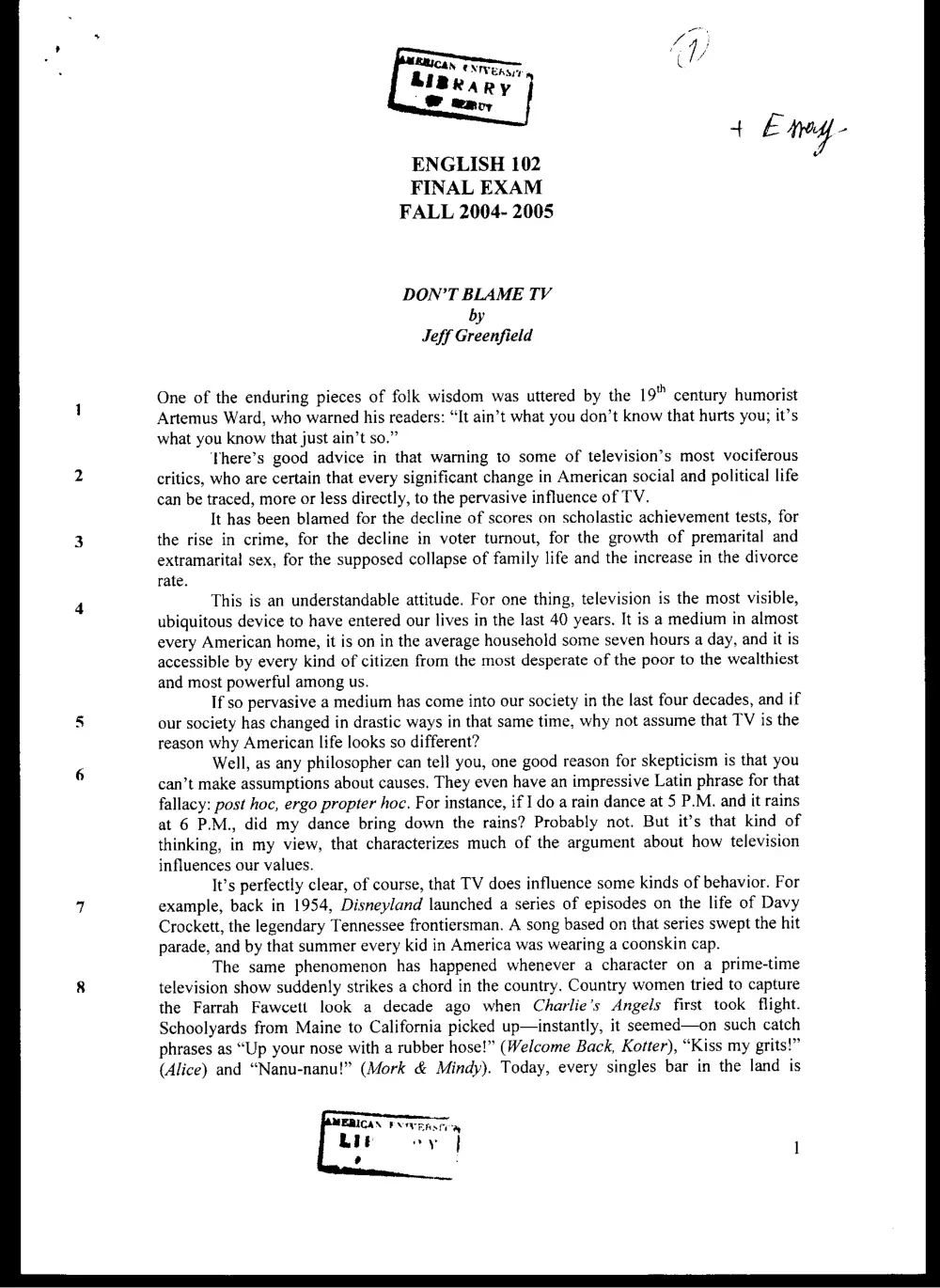
DON’T BLAME TV
by
Jeff Greenfield
One of the enduring pieces of folk wisdom was uttered by the 19” century humorist
Artemus Ward, who warned his readers: “It ain’t what you don’t know that hurts you; it’s
what you know that just ain’t so.”
‘There’s good advice in that warning to some of television’s most vociferous
2 critics, who are certain that every significant change in American social and political life
can be traced, more or less directly, to the pervasive influence of TV.
It has been blamed for the decline of scores on scholastic achievement tests, for
3 the rise in crime, for the decline in voter turnout, for the growth of premarital and
extramarital sex, for the supposed collapse of family life and the increase in the divorce
rate.
4 This is an understandable attitude. For one thing, television is the most visible,
ubiquitous device to have entered our lives in the last 40 years. It is a medium in almost
every American home, it is on in the average household some seven hours a day, and it is
accessible by every kind of citizen from the most desperate of the poor to the wealthiest
and most powerful among us.
If so pervasive a medium has come into our society in the last four decades, and if
5 our society has changed in drastic ways in that same time, why not assume that TV is the
reason why American life looks so different?
Well, as any philosopher can tell you, one good reason for skepticism is that you
can’t make assumptions about causes. They even have an impressive Latin phrase for that
fallacy: post hoc, ergo propter hoc. For instance, if I do a rain dance at 5 P.M. and it rains
at 6 P.M., did my dance bring down the rains? Probably not. But it’s that kind of
thinking, in my view, that characterizes much of the argument about how television
influences our values.
It’s perfectly clear, of course, that TV does influence some kinds of behavior. For
7 example, back in 1954, Disneyland launched a series of episodes on the life of Davy
Crockett, the legendary Tennessee frontiersman. A song based on that series swept the hit
parade, and by that summer every kid in America was wearing a coonskin cap.
The same phenomenon has happened whenever a character on a prime-time
8 television show suddenly strikes a chord in the country. Country women tried to capture
the Farrah Fawcett look a decade ago when Charlie’s Angels first took flight.
Schoolyards from Maine to California picked up—instantly, it seemed—on such catch
phrases as “Up your nose with a rubber hose!” (Welcome Back, Kotter), “Kiss my grits!”
(Alice) and “Nanu-nanu!” (Mork & Mindy). Today, every singles bar in the land is
ERICAN FIV ERS fim
ult wy
; y |
10
11
12
13
14
15
16
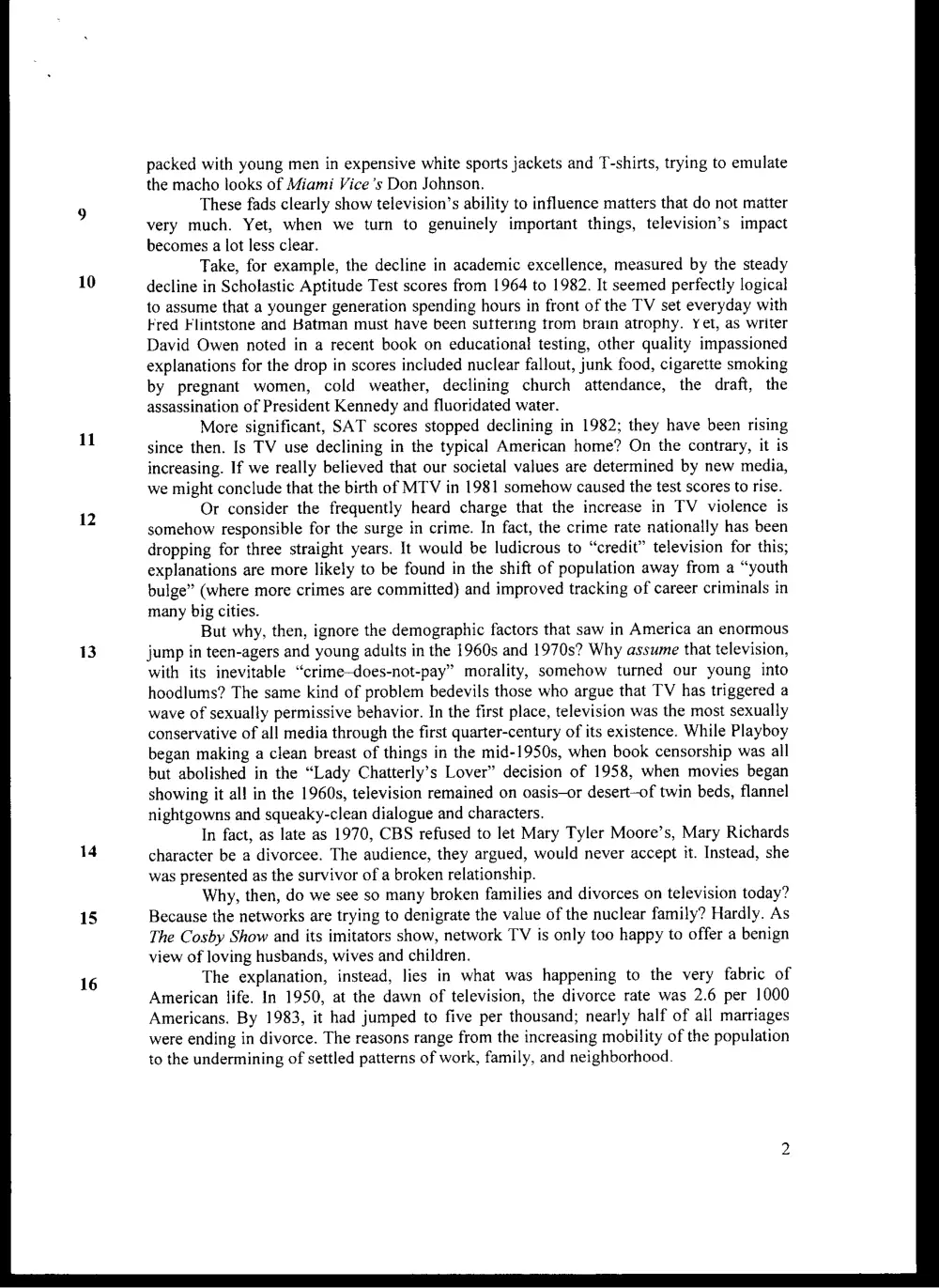
packed with young men in expensive white sports jackets and T-shirts, trying to emulate
the macho looks of Miami Vice ’s Don Johnson.
These fads clearly show television’s ability to influence matters that do not matter
very much. Yet, when we turn to genuinely important things, television’s impact
becomes a lot less clear.
Take, for example, the decline in academic excellence, measured by the steady
decline in Scholastic Aptitude Test scores from 1964 to 1982. It seemed perfectly logical
to assume that a younger generation spending hours in front of the TV set everyday with
Fred Flintstone and Batman must have been suttering trom brain atrophy. Yet, as writer
David Owen noted in a recent book on educational testing, other quality impassioned
explanations for the drop in scores included nuclear fallout, junk food, cigarette smoking
by pregnant women, cold weather, declining church attendance, the draft, the
assassination of President Kennedy and fluoridated water.
More significant, SAT scores stopped declining in 1982; they have been rising
since then. Is TV use declining in the typical American home? On the contrary, it is
increasing. If we really believed that our societal values are determined by new media,
we might conclude that the birth of MTV in 1981 somehow caused the test scores to rise.
Or consider the frequently heard charge that the increase in TV violence is
somehow responsible for the surge in crime. In fact, the crime rate nationally has been
dropping for three straight years. It would be ludicrous to “credit” television for this;
explanations are more likely to be found in the shift of population away from a “youth
bulge” (where more crimes are committed) and improved tracking of career criminals in
many big cities.
But why, then, ignore the demographic factors that saw in America an enormous
jump in teen-agers and young adults in the 1960s and 1970s? Why assume that television,
with its inevitable “crime—does-not-pay” morality, somehow turned our young into
hoodlums? The same kind of problem bedevils those who argue that TV has triggered a
wave of sexually permissive behavior. In the first place, television was the most sexually
conservative of all media through the first quarter-century of its existence. While Playboy
began making a clean breast of things in the mid-1950s, when book censorship was all
but abolished in the “Lady Chatterly’s Lover” decision of 1958, when movies began
showing it all in the 1960s, television remained on oasis—or desert-of twin beds, flannel
nightgowns and squeaky-clean dialogue and characters.
In fact, as late as 1970, CBS refused to let Mary Tyler Moore’s, Mary Richards
character be a divorcee. The audience, they argued, would never accept it. Instead, she
was presented as the survivor of a broken relationship.
Why, then, do we see so many broken families and divorces on television today?
Because the networks are trying to denigrate the value of the nuclear family? Hardly. As
The Cosby Show and its imitators show, network TV is only too happy to offer a benign
view of loving husbands, wives and children.
The explanation, instead, lies in what was happening to the very fabric of
American life. In 1950, at the dawn of television, the divorce rate was 2.6 per 1000
Americans. By 1983, it had jumped to five per thousand; nearly half of all marriages
were ending in divorce. The reasons range from the increasing mobility of the population
to the undermining of settled patterns of work, family, and neighborhood.
17
18
19
20
21
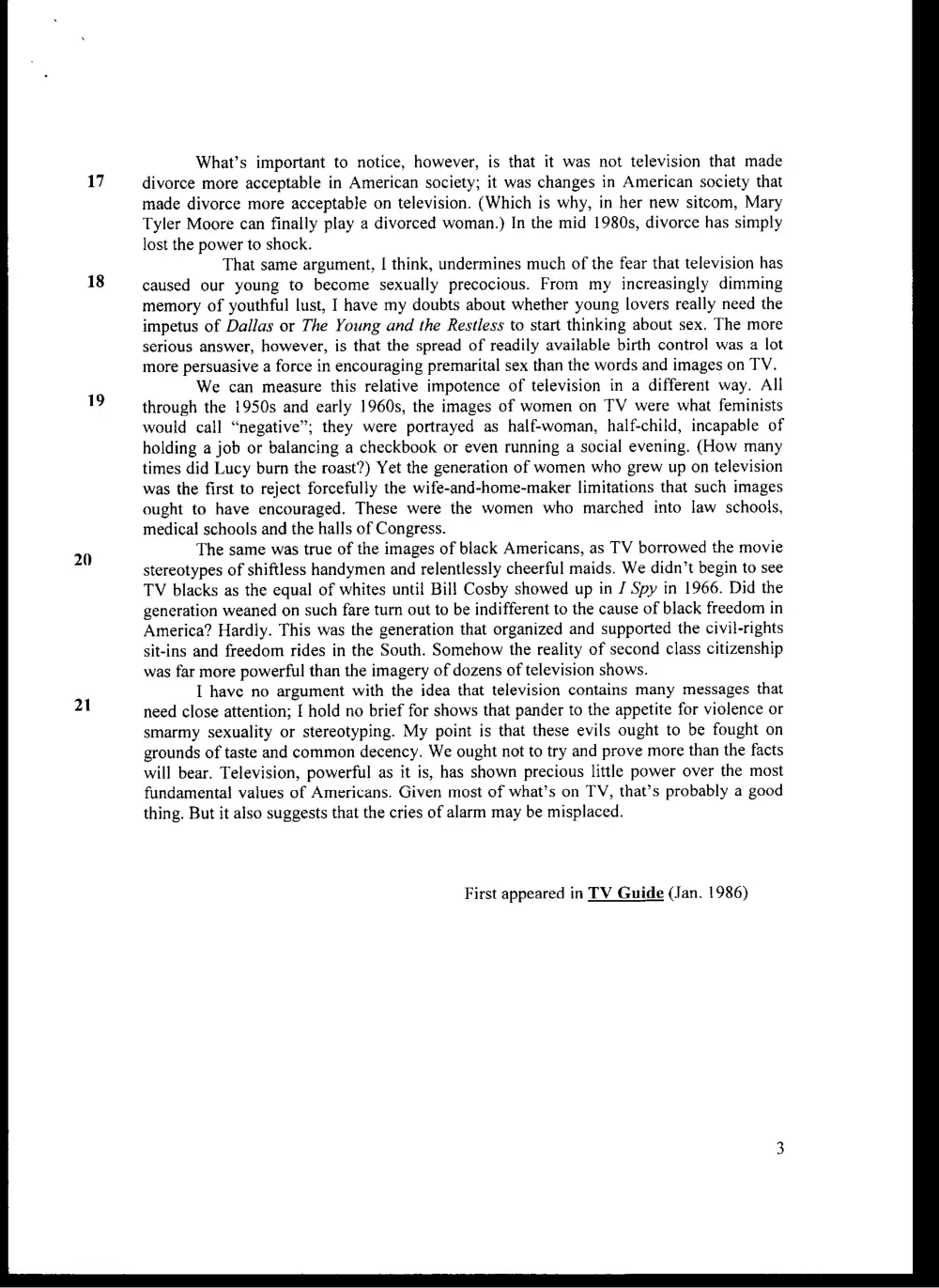
What’s important to notice, however, is that it was not television that made
divorce more acceptable in American society; it was changes in American society that
made divorce more acceptable on television. (Which is why, in her new sitcom, Mary
Tyler Moore can finally play a divorced woman.) In the mid 1980s, divorce has simply
lost the power to shock.
That same argument, | think, undermines much of the fear that television has
caused our young to become sexually precocious. From my increasingly dimming
memory of youthful lust, ] have my doubts about whether young lovers really need the
impetus of Dallas or The Young and the Restless to start thinking about sex. The more
serious answer, however, is that the spread of readily available birth control was a lot
more persuasive a force in encouraging premarital sex than the words and images on TV.
We can measure this relative impotence of television in a different way. All
through the 1950s and early 1960s, the images of women on TV were what feminists
would call “negative”; they were portrayed as half-woman, half-child, incapable of
holding a job or balancing a checkbook or even running a social evening. (How many
times did Lucy burn the roast?) Yet the generation of women who grew up on television
was the first to reject forcefully the wife-and-home-maker limitations that such images
ought to have encouraged. These were the women who marched into law schools,
medical schools and the halls of Congress.
The same was true of the images of black Americans, as TV borrowed the movie
stereotypes of shiftless handymen and relentlessly cheerful maids. We didn’t begin to see
TV blacks as the equal of whites until Bill Cosby showed up in J Spy in 1966. Did the
generation weaned on such fare turn out to be indifferent to the cause of black freedom in
America? Hardly. This was the generation that organized and supported the civil-rights
sit-ins and freedom rides in the South. Somehow the reality of second class citizenship
was far more powerful than the imagery of dozens of television shows.
I have no argument with the idea that television contains many messages that
need close attention; I hold no brief for shows that pander to the appetite for violence or
smarmy sexuality or stereotyping. My point is that these evils ought to be fought on
grounds of taste and common decency. We ought not to try and prove more than the facts
will bear. Television, powerful as it is, has shown precious little power over the most
fundamental values of Americans. Given most of what’s on TV, that’s probably a good
thing. But it also suggests that the cries of alarm may be misplaced.
First appeared in TV Guide (Jan. 1986)
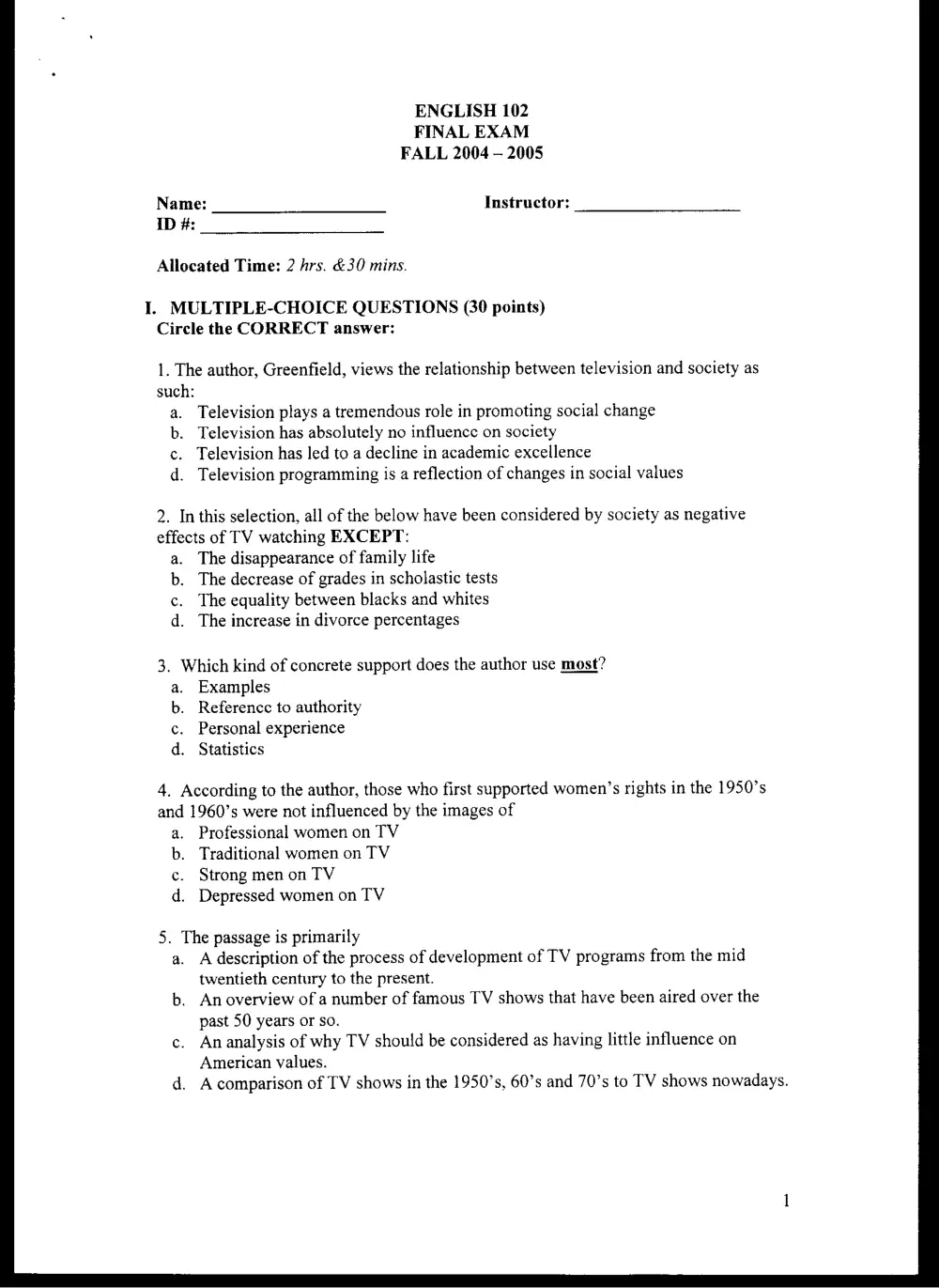
ENGLISH 102
FINAL EXAM
FALL 2004 — 2005
Name: Instructor:
ID #:
Allocated Time: 2 Ars. &30 mins.
I. MULTIPLE-CHOICE QUESTIONS (30 points)
Circle the CORRECT answer:
1. The author, Greenfield, views the relationship between television and society as
such:
a. Television plays a tremendous role in promoting social change
b. Television has absolutely no influence on society
c. Television has led to a decline in academic excellence
d. Television programming is a reflection of changes in social values
2. In this selection, all of the below have been considered by society as negative
effects of TV watching EXCEPT:
The disappearance of family life
The decrease of grades in scholastic tests
The equality between blacks and whites
The increase in divorce percentages
aor Pp
3. Which kind of concrete support does the author use most?
Examples
Reference to authority
Personal experience
Statistics
ac orp
4, According to the author, those who first supported women’s rights in the 1950’s
and 1960’s were not influenced by the images of
a. Professional women on TV
b. Traditional women on TV
c. Strong men on TV
d. Depressed women on TV
5. The passage is primarily
a. A description of the process of development of TV programs from the mid
twentieth century to the present.
b. An overview of a number of famous TV shows that have been aired over the
past 50 years or so.
c. Ananalysis of why TV should be considered as having little influence on
American values.
d. Acomparison of TV shows in the 1950’s, 60’s and 70’s to TV shows nowadays.
Il. COMPREHENSION AND RHETORICAL QUESTIONS (55 points)
1. In your own words, formulate a thesis statement for this essay. (10 pts.)
2. Give two specific examples from the text that the author employs to highlight
the immediate effects of television watching on our behavior. (10 pts.)
3. Which paragraph serves as a transition to the idea that television is not solely
responsible for some of our problems? Justify your answer. (5 pts.)
4. What, according to the author, are the real causes of the following problems?
(12 pts.)
a. Decline in academic scores
c. Increase in divorce rate
5. Paraphrase paragraph 9: “These fads clearly show television’s ability to
influence matters that do not matter very much. Yet, when we turn to genuinely
important things, television’s impact becomes a lot less clear.”(10 pts.)
6. How does the phrase “cries of alarm” in the selection’s closing sentence link the
conclusion to the introductory paragraphs? (8 pts.)
Ill. VOCABULARY (15 pts.)
1. Write synonyms for the following words: (3 pts. each)
“emulate” (para.8) ....ccccsseseesesseneees
“benign” (para.15)....
“ludicrous”(para.12)....ssscsesseceeseees
SP
°
The word “ubiquitous”(para.4) means: (2 pts.)
Absent
Primitive
Widespread
Harmful
2.
a.
b.
c.
d.
3. Find a phrase in paragraph 20 with the same meaning as “persistently
happy” (4 pts.)
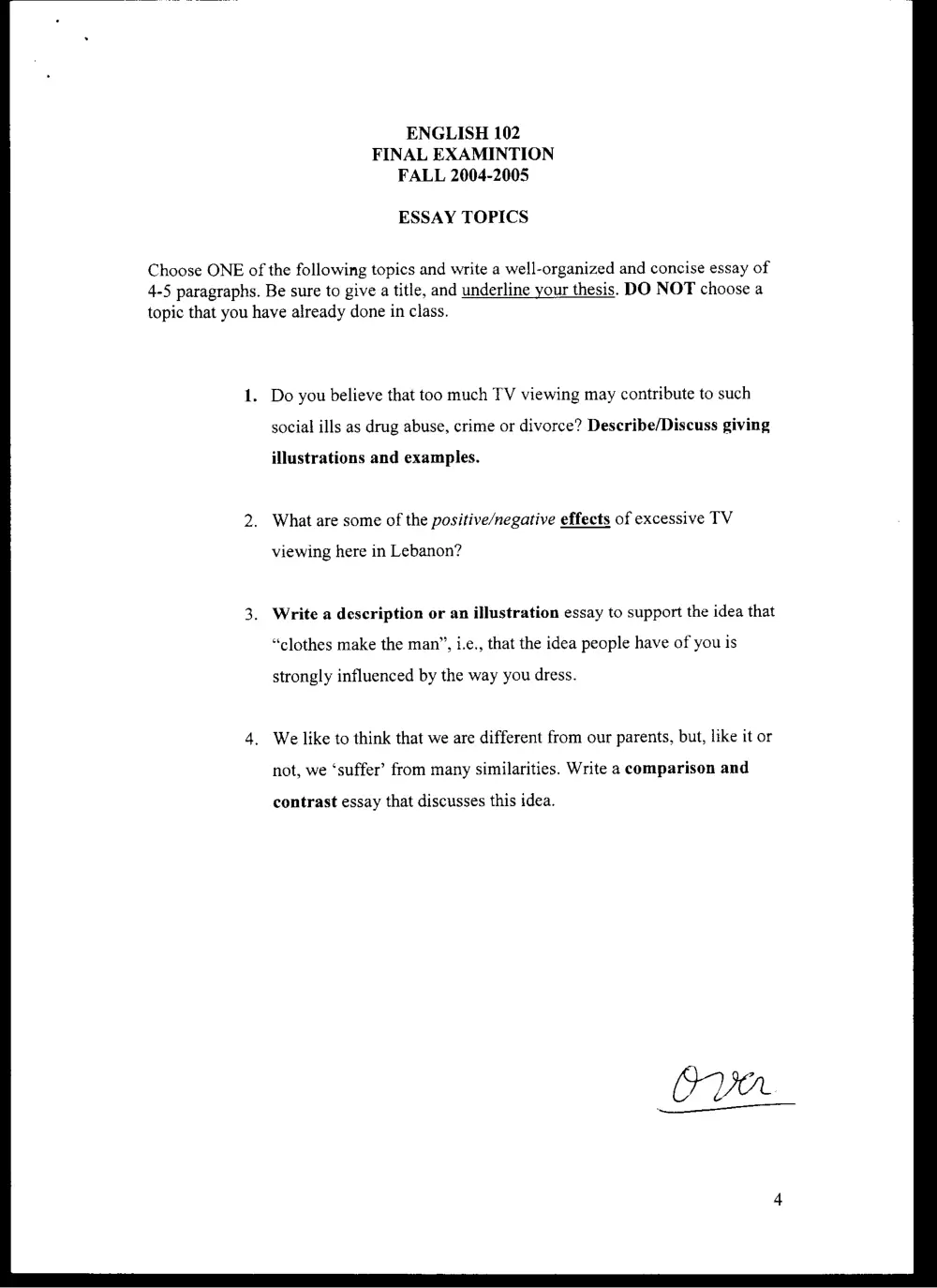
ENGLISH 102
FINAL EXAMINTION
FALL 2004-2005
ESSAY TOPICS
Choose ONE of the following topics and write a well-organized and concise essay of
4-5 paragraphs. Be sure to give a title, and underline your thesis. DO NOT choose a
topic that you have already done in class.
1. Do you believe that too much TV viewing may contribute to such
social ills as drug abuse, crime or divorce? Describe/Discuss giving
illustrations and examples.
2. What are some of the positive/negative effects of excessive TV
viewing here in Lebanon?
3. Write a description or an illustration essay to support the idea that
“clothes make the man”, i.e., that the idea people have of you is
strongly influenced by the way you dress.
4. We like to think that we are different from our parents, but, like it or
not, we ‘suffer’ from many similarities. Write a comparison and
contrast essay that discusses this idea.