
ENG 102 Final, Spring 2005
American University of Beirut · Enrichment Course in English · 9 pages
More ENG 102 files
Show the text of this final exam
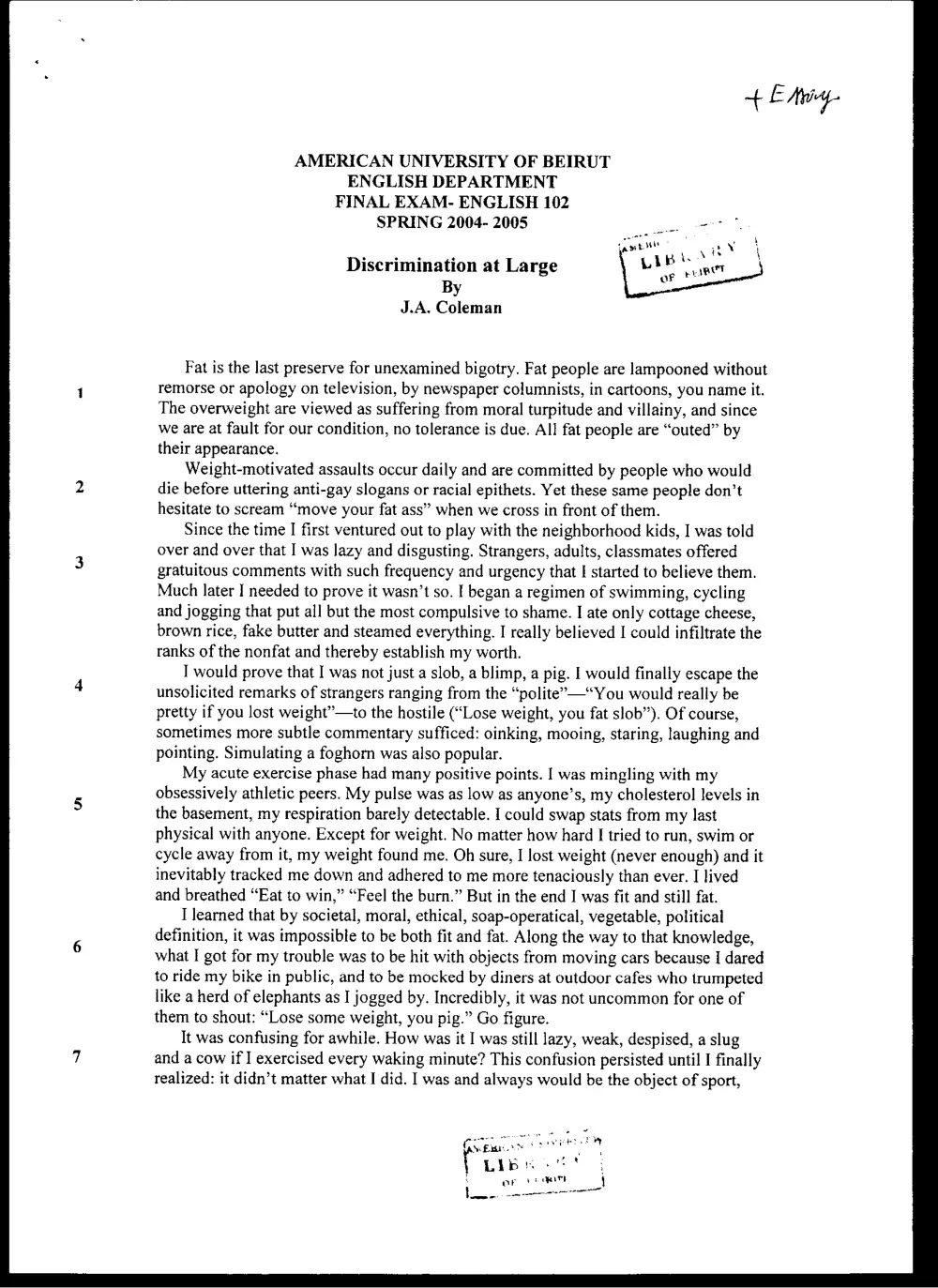
AMERICAN UNIVERSITY OF BEIRUT
ENGLISH DEPARTMENT
FINAL EXAM- ENGLISH 102
SPRING 2004- 2005 oe
; ay
CaS \
Discrimination at Large i
By /
J.A. Coleman
Fat is the last preserve for unexamined bigotry. Fat people are lampooned without
remorse or apology on television, by newspaper columnists, in cartoons, you name it.
The overweight are viewed as suffering from moral turpitude and villainy, and since
we are at fault for our condition, no tolerance is due. All fat people are “outed” by
their appearance.
Weight-motivated assaults occur daily and are committed by people who would
die before uttering anti-gay slogans or racial epithets. Yet these same people don’t
hesitate to scream “move your fat ass” when we cross in front of them.
Since the time I first ventured out to play with the neighborhood kids, I was told
over and over that I was lazy and disgusting. Strangers, adults, classmates offered
gratuitous comments with such frequency and urgency that I started to believe them.
Much later I needed to prove it wasn’t so. I began a regimen of swimming, cycling
and jogging that put all but the most compulsive to shame. I ate only cottage cheese,
brown rice, fake butter and steamed everything. I really believed I could infiltrate the
ranks of the nonfat and thereby establish my worth.
1 would prove that I was not just a slob, a blimp, a pig. | would finally escape the
unsolicited remarks of strangers ranging from the “polite’—“You would really be
pretty if you lost weight”—1to the hostile (“Lose weight, you fat slob”). Of course,
sometimes more subtle commentary sufficed: oinking, mooing, staring, laughing and
pointing. Simulating a foghorn was also popular.
My acute exercise phase had many positive points. I was mingling with my
obsessively athletic peers. My pulse was as low as anyone’s, my cholesterol levels in
the basement, my respiration barely detectable. I could swap stats from my last
physical with anyone. Except for weight. No matter how hard I tried to run, swim or
cycle away from it, my weight found me. Oh sure, I lost weight (never enough) and it
inevitably tracked me down and adhered to me more tenaciously than ever. I lived
and breathed “Eat to win,” “Feel the burn.” But in the end I was fit and still fat.
I learned that by societal, moral, ethical, soap-operatical, vegetable, political
definition, it was impossible to be both fit and fat. Along the way to that knowledge,
what I got for my trouble was to be hit with objects from moving cars because I dared
to ride my bike in public, and to be mocked by diners at outdoor cafes who trumpeted
like a herd of elephants as I jogged by. Incredibly, it was not uncommon for one of
them to shout: “Lose some weight, you pig.” Go figure.
It was confusing for awhile. How was it I was still lazy, weak, despised, a slug
and a cow if] exercised every waking minute? This confusion persisted until I finally
realized: it didn’t matter what I did. I was and always would be the object of sport,
10
11
12
13
14
15
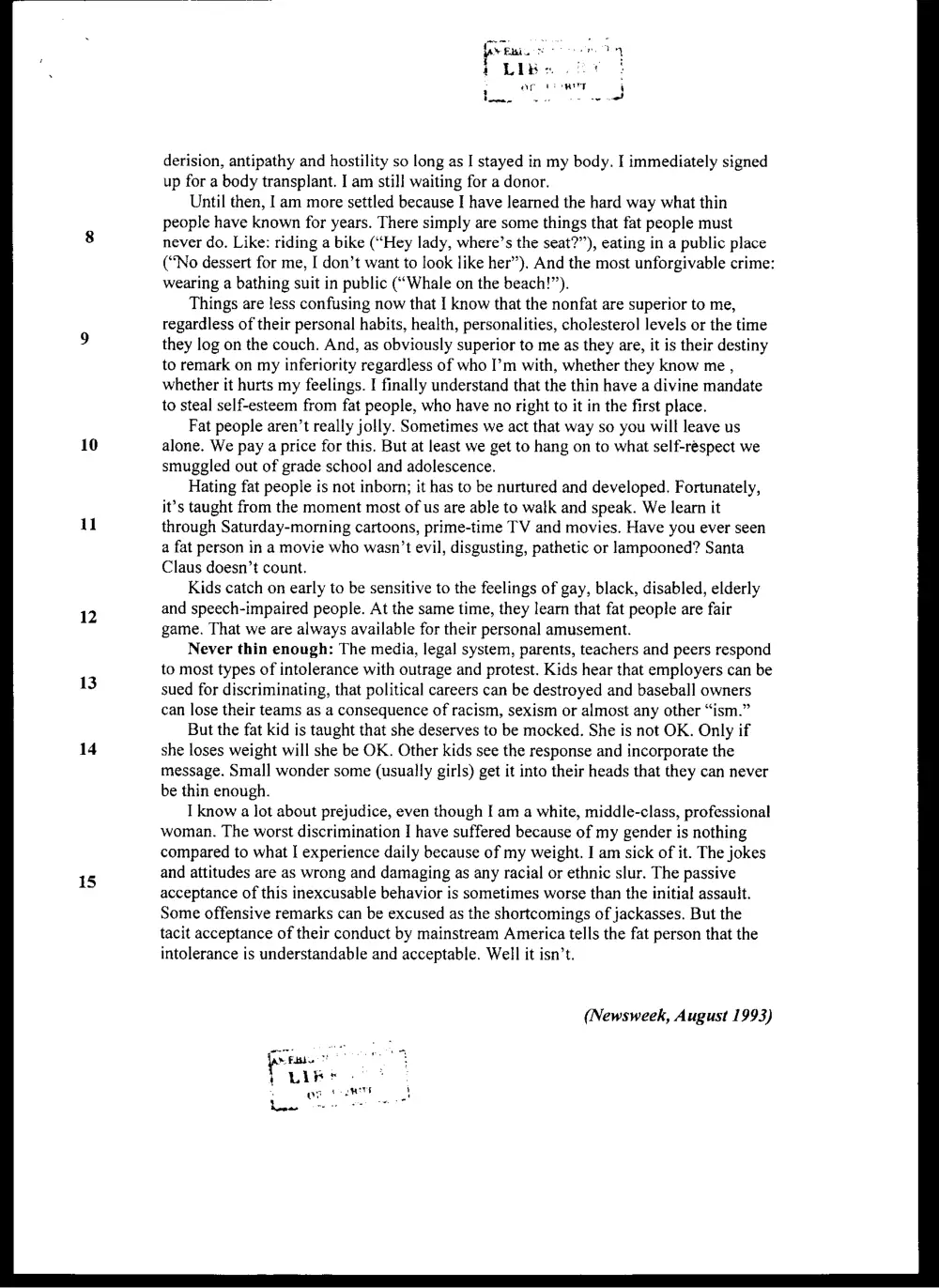
derision, antipathy and hostility so long as | stayed in my body. I immediately signed
up for a body transplant. I am still waiting for a donor.
Until then, am more settled because I have learned the hard way what thin
people have known for years. There simply are some things that fat people must
never do. Like: riding a bike (“Hey lady, where’s the seat?”), eating in a public place
(“No dessert for me, I don’t want to look like her’). And the most unforgivable crime:
wearing a bathing suit in public (“Whale on the beach!”).
Things are less confusing now that I know that the nonfat are superior to me,
regardless of their personal habits, health, personalities, cholesterol levels or the time
they log on the couch. And, as obviously superior to me as they are, it is their destiny
to remark on my inferiority regardless of who I’m with, whether they know me ,
whether it hurts my feelings. I finally understand that the thin have a divine mandate
to steal self-esteem from fat people, who have no right to it in the first place.
Fat people aren’t really jolly. Sometimes we act that way so you will leave us
alone. We pay a price for this. But at least we get to hang on to what self-respect we
smuggled out of grade school and adolescence.
Hating fat people is not inborn; it has to be nurtured and developed. Fortunately,
it’s taught from the moment most of us are able to walk and speak. We learn it
through Saturday-morning cartoons, prime-time TV and movies. Have you ever seen
a fat person in a movie who wasn’t evil, disgusting, pathetic or lampooned? Santa
Claus doesn’t count.
Kids catch on early to be sensitive to the feelings of gay, black, disabled, elderly
and speech-impaired people. At the same time, they learn that fat people are fair
game. That we are always available for their personal amusement.
Never thin enough: The media, legal system, parents, teachers and peers respond
to most types of intolerance with outrage and protest. Kids hear that employers can be
sued for discriminating, that political careers can be destroyed and baseball owners
can lose their teams as a consequence of racism, sexism or almost any other “ism.”
But the fat kid is taught that she deserves to be mocked. She is not OK. Only if
she loses weight will she be OK. Other kids see the response and incorporate the
message. Small wonder some (usually girls) get it into their heads that they can never
be thin enough.
I know a lot about prejudice, even though I am a white, middle-class, professional
woman. The worst discrimination I have suffered because of my gender is nothing
compared to what I experience daily because of my weight. I am sick of it. The jokes
and attitudes are as wrong and damaging as any racial or ethnic slur. The passive
acceptance of this inexcusable behavior is sometimes worse than the initial assault.
Some offensive remarks can be excused as the shortcomings of jackasses. But the
tacit acceptance of their conduct by mainstream America tells the fat person that the
intolerance is understandable and acceptable. Well it isn’t.
(Newsweek, August 1993)
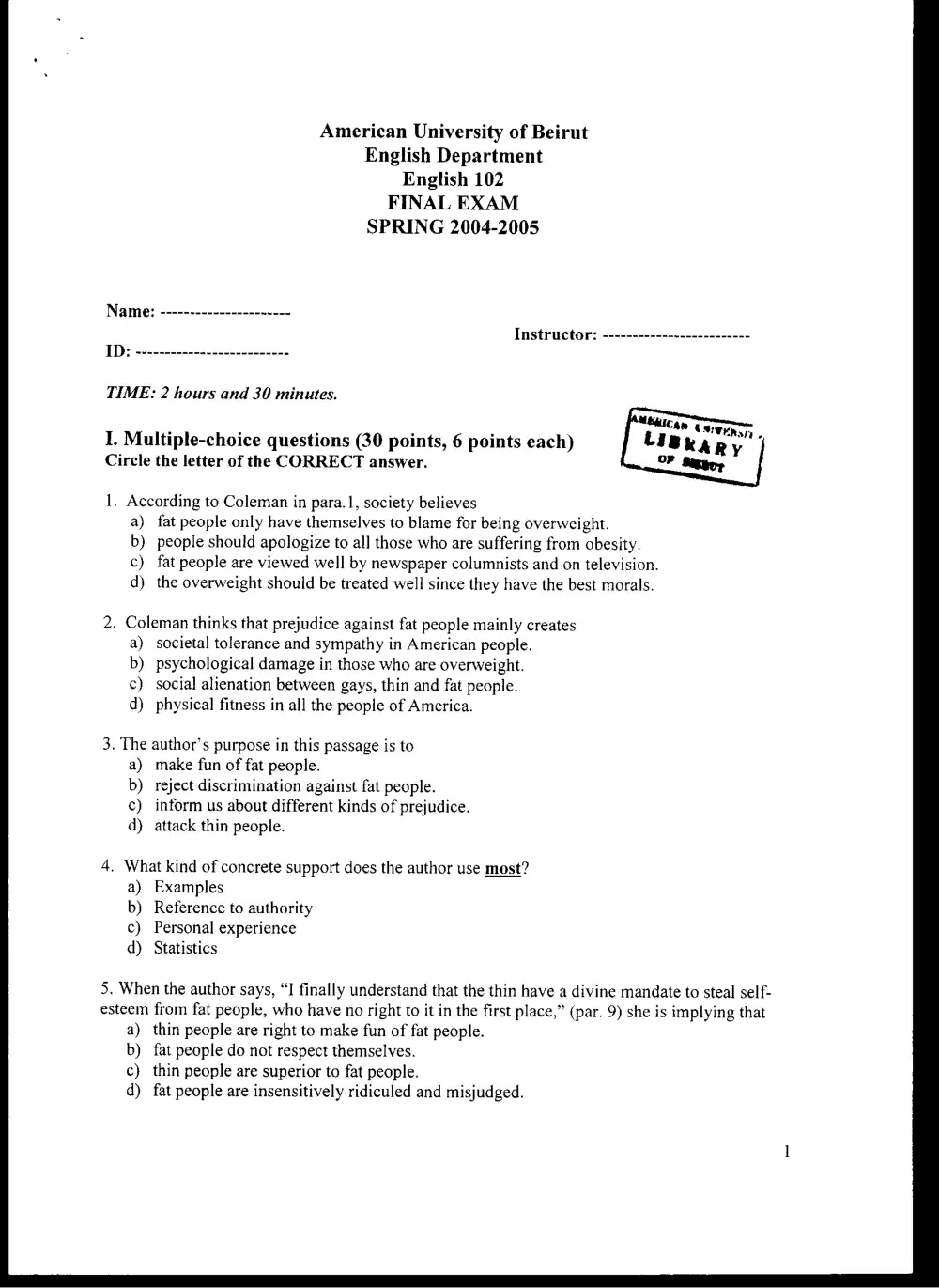
American University of Beirut
English Department
English 102
FINAL EXAM
SPRING 2004-2005
Instructor: -------------------------
TIME: 2 hours and 30 minutes.
I. Multiple-choice questions (30 points, 6 points each)
Circle the letter of the CORRECT answer.
1. According to Coleman in para.1, society believes
a) fat people only have themselves to blame for being overweight.
b) people should apologize to all those who are suffering from obesity.
c) fat people are viewed well by newspaper columnists and on television.
d) the overweight should be treated well since they have the best morals.
2. Coleman thinks that prejudice against fat people mainly creates
a) societal tolerance and sympathy in American people.
b) psychological damage in those who are overweight.
c) social alienation between gays, thin and fat people.
d) physical fitness in all the people of America.
3. The author’s purpose in this passage is to
a) make fun of fat people.
b) reject discrimination against fat people.
c) inform us about different kinds of prejudice.
d) attack thin people.
4. What kind of concrete support does the author use most?
a) Examples
b) Reference to authority
c) Personal experience
d) Statistics
5. When the author says, “I finally understand that the thin have a divine mandate to steal self-
esteem from fat people, who have no right to it in the first place,” (par. 9) she is implying that
a) thin people are right to make fun of fat people.
b) fat people do not respect themselves.
c) thin people are superior to fat people.
d) fat people are insensitively ridiculed and misjudged.
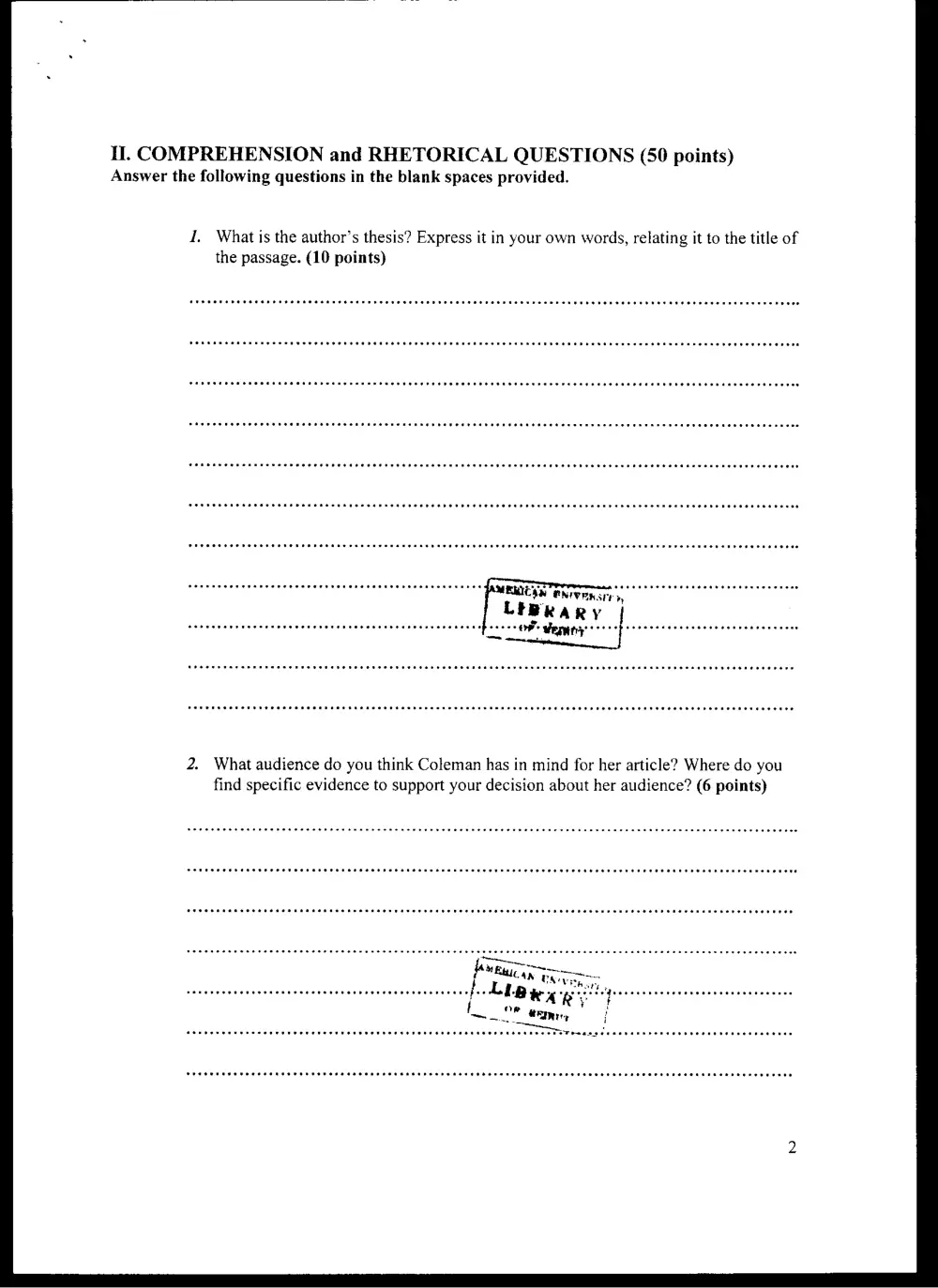
Hl. COMPREHENSION and RHETORICAL QUESTIONS (50 points)
Answer the following questions in the blank spaces provided.
1. What is the author’s thesis? Express it in your own words, relating it to the title of
the passage. (10 points)
2. What audience do you think Coleman has in mind for her article? Where do you
find specific evidence to support your decision about her audience? (6 points)
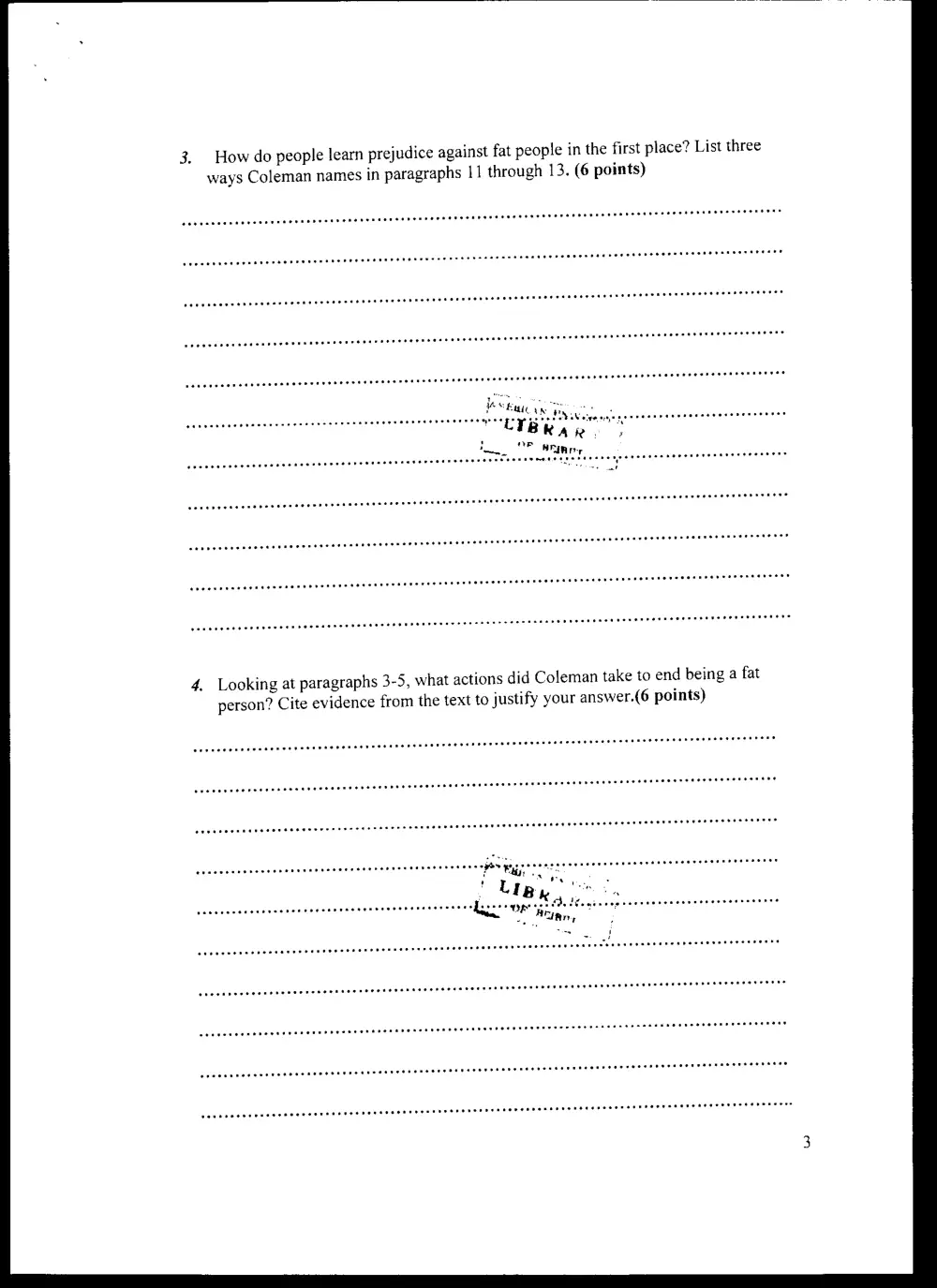
How do people learn prejudice against fat people in the first place? List three
ways Coleman names in paragraphs 11 through 13. (6 points)
4. Looking at paragraphs 3-5, what actions did Coleman take to end being a fat
person? Cite evidence from the text to justify your answer.(6 points)
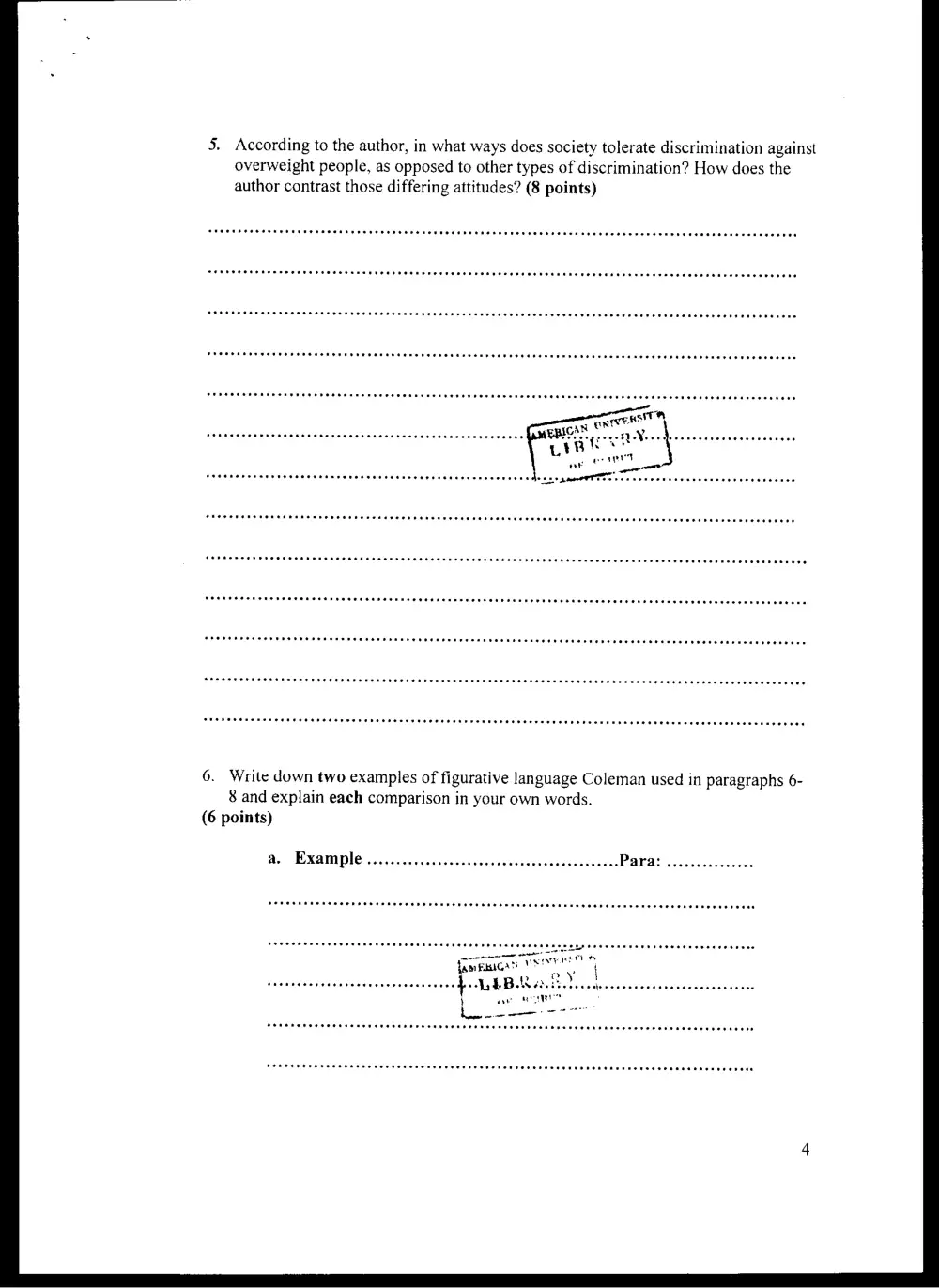
5. According to the author, in what ways does society tolerate discrimination against
overweight people, as opposed to other types of discrimination? How does the
author contrast those differing attitudes? (8 points)
6. Write down two examples of figurative language Coleman used in paragraphs 6-
8 and explain each comparison in your own words.
(6 points)
a. Example
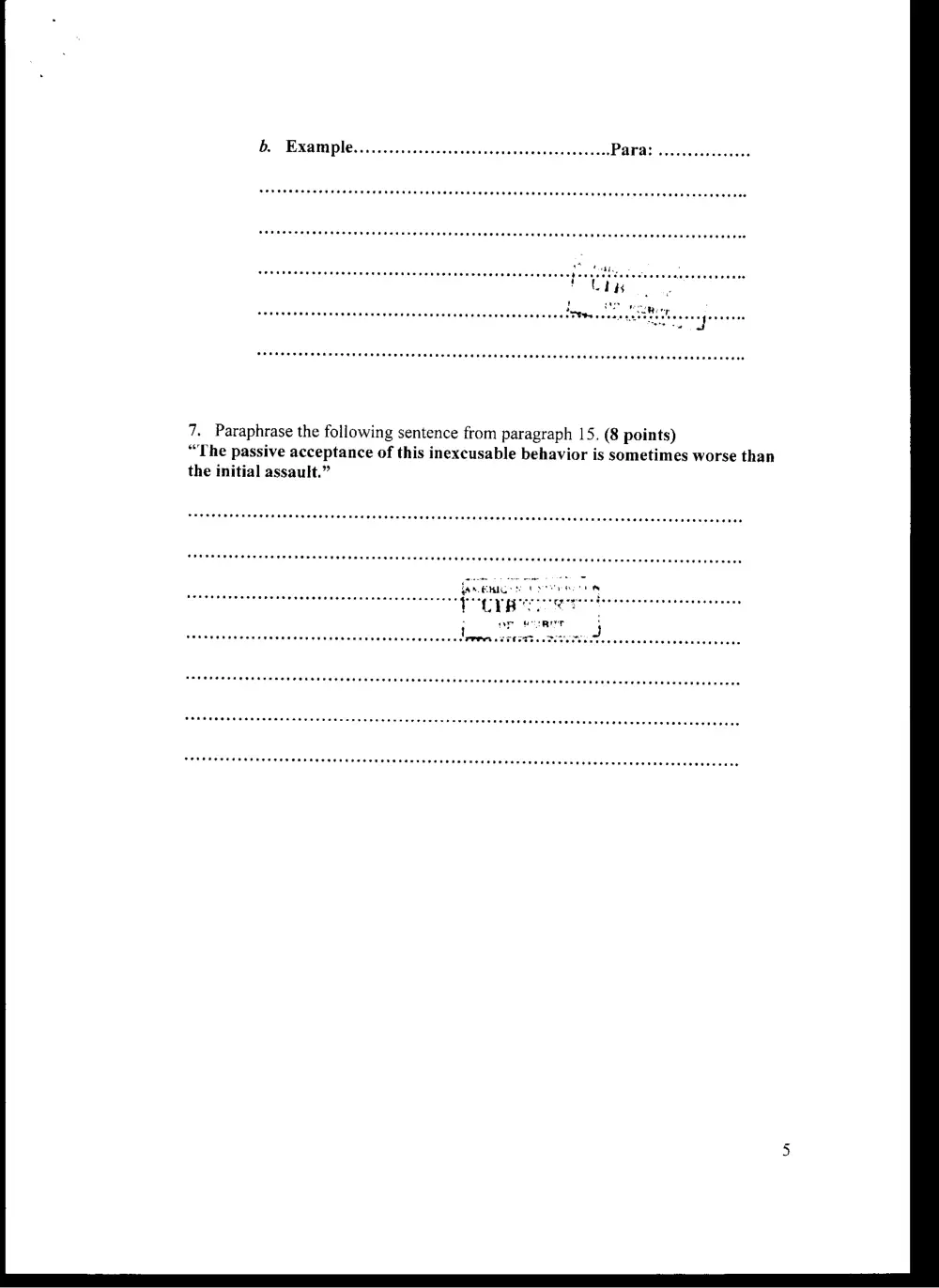
7. Paraphrase the following sentence from paragraph 15. (8 points)
“The passive acceptance of this inexcusable behavior is sometimes worse than
the initial assault.”
5
famtewieas ti
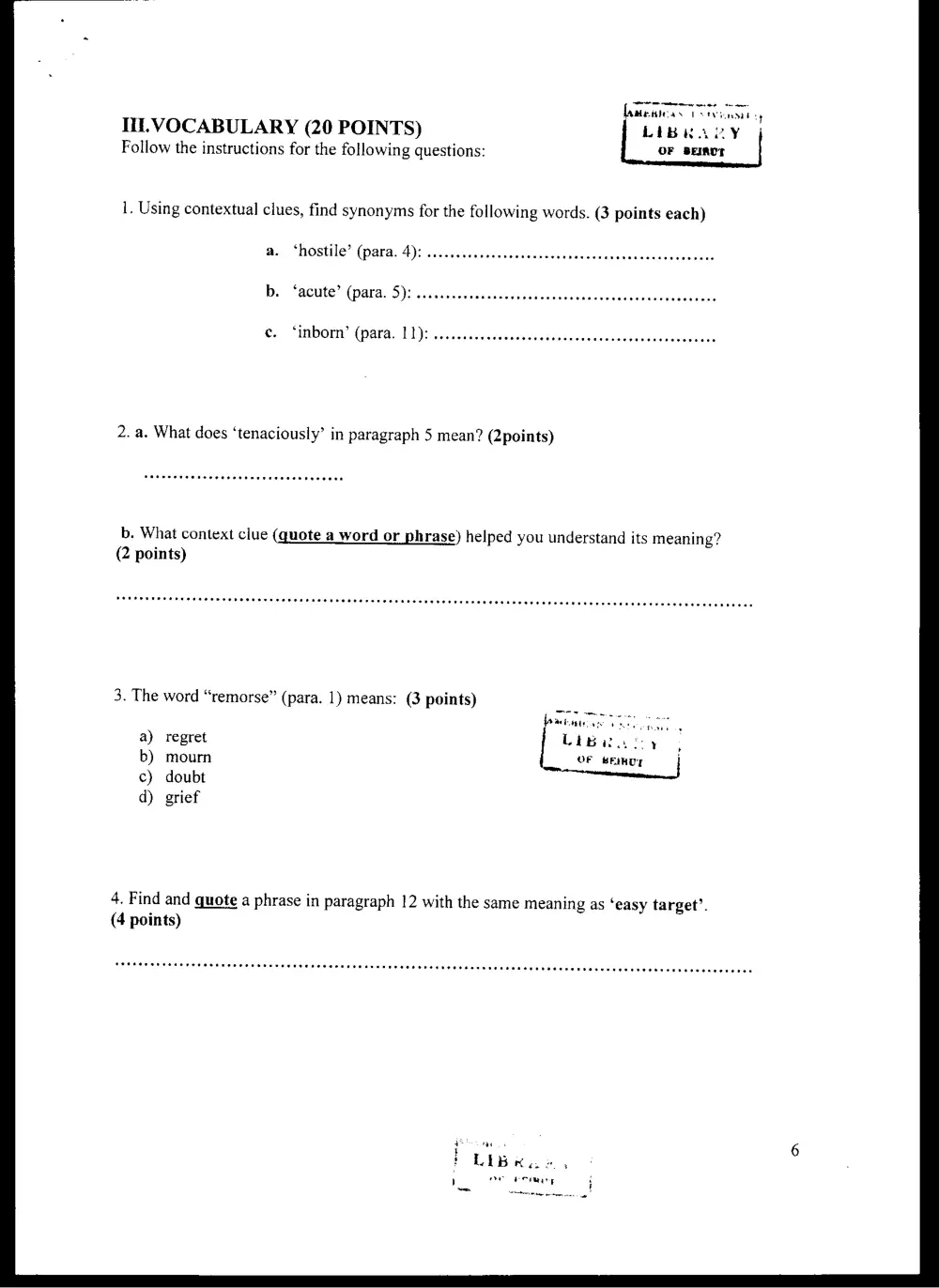
TI. VOCABULARY (20 POINTS) LIBR.
Follow the instructions for the following questions: OF BEIRUT
1. Using contextual clues, find synonyms for the following words. (3 points each)
a. ‘hostile’ (para. 4):
b. facute’ (para. 5): ..c.scecsecsssesseesceseeeceeenssecssseressesesers
e. ‘inborn’ (para. 11):
2. a. What does ‘tenaciously’ in paragraph 5 mean? (2points)
b. What context clue (quote a word or phrase) helped you understand its meaning?
(2 points)
3. The word “remorse” (para. 1) means: (3 points)
a) regret haby
b) mourn eel a |
c) doubt
d) grief
4. Find and quote a phrase in paragraph 12 with the same meaning as ‘easy target’.
(4 points)
4
LiBRKG&
1 Oe peas
H
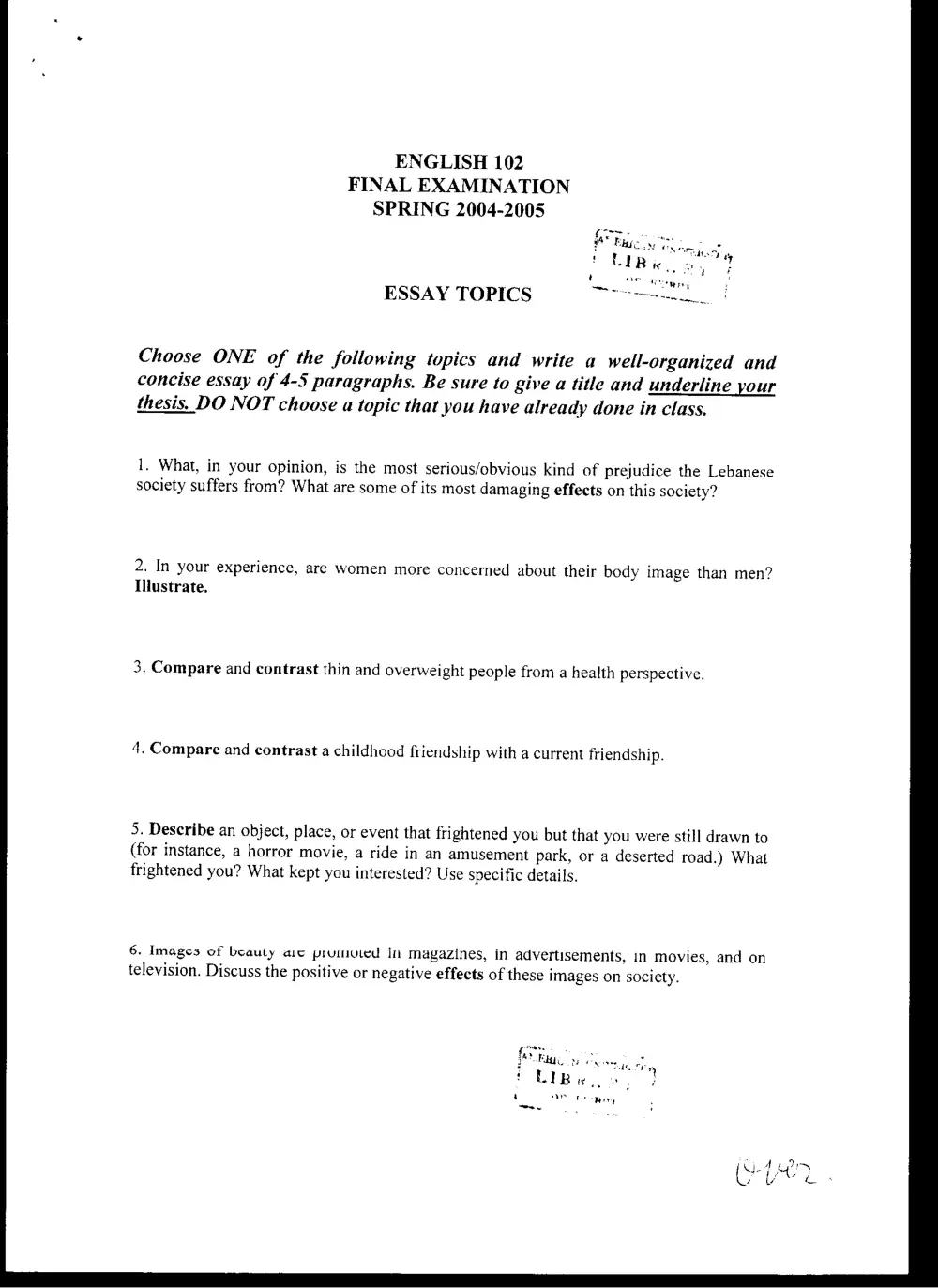
ENGLISH 102
FINAL EXAMINATION
SPRING 2004-2005
ESSAY TOPICS
Choose ONE of the following topics and write a well-organized and
concise essay of 4-5 paragraphs. Be sure to give a title and underline your
thesis. DO NOT choose a topic that you have already done in class.
1. What, in your opinion, is the most serious/obvious kind of prejudice the Lebanese
society suffers from? What are some of its most damaging effects on this society?
2. In your experience, are women more concerned about their body image than men?
Illustrate.
3, Compare and contrast thin and overweight people from a health perspective.
4. Compare and contrast a childhood friendship with a current friendship.
5. Describe an object, place, or event that frightened you but that you were still drawn to
(for instance, a horror movie, a ride in an amusement park, or a deserted road.) What
frightened you? What kept you interested? Use specific details.
6. Images of beauty aie prumuted in magazines, in advertisements, in movies, and on
television. Discuss the positive or negative effects of these images on society.
4 Pm
(s ro